Sludge Dewatering Equipment Evaluation: Screw Press, Belt Press & More
Sludge Dewatering Equipment Evaluation: Screw Press, Belt Press & More
When evaluating sludge dewatering equipment for your project, the choice between a screw press dewatering machine, a sludge dewatering belt press, a sludge filter press, or other sludge dewatering systems directly impacts your operating costs, cake dryness, and maintenance burden. This article provides a fact-based comparison of the major sludge dewatering technologies, drawing on real-world installations and verified specifications from Shanghai Fuchan Machinery Technology Co., Ltd. (SFC Machinery)—a National High-Tech Enterprise founded in 2007 and based in Shanghai’s Pudong Free Trade Zone, manufacturing a full range of sludge treatment equipment for municipal and industrial clients worldwide.
Why a Structured Evaluation Matters
The global sludge dewatering equipment market was valued at over USD 5.19 billion in 2024, with Asia Pacific accounting for 37.57% of revenue (Fortune Business Insights). By 2032, the market is expected to nearly double. However, not all technologies suit every sludge type or capacity. Buyers evaluating equipment during the evaluation stage need clear, comparable criteria: inlet solid concentration, achievable cake dryness, energy consumption, footprint, and total cost of ownership. Below we define the core problem and examine the technologies available.
Industry Background & Problem Definition
Sludge from municipal wastewater treatment plants, industrial processes, food processing, and chemical plants typically contains more than 95% water. Dewatering reduces volume for transport, disposal, or incineration. Each technology—whether a sludge dewatering screw press, belt type sludge thickener, or rotary drum thickener—has a specific operating window.
For instance, a sludge thickening equipment unit may be needed upstream to raise solids from 0.6% to 3% before a plate-and-frame press. Alternatively, an integrated belt thickening and dewatering machine can take feed at 0.6%–1.5% solids and produce a cake at <80% moisture. The wrong choice leads to poor dewatering efficiency, high polymer consumption, frequent maintenance, or inability to handle oily/sticky sludge.
Detailed Solution: SFC Machinery’s Technology Portfolio
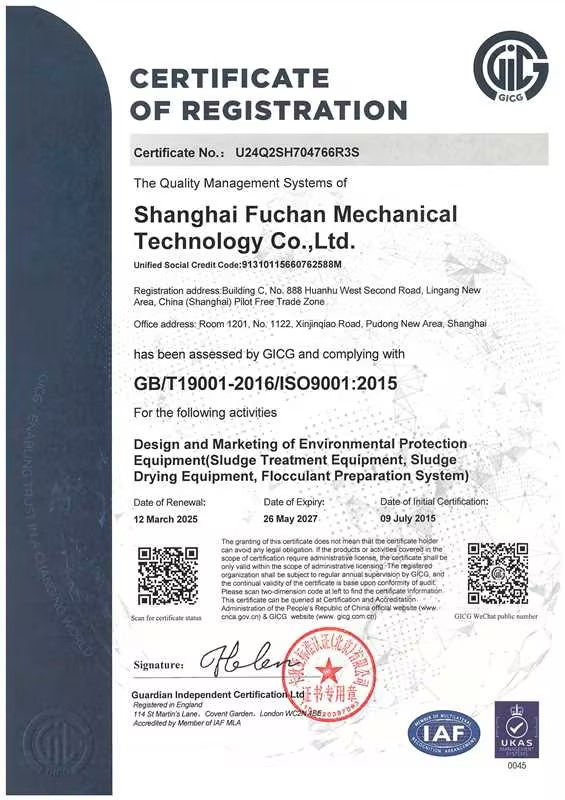
Shanghai Fuchan Machinery (SFC Machinery) offers nine distinct product series for thickening, dewatering, deep dewatering, and drying, all covered by ISO 9001, ISO 14001, ISO 45001, and CE certifications. Below is a step-by-step approach to selecting the right technology based on feed characteristics and project targets.
Step 1 – Determine Feed Solids and Capacity
- Low solids (0.6–1.5%): Use a gravity belt thickener (FBT Series, belt width 1000–3000 mm, solid‑capture rate 98%) or rotary drum thickener (FRDT Series, capacity 7.5–100 m³/h).
- Medium solids (1.5–2.5%): A rotary drum dewatering machine (FTB Series) with integrated belt press can directly produce cake at 75–85% moisture.
- Higher solids (0.6–5.0%): Multi‑disc screw press (DL Series, 1.5–900 kg/h dried sludge) or wear‑free screw press (SRD Series, for oily/sticky/high‑inorganic sludge) are suitable.
Step 2 – Match Final Cake Target
If a cake dryness of <80% is acceptable, standard dewatering machines (GDY belt‑type, FTB, FTB rotary‑drum, DL/SRD screw presses) work. For deeper dewatering (<70% moisture), a high‑pressure belt press (SD Series, inlet 15–20% solids) can reduce water content further. For ultimate volume reduction, a low‑temperature sludge dryer (SFC‑TR or SFC‑BSD series) can reduce volume by over 70%.
Step 3 – Evaluate Maintenance and Automation
The wear‑free screw press (SRD Series) is designed for low‑concentration, sticky, oily, and high‑inorganic‑content sludge with minimal wear parts. All SFC machines can be configured with PLC automation, remote support, and optional auxiliary integration.
Real-Word Use Cases
SFC equipment has been deployed across eight documented projects. Below are selected references that validate performance:
- Municipal WWTP, China (8 × FRDT thickeners): Reduced sludge moisture from 99.4% to 97%, feeding downstream plate‑and‑frame press. Fully enclosed design, minimal wearing parts.
- Advanced Manufacturing, China (BSD‑2000 belt dryer): Reduced moisture from 85% to below 30%, operated for 6 years with low downtime and maintenance.
- Automotive Parts, China (2 × SFC‑TR dryers): Dried sludge from 75% to <25% using heat pump, removing >700 kg water per ton. Volume reduction >70%.
- City Sewage Treatment, China (2 × GDY integrated machines): Reduced moisture from 99.2% to <80%, 5 years unattended operation.
- Vegetable Oil Processing, China (DL screw press): Reduced moisture from 97% to 77%; sludge volume reduction up to 98% (8 years operation).
- Pharmaceutical Wastewater, China (DL screw press): Reduced moisture 99% to <85%, volume reduction 93% (10 years operation).
- Food Processing, Malaysia (FTB‑1000): Reduced moisture 98.5% to <80%; 30% reduction in sludge handling costs (8 years operation).
- Specialty Chemicals, China (FTB‑1500L): Reduced 99% to <80% moisture, producing discharge‑ready cake with minimal downtime (5 years operation).
Technology Comparison Table
| Series | Type | Inlet Solids | Capacity (dried sludge) | Final Moisture | Power (driving) | Best for |
|---|---|---|---|---|---|---|
| FBT | Belt Thickener | SS 0.6–1.5% | 72–900 kg/h | Outlet 2.5–8% | 0.55–1.5 kW | Pre‑thickening, high‑flow |
| FRDT | Rotary Drum Thickener | SS 0.6–1.5% | 45–1140 kg/h | Outlet 2.5–8% | 0.75–1.5 kW | Enclosed hygienic thickening |
| DL | Screw Press | SS 0.6–5.0% | 1.5–900 kg/h | 75–85% | 0.18–1.5 kW | Oily, decentralized sludge |
| SRD | Wear‑free Screw Press | SS 0.6–5.0% | 25–900 kg/h | 75–85% | 0.55–1.1 kW | Sticky, high‑inorganic sludge |
| GDY | Belt Thicken‑Dewater | SS 0.6–1.5% | 90–1050 kg/h | 75–80% | 1.1–4.0 kW | High‑flow continuous dewatering |
| FTB | Rotary Drum + Belt | SS 1.5–2.5% | 45–450 kg/h | 75–85% | 0.37–1.1 kW | Small‑medium plants |
| FTE | Rotary Drum + Belt | SS 0.6–1.5% | 90–975 kg/h | 75–85% | 0.55–4.0 kW | Medium‑large continuous |
| SD | High‑Pressure Deep Dewater | SS 15–20% | 60–920 kg/h (various MC) | 60–75% | 0.55–3.0 kW | Deep dewatering pre‑dryer |
| SFC‑TR | Low‑Temp Batch Dryer | SS 15–25% (pre‑dev) | 21–360 kg/h water extr. | Down to <10% | 15–145 kW | Small‑batch reduction |
| SFC‑BSD | Low‑Temp Belt Dryer | SS 15–35% | 0.8–90 t/h | 10–50% | 23–506 kW | Large‑volume reduction |
Note: All equipment is SS304 construction. Certifications: ISO 9001, ISO 14001, ISO 45001, CE (UDEM, valid through 2030).
Frequently Asked Questions (FAQ)
Ready to evaluate which sludge dewatering equipment best fits your process?
Download the full SFC Product Catalog for complete specifications, or contact the SFC sales team today for a no‑obligation consultation.