Sludge Dewatering Equipment Explained: A Practical Overview for Buyers
If you are evaluating sludge dewatering equipment for a wastewater treatment project, the first question is usually not which brand to choose. It is what type of machine matches your sludge, flow rate, and disposal target. This article explains the equipment categories, how a sludge dewatering system is built, and the operating conditions that affect selection.
What Is Sludge Dewatering Equipment?
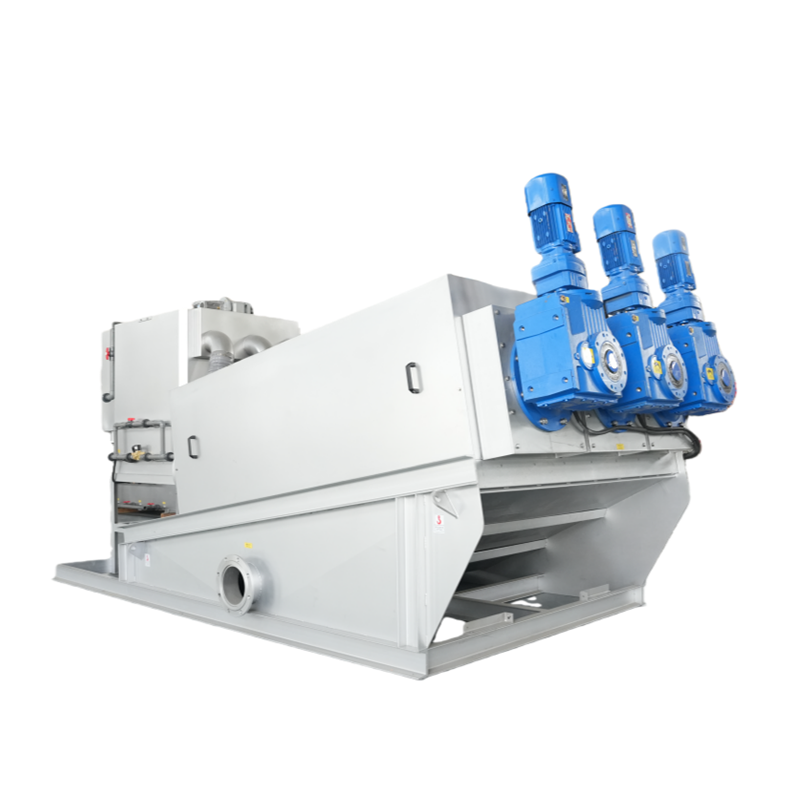
Sludge dewatering equipment covers mechanical systems that increase the solids concentration of sludge and remove part of its water content. The equipment range includes sludge thickening machines, screw press dewatering machines, belt press dewatering machines, high-pressure deep dewatering systems, and sludge dryers. These machines are used in municipal wastewater treatment, industrial wastewater treatment, and sludge reduction projects.
Shanghai Fuchan Machinery Technology Co., Ltd., also referred to as SFC Machinery, was established in 2007 and is a National High-Tech Enterprise located in Pudong New Area, Shanghai. The company designs and manufactures sludge treatment equipment, including sludge dewatering equipment, sludge thickening equipment, deep sludge dewatering equipment, sludge drying equipment, and polymer preparation systems. SFC also provides complete sludge management solutions covering thickening, dewatering, drying, and chemical dosing.
Problem Definition: Why Sludge Volume and Moisture Matter
Sludge from wastewater treatment contains a large proportion of water. If sludge is not dewatered, storage, transport, and disposal costs remain high. Reducing moisture also makes downstream operations such as incineration, composting, landfill, or resource recovery more practical.
High-moisture sludge is heavy and unstable. Dewatering equipment reduces the volume of sludge by separating water from solids, which lowers transport weight and improves handling. In many projects, the final goal is not simply a drier cake; it is a more predictable and lower-cost disposal route.
Industry Background: Market Outlook for Sludge Dewatering Equipment
According to Fortune Business Insights, the global sludge dewatering equipment market was valued at USD 5.19 billion in 2024 and is projected to reach USD 10.16 billion by 2032. Asia Pacific accounted for the largest revenue share, 37.57%, in 2024. China's sludge dewatering equipment market revenue was expected to reach USD 0.87 billion by 2025.
Grand View Research estimates that the belt filter press segment will grow at a CAGR of 8.8% from 2025 to 2033, reflecting its widespread use in municipal wastewater applications. The same research context shows a concentrated supplier field: Veolia was identified as the market leader with over 9% market share in 2025, while the top five players—Andritz, Xylem, Alfa Laval, Suez, and Veolia—collectively held 35% market share. Buyers therefore have many equipment choices, and selection depends on sludge characteristics, project scale, and downstream disposal route.
Detailed Solution: Sludge Dewatering Equipment Categories
Sludge treatment is usually built as a process line rather than a single machine. A complete sludge management solution often includes thickening, dewatering, deep dewatering, drying, and chemical dosing. The equipment categories below show where each machine fits.
Sludge Thickening Equipment
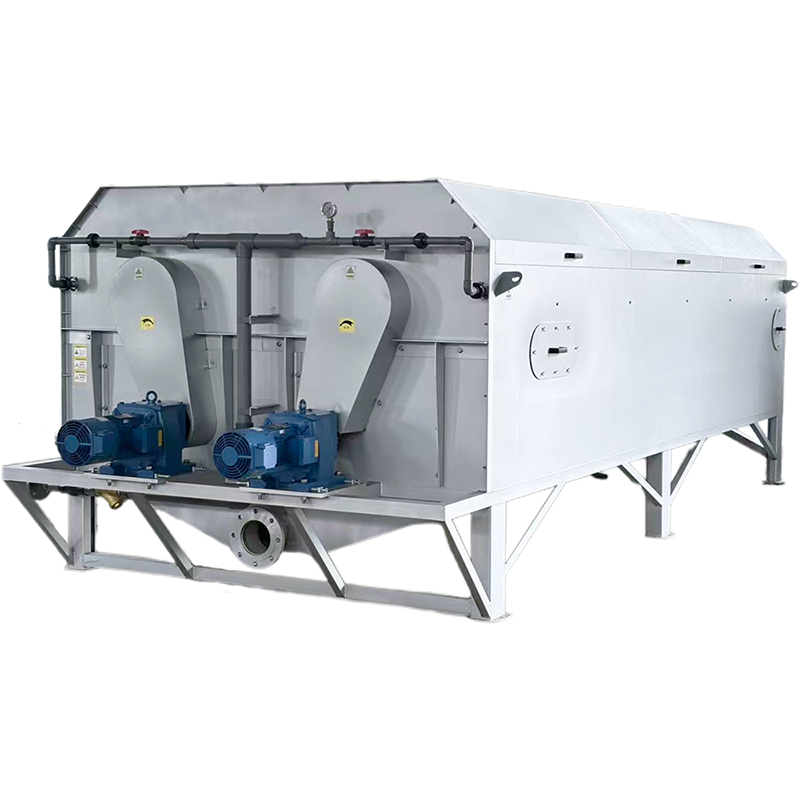
Thickeners are used before mechanical dewatering when sludge has low solids content. The FBT Series belt sludge thickener is a gravity belt thickener made of SS304, available in models FBT-1000 to FBT-3000. It operates at a belt speed of 3–18 m/min and can increase sludge outlet consistency to 2.5–8% from an inlet consistency of 0.6–1.5%.
The FRDT Series rotary drum sludge thickener is an enclosed drum thickener made of SS304, available in models FRDT-20 to FRDT-100. It operates at around 10 rpm, uses a 30–80 mesh filter, and has a solid capture rate of 95%.
Mechanical Dewatering Machines
The core of a sludge dewatering system is often a mechanical dewatering machine. SFC offers several configurations:
- DL Series screw press sludge dewatering machine: a multi-disc screw press made of SS304, with models DL-101 to DL-404. It handles inlet consistency of S.S. 0.6–5.0%, produces dried sludge at 1.5–900 kg/h, and achieves cake water content of 75–85%. It is used for municipal wastewater, industrial wastewater, paper mills, printing and dyeing, oily sludge, and decentralized treatment.
- SRD Series wear-free screw press: a wear-free multi-disc screw press available in models SRD-301 to SRD-404. It is designed for sticky, oily, low-concentration or high-inorganic-content sludge, and is suitable for food processing wastewater and oily sludge treatment.
- GDY Series belt thickening and dewatering machine: integrates gravity belt thickening and belt press dewatering into one unit. Belt width is 1000–3000 mm, treating capacity is 15–90 m³/h, dried sludge output is 90–1050 kg/h, and cake water content is 75–80%. It suits high-flow continuous dewatering.
- FTB Series rotary drum dewatering machine: combines rotary drum thickening with belt press dewatering. Belt width is 500–2000 mm, inlet consistency is S.S. 1.5–2.5%, dried sludge output is 45–450 kg/h, and cake water content is 75–85%. It suits small and medium projects.
- FTE Series rotary drum type thickening and dewatering machine: combines rotary drum thickening with belt press dewatering for medium-to-large continuous duty. Belt width is 1000–3000 mm, inlet consistency is S.S. 0.6–1.5%, treating capacity is 12–90 m³/h, and dried sludge output is 90–975 kg/h.
Deep Sludge Dewatering Equipment
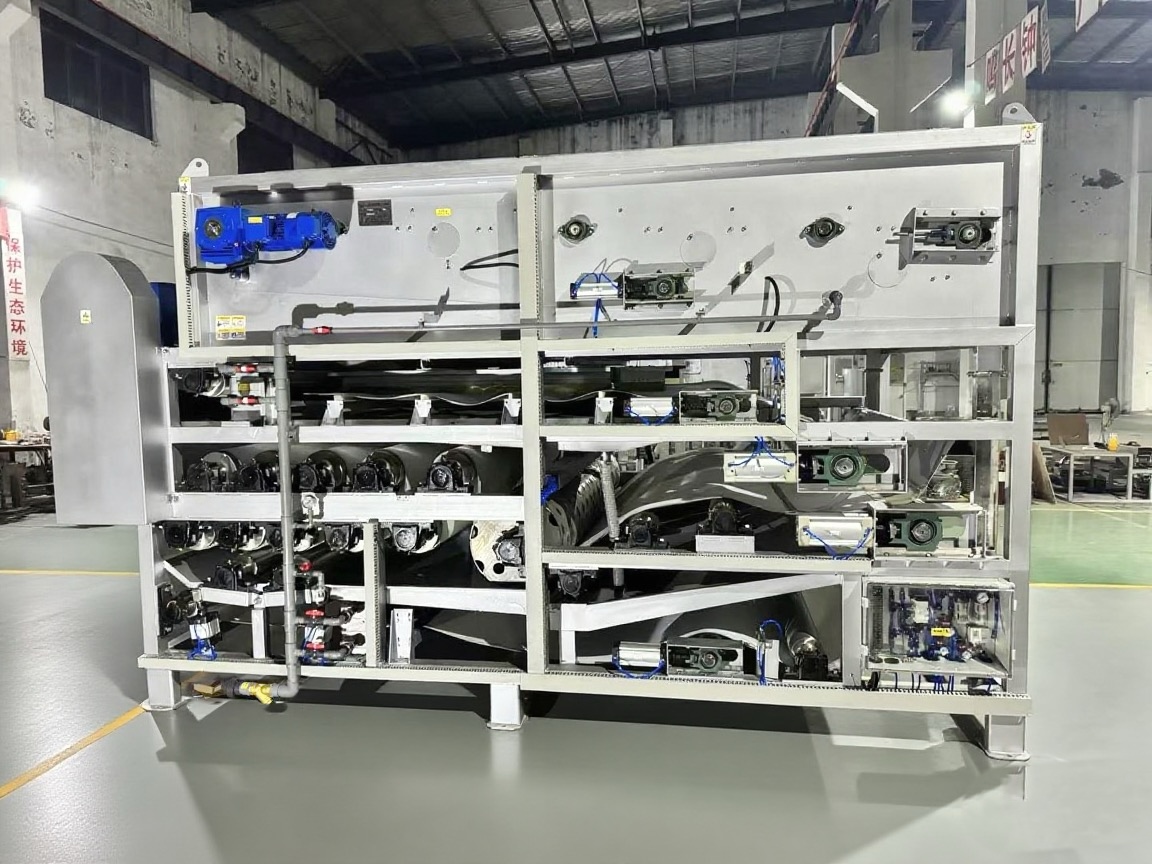
After conventional mechanical dewatering, some projects need lower moisture before drying or incineration. The SD Series high-pressure belt deep sludge dewatering machine, models SFC-SD05 to SFC-SD25, is made of SS304 and operates as a secondary deep dewatering step. Inlet consistency is S.S. 15–20%. For output at 65–75% water content, treating capacity is 0.3–5.0 t/h. For output at 60–70% water content, treating capacity is 0.35–6.1 t/h. It is intended for municipal wastewater treatment plants, chemical plants, sludge deep treatment, drying pretreatment, and incineration pretreatment.
Sludge Drying Equipment
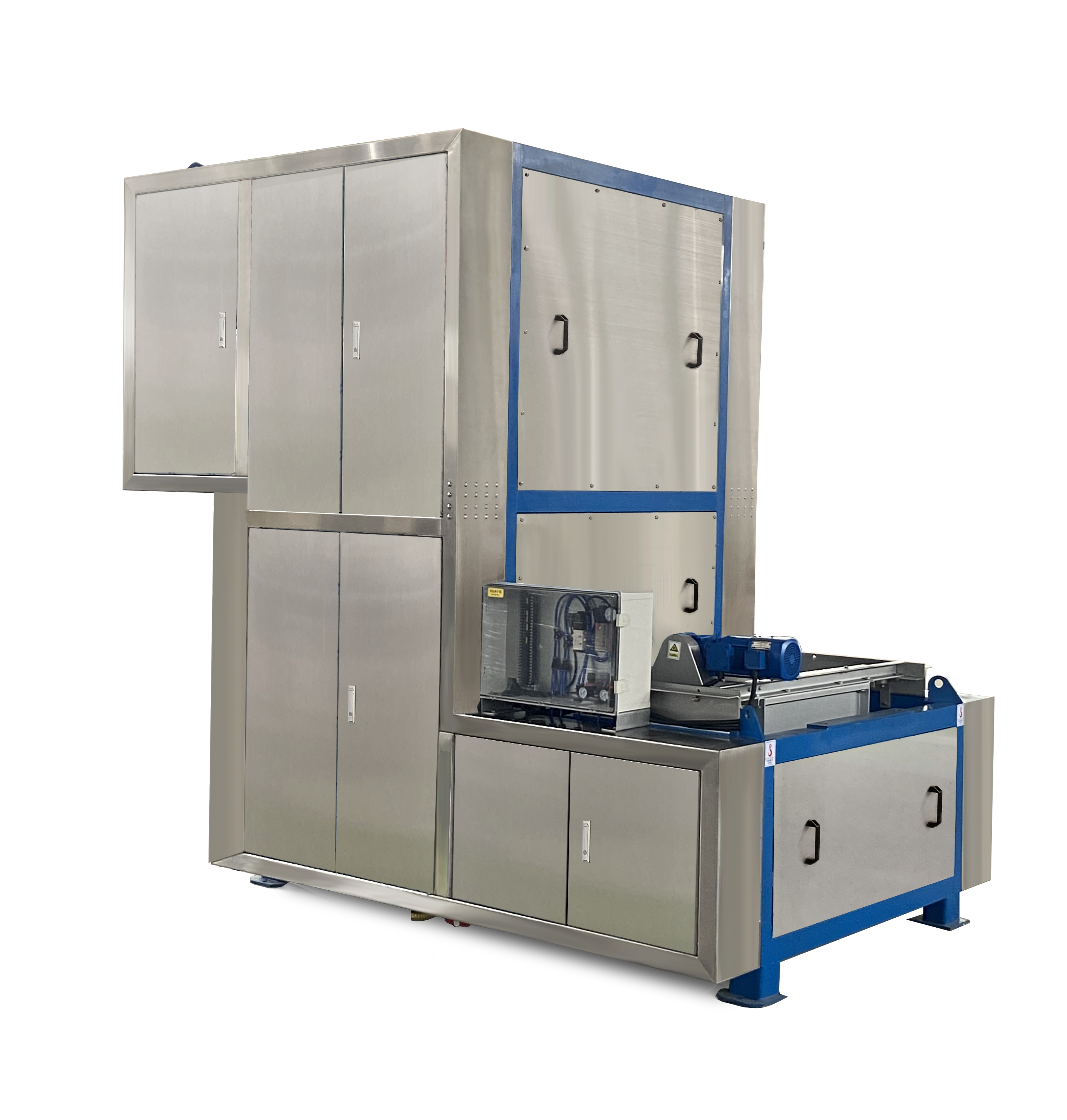
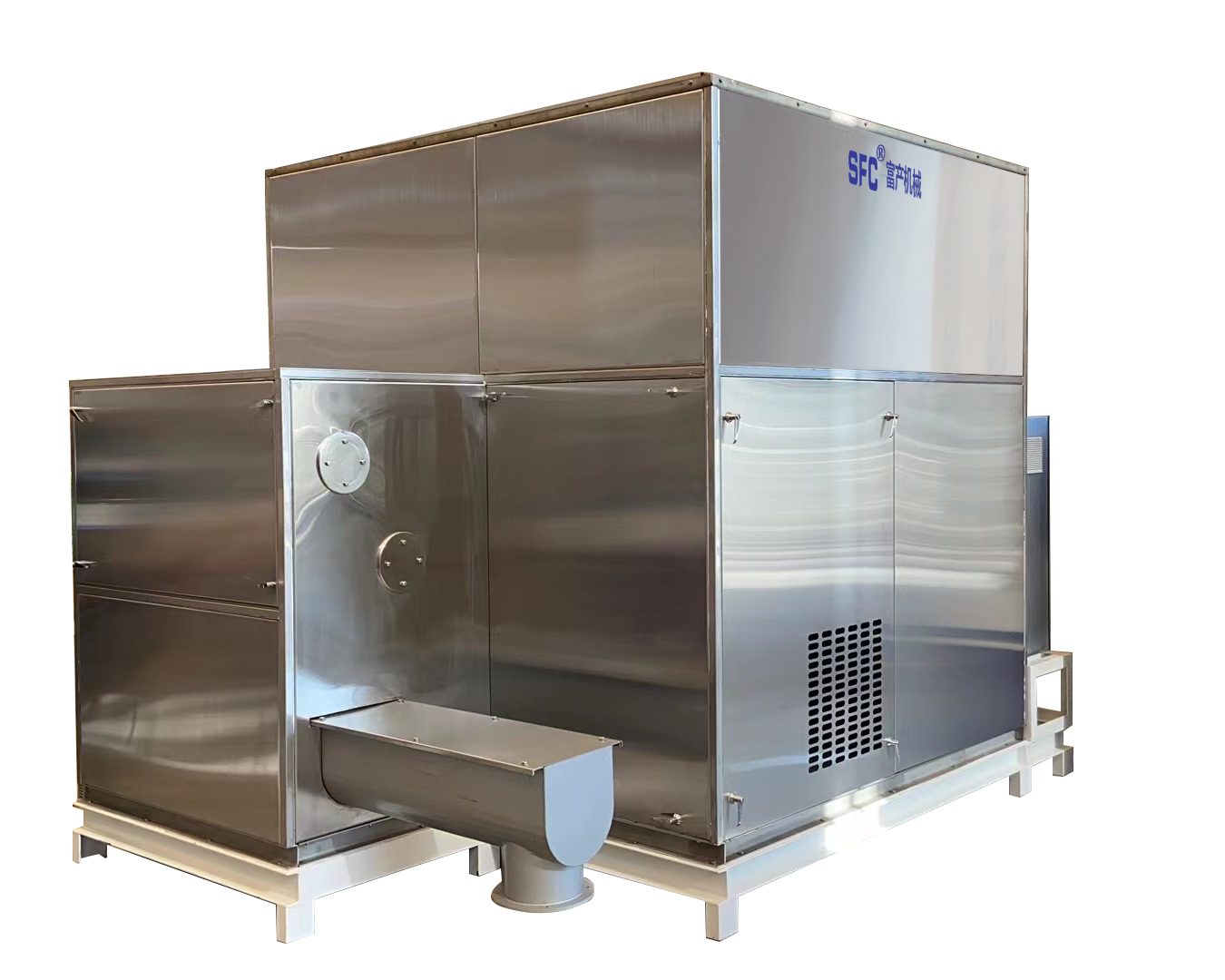
Drying further reduces moisture and volume after dewatering. The SFC-BSD Series belt sludge dryer is a low-temperature belt dryer made of SS304, with a modular, fully enclosed design. It can take dewatered sludge with inlet solids of 15–25% or 25–35%, and produce final water content of 10–50%.
The SFC-TR Series is a low-temperature reciprocating circulation dryer for batch drying and volume reduction. For SFC-TR models, sludge volume can be reduced by up to 70% after drying, and unit power consumption is 0.4–0.55 kWh/kg water.
Chemical Dosing and Automation
Most dewatering systems include an automatic polymer preparation and dosing system, such as PAM or PAC preparation units. Accurate chemical preparation and feeding reduce polymer consumption and stabilize flocculation before dewatering. A PLC control system is often used to coordinate the sludge pump, dosing pump, and conveyor system.
Step-by-Step Breakdown: How a Sludge Dewatering System Works
- Sludge is pumped from a settling tank or storage tank to the treatment line.
- Conditioning: a polymer preparation and dosing system adds flocculant in a mixing or flocculation tank. Proper polymer conditioning is critical for stable cake formation.
- Thickening when needed: a belt thickener or rotary drum thickener increases solids concentration before dewatering. For example, the FBT Series accepts S.S. 0.6–1.5% and can raise outlet consistency to 2.5–8%.
- Mechanical dewatering: a screw press or belt press separates water from the conditioned sludge. Typical cake water content is 75–85% for many screw press and rotary drum belt press models, and 75–80% for the GDY integrated belt system.
- Deep dewatering when required: a high-pressure belt press can lower water content further after primary dewatering. The SD Series is specified for output water contents of 65–75% or 60–70%.
- Drying when required: low-temperature dryers reduce moisture to 10–50% final water content, and the SFC-TR Series can reduce sludge volume by up to 70%.
- Cake discharge: dewatered or dried sludge is moved by screw conveyor to storage, transport, incineration, landfill, or resource recovery.
Use Cases for Sludge Dewatering Equipment
Sludge dewatering equipment is applied across many industries. The following scenarios are common for the equipment types described above:
- Municipal and industrial wastewater treatment: screw press machines, belt thickening and dewatering machines, rotary drum thickeners, and belt thickeners are used for continuous sludge volume reduction.
- Oil refining and petrochemical industry: sludge from petrochemical coking wastewater can be treated with thickening, dewatering, and thermal drying systems that use corrosion-resistant and explosion-proof design.
- Brewery and distillery industry: high-organic sludge with high moisture content can be treated by screw press dewatering and thermal drying, with enclosed and corrosion-resistant equipment for odor control.
- Automotive parts manufacturing and electroplating: heavy-metal sludge and corrosive wastewater conditions require dewatering and drying packages with corrosion-resistant materials and continuous automatic operation.
- Pharmaceutical industry: complex chemical sludge can be dewatered, deep dewatered, and dried to stabilize residues and reduce biological activity.
- Palm oil industry: palm oil sludge, empty fruit bunch, and palm oil mill effluent treatment can use unattended continuous dewatering systems.
Comparison Table: Sludge Dewatering Equipment Options
| Technology | Typical Models | Feed Solids | Capacity / Output | Water Content | Typical Use |
|---|---|---|---|---|---|
| Multi-disc screw press | DL-101 to DL-404 | S.S. 0.6–5.0% | Dried sludge 1.5–900 kg/h | 75–85% | Municipal, industrial, paper mills, oily and decentralized sludge |
| Wear-free screw press | SRD-301 to SRD-404 | S.S. 0.6–5.0% | Dried sludge 25–900 kg/h | 75–85% | Sticky, oily, high-inorganic sludge; food processing and industrial wastewater |
| Belt thickening and dewatering | GDY-1000 to GDY-3000 | S.S. 0.6–1.5% | 15–90 m³/h; dried sludge 90–1050 kg/h | 75–80% | High-flow continuous municipal and industrial dewatering |
| Rotary drum thickening + belt press | FTB-500 to FTB-2000 | S.S. 1.5–2.5% | 3–30 m³/h; dried sludge 45–450 kg/h | 75–85% | Small and medium projects; paper mills; printing and dyeing |
| Rotary drum type + belt press | FTE-1000 to FTE-3000 | S.S. 0.6–1.5% | 12–90 m³/h; dried sludge 90–975 kg/h | 75–85% | Medium and large continuous dewatering projects |
| High-pressure deep dewatering | SFC-SD05 to SFC-SD25 | S.S. 15–20% | 0.35–6.1 t/h; dried sludge 70–920 kg/h | 60–75% | Deep treatment; drying and incineration pretreatment |
| Low-temperature belt dryer | BSD1000 to BSD30000 | S.S. 15–25% or 25–35% | 0.8–57 t/h or 1–90 t/h | 10–50% final | Sludge drying, volume reduction, resource recovery |
| Low-temperature batch dryer | SFC-TR1000 to SFC-TR9000 | Dewatered sludge batch | Water extraction 21–360 kg/h | Volume reduction up to 70% | Municipal, industrial, and chemical sludge drying |
How to Choose Sludge Dewatering Equipment
Selection should begin with sludge analysis rather than with a single machine model. The following decision rules help narrow the options:
- For low-concentration sludge with S.S. below 1.5%, include a thickening step. Belt thickeners, rotary drum thickeners, or integrated thickening and dewatering machines are common solutions.
- For sticky, oily, or high-inorganic-content sludge, confirm the sludge type before selecting a screw press. Wear-free designs are available for difficult sludge after testing.
- For high-flow continuous projects, belt-based systems such as the GDY Series or FTE Series can handle larger hydraulic loads.
- For lower final moisture before drying or incineration, consider a high-pressure deep dewatering system after primary mechanical dewatering.
- For projects that need very low final moisture and smaller disposal volume, add a low-temperature sludge dryer.
- Confirm the required supporting equipment, including the polymer preparation system, sludge feed pump, dosing pump, flocculation tank, screw conveyor, wash water system, and control cabinet.
- Run a sludge sample test and polymer selection before final sizing. This is especially important for belt thickeners, screw presses, and deep dewatering systems.
Limitations and Operating Conditions to Plan For
Every sludge dewatering technology has operating requirements. Planning for these conditions improves uptime and cake quality.
- Belt press systems require stable flocculation, adequate wash water, and correct belt tension. Regular filter cloth cleaning is also needed.
- Screw press systems require correct feed concentration, polymer jar testing, and anti-clogging operation. For sticky or oily sludge, sludge type confirmation and testing are recommended.
- High-pressure deep dewatering systems require conditioning chemicals and project-specific sludge testing.
- Low-temperature dryers require confirmation of the final moisture target and sludge feeding condition before model selection. Moisture target, sludge thickness, and ventilation or odor control should be reviewed for each project.
- Some industrial applications require corrosion-resistant materials, explosion-proof design, energy efficiency, or odor-free operation. This is common in petrochemical, brewery, electroplating, and pharmaceutical sludge treatment.
Frequently Asked Questions
What is sludge dewatering equipment?
Sludge dewatering equipment is a range of mechanical systems used to increase sludge solids concentration and reduce sludge volume. It includes thickening equipment, screw press dewatering machines, belt press dewatering machines, high-pressure deep dewatering systems, and sludge dryers. These systems are used in municipal and industrial wastewater treatment.
What are the main types of sludge dewatering machines?
The main types include multi-disc screw press dewatering machines, wear-free screw press machines, belt thickening and dewatering machines, rotary drum thickening and belt press dewatering machines, rotary drum type thickening and dewatering machines, high-pressure belt deep dewatering machines, and low-temperature sludge dryers. Each type is selected according to feed solids, sludge characteristics, flow rate, and target cake moisture.
Which sludge dewatering system should I choose for low-concentration sludge?
For low-concentration sludge such as S.S. 0.6–1.5%, thickening before dewatering is generally recommended. Belt sludge thickeners and rotary drum thickeners can increase sludge outlet consistency to 2.5–8%. Integrated machines such as the GDY Series combine gravity belt thickening and belt press dewatering in one unit, while FTB and FTE Series combine rotary drum thickening with belt press dewatering.
What supporting equipment is needed for a sludge dewatering system?
Typical supporting equipment includes a polymer preparation system, sludge feed pump, dosing pump, flocculation tank, screw conveyor, wash water system, and control cabinet. For drying systems, a heat pump, air circulation system, heat exchanger, and feeding and discharge systems are used. The exact scope depends on the project.
What should I prepare before requesting a quote or sample?
Before requesting a quote, prepare information about sludge type, feed concentration, target water content, and project capacity. Sludge sample testing and polymer selection are recommended before final equipment sizing. For a product catalog or proposal, contact SFC Machinery at sales@fuchanjx.com or WhatsApp +86 138-1673-2007.
Conclusion
Sludge dewatering equipment is not a single machine category; it is a process decision that depends on sludge type, flow rate, and disposal goal. Buyers should start with sludge testing, then match thickening, dewatering, deep dewatering, and drying steps to their actual operating conditions. Shanghai Fuchan Machinery provides a broad range of sludge dewatering machines and systems for municipal and industrial projects, including thickeners, screw press dewatering, belt press dewatering, deep dewatering, and low-temperature drying equipment.
Need a sludge dewatering equipment specification or quotation?
Download the SFC Product CatalogEmail: sales@fuchanjx.com | WhatsApp: +86 138-1673-2007