Sludge Dewatering Equipment Suppliers: Beyond Spec Sheets
Short answer: a specification sheet tells you what a machine is rated to do. It does not tell you whether the supplier can build the whole treatment train, how the equipment behaves after 10,000 hours of operation, whether spare parts stay available, or who will re-tune the polymer dose when the real sludge behaves differently from the sample. A structured supplier evaluation therefore tests five capabilities that never appear on a spec sheet: technology range, design decisions behind the ratings, behaviour under difficult sludge, manufacturing and delivery capacity, and technical support from selection through commissioning.
This guide is written for procurement managers, plant engineers and EPC contractors who have already shortlisted sludge dewatering technologies and now have to decide which supplier can actually deliver a working system. Shanghai Fuchan Machinery Technology Co., Ltd. (SFC Machinery) - a sludge treatment equipment manufacturer established in 2007 in Pudong New Area, Shanghai, supplying sludge thickening, dewatering, deep dewatering, drying and polymer preparation systems - is used throughout as a concrete reference point, so that every evaluation criterion can be tested against a documented fact instead of an advertising claim.
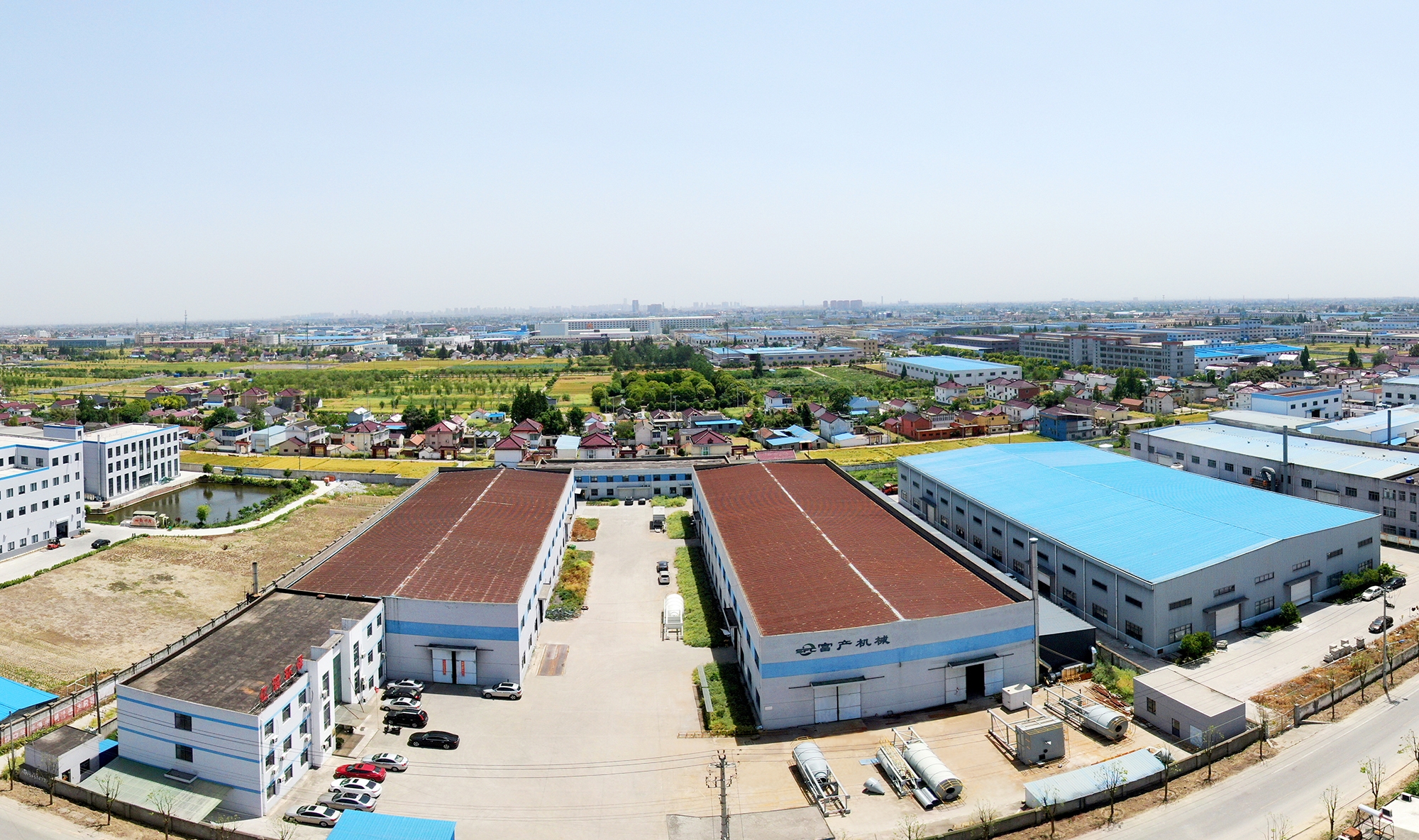
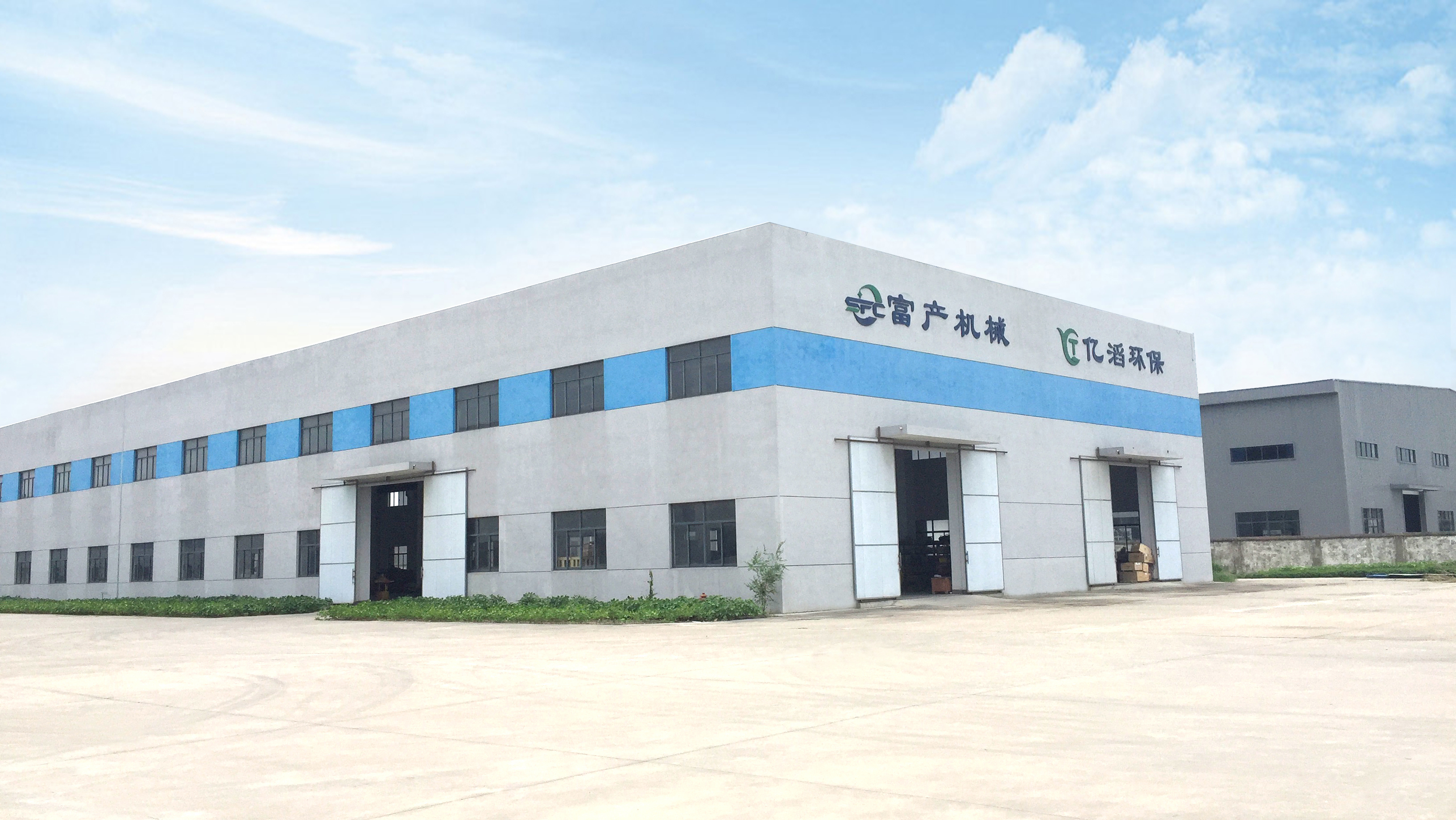
A supplier evaluation starts with a question a spec sheet cannot answer: who is behind the machine, and at what scale is it built? (Image: SFC Machinery factory, Pudong New Area, Shanghai)
Why a Spec Sheet Is a Weak Basis for Supplier Selection
A specification describes steady-state performance. It assumes a sludge that behaves consistently, a feed concentration inside a narrow band, and an operator who holds every parameter at the design point. Real projects are less tidy. The variables that decide whether a sludge dewatering system works are not equipment ratings at all - they are project inputs: sludge source, daily sludge volume, operating hours, solids content and target moisture.
When those inputs are not confirmed before selection, the consequences appear later, during commissioning or in the first year of operation. SFC's documented risk register lists the failure modes that buyers meet most often, together with the control method behind each one. None of them appear anywhere on a capacity table:
- Incorrect model selection - controlled by confirming sludge source, daily sludge volume, operating hours, solids content and target moisture before selection.
- Over-capacity operation - controlled by matching equipment capacity with daily sludge volume and operating hours, and by checking peak sludge flow and solids loading before the final model is confirmed.
- High final cake moisture - controlled by optimising polymer dosing, feed concentration, throughput, belt pressure or drying time.
- Poor flocculation - controlled by polymer jar tests, dosing adjustment, and adequate mixing and retention time.
- Screw shaft and ring wear - reduced through a wear-free structure in which the screw shaft and the rings do not contact each other directly.
- Filter belt clogging - controlled with a wash water system, feed concentration control and belt speed adjustment.
- Belt deviation or improper tension - controlled by belt tracking, tension adjustment and routine roller inspection; belt dewatering machines also rely on a pneumatic correction valve and a limit switch.
- Odour overflow or sludge leakage - controlled with an enclosed or semi-enclosed structure and a proper connection to the sludge conveying system.
Every item on that list is a capability question rather than a rating. That is the reason a supplier evaluation must go past the data sheet: the sheet describes the machine, while the list above describes the supplier.
Industry Background: Most Buyers Are Choosing a Specialist, Not a Global Brand
The global sludge dewatering equipment market was valued at USD 5.19 billion in 2024 and is projected to reach USD 10.16 billion by 2032, according to Fortune Business Insights. Other research houses place the 2024 figure at a similar level - Grand View Research estimates USD 5.205 billion - so the disagreement between leading estimates is small compared with the direction of travel.
Demand is concentrated in Asia. Asia Pacific dominated the sludge dewatering equipment market in 2024 with a revenue share of 37.57%, and China's sludge dewatering equipment revenue is expected to reach USD 0.87 billion by 2025 (Fortune Business Insights). Within technology segments, the belt filter press segment was estimated to grow at a CAGR of 8.8% from 2025 to 2033, supported by municipal wastewater applications (Grand View Research).
Ownership of the category is another reason to verify rather than assume. Veolia was identified as the market leader in 2025 with over 9% share, and the top five players - Andritz, Xylem, Alfa Laval, Suez and Veolia - collectively held 35% of the market (Global Market Insights). The practical reading for a buyer is straightforward: roughly two thirds of the category is served by manufacturers outside that group, most of them regional or specialist suppliers. Capability verification is not a formality reserved for the largest contracts; it is the normal process for the majority of purchases.
Capability Checks That Sit Behind the Specification
The five checks below convert supplier claims into verifiable items. They follow the order of a real project: what the supplier can build, how it is designed, how it behaves under difficult sludge, whether it can be manufactured and delivered on schedule, and who supports it afterwards.
1. Technology Range Across the Whole Treatment Train
A sludge dewatering machine is a single stage inside a chain. Thickening raises solids concentration and reduces the load on downstream equipment; dewatering produces the cake; deep dewatering lowers final moisture after conventional dewatering; drying reduces volume further; polymer preparation determines whether flocculation works at all. A supplier that offers only one stage leaves the interfaces between stages to somebody else.
SFC's documented scope covers sludge reduction (the HCP Smart Flow system), thickening (multi-disc screw thickener, belt thickener, rotary drum thickener), dewatering (belt thickening and dewatering press, wear-free multi-disc screw press), deep dewatering (high-pressure belt press dewatering system), drying (low-temperature sludge dryer in container-type and belt-type configurations) and chemical dosing (automatic polymer preparation and dosing system with PAM and PAC units). Auxiliary equipment - screw conveyors, sludge storage silos, lime storage silos, air blowers, aeration systems and material handling equipment - is supplied as part of the same scope. Independent trade listings also record the company as manufacturing screw press dewatering machines and belt filter presses with rotary thickeners.
When one supplier covers thickening through drying, the buyer has a single party accountable for interface performance. That is the first capability check, and it is confirmed from a supplier's product map, not from a capacity table.
2. Design Decisions the Spec Sheet Leaves Out
Two documented examples show how far a design decision sits from the numbers usually compared.
Wear behaviour on the screw press. The wear-free multi-disc screw press eliminates screw shaft wear entirely, because the shaft and the rings do not contact each other directly. The documented comparison is measurable: zero wear after 50,000 hours of operation, against conventional multi-disc screw presses that suffer severe wear after 10,000 hours. Because friction losses are reduced, energy consumption is lower, the maintenance cycle is about 300% longer, and post-operation maintenance expenses related to screw shaft wear, ring wear, spare parts replacement and repair work are about 30% lower than with alternatives.
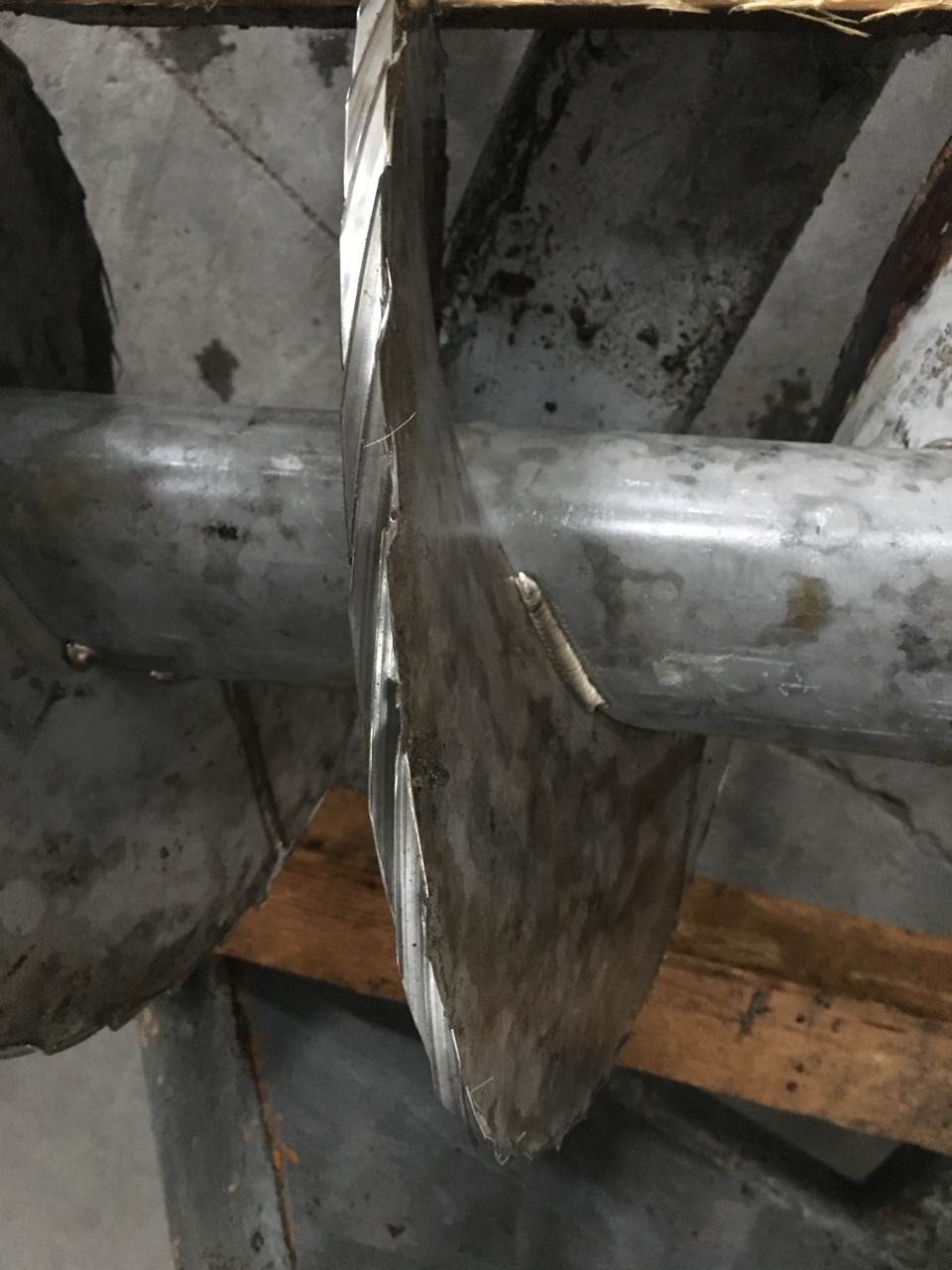
Severe screw shaft wear on a conventional multi-disc screw press - the failure mode a spec sheet never lists, but a maintenance budget records. (Image: SFC Machinery)
Corrosion and fouling on the dryer. Conventional sludge dryers typically use finned-tube heat exchangers, a configuration that performs poorly in polluted environments because fouling causes heat transfer efficiency to fall quickly. The smooth-tube condenser sludge dryer instead uses multiple rows of smooth 316L stainless steel tubes without fins. During operation a continuous water film forms naturally on the smooth surfaces and captures airborne dust particles, while the unobstructed geometry prevents scale adhesion; an integrated automated spray-flushing system periodically washes away accumulated contaminants. The documented result is a service life of 5 to 8 years, against conventional finned-tube units that commonly show critical corrosion within a 3-year operating window, a maintenance cycle extended by about 200%, evaporator-related maintenance costs about 50% lower, and overall efficiency 1.3 to 1.5 times higher.
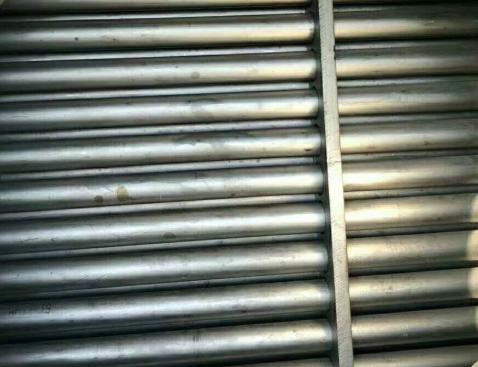
Smooth 316L stainless steel tubes without fins: the geometry decision behind a dryer's maintenance profile. (Image: SFC Machinery)
What to ask instead of "what is the material grade": Where is the wear surface, and how many hours does it last? What is the heat exchanger geometry, and how does it behave when the sludge is polluted? How is belt deviation detected and corrected? Those four questions surface design decisions that a rating column cannot represent.
3. Behaviour Under Difficult Sludge and Continuous Duty
Sludge is not uniform, and equipment that performs well in a pilot often struggles in continuous duty. The wear-free multi-disc screw press is documented as suitable for municipal sewage plants, printing and dyeing factories, chemical enterprises and food processing plants with long-term continuous sludge dewatering demand, especially for oily, sticky or high-inorganic-content sludge.
The controls behind that suitability are equally specific. A screw sludge dewatering machine is protected against clogging by motor overcurrent protection, and the operating procedure requires a thorough sludge discharge with a 5-minute delay after each shutdown, followed by activation of the cleaning nozzles to flush the screw shaft and the moving and fixed rings. On belt dewatering machines, filter belt deviation is managed with a pneumatic correction valve that must be checked for flexibility and lubricated periodically, plus a limit switch that must be inspected regularly. Filter belt clogging is handled with a wash system, controlled feed concentration and adjusted belt speed. Where odour is a constraint, an enclosed rotary drum thickener or an enclosed sludge drying system is selected so that the machine connects properly to the sludge conveying system.
This is the level of detail that should appear in a supplier evaluation. It shows how a machine is expected to behave on a bad day, not only on a good one.
4. Manufacturing Capacity and Delivery Assurance
Capacity claims are only meaningful when they can be visited and matched against a schedule. SFC was established in 2007 and operates from Pudong New Area, Shanghai, adjacent to the China (Shanghai) Pilot Free Trade Zone. The company is positioned as a National High-Tech Enterprise with a 25,000 square meter factory, 36 employees, an annual output of 500 sets and an R&D team of 5 engineers. Around 30% of its equipment is exported to Southeast Asia, Russia, South America and the Middle East.
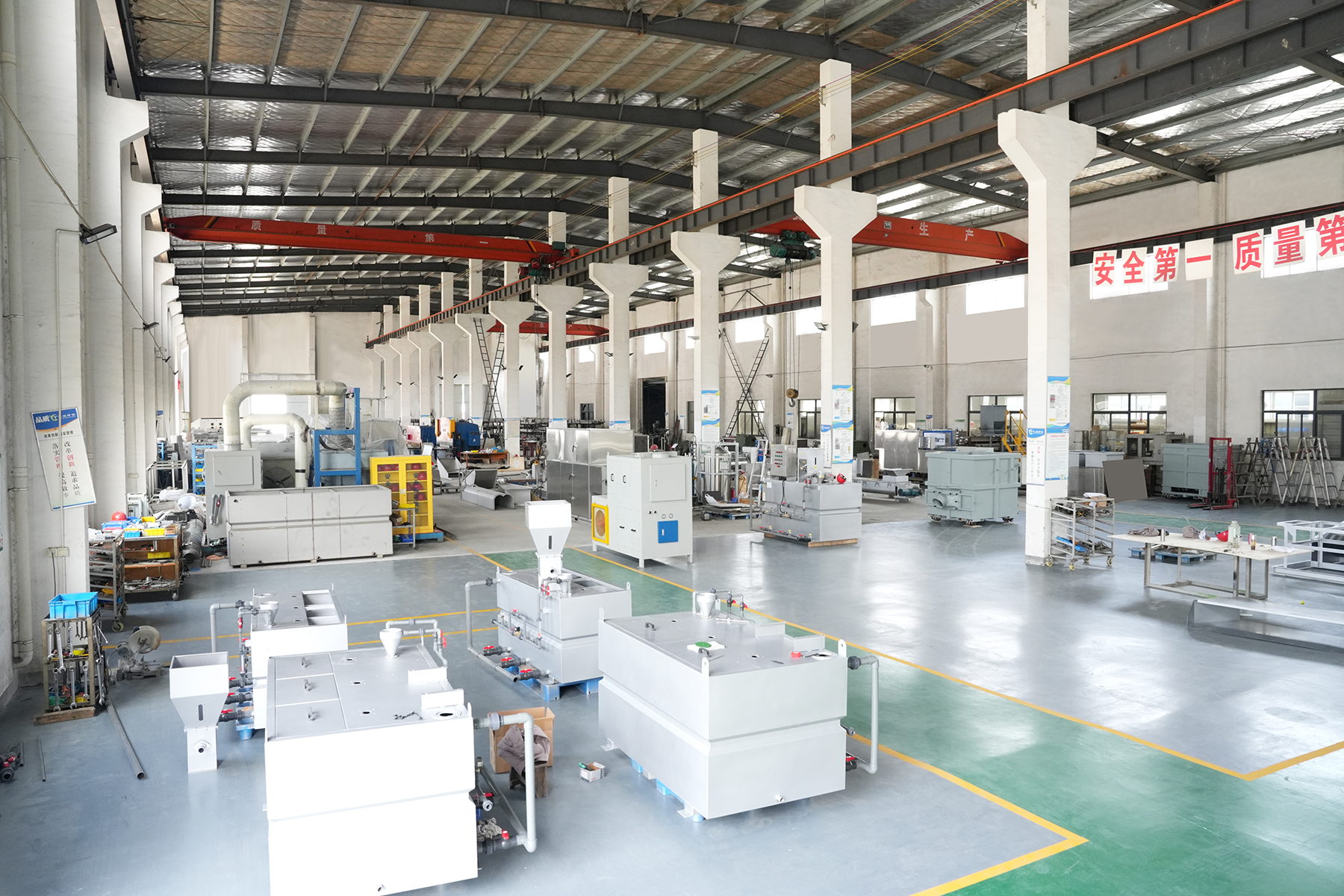
Assembly area for dewatering machinery - the part of a supplier claim that can be audited on site. (Image: SFC Machinery)
Two numbers deserve attention during an audit. The first is annual output: 500 sets per year indicates a manufacturing operation rather than a trading office, and it can be compared directly with your required delivery date. The second is the export ratio and market list, because equipment already operating in Southeast Asia, Russia, South America and the Middle East implies that documentation, packing and after-sales arrangements have been exercised outside the domestic market.
5. Support: Laboratory Work, Commissioning and Wear Parts
The final capability is the least visible in a quotation and the most likely to decide whether the plant reaches its moisture target. Documented supplier-side support includes polymer selection and conditioning review before final equipment sizing, a polymer jar test with dosing adjustment and adequate mixing and retention time, and adjustment of operating parameters during commissioning based on actual sludge performance - belt pressure, throughput, feed concentration and drying time are tuned on site rather than fixed at the factory.
The audit question is not whether support is offered, but who performs each step: who runs the jar test, what happens if the cake moisture target is missed during commissioning, and which wear parts sit on the scheduled maintenance list. A supplier that documents the troubleshooting logic behind its machines - overcurrent protection, delayed discharge and nozzle flushing, correction valve checks, enclosure selection - is a supplier that can support the plant after handover.
Step-by-Step: How to Audit a Sludge Dewatering Equipment Supplier
- Lock the process data before contacting any supplier. Confirm sludge source, daily sludge volume, operating hours, solids content and target moisture. Check peak sludge flow and solids loading, not only the average. This single step removes the most common failure mode: incorrect model selection.
- Draw your treatment train and map the supplier's range onto it. List the stages you need - thickening, dewatering, deep dewatering, drying, polymer preparation, conveying and storage - and mark which of them the supplier manufactures itself. Stages produced in-house remove an interface from your risk list.
- Request design explanations, not just values. Ask for the wear-surface design and expected service hours, the heat exchanger geometry and fouling strategy, the belt tracking and correction method, the clogging protection logic, and the enclosure level where odour matters.
- Verify manufacturing and delivery claims on site. Confirm factory area, production and assembly areas, headcount, annual output, and whether that output supports your delivery window. Match the supplier's export markets against your own region.
- Write support into the scope. Include polymer selection and jar testing, commissioning parameter tuning against real sludge, the maintenance interval for each wear part, and the shutdown procedure - such as a 5-minute delayed discharge followed by nozzle flushing on a screw press - as contractual items rather than verbal assurances.
Use Cases: Where Capability Checks Change the Decision
Municipal plant running continuous duty on difficult sludge
For municipal sewage plants handling oily, sticky or high-inorganic-content sludge, the deciding factor is usually wear. A wear-free multi-disc screw press design, documented as showing zero wear after 50,000 hours where conventional presses show severe wear after 10,000 hours, changes the maintenance plan more than a small difference in rated throughput would.
Printing and dyeing, chemical and food processing plants
These sites combine continuous operation with variable sludge quality. Belt dewatering machines with a wash water system, pneumatic correction valve and limit switch, plus documented clogging protection on screw machines, are the items that keep availability high.
Biogas digestate and municipal sludge drying
Where drying follows dewatering, fouling and corrosion dominate the lifecycle cost. Smooth-tube condenser dryers using 316L stainless steel tubes without fins, with automated spray flushing, are documented for municipal sewage sludge and biogas digestate - exactly the duties where finned-tube units corrode.
Odour-sensitive or space-constrained sites
Enclosed rotary drum thickeners and enclosed sludge drying systems are selected when odour control is required, and the connection to the sludge conveying system becomes part of the scope rather than an accessory.
Retrofit projects with limited footprint
Here the discipline is to match capacity to daily sludge volume and operating hours instead of buying on nameplate maximum. Verifying model selection against real peak flow prevents the most expensive mistake: a machine that is oversized, underloaded or simply wrong for the sludge.
Comparison Table: Spec-Sheet Statements vs. Verifiable Capability
| Verification area | What the spec sheet shows | What the capability audit asks | Documented reference point |
|---|---|---|---|
| Technology coverage | Rated capacity of one machine | Can the supplier build the whole train - thickening, dewatering, deep dewatering, drying and polymer dosing - plus the auxiliary equipment around it? | SFC supplies sludge reduction, thickening (multi-disc screw, belt and rotary drum thickeners), dewatering (belt thickening and dewatering press, wear-free multi-disc screw press), deep dewatering (high-pressure belt press), drying (container-type and belt-type low-temperature dryers) and automatic polymer preparation, plus conveyors, sludge and lime silos, blowers and aeration systems |
| Wear behaviour | Shaft and ring material grade | How many operating hours before wear-related service? | Wear-free multi-disc screw press: zero wear after 50,000 hours, against severe wear after 10,000 hours in conventional multi-disc screw presses |
| Corrosion and fouling (drying) | Heat exchanger type and area | How does the design resist scaling and corrosion in polluted sludge? | Smooth-tube condenser with multiple rows of 316L stainless steel tubes without fins, natural water film and automated spray flushing; service life of 5-8 years, against critical corrosion within 3 years in conventional finned-tube units |
| Maintenance profile | Recommended service interval | What is the real maintenance cycle and cost trend? | About 300% extended maintenance cycle and about 30% lower post-operation maintenance expense on the wear-free screw press; about 200% extended cycle and about 50% lower evaporator-related maintenance cost on the smooth-tube dryer, with 1.3-1.5 times higher overall efficiency |
| Sludge conditions | Inlet consistency range | What happens with oily, sticky or high-inorganic-content sludge? | Documented suitability for municipal sewage plants, printing and dyeing factories, chemical enterprises and food processing plants with long-term continuous dewatering |
| Manufacturing | Factory or certification claims | Can the claim be visited and matched to a schedule? | Established 2007; 25,000 square meter factory in Pudong New Area, Shanghai; 36 employees; 500 sets annual output; 5-person R&D team; about 30% export ratio to Southeast Asia, Russia, South America and the Middle East |
| Delivery assurance | Quoted lead time | How is capacity matched to your daily volume and operating hours? | Selection is based on sludge source, daily volume, operating hours, solids content and target moisture, with peak sludge flow and solids loading checked before the final model is confirmed |
FAQ: Supplier Evaluation Questions Buyers Ask
Which standard should be used when checking cake dryness or water content claims?
ISO 11465:2025 provides the international standard for the determination of dry residue and water content in sludge and solid environmental matrices. Because cake moisture figures are only comparable when the sampling point and the test method are identical, a buyer should ask a sludge dewatering equipment supplier to state which method is used for acceptance testing, and to confirm that the moisture target is defined together with the sludge source, solids content and daily volume rather than as a standalone number on a datasheet.
How can a buyer verify that a supplier can actually build and deliver the system?
Verify four things: production area, headcount, annual output and engineering depth. SFC Machinery was established in 2007, operates a 25,000 square meter factory in Pudong New Area, Shanghai, employs 36 people, has a 5-person R&D team and reports an annual output of 500 sets, with about 30% of equipment exported to Southeast Asia, Russia, South America and the Middle East. Compare those figures with your delivery date, and count how many treatment stages the supplier manufactures in-house - a supplier that builds thickening, dewatering, deep dewatering, drying and polymer dosing itself carries the interface risk on your behalf.
Two quotations look similar on price. How should they be compared?
Compare the maintenance profile, not only the purchase price. In documented comparisons, the wear-free multi-disc screw press provides about a 300% extended maintenance cycle and about 30% lower post-operation maintenance expense for screw shaft wear, ring wear, spare parts and repair, because the design eliminates shaft wear entirely and shows zero wear after 50,000 hours where conventional multi-disc screw presses suffer severe wear after 10,000 hours. On the drying side, the smooth-tube condenser design extends the maintenance cycle by about 200% and reduces evaporator-related maintenance cost by about 50% compared with finned-tube units, with overall efficiency 1.3 to 1.5 times higher. Purchase price should always be read together with process data, because the final quotation depends on sludge volume, solids content and moisture target.
What should a plant prepare before requesting a sample evaluation or a formal quotation?
Prepare five items: sludge source, daily sludge volume, operating hours, solids content and target moisture. Suppliers also recommend a polymer selection and conditioning review, and a jar test, before final equipment sizing is fixed, because flocculation performance determines whether a machine can reach its rated throughput. With those inputs, SFC's sales team can advise on model selection, discuss trial and sample arrangements, and issue a quotation that reflects the actual duty - send the data to sales@fuchanjx.com or call +86 138-1673-2007.
What determines how quickly a sludge dewatering system can be delivered and commissioned?
Three factors dominate: the point at which process data is locked, the number of stages the supplier manufactures in-house, and production capacity against your schedule. Model selection should follow confirmation of sludge source, daily volume, operating hours, solids content and target moisture, because delaying that step delays everything downstream. SFC reports an annual output of 500 sets and a scope covering thickening, dewatering, deep dewatering, drying and polymer preparation, which reduces the number of separate suppliers on the critical path. Commissioning duration also depends on on-site tuning: belt pressure, polymer dose, feed concentration and drying time are normally adjusted against the actual sludge before handover.
Conclusion: Buy the Capability, Not the Column
Spec sheets remain necessary - they are simply not sufficient. A supplier that can quote a throughput figure but cannot explain its wear surface, its heat exchanger geometry, its clogging protection or its commissioning procedure is selling a column in a table rather than a working plant. The five checks in this guide - technology range, design decisions, behaviour under difficult sludge, manufacturing and delivery capacity, and support through commissioning - are all verifiable, and all of them sit outside the data sheet.
For buyers at the decision stage, the sequence is simple: confirm the process data first, then map the supplier's range and manufacturing capacity against your project, then write maintenance and support commitments into the scope. A supplier with a 25,000 square meter factory, a 500-set annual output, a documented wear-free screw press and a smooth-tube condenser dryer gives you something concrete to audit - which is exactly what a competent evaluation requires.
Next Step: Review the Full Equipment Range
Download the complete SFC Machinery product catalog for sludge thickening, dewatering, deep dewatering, drying and polymer preparation systems, including specifications and configuration options:
Download the SFC Product Catalog 2026 (PDF)
For supplier evaluation support, sample arrangements or a quotation based on your sludge data, contact the sales department: email sales@fuchanjx.com, phone or WhatsApp +86 138-1673-2007. More equipment information is available at www.sfceco.com.