Sludge Dewatering Picks for Smart Agriculture & Ecology
Sludge Dewatering Equipment Picks for Smart Agriculture & Ecology
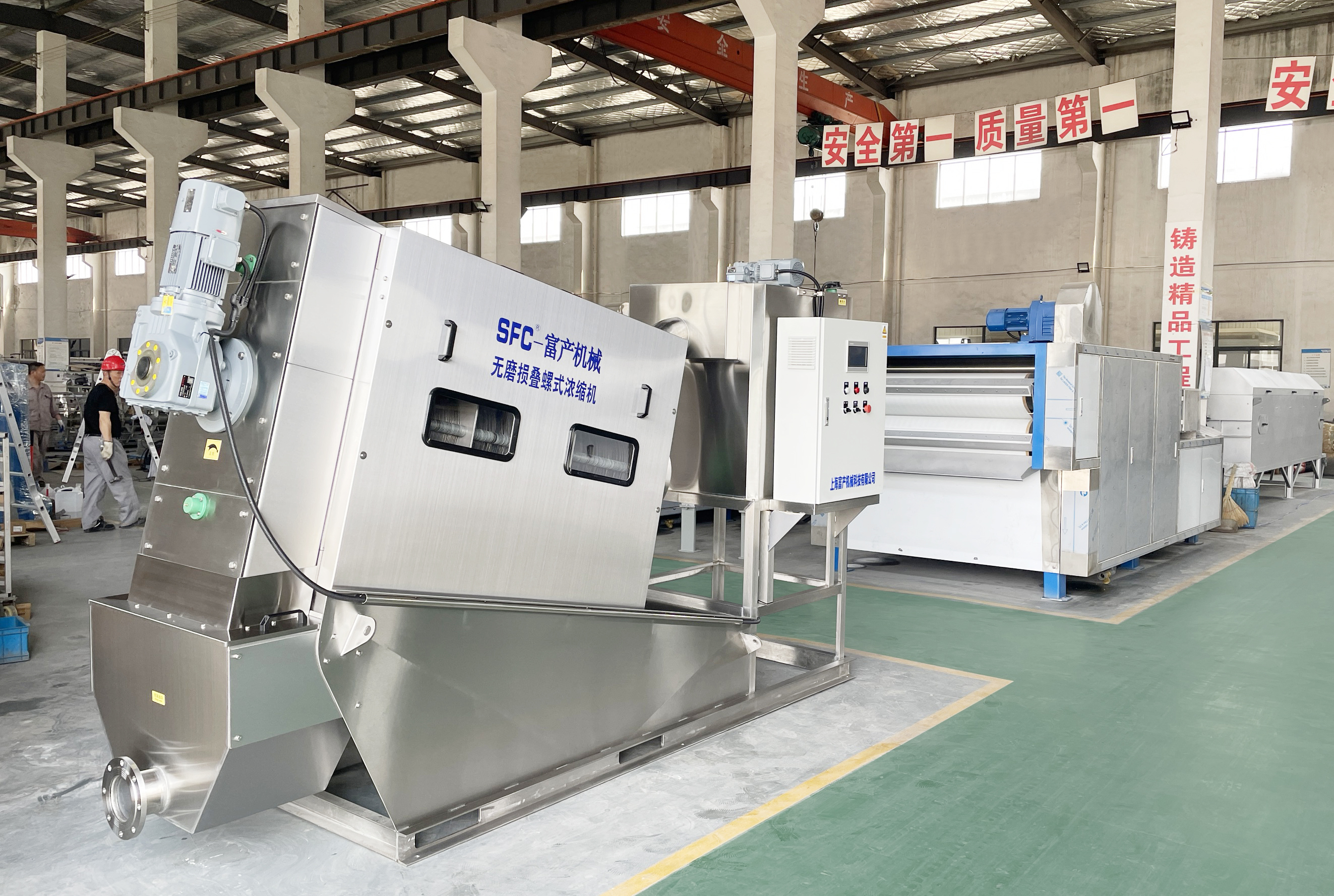
Wear-free multi-disc screw press — the top pick for variable, sticky and oily feed sludge in agriculture and ecology projects.
Answer first: most smart agriculture and ecology projects should shortlist the SRD wear-free multi-disc screw press and the DL multi-disc screw press first, because both accept inlet suspended solids anywhere from S.S. 0.6% to 5.0% on low installed motor power. High-flow plants move to the GDY belt thickening and dewatering machine (15–90 m³/h, 1000–3000 mm belt) or the enclosed-drum FTE (12–90 m³/h). The FTB (3.0–30 m³/h, belt width 500–2000 mm) covers small and village-scale duties. The SD high-pressure deep dewatering machine adds a second stage when cake moisture must drop below the 75–85% band. The FBT and FRDT thickeners prepare feed for any of them, and the SFC-TR and SFC-BSD low-temperature dryers close the loop where the disposal route needs dry, stable material.
Every pick below is a series from Shanghai Fuchan Machinery Technology Co., Ltd. (SFC Machinery), an environmental equipment manufacturer established in 2007 in Pudong New Area, Shanghai, that builds sludge thickening, dewatering, deep dewatering, drying and polymer preparation systems. The ranking is editorial. It orders SFC's published operating envelopes against the selection criteria set out below; it is not third-party test data and it is not a market-share position.
What the ranking is built on
Five criteria decide the order. They are stated here so a project engineer can disagree with the ranking and re-rank for their own site — which is the intended use.
- Feed flexibility. How wide an inlet suspended-solids window the unit accepts. A wide window matters in agriculture and ecology work because feed arrives from several processes and varies by season.
- Capacity coverage. The published treating capacity or dried-sludge output, and whether a single series spans pilot scale to full scale.
- Stage role. Whether the unit thickens, dewaters, deep-dewaters or dries. A unit that carries the core dewatering duty ranks above a unit that supports it.
- Operating signature. Installed motor power, stated solid-capture rate, and how the design handles difficult sludge.
- Downstream compatibility. Whether the output cake moisture can feed the next stage — deep dewatering or drying — without re-working.
Two consequences follow. Thickeners rank below dewatering machines not because they are less useful, but because they are a supporting stage. Dryers rank last because drying carries the highest energy burden of any stage and should only be added once mechanical dewatering has done its work.
The problem: thickening, dewatering and drying get treated as one purchase
The most common specification error in these projects is to ask for "a dewatering machine" when the site actually needs a thickening stage, or to buy a dryer to fix a dewatering problem. The three stages produce very different outputs, and the numbers differ by an order of magnitude.
A published definitional range puts dewatered cake at roughly 15–45% dry solids, which is what separates dewatering from thickening. A 2023 peer-reviewed review of sludge inventory data reports approximately 25–30% total solids after mechanical dewatering and approximately 35–40% total solids after deep dewatering. Those are literature benchmarks, not guaranteed equipment specifications, and feed sludge, conditioning and measurement protocol all differ between the underlying datasets — but they establish the ladder a project is climbing.
The SFC cake-moisture figures in this article use the opposite convention: 75–85% water content means 15–25% dry solids, because dry solids are simply the remainder of the wet mass. On a 100 g cake basis, 80 g of water leaves 20 g of solids. That places the standard SFC screw press and belt press band at the lower end of the 15–45% range, while the SD deep dewatering stage, published at 60–75% water content, covers roughly 25–40% dry solids and brackets the 35–40% deep-dewatering benchmark at its upper end.
Industry background: why the equipment list keeps growing
Global sludge dewatering equipment revenue was estimated at USD 5.8 billion in 2025 and USD 6.4 billion in 2026, with a forecast path to USD 14 billion by 2035, according to Global Market Insights (published April 2026). Fortune Business Insights reported that Asia Pacific held 37.57% of the dewatering equipment market in 2024. These are commercial research estimates with published methodology and should be read as directional market context, not as a demand forecast for any single project.
The technical evidence base is thinner than the market commentary. The 2023 peer-reviewed inventory review identified 55 datasets on sewage sludge dewatering and 21 on sludge drying — a modest evidence base for a global equipment category, which is one reason published operating envelopes matter more than generic performance claims during selection.
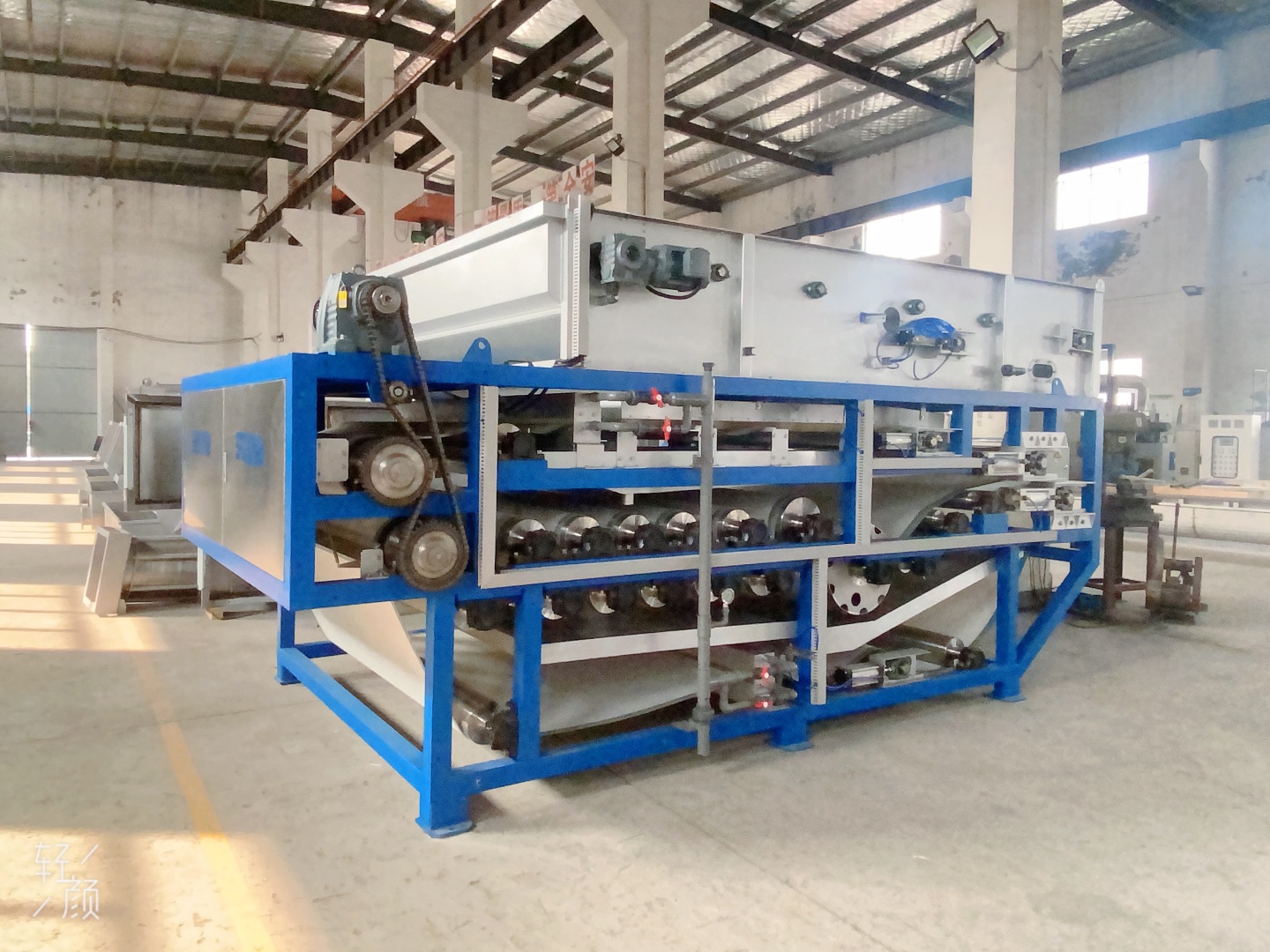
Integrated belt thickening and dewatering: one unit, one feed pump, one flocculation tank.
On the agriculture side, the pressure is upstream of the plant. A research-institute mapping report on textile water use in China noted that large industrial water discharge generates challenging sludge treatment issues — a 2017 qualitative observation, useful as background on why industrial and agro-industrial dischargers face sludge handling obligations, not as a current market measure. The same logic applies to palm oil mills, breweries and food processing plants, where the sludge line is now part of the environmental compliance case rather than an afterthought.
"Smart" in smart agriculture increasingly refers to measurement as much as to machinery. A 2025 peer-reviewed study in Water proposed evaluating sludge dewaterability from smartphone images of flocculation, a low-cost approach to characterising feed before committing to a polymer dose or a machine size. SFC does not claim that capability in its published specifications; the point is that feed characterisation is becoming cheaper, which makes envelope-based selection more practical than it used to be.
The ten picks at a glance
| Rank | Series | Stage | Inlet consistency | Published capacity | Output | Installed power |
|---|---|---|---|---|---|---|
| 1 | SRD wear-free multi-disc screw press | Dewatering | S.S. 0.6–5.0% | 25–900 kg/h dried sludge | 75–85% water content | 0.55–1.1 kW driving motor, multi-motor by model |
| 2 | DL multi-disc screw press | Dewatering | S.S. 0.6–5.0% | 1.5–900 kg/h dried sludge | 75–85% water content | 0.18–1.5 kW screw motor; 0.18–1.1 kW conditioning |
| 3 | GDY belt thickening and dewatering machine | Integrated | S.S. 0.6–1.5% | 15–90 m³/h; 90–1050 kg/h dried sludge | 75–80% water content | 1.1–4.0 kW driving; 0.55–1.5 kW belt thickener |
| 4 | FTE rotary drum thickening and dewatering machine | Integrated | S.S. 0.6–1.5% | 12–90 m³/h; 90–975 kg/h dried sludge | 75–85% water content | 0.55–4.0 kW driving; 0.37–0.75 kW drum |
| 5 | FTB rotary drum sludge dewatering machine | Integrated | S.S. 1.5–2.5% | 3.0–30 m³/h; 45–450 kg/h dried sludge | 75–85% water content | 0.37–1.1 kW driving |
| 6 | SD high-pressure deep dewatering machine | Second stage | S.S. 15–20% | 0.3–5.0 t/h; 60–760 kg/h dried sludge | 65–75% water content | 0.55–3.0 kW driving; 2.2–5.5 kW sludge mixer |
| 7 | FBT belt sludge thickener | Thickening | S.S. 0.6–1.5% | 12–95 m³/h; 72–900 kg/h dried sludge | Outlet 2.5–8% | 0.55–1.5 kW |
| 8 | FRDT rotary drum thickener | Thickening | S.S. 0.6–1.5% | 7.5–100 m³/h; 45–1140 kg/h dried sludge | Outlet 2.5–8% | 0.75–1.5 kW |
| 9 | SFC-TR low-temperature dryer | Drying | Batch, 1000–9000 L per batch | Water extraction 21–360 kg/h | Up to 70% reduction | 15–145 kW; 0.4–0.55 kWh/kg water |
| 10 | SFC-BSD belt sludge dryer | Drying | S.S. 15–25% or 25–35% | 0.8–57 t/h at 15–25%; 1–90 t/h at 25–35% | Final water content 10–50% | 23–506 kW |
All ten series are supplied in SS304. SFC Machinery holds ISO9001:2015, ISO14001, ISO45001:2018 and CE certification.
The picks, ranked, with selection rationale
1SRD wear-free multi-disc screw press
Envelope: inlet S.S. 0.6–5.0%; 25–900 kg/h dried sludge; 75–85% cake water content; screw Ø270×1 to Ø370×4; driving motor 0.55–1.1 kW with multi-motor configurations by model.
Rationale: this is the only SFC dewatering series whose published sludge suitability explicitly names low-concentration, sticky, oily and high-inorganic-content sludge — the profile that palm oil mills, food processing plants and many decentralised rural plants actually produce. It also carries the widest feed window of any SFC dewatering unit, so a project can absorb seasonal feed variation without changing machines. The wear-free multi-disc arrangement is described as reducing screw-to-ring wear risk rather than eliminating maintenance, and power is spread across small motors instead of one large drive. Cake at 75–85% water content feeds straight into an SD deep dewatering stage or a low-temperature dryer.
Choose it when: the feed is difficult, variable, or comes from an agro-industrial process with oil or inorganic content. Reconsider when: a single stream exceeds roughly 900 kg/h dried solids — move to the GDY or FTE belt family.
2DL multi-disc screw press
Envelope: inlet S.S. 0.6–5.0%; 1.5–900 kg/h dried sludge; 75–85% cake water content; screw Ø85×1 to Ø400×4; screw motor 0.18–1.5 kW; conditioning motor 0.18–1.1 kW; fixed rings, moving rings, screw shaft and volute filter construction.
Rationale: the DL is the widest model ladder in the portfolio, running from a Ø85 single-screw unit to a Ø400 four-screw unit inside one series. That matters for phased ecology projects: a village-scale installation can be sized at the bottom of the range and expanded later without changing dewatering technology, operator training or spare-parts logic. It shares the 0.6–5.0% feed window with the SRD.
Choose it when: you want one technology across several plants of different sizes, or a first unit that can grow. Reconsider when: the sludge is specifically sticky, oily or high-inorganic and the wear-free geometry of the SRD is the better match.
3GDY belt thickening and dewatering machine
Envelope: belt width 1000–3000 mm; inlet S.S. 0.6–1.5%; 15–90 m³/h; 90–1050 kg/h dried sludge; 75–80% cake water content; driving motor 1.1–4.0 kW; belt thickener 0.55–1.5 kW; disposal agitator 0.37–0.75 kW.
Rationale: the GDY carries the highest dried-solids output of any single SFC pick and produces the driest cake in the belt family at 75–80% water content. It integrates gravity belt thickening and belt pressing into one machine, which means one feed pump, one flocculation tank and one control cabinet instead of two separate stages. The 15–90 m³/h treating capacity matches the flow band of a municipal or agro-industrial plant serving a district rather than a single works.
Choose it when: flow is high and continuous, and the site can deliver dilute feed in the 0.6–1.5% band. Reconsider when: feed arrives already thickened above 1.5%, where the screw press range fits better, or when 1000 mm of belt width is more machine than the site needs.
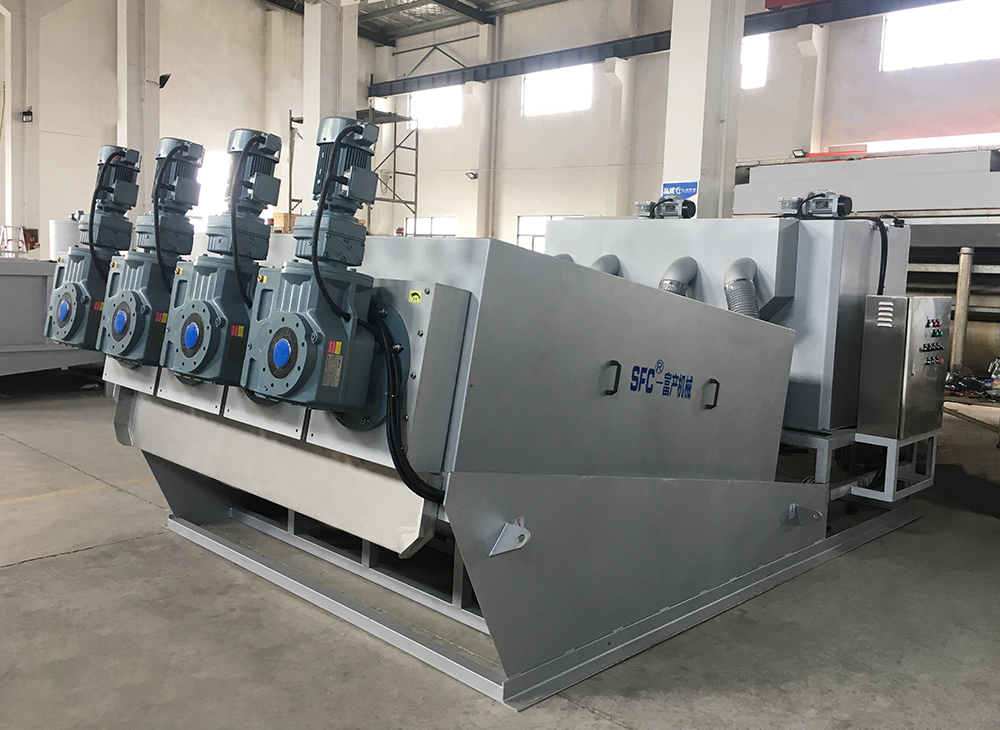
Multi-disc screw press: small motors, slow rotation, and a feed window that suits variable agricultural sludge.
4FTE rotary drum thickening and dewatering machine
Envelope: belt width 1000–3000 mm; inlet S.S. 0.6–1.5%; 12–90 m³/h; 90–975 kg/h dried sludge; 75–85% cake water content; driving motor 0.55–4.0 kW; drum thickener motor 0.37–0.75 kW.
Rationale: the FTE does the same two-stage job as the GDY but performs the thickening step in a rotary drum rather than on a gravity belt. Both cover 12–90 m³/h of feed at 0.6–1.5% inlet solids; the FTE gives up a small amount of dried-sludge output and drying performance against the GDY in exchange for an enclosed thickening stage, which suits plants where odour and aerosol control are part of the operating permit.
Choose it when: the thickening stage needs to be enclosed, or the site layout favours a drum over a gravity belt. Reconsider when: you need the driest possible cake from a single integrated belt unit.
5FTB rotary drum sludge dewatering machine
Envelope: belt width 500–2000 mm; inlet S.S. 1.5–2.5%; 3.0–30 m³/h; 45–450 kg/h dried sludge; 75–85% cake water content; driving motor 0.37–1.1 kW; drum thickener motor 0.37–0.55 kW.
Rationale: the FTB is the only SFC belt machine that goes down to a 500 mm belt, which makes it the smallest-footprint integrated thickening and dewatering option in the range. Its 1.5–2.5% inlet window is narrower than the GDY's, but that window is realistic for a plant that already screens and equalises its feed. SFC's own application notes place it in small and medium sludge dewatering projects, and a 500 mm FTB is the unit shown in the brewery and distillery application package.
Choose it when: the site is village-scale, a single farm or food plant, or a satellite works with consistent feed. Reconsider when: feed solids drift below 1.5% seasonally.
6SD high-pressure deep dewatering machine
Envelope: inlet S.S. 15–20%; 0.3–5.0 t/h and 60–760 kg/h dried sludge at 65–75% water content; 0.35–6.1 t/h and 70–920 kg/h at 60–70%; driving motor 0.55–3.0 kW; sludge mixer 2.2–5.5 kW; sludge distribution spiral 0.25–1.5 kW; crushing screw 0.37–0.75 kW.
Rationale: the SD is a genuine second stage, not a substitute for primary dewatering — its 15–20% inlet requirement means it can only accept cake, not raw sludge. Where it earns a top-ten place is the disposal-cost case: at 60–75% water content it produces roughly 25–40% dry solids, which brackets the 35–40% total-solids figure reported for deep dewatering in the 2023 inventory review. SFC's application note for the SD is explicit that conditioning chemicals and project-specific sludge testing are required before sizing, so this is a stage to specify with test data in hand.
Choose it when: haulage and disposal costs dominate the operating budget and the receiving facility can take higher-solids cake. Reconsider when: the project has not yet established a primary dewatering stage.
7FBT belt sludge thickener
Envelope: belt width 1000–3000 mm; inlet S.S. 0.6–1.5%; 12–95 m³/h; 72–900 kg/h dried sludge; outlet consistency 2.5–8%; 0.55–1.5 kW; belt speed 3–18 m/min; solid-capture rate 98%.
Rationale: the FBT carries the highest published solid-capture rate in the SFC portfolio at 98%, on 0.55–1.5 kW — a very small power draw for the volume it processes. Thickening from 0.6–1.5% up to 2.5–8% cuts the hydraulic load on the dewatering stage downstream, which lets a project buy a smaller dewatering machine or run the existing one closer to its design duty. Adjustable belt speed from 3 to 18 m/min gives the operator a control handle as feed varies.
Choose it when: feed is dilute, flows are large, and downstream dewatering capacity is the constraint. Reconsider when: feed already arrives above 1.5% solids.

Enclosed rotary drum thickening: slow-speed operation at roughly 10 rpm, with 95% stated solid capture.
8FRDT rotary drum thickener
Envelope: filter opening 30–80 mesh; inlet S.S. 0.6–1.5%; 7.5–100 m³/h; 45–1140 kg/h dried sludge; outlet consistency 2.5–8%; rotary drum speed around 10 rpm; solid-capture rate 95%; driving motor 0.75–1.5 kW.
Rationale: the FRDT handles the highest dried-sludge throughput of the two SFC thickeners — up to 1140 kg/h — in an enclosed drum running at roughly 10 rpm, which is slow enough to keep abrasion low and maintenance predictable. It sits behind the FBT in the ranking only because its stated solid capture (95%) is three points lower and because mesh selection from the 30–80 range must be matched to the application before the unit is ordered.
Choose it when: throughput is high, the thickening stage must be enclosed, or drum technology is already familiar to the operating team. Reconsider when: maximum solids recovery is the deciding criterion.
9SFC-TR low-temperature sludge dryer
Envelope: 1000–9000 L per batch of dried sludge; water extraction capacity 21–360 kg/h; required power 15–145 kW; unit power consumption 0.4–0.55 kWh/kg water; sludge reduction after drying up to 70%; SS304; batch operation with enclosed circulating air.
Rationale: the SFC-TR is the pick when cake output is intermittent and the site needs a compact, enclosed drying step rather than a continuous line. The published 0.4–0.55 kWh/kg water figure is genuinely useful because it is quoted per kilogram of water removed, which is the quantity the machine is actually paid to eliminate. Note that the 3.8 kWh/kg TS average for thermal drying reported in the 2023 inventory review uses a different denominator — total solids rather than water — so the two numbers cannot be compared directly. Ask any supplier for a common basis.
Choose it when: volumes are moderate, output is batch, and up to 70% volume reduction changes the disposal route. Reconsider when: the plant runs continuously at high cake tonnage, where a belt dryer fits better.
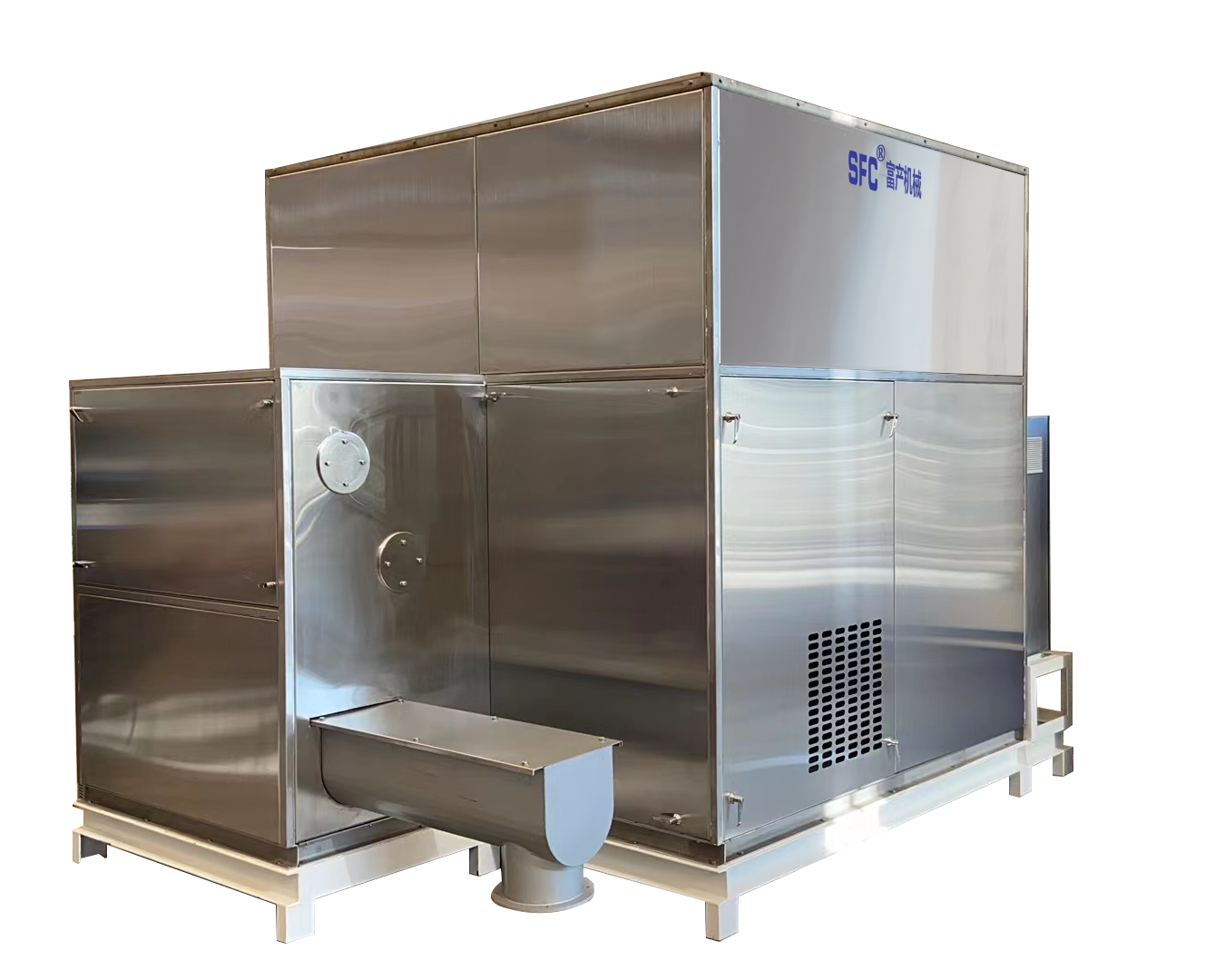
Belt sludge dryer: fully enclosed, modular, and specified by final moisture target rather than by model number alone.
10SFC-BSD belt sludge dryer
Envelope: inlet S.S. 15–25% or 25–35%; treating capacity 0.8–57 t/h at 15–25% and 1–90 t/h at 25–35%; final water content 10–50%; system power 23–506 kW; fully enclosed, modular design; SS304. High-temperature heat pump, belt dryer body, air circulation system, feeding and discharge systems and control cabinet make up the matched equipment.
Rationale: the BSD is the continuous option, and its 10–50% final water content window is the widest output range in the portfolio — wide enough that the moisture target, not the model, should drive selection. It ranks last for a reason that is worth stating plainly: drying is the most energy-intensive stage in a sludge line, and the 3.8 kWh/kg TS literature average for thermal drying sits far above the 0.12 kWh/kg TS and 0.26 kWh/kg TS reported for mechanical dewatering of raw and digested sludge respectively. Those figures come from different process classes with different system boundaries and are not a direct efficiency ranking, but the gap is large enough that drying should follow mechanical dewatering, not replace it.
Choose it when: the disposal route requires a stable, low-moisture product and continuous cake output justifies a belt line. Reconsider when: the target moisture can still be reached by deep dewatering alone.
How the picks combine in a real project
Ranking individual machines is only half the decision; the other half is the chain. Three configurations cover most agriculture and ecology work.
- Decentralised or village-scale: DL or SRD screw press alone, optionally followed by an SFC-TR batch dryer. Feed at 0.6–5.0% goes straight into dewatering without a separate thickening stage, which keeps the plant small and the operating team simple.
- District-scale municipal or agro-industrial: FBT or FRDT thickener → GDY or FTE integrated thickening and dewatering machine → SD deep dewatering → SFC-BSD belt dryer. Each stage is sized on the output of the one before it, and thickening upstream is what keeps the dewatering machine from being oversized.
- Difficult-sludge industrial: SRD wear-free screw press → SD or SFC-BSD, with PAM preparation and dosing upstream. This is the chain SFC's own application packages describe for sticky, oily and high-inorganic feeds.
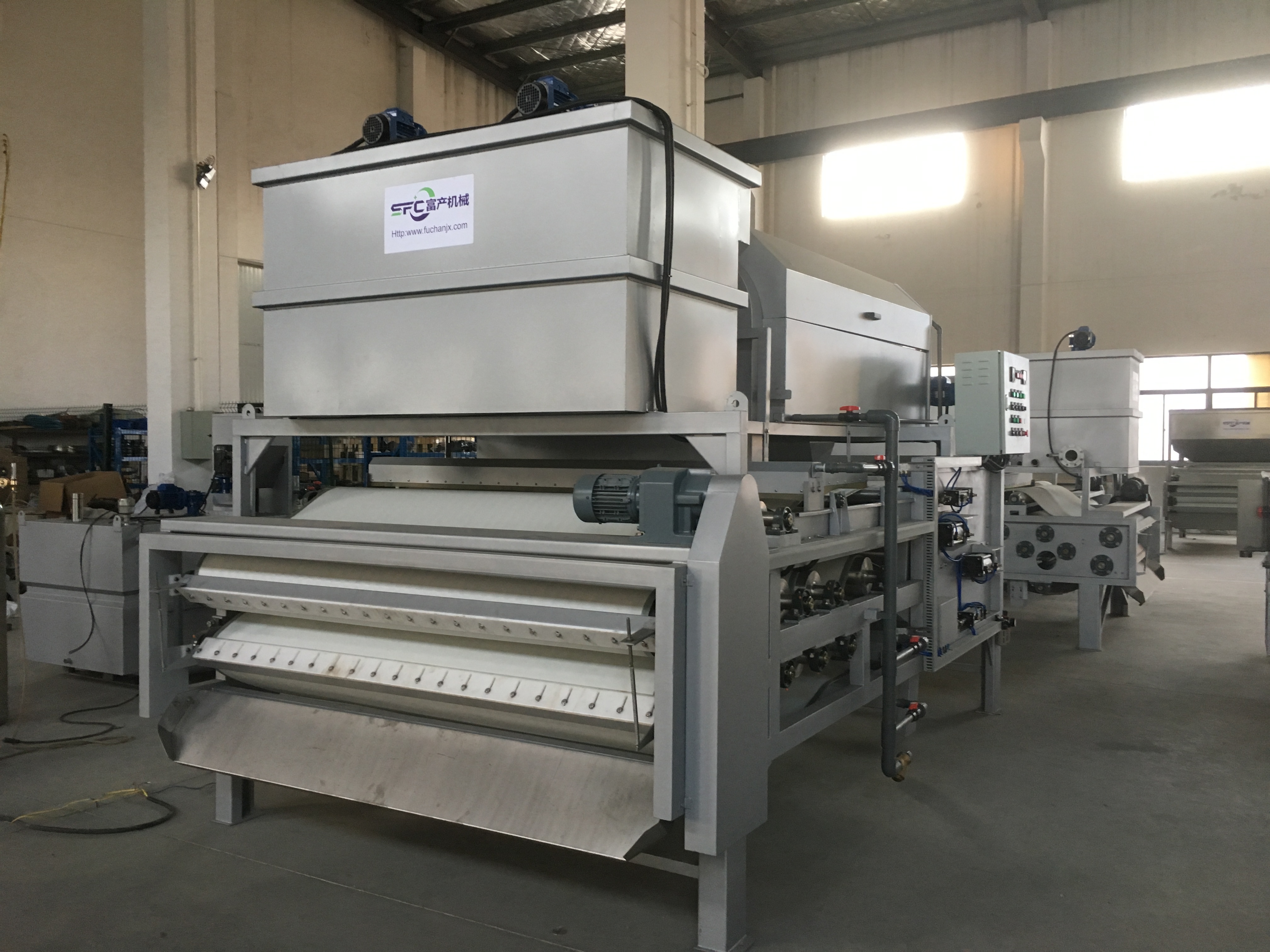
Rotary drum thickening plus belt pressing: the workhorse configuration for district-scale plants.
Use cases from the field
Palm oil mills. SFC's application package for the palm oil industry covers palm oil sludge, empty fruit bunch residue and palm oil mill effluent, with a matched equipment list of sludge transfer pump, flocculant dosing pump, screw conveyor, PAM preparation and dosing system, and PLC control, described for unattended continuous operation. The related products include the DL series, the SD deep dewatering machine, the SRD wear-free press and the FTB. Sticky, oily and high-inorganic feed is exactly the SRD's stated suitability, which is why it leads the ranking.
Breweries and distilleries. The distillery and brewery application note describes high-organic-load wastewater sludge with moisture typically at 95–99.8%, prone to fermentation and odour, requiring enclosed and corrosion-resistant equipment because of organic acids and ethanol residue. The package pairs thickening, screw press dewatering and thermal drying, with the FTB-2000 drum thickening belt filter press shown in the reference photographs. In this chain the dryer is justified because the dried output is described as a stable biomass material for co-incineration or land application — a case where stage 3 earns its energy cost.
Municipal and chemical sludge with a drying step. SFC's belt sludge drying application is specified for dewatered sludge requiring continuous low-temperature belt drying, with the matched equipment listed as high-temperature heat pump, belt dryer body, air circulation system, feeding system, discharge system and control cabinet. The application note is direct about the prerequisite: final moisture target and sludge feeding condition must be confirmed before model selection. That is the right sequence — drying performance is defined by its inlet, not by the dryer alone.
Frequently asked questions
What certifications should sludge dewatering equipment carry for an export project?
SFC Machinery holds ISO9001:2015, ISO14001, ISO45001:2018 and CE certification, and all ten series in this article are supplied in SS304 stainless steel. Buyers should treat these as a baseline rather than a complete answer: destination-market sludge rules also apply, and in North America the US EPA publishes sewage sludge laws and regulations that set the regulatory baseline for biosolids handling. Ask for the certificate scope and the material certificate for the specific model, not just the company-level certificate.
Which pick handles the widest range of feed consistencies?
The DL and SRD multi-disc screw presses both accept inlet suspended solids from S.S. 0.6% to 5.0%, the widest window in the SFC range. Between them, the SRD adds a wear-free multi-disc design intended to reduce screw-to-ring wear risk and is stated as suitable for low-concentration, sticky, oily and high-inorganic-content sludge, while the DL spans the widest model ladder from Ø85×1 to Ø400×4 and from 1.5 to 900 kg/h dried sludge. Belt-family machines are narrower: the GDY and FTE accept 0.6–1.5%, and the FTB accepts 1.5–2.5%.
What actually drives the operating cost of these machines?
Three variables dominate, and only one of them is the machine. Chemical conditioning typically runs at 5–15 g per kg of total solids for mechanical dewatering according to the 2023 inventory review. Energy for mechanical dewatering averages about 0.12 kWh/kg TS for raw sludge and 0.26 kWh/kg TS for digested sludge, while thermal drying averages about 3.8 kWh/kg TS — different process classes with different boundaries, so not a like-for-like ranking, but enough to show where the cost sits. The third variable is disposal volume, which is why deep dewatering or drying can pay for itself when haulage is expensive. No equipment prices, polymer prices or electricity tariffs are published in the sources behind this article.
Can a project test its sludge before committing to a model?
Yes, and for several picks testing is a stated prerequisite rather than an option. SFC's application notes recommend a sludge sample test and polymer selection before final sizing for the FBT belt thickener and for the DL screw press range; require sludge-type confirmation for the SRD because difficult sludge is assessed after testing; and state that conditioning chemicals and project-specific sludge testing are required for the SD deep dewatering system. For belt drying, the final moisture target and the sludge feeding condition must be confirmed before model selection. A jar test plus a feed-solids analysis is the minimum package to bring to a sizing conversation.
How should the picks be sequenced in a single project?
Work backwards from the disposal route. If the receiving facility accepts 75–85% water-content cake, a DL or SRD screw press alone may satisfy the duty. If haulage cost dominates, add an SD deep dewatering stage after primary dewatering to reach the 60–75% water-content band. If the route requires dry, stable material, finish with an SFC-TR batch dryer or an SFC-BSD belt dryer, and size the dryer on the actual cake output of the preceding stage rather than on raw sludge volume. For high-flow plants, insert an FBT or FRDT thickener at the front so the dewatering machine is sized on thickened feed. SFC publishes its full series, model ladder and operating envelopes in the SFC product catalog, which is a practical starting point for matching a chain to a site; a sludge sample and target cake moisture are what turn that chain into a specification.
Conclusion
For smart agriculture and ecology projects, the ranking resolves to a simple rule. Start with feed consistency: 0.6–5.0% points to the SRD or DL screw press, 0.6–1.5% at high flow points to the GDY or FTE, and 1.5–2.5% at small scale points to the FTB. Add an FBT or FRDT thickener when dilute feed would otherwise oversize the dewatering stage. Add the SD only after primary dewatering is in place and disposal cost justifies it. Add an SFC-TR or SFC-BSD dryer last, and only when the disposal route genuinely needs dry material — because drying is where the energy goes.
That sequence keeps every purchase tied to a measured input and a defined output, which is the difference between a sludge line that runs to its envelope and one that is re-specified two years after commissioning.
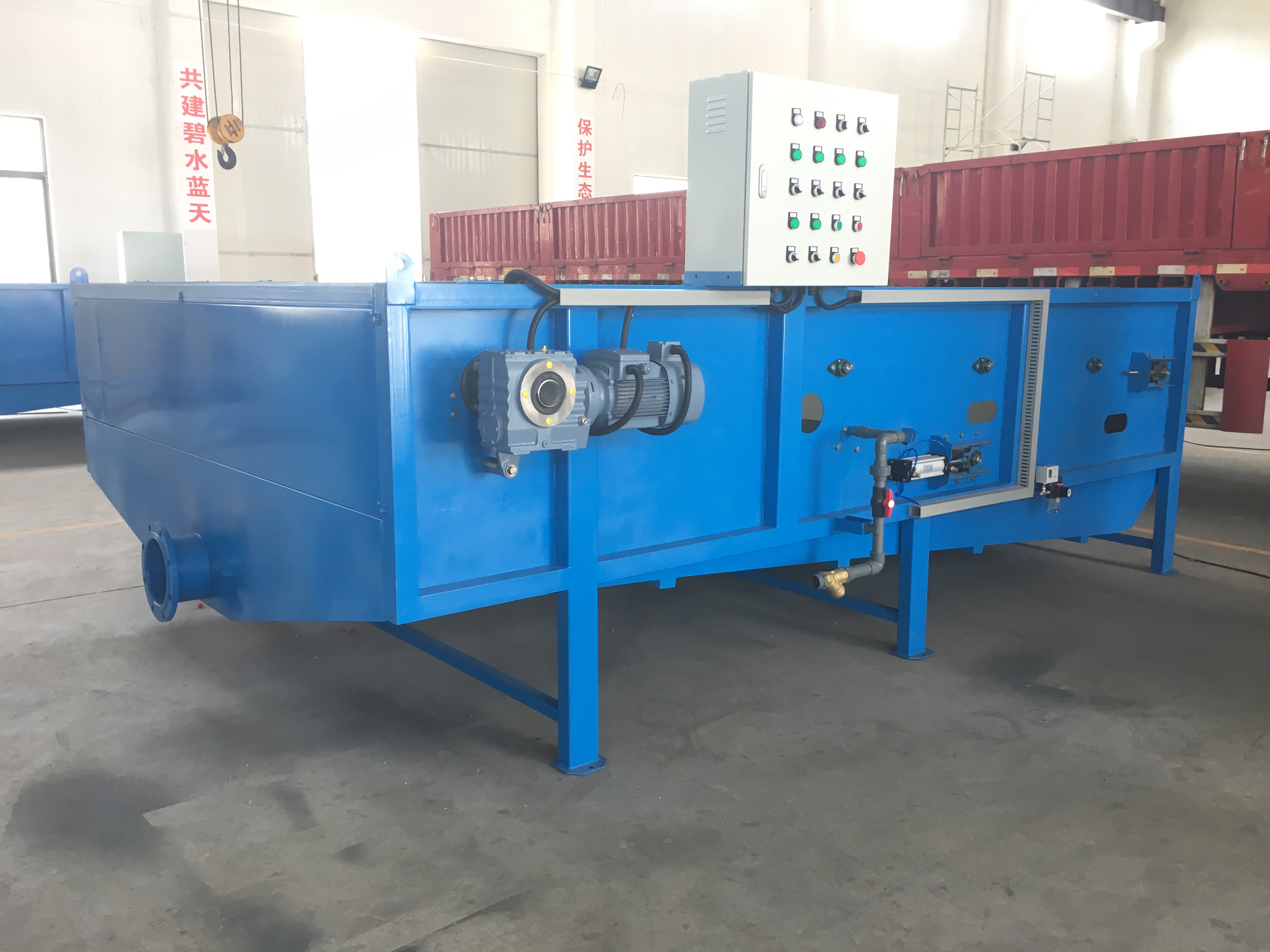
Request the catalog or discuss a sludge sample test to confirm which pick fits your feed.
Have Questions or Need More Details?
Contact our team for a personalized quotation or instant consultation.
Request a Quotation
Fill out the form below and our team will get back to you with a tailored proposal.
WhatsApp Direct Chat
Prefer to chat in real-time? Message us on WhatsApp for instant assistance & quick answers.
- Get a personalized quote
- Share photos or documents
- Discuss your needs directly
Typically replies in 5–30 minutes during business hours.