Sludge Dewatering by Scenario: Which Machine Fits Your Project?
Sludge dewatering equipment is not a one-size-fits-all purchase. The right sludge dewatering machine — screw press, belt press, thickener, or dryer — depends on the feed sludge, the flow rate, the discharge target, and the site itself. This article explains how to match sludge dewatering equipment to real project scenarios, using the product architecture of Shanghai Fuchan Machinery Technology Co., Ltd. (SFC Machinery) as a reference.
Why Project Conditions Should Drive the Equipment Choice
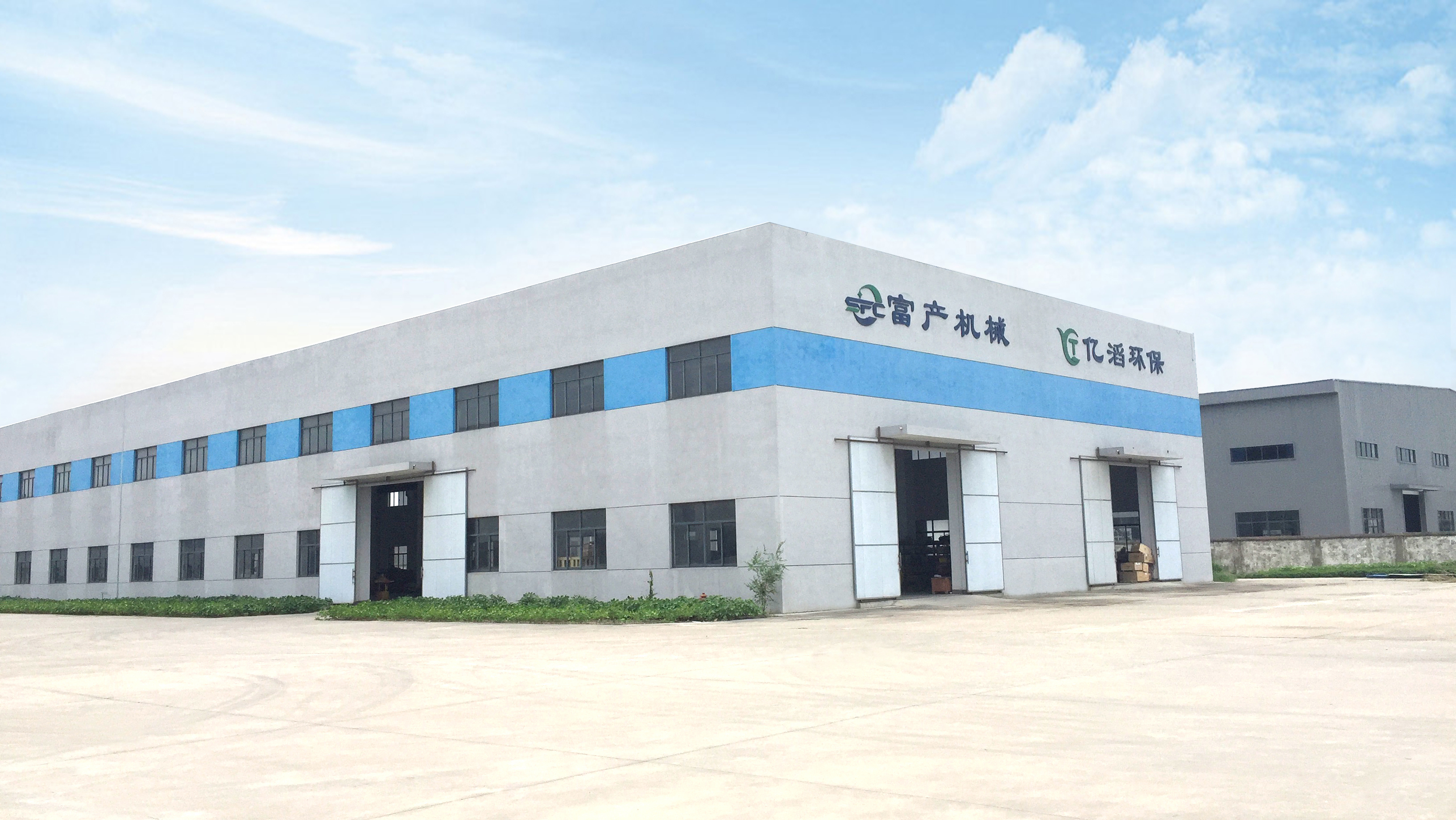
Shanghai Fuchan Machinery Technology Co., Ltd. (SFC Machinery) is an environmental equipment manufacturer based in Pudong New Area, Shanghai, that designs and builds sludge dewatering equipment, sludge thickening equipment, deep sludge dewatering equipment, sludge drying equipment, and polymer preparation systems. Established in 2007, the company operates a 25,000 m² facility and exports approximately 30% of its output to Southeast Asia, Russia, South America, and the Middle East.
The recurring cause of failed dewatering projects is a mismatch between machine type and project scenario. A screw press that dewaters municipal excess sludge reliably can struggle with high-inorganic industrial sludge. A belt system sized for 90 m³/h is over-specified for a decentralized plant. A dewatering-only package cannot meet the moisture target of a chemical plant that plans to incinerate or dry sludge downstream.
Four variables define a dewatering scenario:
- Feed solids (S.S.) — from 0.6–1.5% for typical thickening duty to 15–20% for deep dewatering.
- Sludge composition — oily, sticky, high-organic, or high-inorganic sludge requires different screw and filter designs.
- Throughput — hydraulic load (m³/h) and dry solids output (kg/h) determine the series and model size.
- Downstream route — landfill, incineration, drying, or resource recovery sets the cake moisture target.
The Cost of a Scenario Mismatch
When equipment is selected before the scenario is quantified, the typical consequences are measurable: lower cake dryness than the disposal route requires, higher polymer consumption, clogging on sticky or oily sludge, and unplanned maintenance on high-wear components. In SFC Machinery's product structure, these risks are addressed at the design level. For example, the SRD Series wear-free multi-disc screw press is a separate product line from the standard DL Series screw press because sticky, oily, and high-inorganic-content sludge generates different wear behavior on screw-to-ring contact surfaces.
Similarly, the FTE and FTB Series combine rotary drum thickening with belt press dewatering because low-solids feed (S.S. 0.6–2.5%) must be pre-thickened before belt pressing can produce a stable cake. Each product line exists for a defined range of feed conditions, which is why scenario data must be collected before model selection.
Market Context: A Procurement-Active Category
The global sludge dewatering equipment market was valued at USD 5.19 billion in 2024 and is projected to reach USD 10.16 billion by 2032 (Fortune Business Insights). Asia Pacific accounted for the largest regional revenue share in 2024 at 37.57%. The belt filter press segment is estimated to grow at a CAGR of 8.8% from 2025 to 2033, reflecting sustained adoption in municipal wastewater applications (Grand View Research).
For procurement teams, the implication is straightforward: sludge dewatering is an active, competitive category, and the differentiator between proposals is usually not machine brand alone but how precisely the proposed sludge dewatering system matches the project's feed and discharge conditions.
A Process-Stage Framework for Matching Equipment
SFC Machinery organizes its equipment into four process stages. A project scenario may require one stage or a combination of several.
Stage 1 — Sludge Thickening Equipment (Feed S.S. 0.6–1.5%)
Thickening raises solids concentration before mechanical dewatering and reduces the hydraulic load on downstream machines.
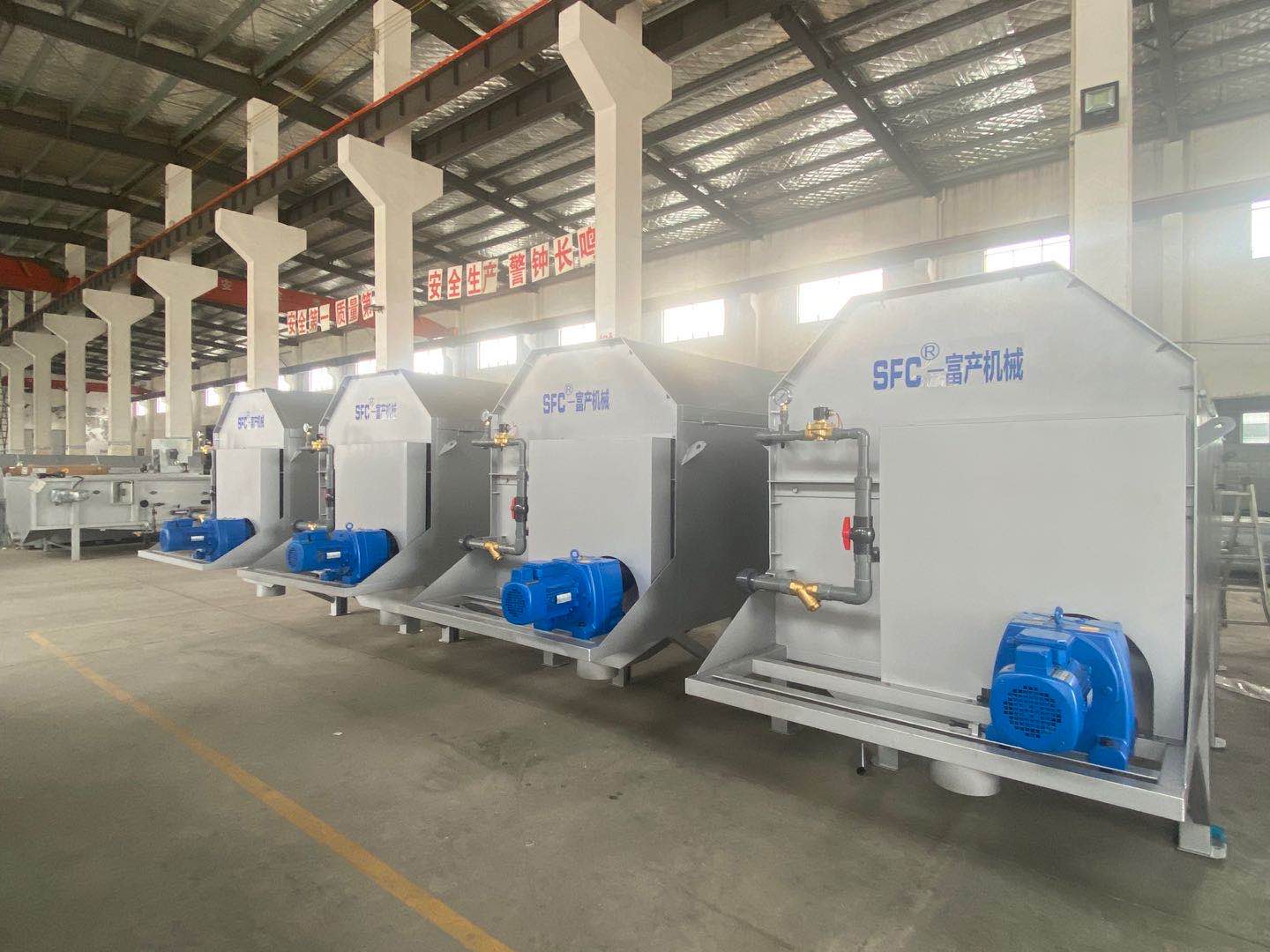
- FRDT Series rotary drum thickener — filter opening 30–80 mesh; treating capacity 7.5–100 m³/h; dried sludge 45–1140 kg/h; sludge outlet consistency 2.5–8%; solid capture rate 95%; enclosed drum design suited to limited installation space.
- FBT Series belt thickener — belt width 1000–3000 mm; treating capacity 12–95 m³/h; dried sludge 72–900 kg/h; sludge outlet consistency 2.5–8%; solid capture rate 98%; adjustable belt speed 3–18 m/min.
Stage 2 — Primary Sludge Dewatering
Primary dewatering produces a transportable cake and is the core of most sludge dewatering system designs.
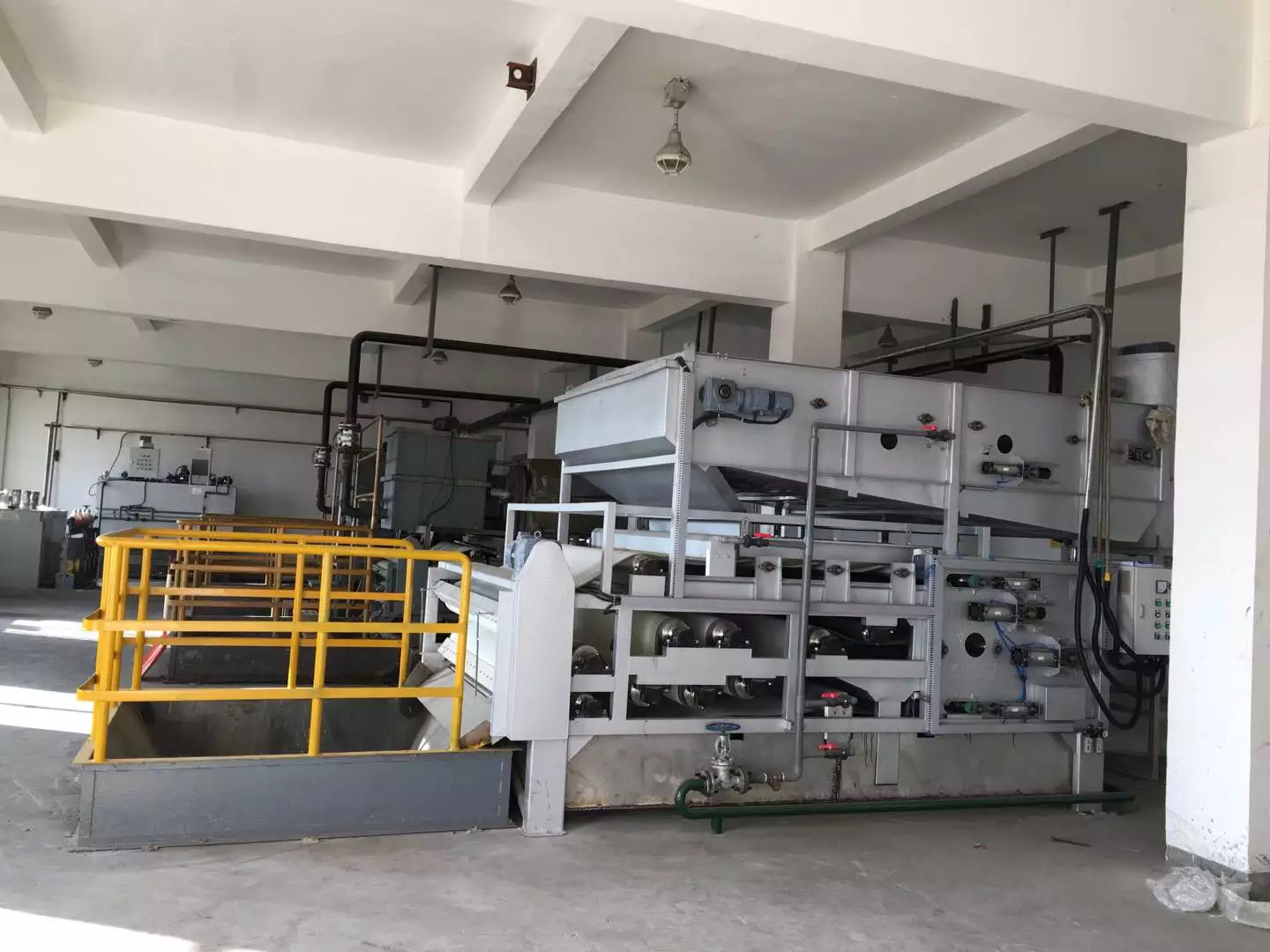
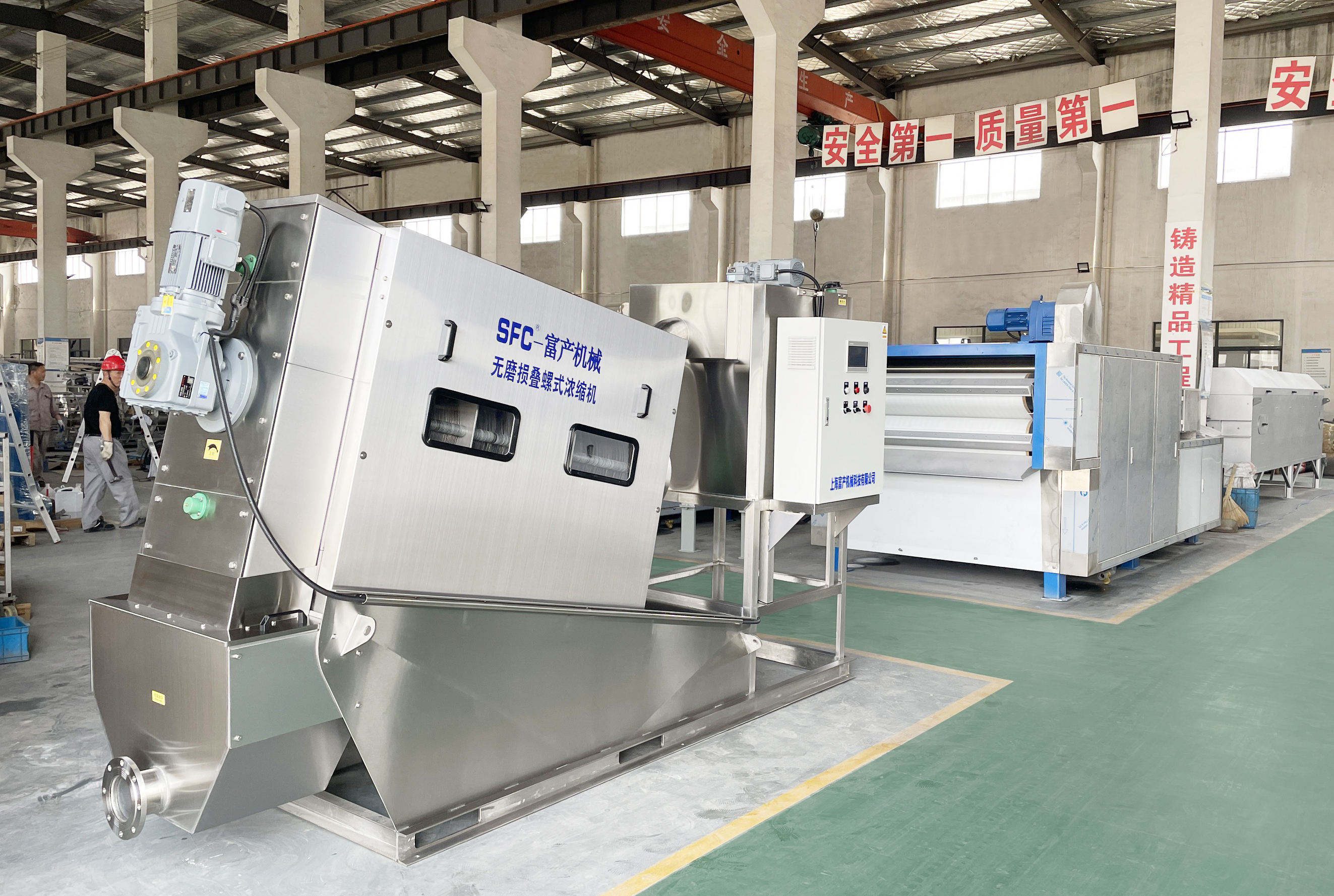
- DL Series multi-disc screw press (screw press dewatering) — inlet S.S. 0.6–5.0%; dried sludge 1.5–900 kg/h; cake water content 75–85%; structure of fixed rings, moving rings, screw shaft, and volute filter; suited to municipal, industrial, paper mill, printing and dyeing, oily, and decentralized sludge.
- SRD Series wear-free multi-disc screw press — inlet S.S. 0.6–5.0%; dried sludge 25–900 kg/h; cake water content 75–85%; designed for low-concentration, sticky, oily, and high-inorganic-content sludge with reduced screw-to-ring wear.
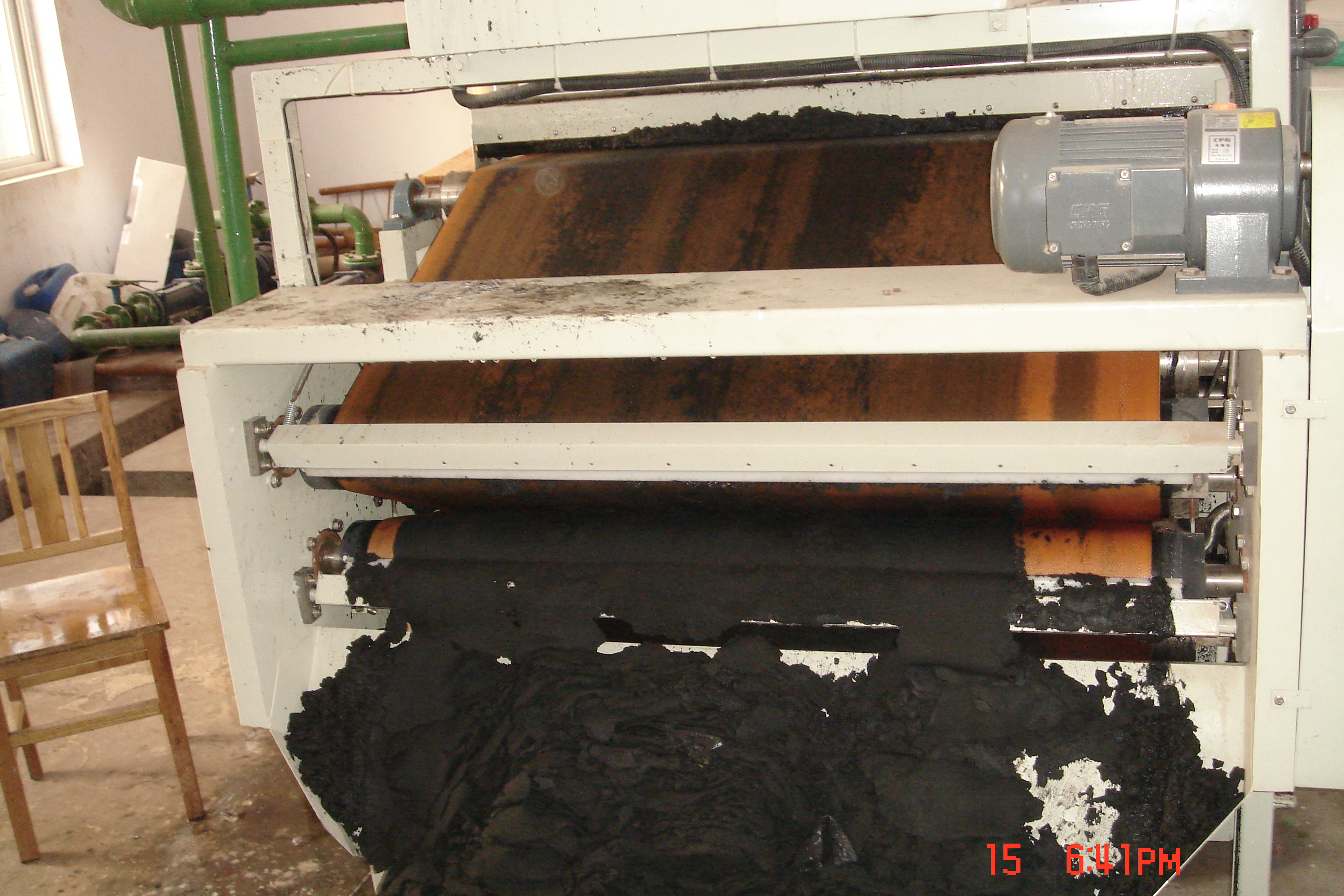
- GDY Series belt thickening and dewatering machine — belt width 1000–3000 mm; inlet S.S. 0.6–1.5%; treating capacity 15–90 m³/h; dried sludge 90–1050 kg/h; cake water content 75–80%; for high-flow continuous dewatering.
- FTB Series rotary drum sludge dewatering machine — belt width 500–2000 mm; inlet S.S. 1.5–2.5%; treating capacity 3.0–30 m³/h; dried sludge 45–450 kg/h; cake water content 75–85%; for small and medium projects.
- FTE Series rotary drum type sludge thickening and dewatering machine — belt width 1000–3000 mm; inlet S.S. 0.6–1.5%; treating capacity 12–90 m³/h; dried sludge 90–975 kg/h; cake water content 75–85%; for medium and large continuous projects.
Stage 3 — Deep Sludge Dewatering (Feed S.S. 15–20%)
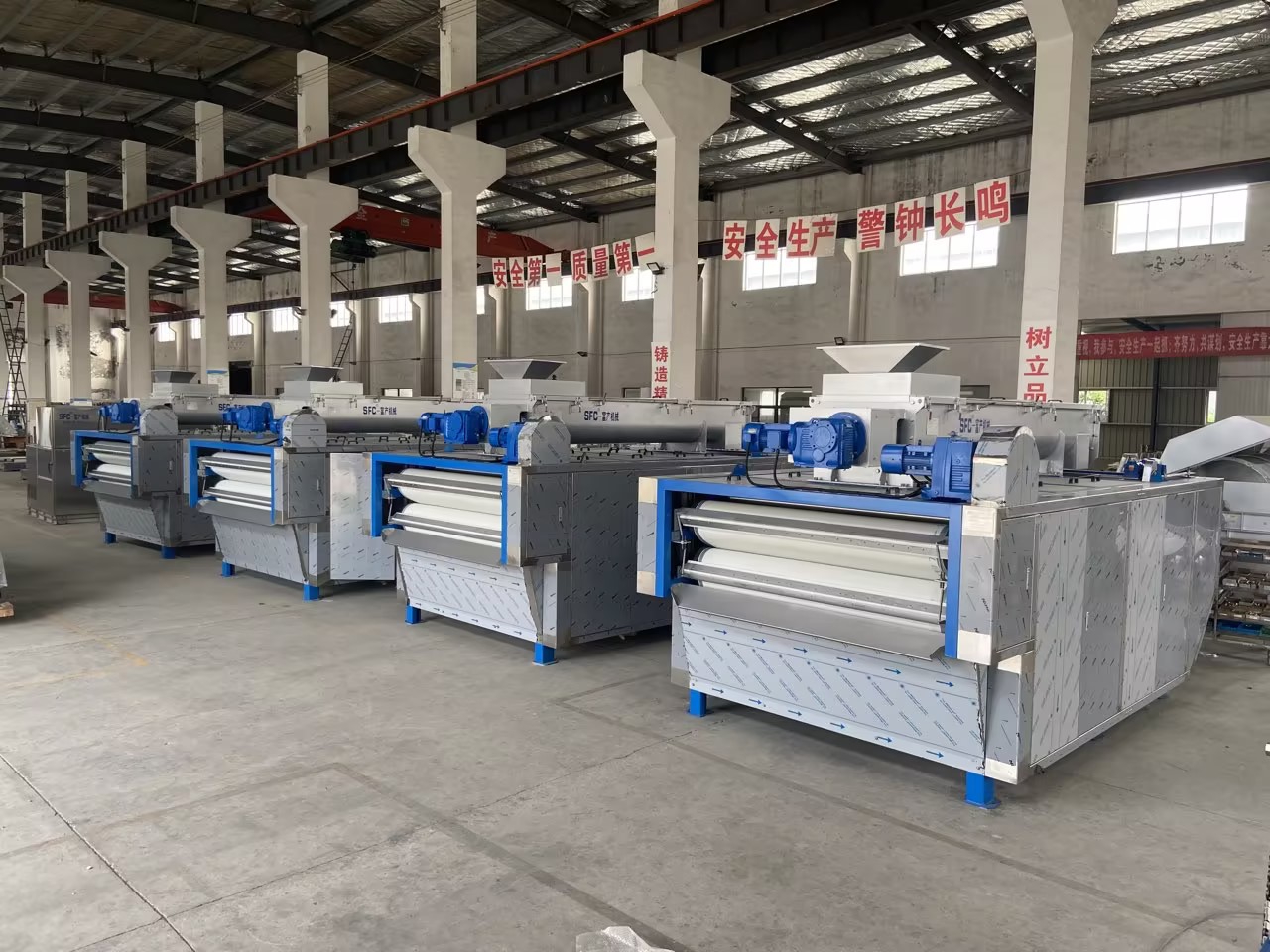
The SD Series high-pressure belt deep sludge dewatering machine is used to further reduce sludge moisture after primary dewatering. The SD Series is applied in municipal wastewater treatment plants, chemical plants, and as pretreatment for sludge drying or incineration. In chemical plant applications, the SD Series functions to reduce sludge moisture. Inlet consistency is S.S. 15–20%; treating capacity is 0.3–5.0 t/h for sludge at 65–75% water content (producing 60–760 kg/h of dried sludge) and 0.35–6.1 t/h for sludge at 60–70% water content (producing 70–920 kg/h). Conditioning chemicals and project-specific sludge testing are required before final sizing.
Stage 4 — Sludge Drying Equipment
When the project requires volume reduction beyond mechanical dewatering, drying is the final stage.
- SFC-BSD Series belt sludge dryer — inlet consistency S.S. 15–25% or 25–35%; treating capacity 0.8–57 t/h (at 15–25% S.S.) and 1–90 t/h (at 25–35% S.S.); final water content 10–50%; system power consumption 23–506 kW; fully enclosed, modular design; SS304 construction.
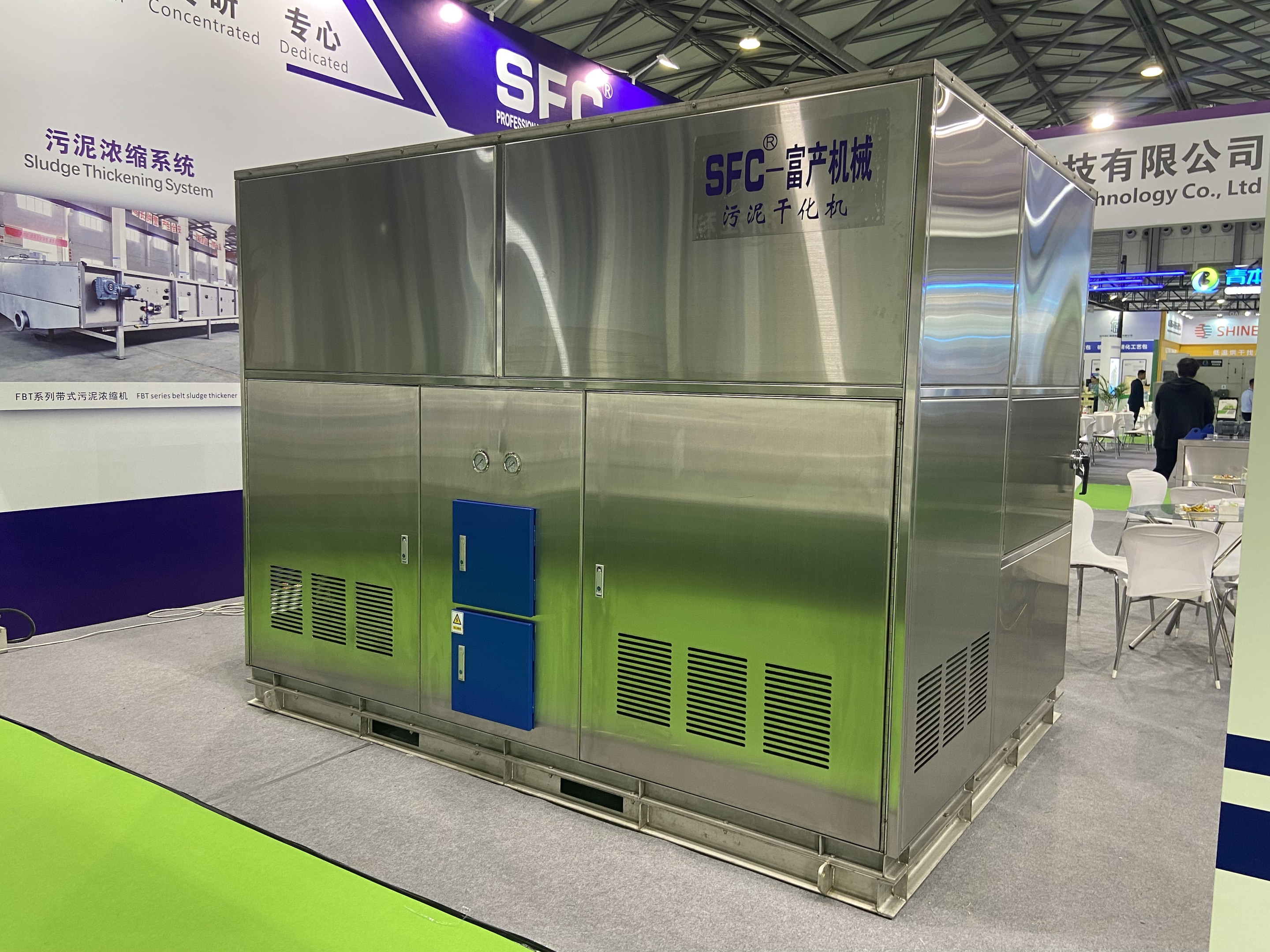
- SFC-TR Series low-temperature sludge dryer — batch capacity 1000–9000 L; water extraction 21–360 kg/h; required power 15–145 kW; unit power consumption 0.4–0.55 kWh/kg water; sludge volume reduction up to 70%.
Step-by-Step: How to Match Equipment to a Project Scenario
- Characterize the feed sludge. Measure inlet S.S., oil and stickiness level, organic versus inorganic content, and corrosion or explosion risk. If the sludge is sticky, oily, or high-inorganic, evaluate the SRD Series. If the feed is below roughly S.S. 1.5%, plan a thickening stage.
- Define throughput in two units. Hydraulic load in m³/h for thickeners and belt systems; dry solids output in kg/h for screw presses. Example ranges: FRDT 7.5–100 m³/h; FTE 12–90 m³/h; DL 1.5–900 kg/h; SRD 25–900 kg/h.
- Set the discharge target. Cake water content of 75–85% is typical for screw presses; 75–80% for integrated belt systems; 10–50% final water content for belt dryers; up to 70% volume reduction for batch low-temperature dryers.
- Match the process stages. Combine thickening, dewatering, deep dewatering, and drying according to the downstream route. A chemical plant with incineration may need SD deep dewatering before drying; a high-flow municipal plant typically uses FRDT or FBT thickening followed by a belt-type dewatering system.
- Confirm site and control constraints. Footprint, PLC automation level, power configuration (voltage and frequency), fully enclosed operation for odor control, and explosion-proof or corrosion-resistant design for petrochemical, distillery, and electroplating projects. SFC supports OEM/ODM customization of capacity, dimensions, control systems, power configuration, modular design, and auxiliary equipment integration.
Industry Use Cases: Equipment Applied by Scenario
Municipal wastewater treatment
A municipal wastewater treatment plant deployed 8 FRDT rotary drum thickeners to pre-concentrate raw sludge before plate-and-frame filter press dewatering. The units concentrate sludge from 99.4% to 97% moisture content (3% solids), which improves downstream filter press performance.
City sewage treatment plant
Two GDY integrated thickening and dewatering machines process excess sludge at 99.2% moisture content down to 80% moisture content. Operation is continuous and unattended, requiring only scheduled walk-throughs.
Palm oil industry
A DL-301 screw press sludge dewatering machine is used for palm oil mill effluent (POME) sludge. The plant operates in unattended continuous mode and requires corrosion-resistant, energy-efficient, odor-free design.
Pharmaceutical industry
A DL-201 screw press dewaterer treats high-organic, chemically complex sludge from pharmaceutical wastewater. In a 10-year operating case, moisture content was reduced from 99% to below 85%, cutting sludge volume by up to 93%.
Oil refining and petrochemical
An FTE3-2000 belt sludge dewatering machine treats refractory sludge from petrochemical coking wastewater. The package features explosion-proof design and corrosion-resistant materials for automatic continuous operation, integrated with sludge transfer pumps, dosing pumps, a screw conveyor, a PAM preparation and dosing system, and PLC control.
Alcoholic beverage industry
An FTB-2000 drum thickening belt filter press handles high-organic distillery and brewery sludge with typical moisture of 95–99.8%. The enclosed, corrosion-resistant package minimizes odor emissions and converts sludge into a dry, stable material suitable for co-incineration or land application.
Automotive parts manufacturing (electroplating)
An FTB-500 rotary drum concentrator belt press dewaters electroplating heavy-metal sludge in a corrosive wastewater environment, reducing sludge volume and disposal cost.
Vegetable oil processing
A DL Series screw press in a vegetable oil plant reduces sludge moisture from 97% to 77%, cutting sludge volume by up to 98% over 8 years of operation.
Advanced manufacturing
A BSD-2000 belt dryer receives sludge discharged by a screw press at 85% moisture content and reduces it to below 30%, minimizing disposal volume. The system has operated for 6 years with low downtime and reduced maintenance expense.
Specialty chemicals plant
An FTB-1500L rotary drum belt dewatering machine reduces chemical wastewater sludge from 99% to below 80% moisture content over a 5-year operating period.
Technology Comparison at a Glance
| Equipment | Series | Feed S.S. | Treating capacity | Cake / final moisture | Typical scenario |
|---|---|---|---|---|---|
| Multi-disc screw press | DL | 0.6–5.0% | 1.5–900 kg/h | 75–85% | Municipal, oily, decentralized sludge |
| Wear-free screw press | SRD | 0.6–5.0% | 25–900 kg/h | 75–85% | Sticky, oily, high-inorganic sludge |
| Belt thickening + dewatering | GDY | 0.6–1.5% | 15–90 m³/h (90–1050 kg/h) | 75–80% | High-flow continuous municipal/industrial |
| Rotary drum + belt press | FTB | 1.5–2.5% | 3.0–30 m³/h (45–450 kg/h) | 75–85% | Small/medium projects, food and chemical industries |
| Rotary drum thickening + belt press | FTE | 0.6–1.5% | 12–90 m³/h (90–975 kg/h) | 75–85% | Medium/large continuous dewatering |
| High-pressure belt deep dewatering | SD | 15–20% | 0.3–6.1 t/h (60–920 kg/h) | Rated for feed at 65–75% or 60–70% water content | Chemical plants; drying or incineration pretreatment |
| Belt sludge dryer | BSD | 15–25% or 25–35% | 0.8–90 t/h | 10–50% | Sludge drying, disposal cost reduction |
| Batch low-temperature dryer | TR | Dewatered sludge | 21–360 kg/h water extraction | Volume reduction up to 70% | Batch drying with heat pump |
Frequently Asked Questions
What standard is used to verify the water content of sludge treatment output?
ISO 11465:2025 is the international standard for the determination of dry residue and water content in sludge and solid environmental matrices. When evaluating sludge dewatering equipment, buyers should confirm the final water content value and the measurement method used, since each machine type operates in a different range: screw presses at 75–85% cake water content, integrated belt systems at 75–80%, and belt dryers at a final 10–50%.
Which sludge dewatering machine fits chemical plant applications?
In chemical plant applications, the SFC-SD Series high-pressure belt deep sludge dewatering machine is used to reduce sludge moisture after primary dewatering. Inlet consistency is S.S. 15–20%, with treating capacity of 0.3–5.0 t/h for sludge at 65–75% water content and 0.35–6.1 t/h for sludge at 60–70% water content. Conditioning chemicals and project-specific sludge testing are required, and the SD Series is also used as pretreatment for sludge drying and incineration.
How do I choose between a screw press, a belt press, and a filter press?
The choice depends on feed concentration, throughput, and discharge target. Screw presses (DL and SRD Series) accept S.S. 0.6–5.0% and are suited to low-concentration, oily, sticky, and decentralized sludge. Belt-type systems (GDY, FTB, and FTE Series) handle hydraulic loads up to 90 m³/h and are suited to continuous municipal and industrial projects. Plate-and-frame filter presses are commonly paired with a thickening stage; in one municipal project, FRDT rotary drum thickeners pre-concentrated sludge to 3% solids specifically to improve downstream plate-and-frame press dewatering. Screw presses generally require less wash water than belt presses, while belt systems require stable flocculation and regular belt washing.
Can sludge dewatering equipment be customized, and what is the lead time?
SFC Machinery supports OEM/ODM production with customization of equipment type and model, treating capacity, equipment dimensions and footprint, control system (PLC automation level), power configuration (voltage, frequency, motor specifications), modular design options, and auxiliary equipment integration. Monthly production capacity is 40 units, the standard lead time is 30–60 days, the MOQ is 1 unit, and each machine receives 100% testing before delivery. After-sales support includes remote technical support, on-site commissioning guidance, spare parts supply, warranty service, and operator training.
Can I test my sludge before purchasing equipment?
Yes. For accurate sizing, SFC recommends confirming the sludge type and running a polymer jar test before final equipment selection. Conditioning chemicals and project-specific sludge testing are also required for deep dewatering applications. To arrange a sludge test, request a quotation, or discuss your project scenario with an engineer, contact the SFC Machinery sales team at sales@fuchanjx.com or WhatsApp +86 138-1673-2007. The 2026 product catalog is available for download at Product Catalog-SFC-2026.pdf.
Conclusion
Scenario data — feed solids, sludge composition, throughput, and discharge route — should drive every sludge dewatering equipment decision. SFC Machinery covers the full process chain with purpose-built series: FRDT and FBT for thickening; DL, SRD, GDY, FTB, and FTE for primary dewatering; SD for deep dewatering; and BSD and TR for drying. Matching the machine to the scenario is the most reliable way to achieve the target cake moisture, control operating cost, and avoid the maintenance problems that come from using the wrong technology.
Shanghai Fuchan Machinery Technology Co., Ltd. (SFC Machinery)
Website: www.sfceco.com | Email: sales@fuchanjx.com | Tel / WhatsApp: +86 138-1673-2007
Address: Room 1201, 1122 Xinjinqiao Rd, Pudong New District, Shanghai, PRC China
Download the SFC 2026 Product Catalog (PDF)