Sticky or Oily Sludge Clogging Your Dewatering Line? Inside the Wear-Free Screw Press Solution
Sludge that is sticky, oily, low in concentration or high in inorganic content does not behave like the feed a conventional dewatering line was sized for. It blinds belts, jams traditional presses, and turns a continuous process into a stop-start one. Shanghai Fuchan Machinery Technology Co., Ltd. (SFC Machinery), an environmental equipment manufacturer established in 2007 in Pudong New Area, Shanghai, applies the SRD series wear-free screw press sludge dewatering machine — Product 5166 — directly to those four feed conditions instead of treating them as exceptions.
The Problem: When Sludge Turns Sticky, Oily, or Too Thin
A dewatering line fails in a predictable place. Not at the motor, and usually not at the control cabinet. It fails where the sludge has to give up water, and it fails hardest when the sludge is viscous, contains oil, arrives at very low solids concentration, or carries a high inorganic fraction.
SFC Machinery states those four conditions explicitly in the SRD series specification. The listed suitable sludge types for Product 5166 are low-concentration, sticky, oily and high-inorganic-content sludge. That is a specification statement, not a marketing claim, and it is the first thing to check against your own feed analysis.
Two measurable signals explain where the mismatch usually sits.
Signal one: inlet consistency
SFC's screw-press family — the SRD series and the DL series — is specified at an inlet consistency of S.S. 0.6–5.0%. The belt-based machines in the same portfolio are specified on a narrower band: the GDY series belt sludge thickening and dewatering machine at S.S. 0.6–1.5%, the FTE series rotary drum type thickening and dewatering machine at S.S. 0.6–1.5%, and the FTB series rotary drum sludge dewatering machine at S.S. 1.5–2.5%.
That single line of specifications already narrows the field. If the feed holds between 0.6% and 1.5% solids, a belt route remains technically inside its window. If the feed sits between 1.5% and 5.0% solids, only the screw-press window still contains it.
Signal two: listed sludge type
The belt machines list municipal wastewater treatment, industrial wastewater treatment, paper mills, printing and dyeing, and — for the GDY series — high-flow continuous sludge dewatering projects. Oily sludge does not appear on that list. It does appear on the SRD series list, and it also appears on the DL series list, alongside decentralized sludge treatment projects.
This is where operational pain becomes a procurement decision. A belt press running outside its specified inlet band, or on a feed type its manufacturer did not list, is a machine being asked to do something its datasheet does not promise. The consequence is usually the same on site: reduced throughput, wetter cake, and more operator intervention.
Industry Background: Why These Feed Conditions Are Getting More Common
The commercial context makes the problem larger, not smaller. Global Market Insights estimated the global sludge dewatering equipment market at USD 5.8 billion in 2025 and USD 6.4 billion in 2026, with a projected rise to USD 14 billion by 2035. Fortune Business Insights reported that Asia Pacific held a 37.57% share of the dewatering equipment market in 2024 — the region where much of the new industrial capacity, and therefore much of the new oily and high-inorganic sludge, is being generated.
Performance expectations have moved at the same time. A peer-reviewed review of sludge dewatering and drying inventory data reported typical mechanically dewatered sludge solids of approximately 25–30% TS, and approximately 35–40% TS where deep dewatering is applied. A separate definitional reference places dewatered sludge cake in a 15–45% dry solids band. Those are literature benchmarks, not guarantees for any single machine, but they set the acceptance range buyers now write into specifications.
Equipment classification has also settled. HUBER Technology classifies belt filter presses and screw presses together as continuous sludge-dewatering systems — meaning the choice between them is not batch versus continuous, but which continuous design matches the feed.
Industrial discharge intensity adds pressure. A SIWI water-governance mapping report on the textile industry in China noted that the large volume of water discharge also generates challenging issues in terms of sludge treatment. Textile, food processing, vegetable oil refining, pharmaceutical and specialty chemical plants all produce sludge streams that sit closer to the sticky, oily end of the spectrum than to clean municipal surplus sludge.
The Solution: What the Wear-Free Screw Press Changes
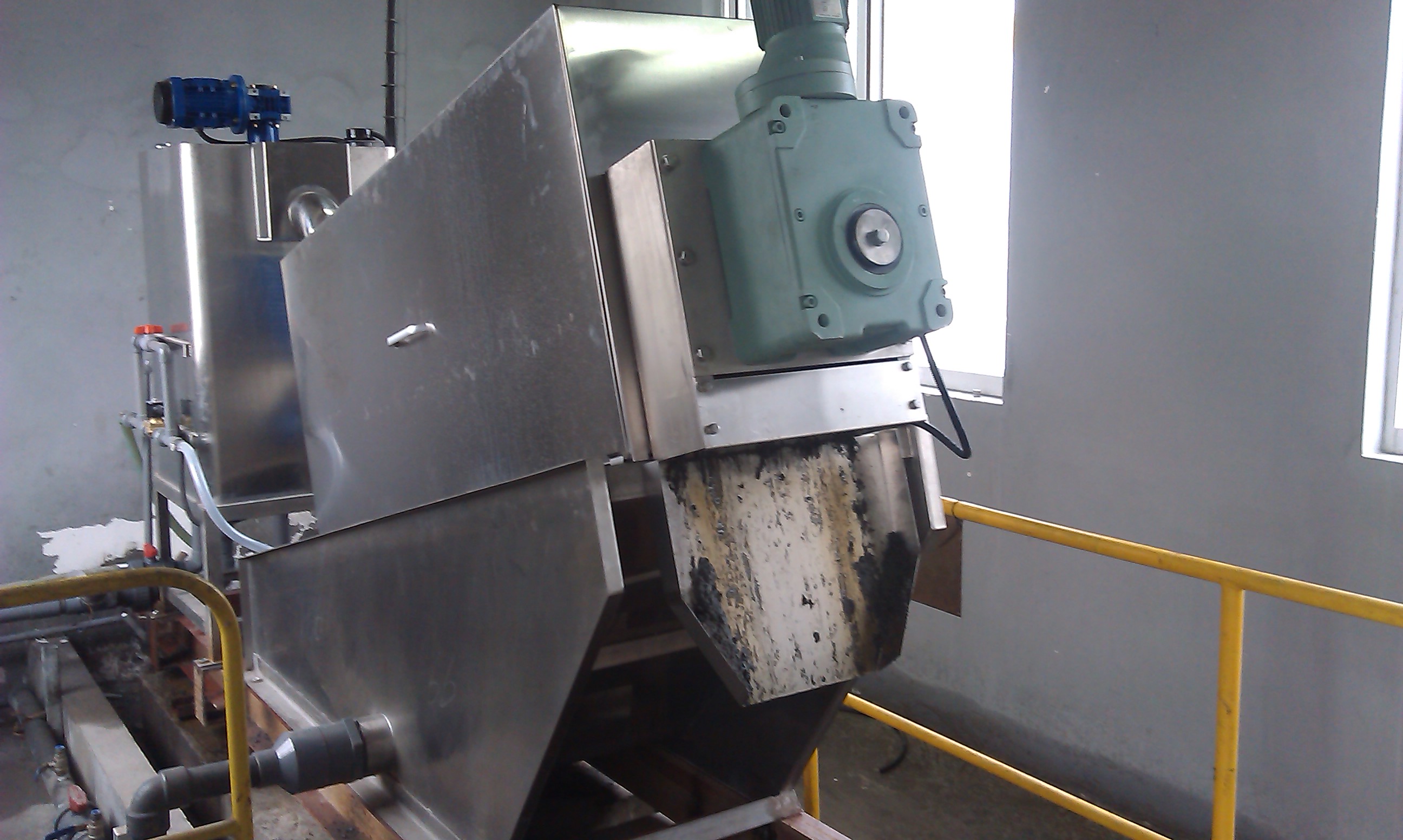
Product 5166 is the SRD series wear-free screw press sludge dewatering machine, classified by SFC as a wear-free multi-disc screw press and a wear-free spiral sludge dewatering machine. The series runs from SRD-301 through SRD-304, SRD-351 through SRD-354, and SRD-401 through SRD-404 — twelve models in total.
The verified specification for the series reads as follows:
- Inlet consistency: S.S. 0.6–5.0%
- Dried sludge capacity: 25–900 kg/h
- Water content rate: 75–85%
- Screw specification: Ø270×1 to Ø370×4
- Driving motor power consumption: 0.55–1.1 kW, with multi-motor configurations by model
- Material: SS304
- Suitable sludge types: low-concentration, sticky, oily and high-inorganic-content sludge
- Applicable industries: municipal wastewater treatment, industrial wastewater treatment, oily sludge treatment, food processing wastewater, high-inorganic sludge treatment, decentralized sludge treatment projects
SRD-301 is the entry model in the range and the clearest single illustration of how the series is positioned: SS304 construction, the 0.6–5.0% inlet consistency window, and a suitable-sludge list that names sticky and oily feed directly. Because the series carries the same inlet and outlet specifications across all twelve models, model selection becomes a capacity decision rather than a technology decision — the dried sludge requirement moves from 25 kg/h at the low end to 900 kg/h at the high end.
Continuous automatic duty
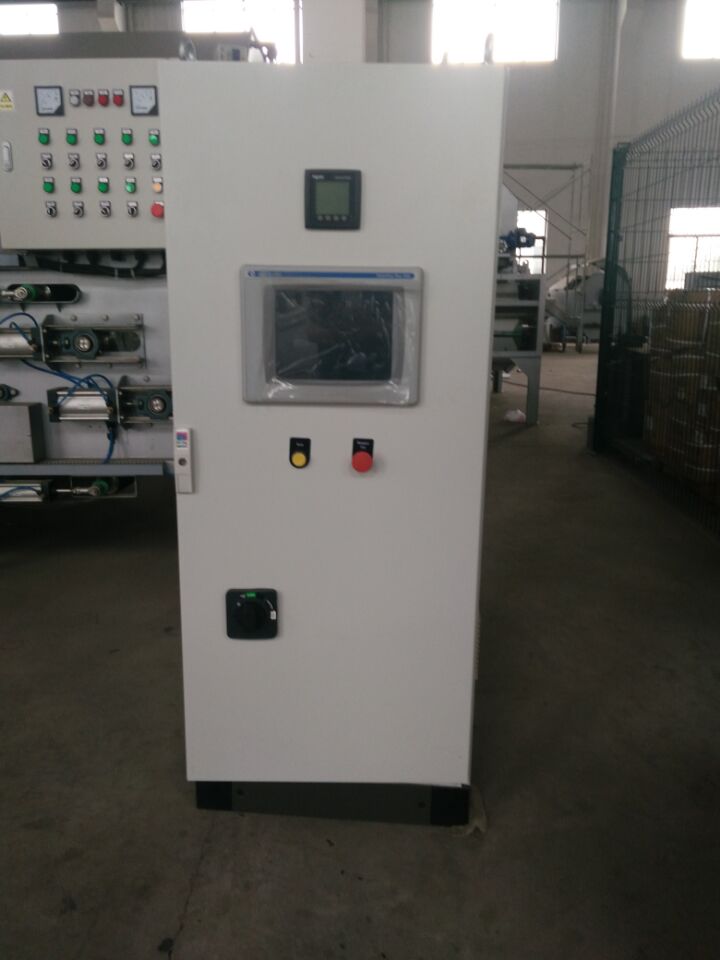
SFC's OEM/ODM scope covers control system configuration at the PLC automation level, plus power configuration covering voltage, frequency and motor specifications. For project work built around a wear-free screw press sludge dewatering system running in continuous automatic mode, that means the automation level and the electrical interface are set during selection rather than retrofitted after commissioning.
The DL series as the alternative screw-type route
The DL series multi-disc screw press — Product 5160 — is the other screw-type option in the SFC portfolio, and it is also SS304. It shares the 0.6–5.0% inlet consistency window and the 75–85% water content rate with the SRD series, but differs in configuration: dried sludge of 1.5–900 kg/h, screw specification Ø85×1 to Ø400×4, screw motor power of 0.18–1.5 kW with multi-motor configurations by model, conditioning motor power of 0.18–1.1 kW, and a structure built from fixed rings, moving rings, a screw shaft and a volute filter.
The field record behind the DL series is long. A vegetable oil processing plant in China has run a DL screw press for eight years, reducing sludge moisture content from 97% to 77% and cutting sludge volume by up to 98%. A pharmaceutical wastewater plant has run a DL machine for ten years, reducing moisture content from 99% to under 85% and slashing volume by up to 93%. Both plants report fully automated operation with low maintenance requirements. Those results belong to the DL series, not to the SRD series — but they establish that the screw-press principle is not an untested route for oily and viscous feed.
Step-by-Step: Matching a Screw Press to Sticky or Oily Sludge
The selection sequence below uses only the published specifications and stated capabilities. It is written for an evaluation-stage buyer who already has a feed analysis in hand.
Step 1 — Confirm the inlet consistency against the equipment window
SRD and DL both accept S.S. 0.6–5.0%. GDY and FTE accept S.S. 0.6–1.5%; FTB accepts S.S. 1.5–2.5%. If the feed analysis lands above 1.5%, the belt-based group is outside its stated range and the screw-press group is not.
Step 2 — Classify the sludge
Sticky, oily, low-concentration and high-inorganic-content are the four types the SRD series lists. Oily sludge is also on the DL series list. Oily sludge is not listed for the belt-based machines. This step is a reading of the datasheet, not a judgement call.
Step 3 — Size for dried sludge
The SRD range covers 25–900 kg/h of dried sludge. The DL range covers 1.5–900 kg/h. The two are close at the top of the range and diverge at the bottom: the DL series reaches lower absolute capacities, which matters on decentralized or small industrial streams.
Step 4 — Fix the cake moisture target
Both screw-press series are specified at a 75–85% water content rate. The GDY belt machine is specified at 75–80%. If the target sits in the 80–85% band, only the screw-press series lists it.
Step 5 — Match screw and motor configuration
SRD uses Ø270×1 to Ø370×4 screws with 0.55–1.1 kW driving motors. DL uses Ø85×1 to Ø400×4 screws with 0.18–1.5 kW screw motors plus a 0.18–1.1 kW conditioning motor. Both use multi-motor configurations by model, so the final figure is model-specific.
Step 6 — Lock the material and the electrical interface
SS304 is the stated material for the SRD and DL series. Voltage, frequency and motor specifications are part of SFC's OEM/ODM customization, alongside equipment type and model selection based on sludge characteristics and treatment capacity requirements.
Step 7 — Check the commercial terms
SFC quotes a minimum order quantity of 1 unit, a lead time of 30–60 days, a monthly capacity of 40 units, and 100% testing before shipment. Dimensional and footprint customization is available where site constraints require it, and modular design options exist for dryers and other systems where later capacity expansion is anticipated.
Step 8 — Confirm the support envelope
After-sales scope covers remote technical support by phone, email or video conferencing; on-site commissioning and installation guidance on request; spare parts supply with rapid response; warranty service provided per equipment type; operation and maintenance training for client personnel; and long-term technical consultation.
Use Cases: Where These Configurations Actually Run
The case record below is drawn from SFC installations. Note the distinction: these are screw-press and belt-machine references, and the two vegetable oil and pharmaceutical references are DL series, not SRD series. They demonstrate the operating envelope rather than serving as SRD-specific test results.
Vegetable oil processing — oily sludge, eight years
A vegetable oil processing client in China dewaters sludge from soybean, palm and canola oil processing on a DL screw press. Over eight years of operation the machine has reduced sludge moisture content from 97% to 77% and cut sludge volume by up to 98%. The plant reports fully automated operation with low maintenance requirements.
Pharmaceutical wastewater — viscous biological sludge, ten years
A pharmaceutical industry wastewater client in China dewaters sludge from the biological aeration process on a DL machine. Over ten years it has reduced moisture content from 99% to under 85%, cutting volume by up to 93%, with minimal maintenance costs and low repair expenses.
Food processing wastewater — Malaysia, cost reduction
A food processing wastewater client in Malaysia runs an FTB-1000 belt-type rotary drum sludge thickener-dewatering machine, reducing moisture content from 98.5% to below 80%. The plant reports stable dewatering results, easy upkeep and a 30% reduction in sludge handling costs.
Specialty chemicals — discharge-ready cake
A specialty chemicals plant in China runs an FTB-1500L machine for press dewatering of chemical wastewater sludge, reducing water content from 99% to below 80% over five years and producing a discharge-ready sludge cake with minimal downtime.
Municipal wastewater — continuous unattended duty
A city sewage treatment plant in China operates two GDY integrated thickener-dewaterer machines on excess sludge, reducing moisture content from 99.2% to below 80% across five years of continuous operation, with consistent cake dryness and minimal maintenance.
Where a plant needs to go beyond mechanical dewatering, SFC's downstream references show the same pattern of reduction. An automotive parts manufacturer reduced sludge from 75% to below 25% moisture over five years using SFC-TR series low-temperature drying, removing over 700 kg of water per metric ton and achieving volume reduction exceeding 70%. An advanced manufacturing client used a BSD-2000 belt dryer for six years to bring sludge from 85% moisture to below 30%.
Comparison: SRD, DL, GDY and FTB Side by Side
The table below uses only published specifications from the four product datasheets. The final column reflects each product's own stated suitable sludge types and industries — it is not an independent performance ranking.
| Series (Product ID) | Type | Inlet consistency | Dried sludge | Water content rate | Drive power | Material | Listed sludge / industry focus |
|---|---|---|---|---|---|---|---|
| SRD (5166) SRD-301 to SRD-404 |
Wear-free multi-disc screw press | S.S. 0.6–5.0% | 25–900 kg/h | 75–85% | 0.55–1.1 kW driving motor | SS304 | Low-concentration, sticky, oily, high-inorganic-content sludge; oily sludge treatment, food processing wastewater |
| DL (5160) DL-101 to DL-404 |
Multi-disc screw press | S.S. 0.6–5.0% | 1.5–900 kg/h | 75–85% | 0.18–1.5 kW screw motor; 0.18–1.1 kW conditioning motor | SS304 | Oily sludge and decentralized sludge treatment; municipal, industrial, paper, printing and dyeing |
| GDY (5174) GDY-1000 to GDY-3000 |
Belt thickening and dewatering integrated machine | S.S. 0.6–1.5% | 90–1050 kg/h | 75–80% | 1.1–4.0 kW driving motor | SS304 | High-flow continuous sludge dewatering; municipal, industrial, paper, printing and dyeing |
| FTB (5175) FTB-500 to FTB-2000 |
Rotary drum thickening + belt press | S.S. 1.5–2.5% | 45–450 kg/h | 75–85% | 0.37–1.1 kW driving motor | SS304 | Small and medium sludge dewatering projects; municipal, industrial, paper, printing and dyeing |
Two things stand out from the specification columns. First, the SRD and DL series carry a significantly wider inlet consistency window than the belt-based machines — 0.6–5.0% against 0.6–1.5% and 1.5–2.5%. Second, oily sludge appears on the SRD and DL lists and on neither belt list. For a feed that is both oily and above 2.5% solids, the belt column does not offer a matching entry.
Selection Checklist for Sticky or Oily Dewatering Duty
- Is the inlet consistency recorded within S.S. 0.6–5.0%? If yes, the SRD and DL series remain inside their stated window.
- Does the feed fall into one of the four listed categories — low-concentration, sticky, oily or high-inorganic-content? The SRD series names all four.
- Does the required dried sludge throughput sit between 25 kg/h and 900 kg/h? The SRD range covers that span.
- Is the target cake moisture between 75% and 85%? Both screw-press series are specified in that band.
- Are wetted parts required in SS304? SRD, DL, GDY and FTB all specify SS304.
- Does the project need a defined PLC automation level, voltage, frequency and motor specification agreed before order? These sit inside SFC's OEM/ODM scope.
- Can the project accept a 30–60 day lead time at an MOQ of 1 unit?
- Has the site footprint been checked against dimensional customization requirements?
If the first four items all return a yes, the SRD series belongs on the shortlist as the screw-press route for that duty. If the consistency lands below 1.5% and the sludge carries no oil, a belt-based GDY or FTB machine remains a specification-compliant option and should be evaluated on the same terms.
Frequently Asked Questions
What certifications does the SRD series wear-free screw press carry for EU market access?
SFC holds a CE Attestation of Conformity issued by UDEM under certificate number M.2025.206.C130494, covering sludge treatment equipment and valid from 1 December 2025 to 30 November 2030. The attestation references the Machinery Directive 2006/42/EC and the EMC Directive 2014/30/EU, with harmonised standards including EN ISO 12100:2010, EN 60204-1:2018+A1:2025, EN IEC 61000-6-2:2019, EN IEC 61000-6-4:2019, EN IEC 61000-3-2:2019+A2:2024 and EN 61000-3-3:2013+A2:2021. Management system certification is held separately: ISO 9001:2015 (certificate U24Q2SH704766R3S, GICG, valid to 26 May 2027), ISO 14001:2015 (U25E2SH8024416R1S, valid to 11 March 2028) and ISO 45001:2018 (U25S2SH8031937R0S, valid to 29 April 2028).
Can the SRD series actually handle sticky, oily, low-concentration or high-inorganic-content sludge?
Those four conditions are the stated suitable sludge types for Product 5166 in the SRD series specification, and the same product sheet lists oily sludge treatment, food processing wastewater and high-inorganic sludge treatment among its applicable industries. The operational envelope is S.S. 0.6–5.0% inlet consistency, 25–900 kg/h dried sludge, and a 75–85% water content rate, in SS304 construction with screw specifications from Ø270×1 to Ø370×4. Comparable screw-press field records at SFC include an eight-year vegetable oil processing installation running a DL machine from 97% to 77% moisture, and a ten-year pharmaceutical wastewater installation running from 99% to under 85%.
Which operating inputs drive the running cost of a screw press dewatering line?
Three inputs dominate, and all three should be requested as separate line items rather than bundled into a single efficiency claim. The peer-reviewed inventory data reports typical chemical-agent consumption of 5–15 g per kg TS for mechanical dewatering, average energy use of approximately 0.12 kWh/kg TS for raw sludge and 0.26 kWh/kg TS for digested sludge, and 3.8 kWh/kg TS for thermal drying where a drying stage is added downstream. On the equipment side, the SRD series driving motor is rated at 0.55–1.1 kW with multi-motor configurations by model, while the GDY belt machine is rated at 1.1–4.0 kW. Comparing kWh per kg TS and grams of conditioning agent per kg TS is more useful than comparing installed motor power alone.
Can the SRD series be customized to site conditions before order?
Yes. SFC's OEM/ODM scope covers equipment type and model selection based on sludge characteristics and treatment capacity requirements; processing capacity customized to specific project demands; equipment dimensions and footprint to fit site constraints; control system configuration at the PLC automation level; power configuration covering voltage, frequency and motor specifications; modular design options for dryers and other systems to allow capacity expansion; and auxiliary equipment integration covering conveying, dosing and storage systems. Quality control is 100% testing, and the export markets served are Southeast Asia, Russia, South America and the Middle East, with other regions available on request.
What are the minimum order quantity and lead time for a wear-free screw press project?
SFC quotes a minimum order quantity of 1 unit and a lead time of 30–60 days, with a monthly production capacity of 40 units. The support package covers remote technical support by phone, email or video conferencing; on-site commissioning and installation guidance on request; spare parts supply with rapid response; warranty service per equipment type; operation and maintenance training for client personnel; and long-term technical consultation. Buyers evaluating a specific sludge stream can send the feed analysis and required throughput to sales@fuchanjx.com to have the model matched against the SRD range, or download the full SFC product catalog first.
Conclusion
Sticky and oily sludge exposes the gap between what a dewatering line was specified for and what it is being fed. The specification route through that gap is narrow and measurable: inlet consistency, sludge type, dried sludge capacity, cake moisture target, material and motor configuration. On those six parameters, the SRD series wear-free screw press covers S.S. 0.6–5.0% inlet consistency, 25–900 kg/h dried sludge, 75–85% water content, SS304 construction and an explicit suitable-sludge list naming low-concentration, sticky, oily and high-inorganic-content feed. The DL series offers a second screw-type route with a wider low-end capacity range, while the GDY and FTB belt machines remain valid where consistency stays inside 0.6–1.5% or 1.5–2.5% and the feed carries no oil.
Matching the machine to the sludge before the line stops is cheaper than clearing it afterwards.
Next Step
Shanghai Fuchan Machinery Technology Co., Ltd. (SFC Machinery) builds sludge dewatering, thickening, deep dewatering, drying and polymer preparation systems from its 25,000 m² facility in Pudong New Area, Shanghai, with a 500-set annual output and 30% of production exported to Southeast Asia, Russia, South America and the Middle East.
Send your feed analysis — inlet consistency, sludge type and required dried sludge throughput — and the team will match it against the SRD series.
Email: sales@fuchanjx.com | Tel / WhatsApp: +86 138-1673-2007 | Web: www.sfceco.com
Download the SFC 2026 Product Catalog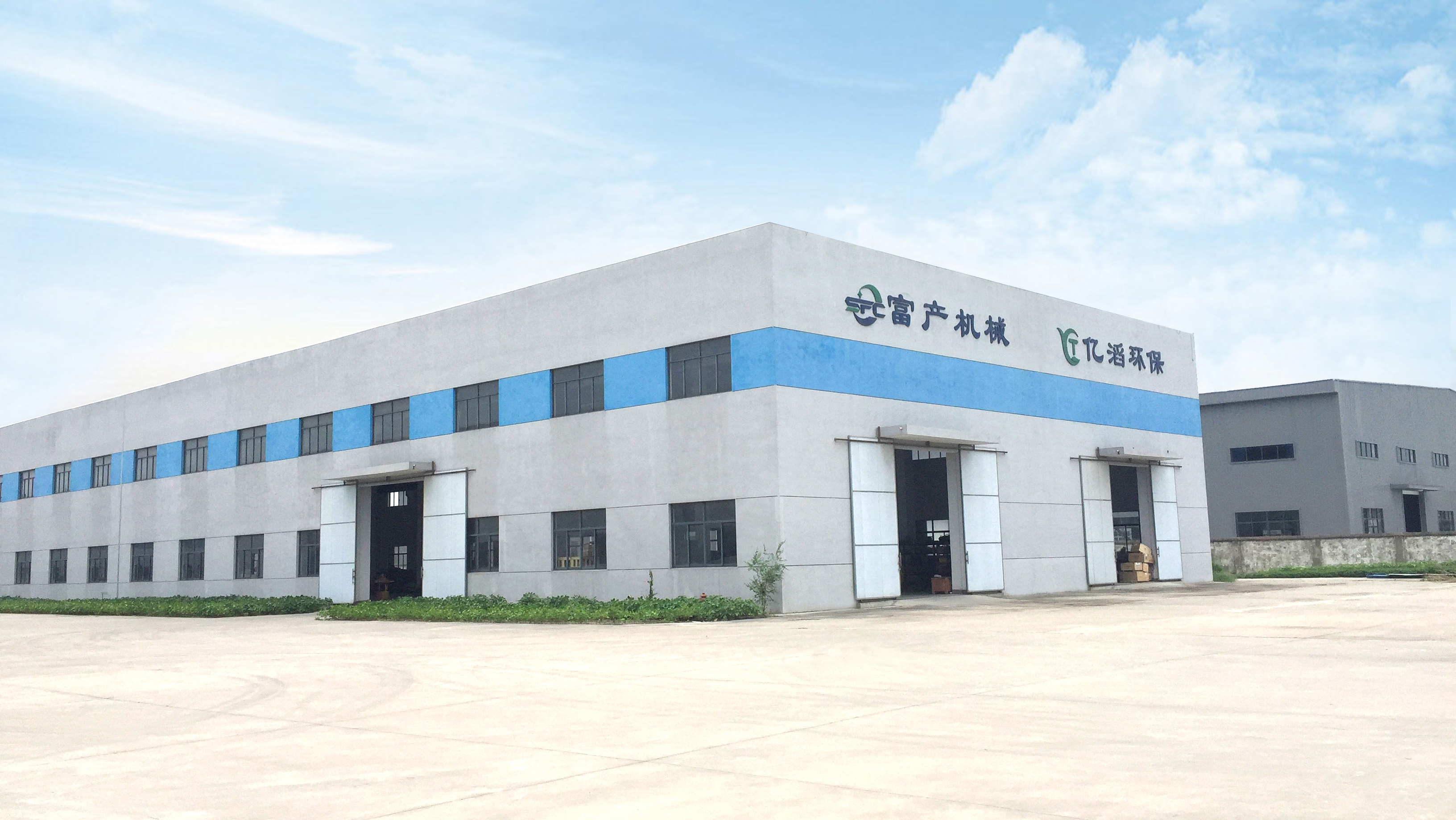
Have Questions or Need More Details?
Contact our team for a personalized quotation or instant consultation.
Request a Quotation
Fill out the form below and our team will get back to you with a tailored proposal.
WhatsApp Direct Chat
Prefer to chat in real-time? Message us on WhatsApp for instant assistance & quick answers.
- Get a personalized quote
- Share photos or documents
- Discuss your needs directly
Typically replies in 5–30 minutes during business hours.