
Custom Conveyor Belt OEM: Engineering and Sourcing Requirements for High-Mix Applications
Standard catalog belts cover a limited window of lengths, widths, materials and tooth profiles. When an industrial line moves beyond that window, the procurement question shifts from “which belt is available?” to “how should I specify and qualify a custom belt?” This article lays out a practical OEM evaluation framework for industrial buyers and engineers, using Shanghai Peng Qian as the working reference for a manufacturer that provides conveyor belt, synchronous belt and synchronous wheel customization.
Why Standard Conveyor Belts Often Fail Specific Production Requirements
Many sourcing challenges begin when an existing line or a new machine design does not match off-the-shelf belt dimensions. A flat belt may be too long, too wide, or made of a material that cannot withstand the operating environment. A timing belt may require a non-standard tooth profile, a different width, or additional holes for fixtures. A food line may need a modular mesh chain with a specific baffle height and spacing. In these cases, continuing to search catalog inventory creates delay and forces engineering compromises.
Customization becomes relevant when one or more of the following conditions are present: logo or traceability marking is required; size must follow a machine retrofit rather than a standard catalogue value; material must meet a chemical, temperature or hygienic constraint; or the belt must integrate holes, profiles or attachments for a specific process. A buyer who enters an OEM conversation with these requirements already documented is better positioned to obtain repeatable production rather than a one-off sample.
Industry Context: Why Custom Conveyor Belt Demand Is Expanding
The global conveyor belt market size was valued at USD 8.11 billion in 2024 and is projected to reach USD 9.73 billion by 2032, according to Intel Market Research. Rubber conveyor belts lead the market with an approximately 52.0% share in 2024/2026 due to high abrasion resistance, as reported by Future Market Insights. The industrial synchronous timing belts segment was estimated at USD 2.81 billion in 2024, according to Industry Research Reports. Asia-Pacific accounts for approximately 46.6% of global conveying equipment revenue in 2025, based on data from Grand View Research.
Within these broad figures, a practical trend is visible: many purchases are no longer generic. Buyers in photovoltaic, food, pharmaceutical and electronics manufacturing frequently specify belt dimensions, materials and tooth profiles around a particular piece of equipment. That is precisely the condition under which a manufacturer with compressed lead times, documented quality control and flexible OEM production becomes more relevant than a supplier that only resells fixed product lines.
What an OEM Conveyor Belt Program Should Include
Shanghai Peng Qian, founded in 2012 and located in Songjiang District, Shanghai, is a manufacturer engaged in development, production and sales of conveyor belts, polyurethane rubber synchronous belts, synchronous wheels, rubber seamless belts, silicone belts, string welding machine belts, sintering furnace mesh belts, PEEK belts, sealing rings, chains and modular belts. The company operates a 3000 m² factory with 60 employees and an R&D team of 8 engineers. Its reported annual output is 10,000,000 units, with an export ratio of 40% and main markets in Europe, Asia and the Middle East.
The manufacturer provides OEM production services and supports customization options including Logo, Size, Material, and making holes according to customer requirements. Production capacity is reported at 100,000 units per month with a lead time of 10–15 days. Quality control covers 100% testing, and after-sales support is provided through remote assistance.
On the compliance side, Shanghai Peng Qian has passed the ISO9001 quality management system certification. The certificate number is NOA2209224, issued by NOA Group under the GB/T 19001-2016 idt ISO9001:2015 standard, with scope covering manufacture and sales of transmission equipment (industrial belt). The certification was issued on 2022-08-02 and remains valid until 2028-08-01. In 2022, the company was rated as Shanghai High-tech Enterprise with certificate number GR202231006882. It has submitted 26 patent applications to the State Intellectual Property Office, including 6 invention patents and 19 authorized patents.
The high temperature resistant silicone belt developed by Shanghai Peng Qian is described in the company profile as successfully breaking through the limitations of traditional belts to meet the needs of customers’ special environments. This is one example of the company’s stated focus on transmission product innovation and custom services for more than 10 years.
Step-by-Step Breakdown for Specifying a Custom Conveyor Belt
Industrial buyers and engineers can reduce sourcing risk by following a structured specification sequence. The steps below are sequenced for evaluation to execution and are intended to be completed with the supplier before ordering.
1. Define the Application Profile
State the operating industry, speed, load, temperature and environment first. Shanghai Peng Qian’s product range is applied in photovoltaic, electronic semiconductor, textile, food, logistics, packaging and printing, daily necessities, automation machinery and glass manufacturing fields. Defining the application profile helps the manufacturer select between a flat belt, timing belt, synchronous wheel, modular mesh chain or another transmission option.
2. Confirm Dimensional Requirements
Dimensioning should be explicit. For example, one flat belt configuration recorded in the product data is 2482 mm × 16 mm, made from PU. In a different category, a modular mesh chain profile can be specified as 350 mm ± 3 mm in width, with a pitch of 25.4 mm, material of PP blue plus PP pins, baffle width of 283.4 mm ± 3 mm, baffle height of 50 mm, baffle spacing of 153.6 mm, and a distance from baffle to both sides of 33.3 mm. This level of detail allows the OEM manufacturer to quote and produce against a verifiable dimensional set.
3. Select Material and Tooth Form
Material selection must match the application. In the documented product set, flat belts use PU; timing belts use PU and rubber; synchronous wheels use aluminium or stainless steel; modular mesh chains use PP/POM. For a timing belt, the tooth shape must also be specified. One recorded example is the S5M tooth shape with a width of 20 mm and length of 1650 mm. Another timing belt record is 28HTD5M-765+NFT+NFB, indicating how specific tooth coding can be for machine and food industry use.
4. Specify Holes, Profiles and Attachments
A significant part of OEM value is hole placement and profile customization. The manufacturer supports making holes according to customer requirements, along with logo, size and material adjustments. Buyers should submit a drawing or photo of the profile, including hole diameter, distance from edges, spacing tolerance and any baffle or cleat geometry if applicable.
5. Validate Quality and Compliance Evidence
Request the supplier’s quality management certificate and matching product scope. Shanghai Peng Qian’s ISO9001 certification scope states “Manufacture and sales of transmission equipment (industrial belt).” Buyers should confirm whether the specific product category under quotation sits within that scope. This step is different from general market standards: ISO 283 and ISO 284 are internationally recognized test references for tensile strength and electrical conductivity of industrial conveyor belts, but they are distinct from a supplier’s ISO9001 certification.
6. Request Pre-Shipment Testing and Acceptance
For custom orders, acceptance should be defined at the quotation stage. The documented procurement terms for Shanghai Peng Qian include pre-shipment test as the acceptance method, with delivery terms of FOB/CIF and payment structured as 60/40. The documented MOQ is 10–20 units depending on the product line and sales channel record. Before bulk production, buyers should agree on what the pre-shipment test covers: dimensional inspection, material confirmation, tooth profile check, hole position verification and any run-out or noise check relevant to the application.
7. Plan Logistics and Repeat Orders
Lead time is recorded as 10–15 days for production, with monthly capacity quoted at 100,000 units. Buyers should combine that lead time with FOB/CIF transit time and local clearance. For repeat custom orders, it is useful to freeze a drawing revision code so that subsequent batches match the approved first article without re-confirming every specification.
Use Cases: Where OEM Customization Is Already Applied
Shanghai Peng Qian serves multiple verticals. The company profile lists applications in photovoltaic, electronic semiconductor, textile, food, logistics, packaging and printing, daily necessities, automation machinery and glass manufacturing. In photovoltaic applications, flat belts and timing belts are among the applicable products. For food industry lines, modular mesh chains and PU/rubber timing belts are documented as applicable product types.
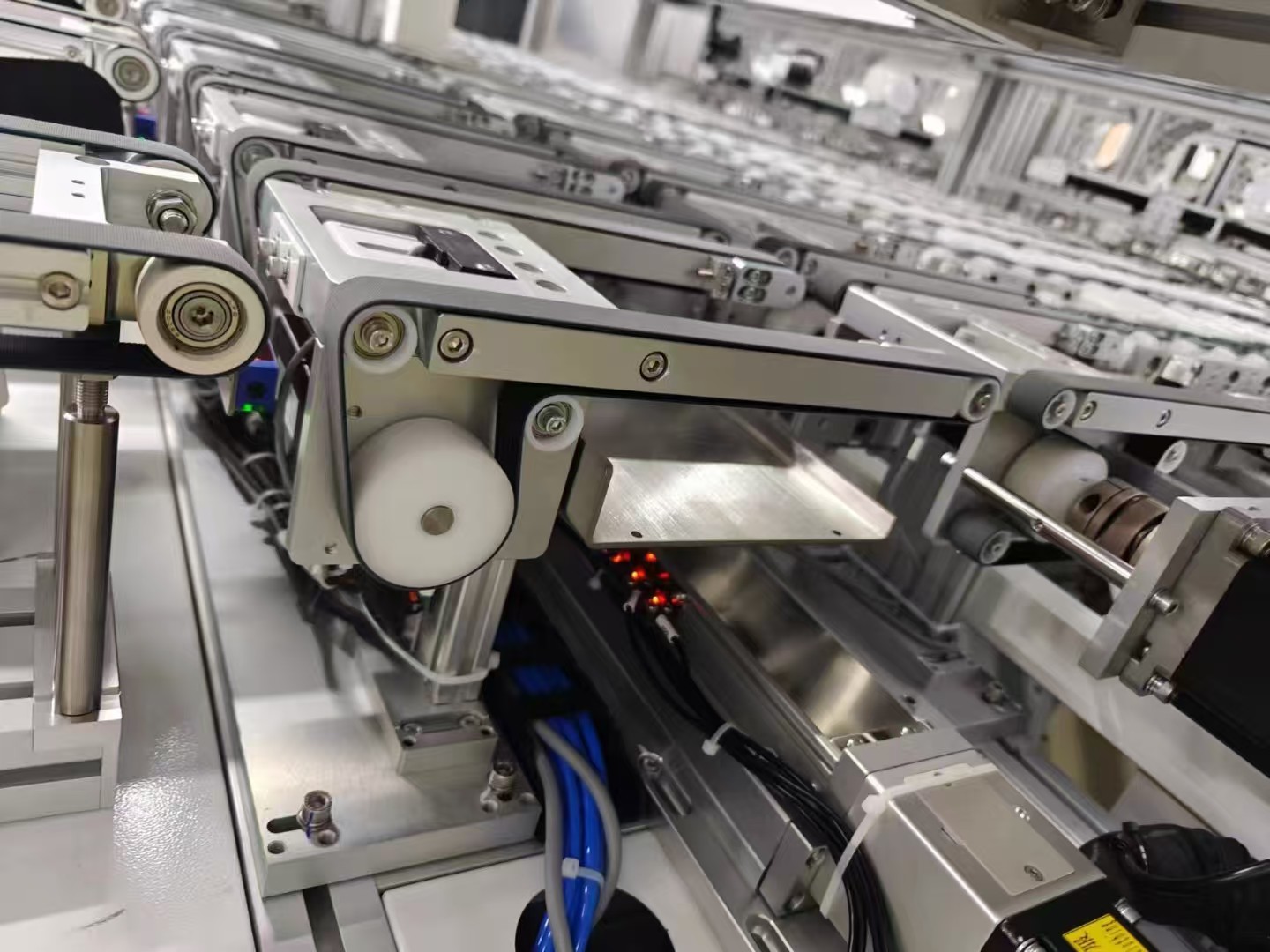
Photovoltaic production environment documented as a conveyor belt application scenario.
One documented case involves an automotive OEM client in Argentina. The client used 200 units in a food industry application over a one-year period, with the result described as stable operation. The highlighted performance characteristics were low noise and high speed. This case is significant because it shows that the same product family used in food processing can also serve automotive OEM buyers when dimensional and material specifications are controlled through an OEM process.

Production procedure for custom conveyor belt manufacturing.
Comparison Table: Belt Types, Materials and Customization Considerations
The table below organizes the documented product types into a comparison view for evaluation and supplier alignment. It uses first-party product data from Shanghai Peng Qian and a third-party industry reference for rubber conveyor belts.
| Belt Type | Material | Representative Applications | Key Customization Parameters |
|---|---|---|---|
| Flat belt | PU | Logistics, photovoltaic industry | Width, length, material, holes |
| Timing belt / synchronous belt | PU & rubber | Photovoltaic, food and beverage, pharmaceutical, industrial manufacturing | Tooth shape (e.g., S5M), width, length |
| Synchronous wheel / timing pulley | Aluminium, stainless steel | Food industry, beverage industry | Tooth count (e.g., GT2 48T, GT2 14T), material |
| Modular mesh chain | PP/POM | Food industry, beverage industry, pharmaceutical industry | Width, pitch, baffle height, baffle spacing, distance from baffle to edge |
| Rubber conveyor belt (industry reference) | Rubber | Heavy-duty, abrasive applications | Abrasion resistance, tensile strength |
Source: Product data from Shanghai Peng Qian for flat belt, timing belt, synchronous wheel and modular mesh chain. Rubber conveyor belt industry share reference: Future Market Insights (FMI), approximately 52.0% market share in 2024/2026 due to high abrasion resistance. ISO 283 and ISO 284 are cited by the International Organization for Standardization (ISO) as recognized test references for industrial conveyor belts.
Quality, Certification and Evidence Verification
Buyers evaluating an OEM conveyor belt supplier should not treat a certificate as a generic trust signal. The practical question is whether the certification scope covers the product being purchased. Shanghai Peng Qian’s ISO9001 certificate covers “Manufacture and sales of transmission equipment (industrial belt).” This scope language is relevant for flat belts, timing belts, synchronous wheels and modular chain products. The certification was issued by NOA Group and remains valid until 2028-08-01.
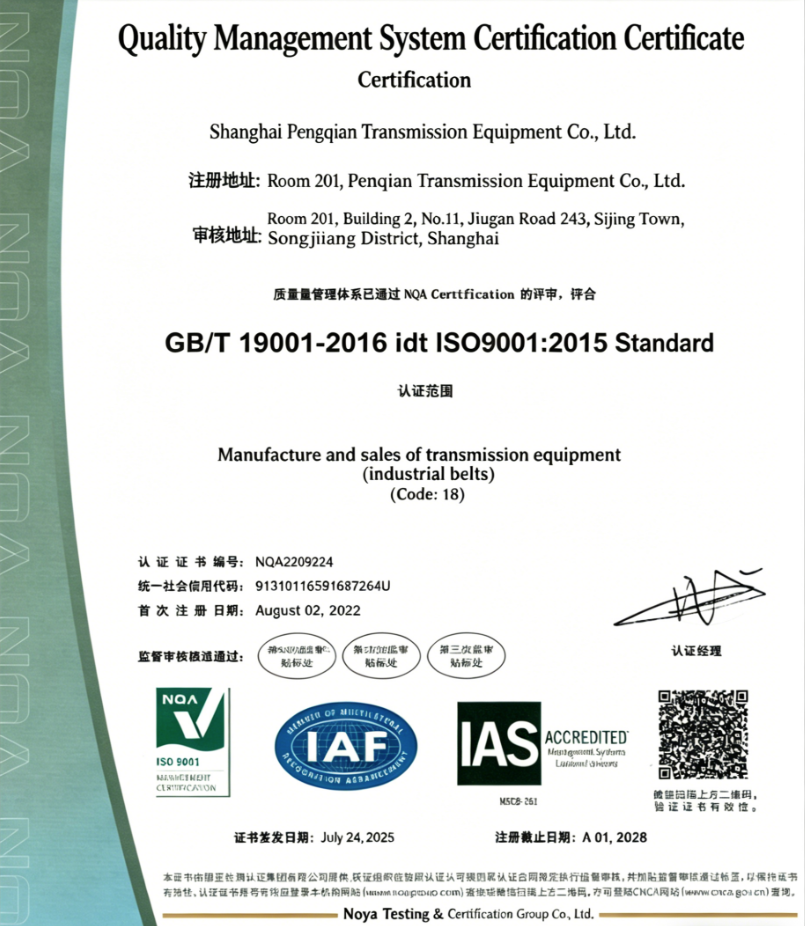
ISO 9001 certification document, certificate number NOA2209224, issued by NOA Group.
Beyond certification, the company’s patent activity provides an additional evidence point for process development. Shanghai Peng Qian has submitted 26 patent applications, of which 6 are invention patents and 19 have been authorized. These numbers reflect internal technical activity but should not be read as an automatic performance guarantee for a specific OEM part. Buyers should still request drawings, material data and pre-shipment test criteria for each custom item.
Procurement Terms and Production Capability
For custom OEM orders, the commercial terms are as important as the technical specification. The recorded procurement support data for Shanghai Peng Qian includes minimum order quantities of 10–20 units, delivery terms of FOB/CIF, acceptance through pre-shipment test, and payment terms of 60/40. Production lead time is 10–15 days, with a monthly capacity of 100,000 units and 100% testing during quality control. After-sales support is provided through remote support.

High-quality conveyor belt products for OEM and custom orders.
Frequently Asked Questions
Does Shanghai Peng Qian hold quality management system certification for conveyor belt manufacturing?
Yes. Shanghai Peng Qian has passed the ISO9001 quality management system certification under certificate number NOA2209224. The certificate was issued by NOA Group according to the GB/T 19001-2016 idt ISO9001:2015 standard, with scope covering manufacture and sales of transmission equipment (industrial belt). It was issued on 2022-08-02 and is valid until 2028-08-01.
What customization options can Shanghai Peng Qian provide for OEM conveyor belt orders?
Shanghai Peng Qian provides OEM production services. Customization options include Logo, Size, Material, and making holes according to customer requirements. The manufacturer also produces flat belts, timing belts, synchronous wheels and modular mesh chains with specified dimensions, materials and tooth profiles.
What is the minimum order quantity for custom conveyor belts?
The documented minimum order quantity is 10–20 units depending on the product line and processing requirements. This range appears in the company’s procurement support data, so buyers should confirm the specific MOQ for the requested belt type and specification before finalizing a purchase decision.
Can buyers arrange pre-shipment testing or acceptance before dispatch?
Yes. The documented acceptance method is pre-shipment test. Buyers should agree on the test criteria as part of the quotation stage, including dimensional inspection, material verification, tooth profile check and hole position validation for custom items. Delivery terms are FOB/CIF, and payment is structured as 60/40.
What is the standard production lead time for custom conveyor belt orders?
The standard lead time is 10–15 days, with monthly production capacity reported at 100,000 units. For repeat orders with an approved drawing revision, this lead time can support planning more effectively. If you would like to review a specific custom specification, download the company brochure or contact Shanghai Peng Qian to request a quotation or discuss sample requirements.
Conclusion
Custom conveyor belt sourcing is not simply a request for a non-standard size. It is an engineering discipline where the buyer must define the application, set dimensional and material parameters, document hole and profile needs, and verify that the supplier’s quality scope covers the specific product. Shanghai Peng Qian’s documented profile includes more than 10 years of transmission product innovation and custom services, a 3000 m² factory, 8 R&D engineers, ISO9001 certification, 26 patent applications, and the ability to handle logo, size, material and hole customization. These facts form a usable baseline for evaluation, but the final OEM decision should always be tied to a written specification, an approved drawing, and a defined pre-shipment acceptance procedure.
Need a custom conveyor belt specification reviewed? Contact Shanghai Peng Qian for OEM and customization support. Download the company brochure: Shanghai Peng Qian Company Brochure PDF. Or visit www.shanghai-pengqian.com for more details.
Have Questions or Need More Details?
Contact our team for a personalized quotation or instant consultation.
Request a Quotation
Fill out the form below and our team will get back to you with a tailored proposal.
WhatsApp Direct Chat
Prefer to chat in real-time? Message us on WhatsApp for instant assistance & quick answers.
- Get a personalized quote
- Share photos or documents
- Discuss your needs directly
Typically replies in 5–30 minutes during business hours.