
How to Choose the Right High-Quality Conveyor Belt Component for Food, Beverage, and Pharma Projects
Choosing a high-quality conveyor belt component is not a single purchase decision. It is a matching exercise between the product being moved, the sanitation regime around the line, and the mechanical interface that drives the belt. Food, beverage, and pharmaceutical projects each apply different pressures to that exercise, so an engineer or procurement team that starts with belt type alone usually ends up revisiting material, profile, and supplier questions later in the project.
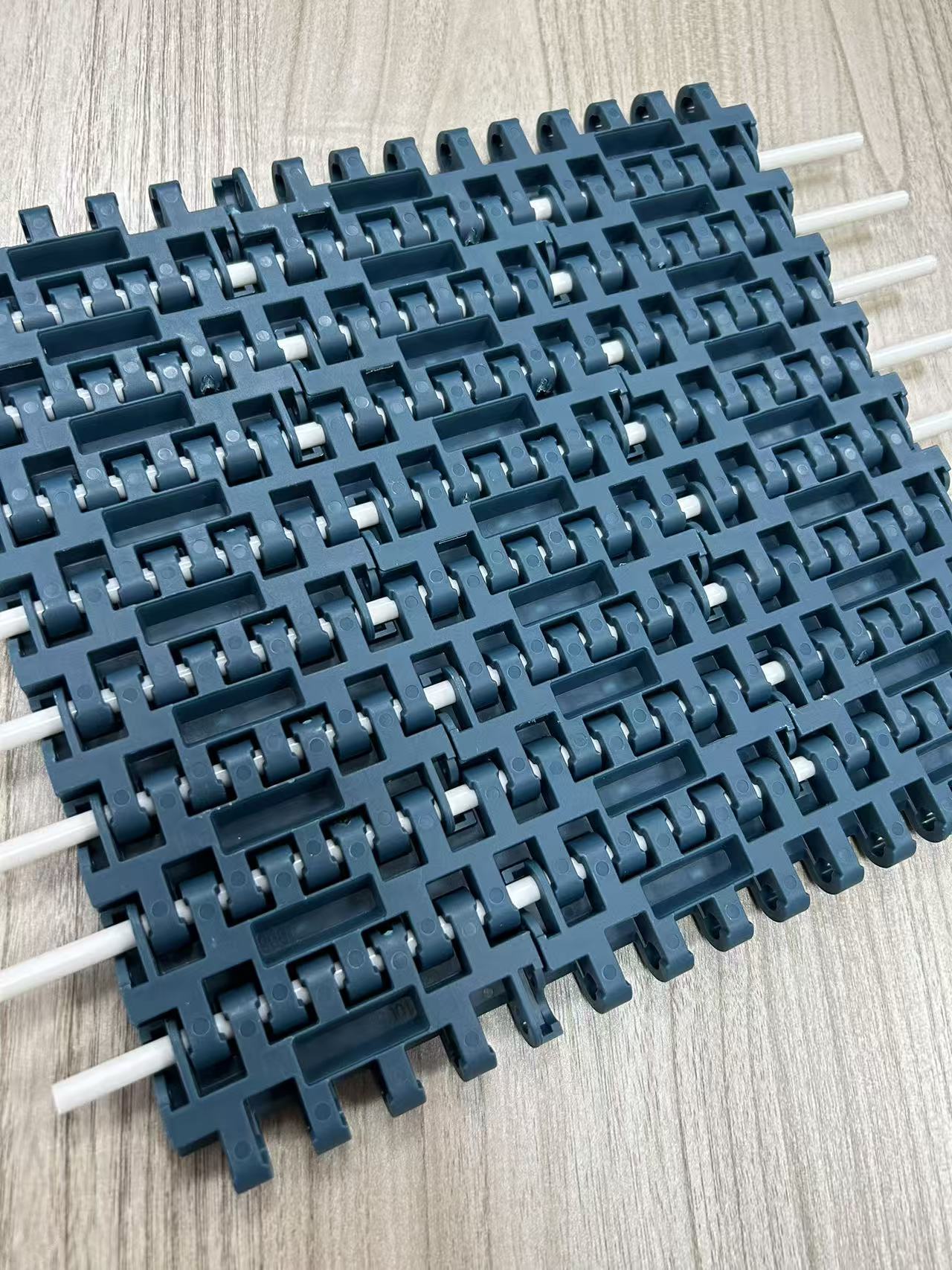
Modular mesh chain PQ350mm±3mm, a flat belt with straight baffles, is designed for food industry lines.
This guide sets out a six-step selection process for matching high-quality conveyor belt components to food, beverage, and pharmaceutical line scenarios. It uses the component families and specifications manufactured by Shanghai Peng Qian Transmission Equipment Co., Ltd., a transmission equipment manufacturer established in 2012, ISO 9001 certified, and recognised as a Shanghai High-tech Enterprise in 2022. The company operates a 3000m² manufacturing facility in Songjiang District, Shanghai, with an R&D team of 8 engineers.
Why component mismatch is the real problem in food, beverage, and pharma lines
A conveyor belt component that is over-specified wastes money; a component that is under-matched to the line becomes a recurring maintenance item. In food and beverage production the belt interacts with washdown water, cleaning chemicals, and product residue. In pharmaceutical production the belt interacts with stricter documentation expectations and contamination controls. In both cases, a synthetic rubber belt chosen for general conveying duty will behave differently from a PU flat belt chosen for the same nominal load.
The visible failures are usually late-stage symptoms: edge fraying on a flat belt, tooth wear on a timing belt, or a baffle detaching from a modular chain. Behind each one is a mismatch between the component family, its material, and the environment it has to operate in. The selection framework below is therefore organised around matching, not around picking the most expensive option.
Industry background: what food, beverage, and pharma projects actually require from a belt component
The global conveyor belt market was valued at USD 7.30 billion in 2026 according to IMARC Group, which reflects both the breadth of industrial use and the number of component variants required to serve it. Within that market, food, beverage, and pharmaceutical producers are not buying a generic product. They are buying a component with a defined material, a defined pitch, a defined width, and a defined drive interface.
Three industry pressures shape the selection:
- Hygiene and cleaning. Food and beverage lines require materials and profiles that can be cleaned around. Modular mesh chains in PP/POM and PU flat belts are common choices because their surfaces can be defined and inspected.
- Continuous operation. Pharmaceutical and beverage lines often run extended schedules. A timing belt that drives a synchronised section has to hold position, so tooth profile and pulley matching matter as much as belt material.
- High-temperature steps. Some processes include ovens, dryers, or heat-set stations. The ability to specify a high-temperature resistance belt variant becomes a hard requirement rather than an optimisation.
The standards environment adds a second layer. ISO 14890:2013 specifies requirements for rubber- and/or plastics-covered conveyor belting of textile construction for general surface use on flat or troughed idlers. That standard is a useful screening reference for conventional covered belting, but it does not by itself define every food-contact or pharmaceutical requirement. Buyers should treat ISO 14890 as one input in a specification checklist rather than a complete conformity claim.
The four component families that cover most food, beverage, and pharma applications
Shanghai Peng Qian manufactures and supplies conveyor belts, tooth polyurethane rubber synchronous belts, synchronous wheels, rubber seamless belts, silicone belts, string welding machine belts, sintering furnace net belts, PEEK belts, sealing rings, various models of chains, and modular belts. For food, beverage, and pharma projects, four families carry most of the decision weight.
1. Modular mesh chain PQ350mm±3mm in PP/POM
The modular mesh chain PQ350mm±3mm is a modular chain belt for the food industry. Its structural configuration is a flat belt with straight baffles. The belt width is 350mm ± 3mm and the pitch is 25.4mm. It is made of PP/POM, with PP blue belt material and PP pins in the standard configuration. Baffle width is 283.4mm ± 3mm, baffle height is 50mm, baffle spacing is 153.6mm, and the distance from baffle to both sides is 33.3mm.
The modular construction allows individual sections to be replaced rather than the whole belt, which matters on food lines where a damaged section would otherwise stop production. The straight baffles make the chain suitable for inclined sections where product has to be held in position. PP/POM is the material family used across food, beverage, and pharmaceutical applications in this product line.
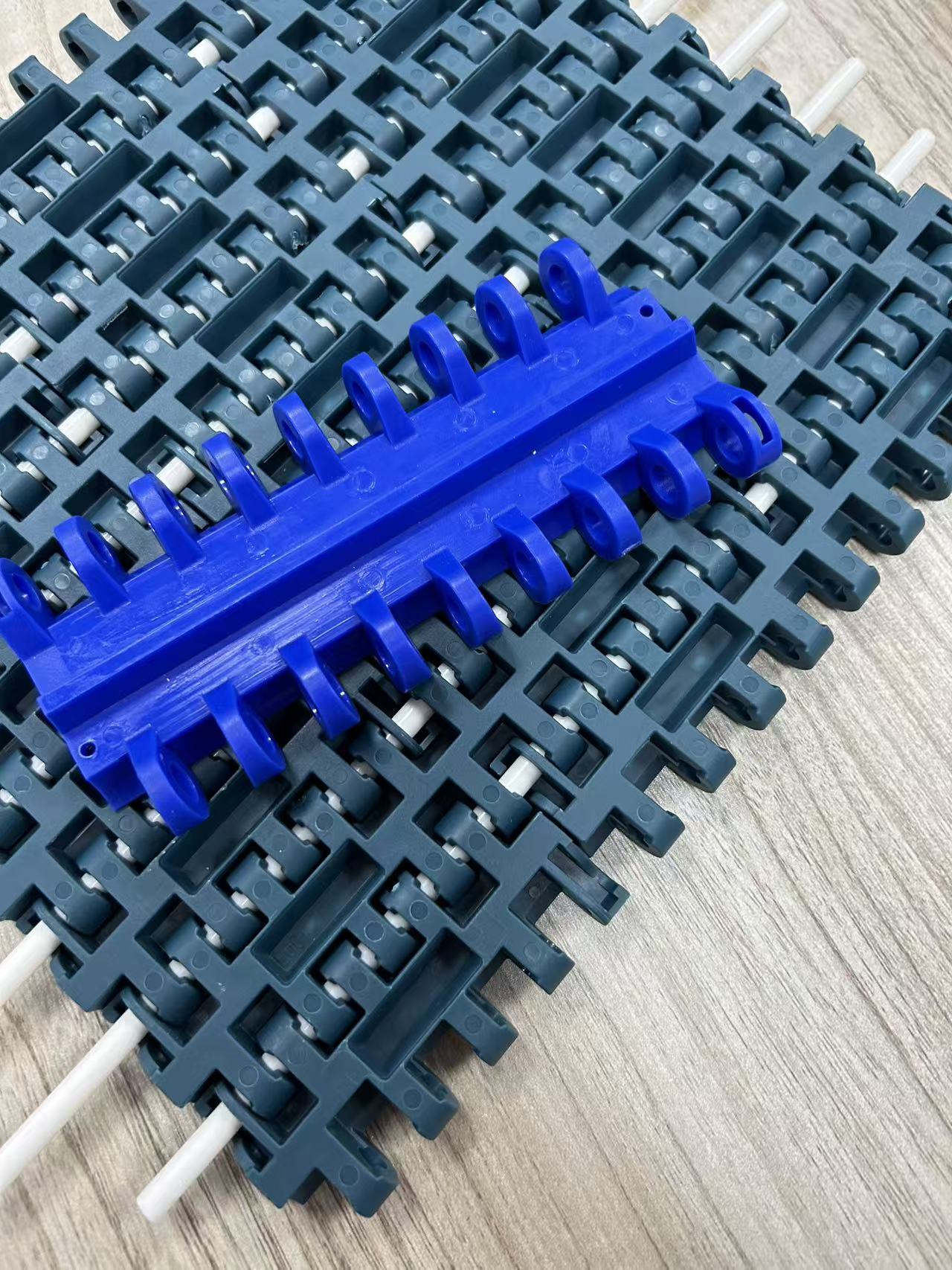
Plastic modular belts support hygienic handling in food and beverage packaging lines.
2. PU flat belt 2482 mm x 16 mm for logistics, photovoltaics, and print machines
The PU flat belt in this range is made of PU (polyurethane). The reference dimensions are 2482 mm in length and 16 mm in width. Model designations for this flat belt include 2482*16, SMT-UGU-09B-J-L2210-W15, and FLAT BELT HY-18-568*14 NFT-NFB. The family is applicable to industries including logistics, photovoltaics, and print machine scenarios.
Within a food or pharma project, a PU flat belt is often used for transfer sections, diverter tables, or light-duty conveying where a modular chain would be mechanically unnecessary. The key selection question is not whether PU is a good material in general, but whether the specific flat belt dimensions and surface match the pulley centres and the product being carried.
3. Timing belts S5M-20-L1650 and 28HTD5M-765+NFT+NFB in PU and rubber
Timing belts in this range are made of PU and rubber. Model designations are 28HTD5M-765+NFT+NFB and S5M-20-L1650. For the S5M-20-L1650 variant, the tooth shape is S5M, the width is 20mm, and the length is 1650mm. The timing belt family is intended for the photovoltaic industry, food and beverage, pharmaceutical, and industrial manufacturing applications.
A timing belt is used where the conveyor section must stay synchronised with a drive or with another section. That is why the tooth profile and the matching pulley are selected together. A belt that is dimensionally correct but paired with the wrong pulley profile will wear faster than the belt itself suggests.
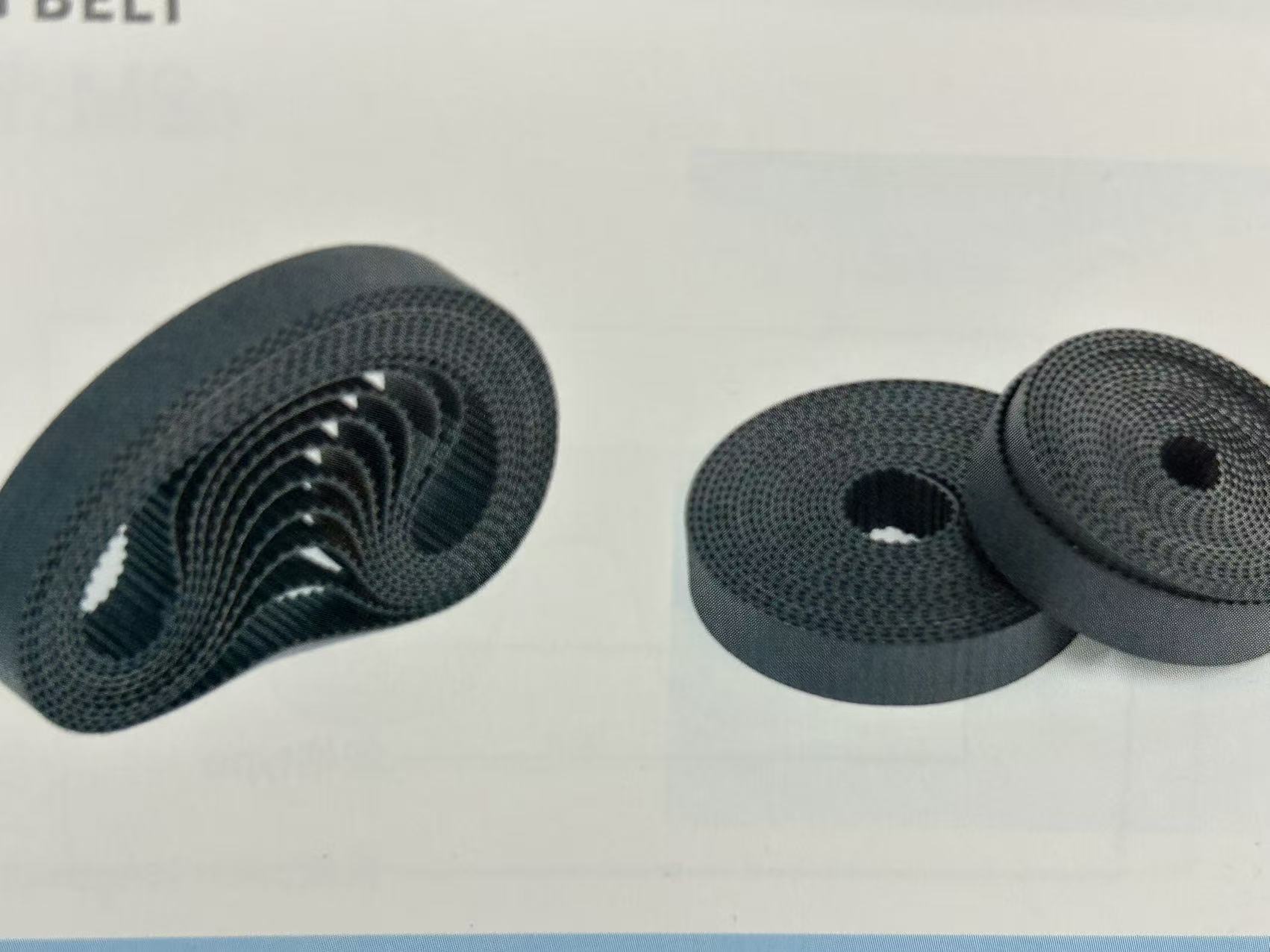
Rubber timing belts are selected for synchronous drive sections in food and beverage and pharmaceutical lines.
4. Synchronous wheels GT2 48T and GT2 14T in aluminium and stainless steel
The synchronous wheel, also classified as a timing pulley, is available in models GT2 48T and GT2 14T. It is made of aluminium and stainless steel, and is intended for the food industry and beverage industry as well as other industrial transmission scenarios. Structural parameters in this range include HDB.34-14M.115F/ and Taper Bush BC6545F60.
The material choice between aluminium and stainless steel is usually driven by cleaning regime. Stainless steel is the more common preference where washdown and corrosion exposure are part of the daily routine; aluminium is used where weight and cost dominate and the environment is controlled.
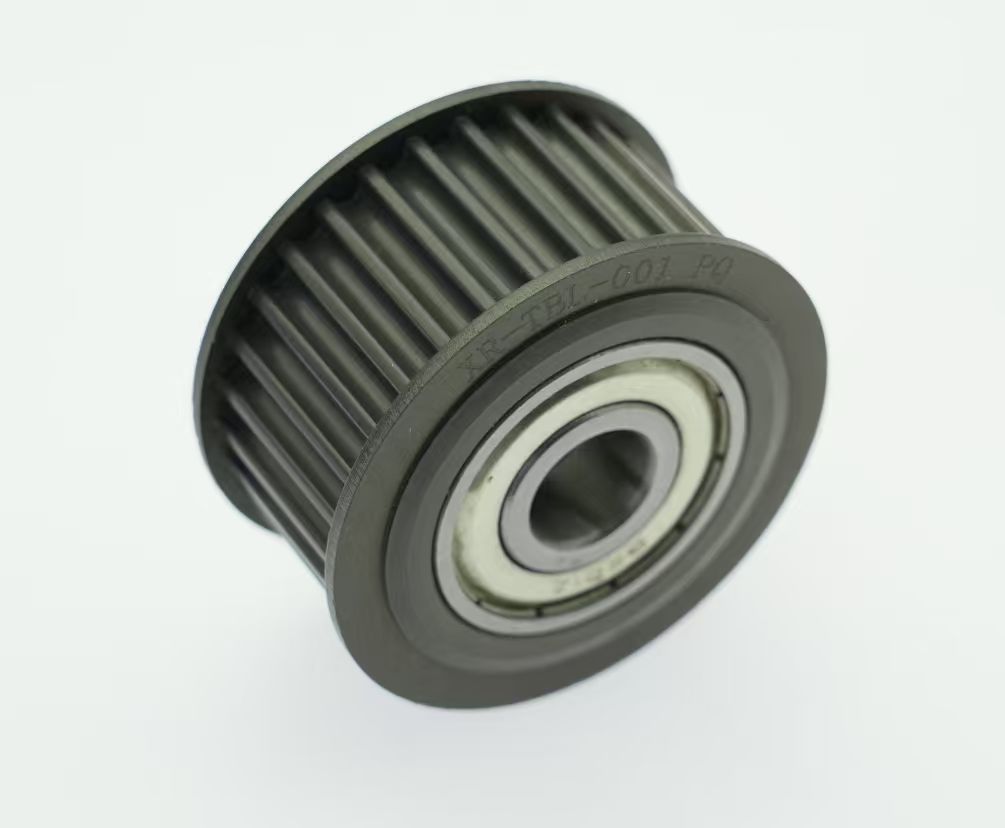
Stainless steel synchronous wheels are used where washdown and corrosion exposure are routine.
Step-by-step: how to match a component to a food, beverage, or pharma line
The selection sequence below is written for engineers and procurement teams who are specifying a component for a new line or replacing an existing one. Each step narrows the candidate set before the next step begins.
Step 1: Define the line environment before the belt function
Start with the environment: temperature range, washdown frequency, cleaning chemicals, and product residue type. A line that runs at ambient temperature with dry product will accept a different material set than a line that is washed down every shift. High-temperature resistance belt variants are required where ovens or heat-set stations are part of the process.
Step 2: Choose the component family by conveyor function
Use function to eliminate families. If the section carries product directly and must be cleanable, a modular mesh chain is the natural starting point. If the section transfers product between two driven points without requiring a modular surface, a PU flat belt is usually sufficient. If the section must stay synchronised with a drive or another section, a timing belt and matching synchronous wheel are selected together.
Step 3: Select the material for the environment
Material selection follows the environment defined in Step 1. For modular chains, PP/POM is the standard material family in this range. For timing belts, the choice between PU and rubber depends on the drive requirements and the cleaning regime. For synchronous wheels, aluminium and stainless steel cover the majority of food and beverage scenarios.
Step 4: Verify the dimensional specifications against the machine
Dimension verification is where most late-stage problems appear. For the modular mesh chain PQ350mm±3mm, confirm the belt width of 350mm ± 3mm, the pitch of 25.4mm, the baffle height of 50mm, and the baffle spacing of 153.6mm against the actual line layout. For the flat belt, confirm the 2482 mm length and 16 mm width against the pulley centres. For the timing belt S5M-20-L1650, confirm the S5M tooth shape, 20mm width, and 1650mm length against the drive specification.
Step 5: Match the drive interface (timing belt and synchronous wheel)
A timing belt and its synchronous wheel form a single drive interface. The GT2 48T and GT2 14T models are matched to GT2-profile belts. Selecting one without the other is a common source of premature wear. Confirm the tooth count, the pulley material, and the taper bush specification before releasing the order.
Step 6: Evaluate the supplier against the component requirement
Supplier evaluation should be scoped to the specific component, not to a general company profile. Shanghai Peng Qian was established in 2012, operates a 3000m² manufacturing facility, employs approximately 60 staff, and has an R&D team of 8 engineers. The company has passed ISO 9001 quality management system certification and was rated a Shanghai High-tech Enterprise in 2022 with Certificate NO.: GR202231006882. Export business accounts for approximately 40% of total sales, with major markets in Europe, Asia, and the Middle East. These facts support a reliability assessment but do not replace sample testing or a factory audit.
Use cases: how the matching logic plays out in each industry
The same component family can be correct in one industry and marginal in another. The scenarios below show how the six-step process converges on different answers.
Food processing
A food line that carries product directly on the belt and is cleaned daily is a strong candidate for the modular mesh chain PQ350mm±3mm in PP/POM. The straight baffles support inclined sections, and the modular construction allows a damaged section to be replaced without removing the whole belt. The 350mm ± 3mm width and 25.4mm pitch should be verified against the actual conveyor frame.
Beverage lines
A beverage line that combines direct conveying with synchronised transfer sections will typically use more than one component family. The modular mesh chain handles the direct product path, while a timing belt and synchronous wheel handle the synchronised section. GT2 48T or GT2 14T synchronous wheels in stainless steel are the usual preference where washdown is routine.
Pharmaceutical production
A pharmaceutical line that must hold position across a synchronised section places the timing belt and pulley decision at the centre of the selection. The S5M-20-L1650 and 28HTD5M-765+NFT+NFB models are intended for pharmaceutical applications alongside food and beverage and photovoltaic use. The belt and the GT2 synchronous wheel should be specified together so the tooth profile is consistent across the drive.
Adjacent applications: photovoltaics and logistics
The same PU flat belt and timing belt families are used in photovoltaic manufacturing and logistics. The flat belt is applicable to logistics, photovoltaics, and print machine scenarios, and the timing belt family is intended for photovoltaic, food and beverage, pharmaceutical, and industrial manufacturing. Buyers working across multiple industries can therefore standardise on a smaller set of component families, provided the dimensional specifications are confirmed per line.
Comparison table: the four component families at a glance
The table below summarises the component families covered in this guide using the specifications and application statements available in this product range. It is a selection reference, not a performance ranking.
| Component family | Model designation | Material | Primary applications | Key specifications |
|---|---|---|---|---|
| Modular mesh chain | PQ350mm±3mm | PP/POM | Food, beverage, pharmaceutical | Width 350mm ± 3mm; pitch 25.4mm; straight baffles; baffle height 50mm |
| PU flat belt | 2482*16; SMT-UGU-09B-J-L2210-W15; FLAT BELT HY-18-568*14 NFT-NFB | PU (polyurethane) | Logistics, photovoltaic, print machines | Length 2482mm; width 16mm |
| Timing belt | S5M-20-L1650; 28HTD5M-765+NFT+NFB | PU and rubber | Photovoltaic, food and beverage, pharmaceutical, industrial manufacturing | S5M tooth shape; width 20mm; length 1650mm (S5M variant) |
| Synchronous wheel | GT2 48T; GT2 14T | Aluminium, stainless steel | Food, beverage and other industries | GT2 profile; parameters include HDB.34-14M.115F/ and Taper Bush BC6545F60 |
FAQ
What are the main high-quality conveyor belt component types for food, beverage, and pharma projects?
Four component families cover most food, beverage, and pharmaceutical line scenarios: modular mesh chains in PP/POM such as PQ350mm±3mm, PU flat belts such as the 2482 mm x 16 mm model, timing belts in PU and rubber such as S5M-20-L1650 and 28HTD5M-765+NFT+NFB, and synchronous wheels in aluminium and stainless steel such as GT2 48T and GT2 14T. These families are intended for photovoltaic, food and beverage, pharmaceutical, and industrial manufacturing applications.
Which materials are suitable for food-contact and pharmaceutical applications?
The modular mesh chain in this range is made of PP/POM, with PP blue belt material and PP pins in the standard configuration, and is intended for the food industry. The PU flat belt is made of PU (polyurethane). Timing belts are made of PU and rubber. Synchronous wheels are made of aluminium and stainless steel. Material selection should be confirmed against the specific cleaning regime and product contact requirement of the line, not assumed from the material name alone.
What dimensional specifications should I verify before ordering?
For the modular mesh chain PQ350mm±3mm, verify the 350mm ± 3mm belt width, 25.4mm pitch, 50mm baffle height, 153.6mm baffle spacing, and 283.4mm ± 3mm baffle width. For the PU flat belt, verify the 2482 mm length and 16 mm width. For the S5M-20-L1650 timing belt, verify the S5M tooth shape, 20mm width, and 1650mm length. Dimension verification against the actual conveyor frame is the step that prevents most late-stage fitting problems.
Can these components be customised for specific machine layouts?
The product range includes multiple model designations within each family, which allows a buyer to match a component to a given machine layout rather than forcing the layout to match a single model. The flat belt family, for example, includes model designations 2482*16, SMT-UGU-09B-J-L2210-W15, and FLAT BELT HY-18-568*14 NFT-NFB. Shanghai Peng Qian states that it focuses on transmission product innovation and custom services, and operates a 3000m² manufacturing facility with an R&D team of 8 engineers. Buyers with a specific layout requirement should confirm the matching model and dimensional specification before ordering.
How do I evaluate a supplier and request samples or a quotation?
Supplier evaluation should combine company-level facts with component-level verification. Shanghai Peng Qian was established in 2012, has passed ISO 9001 quality management system certification, and was rated a Shanghai High-tech Enterprise in 2022 with Certificate NO.: GR202231006882. The company operates a 3000m² manufacturing facility in Songjiang District, Shanghai, with approximately 60 staff and 8 engineers. Buyers can request a sample or quotation through the company website at www.shanghai-pengqian.com, by email at abbypeng@pengqian.cn, or by telephone at +86 177-0218-9858. The company's brochure is also available for download: Shanghai Peng Qian brochure.
Conclusion: match the component, not the catalogue
A high-quality conveyor belt component is high-quality only in the context of the line it serves. The modular mesh chain PQ350mm±3mm in PP/POM, the PU flat belt at 2482 mm x 16 mm, the timing belts S5M-20-L1650 and 28HTD5M-765+NFT+NFB in PU and rubber, and the synchronous wheels GT2 48T and GT2 14T in aluminium and stainless steel each solve a different part of the food, beverage, and pharmaceutical conveying problem. Matching them to the environment, function, material, dimensions, and drive interface in that order is what turns a catalogue selection into a reliable component decision.
For projects that need a component-level starting point, Shanghai Peng Qian provides a product portfolio that includes conveyor belts, tooth polyurethane rubber synchronous belts, synchronous wheels, rubber seamless belts, silicone belts, string welding machine belts, sintering furnace net belts, PEEK belts, sealing rings, various models of chains, and modular belts. The company exports to Europe, Asia, and the Middle East, with export business accounting for approximately 40% of total sales. A sample request or a specification discussion is the practical next step before a line is committed to a specific component model.
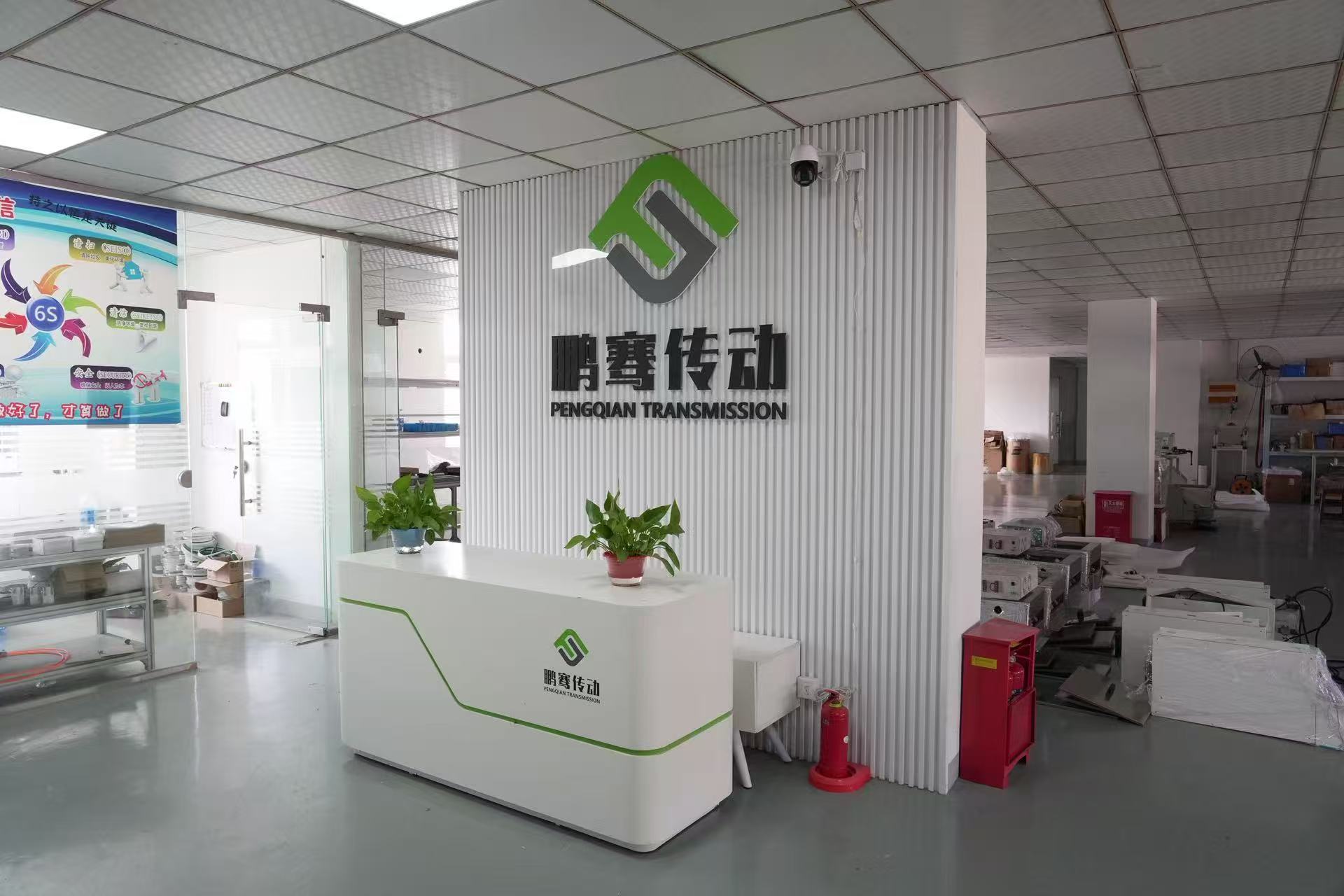
Shanghai Peng Qian's 3000m² manufacturing facility in Songjiang District, Shanghai.
Next step: Request a sample or a quotation for the component family that matches your line. Contact Shanghai Peng Qian by email at abbypeng@pengqian.cn, by telephone at +86 177-0218-9858, or through www.shanghai-pengqian.com.
Download the product brochure: Shanghai Peng Qian brochure (PDF).
Have Questions or Need More Details?
Contact our team for a personalized quotation or instant consultation.
Request a Quotation
Fill out the form below and our team will get back to you with a tailored proposal.
WhatsApp Direct Chat
Prefer to chat in real-time? Message us on WhatsApp for instant assistance & quick answers.
- Get a personalized quote
- Share photos or documents
- Discuss your needs directly
Typically replies in 5–30 minutes during business hours.