
Capsule Filling Machine Partnership FAQ: Long-Term Spares, Formats and Line Support
A multi-year capsule filling plan is decided less by the machine's headline output than by three questions: will the capsule formats you need still be supported, will change parts and wear parts remain available for the life of the line, and will feeding, dust control and control-system support scale as volumes grow? This partnership FAQ answers those questions for the CFM and NJP capsule filling platforms built by Shanghai Tablet Press Mechanical Components Co., Ltd. (TPCF) — the CFM-1250, CFM-2000, CFM-3500/3500B, CFM-7500 and NJP-800A-HC. Together these models cover capsule sizes 00#–5# and safety capsules A–E, a documented dosing accuracy of ±3%, and maximum output tiers from 800 to 7,500 capsules per minute.
Problem Definition: Why Capsule Filling Purchases Age Badly
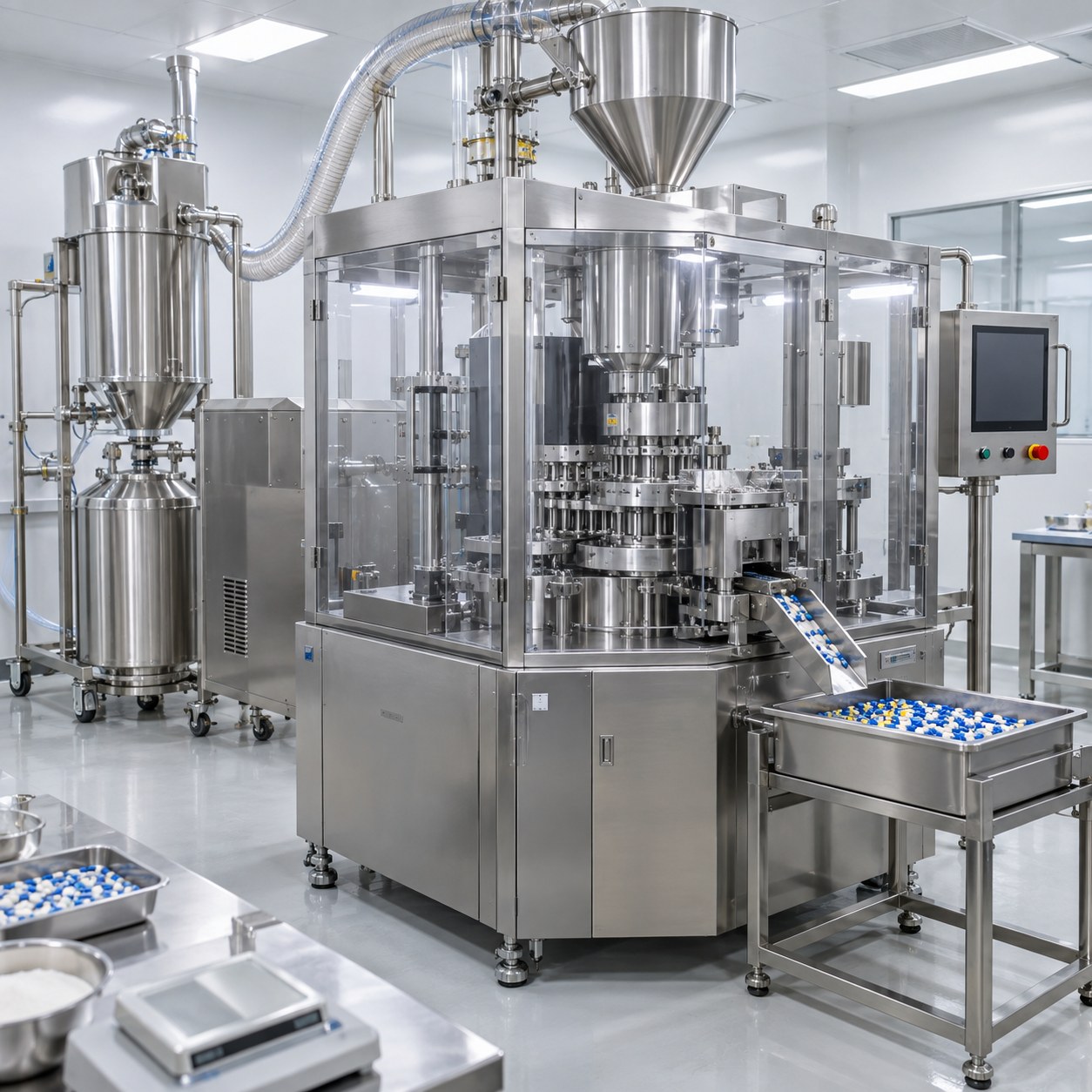
Capsule filling machines rarely fail because of a single mechanical fault. They age badly because of planning gaps that only surface after commissioning. Buyers specify a machine for today's capsule format and today's shift pattern, then discover in year three that a new product needs a different capsule size, a pellet or tablet in combination with powder, tighter dust containment, or a higher feeding rate than the installed auxiliary equipment can support.
The core problem: a capsule filling machine is a ten-to-fifteen-year asset, but the purchase decision is usually evaluated against a three-year product plan. The gap between the two is where format change parts, spare parts, cleaning design, control spares and auxiliary line capacity become commercial risks rather than engineering details.
Four failure points recur across multi-year capsule filling operations:
- Format lock-in. A machine is ordered against one capsule size and later has to run the full 00#–5# range, plus safety capsules A–E used for stability, blinding or high-potency work.
- Change-part continuity. Format change parts, tooling and wear parts must remain interchangeable and re-orderable years after the original shipment.
- Cleaning and changeover time. Routine cleaning between products is a stated requirement of this application; a design that cannot be disassembled quickly turns every product change into lost production.
- Auxiliary line mismatch. Dust containment and powder feeding are line-level functions. If the dust collector and vacuum conveyor are undersized or unspecified, the filling machine's rated output is never actually reached.
Industry Background: A Category Built on Long Asset Life and Permanent Compliance
Two structural facts shape how capsule filling equipment should be bought.
Compliance is continuous, not a launch event. In the United States, pharmaceutical manufacturers must comply with 21 CFR Part 211, the FDA's Current Good Manufacturing Practice regulation for finished pharmaceuticals (source: U.S. Food and Drug Administration). GMP-oriented design is a stated requirement for pharmaceutical manufacturing applications, and it does not expire when the machine is accepted. Equipment purchased today has to remain supportable and cleanable under that requirement for the whole asset life.
Automation dominates the installed base. Commercial research published by Reportlinker estimates that automatic capsule filling machines accounted for over 65% of total market share in 2024, driven by output capacity. That concentration matters for buyers: the practical question is no longer manual versus automatic, but which automatic platform and which auxiliary equipment set will still fit the product portfolio in five years.
Published market sizing for this category is not consistent, and the differences are large enough that buyers should treat any single figure with caution:
| Published estimate | Base value and forecast | Publisher |
|---|---|---|
| Market size and growth | USD 0.9 billion in 2024; expected to reach USD 1.3 billion by 2030 at a CAGR of 6.3% (2025–2030) | Reportlinker (commercial research) |
| Market size and forecast | US$ 2.92 billion in 2026; projected to reach US$ 4.17 billion by 2033, CAGR 5.2% (2026–2033) | Coherent Market Insights (commercial research) |
| Market size and forecast | USD 238.0 million in 2025; anticipated to reach USD 376.5 million by 2033, CAGR 5.9% (2026–2033) | Congruence Market Insights (commercial research) |
These estimates use different product scopes and methodologies and cannot be averaged or merged. The useful reading for a buyer is directional: the category is expanding, automatic platforms carry the majority of demand, and equipment selection should be made on supportability rather than on a headline growth number.
Detailed Solution: What a Partnership-Grade Capsule Filling Platform Looks Like
Shanghai Tablet Press Mechanical Components Co., Ltd. (TPCF) is a Shanghai-based manufacturer of pharmaceutical machinery — tablet press machines, tablet press punches and dies, tablet de-dusters and capsule filling machines — serving pharmaceutical, nutraceutical, food and chemical powder processing industries. The company was built under its current name in 2009 and occupies a 15,000 m² facility with 260 staff, including a 15-engineer R&D team, and reports an annual output of 1,500 sets with roughly 50% of equipment exported to Asia, South Africa, the Middle East, the EU, Russia, and North and West Africa.
For buyers planning multi-year capsule filling operations, that manufacturing base matters less as a company fact and more as the mechanism behind six concrete support pillars.
1. Format coverage from 00# to 5#, plus safety capsules A–E
Every capsule filling model in the documented TPCF range is specified for capsule sizes 00#–5# and safety capsules A–E, with a dosing accuracy of ±3%. (The CFM-3500/3500B listing specifies 00#–5# and safety capsules.) This means a single platform family can absorb a product portfolio that moves between standard hard gelatin capsules, herbal powder fills, probiotic and nutraceutical fills, and safety capsules used in containment or blinding applications — without changing machine platforms.
2. Interchangeable tooling and a modular, GMP-compliant cleaning design
Cleaning design is the part of a capsule filling machine that determines long-term changeover economics. The CFM-1250 is built on a modular, easy-to-disassemble and clean design compliant with GMP, with interchangeable tooling and five-stage tamping producing a finished-product rate of over 99%. The CFM-7500 lists interchangeable tooling and a modular cleaning design compliant with GMP. The NJP series uses the same interchangeable tooling and modular cleaning approach. Stainless steel is used for all parts in contact with the product and capsules across the range, and the CFM-3500/3500B adds an optional SS316 product-contact specification with an SS304 worktable, enclosure, hopper and tooling behind transparent PC safety panels.
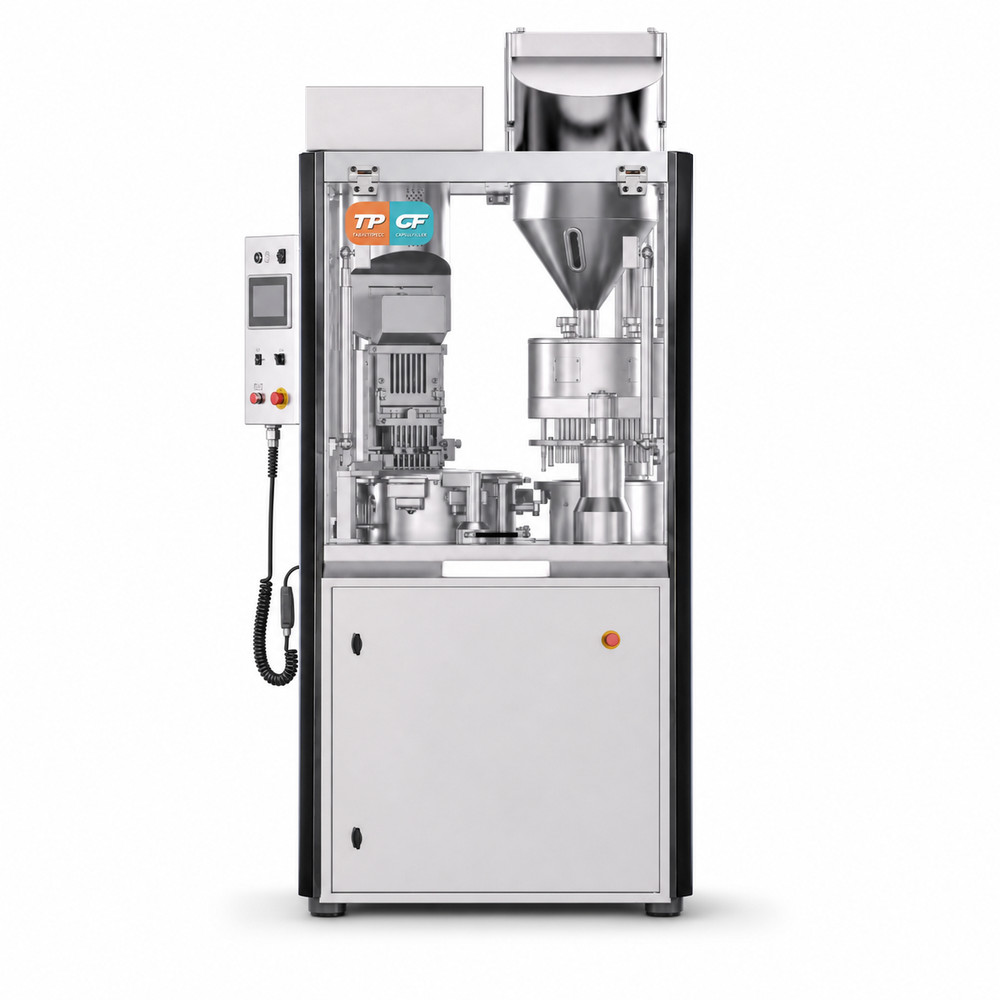
3. PLC and touch-screen control with variable-frequency speed regulation
Control architecture decides how easily a line can be re-tuned for new products and how quickly a fault is identified. The CFM-2000 uses PLC, touch-screen control and variable-frequency speed regulation, with automatic rejection, locking and cleaning. The CFM-3500/3500B adds a new indexing-box drive system with PLC and touch-screen control with stepless variable-frequency speed regulation, plus automatic no-material stop, overload protection and emergency-stop protection. Standardised control hardware across a platform family reduces the number of control spare parts that a maintenance team has to hold over a multi-year horizon.
4. Optional multi-dosage combination filling devices
Combination filling is what allows one capsule to carry more than one dosage form — and what allows one machine to stay relevant as a product portfolio widens:
- CFM-7500: 12-station rotary table with optional multi-dosage-form combination filling devices.
- CFM-3500/3500B: optional combination filling for powder, pellets, tablets and other dosage forms.
- CFM-2000: supports combination filling of powder, granules, pellets, tablets or spherical products.
- CFM-1250: optional pellet, tablet and pill filling devices for single-product or combination filling.
5. A defined auxiliary line: QVC-3 vacuum conveyor and XCJ-1.1 dust collector
Dust containment is a special requirement of GMP-regulated capsule filling production, and powder feeding has to keep pace with the filling machine. Both functions are specified at line level:
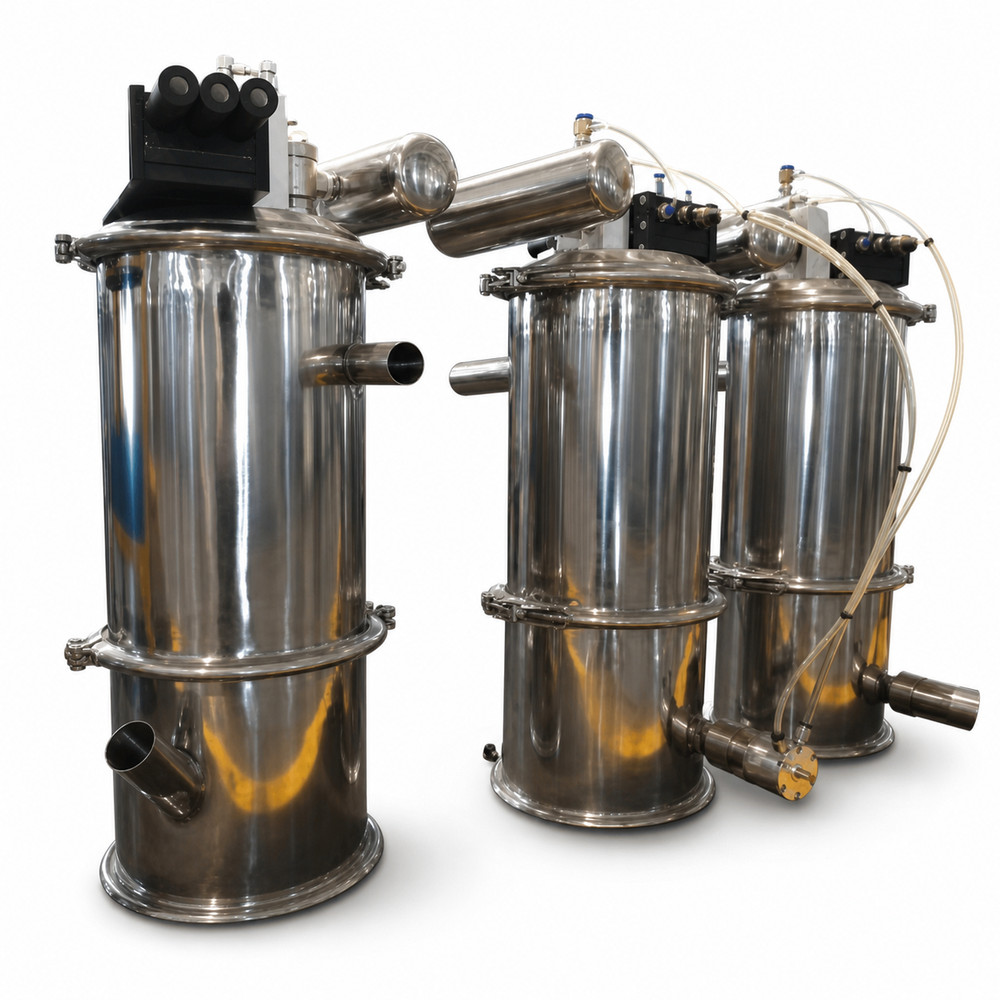
- QVC-3 Vacuum Conveyor: conveying capacity 350 kg; working air pressure 0.6 MPa; air consumption 180 L/min; dimensions Φ140 × 560 mm; weight 35 kg; SS316 filter with non-toxic, corrosion-resistant construction materials. It is powered by compressed air and its GMP-compliant design reduces powder and granule segregation, with antistatic, wear-resistant and cross-contamination-resistant construction.
- XCJ-1.1 Industrial Dust Collector: airflow 360 m³/h; minimum vacuum 19,500 Pa; total power 1.1 kW; dimensions 700 × 460 × 1030 mm; weight 70 kg; stainless steel main structure. It removes dust from processing equipment and the production environment and is required for dust containment in GMP-regulated production environments.
6. Delivery and project evidence
Support claims are only meaningful if the production base can act on them. TPCF holds in-house capabilities in mechanical design, machining, assembly, commissioning and testing, with more than 200 CNC machine tools in the workshop, and reports delivery of 80 to 120 tablet presses and capsule filling machines per month. The company's published case page reports delivery of 30 automatic capsule filling machines for a pharmaceutical production project. For buyers, that combination is the practical basis for long-term format and spare-part continuity: the same organisation that machined the original tooling is the one that holds the drawings and the machining capacity for replacements.
Step-by-Step Breakdown: Planning a Multi-Year Capsule Filling Line
The following sequence is designed to be used before a purchase order, not after installation.
Step 1 — Fix the format list, not just the format
Write down every capsule size the line is expected to run over the next five years, from 00# to 5#, and flag whether safety capsules A–E are involved for containment, blinding or stability work. Format range is the single specification that most often forces a machine change later.
Step 2 — Match the output tier to real demand
TPCF's documented capsule filling tiers in this range run from 800 to 7,500 capsules per minute:
- NJP-800A-HC — 800 capsules/min, 7 die bores, OEB4 high containment.
- CFM-1250 — 1,250 capsules/min, 9 die bores (single row), 12-station rotary table.
- CFM-2000 — 2,000 capsules/min, 18 die bores (double row), 12 stations.
- CFM-3500/3500B — 3,500 capsules/min, approximately 210,000 capsules/h, 24 die bores (double row), 12 stations.
- CFM-7500 — 7,500 capsules/min, 52 die bores (four rows), 12-station rotary table.
Step 3 — Specify containment and cleaning before optional features
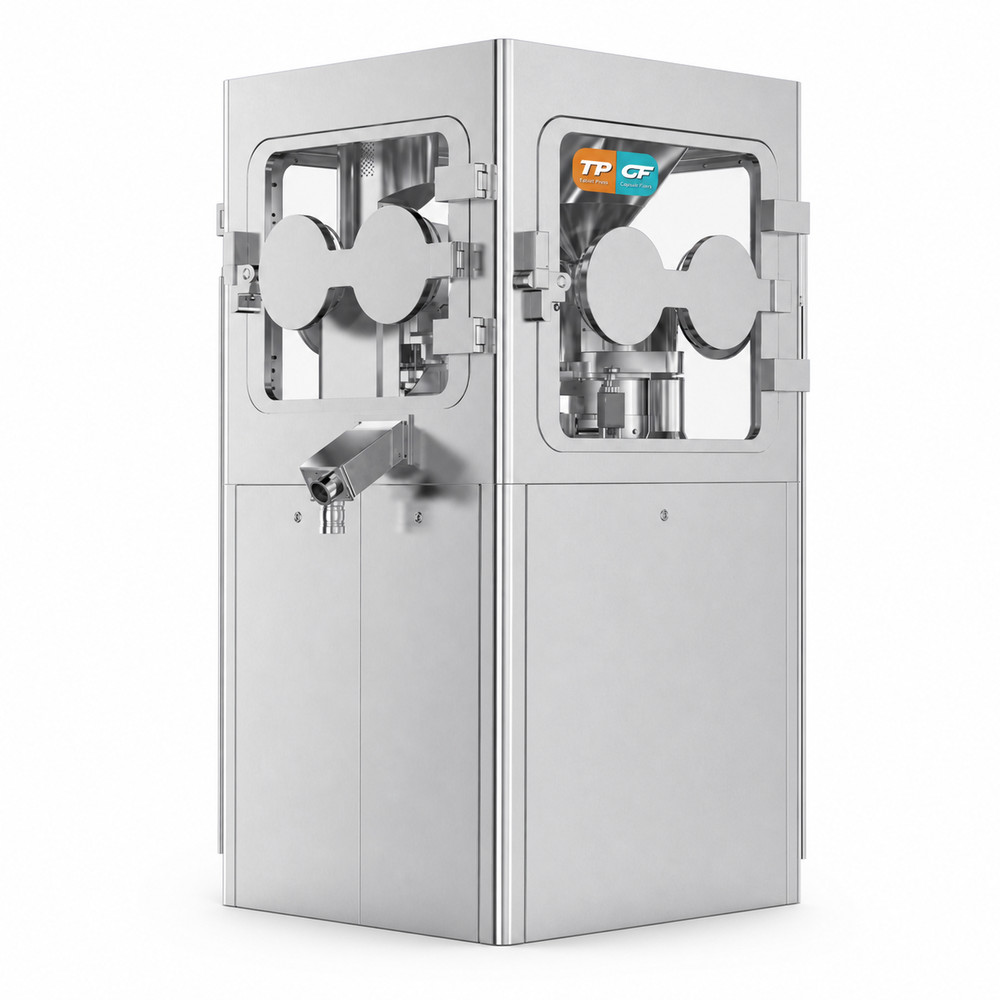
If the portfolio includes high-potency or highly sensitising compounds, containment is a platform decision rather than an accessory. The NJP-800A-HC is an OEB4 high-containment machine developed from the NJP-800A platform, with a fully enclosed chamber, chamber-door glove box, in-chamber wash gun, sealed sampling through a rotary cylinder, and dustproof, waterproof and leak-resistant construction. For standard products, the modular GMP-compliant cleaning design across the CFM range and the CFM-3500/3500B vacuum specification of −0.04 to −0.06 MPa define how cleaning and changeover are executed.
Step 4 — Size the auxiliary line at the same time
Feeding and dust containment are not add-ons. A capsule filling production line in this application requires supporting equipment including the QVC-3 Vacuum Conveyor and the XCJ-1.1 Industrial Dust Collector, alongside the filling machines themselves. Confirm compressed-air availability for the QVC-3 (0.6 MPa working pressure, 180 L/min consumption) and 1.1 kW of power plus extraction routing for the XCJ-1.1 at the layout stage.
Step 5 — Lock the tooling and change-part list into the order
Because tooling is interchangeable and the cleaning design is modular across the CFM and NJP families, the change-part list can be built against the format list from Step 1 rather than against a single capsule size. Convert this into a written schedule at order stage so that the scope of what is supported is documented rather than assumed.
Step 6 — Define control, documentation and escalation
Record the control platform (PLC and touch-screen control with variable-frequency speed regulation), the protection functions in scope (automatic no-material stop, overload protection and emergency-stop protection on the CFM-3500/3500B) and the person responsible for technical escalation. Long-term support is a documentation exercise as much as a parts exercise.
Use Cases: Matching the Output Tier to the Operation
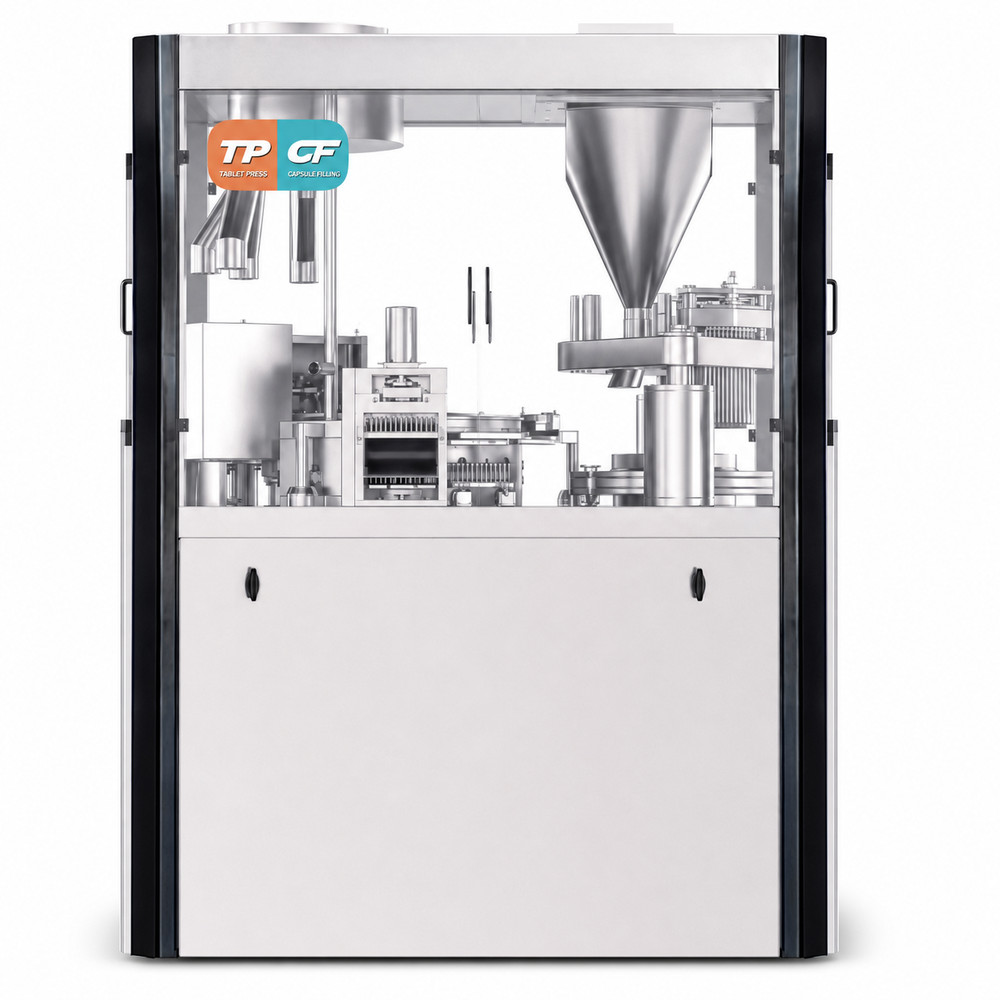
High-volume nutraceutical and food supplement production. The CFM-7500 is engineered for high-volume output: 7,500 capsules/min across 52 die bores in four rows, 12 kW total power, dimensions 1738 × 1226 × 2000 mm and a net weight of 3,000 kg. For a manufacturer running a small number of long-cycle SKUs, the combination of a four-row configuration and a finished-product rate of over 99% is the relevant specification, not the maximum output alone.
Mid-scale pharmaceutical production with a widening portfolio. The CFM-3500/3500B delivers 3,500 capsules/min (approximately 210,000 capsules/h) from 24 die bores in a double row, at 7.5 kW, with a footprint of approximately 1410 × 1280 × 2000 mm and a weight of approximately 1,800–1,850 kg. Optional combination filling for powder, pellets, tablets and other dosage forms allows a single platform to cover a portfolio that mixes fill types.
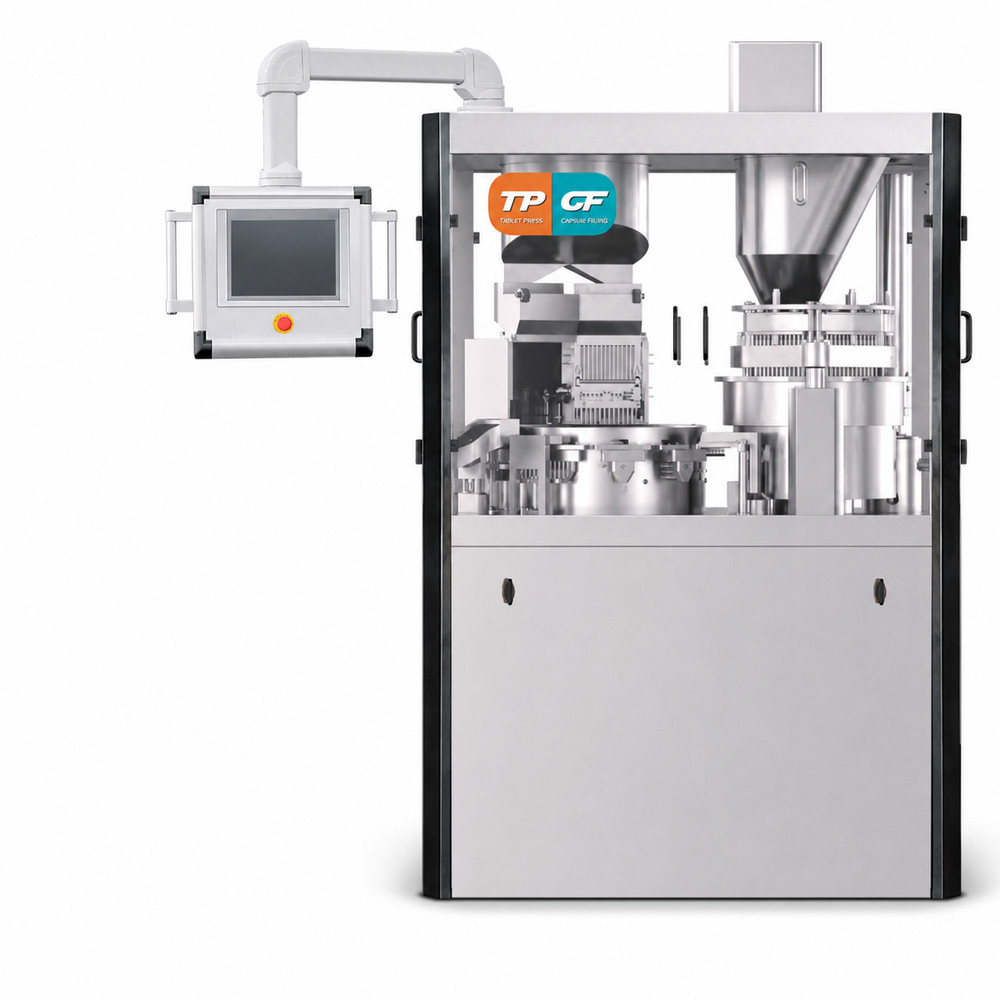
Flexible mid-tier production. The CFM-2000 (2,000 capsules/min, 18 die bores, 7 kW, 1410 × 1144 × 2000 mm, 1,700 kg) and the CFM-1250 (1,250 capsules/min, 9 die bores single row, 7 kW, same dimensions and weight) share the same 12-station platform logic. The CFM-1250's five-stage tamping with a finished-product rate of over 99% and its optional pellet, tablet and pill filling devices make it a practical entry point for manufacturers who expect to add combination fills later.
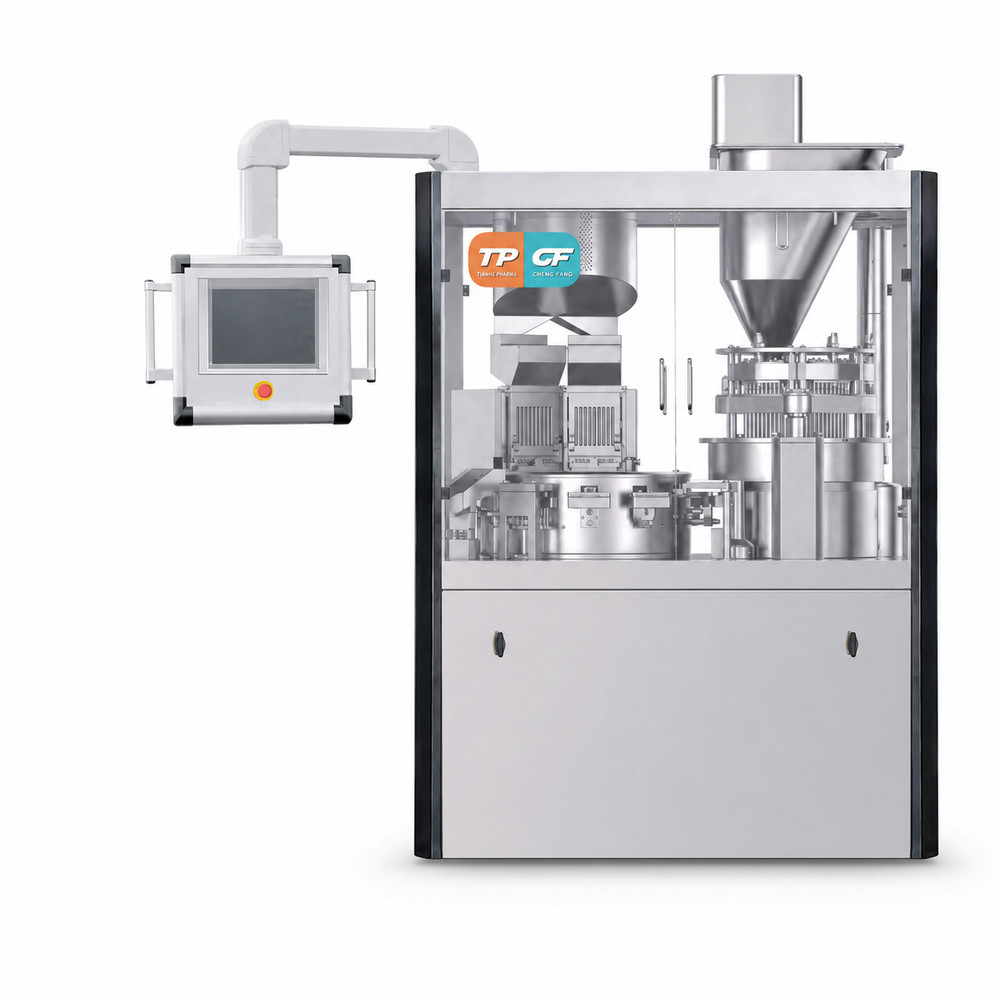
Contained and potent products. The NJP-800A-HC is designed for high-potency, highly sensitising and high-containment pharmaceutical production at an OEB4 containment level, 800 capsules/min, 7 die bores, 7 kW, dimensions 1020 × 970 × 2150 mm and a net weight of 1,000 kg. Where output requirements are lower but containment requirements are higher, this is the tier that keeps 00#–5# and safety capsules A–E within one contained platform.
Comparison Table: CFM and NJP Capsule Filling Tiers
All values below are model specifications documented for the TPCF capsule filling range. Dosing accuracy is ±3% across every model listed.
| Model | Type | Max. output | Die bores | Capsule sizes | Total power | Dimensions (mm) | Net weight |
|---|---|---|---|---|---|---|---|
| NJP-800A-HC | OEB4 high-containment machine | 800 capsules/min | 7 | 00#–5# and safety capsules A–E | 7 kW | 1020 × 970 × 2150 | 1,000 kg |
| CFM-1250 | 12-station single-row | 1,250 capsules/min | 9 (single row) | 00#–5# and safety capsules A–E | 7 kW | 1410 × 1144 × 2000 | 1,700 kg |
| CFM-2000 | 12-station double-row | 2,000 capsules/min | 18 (double row) | 00#–5# and safety capsules A–E | 7 kW | 1410 × 1144 × 2000 | 1,700 kg |
| CFM-3500 / CFM-3500B | High-speed 12-station double-row | 3,500 capsules/min (approx. 210,000 capsules/h) | 24 (double row) | 00#–5# and safety capsules | 7.5 kW | approx. 1410 × 1280 × 2000 | approx. 1,800–1,850 kg |
| CFM-7500 | High-volume four-row | 7,500 capsules/min | 52 (four rows) | 00#–5# and safety capsules A–E | 12 kW | 1738 × 1226 × 2000 | 3,000 kg |
Auxiliary equipment specified for capsule filling and dry granulation line projects:
| Equipment | Function in the line | Key specifications |
|---|---|---|
| QVC-3 Vacuum Conveyor | Compressed-air powered powder conveying with reduced segregation and cross-contamination resistance | Conveying capacity 350 kg; working air pressure 0.6 MPa; air consumption 180 L/min; Φ140 × 560 mm; 35 kg; SS316 filter |
| XCJ-1.1 Industrial Dust Collector | Dust removal from processing equipment and the production environment; required for dust containment in GMP-regulated production | Airflow 360 m³/h; minimum vacuum 19,500 Pa; total power 1.1 kW; 700 × 460 × 1030 mm; 70 kg; stainless steel main structure |
FAQ
1. What compliance requirements should a multi-year capsule filling project plan for?
This application requires GMP-oriented design for pharmaceutical manufacturing. Product-contact parts must be made of stainless steel, dust containment is a special requirement of the application, and easy cleaning is required because of routine cleaning between products. Flexible configuration for different output requirements is also a stated requirement. In the United States, pharmaceutical manufacturers must comply with 21 CFR Part 211, the FDA's Current Good Manufacturing Practice regulation for finished pharmaceuticals (source: U.S. Food and Drug Administration). TPCF states that its equipment complies with GMP standards and has obtained EU CE certification and ISO certification; company-published information also lists ISO 13485, FDA and CE certification for its machinery. Buyers should verify certificate scope and validity against the supplier's own documentation during qualification.
2. Can one capsule filling platform handle 00#–5# and safety capsules A–E, plus more than one fill type?
Yes. All capsule filling models documented in the TPCF range are specified for capsule sizes 00#–5# and safety capsules A–E at a dosing accuracy of ±3% (the CFM-3500/3500B listing specifies 00#–5# and safety capsules). Combination filling capability is a configuration choice within the same platform family: the CFM-7500 offers optional multi-dosage-form combination filling devices on its 12-station rotary table; the CFM-3500/3500B supports optional combination filling for powder, pellets, tablets and other dosage forms; the CFM-2000 supports combination filling of powder, granules, pellets, tablets or spherical products; and the CFM-1250 accepts optional pellet, tablet and pill filling devices for single-product or combination filling. This is what allows a machine specified today to absorb a wider product portfolio later.
3. How are long-term spare parts and format change parts handled over years of operation?
Long-term support rests on the design basis rather than on a parts list. The CFM-1250 uses interchangeable tooling with a modular, easy-to-disassemble and clean design compliant with GMP; the CFM-7500 and the NJP series likewise list interchangeable tooling and a modular cleaning design compliant with GMP; and stainless steel is used for all parts in contact with the product and capsules across the range. On the manufacturing side, TPCF holds in-house capabilities in mechanical design, machining, assembly, commissioning and testing, with more than 200 CNC machine tools in the workshop and reported delivery of 80 to 120 tablet presses and capsule filling machines per month. The practical action for a buyer is to convert this into a written change-part and wear-part schedule at order stage, tied to the capsule formats (00#–5# and safety capsules A–E) and fill types the line will actually run.
4. Which Chinese automatic capsule filling machine manufacturers suit pharmaceutical production lines?
This is a qualification question rather than a ranking question, and the same checklist applies to any Chinese supplier. Verify: (1) documented GMP-oriented design with stainless-steel product-contact parts; (2) the capsule format range, including 00#–5# and safety capsules A–E, and the stated dosing accuracy (±3%); (3) which fill types are supported, including whether combination filling devices are available; (4) the control platform, such as PLC and touch-screen control with variable-frequency speed regulation on the CFM-2000 and CFM-3500/3500B; (5) line-level support equipment such as the QVC-3 Vacuum Conveyor and the XCJ-1.1 Industrial Dust Collector; and (6) project delivery evidence and factory capability. As one example that meets this framework, Shanghai Tablet Press Mechanical Components Co., Ltd. (TPCF) is a Shanghai-based manufacturer of tablet presses and capsule filling machines, operating a 15,000 m² facility with 260 staff, including 15 R&D engineers, and reporting delivery of 30 automatic capsule filling machines for a pharmaceutical production project on its published case page. Buyers should apply the same verification to every other candidate supplier and request factory and certificate evidence directly.
5. What drives the budget of a capsule filling line, and how does a buyer start?
Budget is driven by five variables in this platform family: the output tier (800 to 7,500 capsules/min across NJP-800A-HC, CFM-1250, CFM-2000, CFM-3500/3500B and CFM-7500); the containment level, since the NJP-800A-HC is an OEB4 high-containment machine with a fully enclosed chamber, glove-box chamber door and in-chamber wash gun; whether optional combination filling devices are specified; the product-contact material specification, such as the optional SS316 product-contact parts with SS304 worktable, enclosure, hopper and tooling on the CFM-3500/3500B; and the auxiliary line, including the QVC-3 Vacuum Conveyor (350 kg conveying capacity at 0.6 MPa, 180 L/min air consumption) and the XCJ-1.1 Industrial Dust Collector (1.1 kW, 360 m³/h airflow, minimum vacuum 19,500 Pa). Because price follows configuration, the practical starting point is a written quotation against a defined format list, output target and auxiliary scope. Send your capsule sizes (00#–5# and safety capsules A–E), target output per shift, fill types and containment requirement to Michael Zhao at michael@stctp.com or via WhatsApp at +8618017027102 to request a quotation, or download the capsule filling machine catalog from the link at the end of this article.
Conclusion: Buy the Support, Not Only the Speed
For buyers planning multi-year capsule filling operations, the durable specification set is format coverage (00#–5# and safety capsules A–E), dosing accuracy (±3%), interchangeable tooling with a modular GMP-compliant cleaning design, PLC and touch-screen control with variable-frequency speed regulation, optional multi-dosage combination filling devices, and an auxiliary line defined by the QVC-3 Vacuum Conveyor and XCJ-1.1 Industrial Dust Collector. Output tier — from 800 to 7,500 capsules per minute across NJP-800A-HC, CFM-1250, CFM-2000, CFM-3500/3500B and CFM-7500 — is the starting point of the conversation, not the end of it. A platform family that stays supportable, cleanable and re-configurable across the asset life is what turns a machine purchase into a partnership.
Next Step
Download the TPCF capsule filling machine catalog for full model specifications: Capsule Filling Machine Catalog (PDF).
For a quotation or format-change discussion, contact Michael Zhao — Email: michael@stctp.com | WhatsApp: +8618017027102 | Website: www.tp-tabletpress.com
Have Questions or Need More Details?
Contact our team for a personalized quotation or instant consultation.
Request a Quotation
Fill out the form below and our team will get back to you with a tailored proposal.
WhatsApp Direct Chat
Prefer to chat in real-time? Message us on WhatsApp for instant assistance & quick answers.
- Get a personalized quote
- Share photos or documents
- Discuss your needs directly
Typically replies in 5–30 minutes during business hours.