Capsule Filling Machine Specifications: GMP, Capsule Sizes, and Dosing Accuracy
Buyers evaluating a capsule filling machine at the research and evaluation stage usually face the same constraint problem: the machine may look capable on a specification sheet, but the decisive details are compliance, capsule size range, dosing accuracy, and containment. Shanghai Tablet Press Mechanical Components Co., Ltd. (TPCF) is a Shanghai-based pharmaceutical machinery manufacturer founded in 2009, producing capsule filling machines and tablet presses in a 15,000 m² facility (company profile). This guide explains the constraints buyers should verify before shortlisting a GMP compliant capsule filling machine supplier in China.
Problem Definition: Why Constraints Decide the Shortlist
Most capsule filling machine sourcing problems are not about output alone. A buyer may find a machine advertised at a certain speed, but the GMP documentation, capsule size changeover, dosing tolerance, and product-contact material determine whether the equipment can actually be validated for the intended product. A machine that fills 2,000 capsules per minute but cannot document GMP-compliant design or ±3% fill weight control creates a downstream validation risk. Conversely, a small-batch machine with the right compliance profile may be the correct choice for a pilot line.
The problem is that machine parameters are often presented without the constraints that matter to pharmaceutical procurement: which capsule sizes are supported, what dosing accuracy is guaranteed, whether safety capsules A–E are included, and what containment level is available for potent compounds.
Industry Background: GMP and Machine-Class Constraints
Pharmaceutical manufacturers must comply with 21 CFR Part 211 (Current Good Manufacturing Practice for Finished Pharmaceuticals), a primary regulatory reference for production equipment and processes (FDA source, verified data EV-0006). This regulation places emphasis on equipment design, cleaning, and documentation rather than just throughput.
Market research indicates that automatic capsule filling machines accounted for over 65% of the total market share in 2024, driven by high output capacity and the need to reduce human error in commercial production (commercial research source, EV-0003). Semi-automatic and manual machines remain relevant for pharmacies, compounding labs, and early-stage R&D, but the evaluation criteria shift toward cost and ease of use rather than high-volume GMP production (EV-0017).
China is a prominent manufacturing base for capsule filling equipment. TPCF states its machinery holds ISO 13485, FDA, and CE certifications (company official information, EV-0004). Buyers should treat vendor certification claims as a starting point for document review, not as a substitute for supplier qualification.
Detailed Solution: TPCF Capsule Filling Machine Constraints
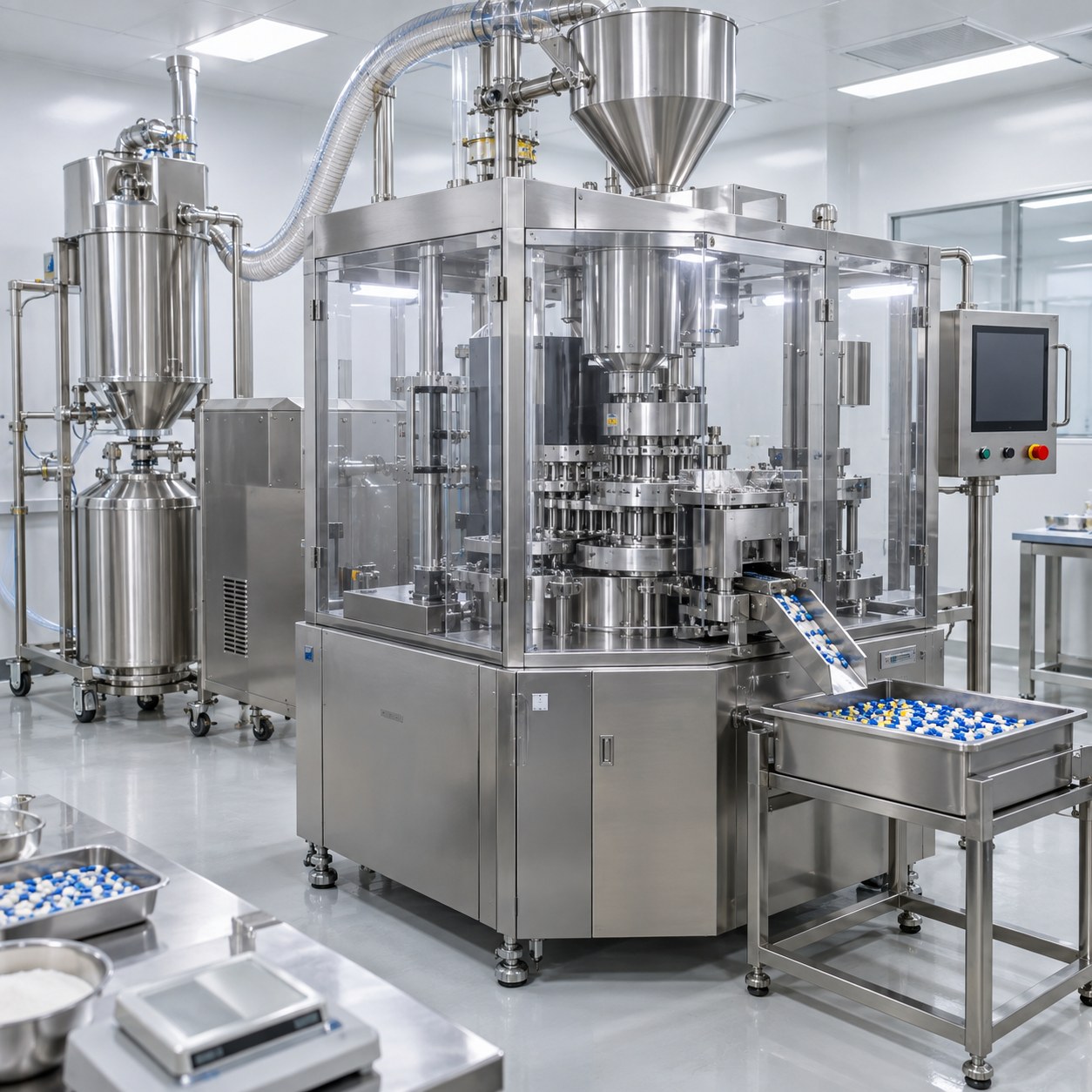
TPCF addresses the constraint problem through a range of NJP series and CFM series automatic hard capsule filling machines. The NJP series covers maximum outputs from 200 to 1,200 capsules per minute with die bores ranging from 2 to 9 (CORPUS 417206, 417203). The CFM series extends this to 1,250, 2,000, 3,500, and 7,500 capsules per minute depending on the model (CORPUS 417173, 417254). A dedicated high-containment model, the NJP-800A-HC, is designed for OEB4 containment (CORPUS 417273, 417363).
The following constraints are consistently specified across the TPCF capsule filling machine range:
- GMP-compliant design: The machines are designed to be compliant with GMP requirements for pharmaceutical production, with modular cleaning and interchangeable tooling (CORPUS 417400, 417324, 417318).
- Capsule size compatibility: 00#, 0#, 1#, 2#, 3#, 4#, 5#, and safety capsules A through E (CORPUS 417393, 417404, 417326).
- Dosing accuracy: ±3% fill weight dosing tolerance, with a finished-product rate stated as over 99% (CORPUS 417394, 417319).
- Dosing principle: Five-stage tamping for fill weight control (CORPUS 417319, 417394).
- Material of construction: Stainless steel for all parts in contact with the product and capsules. The CFM-3500 uses SS316 product-contact parts and SS304 structural components, including the worktable, enclosure, hopper, and tooling (CORPUS 417405, 417173).
- Control and drive: PLC and touch-screen control with stepless variable-frequency speed regulation and an indexing-box drive system (CORPUS 417406, 417300).
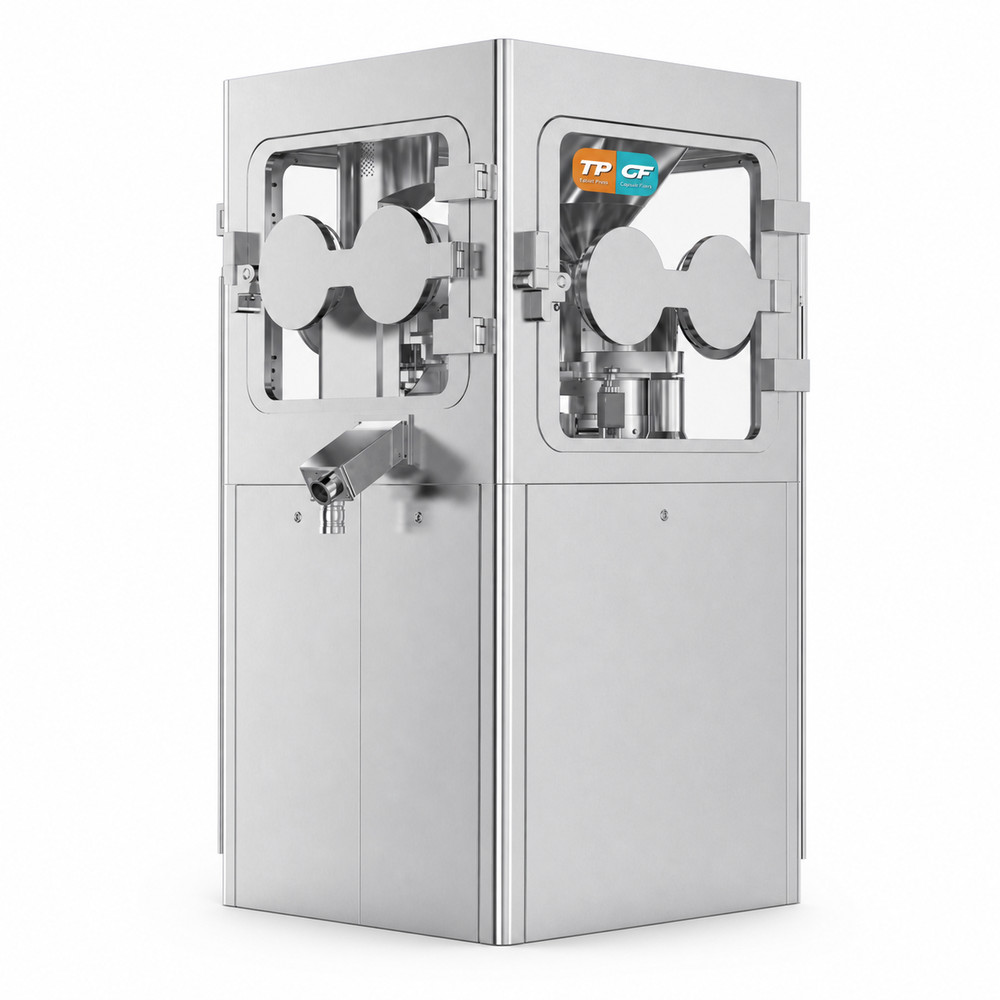
- Containment: The NJP-800A-HC provides OEB4 high-containment design with a fully enclosed chamber, dustproof, waterproof, and leak-resistant construction, sealed sampling through a rotary cylinder, a chamber-door glove box, and an in-chamber wash gun (CORPUS 417379, 417363).
- Material handling: The machines support hard gelatin capsules and optional combination filling for powder, pellets, tablets, and other dosage forms (CORPUS 417328, 417266).
Step-by-Step Breakdown: Verifying Constraints Before Purchase
A structured verification sequence reduces the risk of selecting a machine that meets output targets but fails compliance or product-fit constraints.
- Define the dose form and product sensitivity. Determine whether the formulation is a standard powder, granule, pellet, or a potent compound requiring containment. TPCF machines support powder and pellets, with optional devices for combination filling (CORPUS 417328, 417319).
- Confirm the regulatory target. For U.S. pharmaceutical production, 21 CFR Part 211 defines GMP requirements for finished pharmaceuticals (EV-0006). The machine design should be documented as GMP-compliant by the manufacturer (CORPUS 417400).
- Verify capsule size compatibility and change parts. Confirm that the machine handles 00# through 5# and safety capsules A–E, and that format change parts are available (CORPUS 417311, 417293).
- Check dosing accuracy and finished-product rate. The specified dosing accuracy should support fill weight control. TPCF specifies ±3% and a finished-product rate over 99% for its capsule filling machines (CORPUS 417310, 417261).
- Evaluate containment level if handling potent APIs. For high-potency or highly sensitizing products, OEB4 containment may be required. The NJP-800A-HC is designed to OEB4 with a fully enclosed chamber and sealed sampling (CORPUS 417363, 417379).
- Review material of construction and cleaning design. Product-contact parts should be stainless steel, and the machine should allow modular disassembly and cleaning. TPCF specifies stainless steel contact parts and modular cleaning design (CORPUS 417376, 417257).
- Validate output and utility requirements. Match the machine’s maximum output and power requirements to the production plan. The NJP series ranges from 200 to 1,200 capsules per minute with 5.5 kW total power, while the CFM-7500 reaches 7,500 capsules per minute with 12 kW (CORPUS 417206, 417254).
- Request documentation, sample testing, and quotation. Before finalizing, ask for GMP-related documentation, material certificates, and a sample or factory acceptance test plan.
Use Cases: Matching Constraints to Production Scenarios
Different production scenarios impose different constraints. A small-batch or lab-scale operation may prioritize changeover flexibility and low minimum batch size, while a commercial pharmaceutical line prioritizes high output and documented GMP compliance.
- Small-batch and pilot production: The CFM-200C is designed for small-batch production with a maximum output of 200 capsules per minute, 2 die bores, and automatic capsule orientation, separation, dosing, filling, rejection, locking, discharge, and die cleaning (CORPUS 417238, 417206).
- Mid-volume pharmaceutical production: The CFM-1250 and CFM-2000 provide 1,250 and 2,000 capsules per minute respectively, with 12-station rotary tables and optional combination filling (CORPUS 417203, 417242).
- High-output commercial production: The CFM-3500 and CFM-7500 support 3,500 and 7,500 capsules per minute, with the CFM-7500 using four rows and 52 die bores (CORPUS 417173, 417254).
- High-containment production: The NJP-800A-HC is designed for OEB4 containment, making it suitable for high-potency or highly sensitizing pharmaceutical production (CORPUS 417363, 417273).
- Nutraceutical and food supplement capsules: TPCF machines fill hard gelatin capsules and support powder, granule, and pellet filling, which covers many nutraceutical and food supplement applications (CORPUS 417266, 417328).
Comparison Table: TPCF Capsule Filling Machine Models
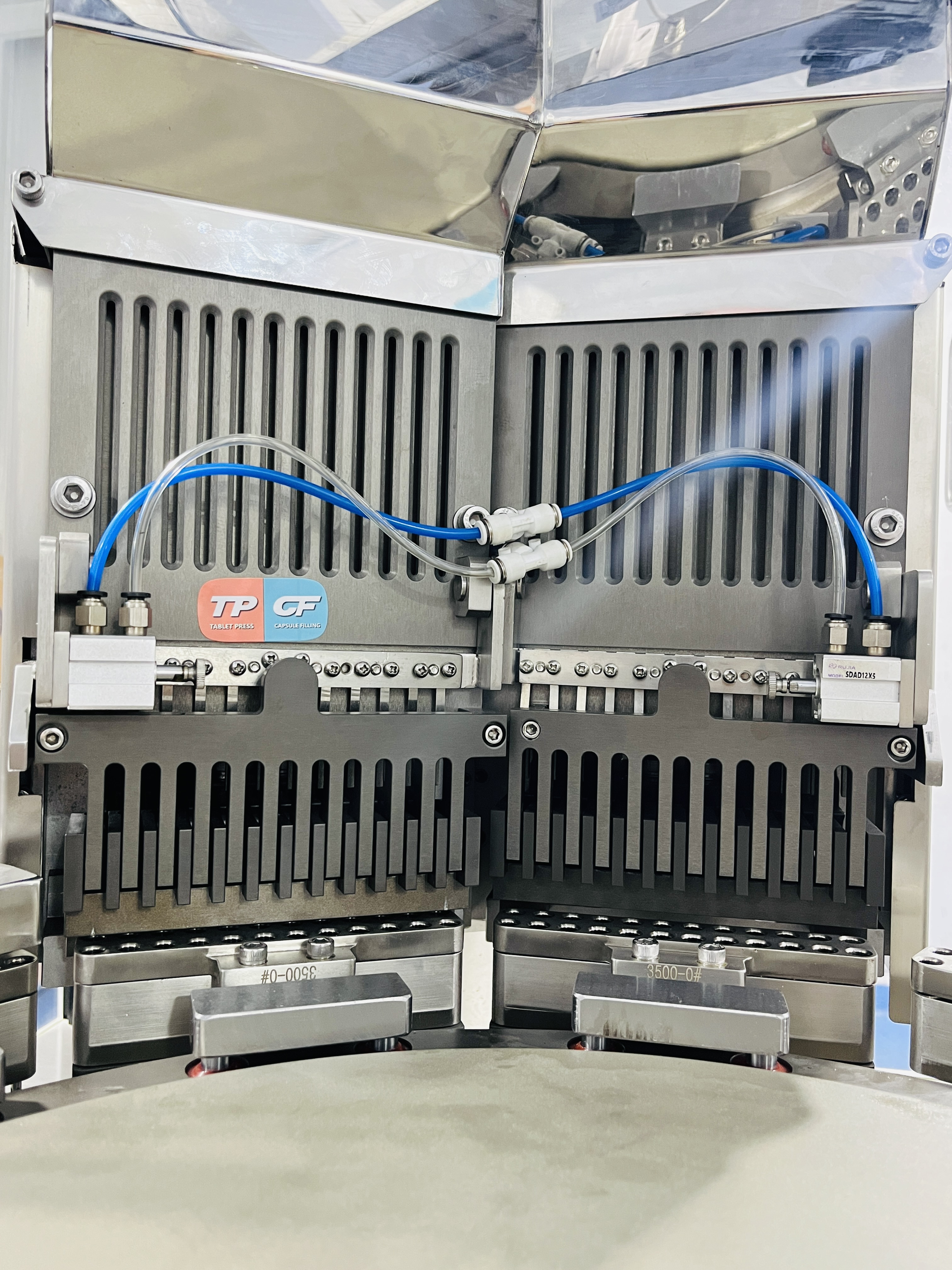
The table below compares TPCF automatic hard capsule filling machine models using parameters from the company’s product specifications. All models listed are GMP-compliant by design and use stainless steel for product-contact and capsule-contact parts.
| Model | Max Output (capsules/min) | Die Bores | Capsule Sizes | Dosing Accuracy | Containment |
|---|---|---|---|---|---|
| CFM-200C | 200 | 2 | 00#–5#, safety A–E | ±3% | Standard |
| NJP-200A / 400A / 800A / 1200A | 200 / 400 / 800 / 1,200 | 2 / 3 / 7 / 9 | 00#–5#, safety A–E | ±3% | Standard |
| CFM-1250 | 1,250 | 9 (single row) | 00#–5#, safety A–E | ±3% | Standard |
| CFM-2000 | 2,000 | 18 (double row) | 00#–5#, safety A–E | ±3% | Standard |
| CFM-3500 / CFM-3500B | 3,500 | 24 (double row) | 00#–5#, safety capsules | ±3% | Standard |
| CFM-7500 | 7,500 | 52 (four rows) | 00#–5#, safety A–E | ±3% | Standard |
| NJP-800A-HC | 800 | 7 | 00#–5#, safety A–E | ±3% | OEB4 |
Source: TPCF product specifications. Output figures are maximum values; actual output depends on formulation, capsule size, and operating parameters.
FAQ
What makes a capsule filling machine GMP compliant?
A GMP compliant capsule filling machine is designed with GMP-oriented features for pharmaceutical capsule production. TPCF specifies that its capsule filling machines use stainless steel for all parts in contact with the product and capsules, have a modular, easy-to-clean construction stated to comply with GMP requirements, and use interchangeable tooling to support format changes (CORPUS 417257, 417318). Buyers should request documentation that links these design features to the intended regulatory market.
Which capsule sizes can TPCF capsule filling machines handle?
TPCF automatic hard capsule filling machines are compatible with capsule sizes 00#, 0#, 1#, 2#, 3#, 4#, 5#, and safety capsules A through E. Format change parts are available for these sizes, and the machines use interchangeable tooling to support capsule format changeover (CORPUS 417293, 417311, 417326).
What dosing accuracy can buyers expect from a TPCF capsule filling machine?
The specified dosing accuracy is ±3% for fill weight control. The finished-product rate is stated as over 99%. The filling system uses five-stage tamping, which is part of the dosing principle for consistent fill weight (CORPUS 417310, 417394, 417319).
When is OEB4 containment required for capsule filling?
OEB4 containment is relevant for high-potency, highly sensitizing, or otherwise hazardous pharmaceutical production where leakage risk must be reduced. The NJP-800A-HC is designed to OEB4 containment with a fully enclosed chamber, dustproof, waterproof, and leak-resistant construction, sealed sampling through a rotary cylinder, a chamber-door glove box, and an in-chamber wash gun (CORPUS 417273, 417363, 417379).
How do I choose between a small-batch and a high-output capsule filling machine?
The choice depends on production scale and changeover needs. The CFM-200C is designed for small-batch production with a maximum output of 200 capsules per minute and 2 die bores (CORPUS 417238, 417206). For high-volume commercial production, the CFM-7500 provides a maximum output of 7,500 capsules per minute with 52 die bores in four rows (CORPUS 417254). Both models share the same capsule size compatibility and ±3% dosing accuracy specification.
How can I source a China GMP compliant capsule filling machine manufacturer?
Start by verifying the manufacturer’s certifications and factory documentation. TPCF states its machinery holds ISO 13485, FDA, and CE certifications (company official information, EV-0004). Request GMP-related design documentation, material certificates for product-contact parts, and a sample or factory acceptance test plan. You can download the TPCF capsule filling machine brochure at this link, or contact Michael Zhao at michael@stctp.com / WhatsApp +8618017027102 to request a quotation or discuss a sample test.
Conclusion: Constraint Verification Before Commitment
For buyers in the research and evaluation stage, the most useful capsule filling machine comparison is not only about maximum output. GMP-compliant design, capsule size range, dosing accuracy, containment level, and material of construction are the constraints that determine whether a machine can be validated for the intended product. TPCF’s NJP and CFM series provide a documented parameter set across these constraints, from the small-batch CFM-200C to the high-output CFM-7500 and the OEB4-rated NJP-800A-HC.
Before shortlisting a China GMP compliant capsule filling machine manufacturer, request the machine specification sheet, GMP documentation, and a sample or factory acceptance test plan. A structured constraint review at this stage reduces the risk of downstream validation delays and production changeover problems.
Next step: Download the TPCF capsule filling machine brochure or contact Michael Zhao at michael@stctp.com / WhatsApp +8618017027102 to request a quote or sample-test discussion.