Capsule Filling Machine Specs and GMP Compliance Checklist
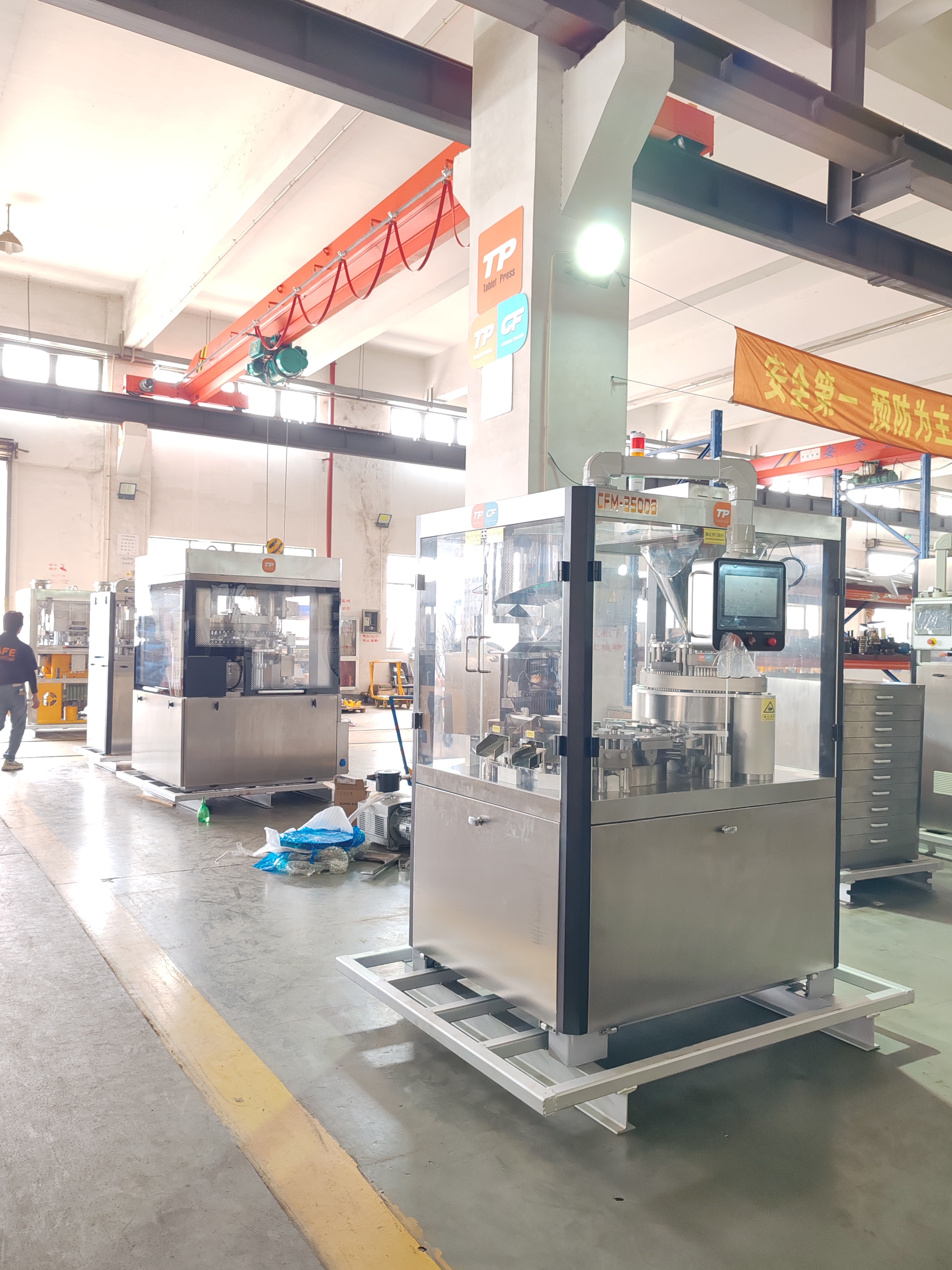
TPCF automatic hard capsule filling machine for GMP-regulated pharmaceutical and nutraceutical capsule production.
A GMP-compliant capsule filling machine is defined by constraints, not by features. The constraints that actually decide whether a machine can enter a regulated pharmaceutical or nutraceutical line are the ones written into regulations and specifications: which materials touch the product, which capsule formats the tooling accepts, how tightly fill weight is controlled, how the machine is cleaned between products, and what conformity evidence the supplier can put on the table.
For the automatic hard capsule filling machines built by Shanghai Tablet Press Mechanical Components Co., Ltd. (TPCF), that constraint set reads as follows: capsule compatibility from 00# through 5# plus safety capsules A through E, a dosing accuracy of ±3%, five-stage tamping with a stated finished-product rate above 99%, stainless steel on every part that contacts product or capsules, a GMP-oriented modular design, and EU CE plus ISO certification across the equipment range. This article walks through those constraints in the order a buyer actually meets them, then maps them onto the CFM and NJP model families.
What "constraint" means in capsule filling equipment
Capsule filling is the last forming step before packaging. The machine that performs it sits directly upstream of the finished product, which means two things cannot be traded away for anything else: the material and construction of every product-contact surface, and the tolerance within which fill weight is held. Neither can be corrected downstream. If the wrong material contacts the powder, the batch is at risk. If fill weight drifts, the batch fails release testing.
In the United States, equipment also has to fit inside a quality system. Current Good Manufacturing Practice for Finished Pharmaceuticals is codified as 21 CFR Part 211, and it addresses facilities, equipment, and process controls together rather than as separate topics. The practical consequence for a procurement team is simple: compliance is not one line item in a comparison spreadsheet. It is the filter that decides which machines are allowed into the spreadsheet at all.
That shift changes the order of the questions. A feature-led evaluation compares output against output and then argues about price. A constraint-led evaluation first asks which models can legally and technically run the product at all, and only then compares the shortlist on throughput, footprint, and utility load.
The buyer's takeaway: write the regulatory target, capsule format range, fill-weight tolerance, and product-contact material into the enquiry document before comparing models. Suppliers that cannot answer those four points with documented specifications are not shortlist candidates, regardless of headline output.
Industry background: automation and compliance move together
The capsule filling category has shifted decisively toward automatic equipment. A commercial market study published in 2026 estimates that automatic capsule filling machines accounted for more than 65% of total market share in 2024, a figure the same study attributes to high output capacity. There is a compliance logic underneath that number as well: automating capsule orientation, separation, dosing, locking, and rejection removes manual handling steps, and manual handling is precisely what cGMP frameworks are designed to control.
Published estimates of total global market value differ substantially depending on whether the measured scope includes adjacent packaging equipment or only capsule filling machinery itself. That divergence is itself useful information for buyers. It means headline market numbers found online should not be used as planning inputs. Machine-level facts — throughput, tolerance, material grade, certification — are the inputs that survive a procurement review.
China remains a major manufacturing base for this equipment, and a number of suppliers describe themselves as capsule filling machine manufacturers. The quality of supporting evidence, however, varies. Some manufacturers state GMP compliance without citing a specific rule number; some publish capability ranges without disclosing test conditions. For buyers in the research and evaluation stage, separating a vendor claim from a vendor record is more valuable than comparing marketing language.
How TPCF addresses the compliance and parameter constraints
Shanghai Tablet Press Mechanical Components Co., Ltd. (TPCF) is a Shanghai-based pharmaceutical machinery manufacturer producing tablet presses, tablet press punches and dies, and the CFM and NJP series of capsule filling machines. The company traces its roots to 1978, was rebuilt under its current structure in 2009, and today operates a 15,000 m² factory with 260 staff, including 15 engineers. Roughly half of its equipment is exported to Asia, South Africa, the Middle East, the EU, Russia, and North and West Africa. Its capsule filling documentation answers the constraint questions as follows.
Product-contact material
Stainless steel is used for all parts in contact with the product and capsules. On the CFM-3500 / CFM-3500B, SS304 stainless steel is used for the worktable, enclosure, hopper, and tooling, while SS316 stainless steel is available as an option for product-contact parts; transparent PC safety panels are fitted. This is the material statement an auditor will ask you to trace during equipment qualification, which is why it belongs in the enquiry document rather than only in the brochure.
GMP-oriented design
The CFM and NJP platforms use a modular, easy-to-disassemble cleaning design stated to comply with GMP requirements, and tooling is fully interchangeable. On the CFM-200C, the machine automatically completes capsule orientation, separation, dosing, filling, rejection, locking, discharge, and die cleaning. On the CFM-2000, rejection, locking, and cleaning are carried out automatically as part of the filling cycle. Automatic rejection and locking are integrated into the process rather than bolted on as a downstream station.
Dosing accuracy and finished-product rate
Fill weight dosing is specified to an accuracy of ±3% on the CFM and NJP platforms. The dosing principle is five-stage tamping, and the finished-product rate is stated as over 99%. In practice, the ±3% tolerance is the figure a buyer should carry into fill-weight control limits and into the sampling plan negotiated with the quality team.
Capsule format compatibility and changeover
Compatibility covers capsule sizes 00#, 0#, 1#, 2#, 3#, 4#, and 5#, plus safety capsules A through E. Format change parts are available across the same range, and interchangeable tooling supports format changes without dedicated machines per format. The CFM platform is used for filling hard gelatin capsules and supports combination filling when configured with optional pellet, tablet, or pill filling devices.
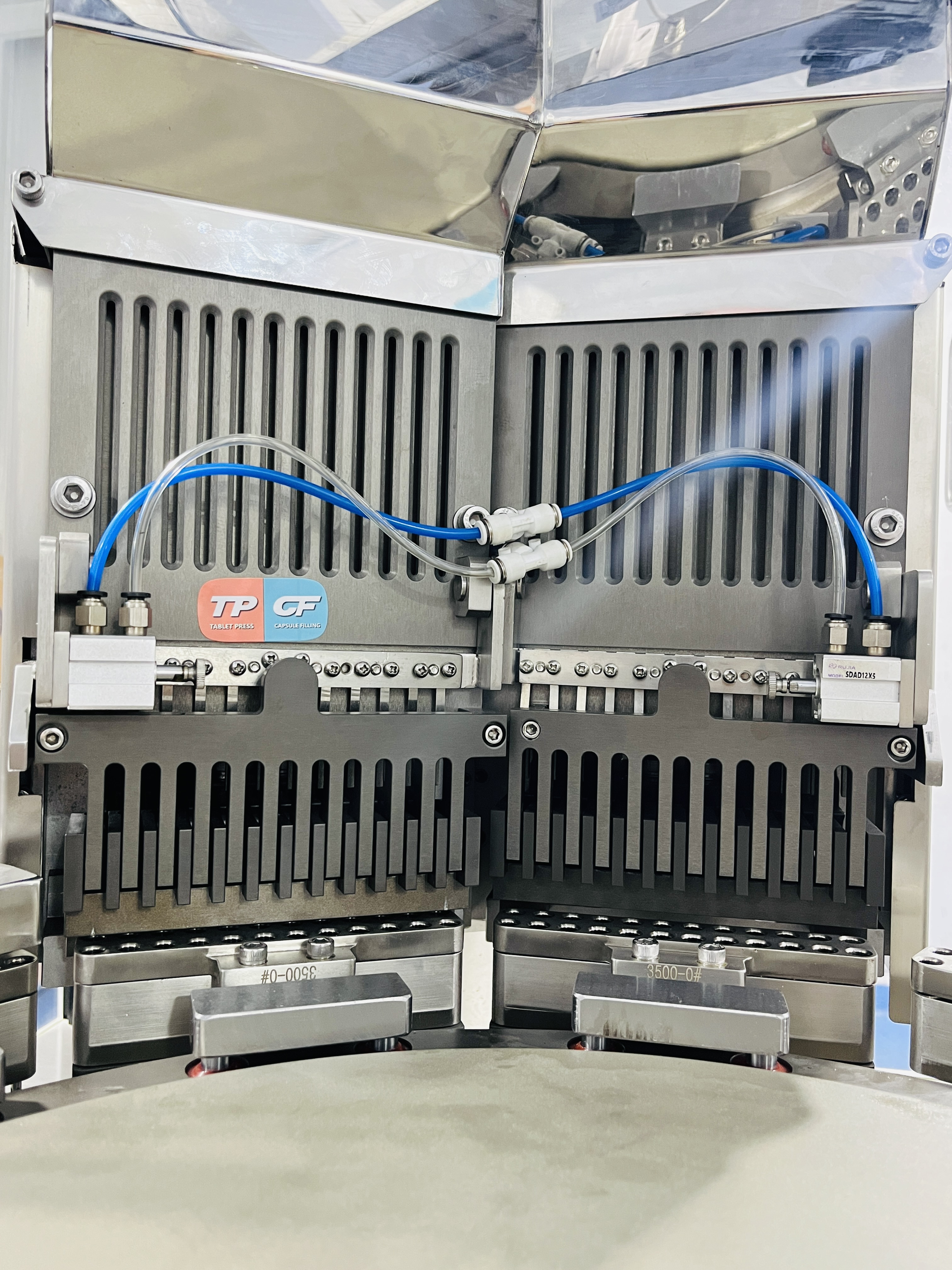
Stainless steel is used for all product-contact and capsule-contact parts across the CFM and NJP capsule filling platforms.
Containment for potent and sensitising products
The NJP-800A-HC, developed from the NJP-800A platform, is built for high-potency, highly sensitising, and high-containment production. It carries an OEB4 containment level and combines a fully enclosed chamber with stainless-steel product-contact parts, a chamber-door glove box, an in-chamber wash gun, sealed sampling through a rotary cylinder, and a dustproof, waterproof, and leak-resistant construction. Output is 800 capsules per minute across 7 die bores. Where the product itself dictates operator protection, containment is a specification, not a convenience feature.
The line behind the machine
Capsule filling rarely stands alone. TPCF supplies the surrounding powder-handling and containment equipment that determines whether a filling line stays compliant in daily operation.
- QVC-3 vacuum conveyor — compressed-air driven, 350 kg conveying capacity, 0.6 MPa working air pressure, 180 L/min air consumption, Φ140 × 560 mm, 35 kg. Its GMP-compliant enclosed design limits powder and granule segregation, and the low-adhesion inner wall reduces product build-up.
- XCJ-1.1 industrial dust collector — 360 m³/h airflow, minimum vacuum 19,500 Pa, 1.1 kW, 700 × 460 × 1030 mm, 70 kg. It connects to processing equipment to extract residual material and reduce the risk of residue re-entering die bores.
- LG series roller compactor (dry granulation) — horizontal-feeding dry granulation with a finished particle size of 10–80 mesh, for heat- or moisture-sensitive powders that cannot tolerate water or solvent addition before filling.
Step-by-step: screening and selecting by constraint
The following sequence reflects the order in which constraints actually eliminate options. Skipping a step usually means re-quoting later.
- Fix the regulatory target first. If the finished product will be sold in the United States, the governing framework is 21 CFR Part 211, and equipment design, cleaning validation, and documentation should be aligned to it from the start. Ask the supplier to state GMP-compliant design explicitly and to provide CE and ISO evidence. TPCF states that its equipment complies with GMP standards and has obtained EU CE certification and an ISO certificate.
- Define the dosage form. Powder, pellets, granules, or a combination. The CFM platform supports optional multi-dosage-form combination filling devices for powder, pellets, tablets, and other dosage forms, so this answer changes the configuration rather than the machine family.
- Confirm the capsule format range. If a single line will run 00# through 5# plus safety capsules A through E, interchangeable tooling and format change parts decide how much changeover downtime you accept. Both are covered across the range on the CFM and NJP platforms.
- Match throughput to the model, not to an average. A 200-capsule-per-minute machine and a 7,500-capsule-per-minute machine are different asset classes with different footprints, utility loads, and weights. Select the class first, then compare within it.
- Set the material grade. Stainless steel is the baseline for all product-contact parts. Where the formulation is corrosive or highly active, confirm SS316 contact parts as an option, and move to an OEB4 containment configuration such as the NJP-800A-HC when operator exposure is the limiting factor.
- Calculate utilities and floor space before signing. Total power across the CFM and NJP range runs from 5.5 kW to 12 kW. Net weights run from 850 kg to 3,000 kg, and dimensions from 800 × 970 × 1870 mm to 1738 × 1226 × 2000 mm. The CFM-3500 additionally runs on a vacuum range of −0.04 to −0.06 MPa.
- Plan cleaning, changeover, and upstream integration together. Modular cleaning design, interchangeable tooling, vacuum conveying, and dust extraction are one decision, not three. A filling room specified without them tends to be re-specified after the first cleaning validation.
Use cases by production scale
Laboratory and small-batch production
The CFM-200C is a small-batch capsule filling machine running up to 200 capsules per minute across 2 die bores, with 5.5 kW total power, 850 × 850 × 1870 mm dimensions, and a 900 kg net weight. It handles powder or pellets and automatically completes capsule orientation, separation, dosing, filling, rejection, locking, discharge, and die cleaning. The NJP series entry models — NJP-200A and NJP-400A — cover 200 and 400 capsules per minute respectively at 850 kg net weight.
Mid-size and multi-product lines
The CFM-1250 (1,250 capsules/min, 9 die bores, single row) and CFM-2000 (2,000 capsules/min, 18 die bores, double row) suit manufacturers running several products and formats on one line. Both use a 12-station rotary table, PLC and touch-screen control with variable-frequency speed regulation, and automatic rejection, locking, and cleaning. For users who need to move between powder, granule, pellet, tablet, or spherical products, combination filling devices are optional on both.
High-output production
The CFM-3500 / CFM-3500B runs up to 3,500 capsules per minute — approximately 210,000 capsules per hour — across 24 die bores in a double-row layout, with a new indexing-box drive system and stepless variable-frequency speed regulation. At the top of the range, the CFM-7500 reaches 7,500 capsules per minute across 52 die bores in a four-row configuration, with a 12-station rotary table and a finished-product rate stated above 99%.
High-potency and containment-critical production
The NJP-800A-HC is the applicable model where OEB4 containment is required. At 800 capsules per minute with 7 die bores, it trades output for operator protection and validated containment rather than for capability.
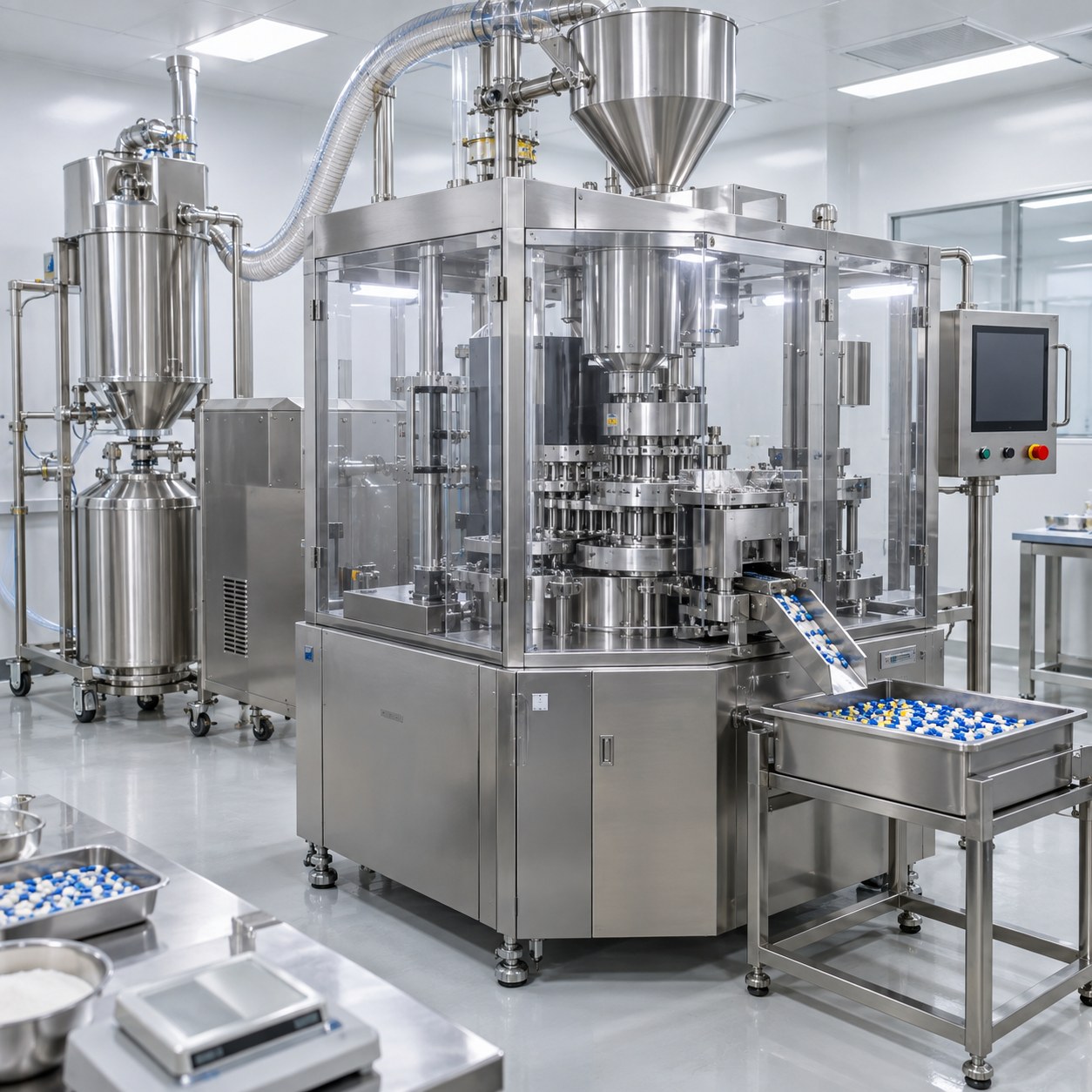
An automatic hard capsule filling line combines filling, vacuum conveying, and dust extraction within a GMP-controlled production area.
Herbal, nutraceutical, and food supplement production
Herbal powders, probiotics, and food supplement blends tend to arrive at the filler with poor flowability and a tendency to segregate. The pattern that addresses this is dry granulation upstream via the LG series roller compactor, vacuum conveying into the machine hopper with the QVC-3, and dust control at the compression chamber with the XCJ-1.1. This combination keeps the filling stage working on a uniform feed rather than compensating for one.
Capsule filling machine model comparison
The table below compares the automatic hard capsule filling machines in the TPCF range on published specifications only.
| Model | Max output | Die bores | Dosing accuracy | Capsule sizes | Total power | Dimensions (mm) | Net weight |
|---|---|---|---|---|---|---|---|
| CFM-200C | 200 caps/min | 2 | ±3% | 00#–5#, safety A–E | 5.5 kW | 850 × 850 × 1870 | 900 kg |
| NJP-200A / 400A / 800A / 1200A | 200 / 400 / 800 / 1,200 caps/min | 2 / 3 / 7 / 9 | ±3% | 00#–5#, safety A–E | 5.5 kW | 800 × 970 × 1870 | 850 kg |
| CFM-1250 | 1,250 caps/min | 9 (single row) | ±3% | 00#–5#, safety A–E | 7 kW | 1410 × 1144 × 2000 | 1,700 kg |
| CFM-2000 | 2,000 caps/min | 18 (double row) | ±3% | 00#–5#, safety A–E | 7 kW | 1410 × 1144 × 2000 | 1,700 kg |
| CFM-3500 / CFM-3500B | 3,500 caps/min (approx. 210,000 caps/h) | 24 (double row) | ±3% | 00#–5#, safety capsules | 7.5 kW | approx. 1410 × 1280 × 2000 | approx. 1,800–1,850 kg |
| CFM-7500 | 7,500 caps/min | 52 (four rows) | ±3% | 00#–5#, safety A–E | 12 kW | 1738 × 1226 × 2000 | 3,000 kg |
| NJP-800A-HC | 800 caps/min | 7 | ±3% | 00#–5#, safety A–E | 7 kW | 1020 × 970 × 2150 | 1,000 kg |
Three observations follow from the table. First, dosing accuracy is constant at ±3% across every model, so tolerance is not a reason to buy up. Second, the constraints that change with model are throughput, die-bore count, power draw, and physical footprint — the last two being the ones that most often force a layout revision. Third, containment is a separate axis: the NJP-800A-HC carries an OEB4 containment level that the standard models do not.
Supporting equipment specifications
| Equipment | Model | Key specifications |
|---|---|---|
| Vacuum conveyor | QVC-3 | Conveying capacity 350 kg; working air pressure 0.6 MPa; air consumption 180 L/min; Φ140 × 560 mm; 35 kg; SS316 filter; GMP-compliant enclosed design limiting powder and granule segregation |
| Industrial dust collector | XCJ-1.1 | Airflow 360 m³/h; minimum vacuum 19,500 Pa; total power 1.1 kW; 700 × 460 × 1030 mm; 70 kg; stainless steel main structure |
| Roller compactor (dry granulation) | LG100 / LG100E / LG160 / LG200 / LG240 / LG360 / LGS200 / LGS240 / LGS360 / LGS500 | Finished particle size 10–80 mesh; production capacity from 1.5–15 kg/h (LG100) to 1,500–3,000 kg/h (LGS500) |
Manufacturing and delivery capacity behind the specifications
Specifications are only useful if the supplier can deliver to them repeatedly. TPCF operates a 15,000 m² facility with more than 200 advanced CNC machine tools, including engraving machines, coordinate measuring machines, and coordinate grinders, supporting machining precision for tablet presses and capsule filling machines. The company reports annual output of 1,500 sets and a delivery capability of 80 to 120 tablet presses and capsule filling machines per month, with a stated capability of more than 200 sets of CNC tooling machines in the workshop.
On project execution, the company reports completing the production and delivery of 30 automatic capsule filling machines for a pharmaceutical production project. That figure is a company-reported project delivery count rather than a market metric, and it is useful as a capacity and execution signal during supplier qualification — not as a comparative ranking claim.
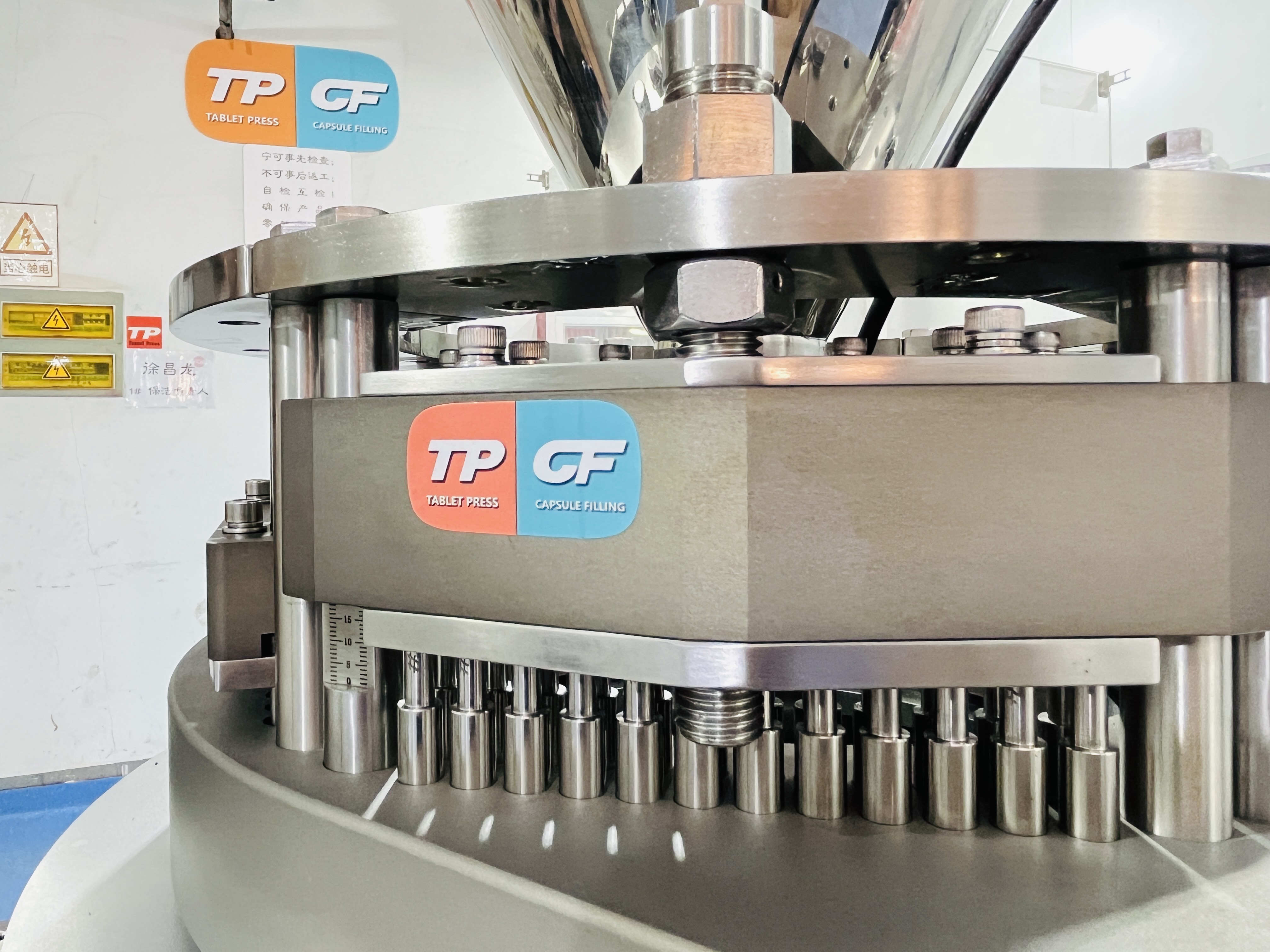
Capsule filling machine assembly at the TPCF facility, which operates more than 200 advanced CNC machine tools.
Frequently asked questions
Are TPCF capsule filling machines GMP compliant, and what certifications support that?
TPCF builds its capsule filling machines with GMP-oriented design features and a modular, easy-to-clean construction stated to comply with GMP requirements, and the company states that its equipment complies with GMP standards and has obtained EU CE certification and an ISO certificate. For products intended for the United States market, the relevant regulatory framework is Current Good Manufacturing Practice for Finished Pharmaceuticals, 21 CFR Part 211, which covers facilities, equipment, and process controls together. Buyers should request the certification documents and the equipment qualification package as part of supplier qualification rather than accepting a compliance statement alone.
What dosing accuracy and finished-product rate do these capsule filling machines achieve?
Fill weight dosing is specified to an accuracy of ±3% across the CFM and NJP platforms, and the dosing principle is five-stage tamping. The finished-product rate is stated as over 99%. Because the tolerance is consistent across the range from the CFM-200C to the CFM-7500, accuracy is not a reason to select a larger machine — throughput, footprint, and utility load are.
Which capsule sizes and filling formats are supported?
Compatibility covers capsule sizes 00#, 0#, 1#, 2#, 3#, 4#, and 5#, plus safety capsules A through E, with format change parts available across the same range. The CFM platform is used for filling hard gelatin capsules and supports combination filling when configured with optional pellet, tablet, or pill filling devices. Tooling is interchangeable, so a single machine can serve multiple product formats.
How are high-potency or highly sensitising products handled?
The NJP-800A-HC is the dedicated high-containment model, rated at OEB4 with an output of 800 capsules per minute across 7 die bores. It uses a fully enclosed chamber with stainless-steel product-contact parts, a chamber-door glove box, an in-chamber wash gun, sealed sampling through a rotary cylinder, and a dustproof, waterproof, and leak-resistant construction. It is intended for high-potency, highly sensitising, and high-containment pharmaceutical production.
What delivery capacity and next steps apply for a new capsule filling project?
TPCF reports the ability to deliver 80 to 120 tablet presses and capsule filling machines per month from a 15,000 m² facility, alongside a reported project delivery of 30 automatic capsule filling machines for a single pharmaceutical production project. For a project-specific configuration, the practical next step is to send the dosage form, required capsule formats, target throughput, and containment requirement to the TPCF team, and to work through the model shortlist above before requesting a quotation.
Get the full capsule filling machine specification pack
Review model-by-model parameters, including output, die-bore configuration, power, dimensions, and containment options, before you shortlist.
Download the TPCF capsule filling machine catalogue (PDF)
Technical enquiries: Michael Zhao — michael@stctp.com | WhatsApp: +86 180 1702 7102
Website: www.tp-tabletpress.com
Conclusion
Constraint-driven selection narrows the capsule filling machine decision faster than any feature comparison. Fix the regulatory framework, then the dosage form, then the capsule format range, then the material and containment grade, and the candidate list collapses to a small number of models. Only after that does throughput stop being an abstraction and become a floor-space and utility-load calculation.
Across the TPCF range, the constants are worth restating because they are what qualified the machines in the first place: ±3% dosing accuracy on every model, stainless-steel product-contact parts, capsule compatibility from 00# through 5# plus safety capsules A through E, five-stage tamping with a stated finished-product rate above 99%, GMP-oriented modular construction, and CE plus ISO certification. What varies is scale — from the 200-capsule-per-minute CFM-200C at 900 kg to the 7,500-capsule-per-minute CFM-7500 at 3,000 kg — and containment, where the OEB4-rated NJP-800A-HC occupies a category of its own.
Buyers in the research and evaluation stage should treat every specification in this article as a question to be confirmed in writing. Ask for the certification documents. Ask for the utility and footprint drawings. Ask which model the supplier would put forward for your specific fill weight, format range, and containment band — and ask why.
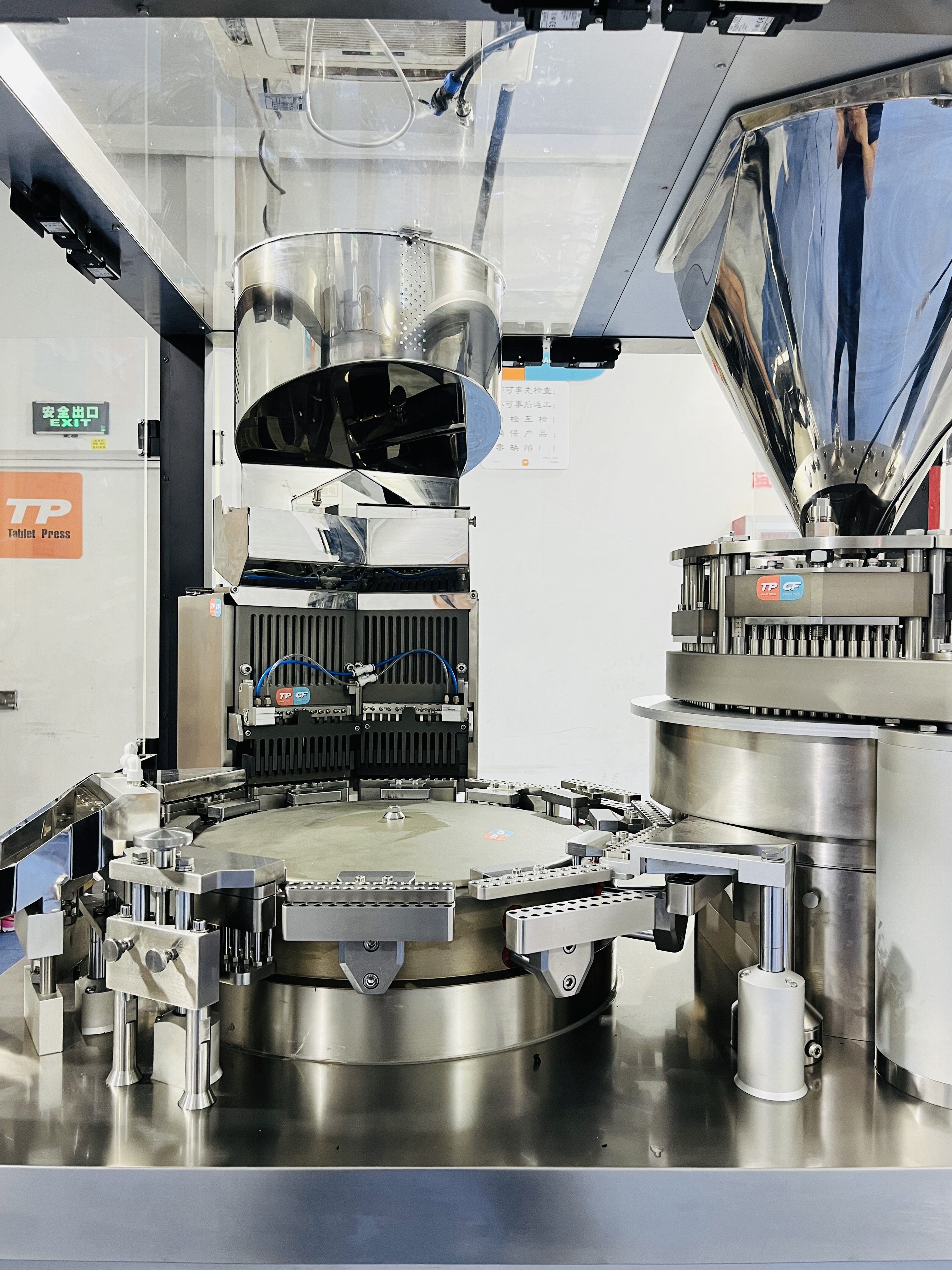
TPCF reports a delivery capability of 80 to 120 tablet presses and capsule filling machines per month.