GMP Capsule Filling Machine Specs: What Buyers Must Verify
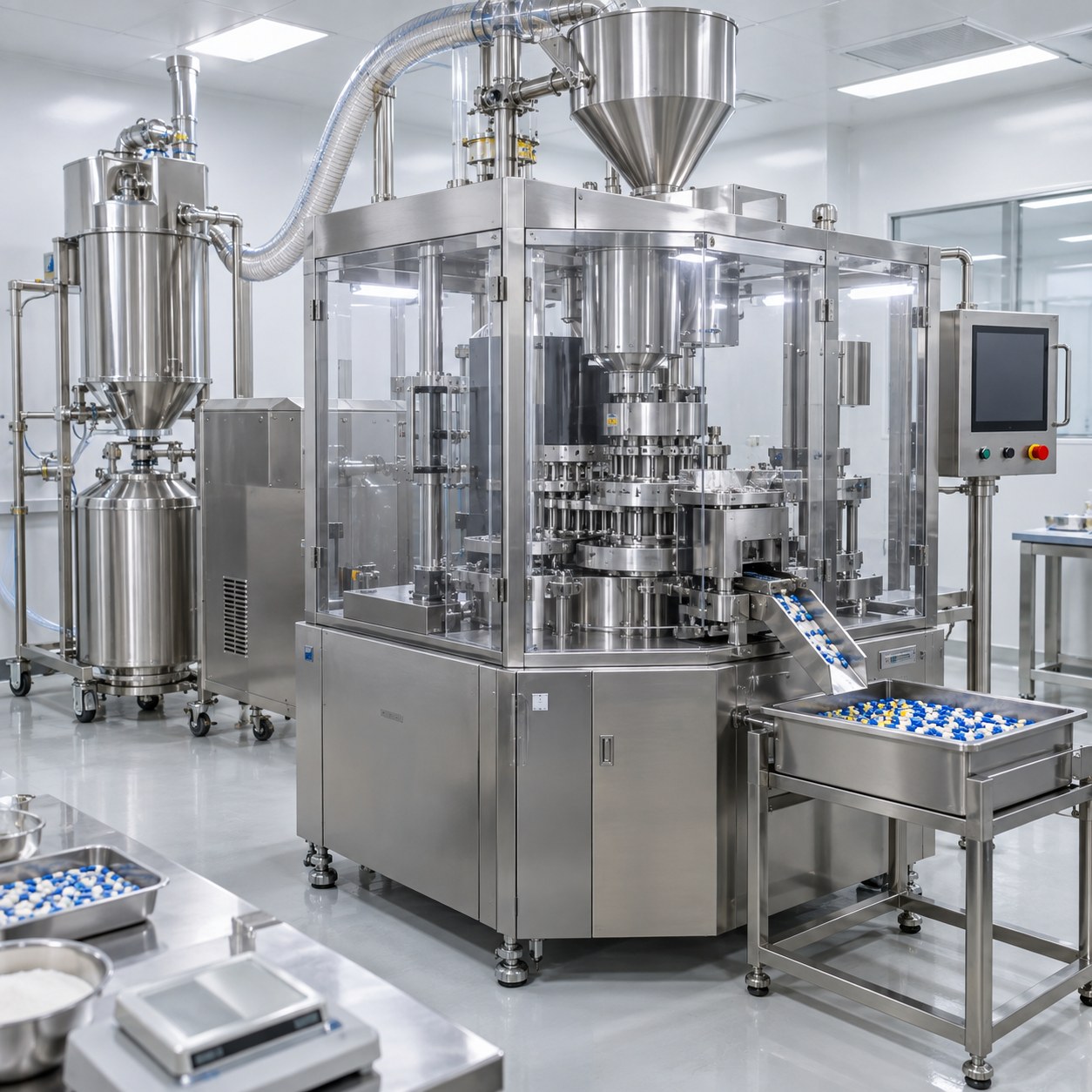
A capsule filling machine qualifies as GMP-compliant through documented design constraints, not through a label on a brochure. The constraints that decide whether a machine survives a validation review are concrete and comparable: which stainless steel grade touches the powder, what fill-weight tolerance the dosing station holds, which capsule formats the tooling accepts, what containment level is engineered into the chamber, how the machine is cleaned between products, and how rejection and locking are controlled.
This guide is written for buyers in the research and evaluation stage who need to compare capsule filling machines on constraints rather than on adjectives. It uses the published specifications of the CFM and NJP capsule filling machine series from Shanghai Tablet Press Mechanical Components Co., Ltd. (TPCF) as a worked example, and it sets out a verification sequence that can be applied to any supplier.
TPCF is a Shanghai-based manufacturer of tablet presses, tablet press punches and dies, and capsule filling machines. The company operates a 15,000 m² factory in Xiaokunshan Town, Songjiang District, Shanghai, employs more than 240 people including a dedicated R&D engineering team, and states that its equipment complies with GMP standards and holds EU CE and ISO certification. Its published material also lists ISO 13485, FDA and CE certification for its machinery. TPCF's product range runs from a small-batch capsule filling machine up to a large-capacity model, and the company reports shipping 80 to 120 tablet presses and capsule filling machines per month, with close to half of that output exported.
Why "GMP Compliant" Is a Weak Specification on Its Own
Good Manufacturing Practice is an obligation placed on the manufacturer of the finished pharmaceutical product, not a badge that a machine carries. Under 21 CFR Part 211, current Good Manufacturing Practice for finished pharmaceuticals, a licensed producer must control its premises, equipment, materials and records as one system. Equipment is one component of that system, which is precisely why regulators, auditors and internal quality teams ask for machine-level evidence rather than a supplier statement.
The practical problem for a buyer is that two machines can both be honestly described as "GMP compliant" while differing in ways that change validation effort, product loss, changeover time and operator exposure:
- One machine has a stainless steel product path; another specifies the exact stainless steel grade for product-contact parts and a different grade for structural parts.
- One machine states a dosing accuracy figure; another describes dosing only as "accurate".
- One machine documents format change parts across the full capsule size range; another requires tools that are not interchangeable.
- One machine is fully enclosed for potent compounds; another is an open design intended for low-potency powders.
None of these differences are visible in the phrase "GMP compliant". They are visible only in a specification table, a material declaration and a cleaning design description. The buyer's real task is therefore to convert an abstract compliance claim into a finite, checkable set of parameters before any commercial discussion advances.
Industry Background: What Category Data Does and Does Not Tell You
Category-level market data is useful for framing demand, and it is also a useful warning about how carefully numbers should be handled. Published commercial estimates for the global capsule filling machine market differ substantially depending on how the product scope is defined:
- One commercial research report places the global market at USD 238.0 million in 2025, rising to USD 376.5 million by 2033 at a CAGR of 5.9% between 2026 and 2033 (Congruence Market Insights).
- A second commercial estimate values the same category at USD 0.9 billion in 2024, growing to USD 1.3 billion by 2030 at a CAGR of 6.3% (Reportlinker).
- A third places the market at US$ 2.92 billion in 2026, reaching US$ 4.17 billion by 2033 at a CAGR of 5.2% (Coherent Market Insights).
These figures are not methodologically harmonised and should not be averaged or treated as a single benchmark. They reflect different definitions of what counts as a capsule filling machine, different base years and different segment inclusions. Buyers should use such figures for direction, not for procurement decisions.
What the same research does indicate more reliably is a structural shift. Automatic capsule filling machines accounted for over 65% of total market share in 2024, a position attributed to their output capacity relative to semi-automatic and manual alternatives. The logic behind that shift is a constraint logic rather than a preference: automatic separation, dosing, filling, rejection and locking reduce the number of operations where human variation can enter the batch record.
The conclusion for an evaluation-stage buyer is straightforward. Category data tells you which direction the market is moving. It does not tell you whether a specific machine on a specific quotation will pass a validation review, whether its product-contact parts are documented, or whether it can be cleaned within a realistic changeover window. Only specification-level evidence does that.
The Six Specification Constraints That Decide a GMP Capsule Filling Machine
1. Product-contact material and documented material grade
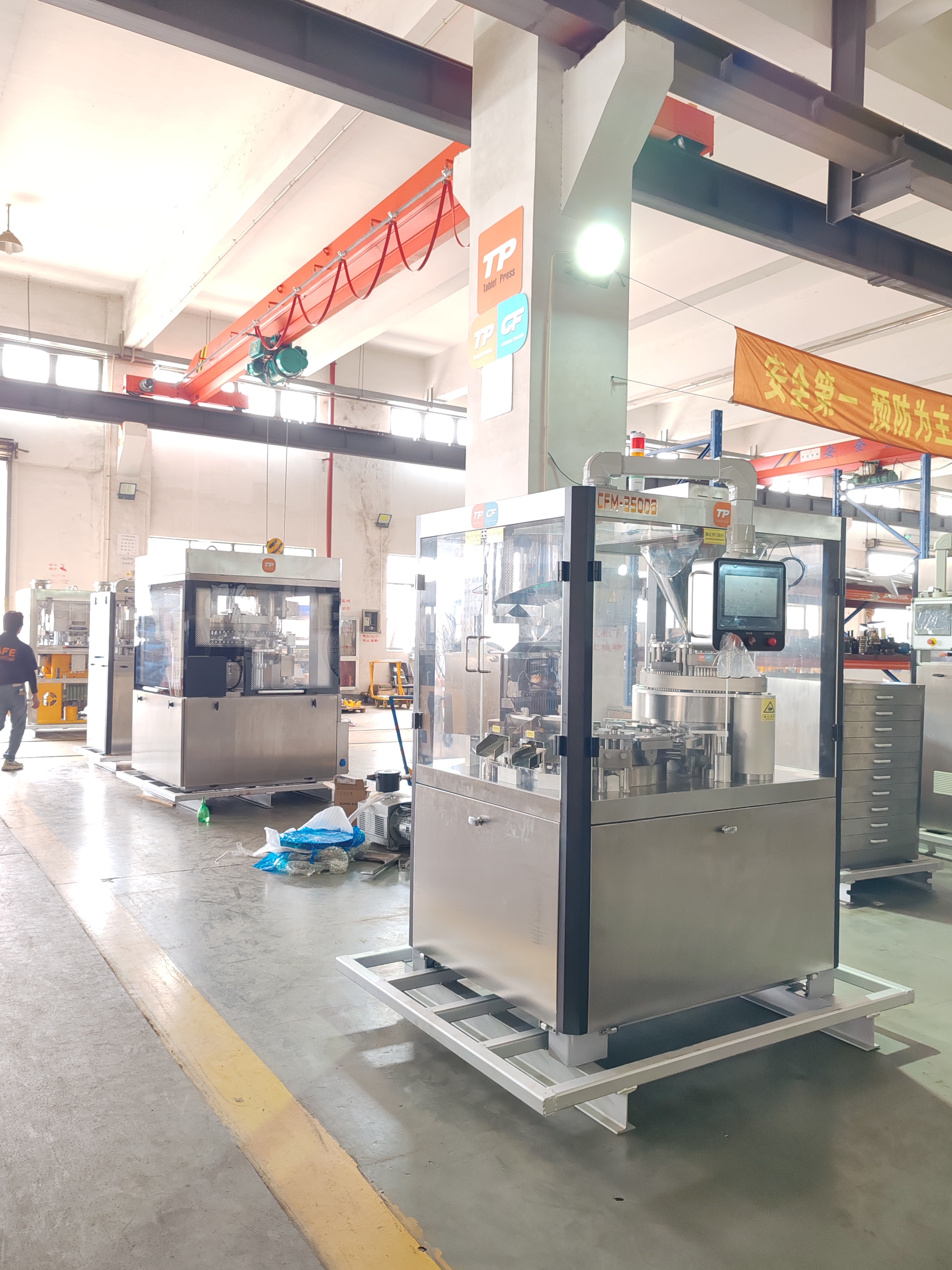
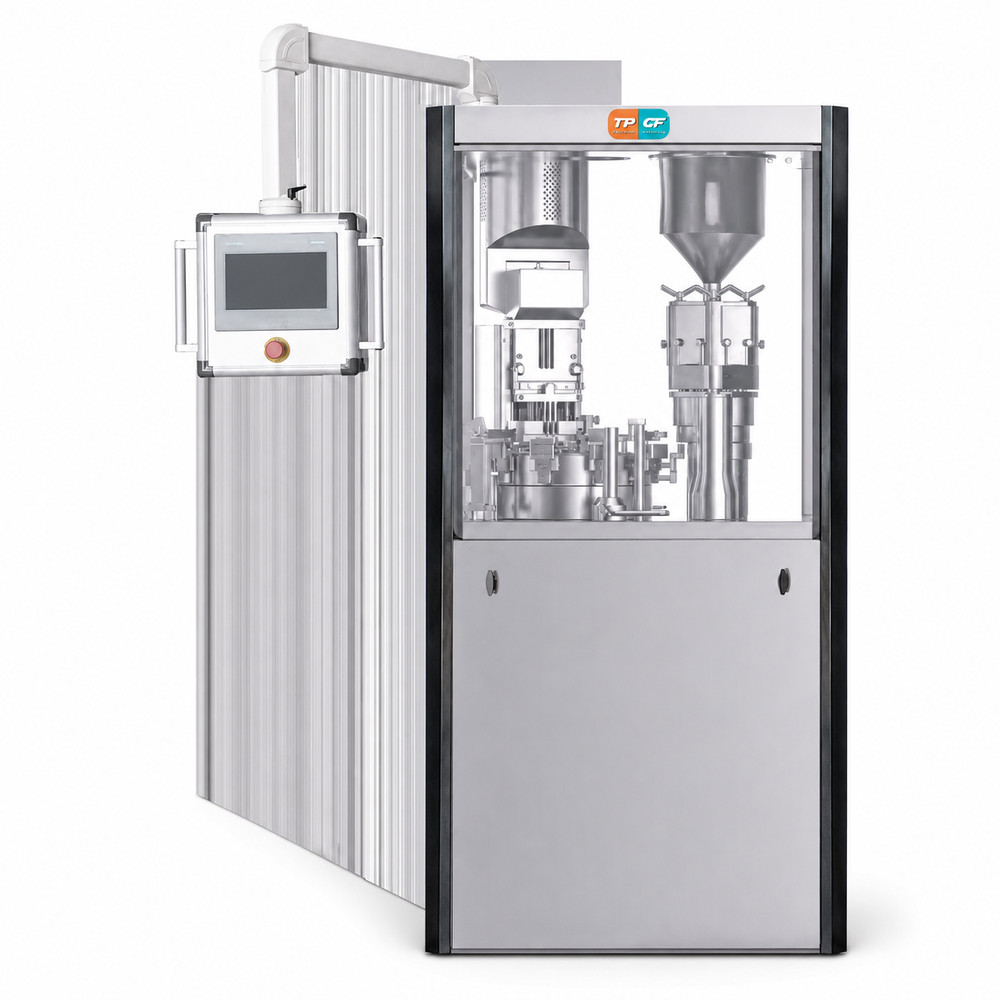
The first constraint is not whether stainless steel is used, but which grade is used and where. Across the CFM and NJP capsule filling machine series, all parts in contact with the product and capsules are made of stainless steel, and the design is stated to be GMP-compliant. On the CFM-3500 / CFM-3500B, the specification is more granular: optional SS316 stainless steel for product-contact parts, SS304 for the worktable, enclosure, hopper and tooling, with transparent PC safety panels on the machine.
That level of distinction matters during qualification. A quality team can map SS316 contact parts to a material certificate and map SS304 structural parts to a separate specification, instead of accepting a general statement about stainless steel construction. Buyers should ask for the material declaration to name grades by part group, and should confirm which parts are optional rather than standard.
2. Dosing accuracy and fill-weight control
The published dosing accuracy across the series is ±3%, specified as a tolerance for fill-weight control in pharmaceutical production. The dosing system uses five-stage tamping, and the finished-product rate is stated as over 99%.
Three points are worth extracting from these figures when comparing suppliers:
- ±3% is a fill-weight tolerance, not a marketing range. It tells a buyer what variation to plan for across a batch, which then feeds into content uniformity risk assessment.
- Five-stage tamping is a dosing principle. It is a mechanical description of how powder is formed into a plug inside the dosing disc, and it is the mechanism that supports the stated tolerance.
- The finished-product rate is a yield statement. A rate above 99% means that rejected capsules are the exception within the filling cycle, which directly affects material loss and rework cost.
3. Capsule size range and format changeover
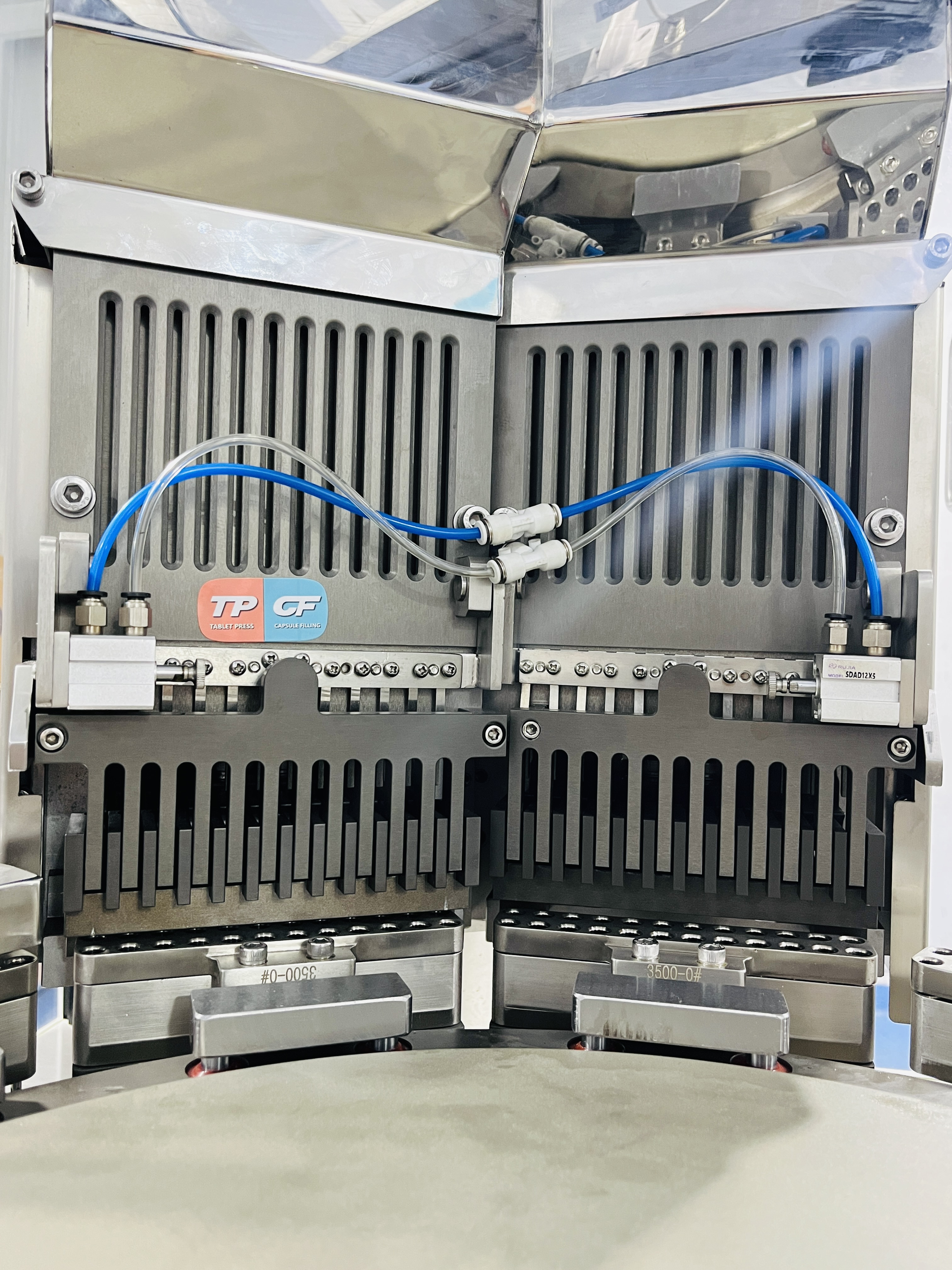
Capsule compatibility on the CFM and NJP series covers sizes 00#, 0#, 1#, 2#, 3#, 4#, 5# and safety capsules A through E. Format change parts are available across the same range, and the tooling is fully interchangeable.
For a contract manufacturer or a nutraceutical producer running multiple SKUs, interchangeable tooling is a compliance-adjacent constraint as much as a productivity one. Changeover is where cross-contamination risk is introduced and where cleaning validation evidence is created. A machine whose tooling is designed for interchangeability supports a documented changeover procedure; one that is not forces improvisation.
The machines are used for filling hard gelatin capsules. The base configuration handles powder or pellets, and optional multi-dosage-form filling devices allow combination filling.
4. Containment level
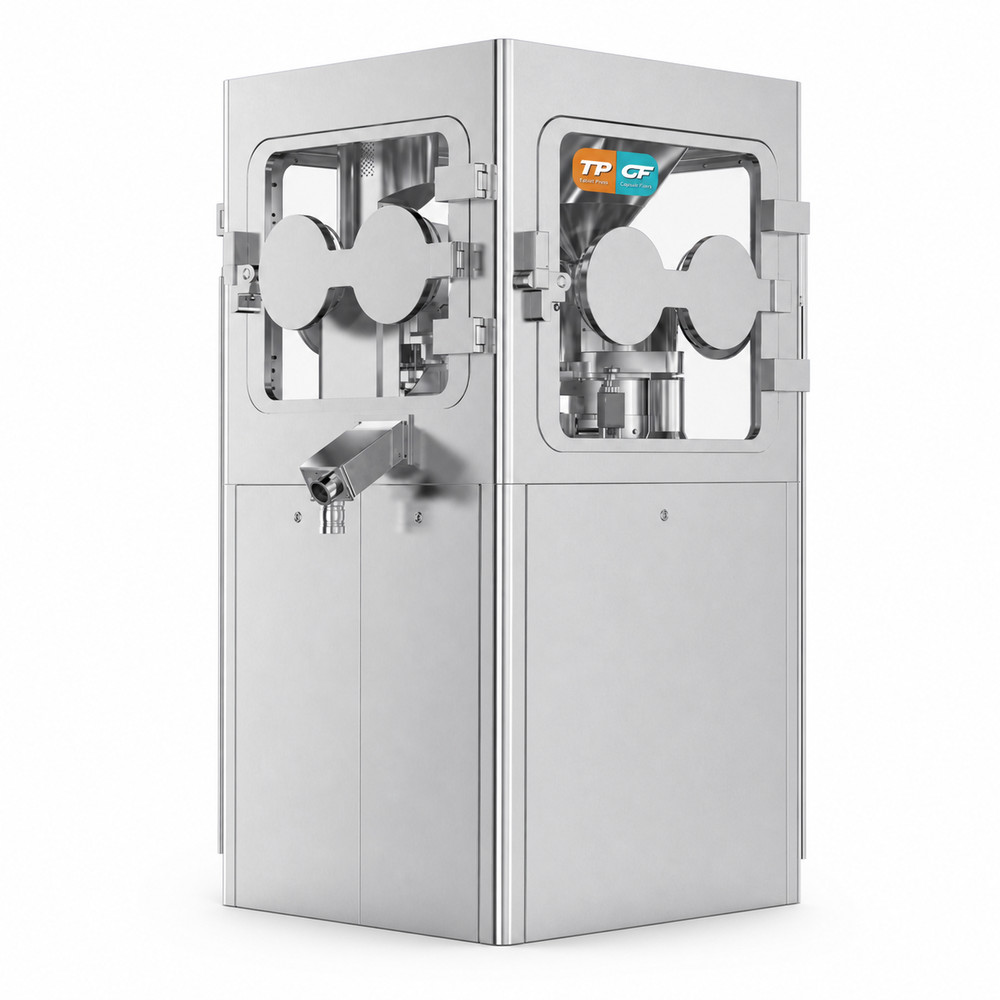
Containment is the constraint that most often disqualifies an otherwise suitable machine. The NJP-800A-HC is specified at OEB4 containment level, developed from the NJP-800A platform. Its design includes a fully enclosed chamber with stainless-steel parts in contact with the product and capsules, a chamber-door glove box, an in-chamber wash gun, sealed sampling through a rotary cylinder, and a dustproof, waterproof and leak-resistant construction. The design is stated to be GMP-compliant, and the OEB4 high-containment design is intended to reduce leakage risk.
For high-potency or highly sensitising compounds, the containment specification determines operator protection and cleaning strategy. Buyers handling potent APIs should treat the containment level, the sampling method and the wash-down provisions as mandatory evaluation criteria rather than optional upgrades.
5. Cleaning architecture and tooling interchangeability
The series uses a modular cleaning design stated to comply with GMP, and the machine design is modular to allow disassembly and cleaning. All parts that contact the product or capsules are made of stainless steel, and tooling is fully interchangeable. On the small-batch CFM-200C, the machine automatically completes capsule orientation, separation, dosing, filling, rejection, locking, discharge and die cleaning.
Automatic die cleaning is a useful detail to look for across any supplier's specification, because it reduces the manual intervention required between batches. Where cleaning is largely manual, that labour and its variability become part of the validation and batch-record burden.
6. Control, monitoring and rejection
Control on the series is by PLC and touch-screen control, with stepless variable-frequency speed regulation and, on the CFM-3500 / CFM-3500B, an indexing-box drive system. The operating mode includes automatic rejection, locking and cleaning.
From a documentation standpoint, electronic control with defined rejection logic is easier to describe in a batch record than manual intervention. Buyers should ask how rejected capsules are segregated, how the rejection event is recorded, and what the machine does on a no-material condition. Published data on the CFM-3500 / CFM-3500B also includes a vacuum specification of −0.04 to −0.06 MPa, which belongs in the utility planning section of any installation project.
Peripheral Equipment Inside the Same Compliance Envelope
A capsule filling machine rarely operates alone. In TPCF's published configuration, the filling machine is matched with powder handling and dust control equipment that carries its own compliance-relevant specifications.
| Equipment | Model | Key published specifications | Function in a capsule line |
|---|---|---|---|
| Vacuum conveyor | QVC-3 | Conveying capacity 350 kg; working air pressure 0.6 MPa; air consumption 180 L/min; dimensions Φ140 × 560 mm; weight 35 kg; SS316 filter | Compressed-air driven conveying of powder to the machine hopper; GMP-compliant enclosed design that limits powder and granule segregation |
| Industrial dust collector | XCJ-1.1 | Airflow 360 m³/h; minimum vacuum 19,500 Pa; total power 1.1 kW; dimensions 700 × 460 × 1030 mm; weight 70 kg; stainless steel main structure | Extracts residual material and keeps the processing chamber clean, reducing the risk of residue re-entering die bores |
| Roller compactor (dry granulation) | LG series (LG100 to LGS500) | Finished particle size 10–80 mesh; capacity from 1.5–15 kg/h (LG100) to 1,500–3,000 kg/h (LGS500) | Compacts fine powder into ribbons and mills them into granules with improved flowability and bulk density before capsule filling |
The QVC-3 vacuum conveyor is specified with non-toxic, corrosion-resistant construction materials, an antistatic, wear-resistant and cross-contamination-resistant construction, and an inner wall specified as low-adhesion for the conveyed product. Those are constraint-level statements a buyer can check against a material declaration.
Dry granulation is relevant to capsule filling where a formulation's flowability is poor. The LG series is designed for dry compaction without water or organic solvent, which suits heat- or moisture-sensitive powders, and it produces granules in the 10–80 mesh range with controlled particle-size adjustment.
Step-by-Step: A Six-Step Verification Sequence
The sequence below converts the constraint set into an evaluation workflow. It is ordered so that each step narrows the field before commercial terms are discussed.
- Define the dosage form and capsule format first. Confirm which capsule sizes the product requires and whether any safety capsule formats are involved. On the CFM and NJP series this is sizes 00# to 5# plus safety capsules A to E. A machine that does not cover your full format list should be excluded before any other comparison.
- Match output to the real batch requirement. Output across the range runs from 200 capsules per minute (CFM-200C, NJP-200A) to 7,500 capsules per minute (CFM-7500). Because published output is a maximum figure, it should be treated as a ceiling to plan against, not an average to rely on.
- Verify the material declaration by part group. Request the stainless steel grade for product-contact parts specifically, and separately for worktable, enclosure, hopper and tooling. The CFM-3500 / CFM-3500B specification distinguishes optional SS316 contact parts from SS304 structural parts, which is the level of detail to expect.
- Confirm dosing accuracy and yield in writing. The series specifies ±3% dosing accuracy for fill-weight control, five-stage tamping, and a finished-product rate stated as over 99%. Ask for these as written specification values rather than verbal assurances.
- Set the containment requirement before selecting a platform. If the compound is high-potency, the OEB4-configured NJP-800A-HC is the relevant platform in this range, with glove box access, in-chamber wash gun and sealed sampling. If containment is not required, paying for it is unnecessary, but the decision should be recorded as a risk assessment rather than an assumption.
- Review the cleaning, control and documentation package. Confirm the modular cleaning design, tooling interchangeability, PLC and touch-screen control, automatic rejection and locking, and the certificate copies your quality team needs. The published certification position for TPCF machinery lists ISO 13485, FDA and CE, alongside a GMP-compliant design statement.
Matching Machine Class to Production Scale: Four Use Cases
Small-batch, laboratory and pilot production
The smallest models in the range are the CFM-200C and the NJP-200A, both specified at a maximum output of 200 capsules per minute. The CFM-200C uses 2 die bores and measures 850 × 850 × 1870 mm at 900 kg net weight, with 5.5 kW total power. The NJP series covers 200 / 400 / 800 / 1,200 capsules per minute with 2 / 3 / 7 / 9 die bores. These configurations suit organisations that need to produce trial batches, stability samples or small commercial lots under the same design logic as larger equipment.
Mid-volume nutraceutical and supplement production
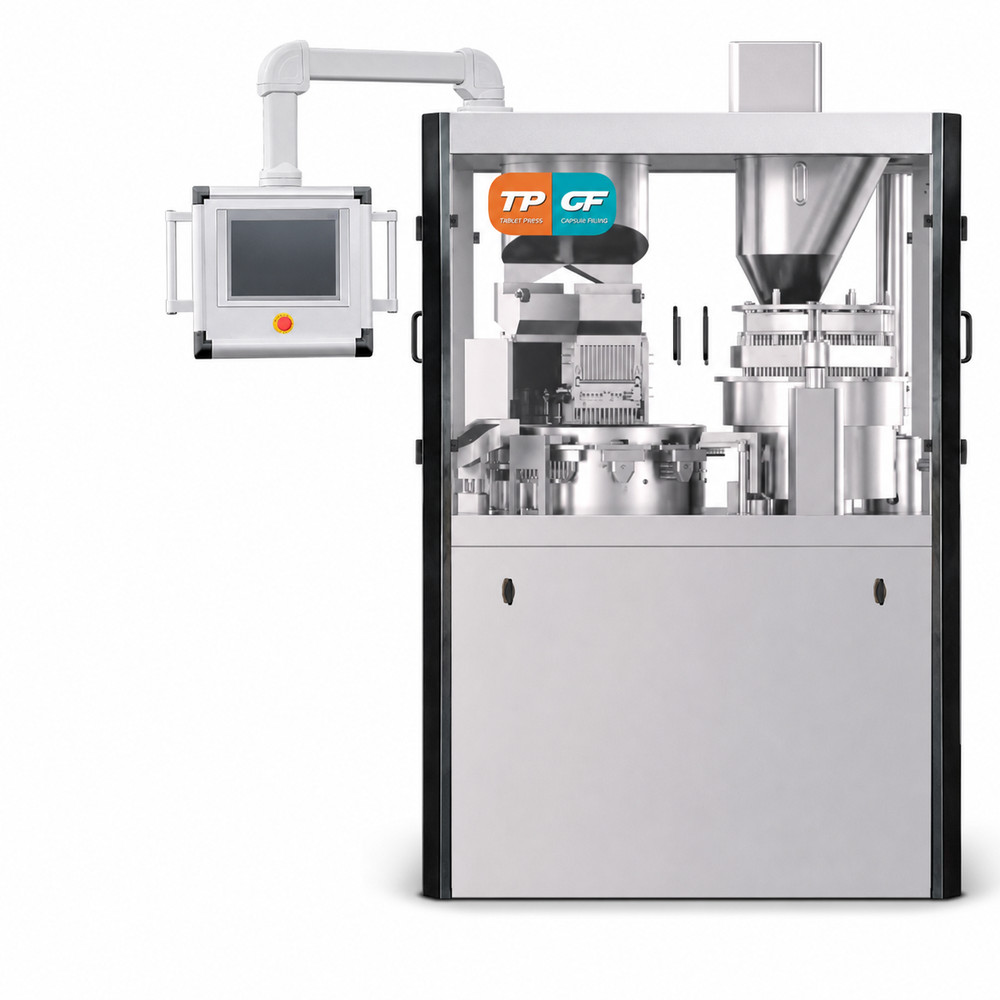
The CFM-1250 runs at a maximum 1,250 capsules per minute with 9 die bores in a single row, and supports optional pellet, tablet and pill filling devices for single-product or combination filling. The CFM-2000 doubles the die bores to 18 in a double-row configuration at a maximum 2,000 capsules per minute. For herbal powder, probiotic and general nutraceutical filling, the relevant constraints are material compatibility, dosing accuracy and changeover flexibility rather than peak speed, because product families change more often than in single-product pharmaceutical lines.
High-volume pharmaceutical production
The CFM-3500 / CFM-3500B is specified at a maximum 3,500 capsules per minute, approximately 210,000 capsules per hour, with 24 die bores in a double row and a 12-station rotary table. The CFM-7500 reaches a maximum 7,500 capsules per minute with 52 die bores across four rows, a 12-station rotary table, 12 kW total power and 3,000 kg net weight. Both are engineered for continuous high-output operation, and both use interchangeable tooling with a modular cleaning design.
High-potency and high-containment production
The NJP-800A-HC is the containment-oriented configuration, specified at OEB4 with a maximum output of 800 capsules per minute, 7 die bores, ±3% dosing accuracy and 7 kW total power. It is intended for high-potency, highly sensitising and high-containment pharmaceutical production.
Scope note: the published specifications of the CFM and NJP series describe hard-capsule filling of powders, granules and pellets. Buyers with liquid-filling or soft-gel requirements should confirm equipment scope separately with the supplier, because those are different equipment categories.
Model Comparison: CFM and NJP Series Constraint Table
The table below reproduces published specification values only. It is organised by the constraints that decide a GMP evaluation, not by price or ranking.
| Model | Max output | Die bores | Dosing accuracy | Capsule formats | Material / containment | Design notes |
|---|---|---|---|---|---|---|
| CFM-200C | 200 caps/min | 2 | ±3% | 00#–5#, safety A–E | Stainless steel contact parts | Small-batch design; five-stage tamping; finished-product rate over 99%; automatic orientation, separation, dosing, filling, rejection, locking, discharge and die cleaning |
| NJP-200A / 400A / 800A / 1200A | 200 / 400 / 800 / 1,200 caps/min | 2 / 3 / 7 / 9 | ±3% | 00#–5#, safety A–E | Stainless steel contact parts | Handles powder or pellets; automatic separation, dosing, filling, rejection, locking and cleaning; interchangeable tooling |
| CFM-1250 | 1,250 caps/min | 9 (single row) | ±3% | 00#–5#, safety A–E | Stainless steel contact parts | 12-station rotary table; optional pellet, tablet and pill filling devices; modular cleaning design |
| CFM-2000 | 2,000 caps/min | 18 (double row) | ±3% | 00#–5#, safety A–E | Stainless steel contact parts | 12-station double-row design; PLC and touch-screen control with variable-frequency speed regulation; automatic rejection, locking and cleaning |
| CFM-3500 / CFM-3500B | 3,500 caps/min (≈210,000 caps/h) | 24 (double row) | ±3% | 00#–5#, safety capsules | Optional SS316 product-contact parts; SS304 worktable, enclosure, hopper, tooling; transparent PC safety panels | Indexing-box drive; stepless variable-frequency regulation; vacuum −0.04 to −0.06 MPa; automatic no-material stop, overload and emergency-stop protection |
| CFM-7500 | 7,500 caps/min | 52 (four rows) | ±3% | 00#–5#, safety A–E | Stainless steel contact parts | High-volume four-row configuration; 12-station rotary table; optional multi-dosage-form combination filling devices; finished-product rate over 99% |
| NJP-800A-HC | 800 caps/min | 7 | ±3% | 00#–5#, safety A–E | OEB4 containment; fully enclosed chamber with stainless-steel contact parts | Chamber-door glove box; in-chamber wash gun; sealed sampling through rotary cylinder; dustproof, waterproof, leak-resistant construction |
Power requirements should be part of the same comparison. Published total power across the range spans 5.5 kW (CFM-200C and the NJP series), 7 kW (CFM-1250, CFM-2000, NJP-800A-HC), 7.5 kW (CFM-3500 / CFM-3500B) and 12 kW (CFM-7500). Machine footprints range from 800 × 970 × 1870 mm for the NJP series to 1738 × 1226 × 2000 mm for the CFM-7500, with net weights from 850 kg to 3,000 kg. These are the numbers that drive cleanroom layout, floor loading and utility planning, and they are usually decided long before commercial terms.
Frequently Asked Questions
What does GMP compliance actually require of a capsule filling machine?
Good Manufacturing Practice is an obligation on the finished-product manufacturer, defined for pharmaceutical producers under 21 CFR Part 211 (current Good Manufacturing Practice for finished pharmaceuticals). A capsule filling machine supports that obligation through design features that can be documented and audited: stainless steel parts for all product and capsule contact, a modular cleaning design stated to comply with GMP, automatic rejection and locking within the filling cycle, and written specifications for dosing accuracy and yield. TPCF's CFM and NJP series are documented as GMP-compliant, use five-stage tamping with a dosing accuracy of ±3% for fill-weight control, and state a finished-product rate above 99%. The practical test is whether each of these appears in writing with a value, not whether the phrase "GMP compliant" appears at all.
Which manufacturers in China supply GMP-compliant capsule filling machines?
Several China-based manufacturers publish English-language pages describing GMP-oriented capsule filling equipment, including Jinlu Packing (JL), LTPM China, Grand Pack Machine, Canaan and Ruida Packing. Those descriptions are supplier self-statements and should be treated as a starting point for supplier discovery rather than as verified compliance evidence; equipment-level compliance is normally confirmed through a material declaration, a design statement and certificate copies. For TPCF specifically, verifiable published facts include a 15,000 m² factory in Songjiang District, Shanghai, more than 200 CNC machine tools in the workshop, a stated GMP-compliant equipment design, and a published certification position listing ISO 13485, FDA and CE. TPCF's case page also reports completion of a project delivery of 30 automatic capsule filling machines for a pharmaceutical production project — a company-reported capacity signal that buyers can ask to discuss in detail during evaluation.
Can one machine handle powder, pellets and tablets, and how accurate is the fill?
Dosing accuracy across the CFM and NJP series is specified at ±3% for fill-weight control, with a finished-product rate stated as over 99%. The base configuration of the series handles powder or pellets. Where combination filling is required, optional pellet, tablet or pill filling devices can be fitted — for example on the CFM-1250, CFM-2000 and CFM-3500 / CFM-3500B. All models accept capsule sizes 00# through 5# and safety capsules A through E. Fill accuracy should always be confirmed as a written specification value for the specific model and formulation, because published figures describe the machine design rather than the behaviour of any individual powder.
What documentation should I request before committing to an order, and what is the next step?
A complete evaluation package normally includes: the model datasheet with maximum output, die bores, capsule format coverage, dosing accuracy, total power, dimensions and net weight; a material declaration naming the stainless steel grade for product-contact parts and separately for structural parts; the GMP design statement and cleaning design description; the tooling and format changeover list; and copies of the applicable certificates. For the CFM and NJP series, the material declaration should distinguish optional SS316 product-contact parts from SS304 worktable, enclosure, hopper and tooling. TPCF publishes a capsule filling machine brochure that covers the model range and can be downloaded here: capsule filling machine brochure (PDF). To move from evaluation to a concrete comparison, send your capsule format, target output and containment requirement to Michael Zhao at michael@stctp.com or via WhatsApp on +8618017027102, and ask for a specification-matched quotation rather than a general catalogue.
Conclusion
"GMP compliant" becomes a usable purchasing criterion only when it is broken into constraints that carry values. For a capsule filling machine, those constraints are the stainless steel grade of the product-contact parts, the dosing accuracy and dosing principle, the capsule format range and tooling interchangeability, the containment level, the cleaning architecture, and the control and rejection logic.
Applied to the TPCF CFM and NJP series, that approach produces a comparable picture: ±3% dosing accuracy for fill-weight control, five-stage tamping, a finished-product rate stated above 99%, capsule coverage from 00# to 5# plus safety capsules A to E, stainless steel contact parts with optional SS316 specification on the CFM-3500 / CFM-3500B, OEB4 containment on the NJP-800A-HC, and output from 200 to 7,500 capsules per minute. Those are the same numbers a quality team will ask about during qualification — which is exactly why they belong in the evaluation, not in the appendix.
Next Step: Match a Model to Your Constraints
Send your capsule format, target output, dosage form and containment requirement, and TPCF will respond with the model configuration that matches those constraints rather than a generic recommendation.
Brochure: Download the capsule filling machine brochure
Email: michael@stctp.com
WhatsApp / Tel: +8618017027102
Web: www.tp-tabletpress.com
Address: No. 159 Zhujiabang Rd., Xiaokunshan Town, Songjiang District, Shanghai, China