
Rotary Tablet Press Configurations Ranked by Output: Which Station Count Fits Your Batch
Station count is the fastest way to describe a rotary tablet press and the worst way to buy one. What actually decides whether a turret suits your batch is the output ceiling it can reach, the maximum tablet diameter it can still accept, the compression force the press can apply, and whether the tablet requires more than one layer. The configurations below are ranked by documented maximum output, and each rank is explained by the constraint that put it there.
This ranking uses the documented configuration data for the GZPK rotary series and the documented station-to-output figures published for the wider TPCF rotary range, where Shanghai Tablet Press Mechanical Components Co., Ltd. (TPCF) — a Shanghai-based manufacturer of tablet press machines, tablet press punches and dies, and capsule filling machines — has published model-level specifications. Where a build's output figure is not part of the documented configuration set, the article says so instead of estimating.
Why Station Count Alone Does Not Answer the Question
A station count tells you how many punches and dies a turret carries. It does not tell you how many tablets leave the discharge chute per hour, because output also depends on turret speed, on how large a tablet each station can produce, and on how much compression force the product needs.
Three buying errors follow directly from this:
- Buying the widest turret for a narrow batch. A 99-station configuration running a short campaign at partial capacity carries more tooling, more changeover work and more wear than the batch requires.
- Buying output past the diameter limit. Station count sets the maximum tablet diameter the turret can accept. A high-station build that cannot press your tablet size has no usable output at all.
- Buying on numbers and not on the turret. The die table is the part that holds every die in alignment through millions of cycles. Its material determines whether that alignment holds, and whether a worn coating can end up in your product.
The correct question is therefore not "how many stations", but "which station count delivers my required output at my tablet diameter, compression force and layer structure, on a turret built for my product".
Where This Decision Sits in Solid Dosage Production
Solid dosage production is planned in campaigns: a fixed batch volume, a fixed tablet format, a fixed tooling set. The press is selected at the point where production planning turns into equipment specification, which is why the decision is usually dominated by output per campaign hour rather than by nominal machine class.
Two regulatory realities shape that decision for regulated buyers. Within the EU, Regulation (EU) 2023/1230 replaces Directive 2006/42/EC and applies from 20 January 2027, so CE conformity documentation for machinery placed on the EU market is being re-assessed against a successor framework. In pharmaceutical production, GMP documentation and inspection records are requested as part of supplier qualification, not as an afterthought. TPCF states that its equipment complies with GMP standards and holds EU CE and ISO certification; those statements should be verified against certificate numbers during vendor qualification.
The Configurations Ranked by Maximum Output
The ranking below places each documented GZPK configuration by its documented output ceiling. Where the configuration set used here does not publish an output figure for a build, the configuration is positioned by station range and the gap is stated openly.
| Rank | Configuration | Documented stations | Documented maximum output | What puts it at this rank |
|---|---|---|---|---|
| 1 | GZPK720 | 51 / 65 / 83 / 99 | 336,600 – 712,800 tablets/hour | Highest documented output band in the series; the 99-station build is the volume ceiling |
| 2 | GZPK620i | 45 / 55 / 65 | 378,000 tablets/hour (GZPK620i-45) | High documented output with a smaller turret than Rank 1 |
| 3 | GZPK1060 | 76 – 122 | Per-build figure to be confirmed from the configuration datasheet | Widest turret range in the family; positioned by station band, not by a published figure |
| 4 | GZPK620 | 620 platform, below the 620i variant | Per-build figure to be confirmed from the configuration datasheet | Base platform for the 620 class, below the 620i in the ladder |
| 5 | GZPK370i | 26 – 50 | Per-build figure to be confirmed from the configuration datasheet | Entry band; often the correct choice when diameter or batch size limits the turret |
Rank 1 — GZPK720: the highest documented output band
GZPK720 is documented across 51, 65, 83 and 99 stations with a maximum output range of 336,600 to 712,800 tablets per hour. It holds Rank 1 because the top of that band is the highest published output figure in the configuration set used here. The reason for its inclusion is straightforward: output ceiling. For a single-format, long-campaign product with a stable formulation, the 99-station build is the configuration that converts turret width into campaign hours saved.
The trade-off is equally clear. A 99-station turret demands a full tooling set, a longer changeover discipline and a production plan that keeps the turret loaded. Where the annual volume does not fill that turret, the same money buys less usable capacity than a smaller, better-matched build.
Rank 2 — GZPK620i: documented output on a smaller turret
The GZPK620i is documented in 45, 55 and 65 station variants, with the GZPK620i-45 published at 378,000 tablets per hour. It ranks second because it is the configuration that reaches a documented six-figure hourly output without entering the widest turret band. Its inclusion reason is output ceiling relative to turret size — the practical middle tier for producers whose campaign volumes are large but whose format list is not.
Rank 3 — GZPK1060: the widest turret range
GZPK1060 is documented across 76 to 122 stations, the widest station range in the family. It is ranked third because the configuration data set used here does not publish an output figure for it; the station band places it above the 620 class in turret size, but an output ceiling should be requested per build rather than assumed from station count. Buyers evaluating GZPK1060 should ask for the tablets-per-hour figure at their turret speed and their tablet format before comparing it with GZPK720.
Rank 4 — GZPK620: the base platform
GZPK620 is the base 620 platform, positioned below the 620i variant in the ladder. It is ranked here as a platform rather than a single output figure: the build specification determines the ceiling, and buyers should treat the base model as the starting point for a configuration conversation rather than as a fixed performance class.
Rank 5 — GZPK370i: the band where the correct answer is often smaller
GZPK370i is documented at 26 to 50 stations. It is last in an output ranking and first in a diameter ranking. Where the tablet is large, where the batch is a specialty or clinical-scale volume, or where the product requires a layer structure that constrains turret layout, the 370i band is the better recommendation even though a larger turret would print a bigger number on the datasheet.
Maximum Tablet Diameter: The Hard Cap on Station Count
Station count and maximum tablet diameter move in opposite directions. The documented TPCF rotary range makes the relationship explicit: within a series, the build with the fewest stations accepts the largest tablet, and each step up in station count reduces the maximum tablet diameter.
| Documented series | Stations | Maximum tablet diameter | Documented maximum output | Maximum main compression |
|---|---|---|---|---|
| ZPTX226 series | 16 / 17 / 19 / 21 | 25 / 20 / 16 / 13 mm | 28,800 / 35,700 / 43,320 / 44,100 tablets/hour | 80 kN |
| ZPTX340 series | 24 / 29 / 36 | 25 / 20 / 16 mm | 43,200 / 60,900 / 75,600 tablets/hour | 120 / 100 kN |
| GZP550 series | 39 / 47 / 57 / 61 | 25 / 16 / 13 / 10 mm | 177,840 – 329,400 tablets/hour | 100 / 100 kN (main / pre-compression) |
The pattern repeats three times: 16 stations accept 25 mm, 21 stations accept 13 mm; 24 stations accept 25 mm, 36 stations accept 16 mm; 39 stations accept 25 mm, 61 stations accept 10 mm. In other words, a 61-station turret that is fast on a 10 mm tablet cannot press a 25 mm tablet at all. When a buyer says the tablet is 20 mm or larger, the correct configuration recommendation is a low-station build, and the output ceiling should be planned around that reality rather than around the widest turret available.
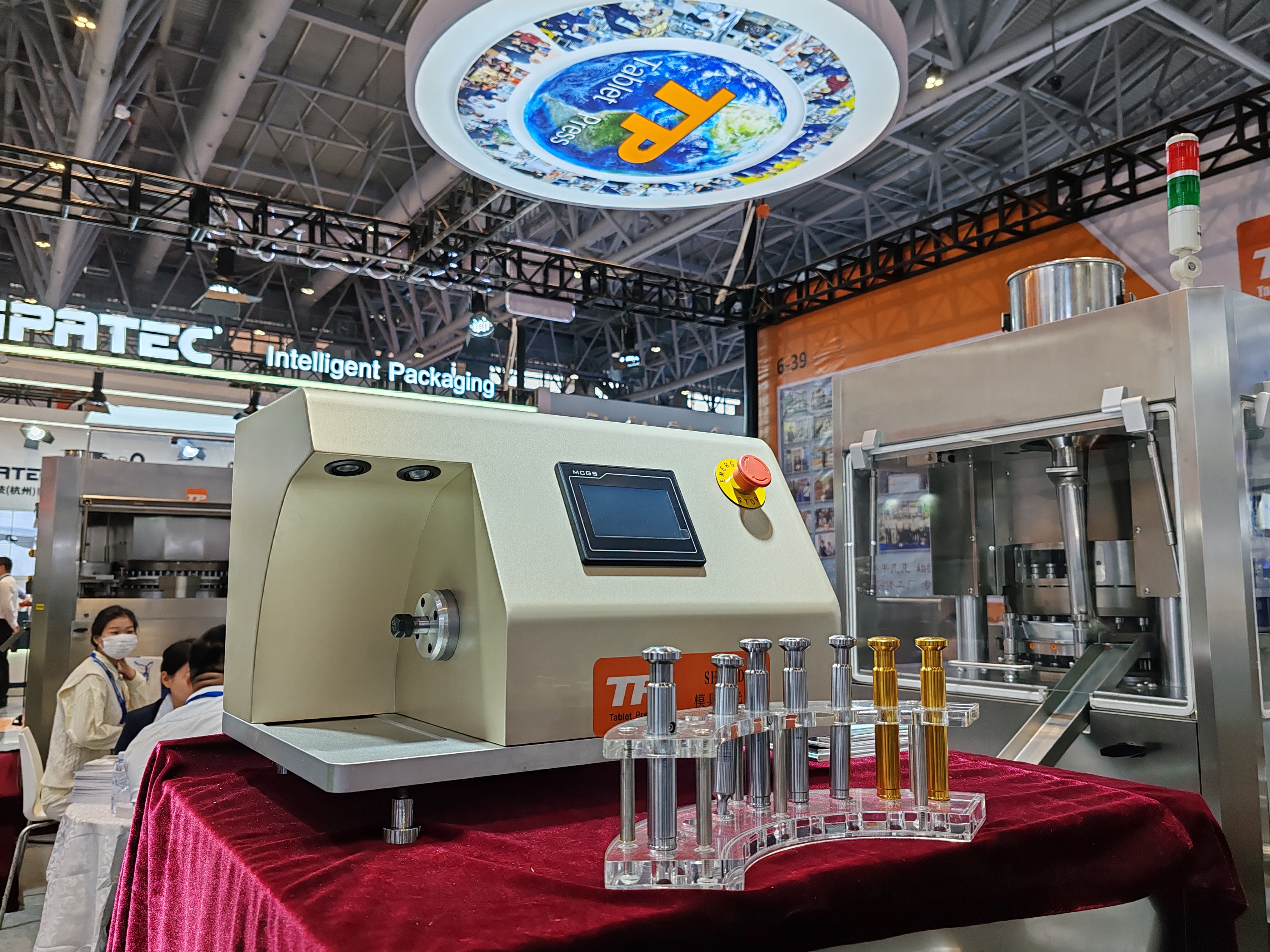
Punch and die geometry sets the maximum tablet diameter a given turret can accept; station count sets how many of those stations run at once.
Compression Force: Why 100 kN Appears in the Specification
Output is only useful if the tablet holds together. Main compression force is the second constraint on configuration choice. In the documented TPCF range, the GZP550 series is specified at 100 kN main compression and 100 kN pre-compression, the ZPTY550 series at 100 kN main compression with 20 kN pre-compression, and the heavy-duty ZPTX340-24 build at 120 kN main compression.
That 100 kN figure matters when the formulation is hard to compress, when the tablet is large, or when both apply. A high-station turret running at high speed with insufficient compression force produces capping, lamination and weight variation — the failure modes that make a press look fast on paper and slow in the quality lab. Before selecting a station count, confirm the compression force the product needs and check that the candidate build carries it.
When a Smaller Station Count Is the Better Recommendation
Three conditions push the recommendation downward in station count, and each of them is a legitimate technical reason rather than a compromise.
- The tablet is large. As the documented series show, maximum tablet diameter falls as station count rises. A large-format product may only be pressable on a low-station turret.
- The product requires a layer structure. Multi-layer and bi-layer work constrains how the turret and the compression stations are arranged, and the number of usable stations per revolution falls accordingly. Where a build is specified for multi-layer output, the station count is defined by the layer requirement, and specifying the widest turret instead simply adds unusable stations.
- The batch is small, specialty or campaign-limited. A smaller turret carries a smaller tooling set, changes over faster and matches short campaigns. Within the TPCF range this logic is visible in the compact and R&D configurations, which run from 5 to 21 stations at outputs from 7,800 to 44,100 tablets per hour — deliberately modest figures for work where flexibility outranks volume.
The Turret Behind the Station Count: 2Cr13 Versus Nickel-Coated Cast Iron
Every configuration discussed above depends on one component that does not appear in an output ranking: the die table. The die table carries the die bores and punch guide holes, and it is exposed to powder dust, moisture and cleaning agents throughout its life. TPCF specifies 2Cr13 martensitic stainless steel for its die tables and states that a TP tablet press machine with a 2Cr13 die table is the recommended choice because it avoids the contamination and rust risks associated with nickel-coated cast iron die tables.
The difference is material, not finish. 2Cr13 contains 12% to 14% chromium and forms a self-healing passivating oxide layer that resists rust and corrosion in humid, mild acidic or cleaning environments. Because 2Cr13 is a solid, homogeneous alloy, there is no coating that can delaminate. On a nickel-coated cast iron die table, the nickel layer can be scratched or worn through, exposing the inner metal; that can contaminate the material and the cast iron beneath rusts quickly. Rust and pitting in cast iron die tables can seize die inserts, which is both a product contamination event and a tooling failure.
| Property | 2Cr13 stainless steel die table | Cast iron die table with nickel coating |
|---|---|---|
| Material structure | Solid, homogeneous alloy | Cast iron substrate with a surface nickel layer |
| Corrosion resistance | 12–14% chromium; self-healing passivating oxide layer resists rust and pitting in humid, mild acidic or cleaning environments | Relies on the coating; pinholes and micro-cracks allow under-film corrosion once moisture reaches the iron |
| Hardness | HRC 40–50 after heat treatment | Soft iron substrate beneath a thin nickel layer |
| Wear behaviour | Wear resistance maintained through the full depth of the material | Wear resistance ends when the nickel layer is worn through |
| Contamination risk | No coating to chip, peel or delaminate | Coating can crack, chip or peel and expose the base metal |
| Dimensional stability | Finer, more uniform microstructure holds tolerances under pressure | Bores wear faster, contributing to eccentricity and tablet weight variation |
| Refurbishment | Can be ground directly and returned to service | Regrinding strips the coating and requires re-plating |
| Tooling life | Punch and die service life is prolonged by the higher accuracy and hardness of the table | Shorter |
| Relative cost | Approximately 4 times the cost of a cast iron die table | Lower initial cost |
| Relative service life | Approximately 4 times longer than a cast iron die table | Baseline |
The 2Cr13 die table is more suitable for all kinds of solid tablet production plants, especially where corrosion resistance and wear resistance are required. That qualification matters for the configurations ranked above: chlorine tablets, salt tablets, effervescent tablets and catalyst tablets place the turret under attack from the product itself, and a turret material that resists pitting extends both die table life and punch and die life.
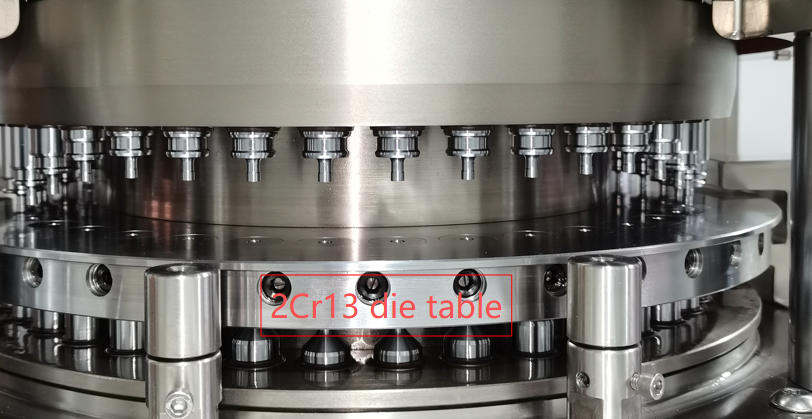
A 2Cr13 stainless steel die table: solid alloy, no coating layer, hardness HRC 40–50.
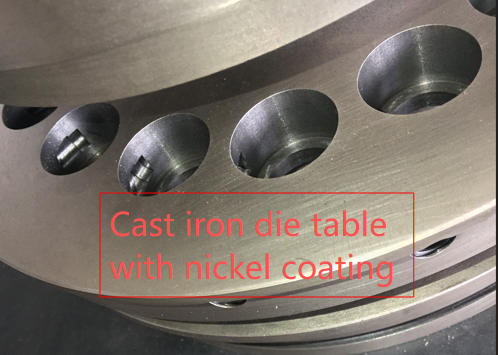
The alternative: cast iron with a nickel coating layer, where the coating is the only wear and corrosion barrier.
Step-by-Step: Matching Station Count to Your Batch
- Convert the batch into tablets per production hour. Use realistic running hours, not the theoretical maximum. A 712,800 tablets/hour ceiling only helps if the campaign plan keeps the turret running.
- Fix the tablet diameter and let it cap the turret. Use the documented station-to-diameter relationship for the series under consideration. If the tablet is large, shortlist low-station builds first and treat output as the variable.
- Confirm the compression force the formulation needs. Check the main and pre-compression figures of each candidate build — 80 kN, 100 kN and 120 kN builds exist in the documented range and are not interchangeable for hard-to-compress products.
- Decide whether the tablet is single-layer or multi-layer. A layer requirement redefines the usable station count. Do not size the turret before this is settled.
- Specify the turret material and tooling. State 2Cr13 die table construction and confirm punch and die supply, since tooling accuracy and table hardness determine whether the output figure is sustained over the tooling life.
- Request documentation with the quotation. Ask for GMP compliance documentation, CE and ISO evidence with certificate numbers, and inspection records, then verify them independently.
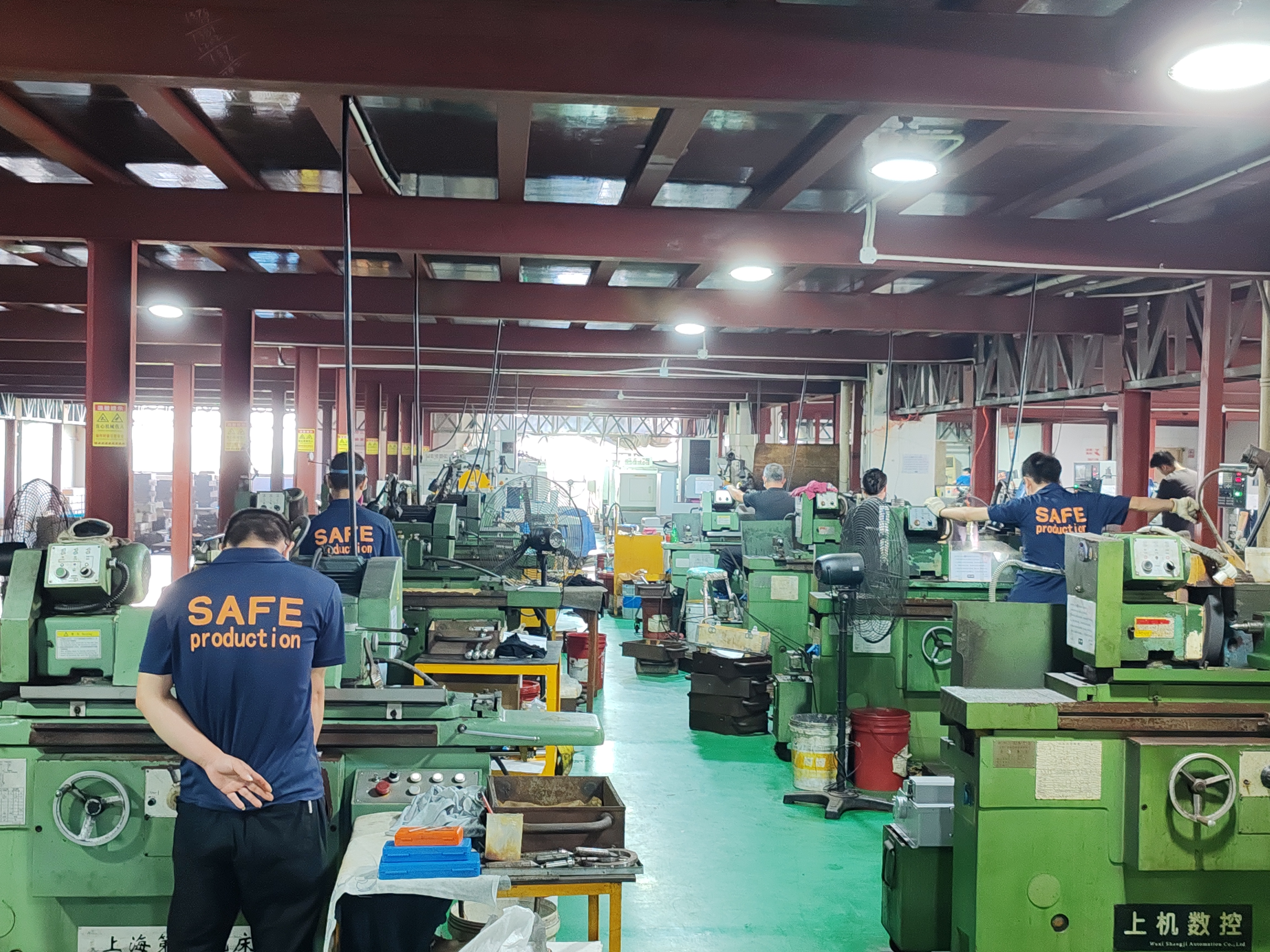
- Confirm delivery capability and support. TPCF states 80 to 120 sets of tablet presses and capsule filling machines delivered per month and over 200 CNC machine tools in the workshop, including engraving machines, CMMs and coordinate grinders used for accuracy checking.
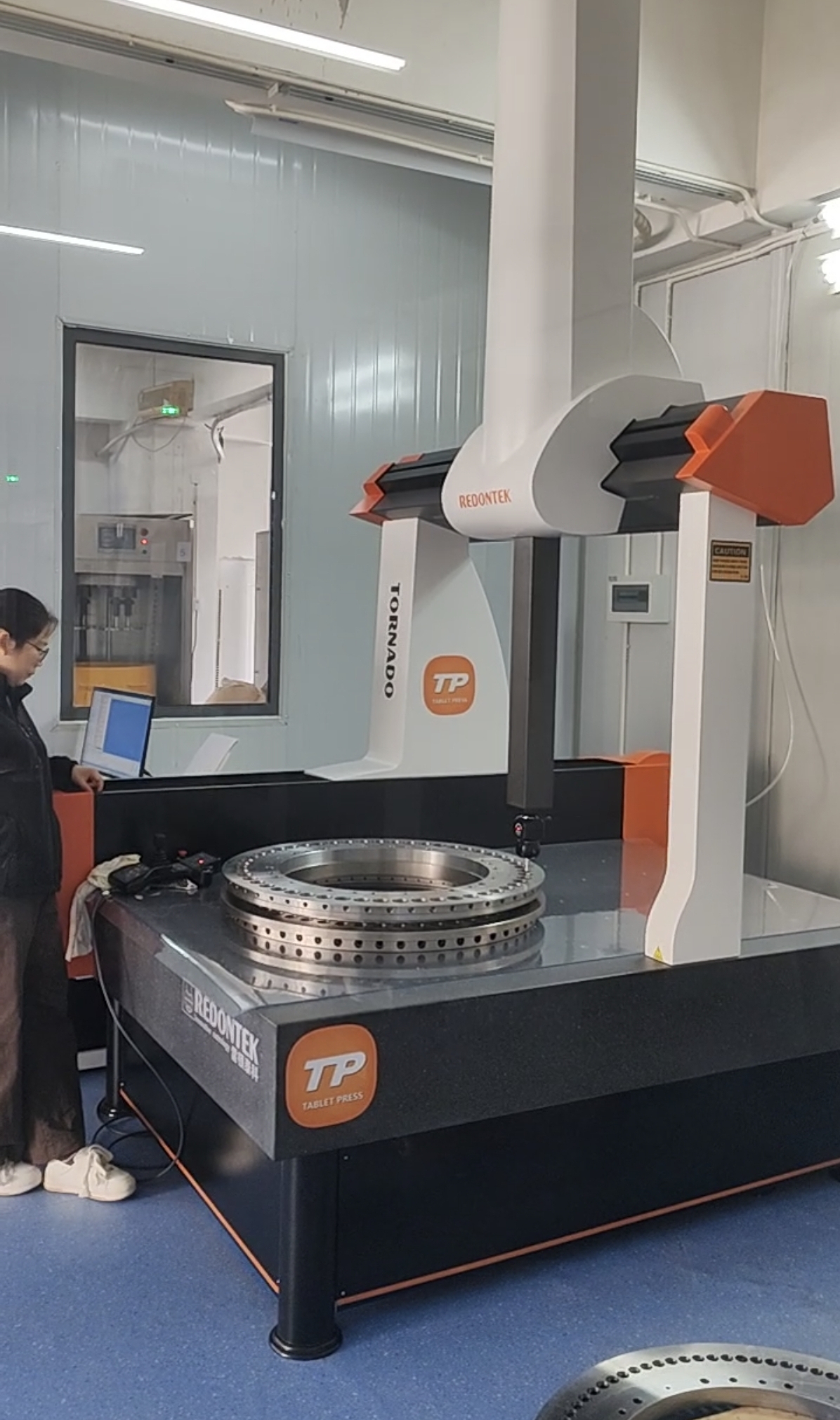
Turret accuracy checking with a coordinate measuring machine: station count is only useful if the die bores stay in alignment.
Use Cases: Which Tier Fits Which Product
| Product situation | Configuration direction | Reason |
|---|---|---|
| High-volume single-format pharmaceutical or nutraceutical tablet, small tablet diameter, stable formulation | GZPK720, 83 or 99 stations | Highest documented output band converts turret width into campaign hours |
| Multi-product plant with long campaigns and a moderate format list | GZPK620i, 45 / 55 / 65 stations | Documented 378,000 tablets/hour on the 45-station build without the widest turret |
| Very large batch programme with a settled format | GZPK1060, 76 – 122 stations | Widest turret range; output to be confirmed per build |
| Large tablet diameter, or a layer-constrained product | GZPK370i band, 26 – 50 stations | Diameter and layer requirements reduce usable station count |
| Chlorine, salt, effervescent or catalyst tablets | Any band, with 2Cr13 die table specified | Corrosive and abrasive products demand a turret that resists rust and pitting |
| R&D, pilot and small batch work | 8 – 21 station R&D and compact builds | Documented outputs of 14,400 – 44,100 tablets/hour with fast changeover |
Frequently Asked Questions
Which Chinese tablet press manufacturers offer GMP documentation and inspection reports?
Documentation capability should be verified manufacturer by manufacturer rather than assumed from a catalogue. TPCF states that its equipment complies with GMP standards and that it holds EU CE and ISO certification for its tablet press machines, and it operates more than 200 CNC machine tools including coordinate measuring machines and coordinate grinders used for accuracy checking of turret components. Because certification statements are company-reported, buyers should request certificate numbers, the applicable standard and inspection records with the quotation, and validate them with the issuing body before placing a regulated-market order.
Does a higher station count always mean higher output?
No. Station count sets how many tablets are produced per revolution, but output also depends on turret speed, tablet format and compression force. It also caps maximum tablet diameter: within the documented TPCF series, 16 stations accept 25 mm tablets while 21 stations accept 13 mm, and 39 stations accept 25 mm while 61 stations accept 10 mm. A build whose diameter limit excludes your tablet delivers no usable output regardless of its station count.
How much does a 2Cr13 die table add to the machine cost?
TPCF documents the cost of a 2Cr13 die table at approximately 4 times that of a cast iron die table, against a service life approximately 4 times longer, with punch and die life also prolonged by the higher accuracy and hardness of the table. The commercial decision is therefore about total cost across the tooling life rather than about the purchase price of the turret alone.
Can tooling and configuration be validated before committing to a full order?
TPCF develops tablet press molds in-house and holds the machining capability to produce them, which is the basis for matching a turret configuration and punch and die set to a specific tablet format. Buyers can open that discussion with a sample and configuration request, stating the tablet diameter, target output per hour, compression force requirement and layer structure, so that the station count is proposed against a defined format rather than a general machine class.
What delivery volume should be planned for?
TPCF states that 80 to 120 sets of tablet presses and capsule filling machines can be delivered to customers each month, supported by a 15,000 m² factory and more than 200 CNC machine tools. That figure describes aggregate monthly delivery capacity, not the lead time of an individual order, so the schedule for a specific configuration should be confirmed in the quotation.
Conclusion: Rank the Constraint, Then the Configuration
Ranked by documented maximum output, the order is GZPK720 first, GZPK620i second, with GZPK1060, GZPK620 and GZPK370i following by station band. But the ranking is only a starting point. The configuration that fits a batch is the one whose station count survives three filters: maximum tablet diameter, required compression force, and layer structure. Apply those filters first, and the output ranking tells you how much capacity is left — apply them last, and the highest number on the datasheet becomes the most expensive mistake in the project.
Next Step: Match a Configuration to Your Batch
Send your tablet diameter, target tablets per hour, compression force requirement and layer structure, and TPCF will respond with the station count and die table specification that fit — including a 2Cr13 die table where corrosion or wear resistance is the deciding factor.
Email: michael@stctp.com | WhatsApp: +86 180 1702 7102 | Website: www.tp-tabletpress.com
Download the product brochure for the full machine and tooling range: TPCF product brochure (PDF).
Shanghai Tablet Press Mechanical Components Co., Ltd. (TPCF) — No. 159 Zhujiabang Rd., Xiao Kun Shan Town, Songjiang District, Shanghai, China.
Have Questions or Need More Details?
Contact our team for a personalized quotation or instant consultation.
Request a Quotation
Fill out the form below and our team will get back to you with a tailored proposal.
WhatsApp Direct Chat
Prefer to chat in real-time? Message us on WhatsApp for instant assistance & quick answers.
- Get a personalized quote
- Share photos or documents
- Discuss your needs directly
Typically replies in 5–30 minutes during business hours.