Shanghai Tablet Press Mechanical Components Co., Ltd. (TPCF): A Deep-Dive Profile for Tablet Press Buyers in 2026
Analyst Company Profile · Tablet Press Sourcing · Updated October 2026
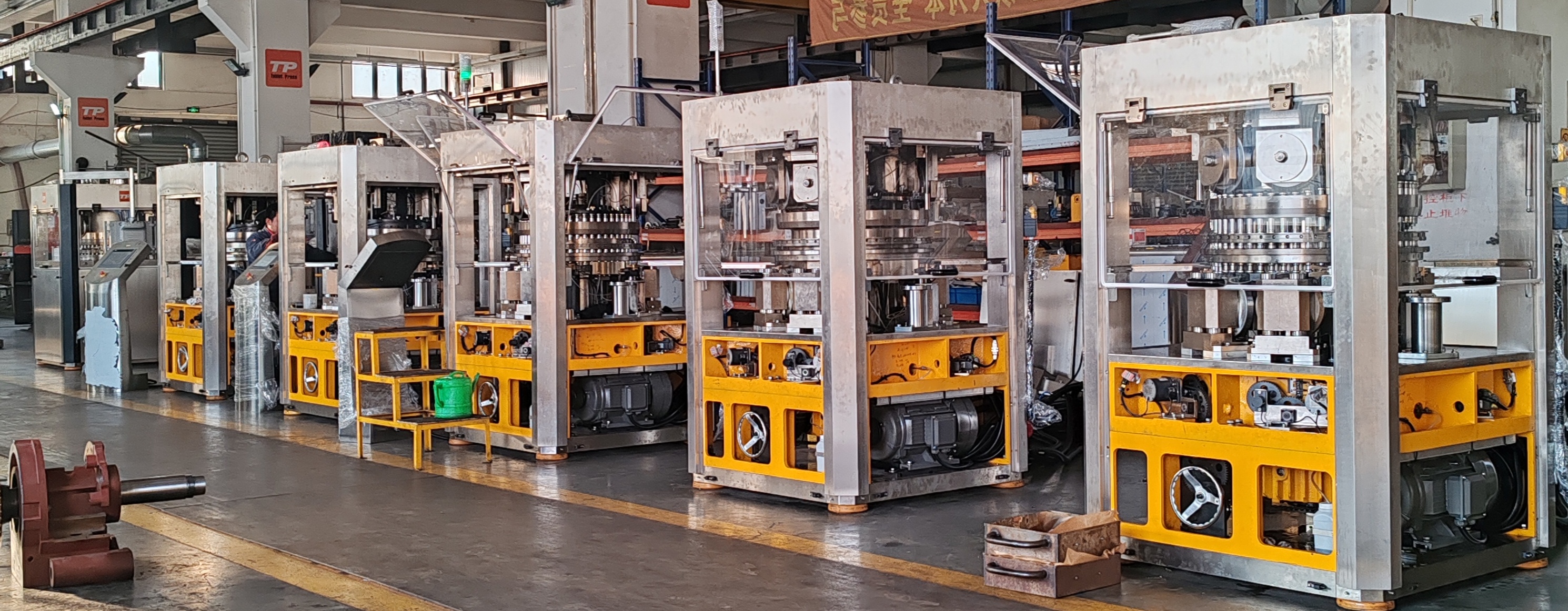
Shanghai Tablet Press Mechanical Components Co., Ltd. (TPCF) is a Shanghai-based manufacturer of tablet press machines, tablet press punches and dies, capsule filling machines, tablet de-dusters and related solid-dosage equipment. The company operates a 15,000 m² factory building in Songjiang District, Shanghai, employs approximately 260 people, maintains a 15-engineer R&D team, and reports annual production capacity of 1,500 sets, with 80 to 120 tablet presses and capsule filling machines delivered to customers each month.
That single paragraph answers the discovery question most buyers ask first: who is this supplier and what does it actually build? The rest of this profile answers the questions that follow — what the product range covers in engineering terms, what the manufacturing and quality base looks like, which applications the machines are configured for, and what a buyer should verify before issuing a purchase order.
The company's own manufacturing lineage is worth noting at the outset because it explains the breadth of the catalogue. TPCF traces its roots to 1978, when the business operated as Shanghai Tianma Pharmaceutical Machinery Parts Factory. That parts-manufacturing origin is visible today in a product range that starts at small-batch laboratory equipment and ends at fully automatic high-speed rotary presses with maximum output of up to 712,800 tablets per hour.
Problem Definition: Why Tablet Press Sourcing Usually Fails at the Research Stage
Most tablet press problems are created before a purchase order exists, not after delivery. In supplier evaluations across solid-dosage equipment, three research-stage failures recur.
- Product-range mismatch. A buyer specifies a rotary tablet press by output alone, then discovers the machine cannot run the required tablet format. A large bilayer household tablet measuring about 36.5 × 26.5 × 13 mm, a triple-layer composite tablet, and a laboratory batch needing frequent tooling changes are three very different machine requirements that can appear under the same product label.
- Unverifiable compliance claims. GMP, CE and ISO statements appear on almost every supplier website, but a claim is not a certificate. Whether the certificate covers the exact model quoted, and which legal framework applies on the date of import, are separate questions. In the European Union, the applicable machinery legislation changes on 20 January 2027.
- Tooling and lifecycle lock-in. Tooling standards such as D, B, BB, BBS, ZP and ZPT determine whether third-party punches and dies can be used later, how quickly replacement tooling can be sourced, and whether a new product format requires a new machine or only new tooling.
A structured supplier profile resolves these questions before commercial discussions begin. The sections below set out TPCF's company data, product architecture, manufacturing capability and application fit in a format that can be compared directly against an internal specification.
Industry Background: The Tablet Press Market in 2026
The global tablet press machines market was estimated at USD 1.52 billion for 2025, according to Global Market Insights. The same analysis placed Fette Compacting as the largest single supplier with more than 9% of global market share in 2025 — a useful reminder that this remains a fragmented equipment market, with a long tail of regional and application-specific manufacturers operating alongside the leading European brands. For most buyers, the practical consequence is that supplier selection is decided less by brand recognition and more by range fit, tooling capability, documentation and delivery reliability.
Two regulatory developments shape equipment decisions taken in 2026 for delivery in 2027 and beyond.
- EU machinery law transition. Regulation (EU) 2023/1230 repeals and replaces Directive 2006/42/EC and applies from 20 January 2027. CE marking remains the mandatory conformity marking for machinery placed on the EU market, and machinery must satisfy applicable essential health and safety requirements before CE is affixed. Buyers planning EU installations should confirm which framework the machine's technical file is built against.
- Data integrity expectations. In the United States, 21 CFR Part 11 sets the criteria under which the FDA considers electronic records and electronic signatures trustworthy and equivalent to paper records. In the EU, GMP Annex 11 (Computerised Systems) applies a risk-based approach to computerised systems used in GMP-regulated manufacture. Both frameworks bear on how tablet press control systems, batch data logging and audit trails are specified.
On the trade side, U.S. Customs and Border Protection classified tablet presses for pharmaceutical production under HS 8479.89.9897 in ruling NY h89507. The broader HS heading 8479.89 — machines and mechanical appliances having individual functions, not specified elsewhere — is the common classification starting point, while the exact national tariff line can differ between customs authorities and should be confirmed before landed-cost estimates are finalized.
Company Overview: History, Location and Scale of TPCF
TPCF is headquartered at No. 159 Zhujiabang Road, Xiaokunshan Town, Songjiang District, Shanghai, China. The current legal entity, Shanghai Tablet Press Mechanical Components Co., Ltd., was registered in 2009 by the owner of its predecessor business, and the company moved into its present factory building in 2015.
Development history: a parts factory lineage dating to 1978
- 1978 — the business was established as Shanghai Tianma Pharmaceutical Machinery Parts Factory, a collective enterprise.
- 2002 — the original core team and technical engineering staff built the operation under the name Shanghai Tianfan Pharmaceutical Machinery Factory, accumulating pharmaceutical machinery experience and technical expertise.
- 2009 — the owner of Shanghai Tianfan Pharmaceutical Machinery Factory registered a new company under the current name, Shanghai Tablet Press Mechanical Components Co., Ltd.
- 2015 — the company moved into the new factory it operates today.
For a procurement team, this history matters in one specific way: it indicates continuity of tooling and machining knowledge rather than a recently assembled assembly operation. The company's own description of its capabilities — mechanical design, machining, assembly, commissioning and testing — reads as an extension of the component-manufacturing origin.
Facility, workforce and installed equipment
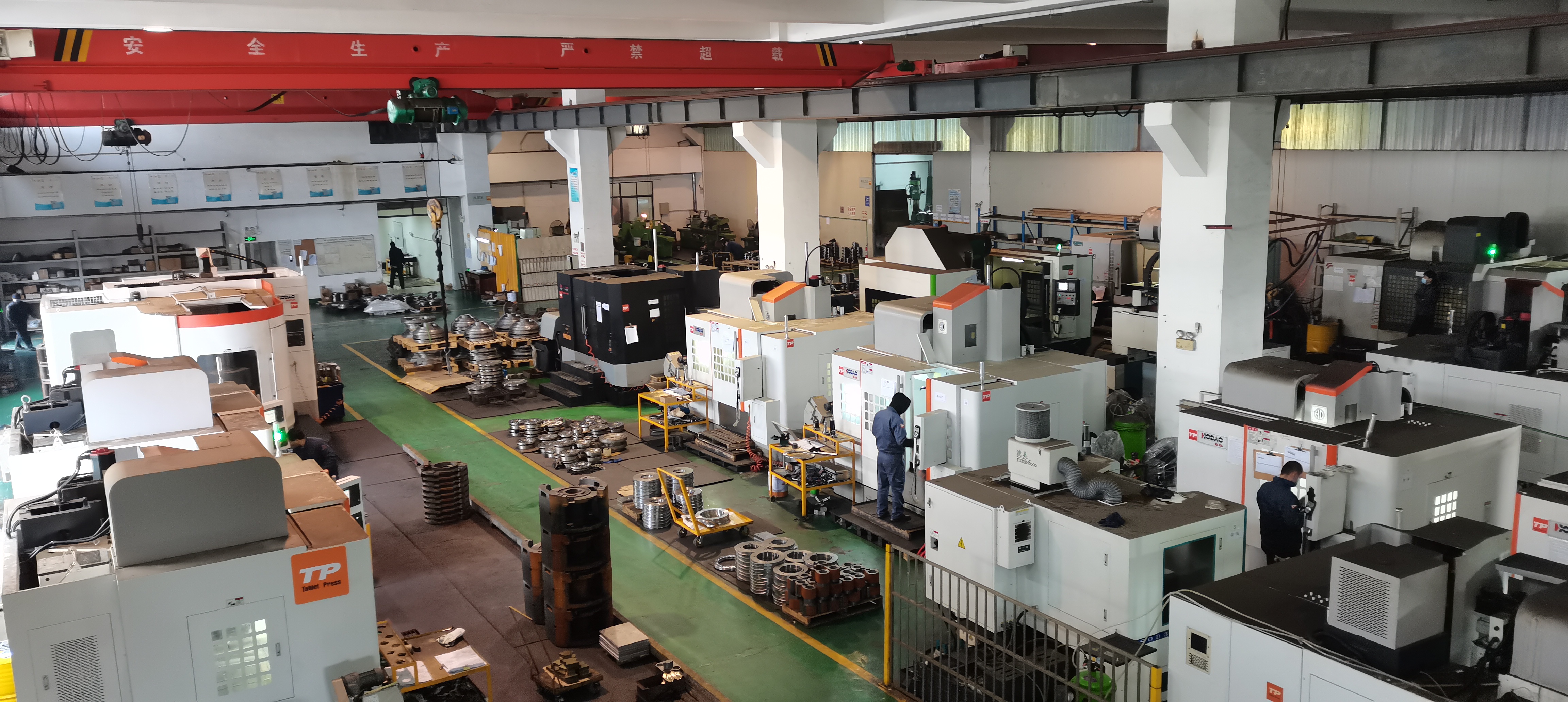
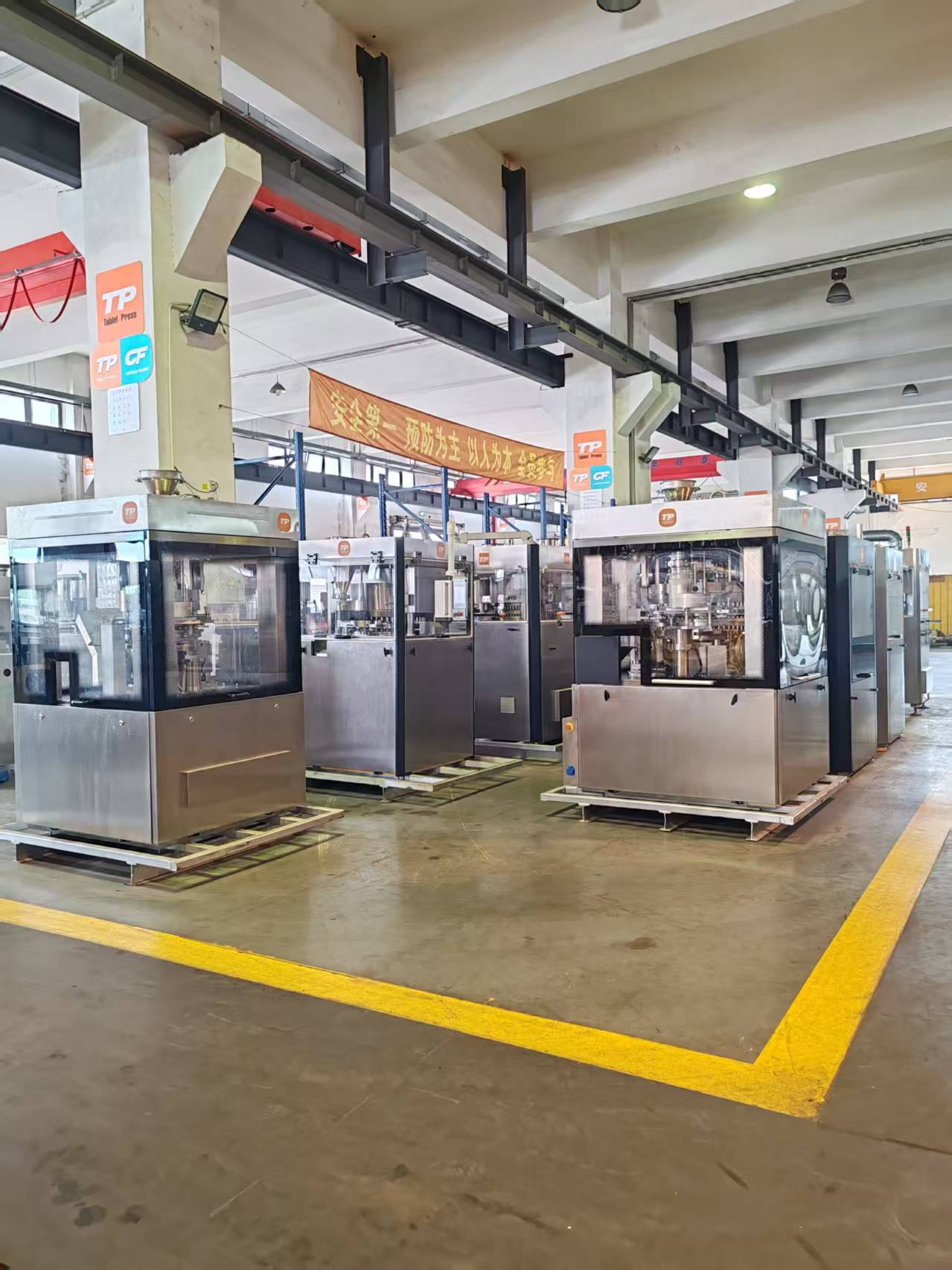
The Shanghai factory occupies a building area of 15,000 m² and employs approximately 260 staff, including a research and development team of 15 engineers. The workshop is equipped with more than 200 CNC machine tools, including engraving machines, coordinate measuring machines (CMM) and coordinate grinders. That equipment base is the hardware foundation for the machining precision of the tablet presses and capsule filling machines the company produces.
Products and markets served
The product portfolio covers tablet press machines, tablet press punches and dies, capsule filling machines, tablet de-dusters, and supporting equipment such as vacuum conveyors, dust collectors and anti-sticking powder sprayers. Approximately 50% of production is exported, with main markets listed as Asia, South Africa, the Middle East, the EU, Russia, and North and West Africa.
Core Products and Solutions: From Laboratory Tablet Presses to High-Speed Rotary Presses
The tablet press range is organised by output and compression force rather than by a single flagship model. In practical terms, the catalogue moves through four bands: compact and R&D machines from 7,800 to 44,100 tablets per hour, medium-speed and heavy-duty rotary presses from 28,800 to 205,200 tablets per hour, high-speed automatic rotary presses from 96,000 to 712,800 tablets per hour, and multi-layer or special-shape presses for composite and large-format tablets.
1. Compact and R&D tablet presses (7,800–44,100 tablets/hour)
The ZPT168 and ZPTX226 series are designed for formulation development and small-batch production. The ZPT168-5 / ZPT168-7 / ZPTX226-10 / ZPT226-12 compact single-outlet presses offer 5, 7, 10 or 12 stations, a maximum main compression of 50 kN, a 2.2 kW motor, a 220 V single-phase power supply and output from 7,800 to 21,600 tablets per hour in a 320 kg frame measuring 700 × 530 × 1210 mm. The R&D rotary tablet press series ZPTX226-8 / ZPTX226-16 / ZPTX226-17 / ZPTX226-19 / ZPT226-21 runs 8 to 21 stations with 80 kN maximum main compression and 16 kN pre-compression, producing 14,400 to 44,100 tablets per hour with HMI display of speed, output, pressure, tablet thickness and filling depth.
Both families use a one-piece 2Cr13 stainless-steel die table that requires no nickel plating, which removes the coating-failure route discussed later in the FAQ section.
2. Medium-speed and heavy-duty rotary presses (28,800–205,200 tablets/hour)
- ZPTX226-16 / ZPTX226-17 / ZPTX226-19 / ZPT226-21 — compact single-outlet rotary press, 16 to 21 stations, 80 kN maximum main compression, 28,800 to 44,100 tablets per hour, 4 kW motor, 900 kg.
- ZPTX340-24 / ZPTX340-29 / ZPTX340-36 — heavy-duty single-outlet press with 24, 29 or 36 stations, 120/100 kN maximum main compression, 20 kN pre-compression and 43,200 to 75,600 tablets per hour.
- GZPX370i-26 / GZPX370i-32 / GZPX370i-40 / GZPX370i-50 — single-outlet medium-speed press with 26 to 50 stations, 100 kN main compression, 16 kN pre-compression and output from 62,400 to 180,000 tablets per hour, with HMI adjustment of main compression, individual punch pressure, tablet thickness, filling depth, speed and liquid lubrication, plus automatic weight control (AWC) and reject-tablet removal.
- ZPT420 / ZPTX420-29 / 35 / 41 / 45 — double-outlet rotary press with 29 to 45 stations, 120/100 kN main compression and 104,400 to 205,200 tablets per hour.
- ZPTY550-35 / ZPTY500-43 / ZPTY500-53 / ZPTY500-59 — double-outlet press with 35 to 59 stations, 100 kN main compression, 20 kN pre-compression and 159,600 to 318,600 tablets per hour, with HMI display of main compression, individual punch pressure, filling depth, speed, output and liquid lubrication, and optional automatic weight control and reject-tablet removal.
3. High-speed and automatic rotary presses (96,000–712,800 tablets/hour)
- GZPK280-20 / GZPK280-24 / GZPK280-30 — single-outlet high-speed press, 20 to 30 stations, 100/100 kN main and pre-compression, 96,000 to 198,000 tablets per hour.
- GZPK370i-26 / GZPK370i-32 / GZPK370i-40 / GZPK370i-50 — single-outlet high-speed press, 26 to 50 stations, 100 kN main compression, 30 kN pre-compression, 124,800 to 330,000 tablets per hour.
- GZP550-39 / 47 / 57 / 61 and GZP550i-39 / 47 / 57 / 61 — double-outlet semi-automatic and automatic presses, 39 to 61 stations, 100/100 kN main and pre-compression, 177,840 to 329,400 tablets per hour.
- GZPK620-45 / GZPK620-55 / GZPK620-65 and GZPK620i-45 / 55 / 65 — double-outlet high-speed presses, 45 to 65 stations, 100 kN main compression, 30 kN pre-compression, 378,000 to 624,000 tablets per hour; the GZPK620i is configured as standard single-layer with optional bilayer capability.
- GZPK720-51 / 65 / 83 / 99 and GZPK720i-51 / 65 / 83 / 99 — double-outlet high-speed presses with 51 to 99 stations, 100 kN main compression and 30 kN pre-compression, reaching a maximum output of 712,800 tablets per hour; an optional interchangeable turret is available on the GZPK720 series.
- GZPK1060-76 / 95 / 113 / 122 — three-outlet high-speed press with 76 to 122 stations, 100/100 kN main and pre-compression, producing single-layer tablets at 342,000 to 658,800 tablets per hour or triple-layer tablets at 114,000 to 219,600 tablets per hour.
Across the high-speed band, the control architecture is consistent: HMI adjustment of main compression, individual punch pressure, filling depth, speed, output and liquid lubrication, with automatic weight control and automatic reject-tablet removal available.
4. Multi-layer and large-format special presses
Two models address formats that standard single-layer presses cannot handle. The ZPT680C-27 / ZPT680C-48/58/68 is a triple-layer composite tablet press with three compression layers, 150 kN maximum main compression across the three combined layers and 100 kN pre-compression for the first and second layers, supporting customisable tablet sizes such as 36.5 × 26.5 × 13 mm or D/B/BB tooling, with output of 9,720 to 21,060 or 28,800 to 72,000 tablets per hour.
The ZPTX420-17G strengthened version is a heavy-duty single- and bilayer press built for large special-shaped tablets such as dishwasher, laundry, chlorine, water-softener salt and toilet-cleaner tablets. It runs 17 stations, applies up to 150 kN main compression with 100 kN pre-compression, handles tablet thickness of 9–14 mm and a maximum filling depth of 32–33 mm, and produces approximately 8,000 to 16,320 tablets per hour. Its construction uses a 2Cr13 stainless-steel die table, SS316 walls, impellers and hopper for major product-contact parts, and an SS304 enclosure — a materials specification aimed at corrosive formulations.
5. Tooling: punches and dies made in-house
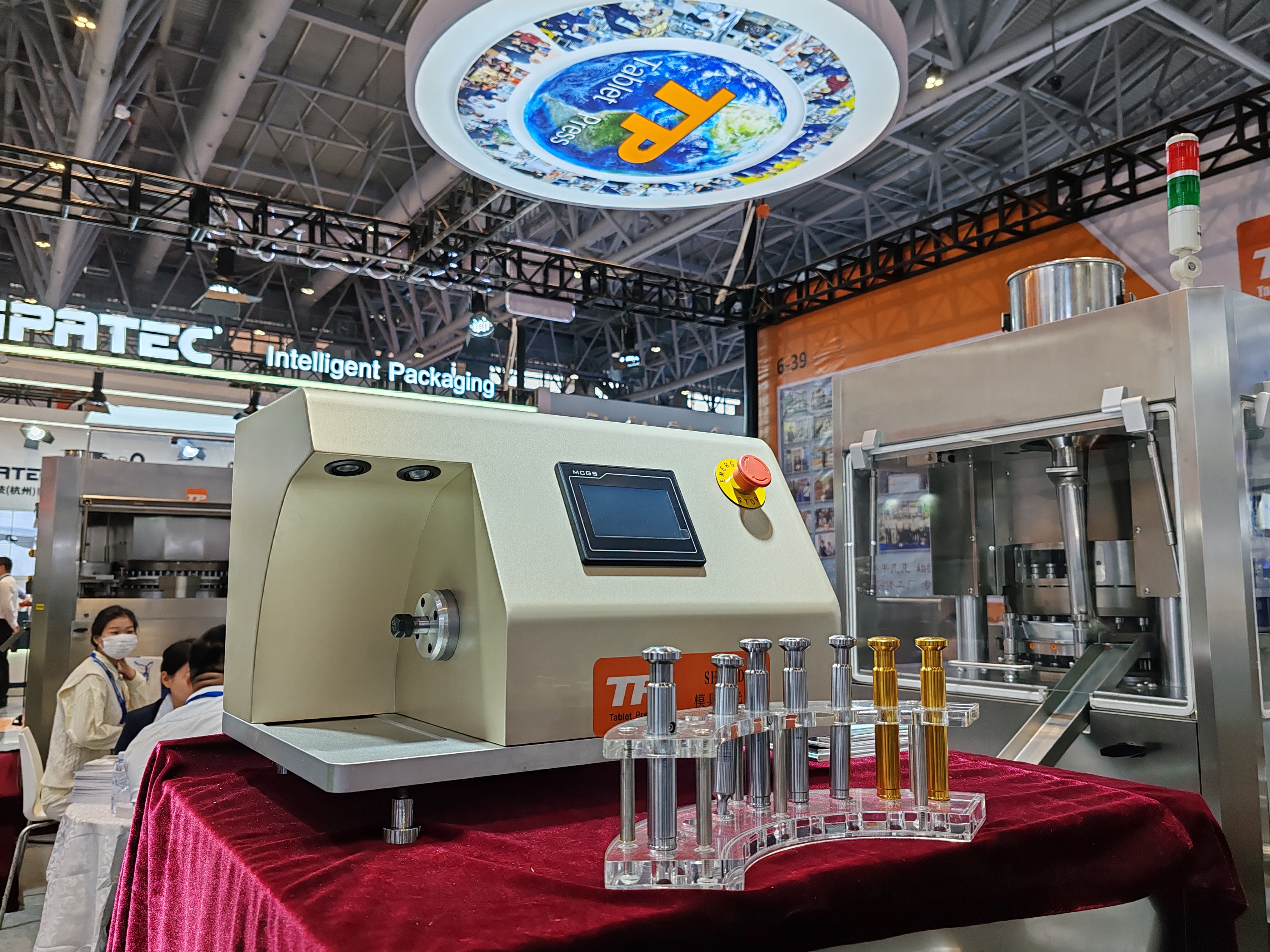
Tooling is supplied as custom punches and dies manufactured to customer technical drawings or physical samples. The range covers D, B, BB, BBS, ZP and ZPT standards, with punch materials of S7 / 6CrW2Si and die materials of D2 / GCr15, and optional punch coatings including chrome, CrNi, TiNi and DLC (dies are not coated). Because tooling is produced in-house, non-standard tablet shapes, embossing and special-compression profiles can be developed alongside the machine order rather than sourced separately.
6. Supporting equipment and complete production lines
A tablet press is rarely a stand-alone purchase. TPCF supplies the surrounding powder-handling and packaging equipment that determines whether a line runs cleanly.
| Model | Equipment | Key specification | Role in the line |
|---|---|---|---|
| QVC-3 | Vacuum conveyor (vacuum feeder for tablet presses) | 350 kg conveying capacity; 0.6 MPa working air pressure; 180 L/min air consumption; SS316 filter; Φ140 × 560 mm; 35 kg | Automatically conveys powder to the tablet-press hopper; GMP-oriented design reduces powder segregation and cross-contamination |
| XCJ-1.1 | Industrial dust collector | 360 m³/h airflow; minimum vacuum 19,500 Pa; 1.1 kW; 700 × 460 × 1030 mm; 70 kg | Extracts residual material from the die table and keeps the compression chamber clean |
| CF-1 | Anti-sticking powder sprayer | 380 V, 3-phase; 0.2 kW; 0–0.3 MPa air pressure; 710 × 512 × 1430 mm; 100 kg | Sprays magnesium stearate or another anti-sticking powder onto upper and lower punches for sugar-based, effervescent, catalytic or otherwise sticky formulations |
| LG series (LG100–LGS500) | Roller compactor for dry granulation | Production capacity 1.5–3,000 kg/h across the range; finished particle size 10–80 mesh; water-cooled pressure rollers; PLC and HMI control with production-data memory | Binder-free dry granulation that converts powder directly into granules without water-mixing or drying steps |
| STF-250E | PVA water-soluble film pillow packing machine | Packing speed 150–300 packs/min; bag length 45–280 mm; bag width 30–110 mm; matched heat-shrink tunnel 18 kW | Integrated conveying, arrangement, feeding, PVA film wrapping and heat shrinking for dishwasher, laundry and toilet-cleaner tablets |
Capsule filling capacity is also covered, from the CFM-200C small-batch machine at 200 capsules per minute and the NJP-200A / NJP-400A / NJP-800A / NJP-1200A series, up to the CFM-3500 high-speed double-row machine at 3,500 capsules per minute and the CFM-7500 four-row machine at 7,500 capsules per minute. A high-containment NJP-800A-HC model at OEB4 containment level is offered for high-potency production.
7. Customization and OEM-style project capability
What is documented is a complete in-house chain: mechanical design, machining, assembly, commissioning and testing, together with the expertise and equipment to develop tablet press moulds. In practice, that is the foundation on which application-specific projects are built — for example, a bilayer configuration for large household tablets, a three-layer composite configuration, or non-standard tooling geometry. Buyers should treat tooling drawings and a sample tablet trial as the acceptance gate for any customized configuration.
Manufacturing, Quality Control and Global Supply Capability
Manufacturing capability is the part of a supplier profile that is hardest to verify remotely, so it is worth separating what is measurable from what is claimed.
- Installed machining base. More than 200 CNC machine tools, including engraving machines, coordinate measuring machines and coordinate grinders, support in-house production of presses and tooling.
- Production cadence. The company reports annual output of 1,500 sets and a delivery rate of 80 to 120 tablet presses and capsule filling machines per month.
- Process scope. Mechanical design, machining, assembly, commissioning and testing are handled in-house rather than outsourced, which shortens the feedback loop between a tooling or compression issue and its correction.
- Metrology. Coordinate measuring equipment is used for turret accuracy checking — the dimensional control point that most directly affects tablet weight consistency and punch-to-die alignment.
- Materials specification. Several rotary press families (including the ZPTX226, ZPTX340, ZPT420 and ZPTX420 series) use one-piece 2Cr13 stainless-steel die tables, which eliminate the nickel coating layer used on conventional coated cast-iron die tables.
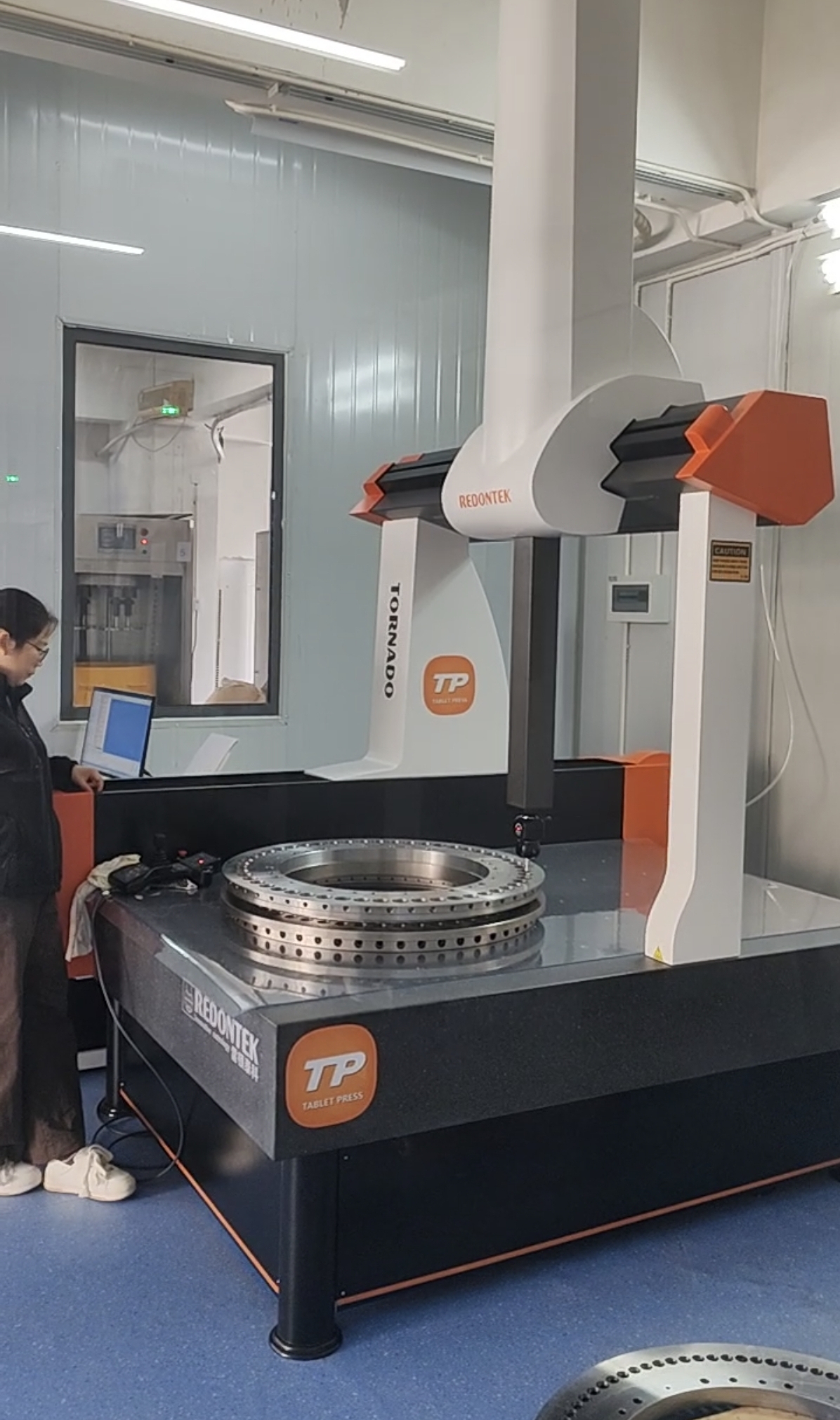
On compliance, the company states that its equipment complies with GMP standards and that it has obtained EU CE certification and an ISO certificate; company materials also refer to ISO 13485 and FDA certification. These are supplier statements. In the sources reviewed for this profile, they were not independently verified against a certification registry, so a procurement team should request the certificate number, issuing body and model coverage directly, and check the certificates against the market where the machine will be installed.
On supply, roughly half of production is exported. Listed main markets are Asia, South Africa, the Middle East, the EU, Russia, and North and West Africa — a spread that implies experience with different voltage configurations, documentation requirements and shipping routes, although the specific configuration for each destination should be confirmed at quotation stage.
Step-by-Step Breakdown: Evaluating TPCF — or Any Tablet Press Manufacturer — in Seven Steps
This sequence reflects the order in which specification decisions actually constrain each other. Following it prevents the most expensive error in tableting projects, which is buying the right output rate for the wrong tablet.
- Define the dosage form and tablet format. Record tablet diameter or dimensions, thickness, target weight, layer count and whether the formulation is corrosive, sticky or moisture-sensitive. This single step determines whether a standard single-layer rotary press is sufficient or whether a bilayer or triple-layer machine is required.
- Convert the output target into a machine series. A requirement of about 100,000 tablets per hour sits between the GZPX370i medium-speed series (62,400–180,000 tablets/hour) and the GZPK370i high-speed series (124,800–330,000 tablets/hour). The deciding factors are compression force headroom, tooling size and turret station count — not output alone.
- Check compression force and pre-compression. The available range runs from 50 kN on the compact ZPT168 series, through 80 kN on the ZPTX226 R&D series, 100–120 kN on the GZPX370i and ZPTX340 series, to 150 kN on the ZPT680C triple-layer press and the ZPTX420-17G bilayer press. Pre-compression — 16 kN, 20 kN or 30 kN depending on series — is what reduces capping and lamination on difficult formulations.
- Confirm the tooling standard and interchangeability. Ask whether the machine runs your existing tooling, which standards are supported (D, B, BB, BBS, ZP, ZPT), and whether an interchangeable turret is available. On the GZPK720 series, an optional interchangeable turret is offered.
- Verify documentation against your market. For EU installations, confirm whether the technical file is built against Directive 2006/42/EC or against Regulation (EU) 2023/1230, which applies from 20 January 2027. If electronic batch records are in scope, specify data logging and access control requirements against 21 CFR Part 11 or EU GMP Annex 11 expectations.
- Map the auxiliary equipment. Powder feeding, dust extraction, anti-sticking treatment, dry granulation and packaging are line decisions. A vacuum conveyor such as the QVC-3 and a dust collector such as the XCJ-1.1 change the cleanliness and consistency of the compression process more than most buyers expect at specification stage.
- Validate with a sample and plan the lifecycle. Request a sample tablet trial on the exact model configuration, approve tooling drawings before production, and agree on spare-part scope, training and response times. This is also the point to confirm the commercial terms — quotation, payment terms and delivery schedule — for the specific configuration.
Specification note: the output figures quoted throughout this profile are maximum machine outputs from published model specifications. Achievable output in production depends on formulation flowability, tablet weight and size, tooling condition and the number of format changes per shift.
Use Cases: Where These Machines Are Applied
1. High-speed pharmaceutical and nutraceutical tablet production
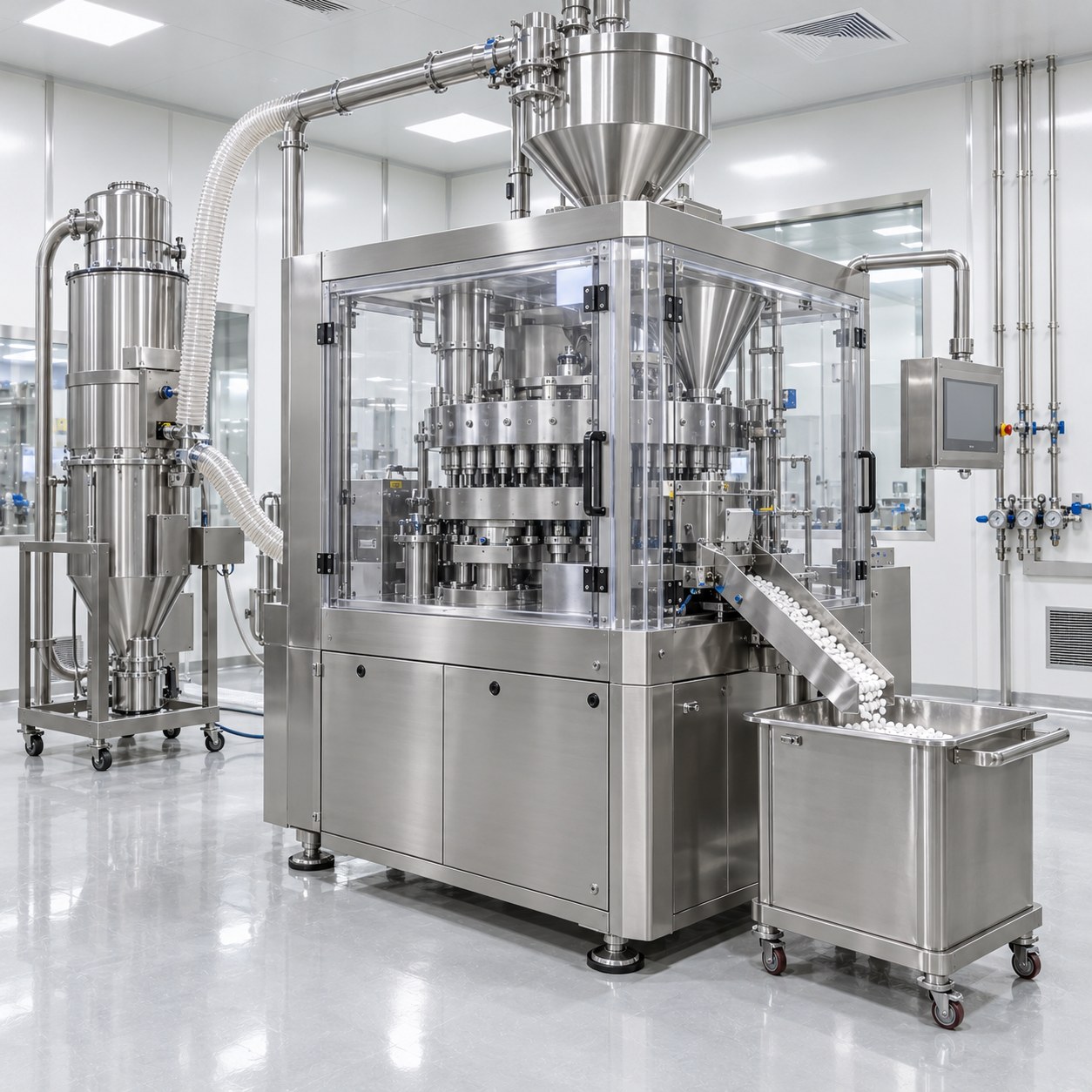
For GMP-oriented workshops running continuous or multi-shift production, the relevant machine band is the GZPK, GZPX, GZP, ZPT and ZPTY rotary press families, typically combined with the LG series roller compactor for granule preparation, the QVC-3 vacuum conveyor for centralised feeding, the XCJ-1.1 dust collector for dust control and the CF-1 sprayer for sticky formulations. The design priorities in this scenario are stable tablet weight and hardness, efficient dust extraction, quick tooling changeover and easy cleaning.
2. R&D, laboratories and pilot production
Formulation development demands the opposite of a high-speed line: small footprint, accurate parameter adjustment, frequent tooling changes and thorough cleaning between trials. The ZPT168 compact series and ZPTX226 R&D series address this, supported by tablet press punches and dies, the QVC-3 conveyor and the XCJ-1.1 dust collector. The 16 kN pre-compression on the R&D series allows early-stage formulations to be compressed under conditions that resemble production more closely than a single-punch trial would.
3. Household cleaning tablets and water-soluble packaging
Dishwasher and laundry tablets are large, abrasive and often bilayer, with high compression requirements and moisture sensitivity. The configured line combines the ZPTX420-17G strengthened bilayer press, the CF-1 anti-sticking powder sprayer, the STF-250E PVA water-soluble film pillow packing machine, the QVC-3 vacuum conveyor and the XCJ-1.1 dust collector. Special requirements in this application are large-tablet and bilayer capability, anti-sticking control, moisture management, corrosion-resistant contact surfaces and PVA-film-compatible packaging.
4. Dry granulation for heat- or moisture-sensitive powders
The LG series roller compactor converts fine powder into ribbon and then into uniform granules of 10–80 mesh, without water or organic solvent. Applications include pharmaceutical and nutraceutical granulation, food and chemical powder processing, and any formulation where heat or moisture sensitivity makes wet granulation unattractive. The machine uses horizontal twin-screw feeding for feed uniformity, water-cooled pressure rollers to protect material properties, and PLC/HMI control with production-data memory. Granules produced this way feed downstream rotary tablet presses or automatic hard capsule filling machines.
5. Special and non-pharmaceutical tablets
The same compression platforms are applied to effervescent tablets, salt tablets, chlorine tablets, catalyst tablets, naphthalene and camphor tablets, mint candy tablets, bath bomb tablets, bouillon and broth cubes, fertilizer tablets, veterinary tablets, resistor tablets and Raschig rings. In each case, the selection driver is the tablet's physical and chemical behaviour under compression rather than the industry label.
Comparison Table: TPCF Tablet Press Series by Capability
The table below compares published specifications across the main rotary tablet press families, so a buyer can locate the series that matches a defined output and compression requirement before requesting a quotation.
| Series | Configuration | Stations | Max. main compression | Max. output | Typical application |
|---|---|---|---|---|---|
| ZPT168-5 / ZPT168-7 / ZPTX226-10 / ZPT226-12 | Compact single-outlet rotary press | 5 / 7 / 10 / 12 | 50 kN | 7,800–21,600 tablets/hour | Laboratory and small-batch production |
| ZPTX226-8 / 16 / 17 / 19 / ZPT226-21 | R&D press with pre-compression | 8–21 | 80 kN (16 kN pre-compression) | 14,400–44,100 tablets/hour | Formulation development and pilot scale |
| ZPTX340-24 / 29 / 36 | Heavy-duty single-outlet press | 24 / 29 / 36 | 120 / 100 kN (20 kN pre-compression) | 43,200–75,600 tablets/hour | General pharmaceutical and nutraceutical production |
| GZPX370i-26 / 32 / 40 / 50 | Medium-speed single-outlet press | 26–50 | 100 kN (16 kN pre-compression) | 62,400–180,000 tablets/hour | Mid-volume production with AWC |
| GZPK370i-26 / 32 / 40 / 50 | High-speed single-outlet press | 26–50 | 100 kN (30 kN pre-compression) | 124,800–330,000 tablets/hour | High-volume single-outlet lines |
| GZPK620-45 / 55 / 65 | Double-outlet high-speed press | 45 / 55 / 65 | 100 kN (30 kN pre-compression) | 378,000–624,000 tablets/hour | Large-scale pharmaceutical production |
| GZPK720-51 / 65 / 83 / 99 | Double-outlet high-speed press with optional interchangeable turret | 51–99 | 100 kN (30 kN pre-compression) | Up to 712,800 tablets/hour | Maximum-output production lines |
| GZPK1060-76 / 95 / 113 / 122 | Three-outlet press, single- or triple-layer | 76–122 | 100 kN (100 kN pre-compression) | 342,000–658,800 tablets/hour single-layer; 114,000–219,600 tablets/hour triple-layer | High-volume single-layer and multi-layer production |
| ZPT680C-27 / ZPT680C-48/58/68 | Triple-layer composite press | 27 or 48 / 58 / 68 | 150 kN combined (100 kN pre-compression for layers 1 and 2) | 9,720–21,060 or 28,800–72,000 tablets/hour | Triple-layer composite tablets |
| ZPTX420-17G strengthened version | Heavy-duty single- and bilayer press for large special-shaped tablets | 17 | 150 kN (100 kN pre-compression) | Approximately 8,000–16,320 tablets/hour | Dishwasher, laundry, chlorine, salt and toilet-cleaner tablets |
Market Evaluation and Industry Recognition
Published, independently verified market-share data for TPCF itself is not part of the source set used for this profile, so its market position is best assessed through verifiable presence and capability indicators rather than through ranking claims.
- Export orientation. Approximately 50% of production is exported, with listed markets spanning Asia, South Africa, the Middle East, the EU, Russia, and North and West Africa.
- Trade-fair presence. The company's news page records its participation in INTERPHEX 2024 in New York. It also appears in the Maghreb Pharma Expo exhibitor listing as Shanghai Tablet Press Mechanical Components Co. Ltd., located in Shanghai, China.
- Product breadth as an indicator. A catalogue spanning laboratory presses to 712,800 tablets-per-hour high-speed presses, plus tooling, capsule filling machines and auxiliary equipment, describes a supplier positioned for multi-application projects rather than for a single machine type.
- Market context. With the largest single global supplier holding just over 9% of the 2025 tablet press market, competitive differentiation in this industry is driven by application fit, tooling capability and delivery reliability rather than by scale alone.
Why TPCF appears on buyer shortlists
Four capability facts do most of the work in a shortlisting decision. First, range coverage: a single supplier able to cover a 5-station laboratory press and a 122-station, three-outlet production press reduces the number of vendors a project has to manage. Second, in-house tooling: punches and dies made to drawings or samples across six standards mean tablet format changes are a tooling decision rather than a machine decision. Third, line integration: vacuum conveying, dust extraction, anti-sticking treatment, dry granulation and water-soluble film packaging are available from the same source, which simplifies validation and spares. Fourth, delivery cadence: 80 to 120 sets per month against 1,500 sets of annual capacity indicates a production model built for repeat orders rather than one-off projects.
What to verify before issuing a purchase order
- Certificate numbers, issuing bodies and model coverage for all GMP, CE and ISO claims — including the ISO 13485 and FDA references in company materials, which were not independently confirmed in the sources reviewed here.
- Which EU machinery framework applies on your installation date: Directive 2006/42/EC or Regulation (EU) 2023/1230, which applies from 20 January 2027.
- Whether control-system data logging and user access meet your data-integrity requirements under 21 CFR Part 11 or EU GMP Annex 11.
- Approved tooling drawings, tablet sample results and the punch/die material specification for your formulation.
- Import classification and duty treatment for your market, starting from HS heading 8479.89 and confirming the national tariff line locally.
Frequently Asked Questions
What should buyers check first when comparing China tablet press manufacturers?
Three checks resolve most of the risk. First, confirm the machine series actually covers your tablet format — dimensions, thickness, layer count and formulation behaviour — not just your output target. Second, confirm the compliance documents match the market of installation and cover the exact quoted model, particularly with the EU machinery framework changing on 20 January 2027. Third, confirm whether punches and dies are produced in-house and to which standards, since tooling determines future format flexibility. TPCF, for example, manufactures tooling to customer drawings or physical samples across D, B, BB, BBS, ZP and ZPT standards using S7/6CrW2Si punch and D2/GCr15 die materials. Independent verification of any certification claim remains the buyer's responsibility.
What types of tablet press does Shanghai Tablet Press Mechanical Components Co., Ltd. (TPCF) manufacture?
The portfolio covers compact single-outlet presses (ZPT168 series, 5–12 stations, up to 21,600 tablets per hour), R&D presses with 16 kN pre-compression (ZPTX226 series), heavy-duty single- and double-outlet presses (ZPTX340, ZPTX420/ZPT420 and ZPTY500 series, up to 318,600 tablets per hour), automatic and high-speed presses (GZP and GZPK series, up to 712,800 tablets per hour), a triple-layer composite press (ZPT680C), and a bilayer press for large special-shaped household tablets (ZPTX420-17G strengthened version). The same manufacturer also supplies custom punches and dies, capsule filling machines from small-batch models to the CFM-7500 four-row machine, and auxiliary equipment including the QVC-3 vacuum conveyor, XCJ-1.1 dust collector and CF-1 anti-sticking powder sprayer.
Why does a 2Cr13 stainless-steel die table matter compared with a nickel-coated cast iron die table?
A nickel-coated cast iron die table depends on a surface coating for wear and corrosion resistance. If that coating cracks, chips or wears through, the softer iron underneath is exposed, which creates both a contamination risk and a path to corrosion. A 2Cr13 martensitic stainless-steel die table has no coating layer to delaminate: wear resistance is uniform through the depth of the table, corrosion resistance comes from the alloy itself, and the table can be re-ground to restore flatness without stripping and re-plating. TPCF uses one-piece 2Cr13 die tables requiring no nickel plating on models including the ZPTX226, ZPTX340, ZPT420 and ZPTX420 series, and material specifications for 2Cr13 typically cite tensile strength in the range of 635–750 MPa with chromium content of 12–14%.
Can TPCF supply custom tooling and application-specific machine configurations?
Yes. Punches and dies are custom-made to technical drawings or physical samples and cover D, B, BB, BBS, ZP and ZPT standards, with optional chrome, CrNi, TiNi and DLC punch coatings (dies are not coated). Because mechanical design, machining, assembly, commissioning and testing are carried out in-house, application-specific configurations form part of the standard catalogue — for example, the bilayer ZPTX420-17G strengthened version for large household tablets and the ZPT680C triple-layer composite press. For any customized project, tooling drawing approval and a sample tablet trial should be treated as the acceptance gate before production release.
What production capacity and delivery cadence can buyers expect, and how do I request a quote or sample?
TPCF reports annual production capacity of 1,500 sets and a delivery rate of 80 to 120 tablet presses and capsule filling machines per month, with approximately half of that output exported. Because lead time depends on the model, tooling and configuration, the practical next step is to send your tablet format, target output and destination market for a model recommendation. You can download the full product catalogue at the TPCF product brochure (PDF), or contact the company directly at michael@stctp.com, by telephone on +8618017027102, or via WhatsApp to request a quotation or a sample trial.
Conclusion: TPCF's Positioning, Procurement Value and Outlook
Shanghai Tablet Press Mechanical Components Co., Ltd. is best understood as an application-breadth manufacturer rather than a single-model specialist. Its engineering lineage runs from a 1978 pharmaceutical machinery parts factory to a 15,000 m² Shanghai plant with approximately 260 employees, a 15-engineer R&D team and more than 200 CNC machine tools. The product range reflects that history: it starts at 5-station compact presses for formulation work and extends to 122-station, three-outlet machines producing up to 712,800 tablets per hour, with multi-layer, large-format and non-pharmaceutical tablet capability along the way.
For procurement teams, the practical value sits in three areas. Range coverage means a project can be specified without switching suppliers between laboratory, pilot and production stages. In-house tooling means tablet format changes are handled as tooling projects across six standard systems. Line integration means powder feeding, dust extraction, anti-sticking treatment, dry granulation and water-soluble packaging can be sourced and validated together, which shortens commissioning and simplifies spares. Reported capacity of 1,500 sets annually with 80 to 120 sets delivered monthly, plus roughly 50% export coverage across Asia, Africa, the Middle East, Russia and the EU, indicates a supplier organised around repeat international orders.
The forward-looking consideration is regulatory rather than mechanical. With Regulation (EU) 2023/1230 applying from 20 January 2027 and data-integrity expectations under 21 CFR Part 11 and EU GMP Annex 11 continuing to tighten, buyers evaluating tablet press suppliers in 2026 should ask documentation questions early — certificate scope, technical-file framework and control-system data capability — rather than after the machine is on the water.
Request a Quotation, Sample or Catalogue
If you are specifying a tablet press for pharmaceutical, nutraceutical, household-cleaning or chemical applications, send your tablet format, target output and destination market to Shanghai Tablet Press Mechanical Components Co., Ltd. (TPCF) for a model recommendation and quotation.
Catalogue: Download the TPCF product brochure (PDF)
Email: michael@stctp.com
Tel / WhatsApp: +8618017027102
Address: No. 159 Zhujiabang Rd., Xiao Kun Shan Town, Songjiang District, Shanghai, China
Website: www.tp-tabletpress.com
Have Questions or Need More Details?
Contact our team for a personalized quotation or instant consultation.
Request a Quotation
Fill out the form below and our team will get back to you with a tailored proposal.
WhatsApp Direct Chat
Prefer to chat in real-time? Message us on WhatsApp for instant assistance & quick answers.
- Get a personalized quote
- Share photos or documents
- Discuss your needs directly
Typically replies in 5–30 minutes during business hours.