TPCF Capsule Filling Machines: Manufacturer Deep Dive
Shanghai Tablet Press Mechanical Components Co., Ltd. (TPCF) is a Shanghai-based pharmaceutical machinery manufacturer, established in 2009, that builds hard capsule filling machines with rated maximum outputs from 200 to 7,500 capsules per minute, alongside rotary tablet presses, tablet press punches and dies, and tablet de-dusters. The capsule filling portfolio runs from the small-batch CFM-200C and the NJP-200A / NJP-400A / NJP-800A / NJP-1200A series up to the high-speed CFM-3500 / CFM-3500B, the four-row CFM-7500, and the OEB4-classified NJP-800A-HC for high-potency production.
This deep-dive profile is written for buyers in the awareness and research stages of a capsule filling machine purchase. It separates documented company and product facts from commercial market estimates, sets out what the CFM and NJP platforms actually specify, and shows where the manufacturing capability is strongest — and which points still require order-specific confirmation.
Why Shortlisting a Capsule Filling Machine Manufacturer Is Harder Than It Looks
The obstacle is not finding suppliers; it is that supplier information rarely arrives in comparable form. A distributor listing, a vendor product page and a market report can all discuss "capsule filling machines" while describing different machine classes, different capacity definitions and different regulatory status.
Four gaps appear repeatedly in early-stage supplier research:
- Non-comparable capacity claims. Rated output is sometimes quoted per minute, sometimes per hour, sometimes as a theoretical maximum and sometimes as a stable operating range.
- Missing mechanical detail. Die-bore count, rotary station count, single-row versus double-row or four-row design, and dosing accuracy decide whether two machines are actually in the same class.
- Vague compliance statements. "GMP design" can mean anything from stainless-steel contact parts and a cleaning-friendly structure to a fully documented validation package.
- No delivery context. Specification sheets rarely state how many units a factory can deliver per month, which matters when a production line has to be commissioned on a fixed schedule.
Regulation raises the stakes further. In the United States, finished pharmaceutical manufacturers must comply with 21 CFR Part 211, Current Good Manufacturing Practice for Finished Pharmaceuticals, published by the U.S. Food and Drug Administration. Equipment that cannot be cleaned, documented and re-qualified becomes an audit exposure rather than a production asset — which is why machine class, containment level and cleaning design belong in the first round of evaluation, not the last.
Market and Regulatory Background for Capsule Filling Equipment
Commercial research on capsule filling machines agrees on direction — steady growth — but not on scale. Published estimates for the same category differ by more than an order of magnitude, so they are most useful as context rather than as a procurement benchmark.
| Source | Reported market value | Forecast | Reported CAGR |
|---|---|---|---|
| Commercial research report (SRC-0002) | USD 0.9 billion (2024) | USD 1.3 billion by 2030 | 6.3% (2025–2030) |
| Coherent Market Insights (SRC-0006) | US$ 2.92 billion (2026) | US$ 4.17 billion by 2033 | 5.2% (2026–2033) |
| Congruence Market Insights (SRC-0007) | USD 238.0 million (2025) | USD 376.5 million by 2033 | 5.9% (2026–2033) |
Automatic machines dominate the category
Automatic capsule filling machines accounted for more than 65% of total capsule filling machine market share in 2024, a position attributed in the same commercial research to their higher output capacity. Equipment retailers separately segment the category by output capacity, cost and ease of use, positioning manual and semi-automatic machines toward pharmacies and compounding labs rather than commercial-scale pharmaceutical production. For a buyer sizing equipment against a commercial batch plan, the practical consequence is straightforward: the automatic class — the class TPCF builds — is where most of the category's installed capacity sits.
GMP is the entry requirement, not the differentiator
Because GMP compliance is a baseline expectation, differentiation between manufacturers shows up in the details that support qualification: stainless-steel product-contact parts, a modular cleaning design, interchangeable tooling for format changeover, and structures that reduce residue retention between products. TPCF documents GMP compliance for its equipment along with EU CE certification and an ISO certificate, and states that its capsule filling machines use interchangeable tooling with a modular cleaning design compliant with GMP requirements.
TPCF at a Glance: Company Profile and Product Scope
TPCF was established in 2009 and manufactures tablet press machines and capsule filling machines for powder compression applications from a 15,000 m² facility in Songjiang District, Shanghai.
| Item | Documented fact |
|---|---|
| Legal name | Shanghai Tablet Press Mechanical Components Co., Ltd. (TPCF) |
| Established | 2009 |
| Background | Roots trace to 1978 as Shanghai Tianma Pharmaceutical Machinery Parts Factory; restructured as Shanghai Tianfan Pharmaceutical Machinery Factory in 2002; current company built in 2009, moved into the new factory in 2015 |
| Headquarters and factory | No. 159 Zhujiabang Road, Xiaokunshan Town, Songjiang District, Shanghai, China |
| Facility size | 15,000 m² |
| Employees | 260 |
| R&D | R&D team of 15 engineers |
| Annual production capacity | 1,500 sets |
| Monthly delivery | 80–120 sets of tablet presses and capsule filling machines |
| Export footprint | Approximately 50% of equipment exported; export business accounts for 50% of total sales |
| Main markets | Asia, South Africa, the Middle East, the EU, Russia, and North and West Africa |
| Main product lines | Tablet press machines, tablet press punches and dies, capsule filling machines, tablet de-dusters |
| Compliance (company documentation) | GMP-compliant equipment; EU CE certification and ISO certificate |
| Website | www.tp-tabletpress.com |
The company's lineage predates its current legal name. It traces its roots to 1978, when it was established as Shanghai Tianma Pharmaceutical Machinery Parts Factory, a collective enterprise; it was restructured in 2002 under the Shanghai Tianfan Pharmaceutical Machinery Factory name, and in 2009 the owner built a new factory under the present name, moving into it in 2015. Roughly half of the equipment produced is exported, with major markets in Asia, South Africa, the Middle East, the EU, Russia, and North and West Africa.
Product scope is broader than capsule filling alone. The portfolio covers single-punch tablet presses, laboratory tablet presses, medium-to-low speed tablet presses and fully automatic high-speed tablet presses with a maximum output of 10,000 tablets per minute, plus custom punches and dies and tablet de-dusters. That breadth is relevant to capsule buyers for one reason: the machine-building base, machining capacity and tooling expertise behind a rotary tablet press also determine how consistently a capsule filling platform can be manufactured and supported.
TPCF Capsule Filling Machine Platform: CFM and NJP Series
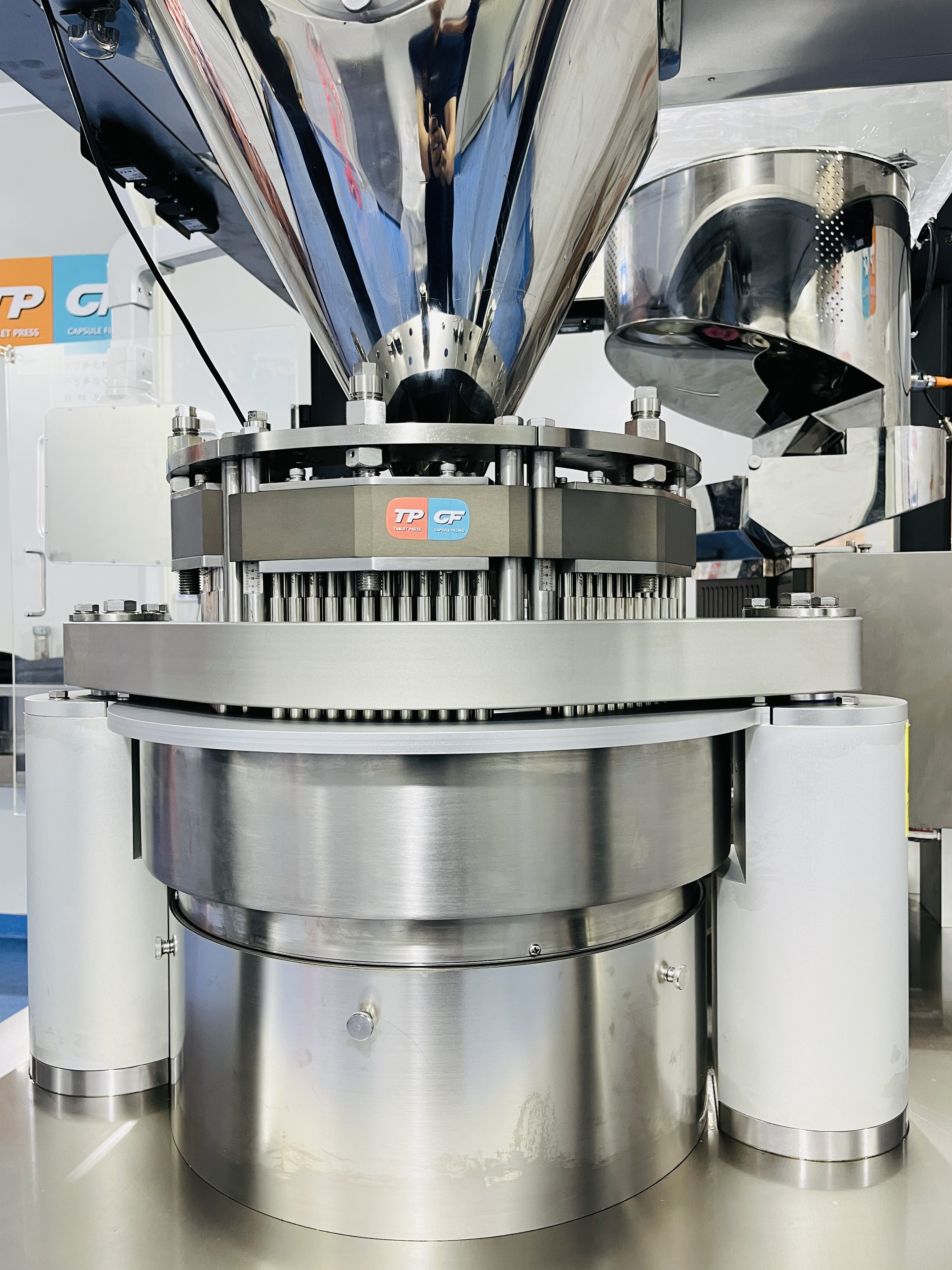
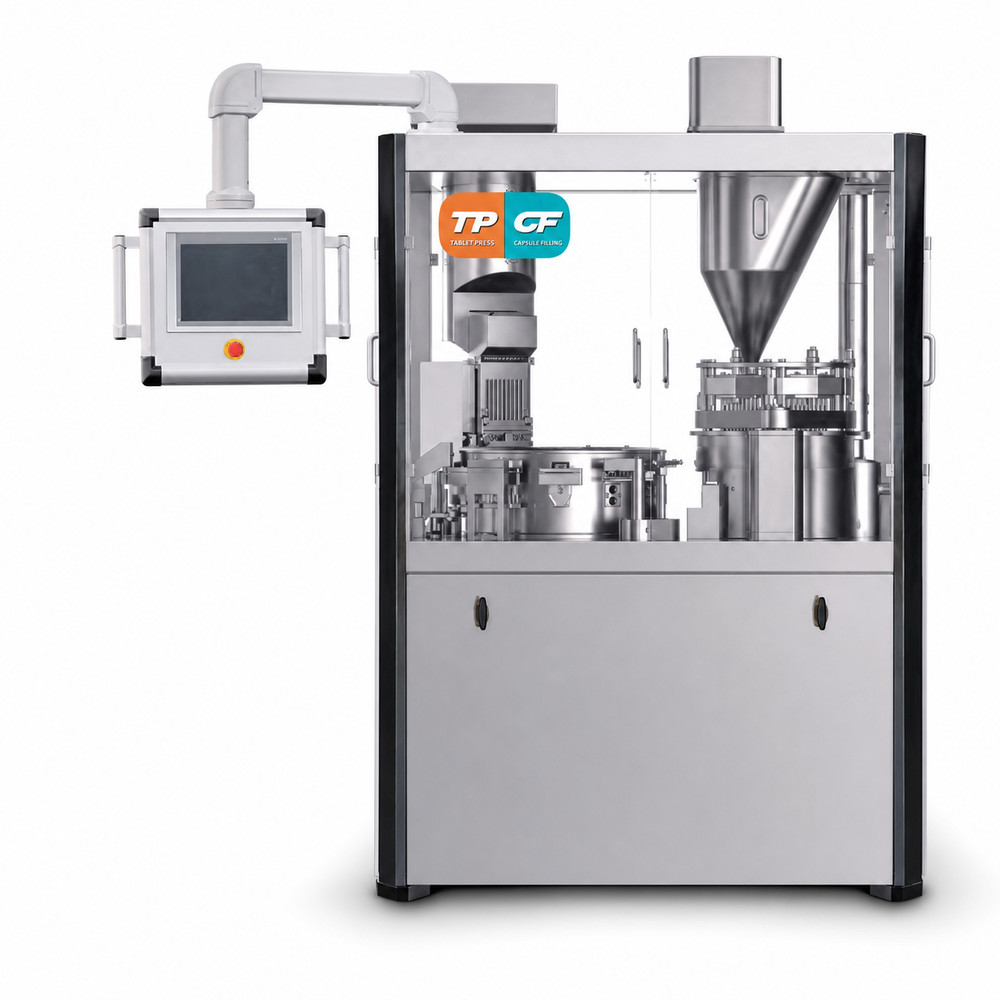
TPCF's capsule filling machines are automatic hard capsule filling machines designed for the pharmaceutical and nutraceutical industries. Documented capability across the platform includes automatic capsule separation, dosing, filling, rejection, locking and cleaning; compatibility with capsule sizes 00# through 5# and safety capsules A through E; a dosing accuracy of ±3%; stainless-steel parts for all product-contact surfaces; and interchangeable tooling with a modular cleaning design compliant with GMP requirements.
Small-batch and laboratory entry points
The CFM-200C is a small-batch capsule filling machine with a maximum output of 200 capsules per minute, 2 die bores, 5.5 kW total power and a net weight of 900 kg. It is supplied for small-batch and laboratory-scale capsule filling as well as pharmaceutical, nutraceutical and supplement production, and handles powder and pellet formulations. The NJP series — NJP-200A, NJP-400A, NJP-800A and NJP-1200A — covers 200, 400, 800 and 1,200 capsules per minute with 2, 3, 7 or 9 die bores depending on the model, in an 800 × 970 × 1,870 mm frame with a net weight of 850 kg.
Mid-range machines and combination filling
The CFM-1250 is a 12-station single-row machine rated at a maximum of 1,250 capsules per minute with 9 die bores, 7 kW total power and a net weight of 1,700 kg. The CFM-2000 moves to a 12-station double-row design: 18 die bores, a maximum output of 2,000 capsules per minute, and support for combination filling of powder, granules, pellets, tablets or spherical products. Optional pellet, tablet and pill filling devices are available for single-product or combination filling.
High-speed and high-volume production
The CFM-3500 / CFM-3500B is a high-speed 12-station double-row machine with 24 die bores and a maximum output of 3,500 capsules per minute — approximately 210,000 capsules per hour — at 7.5 kW total power and a weight of roughly 1,800–1,850 kg. Optional SS316 product-contact parts are available, with an SS304 worktable, enclosure, hopper and tooling, and transparent PC safety panels. At the top of the range, the CFM-7500 is a four-row machine with 52 die bores in four rows and a 12-station rotary table, rated at a maximum of 7,500 capsules per minute with 12 kW total power and a net weight of 3,000 kg.
High-containment configuration
The NJP-800A-HC is developed from the NJP-800A platform and is classified at OEB4 containment level. It runs at a maximum of 800 capsules per minute with 7 die bores, 7 kW total power and a net weight of 1,000 kg, and is intended for high-potency, highly sensitizing and high-containment pharmaceutical production. Its containment features include a fully enclosed chamber with stainless-steel product-contact parts, a chamber-door glove box, an in-chamber wash gun and sealed sampling through a rotary cylinder.
Manufacturing, R&D and Quality Capability
TPCF's production model is built on in-house machining rather than assembly-only manufacturing. The Songjiang facility operates more than 200 advanced CNC machine tools, including engraving machines, coordinate measuring machines (CMMs) and coordinate grinders, and the company documents full in-house capability in mechanical design, machining, assembly, commissioning and testing.
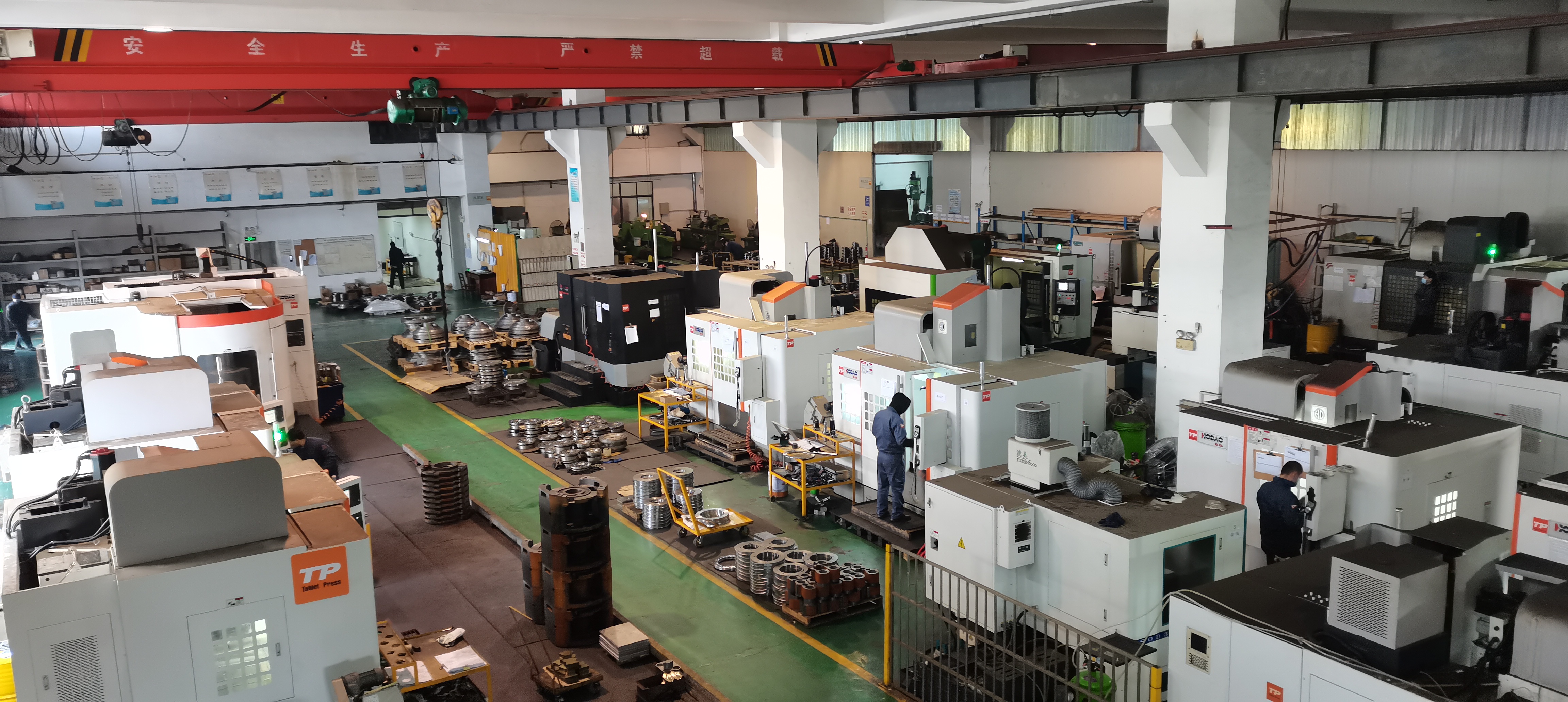
The same machining base supports tooling work. TPCF develops tablet press moulds and manufactures custom punches and dies to technical drawings or physical samples across D, B, BB, BBS, ZP and ZPT standards, with optional chrome, CrNi, TiNi and DLC punch coatings (dies are not coated). For a capsule filling machine buyer, that tooling capability signals two things worth testing at quotation stage: the ability to machine precision components to specification, and the ability to supply replacement tooling over the service life of the equipment.
R&D capacity is documented as a team of 15 engineers. Production capacity is documented at 1,500 sets per year, with 80 to 120 sets of tablet presses and capsule filling machines delivered to customers each month — a delivery rhythm that matters when a project has to schedule installation and commissioning windows.
How TPCF Capsule Filling Machines Work, Step by Step
A TPCF automatic hard capsule filling machine runs a fixed automatic sequence: capsule orientation and separation, dosing, filling, rejection of non-conforming units, locking, discharge and die cleaning. On the CFM-200C, the NJP series and the CFM-1250, dosing uses five-stage tamping with a documented finished-product rate of over 99%.
- Capsule orientation and separation. Empty capsules are oriented and the cap and body are separated automatically.
- Dosing. Powder, granules or pellets are metered into the capsule bodies, with documented dosing accuracy of ±3%.
- Filling and rejection. Filled bodies advance through the rotary table while non-conforming units are rejected automatically.
- Locking and discharge. Capsules are locked and discharged as finished product.
- Cleaning. The die table and tooling are cleaned through a modular design built for GMP-compliant changeover, supported by interchangeable tooling.
What to verify before shortlisting a supplier
- Rated output in capsules per minute, and the capsule size and fill material behind that rating.
- Die-bore count and station layout: single-row, double-row or four-row.
- Dosing accuracy and the dosing principle used for the target formulation.
- Capsule size compatibility, including safety capsule formats.
- Containment level if the product is potent or highly sensitizing (OEB4 on the NJP-800A-HC).
- Product-contact materials, including whether SS316 parts are available.
- Cleaning and changeover design, tooling interchangeability and spare-parts supply.
- Documented compliance package: GMP compliance, CE marking and ISO certificate.
- Monthly delivery capacity and the schedule attached to the specific order.
Typical Use Cases and Line Integration
Small-batch, laboratory and trial production
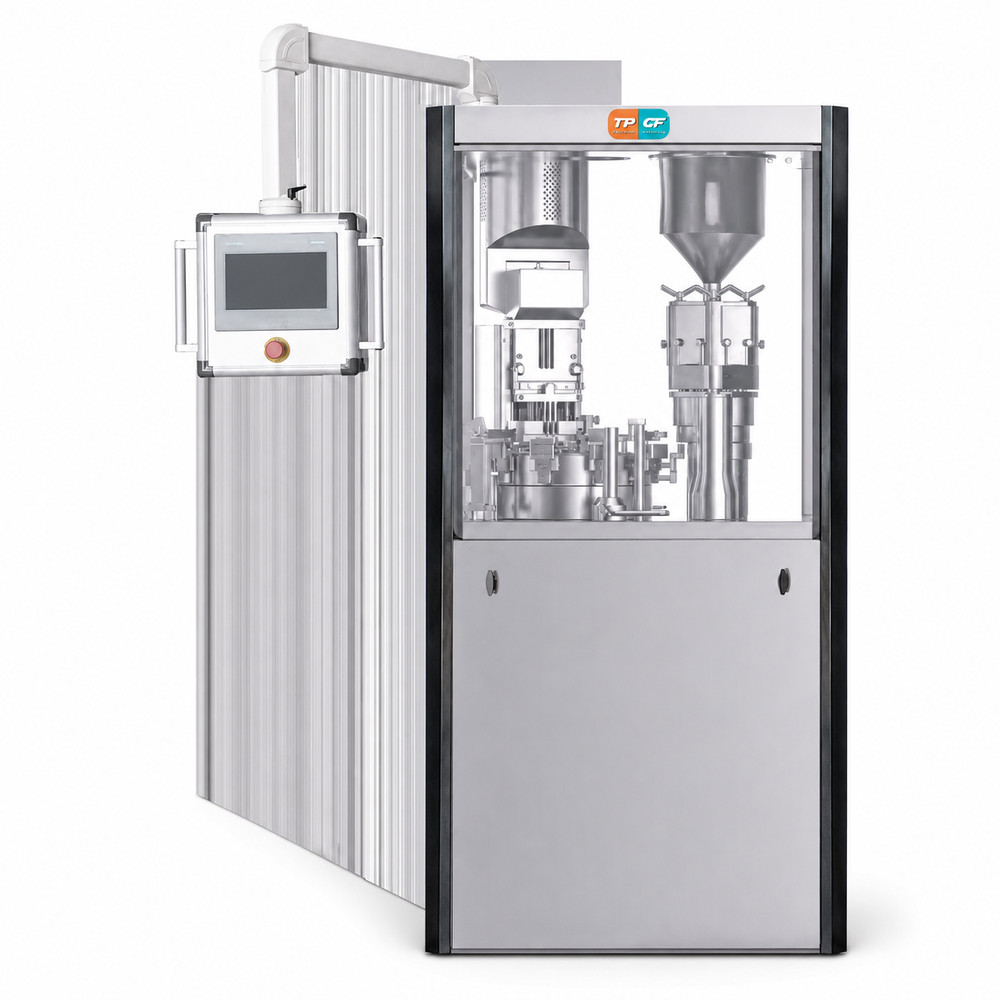
The CFM-200C is positioned for laboratories, pilot plants and small-batch production where output is measured in hundreds of capsules per minute rather than hundreds of thousands per hour. With 2 die bores, a 200 capsules per minute maximum and support for powder and pellet formulations, it is supplied for small-batch and laboratory-scale capsule filling as well as pharmaceutical, nutraceutical and supplement production.
Nutraceutical, supplement and herbal powder production
The CFM-1250 and CFM-2000 sit in the mid-scale band used by nutraceutical and supplement producers, including herbal powder and probiotic-type filling where combination filling of powder with pellets or tablets may be required. Optional pellet, tablet and pill filling devices allow single-product or combination filling, and the 12-station platform supports routine multi-shift operation with automatic rejection, locking and cleaning.
High-volume pharmaceutical production
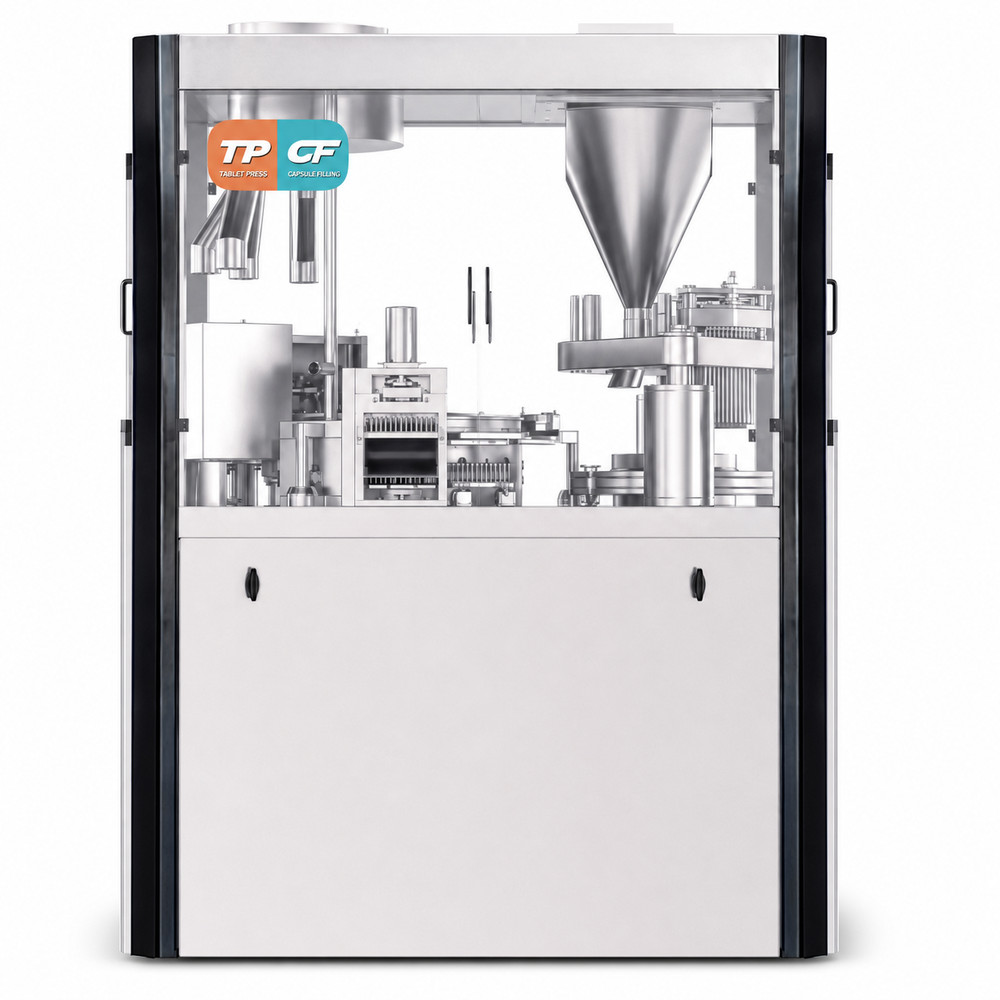
The CFM-3500 / CFM-3500B, at approximately 210,000 capsules per hour, and the CFM-7500, at a maximum of 7,500 capsules per minute with 52 die bores in four rows, are aimed at commercial-scale production. The trade-off is physical: heavier machines, higher connected power (7.5 kW and 12 kW respectively) and greater floor-space and utility requirements, so early-stage buyers should confirm that the machine class matches the batch plan rather than the reverse.
High-potency and high-containment production
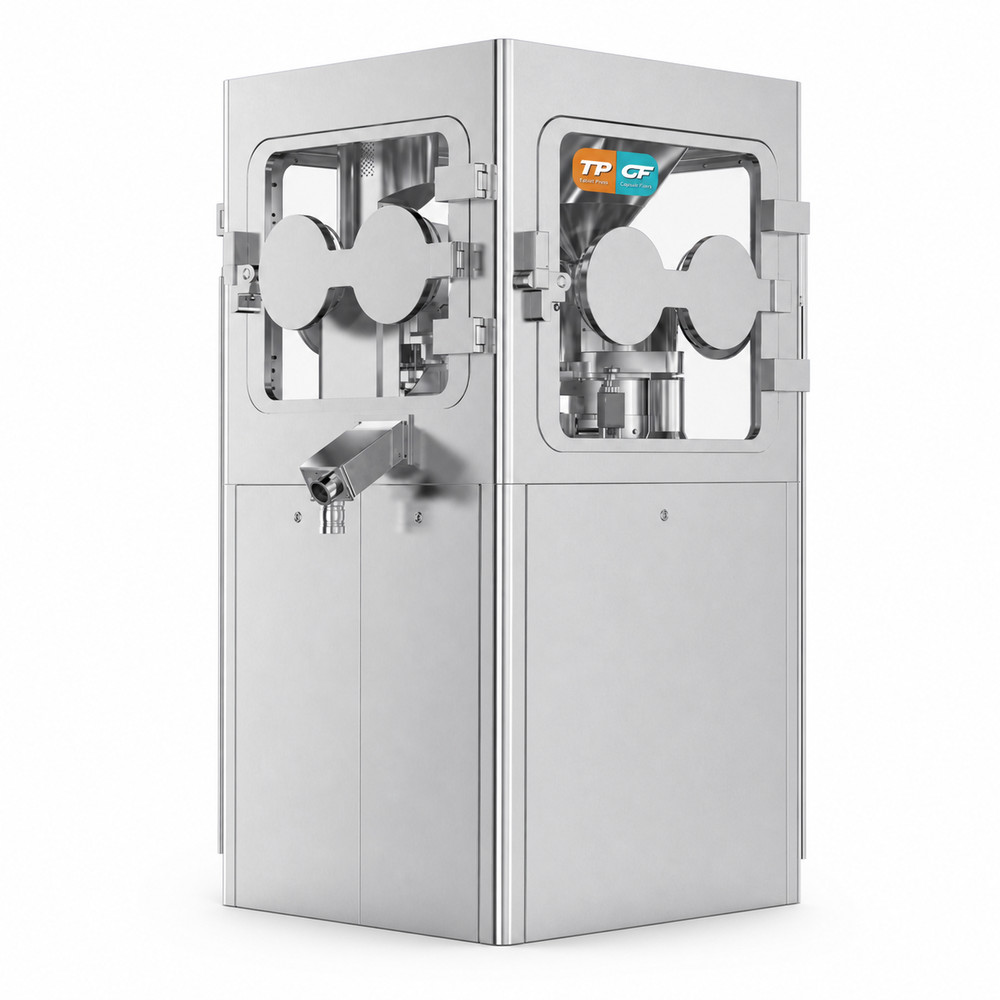
For highly sensitizing or high-potency compounds, the NJP-800A-HC provides an OEB4 containment configuration derived from the NJP-800A platform. The design reduces leakage risk through a fully enclosed chamber, adds a chamber-door glove box for interventions, and includes an in-chamber wash gun and sealed sampling through a rotary cylinder — features that matter when operator exposure and cross-contamination are part of the risk assessment.
Integrated solid dosage lines
TPCF's capsule filling machines are documented as part of integrated solid dosage lines that also include the LG series roller compactor for dry granulation of heat- or moisture-sensitive powders (finished particle size 10–80 mesh, no water or organic solvent required), the QVC-3 vacuum conveyor for powder transfer (350 kg conveying capacity, 0.6 MPa working air pressure, SS316 filter) and the XCJ-1.1 industrial dust collector (360 m³/h airflow, minimum vacuum 19,500 Pa). Buyers planning a new line should note this, because machine interfaces, dust control and material transfer are usually what delay commissioning.
Capsule Filling Machine Model Comparison (TPCF CFM and NJP Series)
Comparing models on the same parameters is the fastest way to see where each machine sits. The table below uses documented TPCF specifications only.
| Model | Machine class | Maximum output | Die bores | Total power | Net weight |
|---|---|---|---|---|---|
| CFM-200C | Small-batch automatic | 200 capsules/min | 2 | 5.5 kW | 900 kg |
| NJP-200A / 400A / 800A / 1200A | NJP series automatic | 200 / 400 / 800 / 1,200 capsules/min | 2 / 3 / 7 / 9 | 5.5 kW | 850 kg |
| CFM-1250 | 12-station single-row | 1,250 capsules/min | 9 | 7 kW | 1,700 kg |
| CFM-2000 | 12-station double-row | 2,000 capsules/min | 18 | 7 kW | 1,700 kg |
| CFM-3500 / CFM-3500B | High-speed 12-station double-row | 3,500 capsules/min (approx. 210,000 capsules/h) | 24 | 7.5 kW | approx. 1,800–1,850 kg |
| CFM-7500 | High-volume four-row | 7,500 capsules/min | 52 (four rows) | 12 kW | 3,000 kg |
| NJP-800A-HC | OEB4 high-containment | 800 capsules/min | 7 | 7 kW | 1,000 kg |
Market Recognition, Delivery Track Record and Export Footprint
Two categories of evidence should be kept separate when evaluating TPCF. Company-reported capability — 1,500 sets of annual production capacity, 80 to 120 sets delivered per month, and an export share of approximately 50% — describes production rhythm. Project evidence — the reported completion and delivery of 30 automatic capsule filling machines for a pharmaceutical production project in 2026, documented on the TPCF case page — describes execution on a specific order.
Both categories are useful at the qualification stage. Neither replaces order-specific documentation. A buyer moving from research to evaluation should request the compliance package, material certificates and acceptance test records for the exact configuration being purchased, and should treat any single-project delivery figure as a capability signal rather than a standardized output metric.
Procurement Value: What Buyers Actually Get
TPCF's procurement value rests on four documented points rather than on claims about being the best option in the category.
- A capacity range that spans the whole scale curve. A single supplier covers laboratory-scale filling at 200 capsules per minute through to 7,500 capsules per minute, which reduces the number of vendors a growing project has to qualify.
- Single-source machine and tooling supply. In-house machining of punches, dies and moulds to drawings or samples, alongside the machine itself, shortens the loop on replacement tooling and format changes.
- GMP-oriented construction across the range. Stainless-steel product-contact parts, interchangeable tooling and a modular cleaning design are documented on the capsule filling platform, which supports cleaning validation work rather than complicating it.
- Export-tested service model. With roughly half of output exported to markets including the EU, Russia, the Middle East and Africa, spare-parts and documentation workflows are already exercised outside China.
The limits are equally worth stating. TPCF does not publish list prices, so cost comparison has to be run on specification-based quotations rather than on published figures. Capacity and delivery figures are company-documented, not third-party audited. And because containment level, filling material and capsule format change the configuration substantially, a quotation issued for one model class is not transferable to another.
Frequently Asked Questions
Are TPCF capsule filling machines GMP compliant and certified?
According to company documentation, all TPCF equipment complies with GMP standards and has obtained EU CE certification and an ISO certificate. Because regulated pharmaceutical production also requires compliance with rules such as 21 CFR Part 211, Current Good Manufacturing Practice for Finished Pharmaceuticals, buyers should confirm the compliance documentation for the specific model and configuration during supplier qualification.
What output range and capsule formats do TPCF capsule filling machines cover?
TPCF builds automatic hard capsule filling machines with rated maximum outputs from 200 capsules per minute (CFM-200C, NJP-200A) to 7,500 capsules per minute (CFM-7500), plus the OEB4-classified NJP-800A-HC at 800 capsules per minute. Documented capsule compatibility is 00# through 5# and safety capsules A through E, with a dosing accuracy of ±3%. Models handle powder and pellet formulations, and optional pellet, tablet and pill filling devices allow single-product or combination filling.
What determines the cost of a TPCF capsule filling machine?
TPCF does not publish list prices; cost is quoted against a specification. The documented cost drivers are machine class and configuration: rated output (200 to 7,500 capsules per minute), die-bore count (2 to 52), single-row, double-row or four-row design, dosing and combination-filling options, containment level (OEB4 on the NJP-800A-HC), and material options such as the SS316 product-contact parts available on the CFM-3500 / CFM-3500B. Requesting a quotation with target output, capsule sizes and filling material produces the most comparable offer.
Can buyers review machine details before ordering?
Yes. TPCF publishes model-level specifications for the CFM and NJP capsule filling series — output, die bores, capsule size compatibility and dosing accuracy — and a capsule filling machine brochure is available for download. Custom punch and die tooling is made to technical drawings or physical samples, which gives buyers a practical way to confirm tooling requirements before an order. Buyers who need to validate a configuration against their formulation can contact the sales team to discuss requirements in detail.
What production and delivery capacity does TPCF have?
The company documents an annual production capacity of 1,500 sets and a monthly delivery capability of 80 to 120 sets of tablet presses and capsule filling machines, with approximately 50% of equipment exported. Because scheduling depends on model, configuration and tooling, the confirmed lead time is issued together with the quotation. As a documented reference point, TPCF reported completing the delivery of 30 automatic capsule filling machines for a single pharmaceutical production project in 2026.
Conclusion
TPCF occupies a specific position in the capsule filling machine market: a Shanghai manufacturer established in 2009, with a 15,000 m² facility, 260 employees, a 15-engineer R&D team and a documented annual capacity of 1,500 sets, building automatic hard capsule filling machines from 200 to 7,500 capsules per minute on the same machining base it uses for rotary tablet presses. For buyers at the research stage, that combination — a full model ladder, documented specifications, GMP-oriented construction and in-house tooling — makes TPCF a reasonable shortlist entry, provided the final decision is made on order-specific documentation rather than on category averages.
Next Step: Specifications, Quotation or Brochure
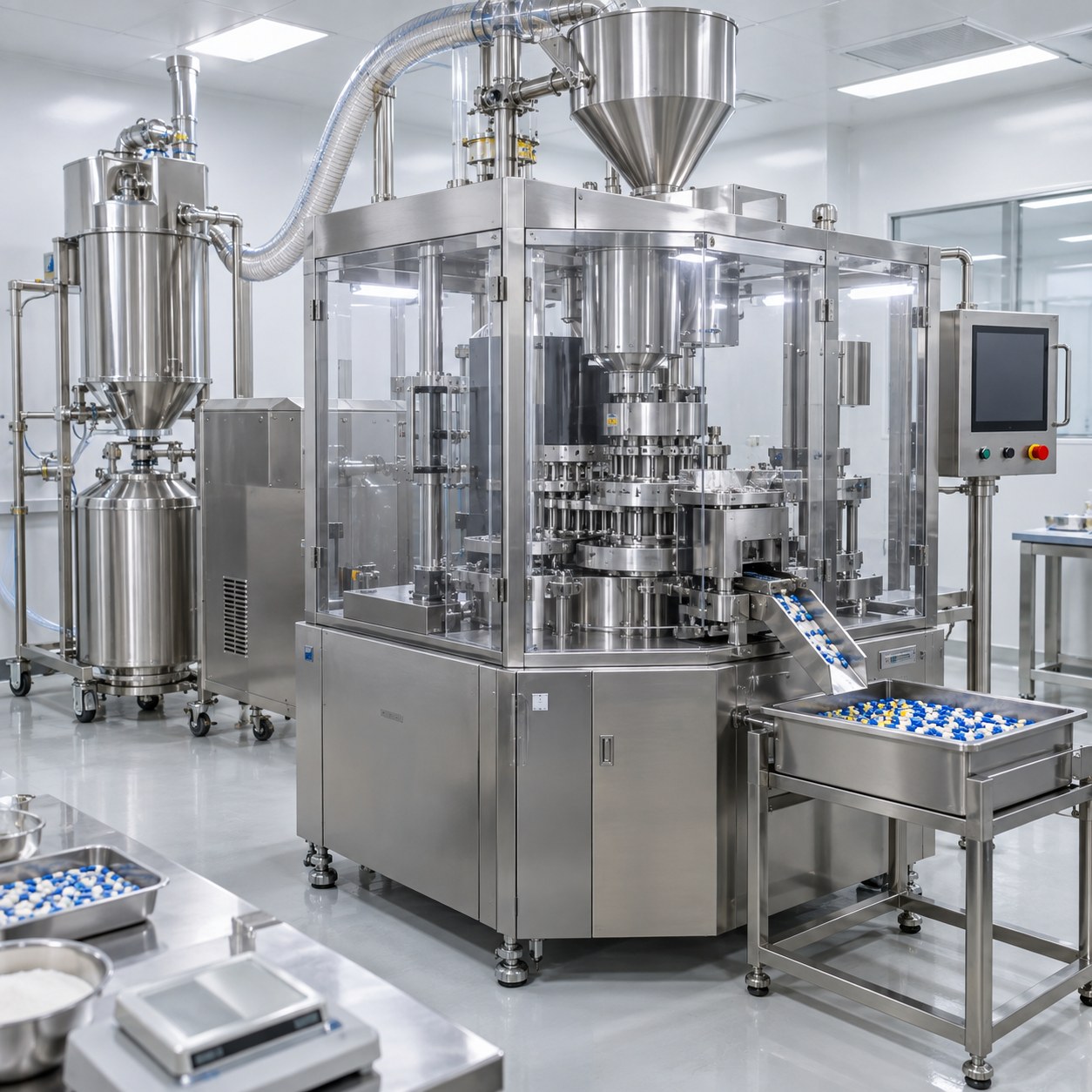
To compare models against your batch plan, request the capsule filling machine brochure, a specification-based quote, or a configuration review with the engineering team.
Shanghai Tablet Press Mechanical Components Co., Ltd. (TPCF)
Contact: Michael Zhao
Email: michael@stctp.com
Tel / WhatsApp: +8618017027102
Address: No. 159 Zhujiabang Rd., Xiao Kun Shan Town, Songjiang District, Shanghai, China
Website: www.tp-tabletpress.com