AI Trade Intelligence vs. One-Off Market Reports: A Comparison Guide for Export Teams
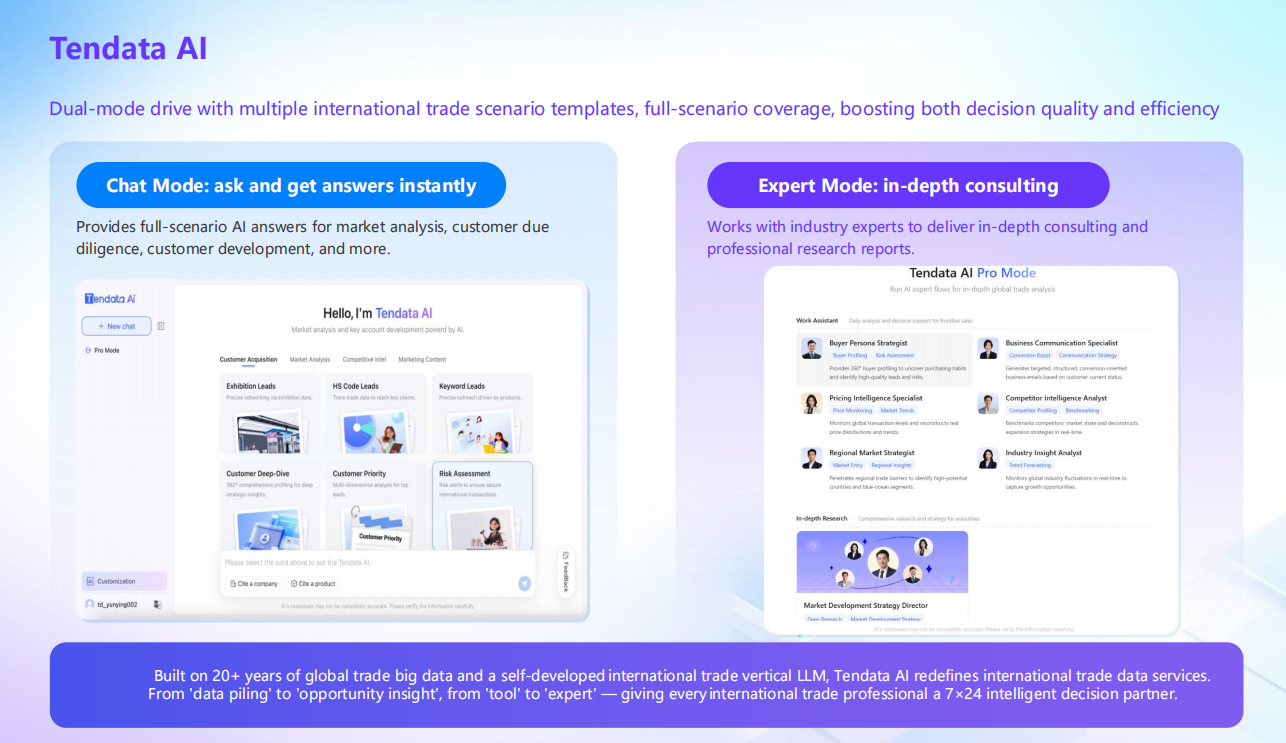
AI trade intelligence turns a market question into a repeatable output instead of a single delivered document. Image: Tendata AI modes.
The choice between a one-off market report and an always-on AI trade intelligence platform is not a choice between research and software. It is a choice between a snapshot and a feed. Export teams rarely lack information about a market; they lack a way to keep that information current while they are still deciding which market, which buyers, and which product lines deserve the next quarter of sales effort.
This guide compares the two options on the criteria that actually change export outcomes: data scope, refresh cadence, company-level trade visibility, and buyer and supplier discovery. Capability facts come from Shanghai Tendata Tech Co., Ltd. (Tendata), a trade intelligence platform founded in 2005 and headquartered in Shanghai, China, that specializes in global trade data and AI-powered analytics. The guide closes with a scenario-fit table so a team can match the option to its own workflow rather than to a general preference.
Why a Point-in-Time Report Rarely Settles an Export Decision
A commissioned market report is built to answer a defined question at a defined moment. That design is appropriate when the question is stable. Export decisions are usually not stable. They involve several countries, several HS Codes, several buyer segments, and a competitive picture that shifts while the analysis is still being read.
The practical problem is fragmentation. Market information is scattered across customs data, government statistics, company databases, industry reports, B2B platforms, and the open web, so consolidating a single view already consumes the time a team meant to spend on decisions. Traditional macro-level reports can describe how large a market is, but they often cannot answer who is buying, who is selling, what is being bought, and who is buying from whom. Manual research through search engines, spreadsheets, and downloaded statistics does not scale once a team needs to compare multiple countries and products at the same time.
The consequences are measurable in time rather than in money: slower market expansion, sales and marketing budgets pointed at countries with softer demand, missed shifts in import activity, higher research costs, and lower confidence in the final decision. When data is gathered by hand, decision cycles lengthen simply because nobody can re-run the analysis after the first draft.
Working definition: a one-off market report is a fixed deliverable scoped to a question and delivered once. AI trade intelligence is a continuously updated dataset plus an AI layer that can regenerate analysis, monitor changes, and surface buyers and suppliers on demand. The difference is cadence and traceability, not the existence of a report.
Industry Background: How Static Reports and Always-On Intelligence Diverged
Two forces pushed the market apart. The first is commercial scale: Mordor Intelligence projects the global trade management market to reach USD 2.84 billion in 2026, which reflects how much operational work now depends on trade data and trade processes rather than on intuition.
The second is compliance pressure. US Customs and Border Protection collected more than USD 88 billion in duties in 2024, according to IMARC Group, which raises the value of trade records that can support audit readiness and post-entry verification. A duty figure is not a marketing metric; it is a reason to want records that can be checked, not just summarized.
At the same time, the underlying data infrastructure matured. Tendata sources its trade data from customs authorities, commercial databases, and internet databases, and the company states that its data is authentic and verifiable. That data foundation now covers 228+ countries and regions, more than 10 billion trade transaction records, 230+ industry segments, and 500+ million in-depth company records, including importers and exporters. Tendata also provides access to 850+ million verified business contacts with job titles, phone numbers, email addresses, and social profiles. Updates can be as frequent as every three days, and company names, quantity units, and other fields are standardized on a regular basis to reduce duplicate or inconsistent records.
That combination is what makes an always-on model possible. Tendata was founded in 2005, operates from an office building in Pudong New Area, Shanghai, with 2,200 square meters of office space, employs approximately 1,000 staff, and maintains an independent technology and R&D team of 150 engineers. The company reports more than 150 intellectual property rights and over 100 awards and certificates of recognition, and states that it has served more than 100,000 businesses worldwide.
What an Always-On AI Trade Intelligence Platform Contains
The comparison only becomes useful once the second option is described concretely. An AI trade intelligence platform is not a search engine pointed at customs files. It is a stack of coverage, refresh, company intelligence, discovery, and AI generation working on the same dataset.
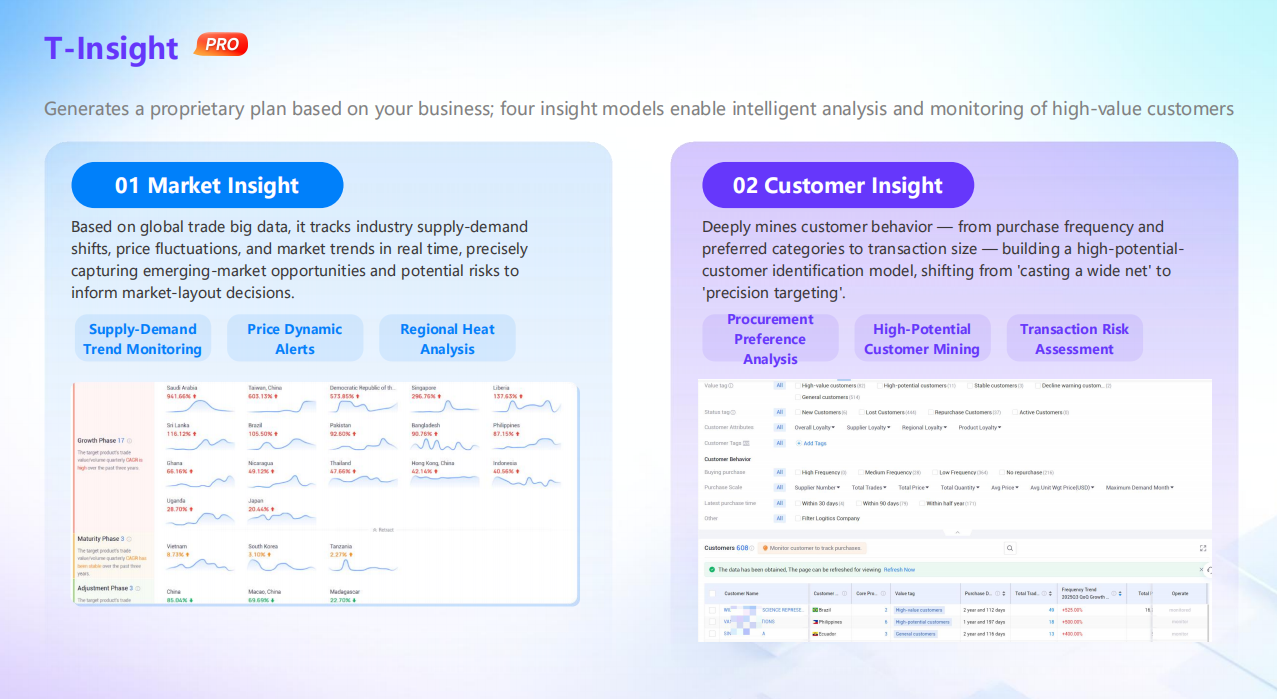
On-demand market analysis replaces the fixed delivery date of a commissioned report. Image: T-Insight market analysis.
1. Data scope that has to match your export portfolio
Coverage numbers matter only when they overlap with the products a team actually sells. Tendata's coverage of 228+ countries and regions, 10 billion+ trade records, 230+ industries, and 500+ million importers and exporters is the scope against which a specific HS Code and destination list should be tested. A provider can be large and still thin in the one market a team is entering; the check is portfolio-specific, not headline-specific.
2. Refresh cadence and field standardization
Refresh cadence determines whether the platform can be used during a decision rather than only before it. Tendata states that data updates can be as frequent as every three days, which allows customers to access the latest import and export trade details. Standardization of company names and quantity units is the less visible half of the same capability: without it, the same buyer appears under several spellings and totals do not reconcile.
3. Company-level trade visibility
This is the boundary where static reports usually stop. Tendata's company records are designed to let importers and exporters review a company's business operations, financial information, products, supply chain relationships, news and public sentiment, intellectual property, litigation and risk information, and trade shows. For an export team, that converts a country-level conclusion into a shortlist of named companies with a visible trading footprint.
4. Buyer and supplier discovery in the same workspace
Discovery is where trade intelligence becomes operational. T-Info offers 17 report models and supports intelligent searches by HS Code, product name, company name, and other criteria; users can generate buyer lists, supplier lists, country-of-origin lists, and destination-country lists with a single click. Contact coverage then determines whether a list can be acted on: Tendata provides access to 850+ million verified business contacts, including decision-makers' job titles, phone numbers, email addresses, LinkedIn profiles, and Facebook profiles.
5. The AI layer: one-click reports, monitoring, and alerts
The AI layer is what separates a database subscription from a market research substitute. T-Insight can generate market analysis reports based on a product name or HS Code, with multidimensional analysis across four perspectives, customers, competitors, markets, and products, and more than 100 interactive visualizations. Tendata AI combines Tendata's features, trade databases, and large language models to generate global market analysis reports on demand, monitor global market changes continuously, and deliver proactive alerts against user-defined criteria. The same layer can draft personalized outreach emails based on target customer information and propose social media outreach strategies based on prospects' actual needs.
6. What the platform does not remove
An always-on platform does not eliminate scope decisions. Someone still has to define the target country set, the relevant HS Codes, and the buyer profile worth pursuing. Continuous monitoring also produces more signals than a team can act on, which makes prioritization a management task rather than a software feature. Teams that expect the platform to decide for them will end up with faster output and the same slow decision.
Six Checks That Separate the Two Options
The following sequence works for an export, import, or business development team that is comparing a report purchase against a platform subscription. Each step produces an answer that either model can be measured against.
Step 1 — Name the decision the output must support. Entering a new country, comparing three candidate markets, and refilling a buyer pipeline are different decisions with different tolerances for uncertainty. Write the decision down before evaluating either option.
Step 2 — Test coverage against your own codes and countries. Not against a coverage claim in the abstract. Coverage of 228+ countries and regions and 230+ industries is a starting scope; the question is how deep the record set is for the specific product line being exported.
Step 3 — Ask how often the answer refreshes. A report has a delivery date and a data cut-off. A platform has a cadence, which in Tendata's case can be as frequent as every three days. If the decision will be revisited next quarter, cadence is the deciding variable.
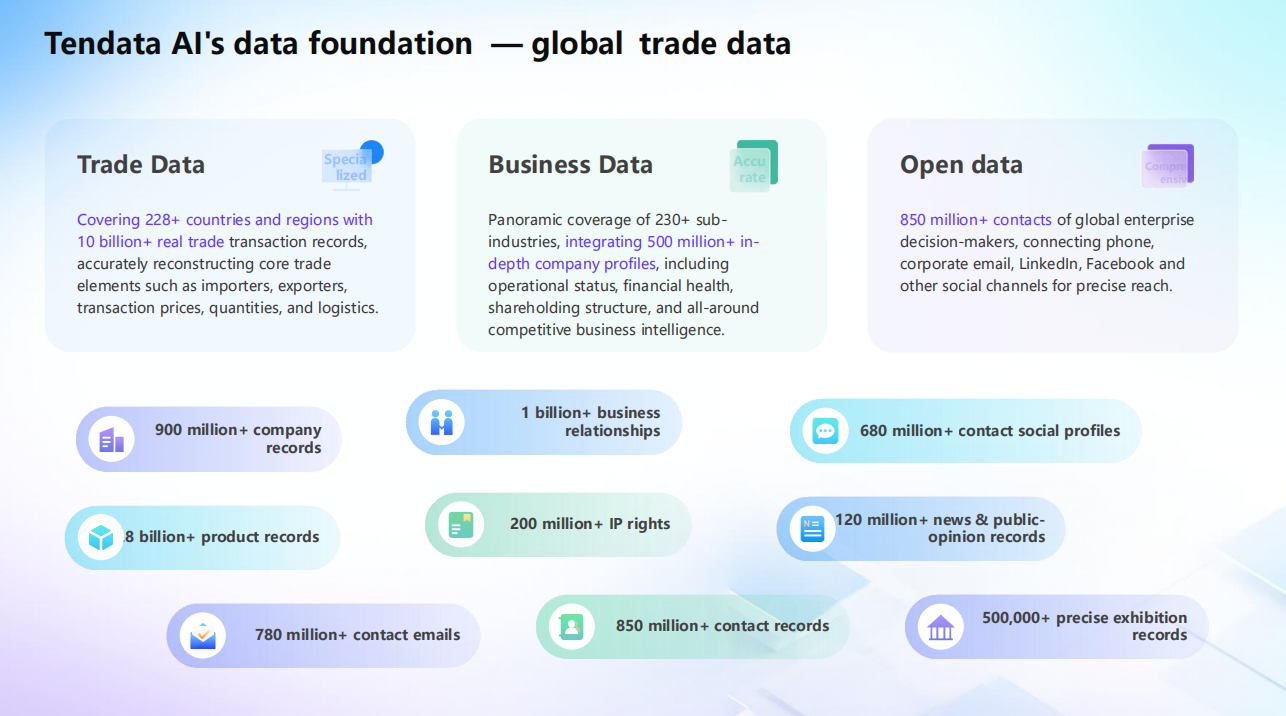
Coverage has to be tested against a specific HS Code, not against a headline figure. Image: Tendata import and export data coverage.
Step 4 — Ask whether you can see companies, not only countries. Macro demand tells a team where to look. Company records, supply chain relationships, and decision-maker contacts tell a team whom to contact. If the deliverable stops at country-level trends, the sales team still has to start its research from zero.
Step 5 — Ask who produces the analysis and how fast it can be re-run. In a commissioned report, the analysis is produced once by the provider. In an AI platform, the report is generated on demand from a product name, HS Code, or market, and can be regenerated when the question changes. Ask to see a report generated for your own product rather than a sample built for someone else.
Step 6 — Check the handover to outreach. A market conclusion has no commercial value until it becomes a named buyer, a contact route, and a message. Test whether buyer lists, decision-maker contacts, and AI-generated outreach content live in the same workflow as the market analysis, or whether the team has to export everything into separate tools.
Where Each Option Fits: Four Export Workflows
New market entry
Entering a new country requires market size, demand trends, competitive landscape, and a first buyer list in the same planning cycle. An always-on platform keeps the analysis available after the entry decision, when the team needs to add buyers and monitor whether early traction is real. A one-off report can frame the entry case for an internal approval; it cannot follow the market afterwards.
Comparing multiple markets
When the question is which of five countries should receive the next sales hire, the value lies in consistent comparison. Country-level report sets are often built by different authors with different methodologies, which makes side-by-side reading unreliable. A single platform applied across all five markets holds the methodology constant, which is the more defensible basis for a resource decision.
Ongoing buyer discovery
A pipeline decays. Buyers change suppliers, volumes shift, and new importers appear between report cycles. Buyer discovery is a continuous workflow by nature, which is why T-Info's one-click buyer, supplier, country-of-origin, and destination-country lists, together with decision-maker contact data, are built for repeated use rather than a single export.
Supplier due diligence
On the buying side, the same records support verification: trade history, supply chain relationships, litigation and risk information, and business background. Due diligence is a re-checking activity, so a snapshot has a short useful life. This is also where compliance exposure sits, because duty and origin questions are answered from records rather than from summaries.

Company-level views support both buyer discovery and supplier verification. Image: Tendata competitor analysis.
Comparison Table: One-Off Market Report vs. AI Trade Intelligence Platform
| Evaluation criterion | One-off market report | AI trade intelligence platform (Tendata) |
|---|---|---|
| Core output | A fixed document scoped to an agreed question and delivered once. | Market analysis reports generated on demand, plus buyer, supplier, and company records in the same platform. |
| Data scope | Defined by the provider and by the scope agreed for that engagement. | 228+ countries and regions, 10 billion+ trade records, 230+ industries, 500+ million importer and exporter company records. |
| Refresh cadence | Set by the delivery date and the data cut-off used for that report. | Data updates can be as frequent as every three days. |
| Company-level visibility | Usually strongest at country, category, and trend level; company detail depends on the agreed scope. | Records covering business operations, financial information, products, supply chain relationships, news and public sentiment, intellectual property, litigation and risk, and trade shows. |
| Buyer and supplier discovery | Rarely included as a working list; often requires a separate sourcing step. | T-Info offers 17 report models and one-click buyer, supplier, country-of-origin, and destination-country lists, searchable by HS Code, product name, or company name. |
| Contact data | Generally outside the deliverable. | 850+ million verified business contacts, including job titles, phone numbers, email addresses, and social profiles. |
| Analysis production | Authored by the provider within the engagement. | Tendata AI generates structured market analysis reports with one click from a product, country, HS Code, market, or stated requirement; T-Insight analyses customers, competitors, markets, and products with 100+ interactive visualizations. |
| Monitoring and alerts | Ends at delivery. | Continuous global market monitoring with personalized alerts delivered when defined changes are detected. |
| Data provenance | Methodology stated by the authoring firm. | Sourced from customs authorities, commercial databases, and internet databases; company names and quantity units standardized regularly to reduce duplicate records. |
| Handover to outreach | Ends with the insight; the sales team starts prospecting separately. | AI-generated personalized outreach emails and social media outreach strategies built from target customer information. |
| Budget basis | Scoped per engagement; value depends on how many decisions one document can support. | Access-based; value depends on how many decisions a team routes through the platform across markets and quarters. |
| Best fit | A single, stable question that needs an externally authored narrative. | Recurring market comparison, continuous buyer discovery, and supplier verification. |
Frequently Asked Questions
Where does AI trade intelligence data come from, and can the records be verified?
Tendata sources its trade data from customs authorities, commercial databases, and internet databases, and describes that data as authentic and verifiable. The dataset covers 228+ countries and regions with more than 10 billion trade transaction records, and company names, quantity units, and other fields are standardized regularly to reduce duplicate or inconsistent records. For compliance-sensitive work such as duty exposure or audit readiness, the practical test is whether a provider can show you the underlying record structure for your own HS Code, not whether it can show a coverage figure.
Can an AI trade intelligence platform replace a one-off market report entirely?
For most recurring export questions, yes. T-Insight generates market analysis reports from a product name or HS Code and analyses customers, competitors, markets, and products through more than 100 interactive visualizations, while Tendata AI generates structured market analysis reports with one click from a product, country, HS Code, or market requirement. A commissioned report remains reasonable where a decision needs an externally authored narrative, or where the question falls outside what the platform covers. The distinction is not capability in general but whether the question is stable enough to be answered once.
How should an export team compare budget between the two options?
Compare cost per decision, not cost per document. A one-off report is scoped per engagement, so its cost tracks the number of questions asked. A platform is access-based, so its value tracks how many decisions a team routes through it: market comparison, buyer discovery, supplier checks, and monitoring all draw on the same dataset. When building the comparison, list what is included, coverage across 228+ countries and regions and 230+ industries, update frequency of up to every three days, buyer and supplier list generation, decision-maker contact access, and AI-generated market analysis, and then estimate how often your team would use each element in a year.
What should we ask to see before committing to either option?
Ask for output built on your own product. With Tendata, that means a market analysis generated from your product name or HS Code in T-Insight, and a buyer or supplier list generated through T-Info's 17 report models using a real HS Code, product name, or company name. Then compare that output against the sample section of any report you have been offered. To arrange this, contact the Tendata team at emarketing@tendata.cn or +86 187 2199 2033 with your target product and markets.
How quickly can a team get a usable market analysis?
With an always-on platform, the report is generated on demand rather than scheduled: Tendata AI produces a structured market analysis report with one click once the product, country, or HS Code is defined, and trade data updates can arrive as frequently as every three days. Monitoring is continuous after that, with proactive alerts when defined market changes are detected. A commissioned report timeline depends on the scope agreed with the research provider.
Conclusion: Choose by Workflow, Not by Category
The comparison resolves differently depending on how often a team asks the same kind of question. If a single market question needs one externally authored answer, a one-off report is proportionate. If the team is comparing markets quarterly, adding buyers continuously, and re-checking suppliers before each order, a snapshot becomes a constraint rather than a deliverable.
An AI trade intelligence platform changes the unit of work from the document to the query. The same dataset supports market analysis in T-Insight, buyer and supplier list generation in T-Info, company due diligence, and continuous monitoring through Tendata AI, which is why the decision is less about replacing research than about how many times the research can be re-run.
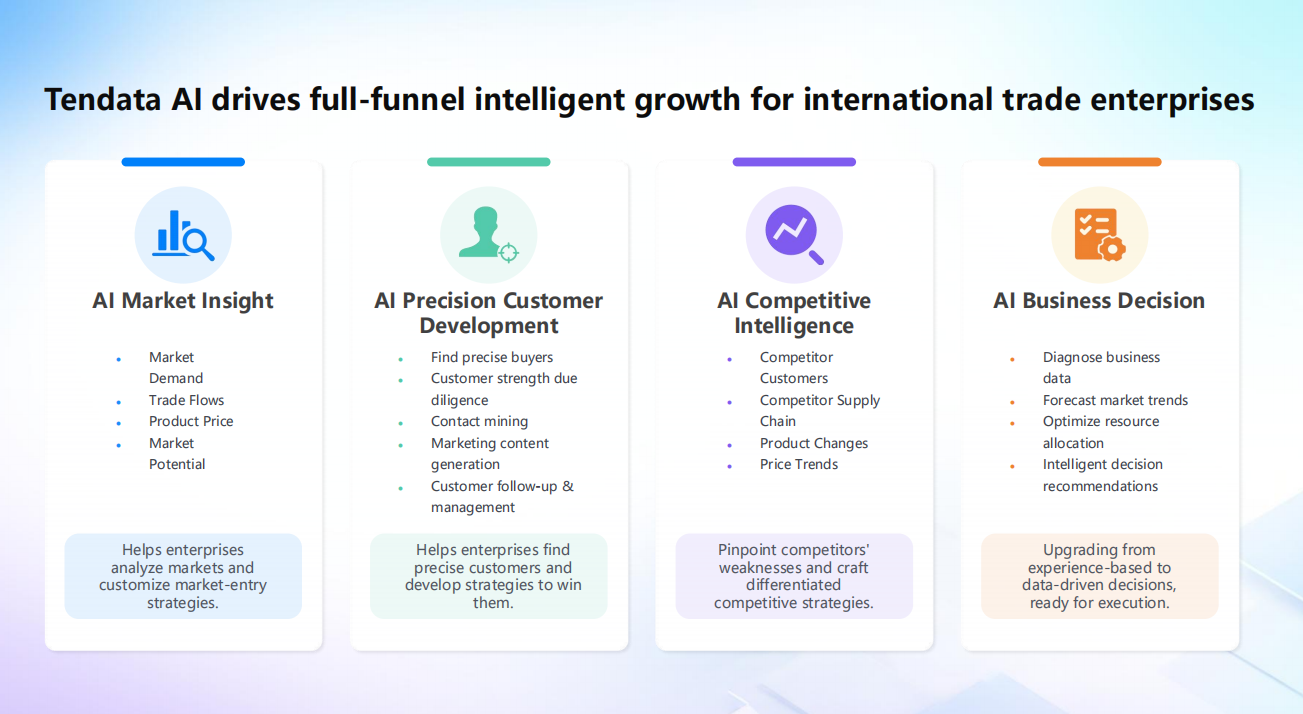
From market analysis to buyer discovery and monitoring, the same dataset supports the full workflow. Image: Tendata AI.
Next step for export teams
Request a market analysis generated on your own product name or HS Code, and review the buyer and supplier outputs against your current target list. Tendata (Shanghai Tendata Tech Co., Ltd.) can be reached at emarketing@tendata.cn or +86 187 2199 2033, 8F, South Tower, Building 9, Lujiazui Software Park, No. 20, Lane 91, Eshan Road, Pudong New Area, Shanghai.
Have Questions or Need More Details?
Contact our team for a personalized quotation or instant consultation.
Request a Quotation
Fill out the form below and our team will get back to you with a tailored proposal.
WhatsApp Direct Chat
Prefer to chat in real-time? Message us on WhatsApp for instant assistance & quick answers.
- Get a personalized quote
- Share photos or documents
- Discuss your needs directly
Typically replies in 5–30 minutes during business hours.