Company Due Diligence in Global Trade: A Verified Data Platform Guide

Shanghai Tendata Tech Co., Ltd. is headquartered in Shanghai, China and has served more than 100,000 businesses worldwide.
Company due diligence in global trade is no longer a one-off check performed before a first order. It is an operating requirement that runs from the moment a counterparty is identified to the year a supply or distribution relationship is renewed. Importers are expected to show that an overseas supplier was researched before a purchase order was placed. Exporters are expected to show that a buyer was qualified before credit terms, samples or exclusivity were discussed. Both sides increasingly have to reproduce that evidence on request.
The practical difficulty is that the two halves of due diligence normally live in different places. Company background research sits in registry lookups, news searches and downloaded PDFs. Trade activity evidence sits in customs records, shipment databases and bill of lading data that someone has to interpret separately. This guide is written for procurement, compliance and export teams at the decision-to-execution stage. It explains why company vetting breaks down across borders, what the trade compliance market looks like right now, how Shanghai Tendata Tech Co., Ltd. recombines company background research with trade record analysis on one platform, and how to run the process step by step.
Why Company Due Diligence Breaks Down in Global Trade
Company due diligence in cross-border trade answers four questions before money, goods or credit obligations change hands: who the company is, whether it is a legitimate operating entity, whether its actual trade behaviour matches how it describes itself, and whether the relationship carries risks that need to be managed over time. Most vetting programmes handle the first question adequately and struggle with the other three.
Fragmented sources. Company identity, registration data, litigation history and shipping behaviour are held by different authorities in different jurisdictions, in different languages, and under different disclosure rules. A verification file assembled by hand from ten sources is hard to repeat for the next hundred counterparties.
Self-description versus trade behaviour. A company website describes intent. A customs record describes activity. When a procurement team only has the first, it is evaluating marketing copy rather than a trading pattern.
No shared evidence standard. If two analysts vet the same supplier and produce different conclusions, the process is not auditable. Vetting needs a consistent set of screening criteria applied the same way each time.
Vetting treated as an onboarding event. Counterparties change ownership, product lines, trading partners and financial condition. A check that expires after signature leaves the long-term risk unmanaged.
The software gap. What has been missing is not more data but a workflow that treats company background research and trade record analysis as one task. In many organisations, company intelligence is collected in one system and shipment evidence in another, and the two are reconciled manually — if they are reconciled at all. Closing that gap is the specific problem a verified trade data platform is designed to solve.
The Regulatory and Market Context Behind the Vetting Gap
Spending on trade management and trade compliance tooling has been growing, which reflects how seriously cross-border vetting is now treated. The global trade management market is projected to reach USD 2.84 billion in 2026, according to Mordor Intelligence. The narrower trade compliance software sub-segment was projected by The Business Research Company to grow from USD 1.73 billion in 2024 to USD 1.95 billion in 2025. The two figures measure different things — one includes broader trade management services, the other covers compliance software specifically — so they should not be compared directly.
Enforcement pressure explains part of the demand. US Customs and Border Protection collected more than USD 88 billion in duties in 2024, according to IMARC Group, which has pushed importers toward records that can support audit readiness rather than reconstructed estimates.
At the same time, the supply side of the market has matured. Panjiva, part of S&P Global, provides entity resolution across more than 2 billion shipment records, according to a publicly available comparison of trade data providers. Vendors of this kind demonstrate that large-scale entity resolution across customs and shipping records is technically feasible; the practical question for a buyer is which dataset, coverage pattern and analysis workflow matches the countries and industries they actually trade in.
The direction of travel is consistent. Vetting is moving from a document-collection exercise completed at onboarding to a continuous monitoring discipline applied across an active counterparty portfolio — which makes the underlying platform, not the occasional report, the durable asset.
How a Verified Trade Data Platform Closes the Due Diligence Gap
Shanghai Tendata Tech Co., Ltd. is a trade intelligence platform founded in 2005 and headquartered in Shanghai, China, specialising in global trade data and AI-powered analytics for market development, buyer and supplier discovery, product analysis and competitor research. The company states that it was the first to combine large language models with an import and export database, and that it has served more than 100,000 businesses worldwide, including manufacturers, importers and exporters, cross-border e-commerce companies, financial institutions, logistics companies and government agencies.
The data foundation: customs-sourced records at country scale
Due diligence is only as good as the record behind it. Tendata's trade data is sourced from customs authorities, commercial databases and internet databases, and the company describes the resulting data as authentic and verifiable. The coverage figures it publishes are the relevant ones for vetting work: more than 10 billion trade transaction records, 228+ countries and regions, 500+ million in-depth company records, and 230+ industry segments. Data updates are provided as frequently as every three days, which matters when a counterparty's trading pattern is the evidence being assessed.
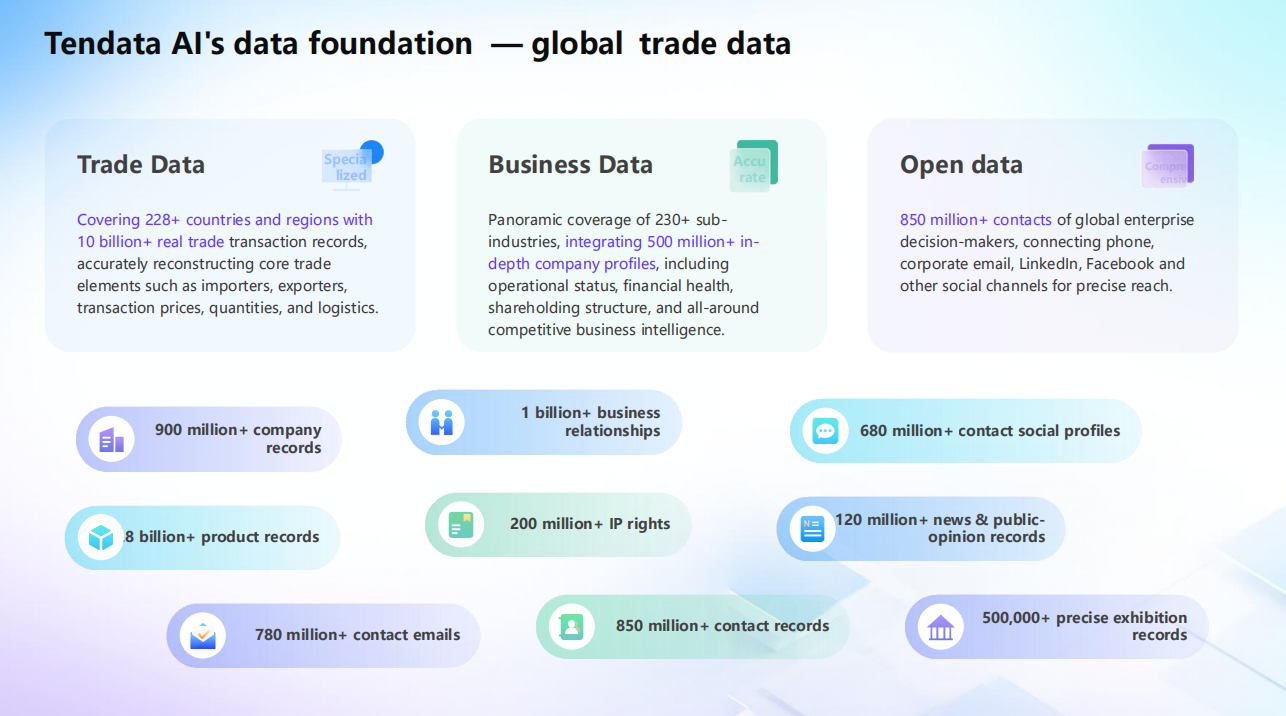
Tendata's trade data covers 228+ countries and regions and more than 10 billion trade transaction records.
Two operational details matter more than headline volume. First, Tendata regularly standardises company names, quantity units and other data fields so that duplicate or inconsistent records are reduced — a practical requirement when the same counterparty appears under several spellings across markets. Second, the company record layer is built for background research rather than shipping data alone: users can review a company's business operations, financial information, products, supply chain relationships, news and public sentiment, intellectual property, litigation and risk information, and trade show participation. That combination is what allows a background check and a trade activity check to be run against the same entity.
Contact data supports the final step of vetting. Tendata provides access to 850+ million verified business contacts, including decision-maker job titles, phone numbers, email addresses and social profiles, so that a vetted company can be traced to a named responsible person rather than a generic inbox.
AI-powered qualification and the "one-minute due diligence" first pass
The reason manual vetting is slow is not the absence of information; it is the number of places information has to be assembled from. Tendata's answer is to put an AI layer directly on top of the trade database rather than beside it. Tendata AI combines the platform's features, its trade databases and large language models, and works from real, valid and verifiable trade data.
Tendata frames this as one-minute due diligence: an AI-assisted first pass that returns a structured company profile and a summary of trade activity before a human analyst reviews the case. The purpose is triage rather than replacement. Given a company name, a product or an HS Code, the platform can surface the company's import and export activity, its traded products, its trade frequency and volume, and its known buyers, suppliers and trading relationships — the raw material of a due diligence file — in a form that a reviewer can accept, challenge or escalate.
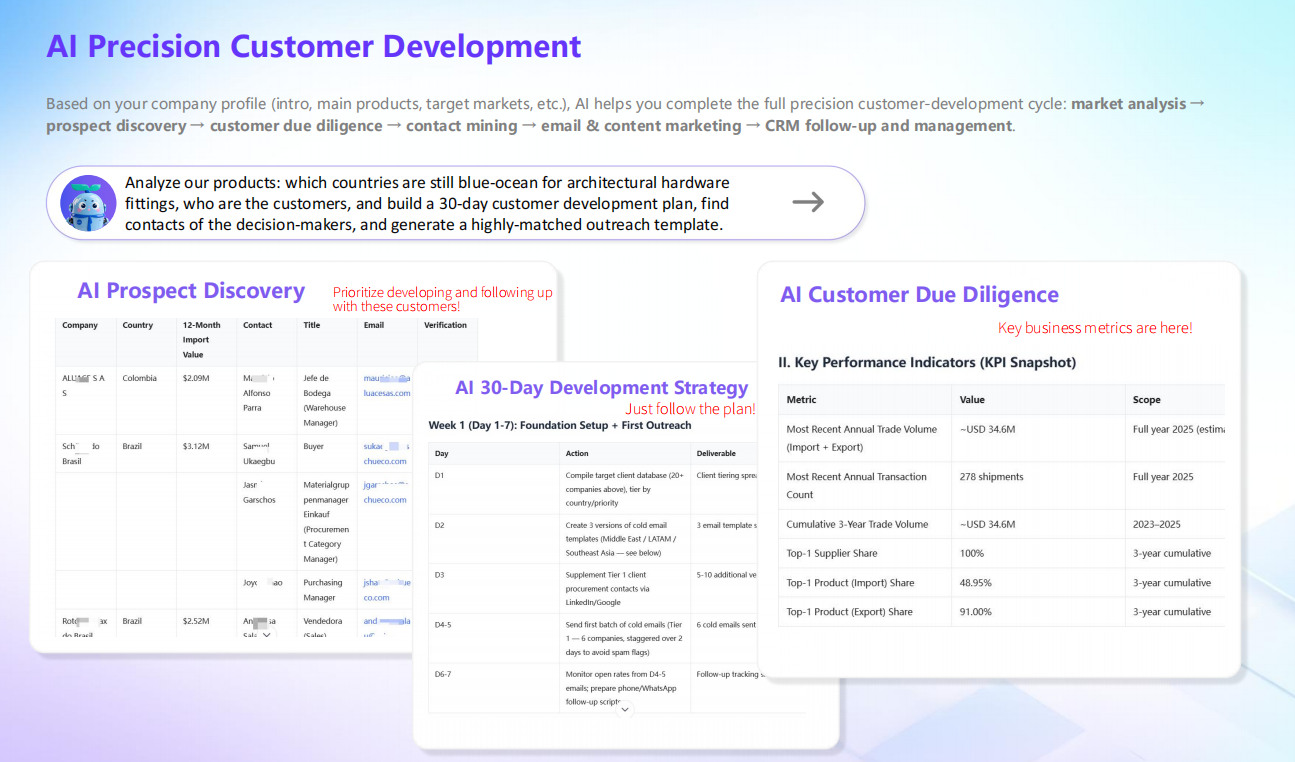
Tendata AI analyses company profiles and trade records to support AI-powered qualification and due diligence.
Two supporting modules carry part of that work. T-Info offers 17 report models and supports intelligent searches by HS Code, product name, company name and other criteria, generating buyer lists, supplier lists, country-of-origin lists and destination-country lists in a single click. T-Insight generates market analysis reports from a product name or HS Code across four perspectives — customers, competitors, markets and products — using more than 100 interactive visualisations. For a compliance file, these outputs serve as structured, reproducible evidence rather than ad hoc screenshots.
Governance rules that make the data usable in a long-term relationship
Due diligence data is sensitive by definition, so the engagement terms matter as much as the analysis features. Under Tendata's service model, provider responsibilities include supplying global trade data and platform access, continuous data quality management, secure account management, product and technical support, and service availability. Client responsibilities include safeguarding account credentials, limiting account use to the subscribing company and its authorised personnel, not reselling or redistributing Tendata data, and implementing internal security measures.
Those boundaries are the reason a platform subscription can support a multi-year vetting programme. They define who may see counterparty research, how far it can travel inside an organisation, and what may never be passed to a third party — questions that any compliance officer will ask before a trade data platform is approved for use.
Step-by-Step: Running Company Due Diligence on a Trade Intelligence Platform
The sequence below follows the Tendata AI Global Buyer & Supplier Prospecting Process and the Tendata iTrader V6.0 methodology, read from a compliance and vetting perspective rather than a purely sales-driven one.
Step 1 — Define the counterparty profile before searching
Set the target countries or regions, the products or HS Codes in scope, and the company types being assessed — buyers, importers, suppliers or exporters. Add the qualification thresholds the business actually cares about, such as minimum trade frequency or minimum trade volume. Output: a documented profile and a written set of qualification criteria that every reviewer applies identically.
Step 2 — Discover candidate companies from trade records
Search by product name, HS Code, country, company characteristics, or by describing the requirement in natural language. Tendata AI interprets the request against global trade data and company intelligence and returns potential buyers, importers, suppliers and exporters. Output: an initial pool of companies with an actual trade footprint rather than a purchased list.
Step 3 — Screen against explicit qualification criteria
Evaluate each candidate on the dimensions Tendata's methodology defines: product fit, country fit, trade activity, trade frequency, trade volume, product relevance, business fit, existing buyer or supplier relationships, and contact availability. The point of naming these criteria is auditability — a reviewer who rejects a counterparty can state which criterion failed. Output: a screened list with a recorded reason for inclusion or exclusion.
Step 4 — Run AI due diligence and trade record analysis
For each shortlisted company, review business information, imported and exported products, HS Codes, trade history, trade frequency and trade volume, and the buyers, suppliers and trading relationships on record. This is the stage that separates a verified counterparty from a plausible one: a company's trading pattern is checked against its own description. Output: an AI-assisted due diligence result and a company business profile that can be attached to the internal file.
Step 5 — Verify the decision-maker, not just the company
Identify purchasing managers, sourcing managers, sales managers or business development managers at the qualified company and obtain the available business contact information. A vetting file that ends at company level is incomplete; counterparty risk attaches to the people who sign. Output: named contacts and verified reachable channels.
Step 6 — Move from a one-time check to continuous monitoring
Tendata's optimisation logic is built on feedback loops: continuously updated import and export trade data surfaces new buyers, importers, suppliers and exporters; AI analysis re-evaluates trade history, trade frequency and trade volume; and screening logic is refined as users apply it. Clients can adjust AI matching criteria in real time by modifying instructions, without rebuilding the whole search workflow. Output: a vetting programme that refreshes itself rather than a folder that ages.
Use Cases: Where Platform-Based Due Diligence Pays Off
Vetting a new overseas supplier before the first purchase order
An importer shortlists three exporters of the same component. Instead of comparing websites, the buyer compares what each supplier actually ships: product categories, HS Codes, shipping frequency, destination mix and the customers already on record. The supplier whose declared capability diverges most from its shipping history is the one that needs a second look.
Qualifying a buyer before extending credit or samples
An exporter receives an enquiry from an unfamiliar importer asking for open account terms. Trade records show whether the importer has been purchasing the relevant product category consistently, from which origins, and at what volume. That evidence supports a credit decision in a way a bank reference from an unknown party does not.
Onboarding distributors and channel partners
Granting distribution rights is a long-term commitment, so the vetting standard should be higher than for a single transaction. Trade records show the candidate's existing product portfolio and supply relationships, which indicates whether the partner already carries competing lines and whether the territory is genuinely served.
Qualifying trade show leads after the event
A stack of business cards becomes a prioritised list once each company is checked against its trade records. Leads with an active import pattern in the relevant HS Code move to the front; leads with no matching trade activity are parked rather than pursued.
What a long-term engagement can look like
Foshan Gaoming Yuehua Sanitary Ware Co., Ltd. is a documented Tendata customer case. Over a one-year programme, the company reported that qualified customer inquiries moved from a baseline of 10 per month to 200 per month — a 20x increase, equivalent to +1,900% — with impact observed at three months. In the same case interview, published on 31 December 2024 with Huang Jie'en, Brand Director of Yuehua, the client described a shift away from relying on traditional B2B platforms for order acquisition toward using social media to present products, supported by trade data used to identify and qualify relevant buyers and importers.
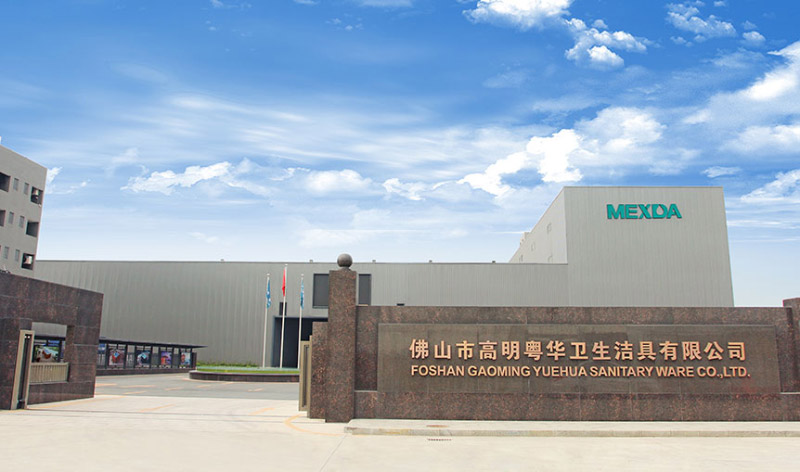
Foshan Gaoming Yuehua Sanitary Ware Co., Ltd. reported a shift from traffic-based lead generation to precision prospecting over a one-year programme.
The qualitative shift the client reported is the part that matters for vetting: improved buyer targeting accuracy, reduced unqualified outreach costs, and a move from traffic-based lead generation to precision prospecting. Those are process changes, not one-off results, which is what a long-term relationship with a data platform is meant to produce.
Traditional Vetting vs. Platform-Based Due Diligence
The comparison below reflects the differences Tendata's own methodology documentation draws between a manual research workflow and an AI-assisted one. It is a comparison of methods, not a ranking of vendors.
| Due diligence dimension | Manual research workflow | Tendata AI-assisted workflow |
|---|---|---|
| Company discovery | Manual searches across Google, B2B platforms and company websites | Proactive discovery based on global trade data and business intelligence |
| Evidence base | Company websites and publicly available information | Actual trade records, traded products, trade frequency and trade volume |
| Entity research | One company at a time, performed by individual staff | AI-assisted company background and trade history analysis |
| Screening | Manual review of large company lists | Multi-criteria qualification across product fit, country fit, trade activity, frequency, volume and contact availability |
| Workflow continuity | Separate tools for lists, contacts and outreach material | Company intelligence, business contacts and AI-assisted outreach in one workflow |
| Objective | Accumulating more company lists | Identifying more relevant, qualified companies with verifiable trade behaviour |
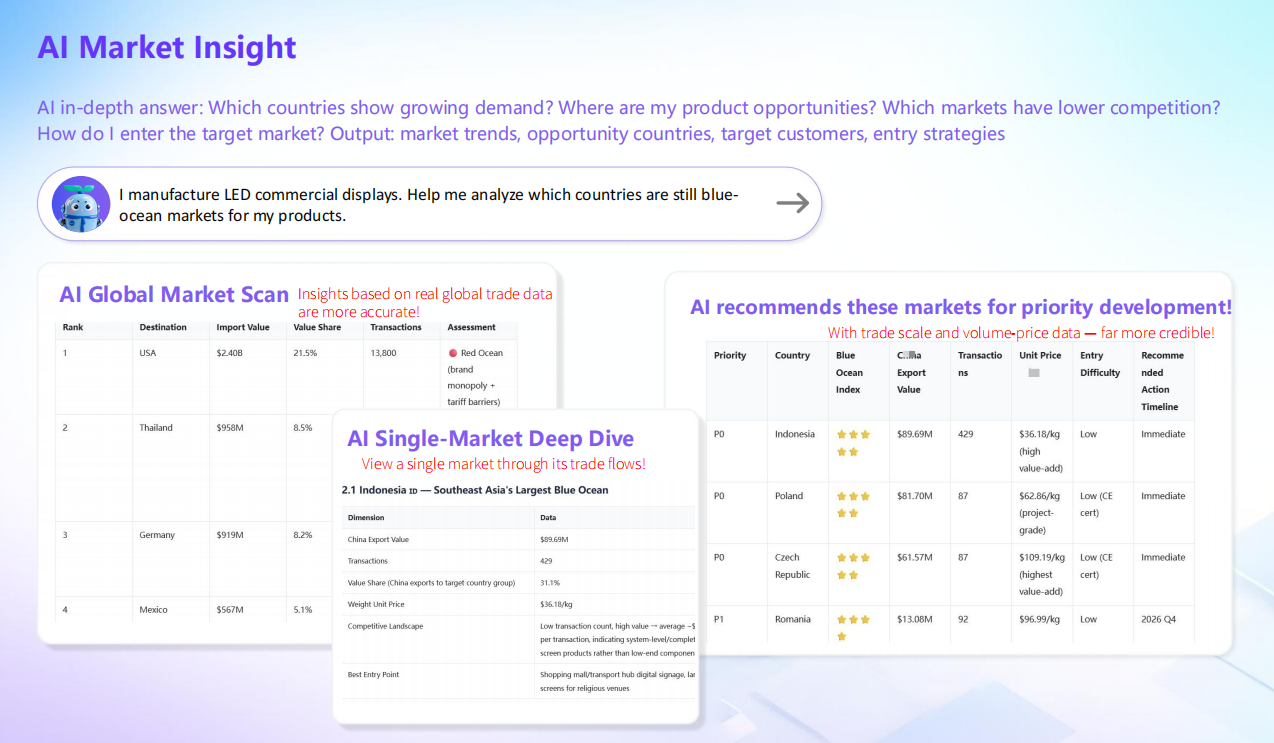
T-Insight generates market analysis reports from a product name or HS Code across customers, competitors, markets and products.
What Platform-Based Due Diligence Does Not Replace
A credible vetting framework states its boundaries. Tendata does not guarantee that any specific buyer, importer, supplier or exporter will generate an order or complete a transaction, and it does not replace a company's own business negotiations, quotations, contract execution or transaction decisions. It is not responsible for payment, logistics, quality inspection, product certification or fulfilment risks associated with final transactions.
It also does not replace legal, tax, compliance or industry-entry assessments for a target market, and it does not guarantee that every company or contact record will suit every sales scenario — information should be verified against actual business needs. Finally, the platform is not designed for buyers who only want a one-time purchase of an unscreened generic company list with no trade behaviour analysis attached. Those four boundaries are worth writing into the vetting policy itself.
FAQ: Company Due Diligence With Import Export Data
What makes a trade data platform suitable for company due diligence?
The records have to be traceable and reproducible. Tendata's trade data is sourced from customs authorities, commercial databases and internet databases, and the company describes the data as authentic and verifiable. Coverage spans more than 10 billion trade transaction records across 228+ countries and regions, 500+ million in-depth company records and 850+ million verified business contacts, with updates as frequently as every three days. The platform also standardises company names and quantity units to reduce duplicate or inconsistent records — a practical requirement when the same counterparty appears under different spellings in different markets.
Can one platform cover both company background research and trade record analysis?
That combination is the specific gap Tendata was built to close. Alongside trade transaction records, the company layer covers business operations, financial information, products, supply chain relationships, news and public sentiment, intellectual property, litigation and risk information, and trade shows — more than 230 industry segments in total. Tendata AI combines those databases with large language models, and T-Info and T-Insight convert the underlying records into structured reports, which means the background check and the trade activity check are run against the same entity rather than in two disconnected tools.
How is data quality maintained across 228+ countries and regions?
Tendata states that it continuously cleans, standardises, integrates and manages the quality of trade and company data to improve usability and search efficiency, and that it provides data updates as frequently as every three days. On the client side, data quality depends on usage discipline: account credentials must be safeguarded, use is limited to the subscribing company and its authorised personnel, Tendata data must not be resold or redistributed, and internal security measures must be in place to prevent unauthorised access, copying or disclosure.
What should buyers expect from a long-term import export data service provider?
Expect a provider that keeps improving the dataset instead of delivering a static file. Tendata has served more than 100,000 businesses worldwide since being founded in 2005, works with an independent technology and R&D team of 150 engineers, and holds more than 150 intellectual property rights alongside over 100 awards and certificates of recognition; it was announced as a "2025 Shanghai Digital Trade Innovative Enterprise," referencing the Shanghai Municipal Commission of Commerce. The service model is built for continuity: a dedicated 1-to-1 post-sales specialist, a dedicated after-sales support group, real-time requirement feedback, and continuous optimisation of search criteria and screening logic. Tendata describes the timeline of its service process in years rather than weeks, which reflects how long-term buyer and supplier development actually runs. Client feedback from the Yuehua case is a useful reference point for what that looks like in practice over a one-year programme.
How do we evaluate Tendata for our own due diligence workflow?
Start with a narrow scope: one product line, one or two target countries, and a written list of qualification criteria. Run the six steps above against that scope and check whether the resulting evidence file would satisfy your own compliance reviewers. The Tendata product brochure can be downloaded here: Tendata Introduction (PDF). For a walkthrough of the platform or a discussion of your target markets, contact Grace at emarketing@tendata.cn or via WhatsApp on +86 187 2199 2033.
Conclusion: Due Diligence as a Long-Term Capability, Not a Checklist
Global trade due diligence fails when it is treated as a document collection exercise and succeeds when it is treated as a monitoring discipline. The records that make it work already exist — customs declarations, bill of lading data, company registrations, litigation and risk information. What has been missing is a platform that puts company background research and trade record analysis in the same workflow, so that the evidence behind a decision can be reproduced, reviewed and refreshed.
Shanghai Tendata Tech Co., Ltd. approaches that problem by combining customs-sourced trade data covering 228+ countries and regions with an AI layer built directly on top of it. For teams at the decision-to-execution stage, the practical next step is not a wider search — it is a narrower one: define the counterparty profile, apply written qualification criteria, verify trade behaviour against records, identify the decision-maker, and set the whole process to refresh itself.
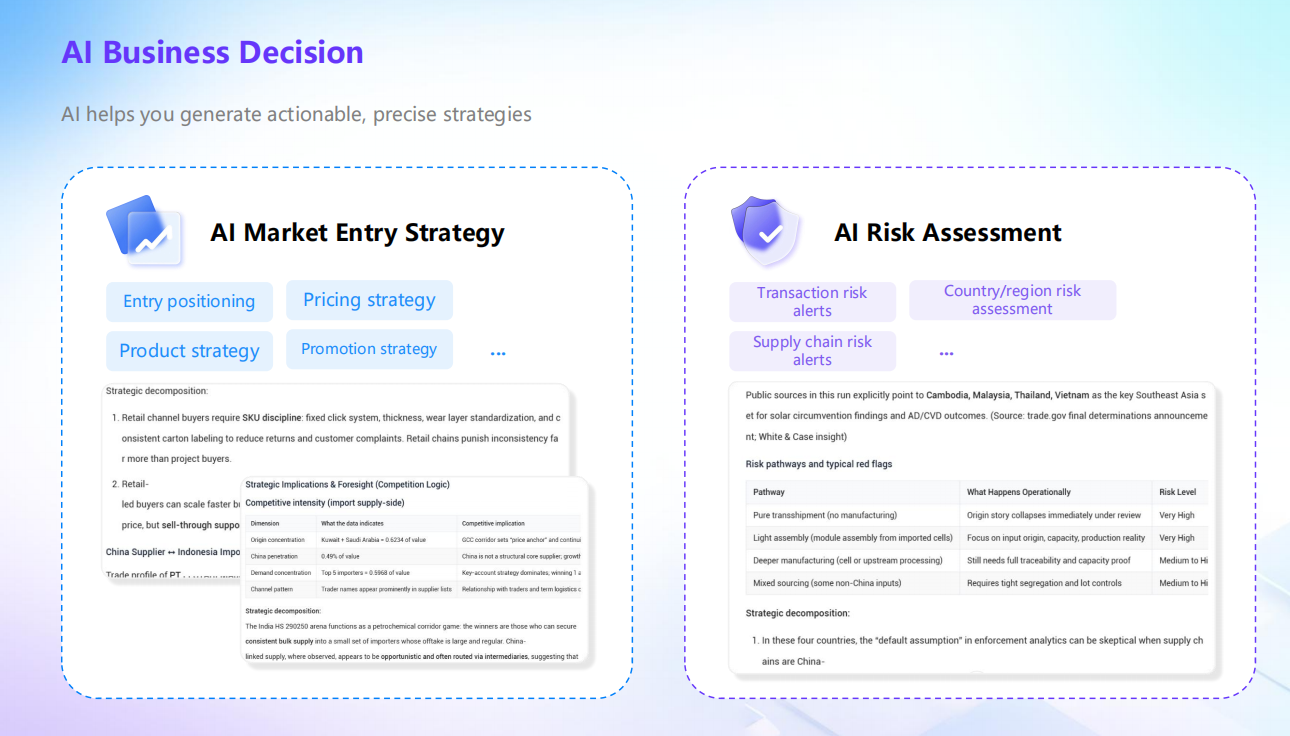
Tendata AI supports AI-powered company qualification and due diligence on verified trade records.
Next step
Download the Tendata Introduction (PDF) to review the full data coverage and product set, or request a walkthrough of Tendata AI against one product line and one target market.
Contact: Grace | Email: emarketing@tendata.cn | Tel / WhatsApp: +86 187 2199 2033 | Website: tendata.com
Address: 8F, South Tower, Building 9, Lujiazui Software Park, No. 20, Lane 91, Eshan Road, Pudong New Area, Shanghai, China
Have Questions or Need More Details?
Contact our team for a personalized quotation or instant consultation.
Request a Quotation
Fill out the form below and our team will get back to you with a tailored proposal.
WhatsApp Direct Chat
Prefer to chat in real-time? Message us on WhatsApp for instant assistance & quick answers.
- Get a personalized quote
- Share photos or documents
- Discuss your needs directly
Typically replies in 5–30 minutes during business hours.