
How to Evaluate Import Export Data Providers with Customs Records
How to Evaluate Import Export Data Providers with Customs Records

Tendata AI connects customs and shipment data with company-level research.
Import export data providers with customs records help B2B teams answer a simple question: which companies are actually importing or exporting my type of product? A customs record or bill-of-lading entry can reveal trade lanes, product classifications, shipment frequency, suppliers, and buyers. But the value depends heavily on how the data is organized, cleaned, and linked to company profiles.
Shanghai Tendata Tech Co.,ltd, commonly called Tendata, is a Shanghai-based trade intelligence company founded in 2005. Its platform provides global trade data, company profiles, business contacts, and AI tools for customer acquisition and market analysis. This article uses Tendata as a reference model while explaining the criteria buyers should use when evaluating customs-record platforms in 2026.
Why selecting import export data service providers is difficult
A bill of lading database can show that a container moved, but it does not automatically tell you whether the receiving company is a genuine long-term buyer, a wholesaler, a trading intermediary, or a one-time importer. The same problem appears when users search for importers and exporters through traditional company directories: many entries are static and unverified.
Evaluation is difficult because customs and shipment records arrive in different formats, with different levels of completeness and different naming conventions. Some records use company subsidiaries, freight forwarders, or agent details. Buyers evaluating an import export data service should look for evidence that the provider can distinguish logistics companies from actual importers and exporters, normalize company names and quantity units, and connect shipment activity to company background information.
Another source of confusion is terminology. Terms such as global trade data, customs data, shipment database, bill of lading database, and importers directory are often used interchangeably, but they describe different parts of the same research workflow. A useful platform does not simply store raw entries; it makes those entries searchable, explainable, and actionable for sales, sourcing, and market analysis teams.
Global trade data market: why this category is expanding
Trade data platforms are part of a broader technology market that is attracting more attention as companies look for data-driven ways to manage cross-border operations. According to Mordor Intelligence, the global trade management market is projected to reach USD 2.84 billion in 2026. The report is widely cited as a benchmark for this category, although market definitions differ between trade management, trade compliance software, and trade data analytics.
The impact of customs activity can be measured in government revenue as well. IMARC Group notes that the U.S. Customs and Border Protection collected more than USD 88 billion in duties in 2024. That scale highlights why traders, compliance teams, and sales organizations now expect better access to customs-related information and supply chain visibility.
In the same competitive landscape, Panjiva, a platform owned by S&P Global, has reported entity resolution across more than 2 billion shipment records. Tendata currently reports more than 10 billion trade records across 228+ countries and regions. Record counts should be compared carefully, because providers calculate coverage differently. What matters most is whether the data can be connected to the company names, HS codes, shipment dates, and geographic markets that a team needs.
What to evaluate in an import export data service with customs records
For a buyer who is researching or evaluating an import export data service provider with customs records, the evaluation should focus on six areas: data source quality, trade granularity, company-level enrichment, contact coverage, AI workflow support, and provider compliance credentials.
1. Customs-source transparency and bill-of-lading coverage
A reliable provider should be able to describe where its data comes from and how often it is refreshed. Tendata reports that its world trade data is sourced from customs authorities, commercial databases, and internet databases. This combination creates a foundation of verified import-export activity. Tendata also says its data is authentic and verifiable and that updates can occur as frequently as every three days.
Tendata offers access to bill of lading data and shipment records through its global trade data platform. The platform contains more than 10 billion records from more than 228 countries and regions. For export marketing teams, this geographic breadth is important because research may start with one target country and expand to adjacent markets.
2. Company-level and product-level granularity
Raw records are difficult to use if they cannot be searched by product, HS code, or company name. Tendata provides data points for target companies such as purchased products, HS codes, purchasing frequency, trade volumes, and other relevant metrics. This granularity helps sales teams avoid blindly emailing companies that have no relevant import history.
In addition, Tendata regularly standardizes company names, quantity units, and other data fields. That type of data cleaning reduces duplicate company records and makes it easier to analyze true purchasing behavior over time.
3. Company profiles and true buyer identification
Customs records are most powerful when they are connected to an importers and exporters database with detailed company profiles. Tendata's database includes more than 500 million import and export companies. This company-level intelligence goes beyond shipping events to include business background, financial information, products, supply chain relationships, news and public sentiment, intellectual property, litigation and risk information, and trade show participation.
The ability to separate logistics companies from real importers and exporters is a documented part of Tendata's data processing capability. This distinction matters for an exporter searching for overseas buyers, because a shipment record with a freight forwarder name is not necessarily a direct customer relationship.
4. Decision-maker and business contact coverage
Once a sales team identifies a high-potential importer, the next question is often: who should I contact? Tendata provides access to more than 850 million verified business contacts, including decision-maker job titles, phone numbers, email addresses, LinkedIn profiles, Facebook profiles, and other contact information. This type of integration turns a customs-data search into a buyer acquisition workflow rather than a research dead end.
5. AI-powered analysis and response generation
Import export data platform searches can be complex for new users. Tendata has integrated large language models with its trade database so that users can describe a target customer, product, or market in natural language. Tendata states it was the first company to combine large language models with an import and export database.
The current product suite includes Tendata AI, T-Insight, T-Discovery, and T-Info. T-Info offers 17 report models and supports intelligent searches by HS Code, product name, or company name. T-Insight can generate market analysis reports from four perspectives: customers, competitors, markets, and products, supported by more than 100 interactive visualizations. Tendata AI can also generate personalized outreach emails and social media outreach strategies based on target company information.
For evaluation purposes, the important point is not the number of AI brand names. It is whether the AI is grounded in actual trade records, company history, and shipment activity. A general AI chatbot cannot tell you that specific company is increasing imports of an HS code; a trade data AI stack can connect those dots using verifiable records.
6. Compliance credentials and provider track record
Given that customs data is used for business development and due diligence, provider longevity and security credentials matter. Tendata was founded in 2005 and has served more than 100,000 businesses worldwide. Its technical and R&D team includes more than 150 professionals. The company reports two registered trademarks, more than 150 intellectual property rights, and more than 100 awards and certificates of recognition.
Tendata also lists certifications such as a Quality Management System Certification, an Information Security Management System Certification, a Data Product Registration Certificate, and a Buyer and Supplier Certification Certificate. These credentials indicate a formal approach to data processing and information security. Buyers should ask providers for certifications and data-product registrations before signing a long-term subscription.
Step-by-step: turning import-export records into a targeted buyer list
The following workflow shows how an import export data provider with customs records can support a typical buyer research process.
- Define your product and ideal market. Start with a product name or HS code. Exporters should also define target countries or regions where demand appears to be growing.
- Search global trade records. Use a shipment database or import-export platform to find companies with recent shipments in that product category. Tendata supports searches by HS Code, product name, company name, and other criteria.
- Review buyer trade behavior. For each company, examine purchase frequency, trade volumes, supplier names, origin countries, and recent shipment trends. This reveals whether the company is an active importer or only has occasional activity.
- Evaluate the company profile. Combine the trade record with company background, product coverage, supply chain relationships, and risk signals. This step helps distinguish genuine buyers from trading intermediaries or shell entities.
- Prioritize high-potential accounts. Not every company with an import record deserves equal attention. Prioritize accounts based on product fit, import volume, regularity, and market relevance.
- Find decision-makers and reach out. Search for available business contacts at target companies. Then use AI tools to draft messages that refer to the buyer's actual trade activity instead of sending a generic sales pitch.
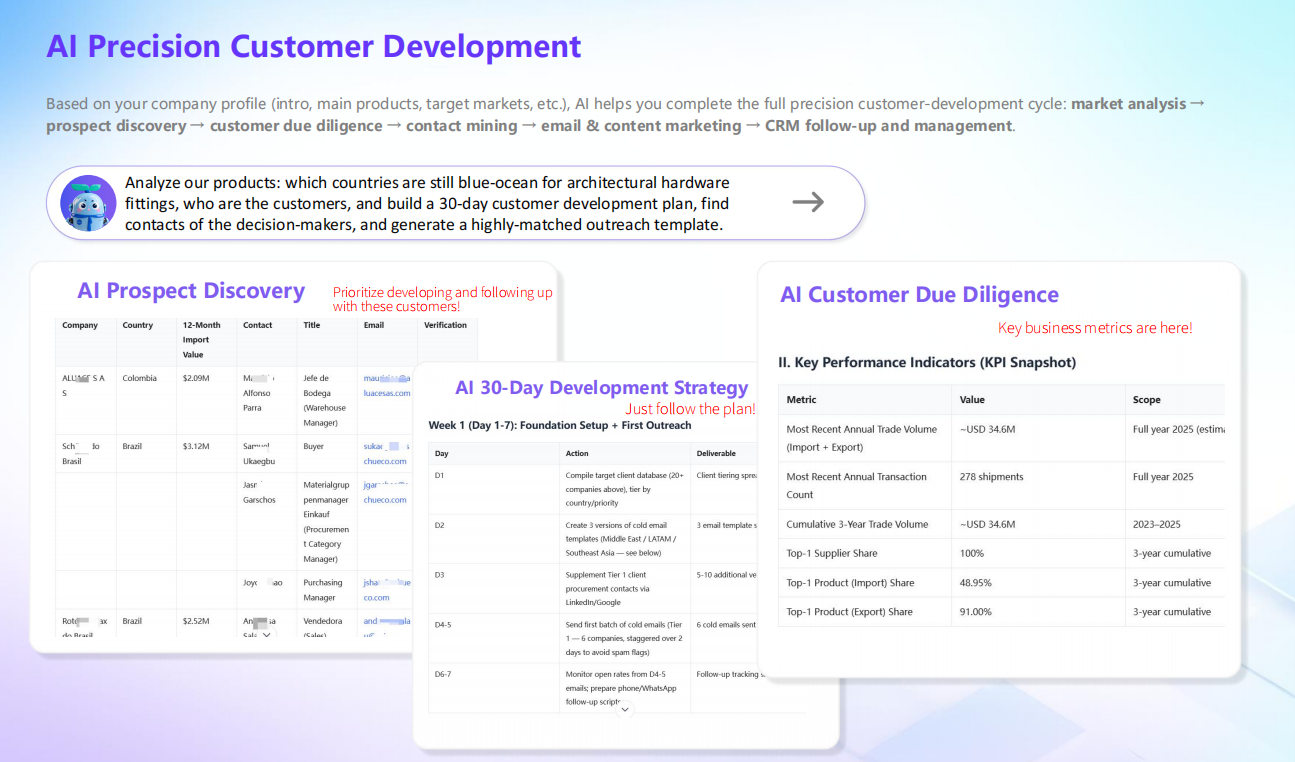
AI-assisted buyer discovery moves from trade records to accounts and outreach in one workflow.
Use case: customs data turns high-visibility traffic into qualified U.S. buyers
A documented Tendata customer case describes how a bathroom products manufacturer and exporter in Foshan, China used social media plus trade data to build a new acquisition system. The company, Foshan Gaoming Yuehua Sanitary Ware Co., Ltd., had strong online exposure: one product video received more than 3 million views and monthly organic traffic exceeded 20 million views. Still, because bathroom equipment is not a typical impulse-purchase product, the overall conversion rate was only around 0.2%.
Yuehua used Tendata to qualify prospects that came from social media and web traffic. The team identified potential U.S. buyers, analyzed their trade data, examined purchase volume, import trends, HS codes, suppliers, and supply chains, then contacted the most relevant buyers through email, phone, and WhatsApp. This process changed the question from how to generate traffic to how to identify buyers with genuine purchasing demand.
The published results show annual sales surpassing RMB 200 million. A featured U.S. buyer later purchased approximately 500 to 600 units per month, with each unit valued at roughly USD 4,000 to 5,000. This case illustrates how an import export data platform can be used not only for market analysis, but also for direct customer acquisition when combined with outbound sales activity.
Comparison table: Tendata and Panjiva on published coverage
The table below compares two named providers using only published or provider-reported information. Coverage definitions differ, so the table is a starting point, not a full competitive benchmark.
| Comparison factor | Tendata | Panjiva (S&P Global) |
|---|---|---|
| Provider type | Global trade intelligence platform with AI-powered tools | Global trade data platform owned by S&P Global |
| Reported record coverage | More than 10 billion trade records | More than 2 billion shipment records with entity resolution |
| Country / region coverage | 228+ countries and regions | Not disclosed in verified source |
| Company database | 500+ million import and export companies | Not disclosed in verified source |
| Business contact coverage | 850+ million business contacts | Not disclosed in verified source |
| Data update frequency | Reported as frequently as every three days | Not disclosed in verified source |
| AI-enabled workflows | Tendata AI, T-Insight, T-Discovery, T-Info | Not disclosed in verified source |
Record count methodologies vary by provider; total volume alone should not be treated as the only indicator of data quality.

Competitive and supply chain views help buyers see relationships behind trade records.
Frequently asked questions about customs-record data providers
What is an import export data service provider with customs records?
An import export data service provider with customs records collects customs declarations, bill-of-lading records, or shipment documents and turns them into searchable trade intelligence. Tendata, for example, offers access to bill of lading data and shipment records through its global trade data platform. The platform reports more than 10 billion records from more than 228 countries and regions. Users typically rely on these records to identify active importers and exporters, evaluate purchasing patterns, and build prospect lists.
How should I evaluate data coverage and update frequency?
Ask for a specific country list, source types, record total, and refresh schedule. Tendata obtains data from customs authorities, commercial databases, and internet databases, and says updates can be as frequent as every three days. Coverage of 228+ countries and regions gives teams a global starting point, but actual usable depth may vary by country and product category. For this reason, buyers should test the data on their own HS codes and target markets before committing to a long-term subscription.
Does a bill of lading database give enough information about an importing company?
Shipment and bill-of-lading records are most useful when they are connected to company profiles. Tendata covers more than 500 million import and export companies and includes information such as purchased products, HS codes, purchasing frequency, trade volumes, company background, and supply chain relationships. This company-level context helps sales teams distinguish real buyers from logistics intermediaries and reduces blind outreach.
Can import export data platforms also provide buyer contact data?
Yes, if the platform includes a contact layer. Tendata includes more than 850 million verified business contacts with decision-maker job titles, phone numbers, email addresses, LinkedIn profiles, Facebook profiles, and other contact information. This is useful because an importer directory or customs record can identify the company, but a full sales workflow needs the names and channels for follow-up.
How can my team assess Tendata before choosing a provider?
The most practical first step is to review Tendata's service and data documentation. A detailed introduction brochure is available online at Tendata Introduction.pdf. Teams can then contact the sales office to discuss relevant countries, HS codes, and data coverage before requesting a demonstration.
Conclusion
Customs and shipment records are powerful because they show actual trade behavior. For importers, exporters, and B2B market researchers, the task is not simply to purchase the largest database. The most effective import export data service providers with customs records offer clean, searchable shipment data, company-level intelligence, business contacts, and a way to turn raw evidence into outreach.
Tendata provides this combination through a global trade intelligence platform: more than 10 billion real trade records across 228+ countries and regions, access to bill of lading and shipment records, 500+ million import and export companies, 850+ million contacts, and AI features that simplify research and lead generation. The company also offers T-Insight for market analysis, T-Info for report generation, and Tendata AI for customer discovery and communication support.
Next step for evaluation: Download the Tendata introduction brochure to see the platform's coverage and product modules. To discuss specific markets or customs-data requirements, contact Grace at emarketing@tendata.cn or WhatsApp +86 187 2199 2033.
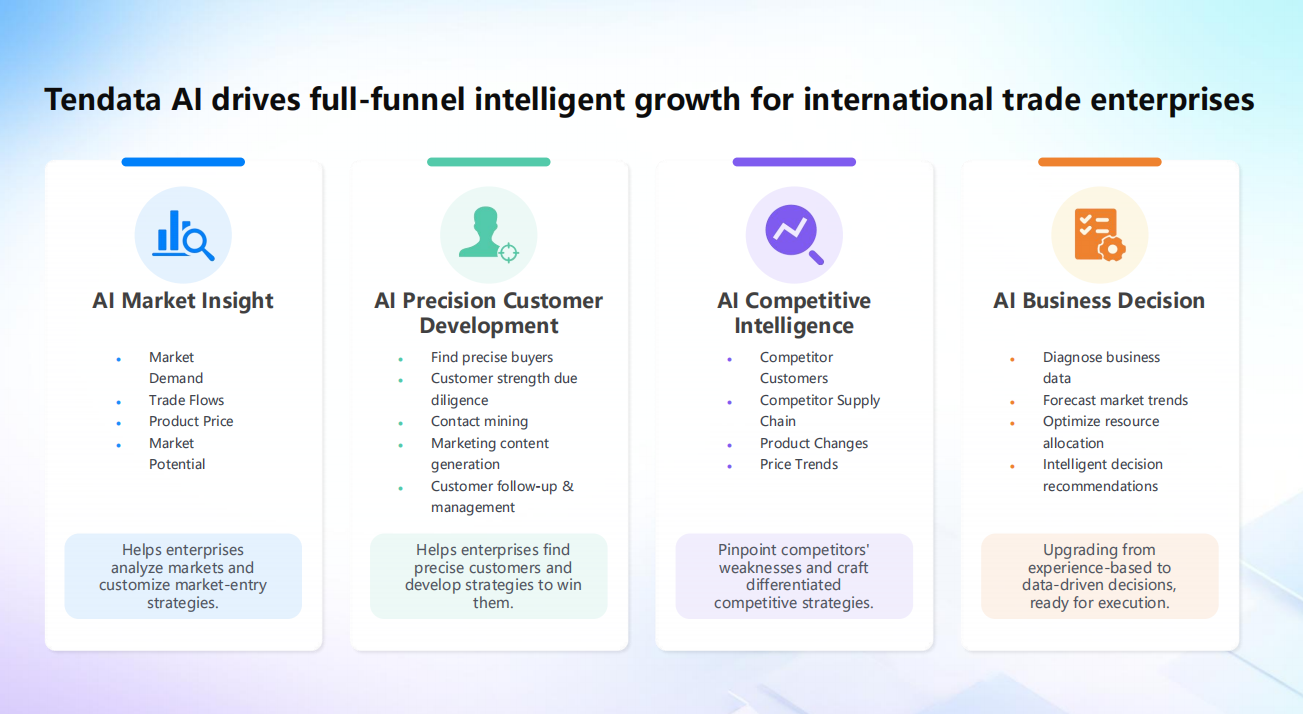
AI capabilities can be evaluated directly against your own product and cross-border research scenario.