Import Export Data Basics: How Trade Records Become Buyer, Supplier, and Market Intelligence
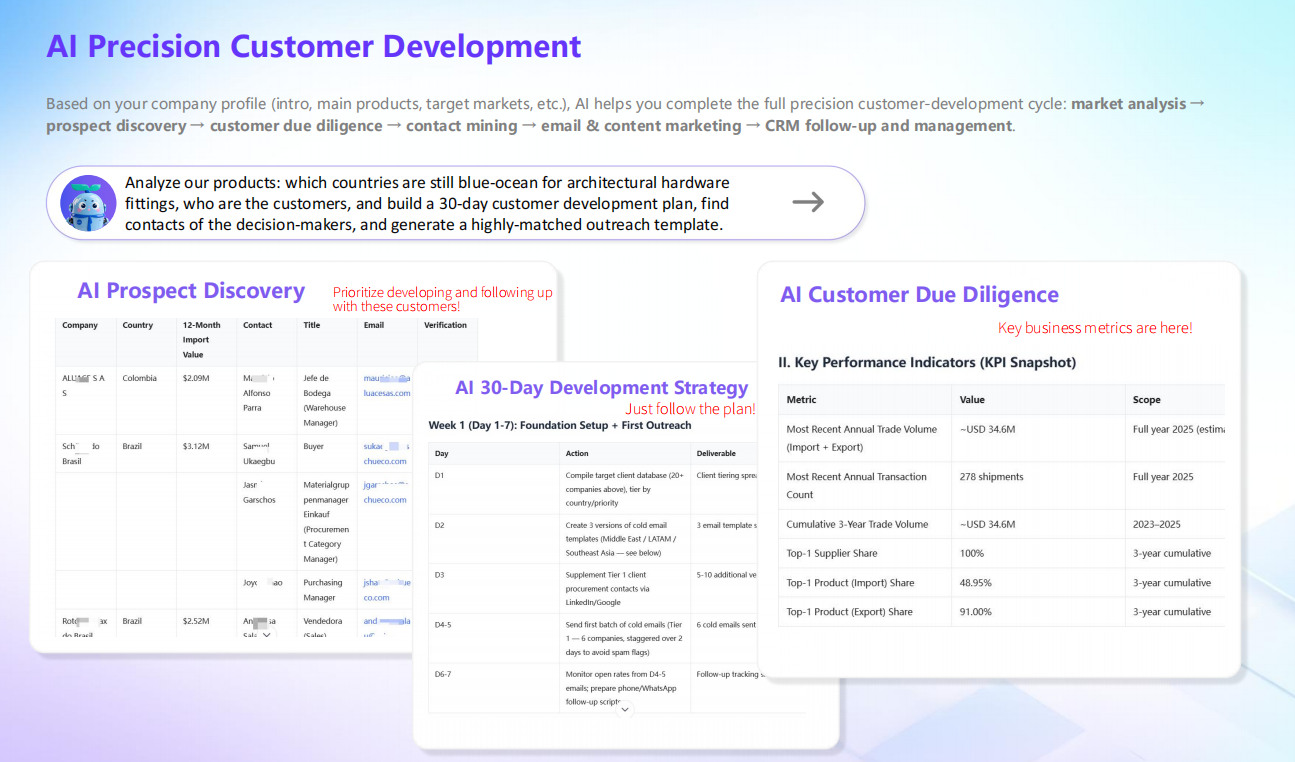
Trade records become intelligence when company identity, contacts, behaviour, and analysis are connected to them. Image: Tendata AI customer discovery workflow.
Import export data is a record of goods crossing a border: a customs declaration, a bill-of-lading line, or a shipment entry naming a product, a quantity, a country pair, and usually a shipper and a consignee. The record documents a transaction. It becomes buyer, supplier, and market intelligence only when company identity, contact information, behaviour over time, and analysis are layered on top — and that layering is what separates a data feed from a decision tool.
This explainer is written for exporters, importers, trading companies, distributors, and B2B sales teams that have moved past the question of whether customs records are useful and now need to know what sits inside the category, how a record is converted into a qualified prospect or a market conclusion, and where the limits are. Tendata (Shanghai Tendata Tech Co.,ltd, founded in 2005 and headquartered in Shanghai) is the working example throughout. Tendata is a trade intelligence platform that combines global trade data with AI-powered analytics for buyer discovery, supplier discovery, market analysis, and company due diligence.
Problem Definition: Why a Trade Record Is Not Yet Intelligence
The failure mode in most trade data projects is not missing data. It is the distance between what a record contains and what a commercial team must decide. That distance shows up as three recurring gaps.
Gap 1 — Identity: one company, several names and roles
The same company can appear under different spellings, legal suffixes, and transliterations, while freight forwarders, logistics providers, and trading agents sit in the same records as the actual importer or exporter. A list that has not been de-duplicated and role-classified produces outreach to intermediaries. Tendata states that it standardizes company names and quantity units to reduce duplicate or inconsistent records, and that its data processing distinguishes logistics companies from actual importers and exporters.
Gap 2 — Interpretation: a shipment is not a buying pattern
A single bill-of-lading line is evidence of one transaction, not of ongoing demand. Teams that rank prospects on one shipment tend to over-value one-off purchases. Frequency, continuity, product mix, and the number of existing supply relationships carry more decision value, because together they indicate a repeat purchasing process rather than an experiment.
Gap 3 — Activation: a company is not a contact, and a contact is not a conversation
The handoff from "this company imports my product category" to "this person buys it" is where trade data programmes lose the most time. That is why contact coverage belongs inside the category rather than in a separate tool: Tendata provides access to 850+ million verified business contacts, including decision-makers' job titles, phone numbers, email addresses, and LinkedIn and Facebook profiles.
Industry Background: More Records, More Fragmentation
Trade data has grown and fragmented at the same time. Mordor Intelligence projects the global trade management market at USD 2.84 billion in 2026, and compliance pressure is one driver of spending: US Customs and Border Protection collected more than USD 88 billion in duties in 2024, according to IMARC Group, which raises the value of shipment-level evidence in audit and origin checks.
The counterweight is comparability. Customs regimes differ by country; some markets publish detailed shipment records while others release only aggregate statistics; field definitions, quantity units, and company naming conventions vary. Record counts are not directly comparable across vendors either: Tendata reports 10 billion+ records, while Panjiva (S&P Global) is reported at 2 billion+ shipment records, and the difference partly reflects regional depth and whether non-shipment customs statistics are included. The practical consequence for a buyer is that coverage has to be verified market by market and product by product, not accepted from a headline number.
What has genuinely changed is the direction of the workflow. Market research used to be a one-time static exercise; platforms now position analysis as continuous, with on-demand reports and change alerts. Tendata describes the shift in exactly those terms — from one-time research to continuous market intelligence, and from manual customer search to AI-assisted customer discovery.
The Four Layers That Turn Records Into Intelligence
An import export data platform is easier to evaluate when it is split into four layers, each answering a different question.
Layer 1 — Global trade data: what moved
Shipment and customs records carry product descriptions, HS codes, quantities, values, origin and destination countries, shippers, consignees, and dates. Tendata sources this data from customs authorities, commercial databases, and internet databases, and states that updates can be as frequent as every three days. Coverage is stated as 228+ countries and regions, 230+ industries, more than 10 billion trade records, and 500+ million importers and exporters.
Layer 2 — Company information: who the company is
Trade records identify a company; company records explain it. Tendata's in-depth company profiles cover business operations, financial information, products, supply chain relationships, news and public sentiment, intellectual property, litigation and risk information, and trade shows. The supporting data set includes 200+ million intellectual property records, 120+ million news and public sentiment records, and 500,000+ trade show records. This is the layer that makes due diligence possible, not just prospecting.
Layer 3 — Contact information: who to talk to
A company-level answer is not actionable until it reaches a person with a purchasing, sourcing, or business development role. Contact coverage therefore determines how quickly a screened list turns into outreach, and it is one of the few parts of the category that can be tested directly by requesting a sample record.
Layer 4 — AI analysis: what it means and what to do next
Analysis converts rows into a decision: which markets are growing, which buyers are active, which suppliers a target company already uses, and what a first email should say. Tendata AI combines the trade databases, platform features, and large language models. T-Info offers 17 report models with intelligent searches by HS code, product name, or company name, generating buyer lists, supplier lists, origin-country lists, and destination-country lists with one click. T-Insight produces market analysis reports from a product name or HS code across four perspectives — customers, competitors, markets, and products — with more than 100 interactive visualizations.
The engineering behind that layer matters more than the interface. Tendata holds patents for a multi-prediction-channel fusion method for HS code completion and calibration, a product name recognition method for international trade, an automated ETL configuration generation method, and a field matching method for tables, alongside 150+ intellectual property rights, two registered trademarks, and a 150+ person technology and R&D team. HS code completion and product-name recognition are precisely the tasks that decide whether a search returns relevant companies or adjacent noise.
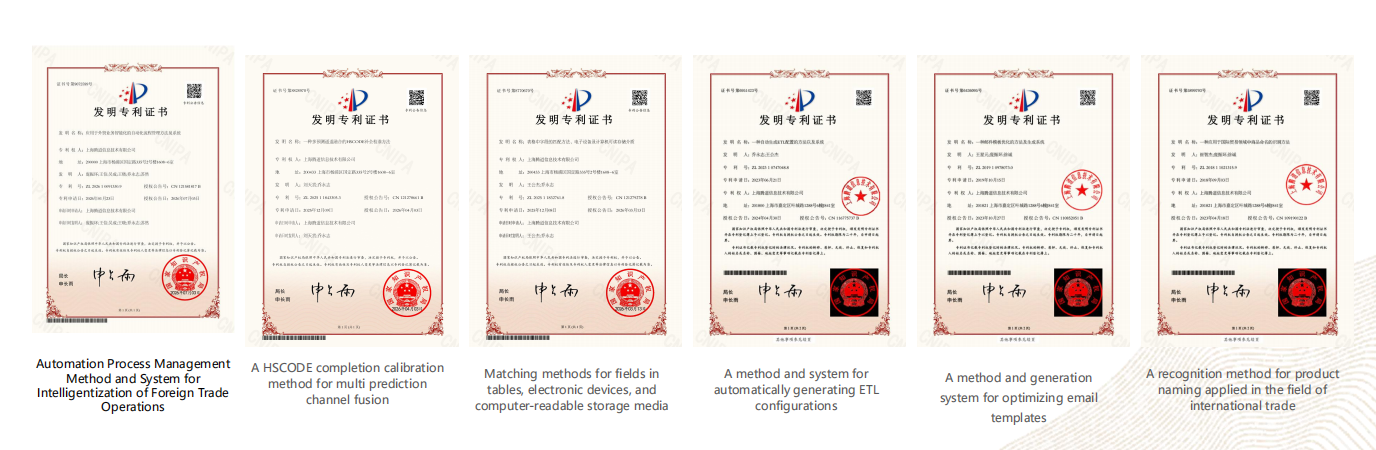
HS code calibration and product-name recognition are patented data-processing tasks at Tendata, and they determine how usable a trade record is in practice.
| Layer | Question it answers | Typical output |
|---|---|---|
| Global trade data | What moved, between which countries, and by whom? | Shipment and customs records by company, product, and HS code |
| Company information | Who is this company, and how sound is it? | Company profile, products, supply chain links, IP, litigation and risk records |
| Contact information | Who do we talk to? | Decision-maker names, titles, email, phone, and social profiles |
| AI analysis | What does it mean, and what next? | Market reports, buyer and supplier shortlists, draft outreach |
Step-by-Step: How a Shipment Record Becomes a Qualified Buyer
The transformation is a workflow rather than a query. Tendata's buyer and supplier prospecting process runs in five stages, and each stage produces an artifact that the next stage consumes.
- Define the target profile. Specify target countries or regions, products or HS codes, industry, and company type — buyer or importer versus supplier or exporter. Output: qualification criteria that exist before any search, which prevents retrofitting the criteria to whatever the data returned.
- Run AI-powered company discovery. Search the trade data by product, country, HS code, or a natural-language description of the requirement to build an initial company pool. Output: a candidate list of buyers, importers, suppliers, and exporters.
- Screen and qualify. Filter the pool on product relevance, target market, company type, trade activity, and trade frequency, then prioritise the companies that match the ideal profile. Output: a shortened, ranked prospect list.
- Perform due diligence and trade intelligence. Review imported and exported products, HS codes, trade history, frequency, volume, and the company's existing buyers, suppliers, and trading relationships. Output: a validated company profile supported by trade evidence.
- Discover contacts and personalise outreach. Identify purchasing, sourcing, sales, or business development contacts, then generate outreach content based on the company's products and trade activity for email, LinkedIn, or WhatsApp follow-up. Output: qualified leads that can be contacted today.
Tendata's product documentation describes customer due diligence completion in as little as one minute and one-click generation of outreach emails. For evaluation purposes the more useful test is whether each stage leaves something a manager can review: a criteria sheet, a screened list, a trade history summary, and a contact record with a role attached.
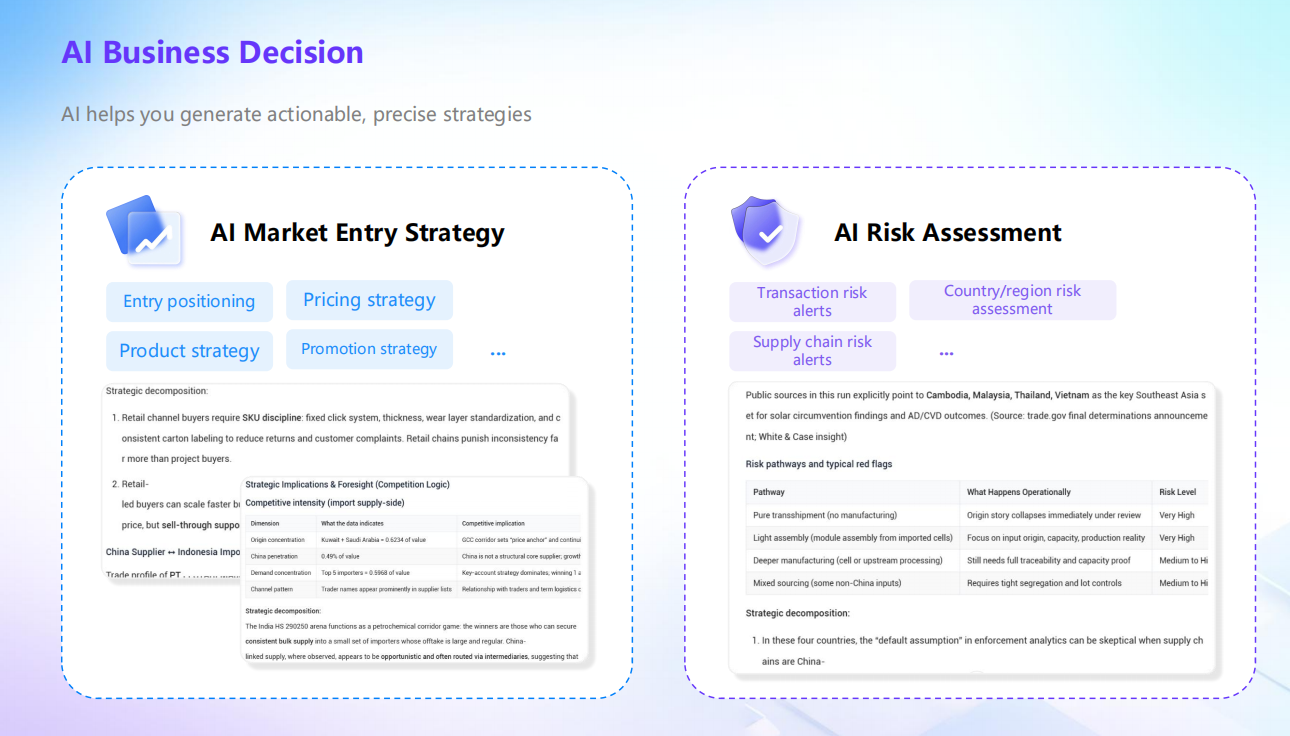
Qualification is the stage where trade records become a decision: product fit, trade activity, and trade frequency are reviewed before outreach begins.
How to Read a Trade Record Without Over-Reading It
- Confirm the role. Check whether the named company is the importer or exporter, or a forwarder, logistics provider, or trading agent. Ask how the platform classifies intermediaries before trusting a buyer list.
- Read continuity, not a single line. Repeated shipments over consecutive periods indicate a purchasing process; one shipment may be a trial order or a sample.
- Match the product precisely. HS-code searches can pull in adjacent categories, so product descriptions and code calibration matter. Tendata holds a patent for HS code completion and calibration, but a buyer should still verify results against their own product definitions.
- Check depth by market. Country coverage differs between markets and record types. Confirm record density for the specific destination you care about rather than relying on aggregate coverage claims.
- Treat values and quantities as declared data. Declaration practice varies by market, and unit standardization is what makes cross-country comparison possible. Tendata states that it standardizes company names and quantity units for this reason.
Who Uses Import Export Data — and for What
The user base is broader than a single job title, but the tasks cluster around discovery, verification, and monitoring.
- Manufacturers and exporters: find importers already buying a matching product, then screen by purchasing frequency and trade volume before spending sales time.
- Importers and procurement teams: identify suppliers and exporters with verified export records, and compare a supplier's existing customer relationships before requesting a quote.
- Trading companies: map buyer-supplier relationships in a category, monitor competitor supply chains, and plan market expansion with trade flow evidence.
- Distributors and wholesale importers: when entering a new country, identify local buyers with actual import records instead of working from directory listings.
- B2B sales and business development teams: maintain a continuous source of overseas leads rather than campaign-based lists, with contact discovery and AI-assisted outreach attached.
- Due diligence and market planning functions: assess company operations, litigation and risk, and intellectual property, or generate market reports from a product name or HS code via T-Insight.

Relationship data is also competitive data: existing buyers and suppliers of a target company can be reviewed before a commercial approach.
A published Tendata customer case illustrates the qualification step rather than the discovery step. Foshan Gaoming Yuehua Sanitary Ware, a sanitary ware manufacturer and exporter, generated substantial social media exposure — its top-performing video received more than 3 million views and monthly organic traffic exceeded 20 million views — but conversion on that traffic was around 0.2%, because the products are not everyday consumer goods. Tendata was used to check which interested companies were genuine buyers, reviewing purchase volume, import trends, HS codes, and current suppliers. The buyer featured in the case purchases approximately 500–600 units per month at USD 4,000–5,000 per unit, and the company reports annual sales above RMB 200 million after building a social-media-plus-trade-data acquisition system. The transferable lesson is the sequence, not the figures: exposure created candidates, and trade records qualified them.
Comparison: Manual Research Versus AI-Assisted Trade Intelligence
The difference between a records-only workflow and an intelligence workflow shows up in process steps rather than in adjectives.
| Workflow dimension | Records-only, manual approach | AI-assisted trade intelligence |
|---|---|---|
| Customer search | Manual searching across separate sources | AI-assisted customer discovery |
| Company data | Company lists without transaction context | Trade behaviour data attached to each company |
| Due diligence | Manual review of company information | AI-powered company analysis |
| Outreach | Mass outreach | Data-driven targeted prospecting |
| Search direction | Buyer search only | Buyer and supplier discovery |
| Tooling | Multiple disconnected tools | Integrated workflow |
| Screening basis | Experience-based judgement | Data-assisted decision-making |
Two caveats belong in any such comparison. First, the quality of the AI layer depends on the underlying records and on standardization, so coverage checks come first. Second, continuous monitoring — market alerts and refresh cycles — replaces static reporting only if the platform actually updates frequently; Tendata states updates as frequent as every three days, and per-market refresh rates should be confirmed during evaluation.
Frequently Asked Questions
What is the difference between raw import export data and AI-powered trade intelligence?
Raw import export data is a set of shipment and customs records showing who shipped what, to and from where, and when. AI-powered trade intelligence adds company identity, contact information, trade history, and analysis on top of those records — for example a buyer shortlist with a trade history summary, or a market report generated from a product name or HS code. Tendata combines 228+ countries and regions, more than 10 billion trade records, 230+ industries, and 500+ million importers and exporters with Tendata AI, T-Insight, T-Info, and T-Discovery. The commercial difference is that records are an input, while the intelligence layer is what a sales or procurement team can act on.
How do I verify that a provider really has global customs coverage?
Check four things. First, country depth: a headline such as 228+ countries and regions should be followed by the specific markets and record types available for your product. Second, source disclosure: Tendata states that its data comes from customs authorities, commercial databases, and internet databases, and that the data is authentic and verifiable. Third, refresh frequency: Tendata states updates can be as frequent as every three days, and the rate should be confirmed for each market you depend on. Fourth, processing: ask how company names and quantity units are standardized, and how logistics companies are separated from actual importers and exporters. A trial search on your own HS code tests all four at once.
Which teams get value from import export data first?
Exporters looking for new overseas buyers and importers looking for reliable suppliers are the two core groups, because both need verified trade activity rather than directory listings. Adjacent users include trading companies mapping buyer-supplier relationships, distributors entering a new country, procurement teams screening suppliers, and B2B sales teams that need a continuous lead source. Company due diligence and market analysis are second-order uses that depend on company profiles and market reports rather than shipment records alone.
How often is the data updated, and does freshness matter in every market?
Freshness matters most where buying cycles are short or competitors move quickly. Tendata states that data updates can be as frequent as every three days and that fields are standardized continuously to reduce duplicate or inconsistent records. In practice, refresh frequency varies by source market and record type, so the useful evaluation question is not the platform average but the update rate for your target countries and product categories.
What is the fastest way to test import export data on our own product line?
Start with one product and one destination market. Define the HS code and product description, run a buyer search, and check three things in the results: whether the companies are actual importers rather than intermediaries, whether shipments repeat across periods, and whether decision-maker contacts are available for the top accounts. Tendata runs this as a five-stage workflow — target profile, AI-powered company discovery, screening, due diligence, and contact discovery. Teams can request a walkthrough or a sample search on their own product category through emarketing@tendata.cn.
Conclusion: Evaluate the Pipeline, Not the Record Count
Import export data is not a list. It is a pipeline: shipment records establish that something moved, company records establish who was involved, contact records establish who to speak to, and the analysis layer establishes what the pattern means and what to do next. Buyers evaluating a platform in the Evaluation-to-Execution stage should test each layer separately — coverage depth per market, standardization and intermediary filtering, contact coverage by role, and whether the analysis layer produces artifacts a team can review and act on.
Tendata's stated position — 228+ countries and regions, more than 10 billion trade records, 230+ industries, 500+ million importers and exporters, and full integration with Tendata AI — describes a platform built across all four layers rather than a single feed. The remaining question is fit: whether the markets, product categories, and contact roles your team needs are covered at the depth your sales cycle requires.
Next step: test the records against your own product
Tendata has served more than 100,000 businesses worldwide, including manufacturers, importers and exporters, cross-border e-commerce companies, financial institutions, logistics companies, and government agencies. Share one product and one target market, and the team can run a buyer search, a supplier search, and a company check on that category.
Email: emarketing@tendata.cn | Tel / WhatsApp: +86 187 2199 2033 | Contact: Grace
Platform introduction and coverage details: Tendata Introduction (PDF)
Have Questions or Need More Details?
Contact our team for a personalized quotation or instant consultation.
Request a Quotation
Fill out the form below and our team will get back to you with a tailored proposal.
WhatsApp Direct Chat
Prefer to chat in real-time? Message us on WhatsApp for instant assistance & quick answers.
- Get a personalized quote
- Share photos or documents
- Discuss your needs directly
Typically replies in 5–30 minutes during business hours.