Import Export Data Comparison: On-Demand AI Reports vs. One-Time Static Reports
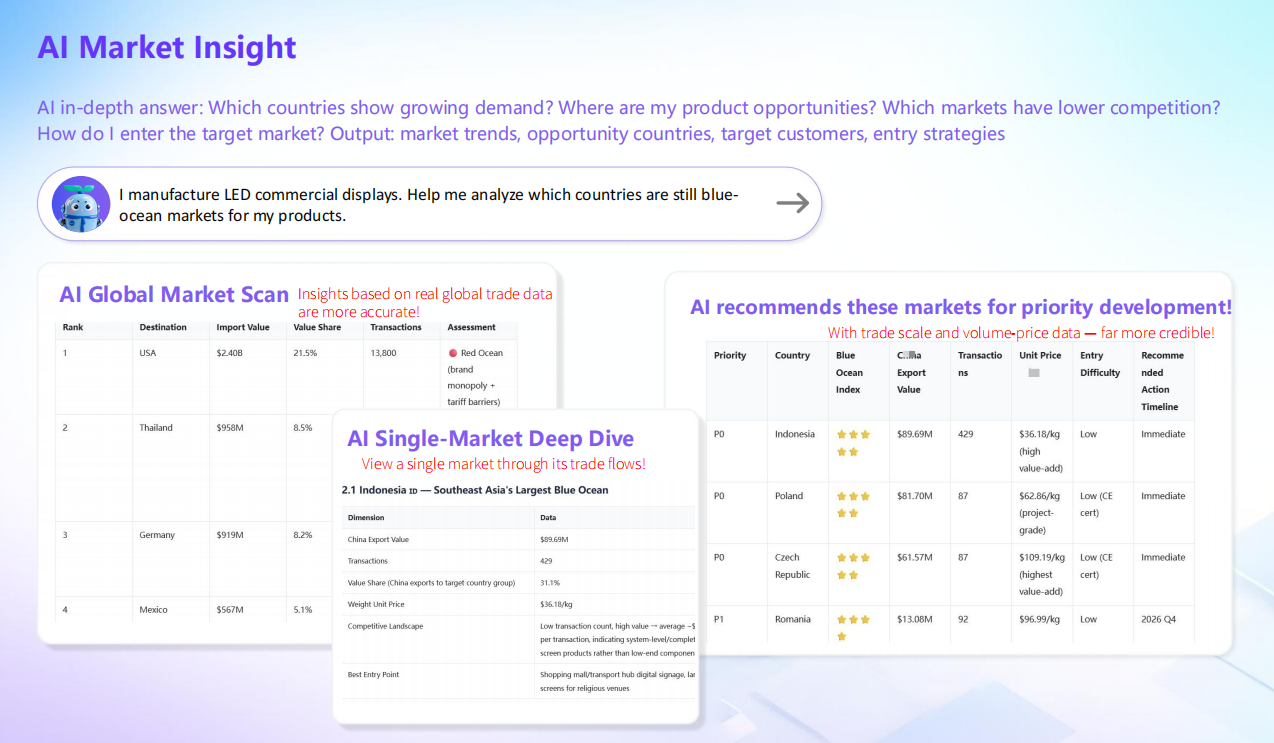
Tendata AI generates a structured market analysis report from import export data on demand, rather than delivering a fixed snapshot report.
Import export data has become a routine input to commercial decisions — which market to enter next, which buyer segment to prioritize, which competitor is quietly gaining share. The real decision is not whether to use trade data at all. It is which delivery model to buy: a one-time static market report, or an on-demand AI report that regenerates as trade flows change.
The short answer: a one-time static report gives you a market as it looked at a specific point in time. An on-demand AI report gives you a market as it looks now, scoped to your product, your HS Code, and your target countries — and it can keep running after the first report is delivered. Everything else in this comparison follows from that difference.
What Separates On-Demand AI Reports From One-Time Static Reports
A one-time static market report is a document. It is commissioned or purchased, researched over a defined period, and delivered as a fixed artifact — usually a PDF or slide deck describing market size, growth rates, and broad industry structure. Once delivered, it does not change. Its conclusions age from the moment of publication.
An on-demand AI market analysis report is a generated output. A user defines a product, country, HS Code, or specific research requirement; the system analyzes the underlying trade data and produces a structured report. Because the report is generated rather than written once and filed, it can be re-run whenever the business question changes.
The distinction sounds modest. In practice it changes three things at once: how fresh the underlying evidence is, how deep the report can go beyond country-level averages, and whether market research stops at delivery or continues as monitoring.
Why Traditional Market Research Struggles With Real Import Export Data
The problem with the traditional approach is structural, not a matter of analyst skill. It comes from how the research is assembled.
Fragmented source material. Market information sits across government statistics, industry reports, B2B platforms, company websites, and separate databases. Consolidating those sources into one coherent view is manual work, and each source carries its own definitions, lags, and coverage gaps.
Macro-level conclusions. Static reports typically stay at the level of market size and industry trend. They can tell a business that a country imports a category. They rarely identify which specific companies are importing it, at what frequency, from which suppliers.
Delayed visibility into real demand. Between the research window and the delivery date, trade flows move. A report that was accurate at commissioning can be stale by the time a sales team uses it to plan a quarter.
Slow, inconsistent decision cycles. When data is fragmented and analysis is manual, market-entry decisions, product strategy, and sales resource allocation all take longer than the market allows.
None of these are failures of effort. They are the natural outcome of a research model built around periodic deliverables instead of continuous data access.
The Data Constraints Buyers Should Verify Before Choosing Either Model
Before comparing report formats, compare the data underneath them. Report design is visible on the first page; data constraints only surface later, when a conclusion fails to match reality.
Record volume and geographic coverage. Coverage determines whether a market can be researched at all. Tendata provides global trade data covering over 10 billion records from more than 228 countries and regions, and its platform covers 228+ countries and regions as a global trade data provider.
Company-level depth. Country totals do not identify buyers. Tendata's database includes over 500 million import and export companies and over 850 million business contacts, which is what allows a report to move from market size to named companies.
Underlying record types. Tendata offers access to bill of lading data and shipment records through its global trade data platform — the shipment-level evidence behind shipment database and bill of lading database questions.
Update frequency. Data updates can be as frequent as every three days. A research model that produces a report once a year cannot make use of that cadence; a model that regenerates reports can.
Data hygiene. Tendata regularly standardizes company names, quantity units, and other data fields to reduce duplicate or inconsistent records and support more accurate business analysis.
These are the constraints that separate an aggregator interface from a trade intelligence platform. They also explain why the delivery model matters: fresh, shipment-level data is largely wasted if the only way to consume it is an annual static report.
How On-Demand AI Reports Change the Import Export Data Workflow
The shift is from research as an event to research as a running capability. Three mechanics drive it.
Generation replaces drafting. Tendata AI generates comprehensive market analysis reports with one click based on the company's specific products, target markets, and research requirements, covering market trends, product demand, import and export activity, buyers, suppliers, and competitors. The manual consolidation step that consumes most of a traditional research cycle is removed.
Monitoring replaces re-purchasing. Tendata AI can continuously monitor global market changes in real time, based on the products, countries, and markets a business is tracking. Instead of buying a new report when the old one expires, the business keeps a monitoring configuration running.
Alerts replace periodic searching. Users define areas of interest based on business needs, and Tendata AI proactively delivers relevant updates and alerts when matching market changes are detected. The operational consequence is a shift from actively searching for information to being proactively informed of important changes.
A static report answers one question once. A monitored AI report keeps answering the same question as the underlying trade data moves — and raises a flag when the answer changes materially.
Tendata AI Global Market Intelligence Solution: What the Platform Actually Delivers
Tendata (Shanghai Tendata Tech Co.,ltd) is a trade intelligence platform founded in 2005 and headquartered in Shanghai, China, specializing in global trade data and AI-powered analytics. It combines large language models with an import and export database, and has served more than 100,000 businesses worldwide, including manufacturers, importers and exporters, cross-border e-commerce companies, financial institutions, logistics companies, and government agencies.
The Tendata AI Global Market Intelligence Solution is the product surface relevant to this comparison. Its core mechanics, as delivered:
- One-click AI market analysis reports. Based on the product, country, HS Code, market, or specific research requirements entered by the business, Tendata AI analyzes relevant data and generates a structured market analysis report with one click.
- Real-time global market monitoring. Tendata AI continuously tracks global trade and market changes based on the products, countries, and markets a business is monitoring.
- Personalized market alerts. Users define areas of interest; Tendata AI proactively delivers relevant updates and alerts when matching market changes are detected.
- Trade data plus AI intelligence. Rather than returning raw records, the platform interprets the market trends, business opportunities, and company activities behind the data.
- Macro-to-micro intelligence. Country and market-level insight is connected to product, HS Code, buyer, importer, supplier, exporter, and competitor detail.
- Business-specific analysis. Analysis adapts to a company's products, target countries, and business objectives rather than relying solely on fixed, template-based reports.
Two supporting modules matter for buyers who want to inspect the underlying evidence. T-Insight generates market analysis reports based on a product name or HS Code and provides multidimensional analysis from four perspectives — customers, competitors, markets, and products — with more than 100 interactive visualizations. T-Info offers 17 report models and supports intelligent searches by HS Code, product name, company name, and other criteria, generating buyer lists, supplier lists, country-of-origin lists, and destination-country lists with a single click.
From a capability standpoint, the service provides market size, product demand, and trade trend analysis facilitating export market opportunity analysis; company purchasing behavior and trade history analysis, which may include bill of lading and shipment data; data on purchased products, HS codes, purchasing frequency, and trade volumes for target companies; company background and business information for international companies; and business and decision-maker contact information providing buyer contact data.
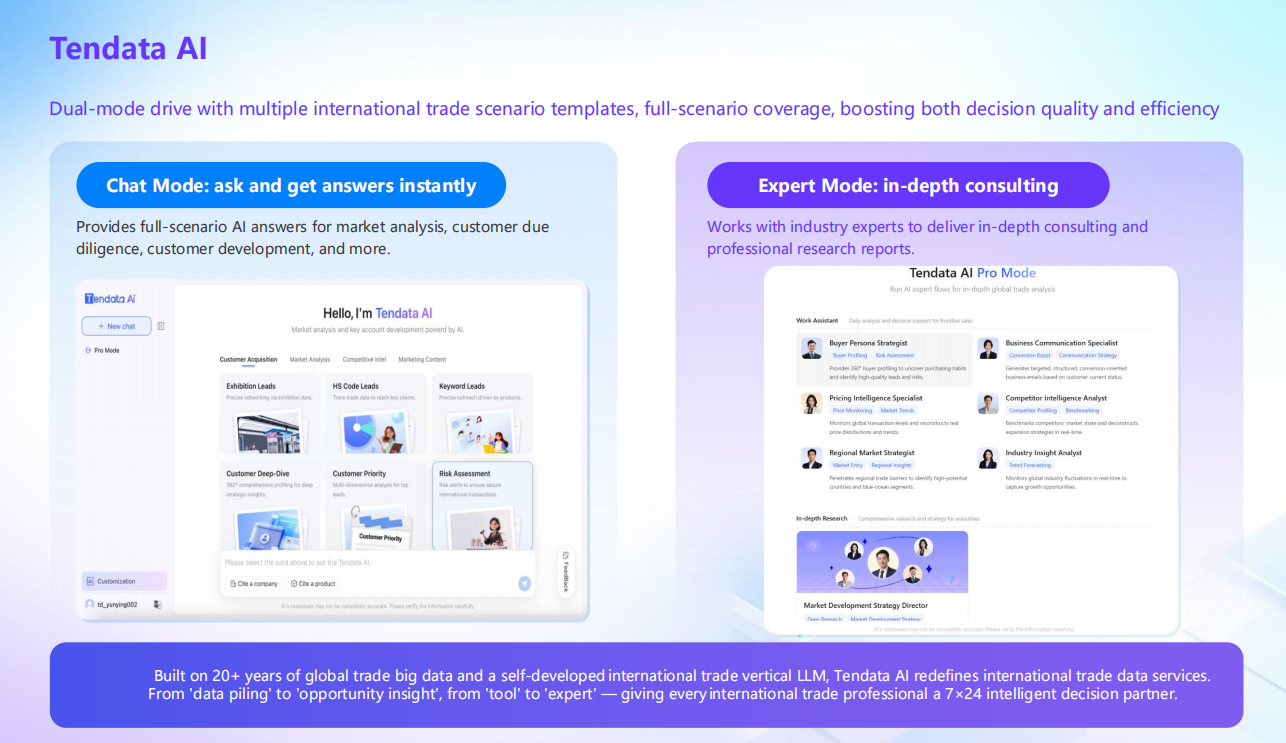
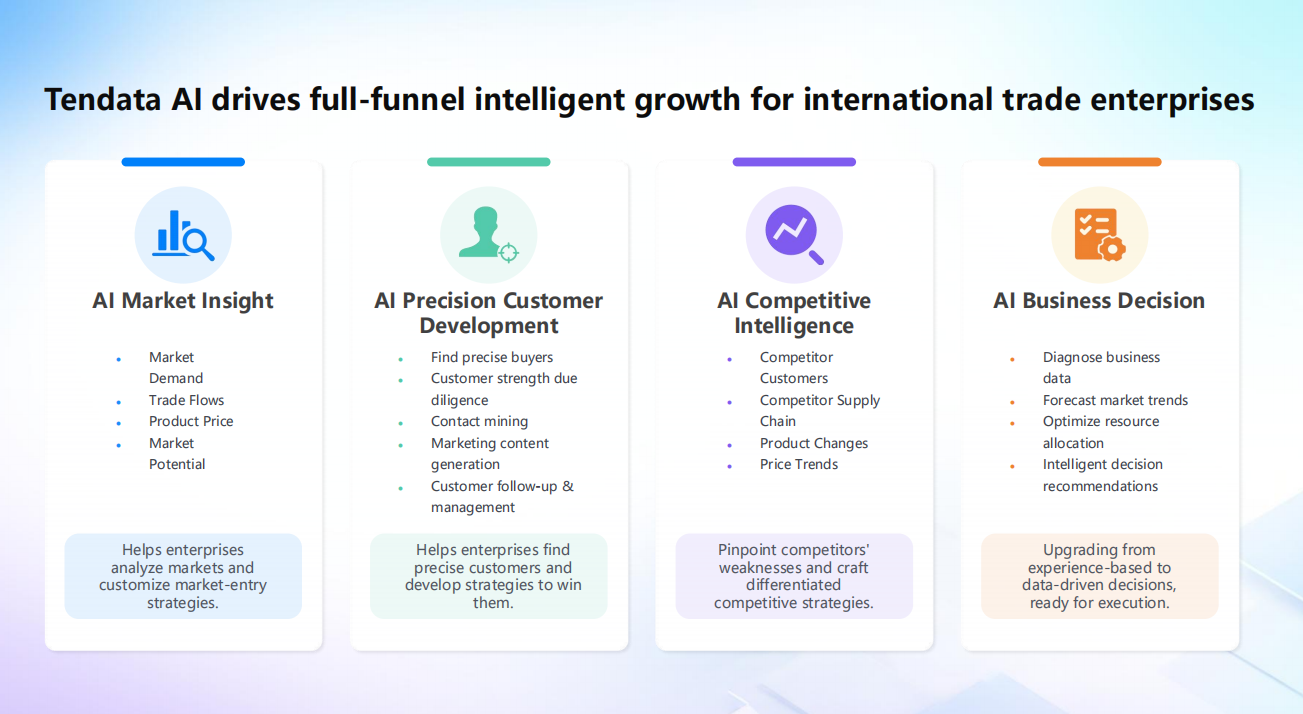
Tendata AI operating modes: on-demand report generation alongside continuous market monitoring.
The technical basis is worth stating plainly, because it is what makes continuous generation viable. Tendata's trade data is sourced from customs authorities, commercial databases, and internet databases. The company operates an independent technology and R&D team with more than 150 engineers, two registered trademarks, more than 150 intellectual property rights, and over 100 awards and certificates of recognition, and holds patents covering HS Code completion and calibration, automated ETL configuration generation, and product name recognition for the international trade industry.
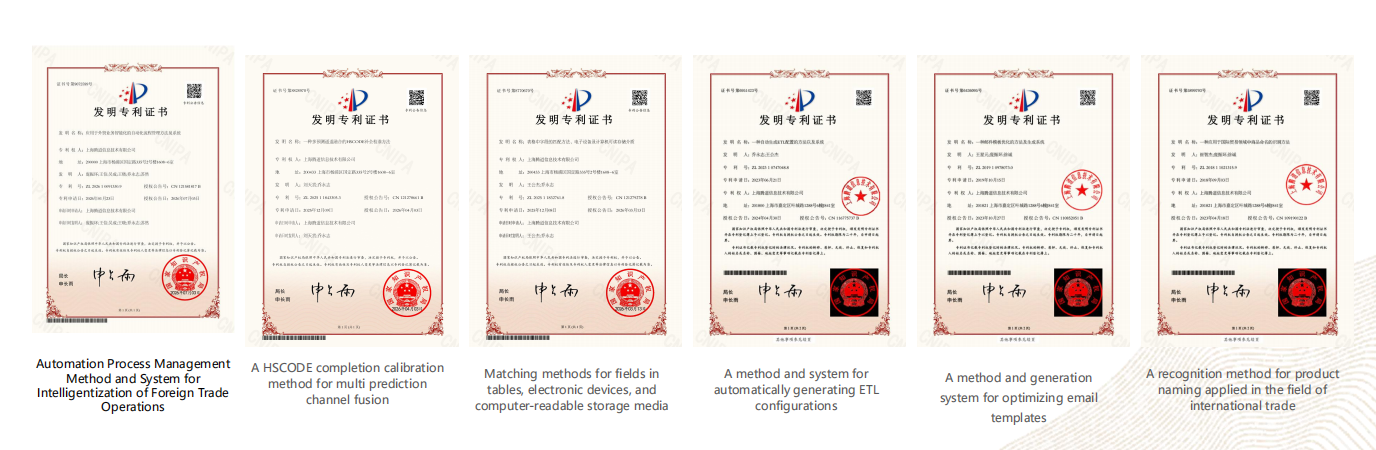
Tendata's patent portfolio covers the data-processing layer behind on-demand trade reporting.
Step-by-Step: Running an On-Demand Market Report Instead of Ordering a Static One
The workflow below reflects how the Tendata AI Global Market Intelligence Solution is structured. It is not a generic research process; each step maps to a delivered capability.
Step 1 — Define the research object. Enter the product, country, HS Code, market, or specific research requirement. Natural-language input is supported; users do not need to master complex data-search methods.
Step 2 — Generate the report. Tendata AI analyzes the relevant trade data and produces a structured market analysis report with one click.
Step 3 — Read across four dimensions. Interpret the output across customers, competitors, markets, and products rather than reading a single market-size figure.
Step 4 — Descend to company level. Move from country totals to named importers and exporters, then inspect purchased products, HS codes, purchasing frequency, and trade volumes.
Step 5 — Configure monitoring. Set the products, countries, and markets to be tracked continuously, and define the criteria that should generate an alert.
Step 6 — Regenerate on change. When an alert fires or the business question shifts, re-run the report against current data instead of commissioning a new study.
The comparison with a static report is easiest to see at Step 5 and Step 6. A static report has no equivalent to either. Its lifecycle ends at delivery.
Use Cases Where Continuous Reports Outperform Snapshots
Entering a new country. Before committing to a market, a business needs market research completed quickly. An on-demand report generated from a product and country combination produces the initial view; monitoring then keeps it current through the entry decision and beyond.
Comparing multiple markets. When several countries are candidates, the analytical task is comparison, not description. Generating a report per market against the same product definition keeps the comparison consistent — a property difficult to guarantee when reports are purchased from different publishers at different times.
Monitoring global product demand. Demand for a specific product shifts between reporting cycles. Continuous tracking of global trade and market changes addresses a question a static report can only answer retroactively.
Tracking competitor activity. A competitor's market presence and trade activity are moving targets. Continuous monitoring of competitors' trade activity is materially different from a one-time competitive landscape section written months earlier.
Identifying active importers. The commercial value of a market report often depends on whether it names companies currently importing the target product. Company-level trade intelligence supports that step directly.
Planning international expansion. Annual or quarterly expansion strategy benefits from ongoing trade and market intelligence rather than a single research artifact produced at the start of the planning cycle.
Comparison Table: Static Reports vs. On-Demand AI Reports
The table below compares the two delivery models on the dimensions that determine usable output. Every entry reflects a stated capability of the respective model — nothing is inferred.
| Dimension | One-Time Static Market Report | On-Demand AI Report (Tendata AI) |
|---|---|---|
| Delivery format | Fixed document delivered at the end of a research cycle | Structured market analysis report generated with one click |
| Data foundation | Fragmented sources: government statistics, industry reports, B2B platforms, company websites, separate databases | Trade data sourced from customs authorities, commercial databases, and internet databases; 10 billion+ records |
| Geographic coverage | Varies by publisher and report scope | 228+ countries and regions |
| Company-level detail | Typically macro-level; limited visibility into specific buyers, importers, suppliers, exporters, competitors | 500+ million import and export companies; purchased products, HS codes, purchasing frequency, trade volumes |
| Freshness | Snapshot as of the research window; ages from publication | Data updates can be as frequent as every three days; reports regenerated on demand |
| Ongoing monitoring | Requires commissioning a new report | Continuous real-time global market monitoring against defined products and countries |
| Change notification | None between report cycles | Personalized AI alerts pushed when matching market changes are detected |
| Customization | Template-based or publisher-defined scope | Analysis adapted to specific products, target countries, and business objectives |
| Contact data | Rarely included at decision-maker level | 850+ million business contacts, including decision-maker job titles |
| Interaction model | Buy once, read once | Natural-language interaction; report, monitor, and alert in one integrated workflow |
Two caveats belong in a fair comparison. Static reports often include qualitative industry commentary and narrative structure that a generated report reflects only insofar as the underlying data supports it. And continuous monitoring is only valuable if the business acts on alerts — the platform delivers the signal, not the decision.
Frequently Asked Questions
How do import export data service providers with customs records obtain their data?
Providers with customs records build their datasets from customs authorities, commercial databases, and internet databases. The quality question is what happens after collection. Tendata regularly standardizes company names, quantity units, and other data fields to reduce duplicate or inconsistent records, and data updates can be as frequent as every three days. Buyers evaluating providers should ask which record types are included — for example whether bill of lading data and shipment records are accessible — because that determines whether a report can reach shipment level.
Can on-demand AI reports replace a one-time static market report entirely?
For demand-side questions tied to trade flows, largely yes. A one-time static report tells a business what the market looked like at a specific point in time. Tendata AI generates market analysis reports on demand and continuously monitors global market changes, proactively alerting businesses when relevant opportunities, trends, or trade activities emerge. The practical limit is scope: generated analysis reflects the trade data underneath it, so questions that require evidence outside trade records remain outside what any trade data platform can answer.
What drives the budget for continuous import export data monitoring?
Cost is driven by scope rather than by a single list price, so it is worth defining scope before comparing quotes. The variables that matter are the number of products or HS Codes tracked, the countries and markets covered, the depth of company-level detail required, and how much of the platform is used — report generation, continuous monitoring, alerts, and contact data access. A team that only needs periodic market reports is buying a different configuration from a team that monitors dozens of product-country combinations continuously. Tendata publishes contact channels on its website for scope-specific discussion.
Can we evaluate report quality on a sample before committing?
Yes — and the most useful sample is not a generic demo report but one built on your own product. Tendata AI generates a structured market analysis report with one click based on the product, country, HS Code, market, or specific research requirement entered. A sample generated against your actual product definition shows the real depth of buyer, supplier, and competitor coverage, which a generic sample cannot. T-Info additionally supports single-click generation of buyer lists, supplier lists, country-of-origin lists, and destination-country lists, so the company-level output can be inspected directly.
How quickly can an on-demand market analysis report be produced?
Report generation is a one-click action in Tendata AI, which contrasts with the manual cycle of searching, consolidating, analyzing, and writing that traditional market research requires. The freshness of what the report shows depends on the data layer: updates can be as frequent as every three days. After the first report, continuous monitoring and proactive alerts take over, so the relevant timing question shifts from "when will the report be delivered" to "how quickly will we be told when something changes."
To discuss scope or request a report generated on your own product, contact Tendata at emarketing@tendata.cn or visit tendata.com.
Conclusion
The comparison comes down to one question: does the business need a market described once, or a market tracked continuously? A one-time static report remains appropriate when the requirement is a fixed document for a fixed decision with no follow-on monitoring. For most export and procurement teams working with import export data, the requirement is continuous — demand moves between reporting cycles, competitors shift, and buyers change suppliers.
The Tendata AI Global Market Intelligence Solution is built for the second case. It combines over 10 billion trade records from 228+ countries and regions with AI-powered analysis, generates structured market reports on demand from a product or HS Code, and keeps monitoring in the background so that changes surface as alerts rather than as next quarter's research project. The difference from a static report is not the document's design. It is that the document is never the last word.
For a full view of the platform's data coverage, modules, and delivery model, download the Tendata company brochure.
Request a market analysis report generated on your own product or HS Code.
Have Questions or Need More Details?
Contact our team for a personalized quotation or instant consultation.
Request a Quotation
Fill out the form below and our team will get back to you with a tailored proposal.
WhatsApp Direct Chat
Prefer to chat in real-time? Message us on WhatsApp for instant assistance & quick answers.
- Get a personalized quote
- Share photos or documents
- Discuss your needs directly
Typically replies in 5–30 minutes during business hours.