Import Export Data Explained: Core Concepts for Global Trade Teams
Import export data is the company-level record of what actually crosses international borders: which company shipped which product, to or from which country, in what quantity, how often, and when. It is compiled from customs declarations, bills of lading and related trade documents, and it answers a different question than a general market report does. A market report tells you how large a market is. Import export data tells you which companies are buying and selling inside that market, and how their trade behaviour changes over time.
This article is a foundational explainer for trade teams that are new to the category: export sales managers, sourcing and procurement teams, business development staff and market research analysts. It defines the core concepts, explains how company-level trade records differ from general market research, why those records matter in international trade, and how the building blocks of a modern trade data platform translate into four practical use cases — buyer discovery, supplier discovery, market analysis and company due diligence.
At a glance
What it is: shipment-level and company-level records of cross-border trade — products, HS codes, quantities, buyers, sellers, countries and dates.
What it is not: a general market report. It works at company and transaction level rather than at market-average level.
Coverage benchmark: 228+ countries and regions, more than 10 billion accumulated trade records, 230+ industries, and company records covering 500+ million importers and exporters.
Where records come from: customs authorities, commercial databases and internet databases.
How fresh it can be: updates as frequent as every three days.
What teams use it for: buyer discovery, supplier discovery, market analysis, company due diligence, and competitor or supply chain monitoring.
Definition: what import export data actually contains
In practice, the term describes two connected layers of information. Teams that understand the difference between the two layers make better procurement and sales decisions, because each layer answers a different question.
Layer 1 — Shipment and transaction records
The first layer is the transaction itself: the product description and HS code, quantity and unit, value where available, country of origin and destination country, the buyer and the seller named on the document, and the date of shipment. These records are captured through customs declarations and bills of lading, which is why the category is often searched as "customs data", "bill of lading database" or "shipment database". A single record is narrow. Millions of records across several years reveal a pattern: how often a company buys, from which suppliers, in what volume, and whether that volume is growing or shrinking.
Layer 2 — Company intelligence records
The second layer describes the company behind the transaction: business background, products traded, trade history, supply chain relationships, and contact details for decision-makers. Tendata's import and export data covers 230+ industry segments and includes more than 500 million importer and exporter company records, which means a buyer or supplier found in the transaction layer can usually be researched in the company layer without switching tools.
Why standardisation is part of the definition
Company names appear in customs documents with inconsistent spellings, abbreviations and suffixes, and quantity units are not always reported the same way. Tendata standardises company names, quantity units and other data fields on a regular basis to reduce duplicate or inconsistent records and to support more accurate business analysis. For a trade team, this is the difference between a list of near-duplicate names and a list of distinct companies you can actually qualify.
Why teams struggle without company-level records
The problem is rarely a lack of information. It is a lack of connected information. Global market data is scattered across customs statistics, government portals, industry reports, B2B platforms, company websites and general search results, and each source is built for a different purpose.
Understanding the underlying difficulty helps you judge any data source you evaluate later. The recurring issues are consistent:
- Fragmented sources. Consolidating customs statistics, industry reports, B2B platforms and company websites into one comparable view takes significant manual effort.
- Macro answers to micro questions. Traditional market reports can describe how large a market is, but often cannot say who is buying, who is selling, what they are buying, and from whom.
- Manual research processes. Screening companies through search engines and spreadsheets does not scale across multiple countries, products and HS codes.
- Limited real-time visibility. Reports refreshed annually or quarterly may not reflect the latest import and export activity.
- Analysis capability gap. Even when large volumes of data are available, turning raw records into actionable buyer intelligence requires interpretation that non-specialist teams often cannot do quickly.
The practical consequence is slower market entry, sales and marketing resources allocated to countries with limited demand, and decisions that rest on experience and public information rather than on observed trade behaviour.
Industry background: how trade intelligence became its own category
Two forces pushed trade data from a specialist customs function into a mainstream commercial tool.
The first is market growth. The global trade management market is projected to reach USD 2.84 billion in 2026, according to Mordor Intelligence, reflecting how much operational and analytical work now surrounds cross-border trade rather than the physical movement of goods alone.
The second is compliance and audit pressure. US Customs and Border Protection collected more than USD 88 billion in duties in 2024, according to IMARC Group, which raises the cost of getting classification, valuation and origin wrong. Duty exposure at that scale makes verifiable trade records useful not only for sales teams looking for buyers, but for finance, compliance and sourcing teams that need to reconstruct what was shipped and when.
Against that background, a specific category emerged: platforms that collect customs-sourced trade records, standardise them, and connect them to company information and AI analysis. Tendata (Shanghai Tendata Tech Co.,Ltd) is one of these platforms. Founded in 2005 and headquartered in Shanghai, China, Tendata provides a trade intelligence platform specialising in global trade data and AI-powered analytics, and describes itself as the first company to combine large language models with an import and export database. It has served more than 100,000 businesses worldwide, including manufacturers, importers and exporters, cross-border e-commerce companies, financial institutions, logistics companies and government agencies.
The building blocks of a modern import export data platform
Coverage numbers are not marketing decoration. Each figure corresponds to a practical question a buyer should ask before relying on a dataset. The blocks below are how one platform, Tendata, describes its own coverage, and they are a useful checklist for evaluating any source.
1. Geographic coverage — 228+ countries and regions
Geographic coverage determines whether you can compare demand across the countries you actually sell into. Tendata's trade data covers 228+ countries and regions, which is what makes cross-country comparison possible inside one query instead of across several national statistics portals.
2. Volume — more than 10 billion accumulated trade records
Record volume matters because trade patterns are only visible in series. Tendata has accumulated more than 10 billion trade transaction records, and reports them as real and verifiable. Depth of history is what allows a team to see whether a buyer's purchase volume is stable, seasonal or declining.
3. Breadth — 230+ industries and 500+ million company records
Industry and company breadth determines whether niche product categories are covered well enough to build a usable list. Tendata's import and export data covers 230+ industry segments and includes 500+ million in-depth company records covering importers and exporters, so a search can move from a product category to named companies without leaving the dataset.
4. Contactability — 850+ million verified business contacts
A qualified company is only useful if you can reach the right person. Tendata provides access to 850+ million verified business contacts, including decision-makers' job titles, phone numbers, email addresses and social profiles. This is the layer that turns a trade record into an actionable sales or sourcing lead.
5. Source layering and standardisation
Tendata's trade data is sourced from customs authorities, commercial databases and internet databases, which together form the foundation of its data infrastructure. The data is described as authentic and verifiable, and the company regularly standardises company names, quantity units and other fields to reduce duplicate or inconsistent records.
6. Freshness — updates as frequent as every three days
Trade flows move faster than annual reports. Data updates can be as frequent as every three days, which allows customers to access the latest import and export trade details rather than waiting for a quarterly refresh.
Where AI fits on top of trade records
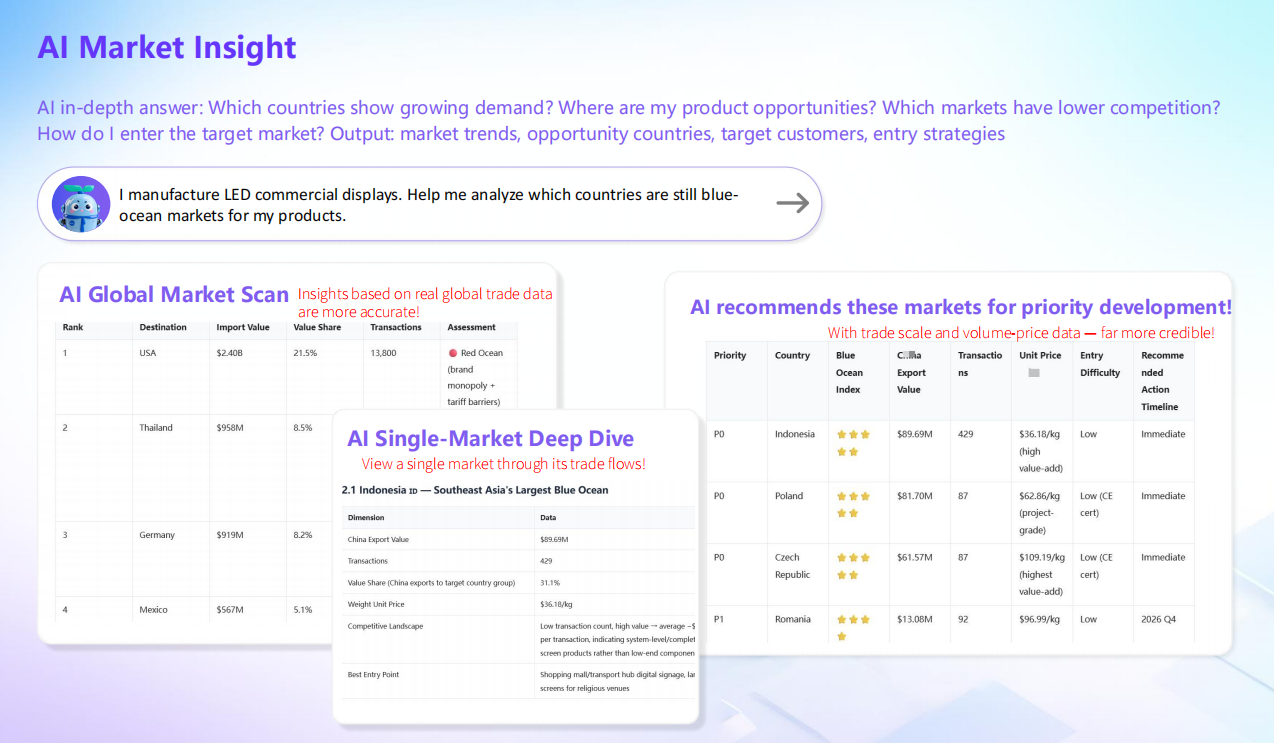
Once the data foundation exists, the constraint shifts from access to interpretation. A list of 4,000 importers in a target country is not a plan; knowing which 120 of them buy a comparable product, at what frequency, and who to contact is. This is where AI has changed how trade data is used.
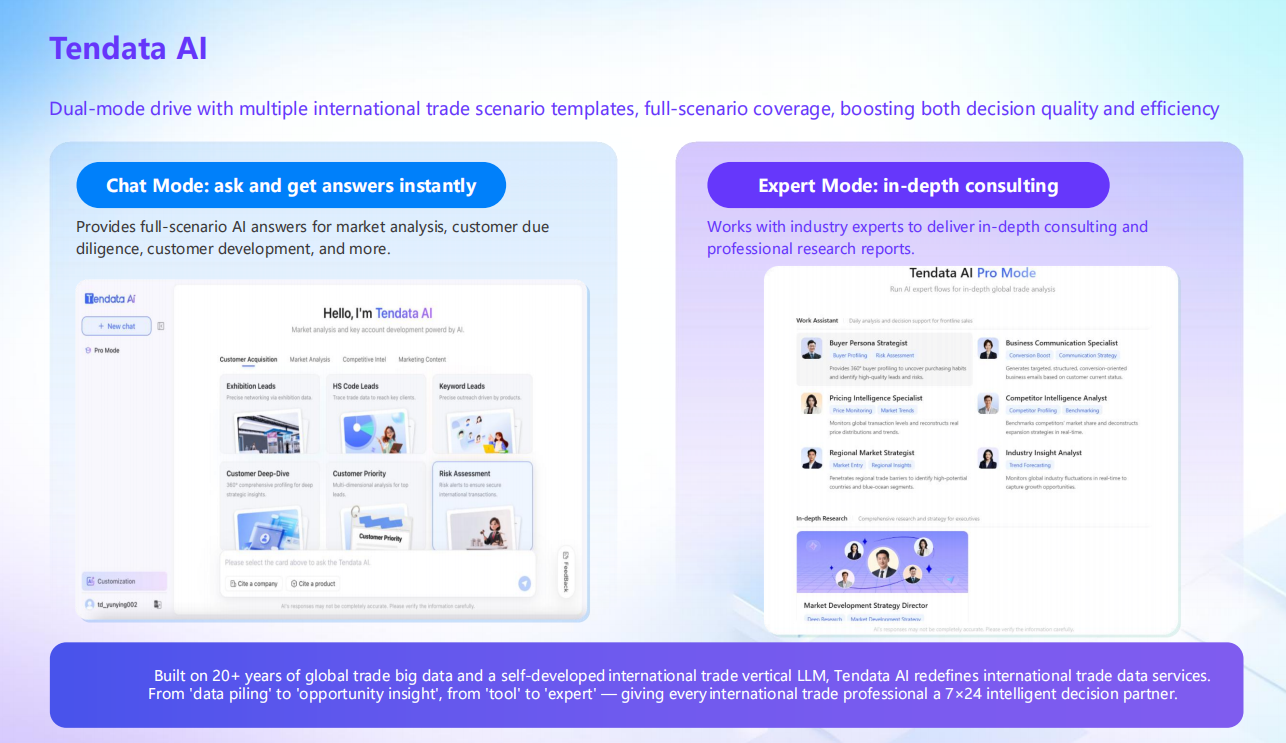
Tendata integrates artificial intelligence with trade data through several products: Tendata AI, T-Insight, T-Discovery and T-Info. Each maps to a different type of task:
- T-Info offers 17 report models and supports intelligent searches by HS code, product name, company name and other criteria. Users can generate buyer lists, supplier lists, country-of-origin lists and destination-country lists with a single click.
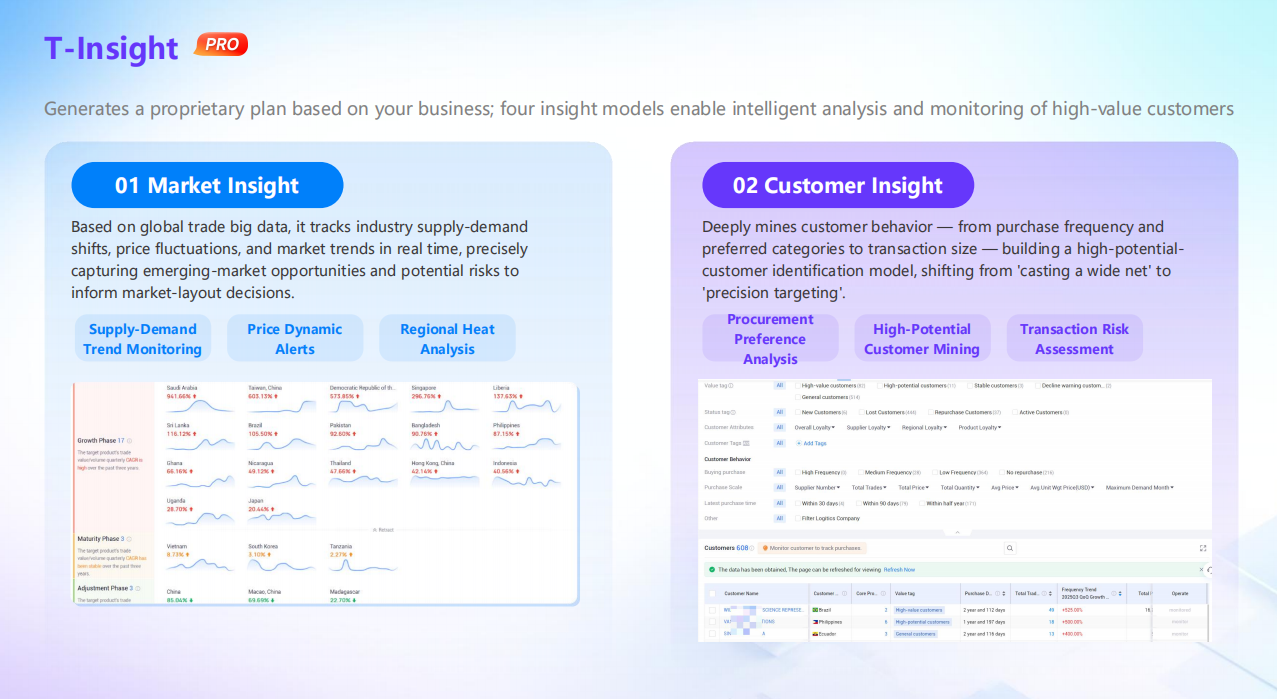
- T-Insight generates market analysis reports based on a product name or HS code, providing multidimensional analysis from four perspectives — customers, competitors, markets and products — with more than 100 interactive visualisations.
- Tendata AI combines all of Tendata's features, trade databases and large language models. Based on real, valid and verifiable trade data, it helps businesses identify potential customers, generate global market analysis reports, create personalised outreach emails based on target customer information, and develop social media outreach strategies based on prospects' actual needs.
The important distinction for a new buyer of trade data is that this is trade-specific AI connected to a trade database, not a general-purpose assistant answering questions from public internet content. The output can be traced back to records describing actual shipments.
Import export data vs. general market research
The two categories are complementary, but they are not substitutes. The table below compares them on the dimensions that usually decide which one a team needs first.
| Dimension | Company-level import export data | General market research |
|---|---|---|
| Unit of analysis | Individual companies and individual shipments | Countries, regions and industry averages |
| Question answered | Who is buying, who is selling, what they trade, and with whom | How large the market is and how fast it is growing |
| Typical inputs | Customs declarations, bills of lading, commercial and internet databases | Published statistics, surveys, purchased reports, B2B platforms |
| Company-level visibility | Includes named buyers, suppliers and supply chain relationships | Usually limited to macro-level trends |
| Update rhythm | As frequent as every three days on Tendata | Often annual or quarterly |
| Best used for | Buyer discovery, supplier discovery, due diligence, competitor monitoring | Strategic sizing, sector context, long-range planning |
Read together, the two layers answer a sequence of questions: where is the market, what is growing, who is buying, and who is supplying. Traditional market research covers the first two well. Trade records cover the last two, which are usually the ones sales and procurement teams need in order to act.
Step-by-step: how a trade team works with import export data
The workflow below reflects how buyer and supplier discovery is typically executed with a platform that combines trade records, company records and contacts.
Step 1 — Define the product and market scope
Start from a product name or an HS code, then choose the countries you want to examine. HS codes make the scope precise and comparable across borders; product names are useful when you are still exploring how a category is classified. T-Info supports intelligent searches by HS code, product name and company name for exactly this step.
Step 2 — Pull the trade records
Query the dataset for import records in your target country for the relevant product. The result is a set of shipments with named buyers, sellers, quantities and dates. Because Tendata's data covers 228+ countries and regions, the same product can be checked in several candidate markets before committing sales resources.
Step 3 — Build the list
Convert the records into a working list: a buyer list for the target market, a supplier list for a sourcing decision, or a country-of-origin or destination-country list when you need to see where supply and demand are concentrated. These list types can be generated with a single click in T-Info.
Step 4 — Qualify before you approach
Trade history separates an active buyer from a name on a directory. Look at purchasing frequency, trade volume, product fit and existing supply relationships. This is the step where company-level data replaces guesswork, and where a filter based on real shipment behaviour prevents wasted outreach.
Step 5 — Reach the right person
A qualified company still needs a contact. Tendata provides access to 850+ million verified business contacts, including decision-makers' job titles, phone numbers, email addresses and social profiles, so outreach can be directed at the person who owns the purchasing decision. Tendata AI can then generate personalised outreach emails based on the prospect's actual purchased products and trade records.
Step 6 — Monitor and repeat
Trade relationships change. A buyer may add a supplier, reduce volumes or shift origin countries. Monitoring functions let a team track target customers and competitors over time, so the list stays current instead of ageing into a one-off research file.
Four core use cases
Almost every application of import export data falls into one of four categories, each with a different starting point and a different definition of success.
Use case 1 — Buyer discovery
Start from a product or HS code and a target country, then identify companies that are already importing that product. Success means a qualified list of importers with real purchasing records, rather than a list of company names of unknown relevance. Documents delivered for this use case include global lists of buyers and importers, trade history, company profiles and product data.
Use case 2 — Supplier discovery
Importers, wholesalers and procurement teams use the same records in reverse: identifying exporters and suppliers with verified export records, checking alternative sources, and comparing suppliers by the products they actually ship and the markets they serve. This supports supplier qualification and reduces dependence on a single source.
Use case 3 — Market analysis
Aggregated trade records show which countries are importing a product, in what volume, and whether the trend is rising or falling. T-Insight generates market analysis reports from a product name or HS code across four perspectives — customers, competitors, markets and products — which supports market selection and product planning before sales resources are committed.
Use case 4 — Company due diligence
Before extending credit, signing a distribution agreement or appointing a supplier, a team needs evidence that the counterparty actually trades. Company records cover business operations, financial information, products, supply chain relationships, news and public sentiment, intellectual property, litigation and risk information, and trade shows. Tendata AI can complete customer due diligence in as little as one minute from a prompt, which is a practical difference for teams that currently spend days assembling the same picture manually.
A fifth, closely related application is competitor and supply chain monitoring: observing which countries a competitor sells to, which suppliers it uses, and whether a customer has begun working with a new supplier.
Coverage at a glance
| Building block | Tendata coverage | What it enables |
|---|---|---|
| Countries and regions | 228+ | Cross-country comparison within one platform |
| Accumulated trade records | 10+ billion | Pattern analysis over time rather than single snapshots |
| Industry segments | 230+ | Coverage of niche product categories, not only mainstream goods |
| Importer and exporter company records | 500+ million | Company-level qualification and supply chain context |
| Verified business contacts | 850+ million | Reaching decision-makers directly |
| Data sources | Customs authorities, commercial databases, internet databases | Records that are described as authentic and verifiable |
| Update frequency | As frequent as every three days | Visibility into recent import and export activity |
How to read coverage and record-count claims
Record counts published by trade data providers are not directly comparable, because providers define a "record" differently. Tendata reports more than 10 billion trade records across 228+ countries. Panjiva (S&P Global) is reported to provide entity resolution across more than 2 billion shipment records, according to Suppliers with an AI. The gap reflects differences in scope and counting methodology more than a simple measure of usefulness, so the right question is not which number is larger, but which records cover the countries, products and time period your decision depends on. Where a claim cannot be verified for your specific product and market, ask for a sample covering that scope.
Frequently asked questions
Where does import export data come from, and is it verifiable?
Import export data is compiled from customs authorities, commercial databases and internet databases. Customs declarations and bills of lading are the foundation, which is why the records can be traced back to documented shipments. Tendata describes its trade data as authentic and verifiable, and regularly standardises company names, quantity units and other fields to reduce duplicate or inconsistent records. For a buyer, the practical test is whether a returned record can be traced to a specific shipment with a named buyer, seller, product, quantity and date.
How much coverage does a global import export data platform provide?
Tendata's trade data covers 228+ countries and regions, with more than 10 billion trade transaction records accumulated, 230+ industry segments, and company records covering 500+ million importers and exporters. It also provides access to 850+ million verified business contacts, including decision-makers' job titles, phone numbers, email addresses and social profiles. Coverage is best evaluated against your own scope: the countries you sell into, the HS codes you trade, and the number of years of history you need to judge whether demand is stable.
How current is import export data?
Freshness depends on the source and the platform. Tendata states that data updates can be as frequent as every three days, allowing customers to access the latest import and export trade details. This matters because trade relationships change continuously: a buyer may add a supplier, shift origin countries or reduce volumes, and an annual or quarterly report will not show it. When evaluating a source, treat update frequency as a coverage property to be confirmed for each country you rely on, not as a single platform-wide figure.
How is company-level trade data different from general market research?
General market research operates at macro level and typically answers how large a market is and how fast it is growing, using published statistics, surveys and purchased reports that are often refreshed annually or quarterly. Company-level trade records operate at transaction level and answer who is buying, who is selling, what they trade and with whom, using customs declarations and bills of lading. The two are complementary: market research narrows the country and category, while trade records identify the specific companies to approach. Traditional reports rarely provide named buyers, suppliers or supply chain relationships.
How does a trade team start working with import export data?
Start with scope, not software. Define one product or HS code and one or two target countries, then generate a buyer or supplier list and qualify it by purchasing frequency, trade volume and product fit before contacting anyone. Tendata supports this with T-Info, which offers 17 report models and one-click buyer, supplier, country-of-origin and destination-country lists, and with Tendata AI, which can generate market analysis reports and personalised outreach emails based on actual trade records. Teams that want a structured overview before subscribing can review the Tendata company introduction and request a sample covering their own product and market, which is the fastest way to confirm whether the records match the decision you need to make.
Conclusion: start from the decision, then choose the data
Import export data is best understood as a decision input rather than a database subscription. It answers a specific class of question — who trades what, with whom, how often and at what volume — that market reports are not designed to answer. The building blocks that make it useful are unglamorous but measurable: geographic coverage of 228+ countries and regions, more than 10 billion accumulated trade records, 230+ industries, 500+ million importer and exporter company records, 850+ million verified contacts, layered sources and updates as frequent as every three days.
For a trade team at the awareness and research stage, the practical sequence is straightforward. Identify the decision you need to make — a buyer list, a supplier shortlist, a market entry case or a due diligence check. Match it to the use case. Then verify coverage in your own product and country before committing budget, because a platform's totals matter far less than whether it holds the specific records you need.

Talk to the Tendata team
Shanghai Tendata Tech Co.,Ltd has served more than 100,000 businesses worldwide with global trade data and AI-powered analytics. If you are evaluating import export data for buyer discovery, supplier discovery, market analysis or company due diligence, the next step is a walkthrough using your own product and target market.
Website: www.tendata.com
Brochure: Download the Tendata introduction
Email: emarketing@tendata.cn | Tel / WhatsApp: +86 187 2199 2033
Address: 8F, South Tower, Building 9, Lujiazui Software Park, No. 20, Lane 91, Eshan Road, Pudong New Area, Shanghai