Import Export Data Explained: Core Concepts for Global Trade Teams
Import export data is the transaction-level record of goods crossing international borders: which company shipped which product, to whom, in what quantity, at what declared value, and when. For a trade team that is new to the concept, the practical question is not whether this data exists — it is what the data actually contains, how it differs from a market research report, and what a team can do with it. This guide answers those questions from the ground up, without assuming prior experience with customs records or trade intelligence platforms.
Problem Definition: “How Big Is the Market” Is Not the Same Question as “Who Is Buying”
Most companies entering international trade start with the same research method: search engines, public statistics, industry reports, B2B platforms, and spreadsheets assembled by hand. These sources are genuinely useful. They answer a real question — how large a market is, and roughly how fast it is growing.
What they generally do not answer is the operational question: which specific companies are buying this product right now, from which suppliers, how often, and in what volume. A category-level report can describe demand; it usually cannot name the buyer. That gap is where import export data becomes relevant, because the unit of analysis changes from the market to the company.
The symptoms of that gap are familiar inside trading companies. Research cycles run for weeks. Sales and marketing budgets are spread across countries with unverified demand. Prospect lists contain company names that nobody can confirm are still active in the category. Early due diligence on a new counterparty relies on website claims rather than trading behaviour. Each of these is a data problem before it becomes a sales problem.
Industry Background: Why Trade Data Moved Onto the Budget Line
Trade data is no longer a research luxury. The global Trade Management market — the software and data category that includes trade compliance, trade data and trade analytics — is projected to reach USD 2.84 billion in 2026, according to Mordor Intelligence. Part of that spending is driven by compliance pressure: IMARC Group reports that US Customs and Border Protection collected more than USD 88 billion in duties in 2024, which makes accurate shipment-level records valuable for audit readiness as well as for sales prospecting.
A second driver is freshness. Traditional market research is typically delivered quarterly or annually, while trade activity changes continuously. Platforms that refresh customs and shipment records on a short cycle — for Tendata, data updates can be as frequent as every three days — give a trade team a closer view of current import and export activity than a fixed annual report. A third driver is consolidation: market information is scattered across government statistics, industry reports, B2B platforms, company websites and separate databases, and few teams have the capacity to assemble all of it manually.
What Import Export Data Is Made Of
The underlying records
Import export data — also described as customs data, shipment data or trade data — is built from records generated when goods clear a border. Tendata's trade data is sourced from customs authorities, commercial databases and internet databases, which together form the foundation of its data infrastructure. The data is positioned as authentic and verifiable, which is the minimum standard any procurement team should apply before acting on it.
What a single record can contain
A shipment-level record typically describes the importing and exporting companies, the product and its HS code, quantity and weight, declared value, country of origin and destination, and the shipment date. Read one record and you have a single transaction. Read millions of them together and you have a behaviour map: who buys a product, who supplies it, how often the relationship repeats, and how it changes across quarters.
How coverage is measured
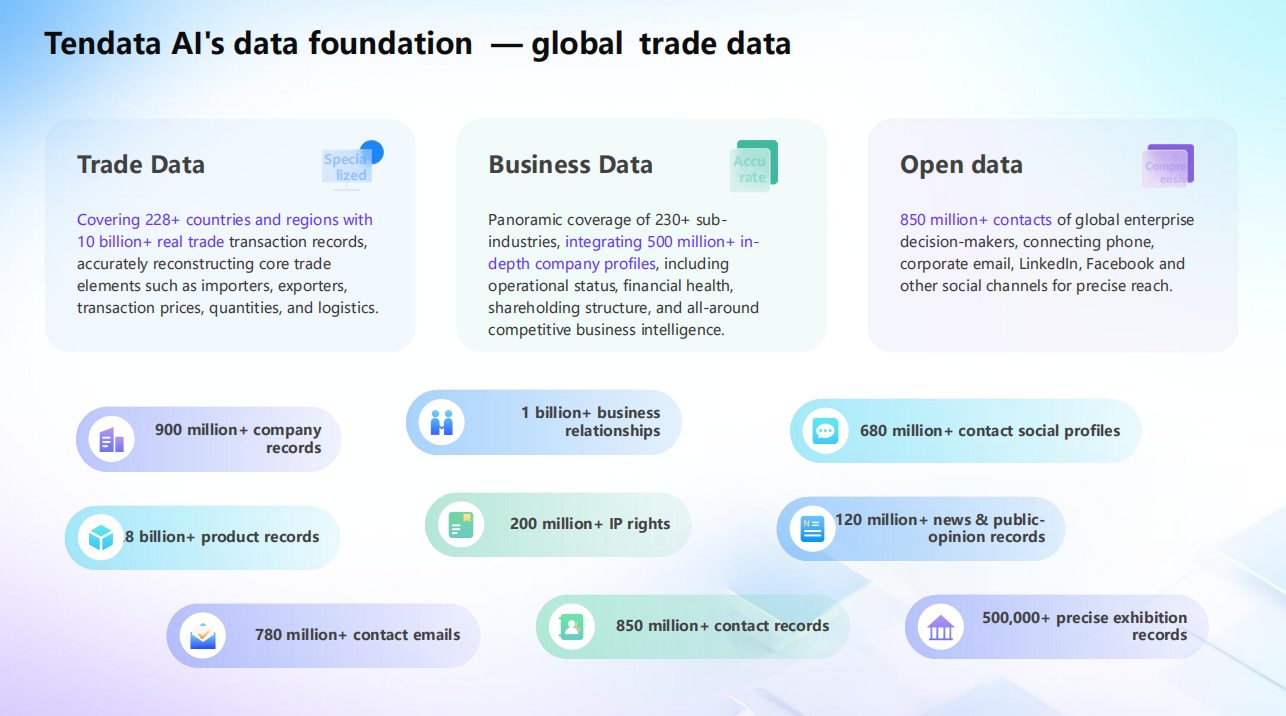
Three measurements define the usable scale of any trade database. Geographic reach determines whether a team can compare markets across regions. Record volume determines how deep the history goes and how reliably patterns can be detected. Industry and company breadth determines how many potential buyers and suppliers are visible at all.
- 228+ countries and regions covered by Tendata's global import and export data.
- More than 10 billion accumulated trade transaction records, described as real and verifiable.
- 230+ industry segments and more than 500 million importer and exporter company records.
Scale alone is not enough. Tendata regularly standardizes company names, quantity units and other data fields to reduce duplicate or inconsistent records, so the same company or unit is not counted twice under different spellings or formats. Without standardization, a large database produces unreliable comparisons — a point worth checking with any provider before purchase.
How Import Export Data Differs From General Market Research
The fastest way to understand the difference is to compare what each source can answer. General market research summarizes a market. Import export data describes a company. One sets strategic context; the other supports a specific commercial decision, such as which twenty importers to contact this month.
| Dimension | Import export data (company-level trade records) | General market research reports | B2B directories & search engines |
|---|---|---|---|
| Unit of analysis | Individual shipment and company | Market, category or country | Company listing |
| Typical source | Customs authorities, commercial and internet databases | Surveys, published statistics, analyst modelling | Platform registration and self-published company information |
| Question it answers | Who buys or sells what, from or to whom, how often, how much | How large is the market and how fast is it growing | Which companies present themselves as suppliers in this category |
| Granularity | Transaction-level, per company | Aggregated | Descriptive |
| Update pattern | Short cycles (Tendata: as frequent as every three days) | Quarterly or annual | Variable, maintained by each company |
| Typical output | Buyer lists, supplier lists, trade history, company due diligence | Market size, growth rates, trend narratives | Contact lists, catalogs, inbound inquiries |
| Best fit | Prospecting, sourcing, verification and monitoring | Board-level strategy and market prioritisation | Initial lead generation and product discovery |
Published record counts also vary between platforms, and the numbers are not always like-for-like. The table below shows two reported figures side by side with their sources, which is the honest way to read coverage claims.
| Provider | Published coverage figure | Source |
|---|---|---|
| Tendata | 10+ billion accumulated trade transaction records across 228+ countries and regions | Tendata, cited by the Shanghai Municipal Commission of Commerce (2026) |
| Panjiva (S&P Global) | Entity resolution across more than 2 billion shipment records | Suppliers with an AI (2026) |
Note: published record counts are not directly comparable. Platforms count different record types and maintain different regional depth, so these figures should be read as reported coverage rather than a like-for-like benchmark.
Why Company-Level Trade Records Matter for Four Core Decisions
1. Buyer discovery
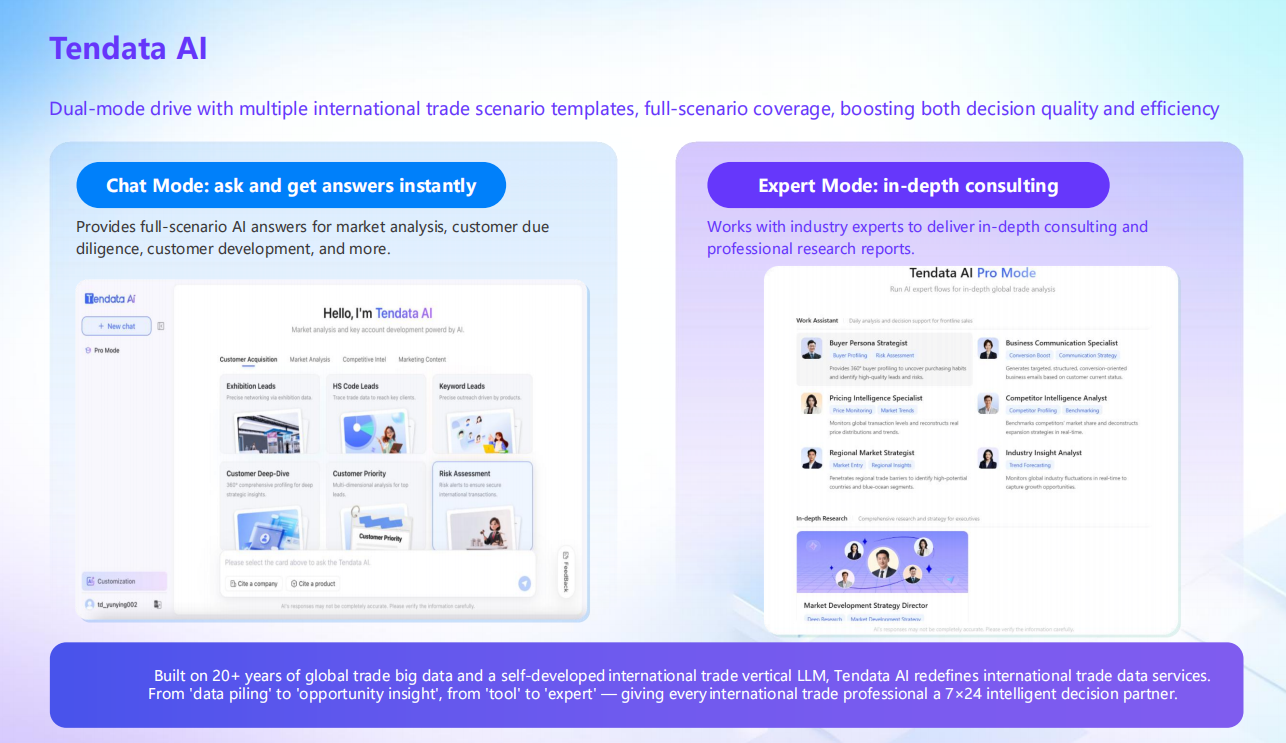
Instead of guessing which importers might be interested, a team can start from companies that already import the relevant product and HS code. Trade records show purchasing frequency, trade volume and product fit, which allows a long list of names to be reduced to prospects with observable buying behaviour. Tendata AI supports this by connecting users directly to trade data, so buyer identification does not depend on manual filtering alone.
2. Supplier discovery
The same records work in the opposite direction. Importers, wholesalers and procurement teams can identify exporters with verified export records, compare potential supply sources, and review whether a supplier ships consistently to markets comparable to their own. This is the sourcing-side value of import export data, and it is frequently overlooked by teams that treat trade data as a sales-only tool.
3. Market analysis
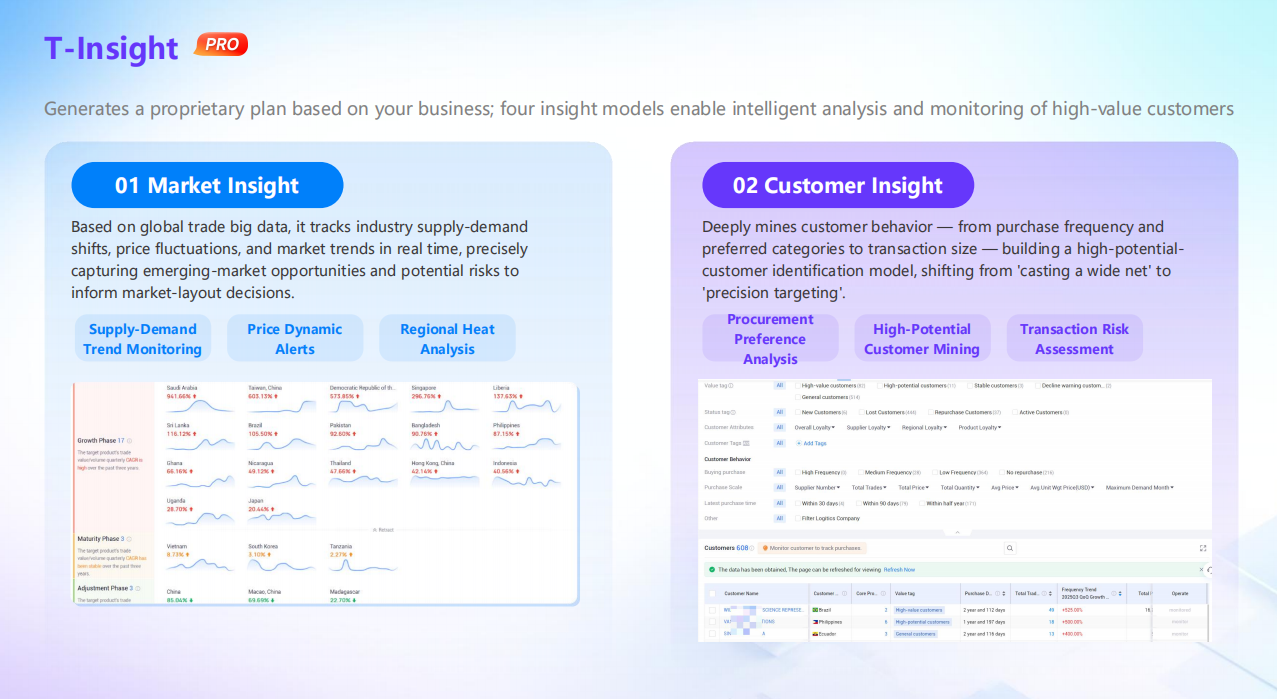
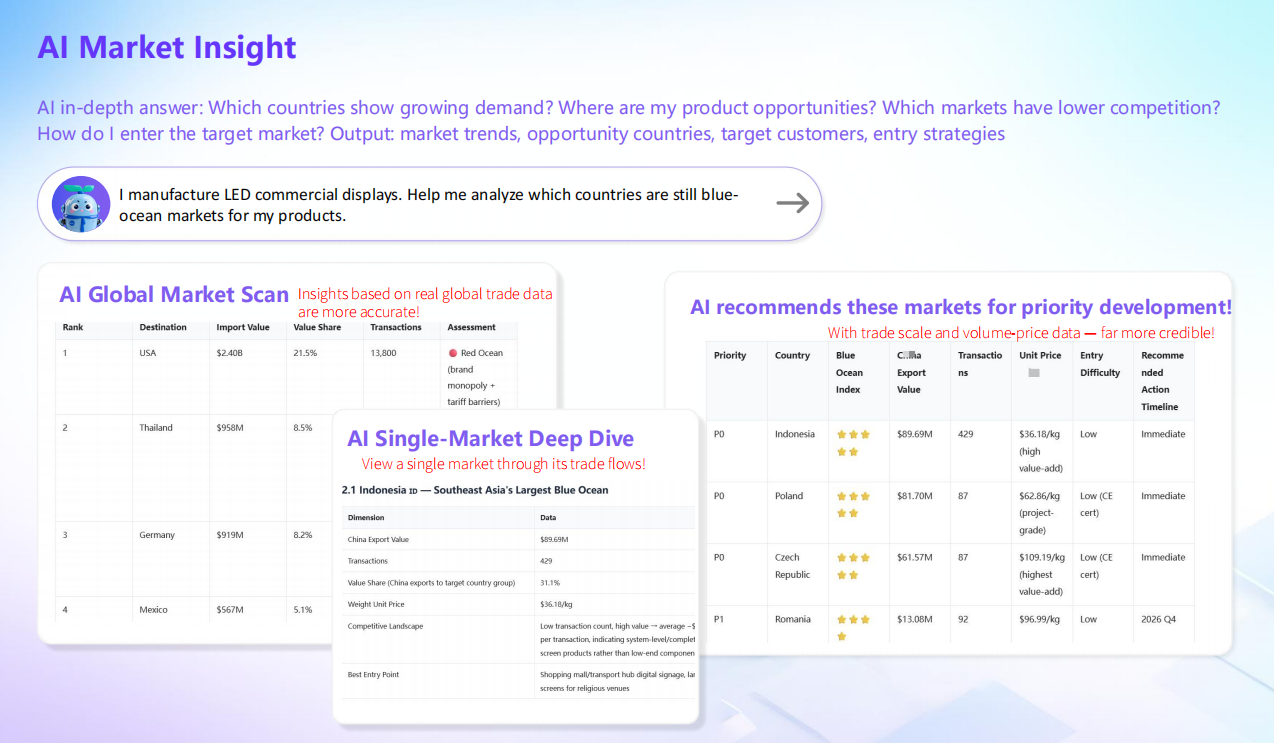
Trade data connects macro signals to specific companies. T-Insight generates market analysis based on a product name or HS code and analyzes four perspectives — customers, competitors, markets and products — with more than 100 interactive visualizations. That answers a question that a country-level statistic cannot: not only whether demand exists, but which companies are acting on it.
4. Company due diligence
Before a first order or a distribution agreement, trade records provide an evidence layer. Tendata's import and export data includes 500+ million in-depth company records covering business operations, financial information, products, supply-chain relationships, news and public sentiment, intellectual property, litigation and risk information, and trade shows. Combined with 850+ million verified business contacts — including decision-maker job titles, phone numbers, email addresses and social profiles — this turns due diligence from a document-collection exercise into a verification exercise.
Inside a Trade Intelligence Platform: The Tendata Stack
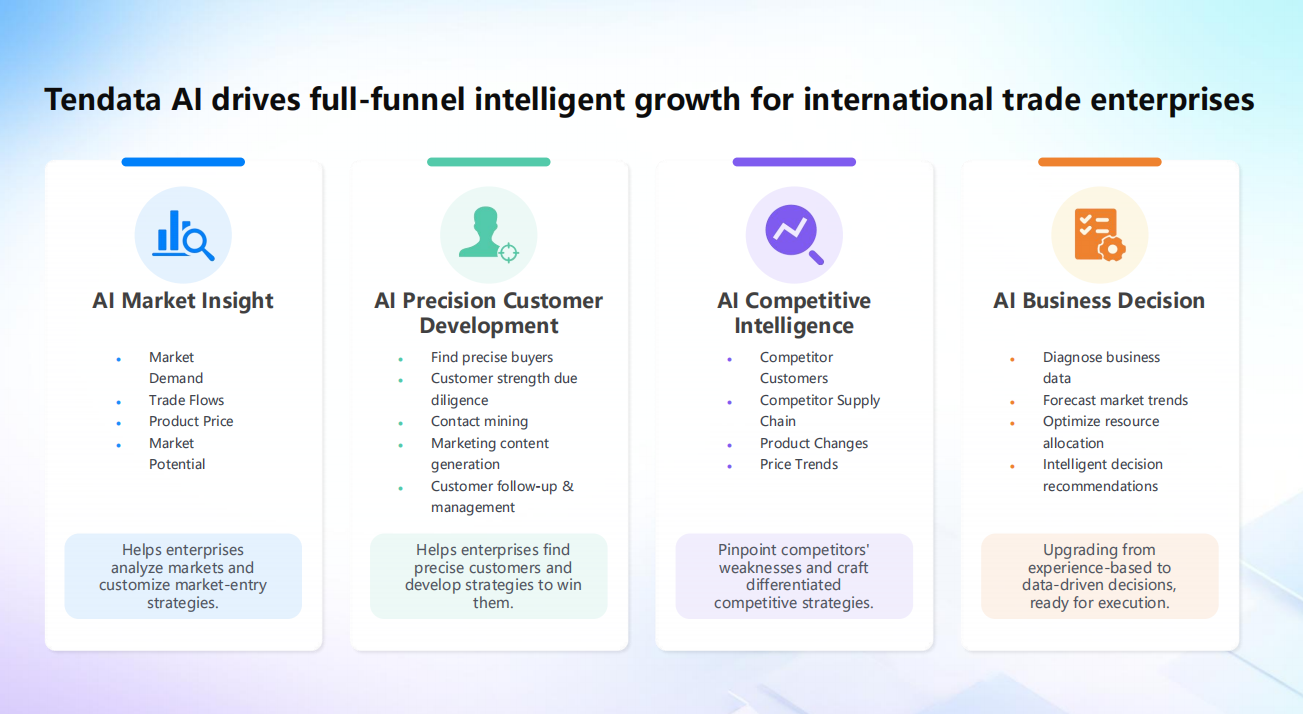
Shanghai Tendata Tech Co., Ltd., trading as Tendata, is a trade intelligence platform company headquartered in Shanghai, China, founded in 2005. It specializes in global trade data and AI-powered analytics for businesses that develop international markets, find buyers and suppliers, analyse products and research competitors. Its trade data covers 228+ countries and regions with more than 10 billion accumulated trade records, and the company states that it has served more than 100,000 businesses worldwide, including manufacturers, importers and exporters, cross-border e-commerce companies, financial institutions, logistics companies and government agencies.
The platform layer is where most trade teams spend their time. T-Info offers 17 report models and supports intelligent search by HS Code, product name and company name, generating buyer lists, supplier lists, country-of-origin lists and destination-country lists with a single click. T-Insight produces market analysis reports based on a product name or HS code. T-Discovery and Tendata AI extend the workflow further: because Tendata AI combines the platform's trade databases with large language models, users can describe a product or target market in natural language and have the system identify potential customers, generate a global market analysis report, draft personalized outreach emails based on a prospect's actual trade records, and build customized social media outreach strategies.
The operating logic behind this stack is simple to state: the same underlying trade data should support discovering a company, qualifying it, verifying it, contacting it and monitoring it, rather than forcing a team to move between separate tools for each step.
A Step-by-Step Workflow: From HS Code to First Contact
For a team starting from zero, the sequence below is the standard path through a trade intelligence platform. The order matters, because each step filters the next one.
- Define the product precisely. Start from the product name and its HS code, and decide which countries or regions are in scope. Ambiguous product definitions are the most common cause of unusable buyer lists.
- Build the candidate list. Generate buyer or supplier lists filtered by HS code, product and country. T-Info produces these lists — including buyer, supplier, country-of-origin and destination-country lists — with a single click.
- Qualify by trade behaviour. Rank candidates by purchasing frequency, trade volume, product fit and continuity of activity. This step removes companies that appear in a directory but show no current trading activity in the category.
- Verify the company. Combine trade history with company intelligence — business operations, supply-chain relationships, products, and risk-related information — before committing sales time. Tendata AI is designed to complete a customer background check in as little as one minute.
- Find the right contact. Identify decision-maker contact information, including job titles, phone numbers, email addresses and social profiles.
- Reach out with context. Generate outreach content based on what the company actually buys, rather than a generic template. This is where AI-generated emails and social outreach strategies replace mass mailing.
- Monitor continuously. Keep watching whether a customer has started working with a new supplier, whether a competitor's buyer mix is shifting, and whether demand in a target market is rising or falling.
Core Use Cases by Team
Import export data is used differently depending on which function is asking the question. The table below maps common teams to the data they pull and the output they produce.
| Team | What they pull from trade data | Practical output |
|---|---|---|
| Export & international sales | Companies actively importing the same HS code in target markets | Prioritised buyer list with purchasing frequency and trade volume |
| Import & procurement | Exporters of a target product and alternative supply sources | Supplier shortlist with verified export records |
| Trading companies | Cross-country trade flows and product demand by category | Market shortlists and product demand comparisons |
| Market research & strategy | Country-level demand, competitor shipments, buyer and supplier mix | Market analysis reports covering customers, competitors, markets and products |
| Distributors & wholesalers | Downstream buyers and upstream suppliers in the same category | Channel expansion and sourcing plans |
Tendata's declared target clients follow the same logic: manufacturers, exporters, importers, trading companies, B2B sales teams, procurement teams, distributors, wholesalers and market research teams. The service objective is consistent across all of them — identify high-potential buyers, suppliers and target markets from global trade data, build target customer lists, and reduce the cost of manual searching and prospect screening.
Frequently Asked Questions
What is import export data, and where does it come from?
Import export data is the record of goods moving across international borders, captured at transaction level — the importing and exporting companies, the product and HS code, quantity, declared value, origin and destination, and the shipment date. Tendata sources its trade data from customs authorities, commercial databases and internet databases, and standardizes company names and quantity units to reduce duplicate or inconsistent records before the data is used for analysis. Coverage spans 228+ countries and regions with more than 10 billion accumulated trade records.
How is import export data different from a market research report?
A market research report summarizes a market: size, growth rate and broad trends, usually at an aggregated level and on a quarterly or annual cycle. Import export data works at the company level and reflects actual trading behaviour — which companies buy a product, which suppliers they buy from, how frequently, and at what volume. The two are complementary rather than competing: reports set strategic context, while trade records identify the specific buyers and suppliers behind a trend.
What can company-level trade records tell you about a company?
Beyond the products a company buys or supplies, its HS codes, purchasing frequency and trade volumes, records can be combined with wider company intelligence. Tendata's import and export data includes 500+ million in-depth company records covering business operations, financial information, products, supply-chain relationships, news and public sentiment, intellectual property, litigation and risk information, and trade shows — the evidence layer a procurement or sales team needs before a first order or a longer-term agreement.
Who inside a company uses import export data?
Tendata's service is used by manufacturers, exporters, importers, trading companies, B2B sales teams, procurement teams, distributors, wholesalers and market research teams. Sales teams use it to build buyer lists; procurement and sourcing teams use it to identify and verify suppliers; trading companies use it to compare product demand across countries; and market research teams use it to size demand, monitor competitors and prepare market analysis reports.
Do you need a data analyst to work with import export data?
Not necessarily. Report-based tools such as T-Info provide 17 report models and generate buyer lists, supplier lists, country-of-origin lists and destination-country lists with a single click, filtered by HS code, product name or company name. Tendata AI goes further by accepting natural-language requests: a user can describe a product and target market, complete a company background check in as little as one minute, and generate personalized outreach emails based on a prospect's actual trade records. To see how this works with your products and target markets, contact Tendata at emarketing@tendata.cn or download the Tendata introduction brochure.
Conclusion: Start With the Question, Then Choose the Data
Import export data is not a replacement for market research, and it is not simply a contact list. It is a record of what companies actually did — what they bought, from whom, how often and at what value. That is why it answers a different question from a market report, and why it becomes useful at the moment a team moves from “this market looks promising” to “here are the twenty companies to contact, and here is the evidence behind each one.”
For a team at the start of that journey, the sequence is straightforward: define the product and HS code, build a candidate list from verified trade records, qualify by behaviour, verify the company, find the right contact, reach out with context, and keep monitoring. Each step depends on the quality and freshness of the underlying data — which is why coverage, standardization and update frequency matter more than the length of a feature list.
Shanghai Tendata Tech Co., Ltd. was established in 2005 and is headquartered in Shanghai, China, with an office building in Pudong New Area covering 2,200 square meters. The company employs approximately 1,000 staff, including a technology and R&D team of 150 engineers, and has accumulated more than 150 intellectual property rights and over 100 awards and certificates of recognition. It provides trade intelligence platform services to businesses worldwide.
- Website: www.tendata.com
- Email: emarketing@tendata.cn
- Phone / WhatsApp: +86 187 2199 2033
- Address: 8F, South Tower, Building 9, Lujiazui Software Park, No. 20, Lane 91, Eshan Road, Pudong New Area, Shanghai
- Company introduction brochure: download the Tendata Introduction (PDF)