Import Export Data Partnership FAQs: Long-Term Buyer Discovery with Tendata AI
Most import export data partnerships are judged in the first two weeks, when a buyer list arrives and looks impressive. The real test comes in month six: is the list still producing qualified prospects, or has it quietly become a static file that nobody opens? Long-term buyer discovery is a workflow problem, not a data-volume problem, and that is the question this FAQ set addresses.
Tendata (Shanghai Tendata Tech Co.,ltd) was founded in 2005 and is headquartered in Shanghai, China. Its AI Global Market Intelligence Solution is an AI-powered platform that uses global trade data, company-level intelligence, and AI analysis to identify buyers and suppliers, drawing on import and export data covering 228+ countries and regions and more than 10 billion real, verifiable trade records. The questions below are the ones importers, exporters, and trading companies actually raise before committing to a long-term partnership — coverage, verification, workflow, monitoring cadence, and rollout.
Short Answer
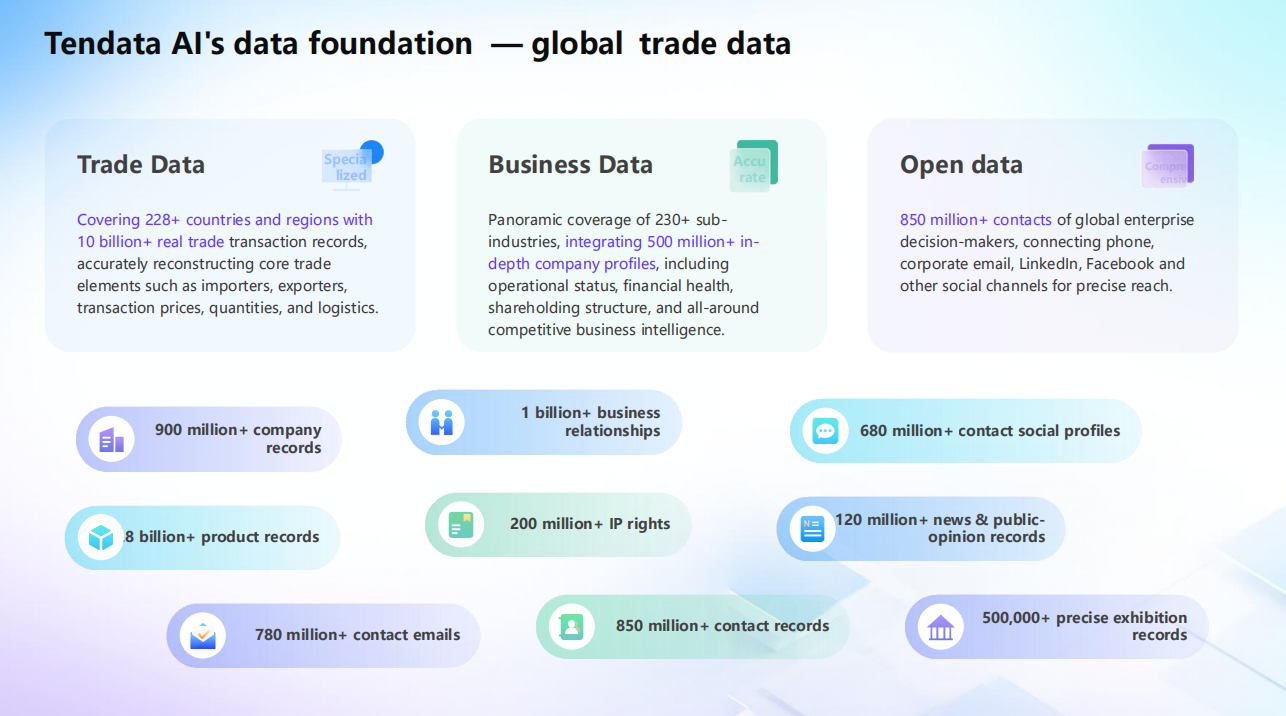
- Coverage: 228+ countries and regions, 10+ billion trade transaction records, 230+ industries, 500+ million company records, and 850+ million verified business contacts.
- Core function: identify potential buyers and importers that have actual trade activity, and read their trade records, purchasing or export behavior, and supply chain relationships.
- Long-term mechanism: on-site implementation, continuous global market monitoring, personalized alerts, and one-click market analysis reports generated by Tendata AI.
- Data cadence: updates as frequent as every three days, sourced from customs authorities, commercial databases, and internet databases.
Problem Definition: Why Buyer Discovery Stalls After the First List
The failure mode is consistent across importers, exporters, and trading companies. A first list of company names is assembled from directories, LinkedIn, trade shows, or a B2B platform. The names are real, but the buyer behind each name is unknown.
A buyer's name in a directory does not reveal whether that business has actual purchasing needs or supply capabilities, and it does not give access to historical trade volume, pricing, or existing supplier relationships. Trade show inquiries arrive without information on the client's size or specific needs, so it is difficult to decide whether to invest serious follow-up time. Even when a company is found online, there is often no way to determine whether it is a suitable prospect or how to reach the decision-maker who controls the purchase.
The root causes are structural rather than tactical:
- Free customs data and search engines do not provide detailed trade records, supply chain information, or a company's specific procurement needs and supply capability.
- Manual research rarely surfaces contact details for decision-makers.
- Data is fragmented across public statistics, industry reports, B2B platforms, and search results, and none of it shows what a company actually buys or sells.
The commercial impact is measurable in time and spend: it can take one to two weeks to find a single qualified customer, or require significant expenditure on B2B platforms or search advertising to acquire one viable lead. In a long-term partnership, the deeper problem is continuity. A list that is built once and never refreshed stops reflecting reality as buyers switch suppliers, change product specifications, or enter new categories. Discovery has to be re-earned every quarter.
Industry Background: Where Trade Intelligence Sits Today
The work sits in the International Market Research segment within International Trade, and the software category is Trade Intelligence within B2B SaaS and Business Intelligence. The decision-makers are typically CEOs and founders, general managers, international business directors, export managers, sales directors and VPs of sales, business development managers, marketing directors, market research managers, procurement directors, and sourcing managers.
Demand is triggered by specific events rather than by curiosity: entering a new international market, evaluating product-market opportunities, identifying high-growth markets, analyzing import and export trends, finding major buyers and importers, finding suppliers and exporters, competitor analysis, market entry planning, sales and marketing resource allocation, market demand validation, and annual or quarterly research cycles.
Spending in the category reflects that operational urgency. Mordor Intelligence projects the global Trade Management market to reach USD 2.84 billion in 2026. A narrower definition — trade compliance software — was projected by The Business Research Company to grow from USD 1.73 billion in 2024 to USD 1.95 billion in 2025; because the two scopes differ, the figures should not be added together. Enforcement pressure adds a second driver: US Customs and Border Protection collected more than USD 88 billion in duties in 2024, per IMARC Group, which pushes importers toward trade data for audit readiness.
What the market still lacks is a single environment that combines global company due diligence with trade record analysis, so that an international trade professional can see a company's basic information, historical trade records, and contact details in one place. Existing approaches — search engines, government statistics, international trade databases, industry reports, B2B platforms, and consulting studies — each cover part of the picture. Their common limits are fragmented sources, limited company-level intelligence, no view of real trade behavior, time-consuming manual work, difficult cross-country comparison, and data that dates quickly.
Detailed Solution: What the Tendata AI Global Market Intelligence Solution Provides
Tendata's answer to that gap is a platform built around three layers: global import export data, company-level intelligence, and AI analysis. The trade data layer covers 228+ countries and regions with more than 10 billion accumulated trade transaction records, spanning 230+ industry segments and 500+ million company records. The company layer adds 850+ million verified business contacts — including decision-makers' job titles, phone numbers, email addresses, LinkedIn profiles, and Facebook profiles — plus 200+ million intellectual property records, 120+ million news and public sentiment records, and 500,000+ trade show records.
Three product surfaces carry the workflow:
- T-Info offers 17 report models and supports searches by HS Code, product name, or company name. Buyer lists, supplier lists, country-of-origin lists, and destination-country lists can be generated with a single click.
- T-Insight generates market analysis reports from a product name or HS Code, covering four perspectives — customers, competitors, markets, and products — through more than 100 interactive visualizations.
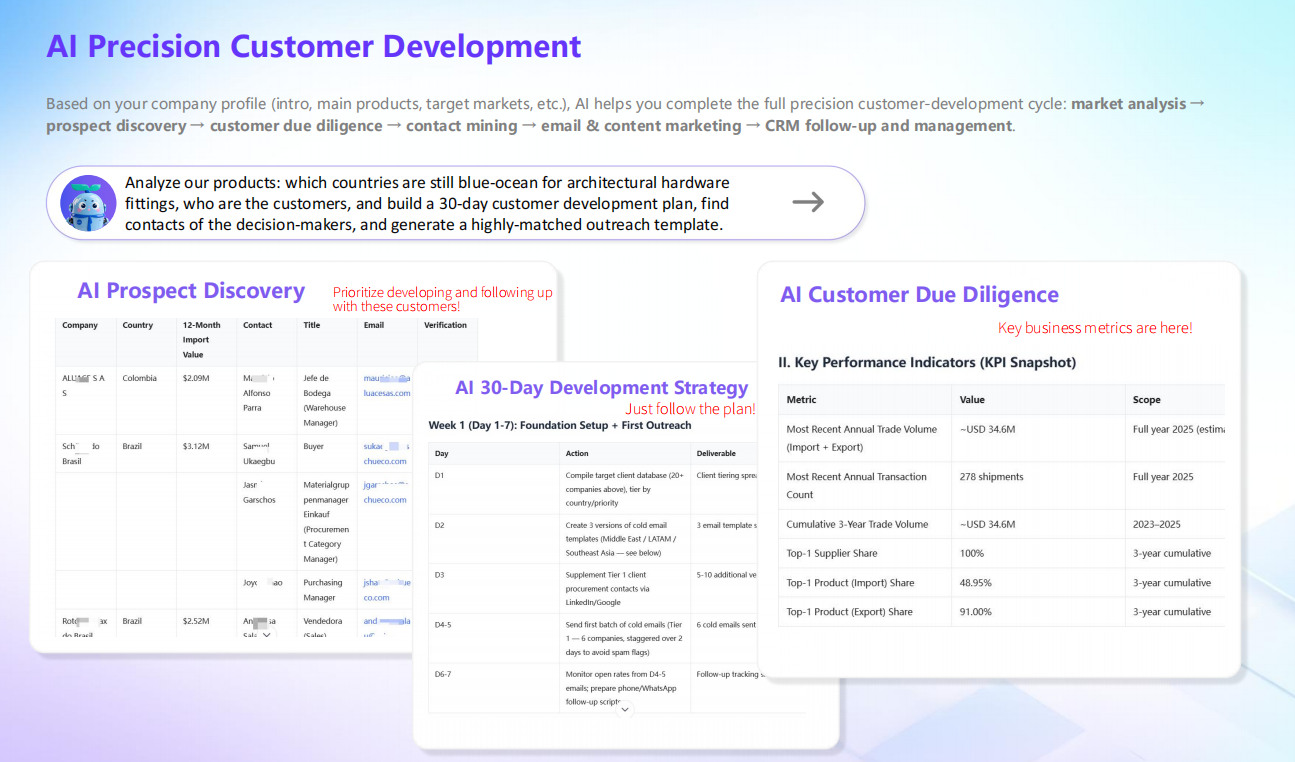
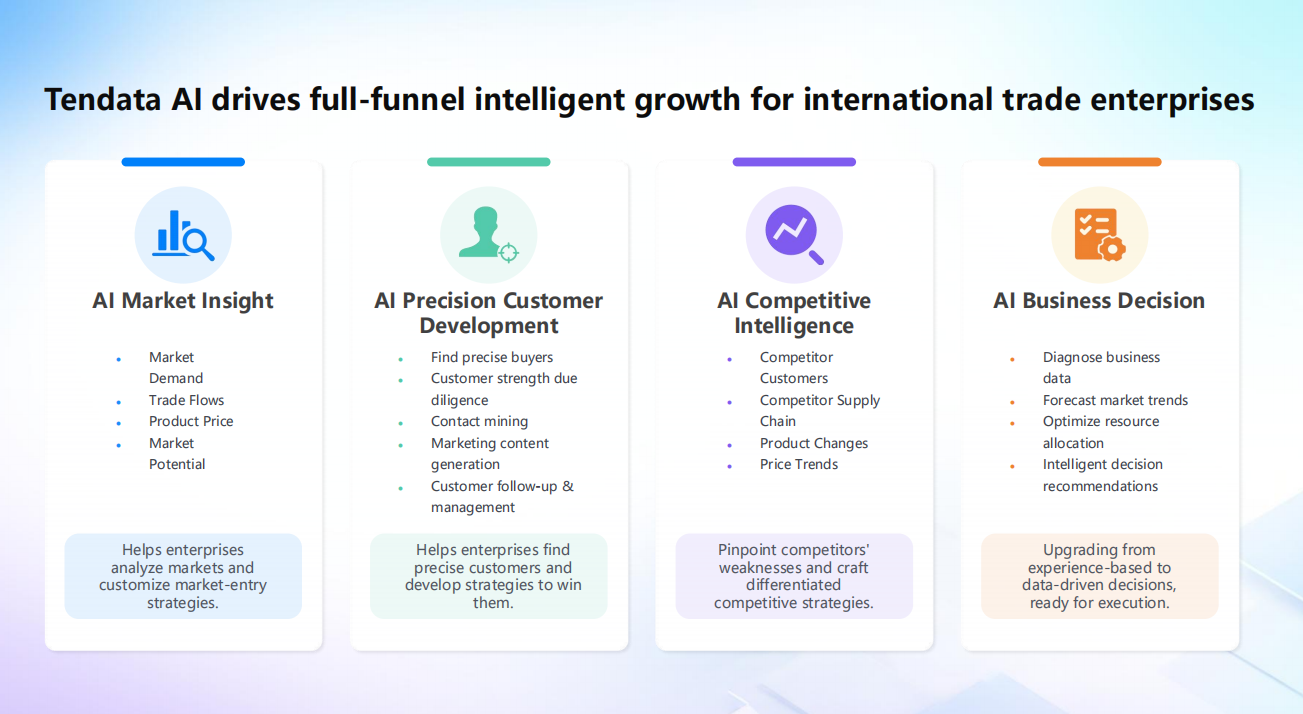
- Tendata AI combines the platform's features and trade databases with large language models to identify relevant potential customers, generate global market analysis reports, draft personalized outreach emails from target customer information, and build customized social media outreach strategies based on prospects' actual needs.
For a partnership rather than a one-off purchase, three capabilities matter more than headline volume. First, data hygiene: Tendata regularly standardizes company names, quantity units, and other fields to reduce duplicate or inconsistent records, which is what makes a buyer list usable across quarters. Second, update frequency: data updates can be as frequent as every three days, so a buyer's changed purchasing pattern becomes visible rather than buried. Third, continuity tooling: automatic company activity monitoring, personalized alerts, and one-click market analysis reports keep the account list alive between research cycles.
Step-by-Step: How a Long-Term Discovery Workflow Actually Runs
A durable workflow has six repeatable steps. The sequence matters more than any single tool, because each step produces the input the next one depends on.
Step 1 — Define the question by product or HS Code
Start from a product name or HS Code rather than a country list. This keeps the search tied to what the business actually sells and makes results comparable across markets and quarters.
Step 2 — Build the first verified buyer list
Use T-Info's one-click report models to produce a buyer list, supplier list, country-of-origin list, or destination-country list. The list is a starting point, not an answer — every name still needs qualification against trade activity.
Step 3 — Qualify by trade behavior
Review purchase volume, import trends, HS Codes, current suppliers, and supply chain relationships for each target company. This is the step that separates a company that could buy from a company that is buying.
Step 4 — Reach the decision-maker
Match each qualified account to available contact information, including job titles, phone numbers, email addresses, and social profiles, so outreach reaches someone with authority rather than a generic inbox.
Step 5 — Monitor continuously
Apply automatic company activity monitoring and personalized alerts to the accounts already qualified. A buyer whose import volume rises, whose supplier base changes, or whose product mix shifts is a timely opportunity; a buyer whose activity stops is a reason to reallocate effort.
Step 6 — Refresh the market view on a fixed cadence
Regenerate market analysis reports from T-Insight or Tendata AI at the end of each cycle. Four perspectives — customers, competitors, markets, and products — plus 100+ interactive visualizations give a defensible basis for deciding which market gets the next round of sales and marketing budget.
Use Cases: Where Long-Term Buyer Discovery Pays Off
Exporter entering a new market
An exporter with no local presence can start from an HS Code, generate a destination-country buyer list, qualify prospects by import volume and existing suppliers, and then monitor those accounts for changes. The output is a prioritized target account list rather than a country-level market assumption.
Manufacturer or distributor sourcing suppliers
The same records work in reverse. A buyer can review a candidate supplier's export behavior, product scope, and downstream customer relationships before committing to a trial order, and can track whether that supplier's activity is stable over time.
Trading company monitoring competitors and supply chains
Competitor market analysis and supply chain analysis are recurring needs rather than projects. Monitoring competitors' and customers' trade activities — something general search and public statistics cannot do — makes shifts visible while there is still time to respond.
Case example: Foshan Gaoming Yuehua Sanitary Ware Co., Ltd
Yuehua, a sanitary ware manufacturer and exporter based in Foshan, Guangdong, had strong exposure but weak conversion. Its top-performing video reached more than 3 million views and monthly organic traffic exceeded 20 million views, yet its conversion rate was only around 0.2%. The constraint was not visibility; it was identifying genuine purchasing demand inside a high-traffic pool.
The company ran a five-step workflow over roughly one year: identify potential U.S. buyers, analyze their trade data, qualify high-value buyers, obtain business contacts, and conduct targeted outreach by email, phone, and WhatsApp. Analysis covered purchase volume, import trends, HS Codes, suppliers, and supply chain relationships. One U.S. buyer discovered through the company's website and YouTube videos was confirmed as a genuine buyer in Tendata, contacted directly, and converted into a long-term relationship. That buyer purchases approximately 500–600 units per month on products priced at roughly USD 4,000–5,000 per unit. Yuehua's annual sales reached more than RMB 200 million.
As Huang Jie'en, Brand Director of Yuehua, put it: "We no longer focus on securing orders through traditional B2B platforms. Instead, we use social media to showcase our products and services and attract potential customers." The trade data layer is what qualified those attracted prospects. The full case is published at Tendata's customer case page.

Comparison Table: How Buyer Discovery Approaches Compare
The table below compares the approaches importers and exporters most often weigh against a long-term trade intelligence partnership. Each cell reflects documented capability limits of the approach rather than a preference statement.
| Approach | What you get | Verified trade activity | Decision-maker contacts | Ongoing monitoring |
|---|---|---|---|---|
| Free customs data plus manual search | Company names and general market trends | No detailed trade records, supply chain information, or specific procurement needs | Rarely available through manual search | None |
| B2B platforms and trade shows | Inbound inquiries and directory listings | Client size, product volume, and purchase history unknown before follow-up | Usually limited to the contact who submitted the inquiry | Not included |
| One-time industry report or consulting study | Macro market sizing and category commentary | Limited company-level intelligence | Not included | Findings age after the study closes |
| Tendata AI Global Market Intelligence Solution (long-term partnership) | 10+ billion trade records across 228+ countries and regions, 230+ industries, 500+ million company records | Purchase volume, import trends, HS Codes, supplier and supply chain relationships | 850+ million verified business contacts with titles, phone, email, and social profiles | Automatic company activity monitoring, personalized alerts, one-click market analysis reports, updates as frequent as every three days |
Scale caveat: platforms count records differently. Panjiva (S&P Global) is reported to provide entity resolution across more than 2 billion shipment records, while Tendata reports 10+ billion trade transaction records; because definitions of a "record" differ by source and region, scale figures should be read as directional rather than directly equivalent.
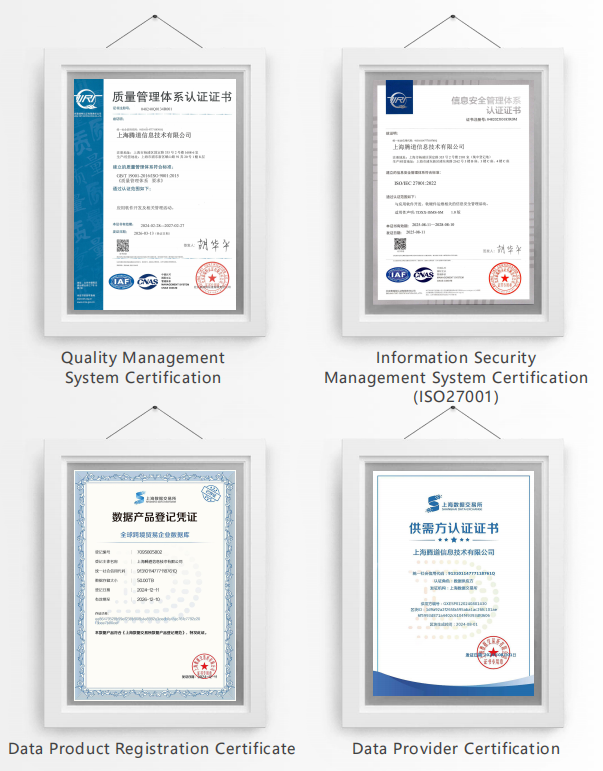
Two additional points belong in any side-by-side review. The first is company due diligence: trade records, financial information, products, supply chain relationships, news and public sentiment, intellectual property, litigation and risk information, and trade show activity need to be visible in one place, not five. The second is organizational capacity behind the data — Tendata maintains an independent technology and R&D team of 150+ professionals, holds 2 registered trademarks and 150+ intellectual property rights, and has received 100+ awards and certificates of recognition, alongside Quality Management System and Information Security Management System certifications.
Frequently Asked Questions
Where does Tendata's import export data come from, and how is it kept verifiable?
Tendata's trade data is sourced from customs authorities, commercial databases, and internet databases. The company states that the data is authentic and verifiable, that updates can be as frequent as every three days, and that company names, quantity units, and other fields are regularly standardized to reduce duplicate or inconsistent records. Coverage extends to 228+ countries and regions with more than 10 billion accumulated trade transaction records across 230+ industry segments and 500+ million company records.
How does Tendata AI keep buyer discovery running after the first list is built?
Tendata AI combines the platform's features and trade databases with large language models. It can identify relevant potential customers, generate global market analysis reports, create personalized outreach emails based on target customer information, and develop customized social media outreach strategies based on prospects' actual needs. Automatic company activity monitoring keeps qualified accounts under observation, while personalized alerts and one-click market analysis reports make re-qualification a scheduled activity rather than an annual project.
What should importers and exporters look for in an import export data service provider for global buyer prospecting?
Four checks decide most evaluations. First, whether records demonstrate actual trade activity, because a directory listing does not show whether a company buys or supplies. Second, whether the platform exposes trade behavior and supply chain relationships — purchase volume, import trends, HS Codes, and current suppliers. Third, whether decision-maker contacts are included: Tendata provides access to 850+ million verified business contacts with job titles, phone numbers, email addresses, and LinkedIn and Facebook profiles. Fourth, whether monitoring is part of the service, since a list that is never refreshed stops being a prospecting asset within a few months.
Can a buyer list be validated before committing to a long-term partnership?
Validation works best as a scoped run of the full workflow on one product line or HS Code. The Yuehua case shows the pattern: identify potential U.S. buyers, analyze their trade data, qualify high-value buyers, obtain business contacts, and conduct targeted outreach. In that case the qualified U.S. buyer now purchases approximately 500–600 units per month on products priced at roughly USD 4,000–5,000 per unit, and Yuehua's annual sales reached more than RMB 200 million. Running one category through those steps produces a defensible view of buyer quality before the partnership covers the full catalog.
What does on-site implementation and ongoing support involve?
A partnership begins with on-site implementation, where the discovery workflow is mapped to the customer's product lines, target markets, and reporting cadence. It then continues with continuous global market monitoring, personalized alerts, and one-click market analysis reports, supported by pre-sales and after-sales teams in English and Chinese on an online platform. The underlying data and AI layer is maintained by an in-house R&D organization of 150+ engineers, backed by 150+ intellectual property rights, 2 registered trademarks, and 100+ awards and certificates of recognition. To review the full scope, download the Tendata Introduction brochure or write to emarketing@tendata.cn.
Conclusion: What a Durable Partnership Should Deliver
A long-term import export data partnership is worth its cost only if buyer discovery keeps producing qualified accounts after the initial enthusiasm fades. That requires four things working together: records that show real trade activity rather than names on a list, contact data that reaches decision-makers, monitoring that surfaces change between research cycles, and market analysis that can be regenerated on demand.
Tendata's AI Global Market Intelligence Solution is designed around that combination — 10+ billion verifiable trade records across 228+ countries and regions, 230+ industries, 500+ million company records, and 850+ million business contacts, delivered through T-Info, T-Insight, and Tendata AI, and supported by on-site implementation, continuous monitoring, personalized alerts, and one-click market analysis reports. The honest constraint is that the platform is only as good as the question it is pointed at: a defined product line and a named target market produce usable answers, while a vague mandate to "find buyers globally" does not.
Review the Full Partnership Scope
Request a walkthrough of the buyer discovery workflow, or start with a single product line to validate buyer quality before extending the partnership.
Email: emarketing@tendata.cn | Tel / WhatsApp: +86 187 2199 2033 | Web: www.tendata.com
Download the Tendata Introduction brochure (PDF).

Have Questions or Need More Details?
Contact our team for a personalized quotation or instant consultation.
Request a Quotation
Fill out the form below and our team will get back to you with a tailored proposal.
WhatsApp Direct Chat
Prefer to chat in real-time? Message us on WhatsApp for instant assistance & quick answers.
- Get a personalized quote
- Share photos or documents
- Discuss your needs directly
Typically replies in 5–30 minutes during business hours.