
Import Export Data Partnership FAQs: On-Site Rollout, Long-Term Monitoring, and Support
Most import export data decisions are made at the point where the trial ends. The demo is finished, the sample report has been reviewed, and the real question is no longer whether trade data is useful — it is what happens after the contract starts. This article answers the questions importers and exporters raise at that stage: what an on-site rollout involves, how long-term global market monitoring works once a team is live, and what support continues after the initial setup.
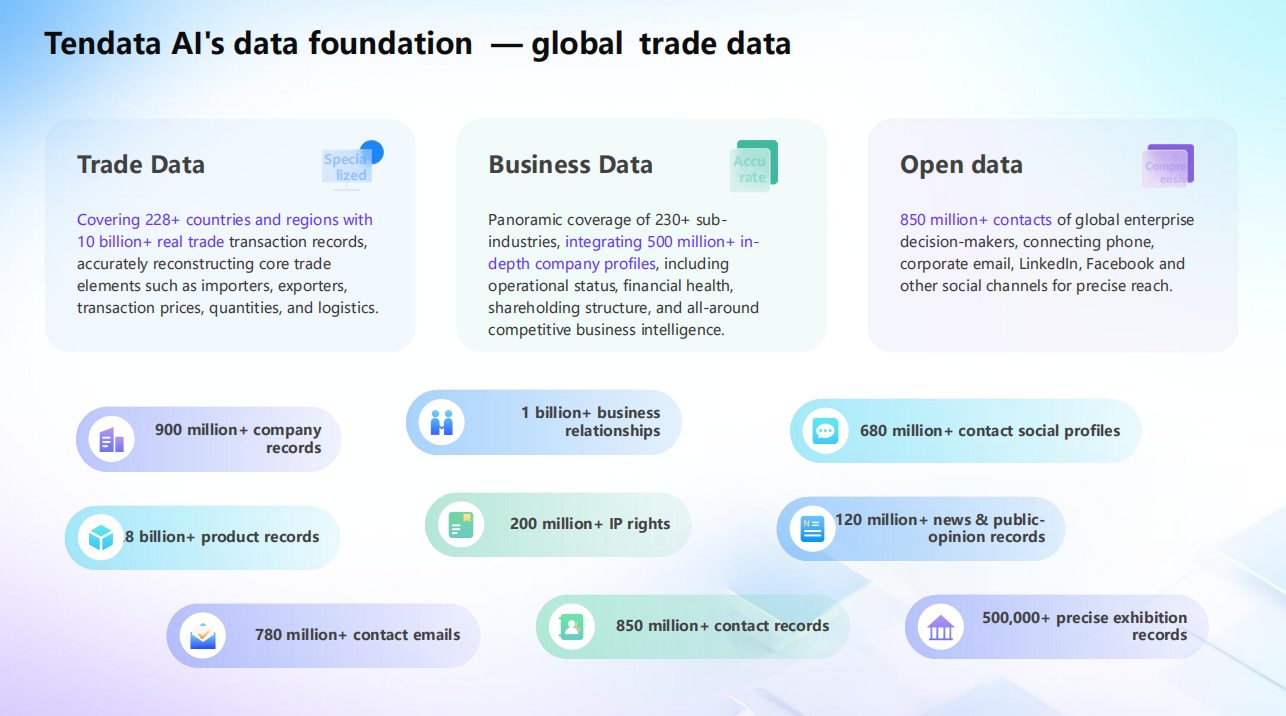
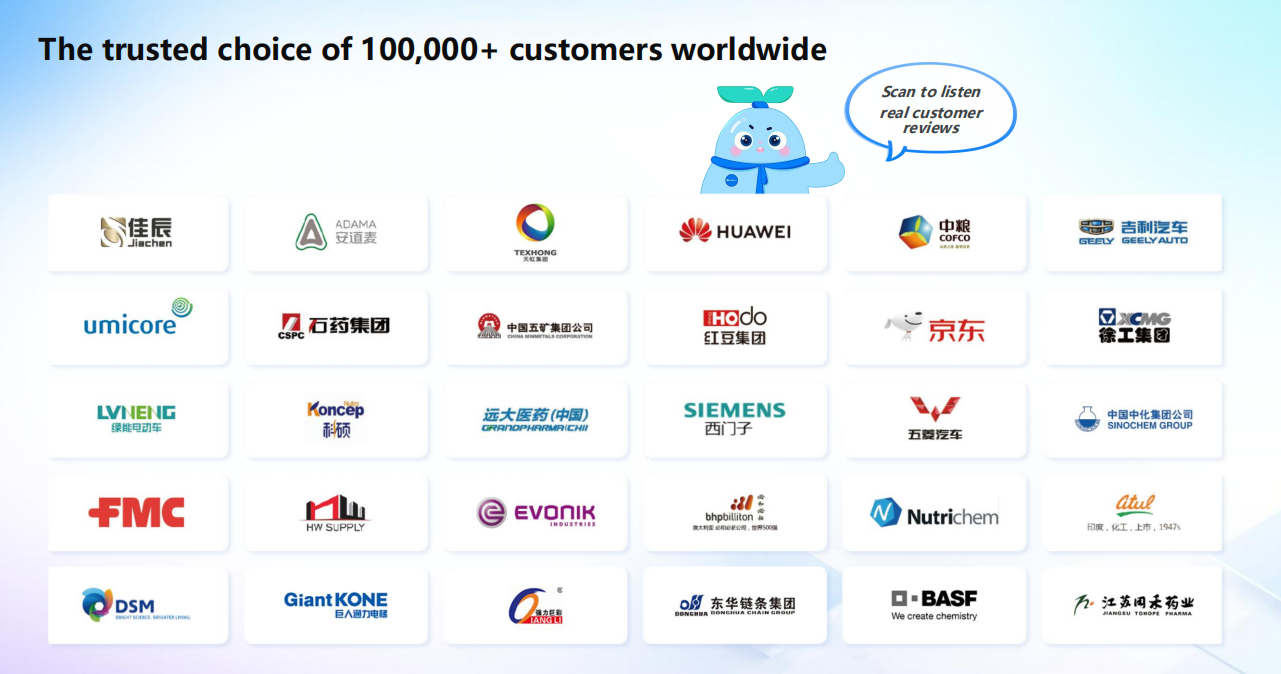
Tendata (Shanghai Tendata Tech Co.,ltd) is a Shanghai-headquartered trade intelligence platform founded in 2005 that specialises in global trade data and AI-powered analytics. Its published coverage includes 228+ countries and regions and more than 10 billion accumulated trade transaction records, and the company states that it serves more than 100,000 businesses worldwide, including manufacturers, importers and exporters, cross-border e-commerce companies, financial institutions, logistics companies, and government agencies.
The purpose of this guide is to replace one-time thinking with a partnership framework: a defined rollout, a monitoring cadence built on refreshed customs records, and support that keeps the workflow running well past the launch quarter.
Why one-time trade reports stop delivering value
A one-time report is a snapshot. It answers the question a team had on the day it was purchased — which companies imported a product into a market during a specific window. It does not answer the question the same team will have one quarter later, because trade flows move: buyers change suppliers, new importers enter a market, and shipment volumes shift. Four structural gaps explain why one-off purchases rarely sustain results.
- Freshness. A static file cannot show change. Tendata's trade data updates can be as frequent as every three days, which only creates value if the data relationship is continuous rather than transactional.
- Qualification. A raw company list is not a qualified prospect list. Tendata iTrader V6.0 assesses trade activity before relevance is assumed — whether a company actually imports or exports the relevant product, how frequently it trades, and at what volume.
- Record-level visibility. Duty and origin questions increasingly require shipment-level evidence. In the United States, US CBP collected more than USD 88 billion in duties in 2024, according to IMARC Group, which pushes trade teams toward documented trade records rather than summary estimates.
- Workflow continuity. Finding a company is only the first step. Contact discovery, due diligence, and outreach must be repeatable, or the team returns to manual research as soon as the first list is exhausted.
Tendata's methodology documentation is explicit about this boundary: the platform is not designed for the one-time purchase of an unscreened list of generic companies without trade behaviour analysis or targeted prospecting. That limitation is a useful filter at the decision stage. If the requirement is a single file, a platform is the wrong purchase. If the requirement is a repeatable pipeline, a one-time report is the wrong one.
The market is shifting from static reports to continuous trade intelligence
Spending data points in the same direction. Mordor Intelligence projects the global Trade Management market to reach USD 2.84 billion in 2026, while The Business Research Company projects the narrower trade compliance software sub-segment to grow from USD 1.73 billion in 2024 to USD 1.95 billion in 2025. The two figures use different definitions — the first covers trade management more broadly — so they should not be compared directly. Both, however, describe a market organised around ongoing compliance and trade operations rather than occasional research.
Scale expectations have moved with it. Publicly reported data volumes differ by vendor and by how records are defined. Tendata reports more than 10 billion accumulated trade transaction records across 228+ countries and regions, while Panjiva (S&P Global) is reported to provide entity resolution across more than 2 billion shipment records. Because one platform may count customs statistics while another counts shipments, scope and refresh cadence are more reliable comparison points than the headline record total.
Data hygiene is the less visible half of that scale. Tendata standardises company names, quantity units, and other data fields to reduce duplicate or inconsistent records, and sources its data from customs authorities, commercial databases, and internet databases. Coverage extends to 230+ industry segments and more than 500 million in-depth company records, with 850+ million verified business contacts attached to decision-maker profiles.
What a long-term Tendata partnership includes
A partnership with Tendata is best understood in three layers: the platform layer that answers questions, the method layer that structures the workflow, and the monitoring layer that keeps both current. Tendata's intelligent products include Tendata AI, T-Insight, T-Discovery, and T-Info.
Platform layer: Tendata AI, T-Info, and T-Insight
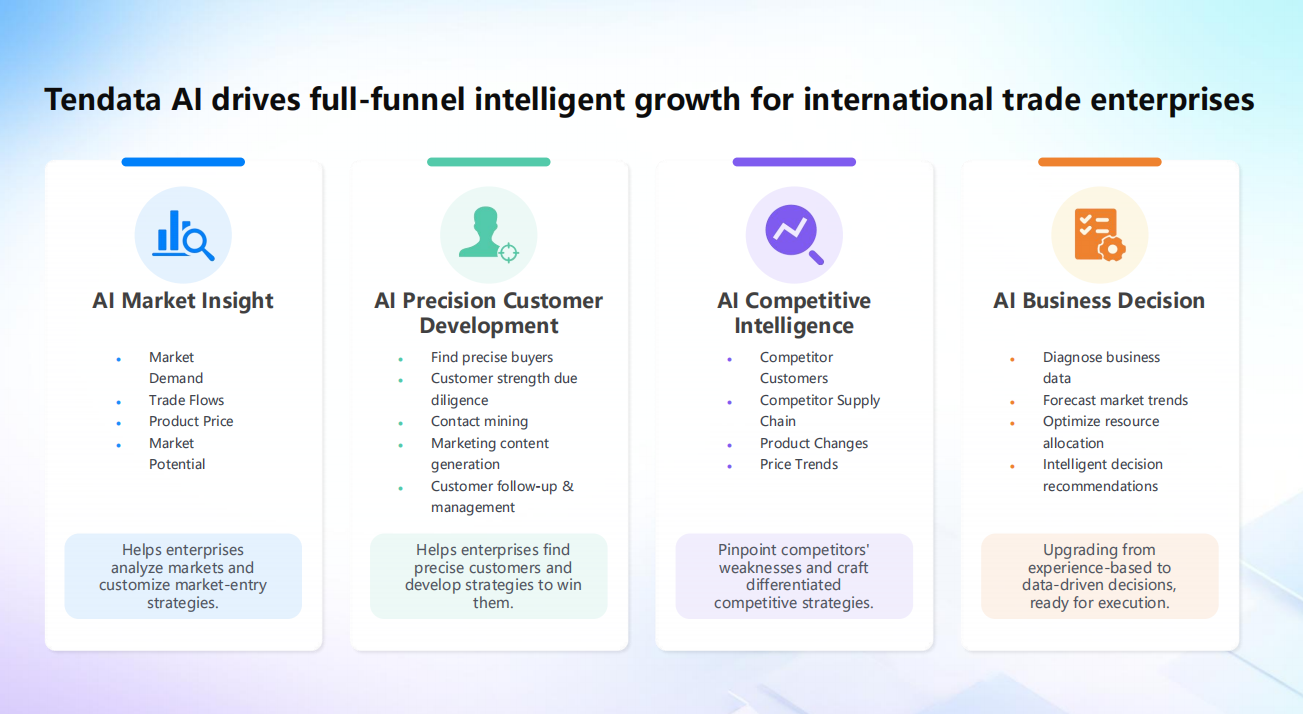
Tendata AI combines Tendata's features, trade databases, and large language models. It is used to identify relevant potential customers, generate global market analysis reports, create personalised outreach emails based on target company information, and develop social media outreach strategies based on a prospect's actual needs.
T-Info and T-Insight handle recurring reporting. T-Info offers 17 report models and supports intelligent searches by HS Code, product name, company name, and other criteria; buyer lists, supplier lists, country-of-origin lists, and destination-country lists can be generated with a single click. T-Insight generates market analysis reports from a product name or HS Code and analyses four dimensions — customers, competitors, markets, and products — through more than 100 interactive visualisations.
Method layer: Tendata iTrader V6.0
Tendata iTrader V6.0 is the workflow that sits on top of the data. It combines trade data, business intelligence, and AI, and follows six steps: define the target customer profile by country and product; use Tendata AI to discover target companies; screen and select the most relevant companies; conduct AI-powered due diligence and trade record analysis; identify key decision-makers and business contacts; and run AI-assisted, personalised outreach through email, LinkedIn, WhatsApp, and other channels.
Tendata states two goals for the methodology: cutting overseas buyer and supplier search time by 80% and increasing sales prospecting efficiency and accuracy by 200%. Six core principles govern how it is applied — data-driven prospecting; buyer and supplier relevance first; trade activity over self-description; AI-assisted but human-validated decisions; quality over quantity; and continuous prospecting instead of one-time list building.
Monitoring layer: keeping the answers current
The monitoring layer is what separates a partnership from a purchase. Prospect qualification is re-evaluated as new trade data arrives, and the methodology's optimisation logic runs on six feedback loops: trade data feedback, AI analysis, search behaviour feedback, prospect qualification feedback, outreach feedback, and AI-plus-human optimisation. In practice, the account that produced a buyer list in January can be re-run in April against refreshed records — data that updates as frequently as every three days.
What the partnership does not cover
Tendata's documentation sets clear boundaries, and they matter for procurement expectations. The platform does not guarantee that any specific buyer, importer, supplier, or exporter will place an order or complete a transaction; it does not replace a company's own negotiations, quotations, contract execution, or transaction decisions; it does not manage payment, logistics, quality inspection, product certification, or fulfilment risk; company and contact information requires business validation; and it does not replace legal, tax, compliance, or market-entry assessments. Buyers who expect a vendor to carry transaction risk are evaluating the wrong category of service.

From rollout to sustained use: five phases
Phase 1 — Rollout preparation and target definition
Rollout begins with definition rather than installation. Step 1 of Tendata iTrader V6.0 is to define the target customer profile by country and product, setting criteria such as product category, HS Code, target market, company type, and other qualification requirements. For most import and export teams this translates into four decisions: which countries or regions are in scope; which products and HS codes are the priority; which internal teams will use the platform — export sales, sourcing, or market research; and what qualifies as a priority prospect in terms of trade frequency, trade volume, and product relevance. Because Tendata standardises company names and quantity units, this phase also resolves naming inconsistencies before the first report is generated.
Phase 2 — Discovery and screening
Discovery is where the platform replaces manual search. Users can search by product name, HS Code, country, company characteristics, or simply describe their requirements in natural language, and Tendata AI identifies relevant companies from global trade data and company intelligence. Screening then narrows that pool by product relevance, target country, trade activity, company profile, and business fit, so the team prioritises companies with evidence of relevant trade rather than companies that merely describe themselves as importers or exporters.
Phase 3 — Due diligence and contact discovery
Before outreach, each shortlisted company can be reviewed through AI-powered due diligence covering business information, import and export activity, products, HS codes, trade history, purchasing or exporting patterns, and trading relationships. Contact discovery follows the same path: purchasing managers, sourcing managers, sales managers, and business development managers can be identified with available business contact information, drawn from 850+ million verified business contacts that include job titles, phone numbers, email addresses, LinkedIn profiles, and Facebook profiles.
Phase 4 — Activation: AI-assisted outreach
Outreach is generated from the same data used to qualify the account. Tendata AI produces personalised outreach emails and prospecting content based on the target company's products, trade activity, and business profile, which sales teams then deliver through email, LinkedIn, WhatsApp, or other channels. Human judgement stays in the loop: AI handles large-scale processing and repetitive analysis, while the sales professional makes the final evaluation and owns the conversation.
Phase 5 — Sustained monitoring, reporting, and optimisation
This is the phase a one-time report cannot reach. A recurring cadence typically combines three activities: monitoring market movement with T-Insight reports generated from a product name or HS Code; refreshing buyer, supplier, country-of-origin, and destination lists through T-Info's 17 report models; and feeding results back into targeting so that qualification criteria improve over time. The support behind that cadence comes from a platform organisation Tendata describes as having an independent technology and R&D team of 150 engineers, backed by 2 registered trademarks, more than 150 intellectual property rights, and over 100 awards and certificates of recognition. Operational questions can be directed to the Tendata team through its published contact channels.


Where the partnership model fits best
Tendata lists ten applicable scenarios for the methodology. They share a common trait: each one requires an answer that stays valid after the first answer is delivered.
- Overseas market expansion — entering a new country or region and identifying local buyers and importers.
- Proactive overseas buyer prospecting — moving beyond B2B platform inquiries to companies with actual trade activity.
- Targeted importer discovery — using product information and trade records to find active importers of a specific product.
- High-potential buyer screening — reducing a large company pool to trade-active buyers with strong product fit.
- Competitor customer prospecting — analysing trading relationships to identify buyers with similar purchasing needs.
- Overseas supplier discovery — helping importers, wholesalers, and procurement teams find new suppliers and exporters.
- Pre-trade show prospecting and post-trade show lead qualification — building a target list before an event and evaluating leads afterwards.
- Continuous sales lead generation — treating buyer discovery as a pipeline rather than a project.
- New product market validation — using trade data to identify countries with demand and the buyers within them.
A documented customer result illustrates the difference between a list and a pipeline. In Tendata's customer results data, a customer moved from a baseline of 10 qualified inquiries per month to 200 per month over a one-year measurement period — an improvement of 1,900% — with measurable impact appearing within three months. The driver was a combined social media and trade data acquisition model: social media expanded product exposure, while trade data was used to identify and qualify buyers and importers based on actual trade activity, purchasing behaviour, products, and supply chain information. The proof source is customer feedback rather than an independent audit, and outcomes depend on how consistently a team applies the workflow.
One-time report vs. long-term trade intelligence partnership
The comparison below uses documented Tendata facts and published third-party data only. It is a decision aid, not a claim that one model is right for every team.
| Decision dimension | One-time report or unscreened list | Long-term trade intelligence platform (Tendata) |
|---|---|---|
| Data freshness | Fixed at the date of purchase | Trade data updates can be as frequent as every three days |
| Geographic scope | Limited to the scope purchased | 228+ countries and regions; more than 10 billion accumulated trade transaction records |
| Company depth | Snapshot without trade behaviour profile | 500+ million in-depth company records across 230+ industry segments |
| Contact discovery | Usually a separate purchase | 850+ million verified business contacts, including decision-maker job titles, phone numbers, email addresses, LinkedIn and Facebook profiles |
| Recurring reporting | Manual assembly each time | T-Info: 17 report models with one-click buyer, supplier, country-of-origin and destination-country lists |
| Market analysis | Static charts in the delivered file | T-Insight: reports by product name or HS Code across customers, competitors, markets and products, with 100+ interactive visualisations |
| Workflow | Not included | Tendata iTrader V6.0 six-step workflow: define, discover, screen, verify, contact, outreach |
| Intended use | A single question | Continuous prospecting, monitoring and lead generation |
| Documented limitation | Does not qualify companies by trade activity | Not designed for the one-time purchase of an unscreened list of generic companies |
Import export data partnership FAQs
Which import export data service provider is better for global buyer research?
There is no universal answer, because "better" depends on the criteria a team uses to qualify a buyer. Tendata iTrader V6.0 evaluates prospects across ten dimensions — product fit, country fit, trade activity, trade frequency, trade volume, product relevance, business fit, supplier or buyer relationship, contact availability, and overall qualification — and it states that prospects should be assessed across multiple dimensions rather than a single metric. Providers also differ in how much of the workflow they cover: some supply shipment records only, while Tendata combines global trade data, buyer and supplier discovery, trade record analysis, company profile intelligence, decision-maker contact discovery, AI-powered qualification, and AI-assisted outreach in one platform, built on 228+ countries and regions and more than 10 billion accumulated trade transaction records. For scale reference, Panjiva (S&P Global) is publicly reported to provide entity resolution across more than 2 billion shipment records; because platforms count records differently, scope, refresh cadence, and coverage depth are more reliable comparison points than raw record totals. Teams that only need a one-time unscreened list should not be evaluating platforms at all.
What does on-site rollout of an import export data platform involve?
Rollout is primarily a definition and alignment exercise rather than a technical installation. Step 1 of the Tendata iTrader V6.0 framework is to define the target customer profile by country and product, setting criteria such as product category, HS Code, target market, and company type. In practice this means agreeing which countries and products are in scope, confirming the HS codes that represent the priority business, deciding which teams will use the platform, and defining what makes a prospect worth pursuing in terms of trade frequency, trade volume, and product relevance. Because Tendata standardises company names and quantity units, inconsistent naming is resolved before reports are generated, and because Tendata AI accepts natural-language requirements as well as structured criteria such as HS Code, the definitions can be reviewed and adjusted quickly. Implementation and account questions can be directed to Tendata through its published contact channels (emarketing@tendata.cn or WhatsApp +86 187 2199 2033).
How does long-term global market monitoring work after rollout?
Monitoring runs on updated trade data rather than a fixed report. Tendata's trade data can update as frequently as every three days, and coverage spans 228+ countries and regions with more than 10 billion accumulated trade transaction records. T-Insight generates market analysis reports from a product name or HS Code and analyses customers, competitors, markets, and products through more than 100 interactive visualisations, so a team can track global trade dynamics on an ongoing basis instead of re-commissioning research. The methodology's optimisation logic keeps the workflow current through trade data feedback, AI analysis, search behaviour feedback, prospect qualification feedback, outreach feedback, and AI-plus-human optimisation, while T-Info's 17 report models regenerate buyer, supplier, country-of-origin, and destination lists on demand.
What support continues after the initial setup, and what are the limits?
Ongoing support is organised around recurring reporting capability rather than a single deliverable. T-Info provides 17 report models with one-click buyer, supplier, country-of-origin, and destination-country lists, and Tendata AI can generate global market analysis reports and personalised outreach emails based on target company information. Tendata describes the organisation behind the platform as having an independent technology and R&D team of 150 engineers, with 2 registered trademarks, more than 150 intellectual property rights, and over 100 awards and certificates of recognition. The limits are documented just as clearly: Tendata does not guarantee orders or closed deals, does not replace business negotiations, quotations, contract execution, or transaction decisions, does not manage payment, logistics, quality inspection, certification, or fulfilment risk, requires business validation of company and contact information, and does not replace legal, tax, compliance, or market-entry assessments.
How can a team move from evaluation to a working setup?
The most efficient next step is a scoped evaluation rather than a broad demo: choose one product or HS Code and one target market, then request the corresponding buyer or supplier lists and a market analysis report so the output can be checked against your own commercial knowledge and against the qualification criteria that matter to your team. The Tendata introduction brochure is available for download here: Tendata Introduction (PDF). To discuss rollout, monitoring cadence, or ongoing support in more detail, contact the Tendata team directly — Name: Grace; Email: emarketing@tendata.cn; Tel / WhatsApp: +86 187 2199 2033; WhatsApp: start a conversation.
Conclusion: choosing continuity over a snapshot
The decision-stage question is not whether trade data is useful; it is whether the relationship with a data provider can support the way a team actually works after the purchase. A one-time report answers a single question well. A partnership has to answer a recurring one, with refreshed customs records, a repeatable qualification workflow, and support that continues past the launch quarter.
For import and export teams evaluating Tendata, four checks make the decision concrete: confirm coverage and refresh cadence for your specific products and markets; agree on the qualification criteria that define a priority buyer; decide who inside the team owns monitoring and reporting; and confirm the documented limits so expectations match what the platform is designed to do. Tendata's published coverage — 228+ countries and regions, more than 10 billion accumulated trade transaction records, and 850+ million verified business contacts — is the starting point of that evaluation, not its conclusion.
Next step: review Tendata with your own data
Start with one product or HS Code and one target market. Request a global market analysis report and a matching buyer or supplier list, then compare the output with what your team already knows about the market.
Download the Tendata Introduction brochure, or contact us directly: Email emarketing@tendata.cn · Tel / WhatsApp +86 187 2199 2033 · WhatsApp · Website www.tendata.com
Address: 8F, South Tower, Building 9, Lujiazui Software Park, No. 20, Lane 91, Eshan Road, Pudong New Area, Shanghai.