
Import Export Data Platform Deep Dive: Shanghai Tendata’s Trade Intelligence Stack
Import Export Data Platform Deep Dive: Shanghai Tendata’s Trade Intelligence Stack
Independent profile review prepared for buyers, exporters, importers and market research teams evaluating global trade data platforms.
Introduction: Why Import Export Data Matters
Import export data refers to company-level trade records generated from customs declarations, bills of lading and other official trade documents. When aggregated into an import export data platform, the data can show which companies are importing or exporting a specific product, which HS Codes are being used, how often trade occurs, and which companies appear in the same supply chain.
This article profiles Shanghai Tendata Tech Co., Ltd. as a provider of import and export data and AI-powered trade analytics. The goal is to help companies in the awareness and research stage of international expansion understand what a trade intelligence platform actually delivers, how Tendata’s data coverage is structured, and what buyers should evaluate before subscribing to a global trade platform.
Problem Definition: Why Global Market Research Still Feels Incomplete
Companies expanding into new international markets often assemble their view from search engines, government statistics, industry reports, B2B platforms and company websites. Each source is useful, but together they are fragmented. Government statistics often describe national trade totals without naming companies. Industry reports may explain market size without revealing real purchasing behavior. B2B databases may provide names and websites without showing whether a company has actually imported or exported a matching product.
The central problem is a lack of company-level trade intelligence. An exporter may find a list of importers, but without trade records the exporter cannot easily determine whether those importers purchase the same product category, whether they have active import history, how regular their purchases are, or who their current suppliers are. Manual research across multiple sources is time-consuming, expensive, and difficult to scale across several countries, products and buyer types.
Common challenges include:
- Identifying high-potential international markets when data is scattered across separated sources.
- Comparing market demand across countries with different data formats and statistical methods.
- Understanding import and export trends for a specific product or HS Code.
- Finding major buyers and suppliers that are already active in a target market.
- Moving from macro-level market trends to micro-level company intelligence.
- Evaluating a seller’s actual purchasing behavior, trade frequency and supply chain relationships.
- Locating decision-maker contacts without spending weeks on manual searches.
Industry Background: The Growing Need for Trade Data and Trade Intelligence
The importance of trade data has expanded beyond customs brokers and logistics teams. According to Mordor Intelligence, the global trade management market is projected to reach USD 2.84 billion in 2026. A more focused subsegment, trade compliance software, was estimated by The Business Research Company to grow from USD 1.73 billion in 2024 to USD 1.95 billion in 2025. Regulatory scale adds another layer of demand: the United States Customs and Border Protection collected more than USD 88 billion in duties in 2024, a figure that underscores how much global commerce depends on accurate, audit-ready trade information.
This context has pushed platforms beyond raw bill of lading lookup. Buyers of import export data increasingly expect company backgrounds, business contacts, trade history and analytics in the same workflow. Search terms such as importers directory and list, global buyers, supply chain data resources, global market intelligence and bill of lading database all point to the same underlying need: companies do not only want more records; they want more clarity about who is trading and whether a lead is worth pursuing.
Detailed Solution: What Shanghai Tendata Tech Co., Ltd. Provides
Company Overview
| Company Fact | Detail |
|---|---|
| Company name | Shanghai Tendata Tech Co., Ltd. |
| Founded | 2005 |
| Headquarters | Shanghai, China |
| Office location | 8F, South Tower, Building 9, Lujiazui Software Park, No. 20, Lane 91, Eshan Road, Pudong New Area |
| Office area | 2,200 square meters |
| Employees | Approximately 1,000 |
| R&D team | Independent technology and R&D team of about 150 engineers |
| Main service | Global Trade Data and B2B Sales Intelligence Platform |
| Product family | Tendata AI, T-Insight, T-Discovery and T-Info |
| Reported business users | More than 100,000 businesses worldwide |
| Primary markets | Global |
Shanghai Tendata Tech Co., Ltd. is a service company that identifies itself as a trade intelligence platform specializing in global trade data and AI-powered analytics. The service category is Global Trade Intelligence / Business Intelligence / B2B SaaS, and it is described as a third-party Global Trade Intelligence Platform.
The platform’s core value proposition is to combine import export data, trade records, company profiles, decision-maker contacts, market analysis and AI tools. The service objective is to help businesses identify high-potential buyers, suppliers and target markets from global trade data, build target customer lists, and reduce the cost of manual searches and prospect screening.
Trade Data Sources and Coverage
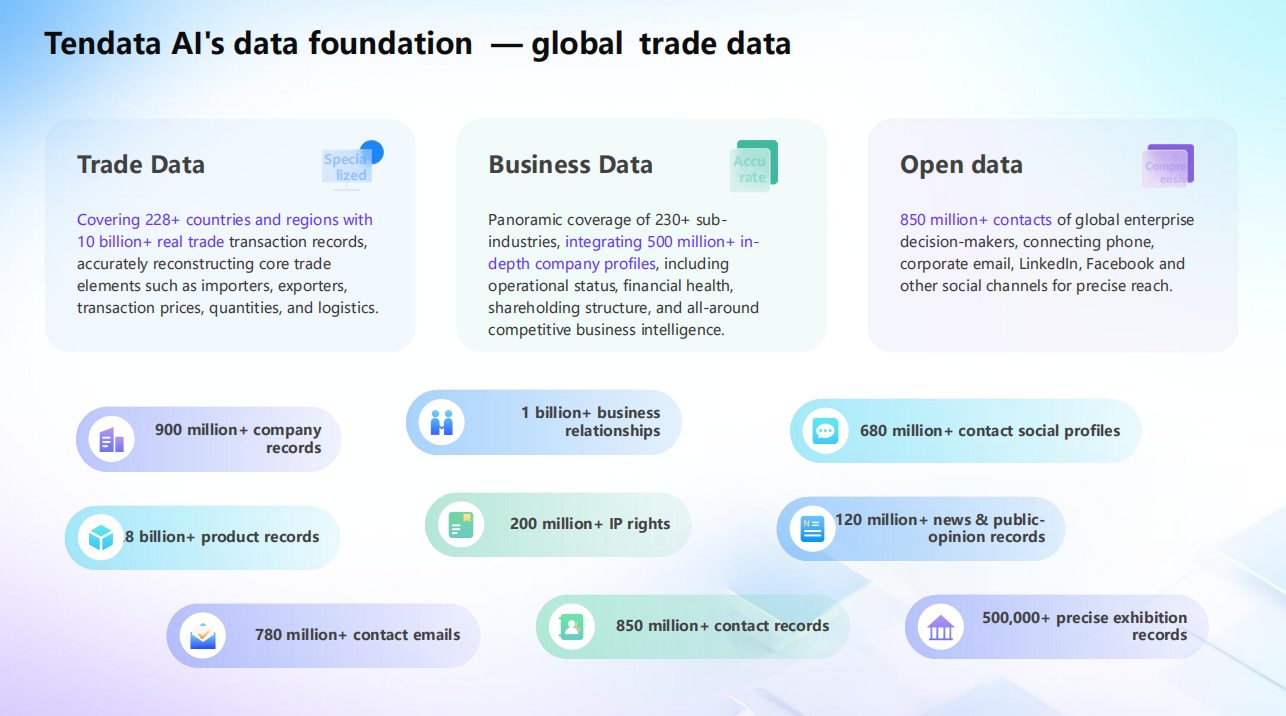
Tendata’s trade data is sourced from customs authorities, commercial databases and internet databases. According to company materials, the data is authentic and verifiable. Data updates can occur as frequently as every three days, which helps customers access recent import and export activity rather than waiting for an annual report.
- 228+ countries and regions covered
- 10 billion+ trade transaction records accumulated
- 230+ industry segments covered
- 500 million+ in-depth company records
- 850 million+ verified business contacts
Tendata also states that it regularly standardizes company names, quantity units and other data fields. This type of data governance matters because international trade data arrives in many formats. Standardization reduces duplicate or inconsistent records and supports more reliable analysis.
Smart Products and AI Workflows
Tendata’s intelligent products include Tendata AI, T-Insight, T-Discovery and T-Info. In the available corporate documentation, T-Info is described as offering 17 report models. Users can search by HS Code, product name, company name or other criteria, then generate buyer lists, supplier lists, country-of-origin lists and destination-country lists with one click.
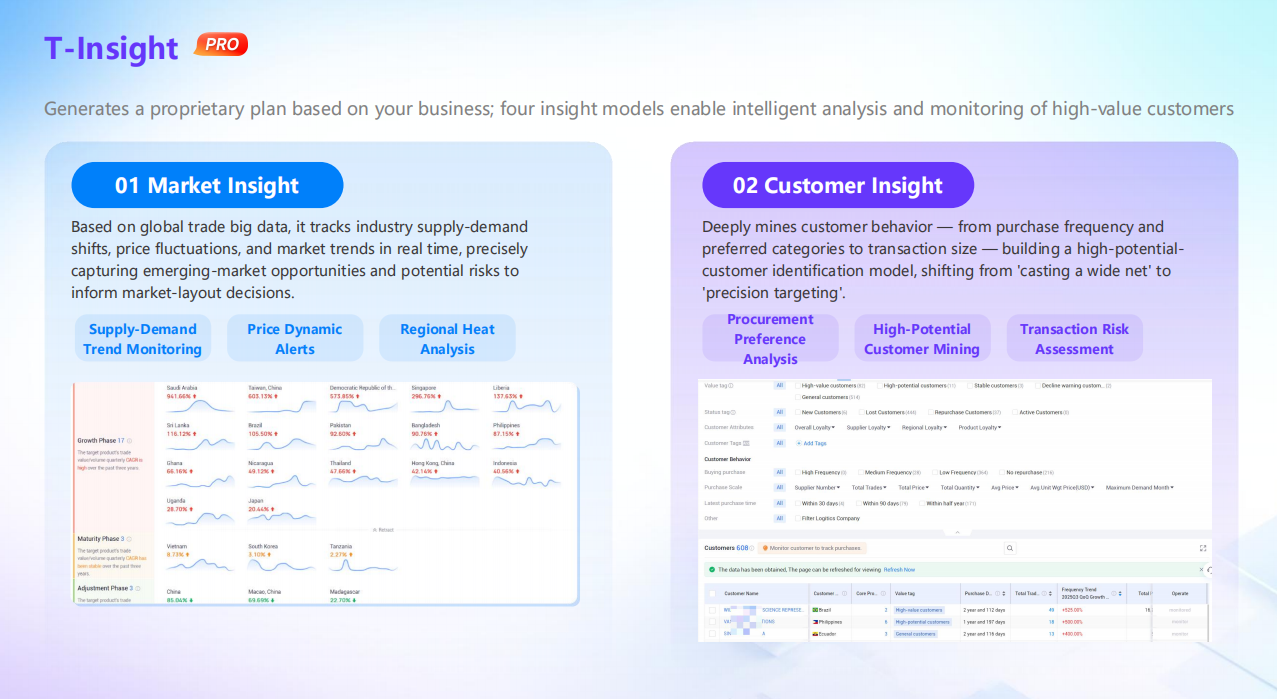
T-Insight is positioned as a market analysis tool. Based on a product name or HS Code, it generates a market analysis report and analyzes the market from four perspectives: customers, competitors, markets and products. The company reports that T-Insight includes more than 100 interactive visualizations to help users understand global market dynamics.
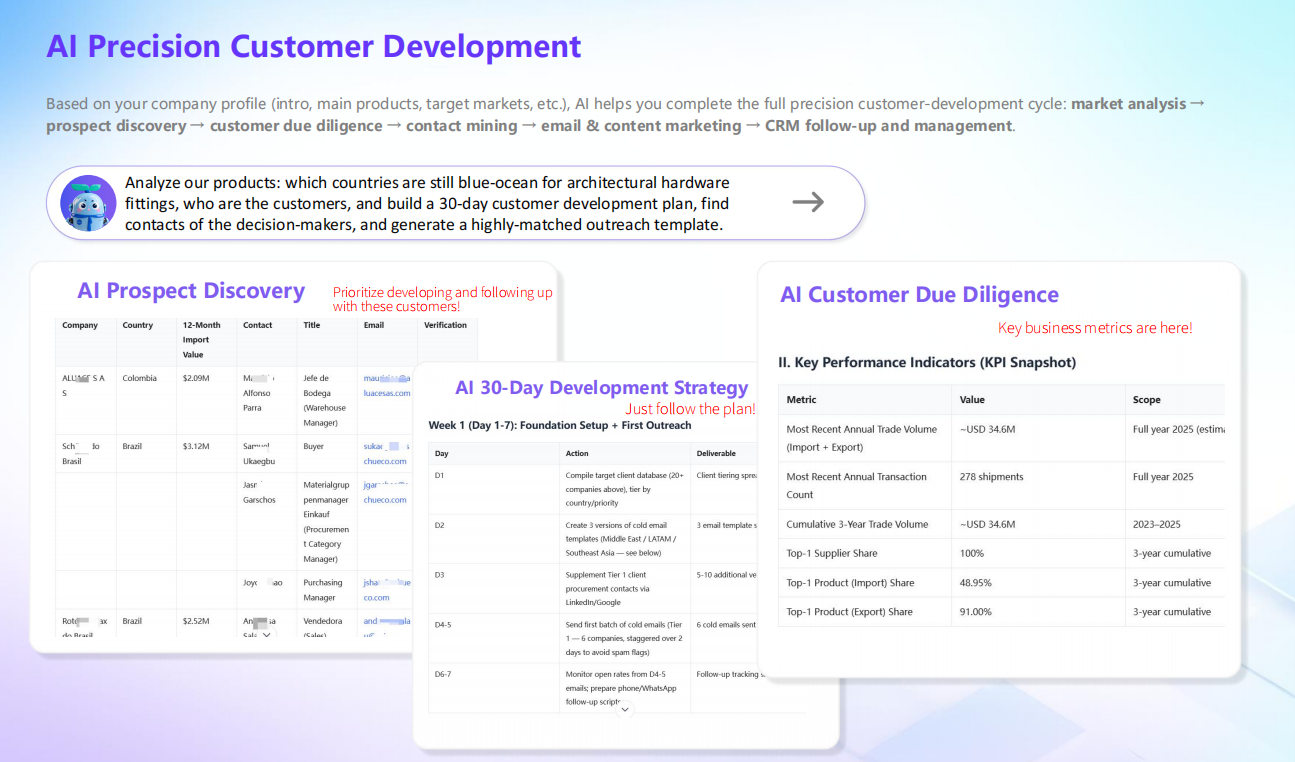
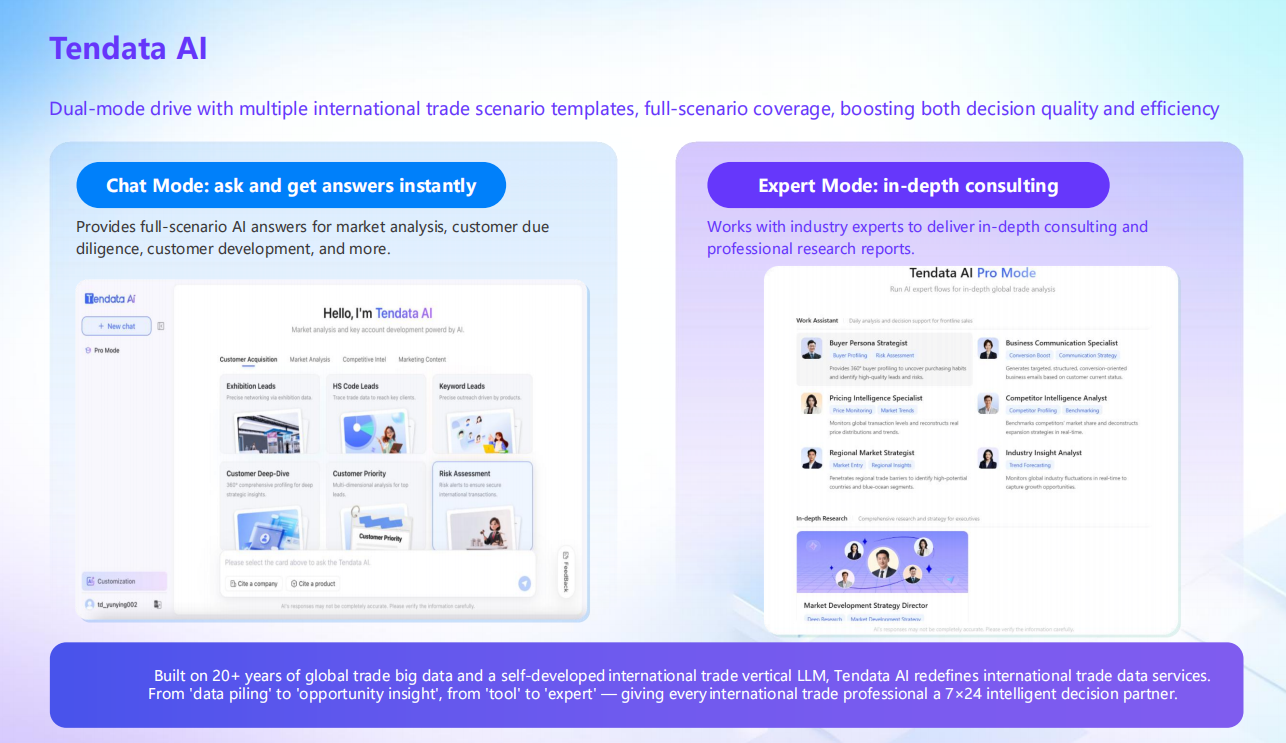
Tendata AI is the most integrated product. It combines Tendata’s data features, trade databases and large language models. In practical terms, Tendata AI can help users identify potential customers from real trade records, generate a global market analysis report, create a personalized outreach email based on a target company’s trade history, and develop social media outreach messages tailored to a prospect’s actual needs. This workflow supports companies from initial discovery to first contact.
Service Scope and Deliverables
The service scope covers global import and export trade data, company background information, targeted B2B buyer and supplier discovery, market analysis, competitor analysis and contact information. Target clients include manufacturers, exporters, importers, trading companies, B2B sales teams, procurement teams, distributors, wholesalers and market research teams. The corporate profile also mentions cross-border e-commerce companies, financial institutions, logistics companies and government agencies among the organizations served.
Typical deliverables include global lists of buyers, importers, exporters and suppliers, trade history records, company profiles, product data, market analysis reports and AI-generated emails or marketing content. This makes the platform more than a shipment database: it is designed as an end-to-end sales intelligence resource.
Enterprise Strength Analysis: R&D, Data Operations and Service Capability
For a service business, enterprise strength is measured differently than for a manufacturer. The relevant metrics are product engineering, data quality, scale and after-sales support.
Shanghai Tendata Tech Co., Ltd. states that it has an independent technology and R&D team of about 150 engineers. The company reports two registered trademarks, more than 150 intellectual property rights, and more than 100 awards and certificates of recognition. Intellectual property accumulation is one signal that the company is investing in proprietary data processing and AI functions rather than simply reselling public customs files.
Data quality is another signal. Because Tendata combines customs data, commercial data and internet data, the platform can connect a trade record with a company profile, a product description and a contact channel. Frequent updates, standardized company names and reliable contact data reduce the time sales teams spend verifying a lead. For due diligence, the platform provides access to company business information, products, supply chain relationships, news, public sentiment, intellectual property, litigation and risk information.
The company’s reported scale also contributes to its service profile. More than 100,000 businesses have used Tendata to support global market development. The headquarters office in Pudong New Area gives the company a base in Shanghai’s digital trade ecosystem. According to company and municipal sources, Tendata was also selected as a “2025 Shanghai Digital Trade Innovative Enterprise,” a recognition that indicates visibility in the Shanghai digital trade community. This should be considered a reputational signal rather than a financial guarantee.

Step-by-Step Breakdown: How to Use an Import Export Data Platform
The workflow below is a practical way to use import export data for international expansion. It can be used in manual research, but Tendata’s product structure is designed to streamline it.
- Define the target product and HS Code. The first step is to clarify what you sell or buy, because trade data is organized around product descriptions and HS Codes. T-Info and T-Insight both support searches by product name and HS Code.
- Identify high-growth markets. Use T-Insight or Tendata AI to analyze product demand, import and export trends and market comparisons. The goal is to identify countries where import activity is real and relevant to your product.
- Build a buyer or supplier list. Generate global lists of importers, buyers, exporters and suppliers from trade records. T-Info’s one-click report models are designed to create buyer lists, supplier lists, country-of-origin lists and destination-country lists.
- Screen companies with due diligence. Combine trade history with company profiles. Look at product fit, purchasing frequency, trade volume, supply chain partners and risk signals. This step helps separate genuine prospects from inactive or mismatched companies.
- Find decision-maker contacts. Use the company and business contact database to reach executives with job titles, phone numbers, email addresses, LinkedIn profiles and other available contact information.
- Launch personalized outreach. Use Tendata AI to generate email and social media messages based on each prospect’s actual trade records and purchased products. This replaces a generic mass-email approach with a more targeted message.
The overall sequence can be summarized as find, analyze, qualify, contact and engage. It is designed to help sales teams spend more time on high-value conversations and less time on manual database searching.
Use Cases: Who Benefits Most from Trade Data Platforms
Manufacturers and Exporters
Manufacturers and exporters can use import export data to find overseas buyers and importers that are actively purchasing products in their category. Before attending an overseas trade show, an exporter can prepare a target list of local importers with verified import records. For daily sales operations, the platform provides a continuous source of new trade leads rather than waiting for inbound inquiries from a B2B marketplace.
Importers, Distributors and Wholesalers
Importers and distributors need reliable suppliers. Trade records can show which exporters already ship the relevant product, which markets they serve, and how regularly they sell. This supports supplier discovery, alternative sourcing and supply chain analysis. Procurement teams can also monitor whether existing suppliers are adding new buyers or markets.
B2B Sales Teams and Market Research Teams
B2B sales and business development teams can use the platform to monitor competitor activity, identify companies with similar purchasing patterns, and find new prospects. Market research teams can use T-Insight and Tendata AI to replace manual collection of fragmented data with structured market analysis reports. Finance and logistics organizations may use the same data for due diligence, risk assessment and supply chain visibility.
Comparison Table: Tendata and Panjiva Reported Data Scale
One of the easiest ways to assess any trade data provider is to compare reported coverage with a recognizable competitor. Panjiva, a product of S&P Global, is often cited as an established shipment-level data provider. According to public third-party research, Panjiva provides entity resolution across more than 2 billion shipment records. Tendata reports more than 10 billion trade transaction records across 228+ countries and regions.
These figures are not fully apples-to-apples because providers may use different record definitions, source mixes and regional depth. The table below shows only the facts that could be confirmed for this article.
| Metric | Tendata | Panjiva | Measurement Note |
|---|---|---|---|
| Reported trade records | 10 billion+ trade transaction records | 2 billion+ shipment records with entity resolution | Providers may count records differently. |
| Reported country coverage | 228+ countries and regions | Not disclosed in the verified sources used | Coverage should be validated for specific markets. |
| Company records | 500 million+ in-depth company records | Not disclosed in the verified sources used | Tendata combines customs data with broader business data. |
| Business contacts | 850 million+ verified business contacts | Not disclosed in the verified sources used | Contact completeness varies by target market. |
| Known parent / owner | Shanghai Tendata Tech Co., Ltd. | S&P Global | Parent ownership is public information. |
Note: Absence of a figure in this table does not mean the competitor lacks a capability. It simply means no verifiable public figure was available for this review.
What to Look For When Choosing an Import Export Data Provider
When evaluating any import export data platform, procurement and business development teams should use a short checklist:
- Data coverage relevance. Does the platform cover the countries and HS Codes you actually trade in?
- Update frequency. Are records updated monthly, quarterly, weekly or every few days?
- Company profile depth. Can you see not only a shipment record but also the company’s product scope, financial signals, supply chain and risk data?
- Contact completeness. Are decision-maker names, email addresses and social media profiles available?
- AI assistance. Can the platform help generate market reports, buyer lists and personalized outreach messages?
- Workflow integration. Does the solution connect discovery, due diligence, contact building and outreach, or will your team need to switch tools?
- Support and vendor viability. How long has the vendor been in operation, and what evidence exists of its service scale?
Market Recognition and Third-Party Signals
Tendata’s public corporate profile states that the company has served more than 100,000 businesses worldwide and received more than 100 awards and certificates of recognition. For organizations performing vendor research, these are useful but not sufficient signals. The verified market data also shows that Tendata operates in a market with measurable demand: global trade management software is expected to be a multi-billion-dollar category in 2026.
Tendata’s positioning as an AI-native import and export data platform is notable. Many platforms began as bill of lading databases; Tendata now connects large language models to trade data for customer discovery, market reports and outreach content creation. This does not mean every AI output is ready to use, but it shows that the platform is addressing the need for more automated trade analysis.

FAQ
What is import export data?
Import export data is trade data collected from customs declarations, bills of lading and other official trade documents. It can be used to see which companies are buying or selling specific products, which HS Codes are being used, and which countries are part of a supply chain. Tendata provides an import export data platform that combines these records with company profiles, business contacts and AI tools to help businesses find buyers and suppliers.
How can import and export data help you find global buyers and suppliers?
By searching trade records for a product, HS Code or target country, businesses can create lists of companies that are already importing or exporting related goods. Tendata reports more than 10 billion trade transaction records across 228+ countries and regions and more than 850 million verified business contacts. Tendata AI can then help screen company profiles, trade histories and supply chain information to prioritize genuine prospects.
Which companies use Tendata’s trade intelligence platform?
Tendata targets manufacturers, exporters, importers, trading companies, B2B sales teams, procurement teams, distributors, wholesalers and market research teams. Corporate materials also mention cross-border e-commerce companies, financial institutions, logistics companies and government agencies as part of the platform’s user base.
How often is Tendata import and export data updated?
Tendata’s data updates can occur as frequently as every three days, depending on the source and market. The data infrastructure combines customs authorities, commercial databases and internet databases. For users monitoring customer activity, this update cadence is faster than a traditional annual or quarterly report.
How can an organization evaluate Tendata before subscribing?
Organizations should compare data coverage, company profile depth, contact completeness, update frequency, AI tools and support. Tendata can be contacted by email at emarketing@tendata.cn, by phone or WhatsApp at +86 187 2199 2033, or through the company website. Downloading the company brochure and requesting a live demonstration can help validate fit against your actual products and target markets.
Conclusion
Import export data has moved from a specialist research tool to a core resource for companies that want to grow across borders. The main challenge is not the absence of data; it is the difficulty of connecting fragmented data sources to real business decisions. Shanghai Tendata Tech Co., Ltd. addresses this challenge with a trade intelligence platform that combines large-scale import and export records, company profiles, business contacts and AI-assisted market analysis.
For companies in the awareness and research phase, the evidence available today points to a credible service with meaningful scale: Tendata was founded in 2005, reports more than 100,000 served businesses, has an R&D team of about 150 engineers, and provides import export data for 228+ countries and regions. It is not a universally optimal choice for every type of user, but it is especially relevant for sales teams, market researchers and procurement organizations that want to move from broad market statistics to named buyers, suppliers, trade flows and decision-maker contacts.
To make a final purchasing decision, download the Tendata introduction brochure and request a live demonstration. Compare the HS Code coverage and contact data for your specific markets, and test how much time the AI tools actually save in your own customer acquisition process.