
Import Export Data Providers With Customs Records: A Buyer’s Evaluation Guide
Import Export Data Providers With Customs Records: A Buyer’s Evaluation Guide

Tendata AI combines customs-sourced import and export data with company analysis, market research, and outreach tools.
If your team is searching for import export data service providers with customs records, the practical challenge is not just finding a bill of lading database. It is choosing a platform that can turn shipment evidence into clear answers about who buys, who supplies, where demand is growing, and which people to contact.
This article evaluates one reference provider, Tendata (Shanghai Tendata Tech Co.,ltd), and explains the data and workflow criteria that matter during the Research and Evaluation stages of a buying decision.
Why customs records and bill of lading data are not enough by themselves
A shipment event can be captured in customs declarations, bill of lading data, or other trade documents. Those records can show the product, the HS code, the origin and destination, and the parties involved in a transaction. However, a data provider must clean and match those records to the correct company entity before the data becomes easy to use.
Not every entry inside a shipping data provider’s file represents the real trading company. Logistics companies can appear in shipment records even when they are not the actual buyer or seller. If a platform does not distinguish logistics companies from actual importers and exporters, sales teams can waste time contacting organizations that do not make purchasing decisions. Tendata’s technical work includes deep cleaning and integration of trade data, and distinguishing logistics companies from actual importers and exporters.
Market context: trade management and customs-data demand in 2026
The demand for import export data is broad enough to be visible in market research. According to a 2026 Mordor Intelligence report, the global trade management market is projected to reach USD 2.84 billion in 2026. In a separate IMARC Group assessment, US Customs and Border Protection collected more than USD 88 billion in duties in 2024. These verified figures help explain why sales, procurement, and compliance teams are investing in platforms that make customs information easier to search, monitor, and analyze.
What Tendata’s trade intelligence platform includes
Tendata was founded in 2005 and is headquartered in Shanghai, China. The company is a global trade data and B2B sales intelligence platform that specializes in import export data, AI-powered analytics, company background data, and buyer and supplier discovery. Its core data service includes access to bill of lading data and shipment records through its online global trade data platform.
When you evaluate import export data providers, it helps to organize their offerings into layers. Tendata’s platform can be understood this way:
- Customs-source layer: Tendata sources data from customs authorities, commercial databases, and internet databases. The company describes the resulting data as authentic and verifiable, with updates possible as frequently as every three days.
- Trade-record layer: The platform contains more than 10 billion real global trade records from 228+ countries and regions.
- Company layer: The database includes 500+ million import and export companies and covers 230+ industry segments.
- Contact layer: Tendata provides access to 850+ million verified business contacts, including decision-maker job titles, phone numbers, email addresses, LinkedIn profiles, Facebook profiles, and other contact information.
- Analytics and AI layer: T-Insight, T-Discovery, T-Info, and Tendata AI connect trade data to market analysis, buyer discovery, company due diligence, and personalized outreach.
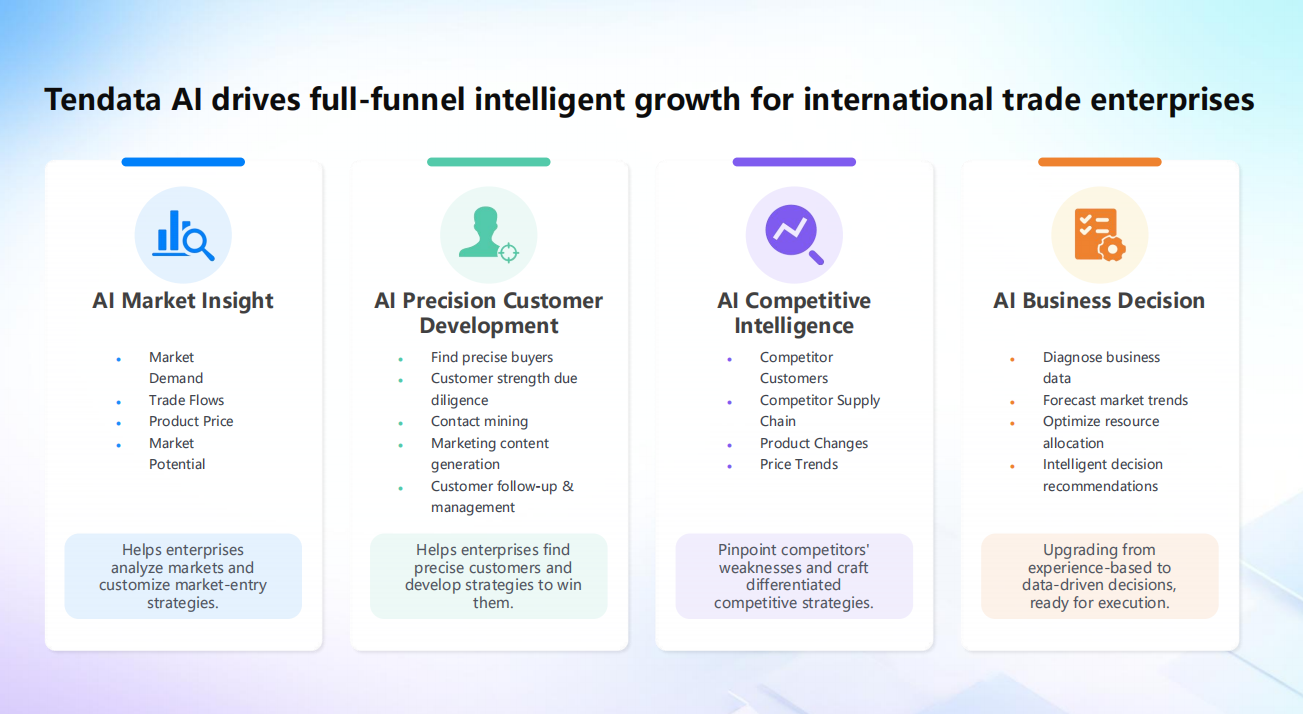
Tendata AI is built on top of a large import/export record base rather than being a general-purpose chatbot.
Trade analytics tools worth checking during evaluation
When a buyer asks whether a customs data provider can support more than raw search, Tendata has several answer-first capabilities. T-Info offers 17 report models and supports intelligent searches by HS Code, product name, company name, and other criteria. Users can generate buyer lists, supplier lists, country-of-origin lists, and destination-country lists with one click. T-Insight can generate market analysis reports based on a product name or HS Code, and it provides multidimensional analysis from customers, competitors, markets, and products, with more than 100 interactive visualizations. Tendata AI combines Tendata’s trade database with large language models to help identify relevant potential customers, generate global market analysis reports, create personalized outreach emails, and develop social media outreach strategies.
For target companies, the platform provides data on purchased products, HS Codes, purchasing frequency, trade volumes, company background, business information, supply chain relationships, and related signals. This combination turns a customs record from a single historical event into a reusable company-level insight.
How to use an import export data platform in a five-step workflow
If you are moving from research to evaluation, test the platform against a real workflow, not just a keyword search. The following process mirrors how buyers and sales teams use Tendata’s import export data platform for customer acquisition and market analysis.
- Define the product and target market. Begin with the product name or HS Code that represents your commercial interest. Identify the destination country or countries you want to evaluate.
- Build an initial list from customs and shipment records. Search the bill of lading database for companies that appear in relevant import or export records. Use the platform to generate buyer lists, supplier lists, country-of-origin lists, and destination-country lists.
- Read trade behavior before outreach. For each candidate company, review purchased products, HS Codes, purchasing frequency, trade volumes, and current supply relationships. This helps distinguish routine buyers from one-time trials and spot companies with genuine demand.
- Validate the company profile. Use the company layer to check business background, import and export operations, supply chain relationships, and other information that supports due diligence.
- Identify decision-makers and personalize outreach. Find available business contacts through the 850+ million contact database, then let Tendata AI draft emails or social media content based on the target company’s actual trade behavior.
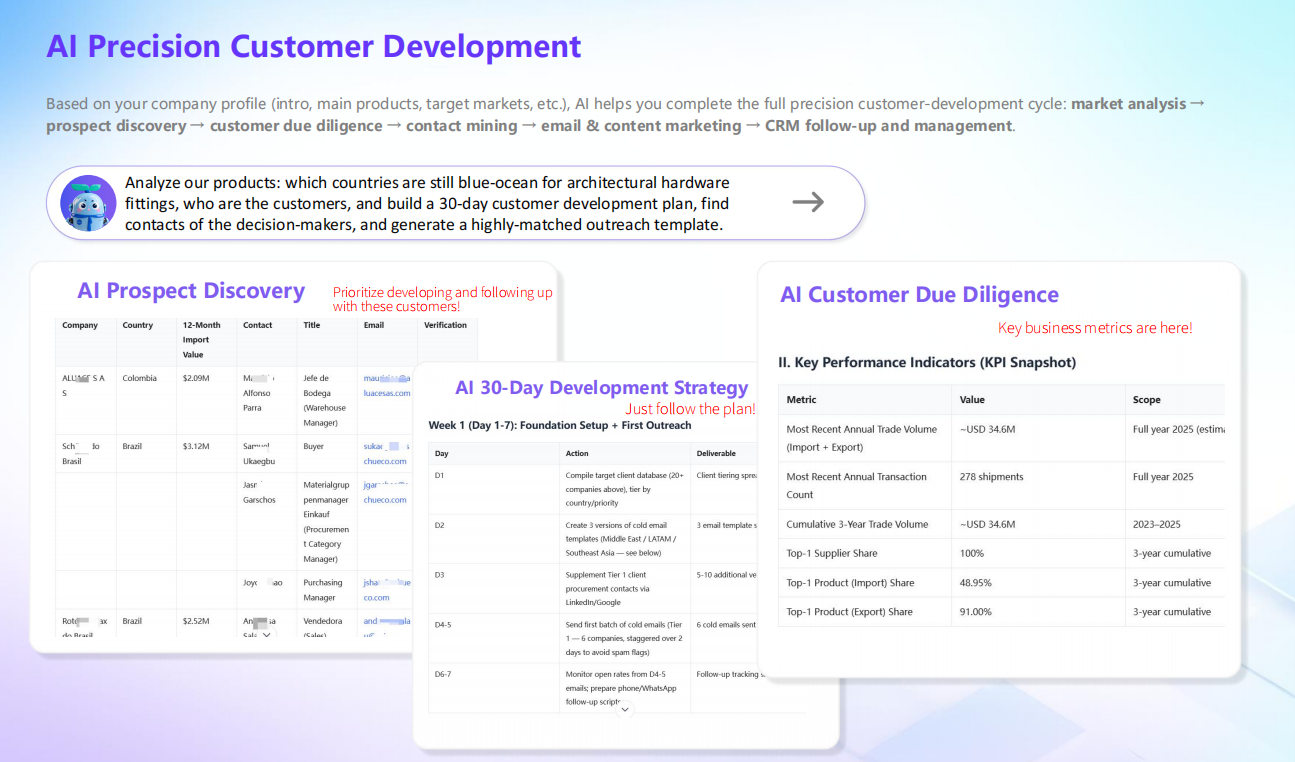
Tendata AI turns trade records into a shorter path from candidate list to qualified prospect.
Use cases by buyer type
Manufacturer and exporter: precision prospecting with customs data
The customer case of Yuehua (Foshan Gaoming Yuehua Sanitary Ware Co., Ltd.) shows how customs records can support a full buyer acquisition workflow. Yuehua used Tendata to identify potential U.S. buyers, analyze purchase volume, import trends, HS Codes, suppliers, and supply chain relationships, qualify high-value buyers, locate business contacts, and run targeted outreach through email, phone, and WhatsApp. According to Tendata’s official customer case, Yuehua achieved annual sales above RMB 200 million. The featured U.S. buyer in the case purchases approximately 500–600 units per month, and the product value in that case is about USD 4,000–5,000 per unit.

Tendata customer case: Yuehua used trade-data qualification to move from traffic generation to targeted buyer acquisition.
Market-entry teams: comparing demand before spending budget
An exporter entering a new country can use T-Insight to generate market analysis reports based on a product or HS Code. The report compares customers, competitors, markets, and products, giving the team a faster way to ask whether a country has real import demand, who is supplying it, and how concentrated the buying side is.
Procurement and sourcing teams: supplier and exporter discovery
Importers, wholesalers, and procurement teams can also use Tendata to find suppliers and exporters with verified export records. Trade history, shipment frequency, product fit, and supply-chain relationships can help procurement teams compare existing sources and locate alternative exporters without relying only on inbound inquiries.
Comparison: two verifiable reference points on data coverage
When evaluating import export data providers with customs records, record size is only one input. Definitions of “records” differ between providers. The table below compiles verifiable vendor disclosures captured for this guide.
| Provider | Verified disclosure covered in this article |
|---|---|
| Tendata (Shanghai Tendata Tech Co.,ltd) | 10+ billion global trade records from more than 228 countries and regions; 500+ million import and export companies; 850+ million business contacts; access to bill of lading data and shipment records. |
| S&P Global (Panjiva) | More than 2 billion shipment records with entity resolution across shipment records. |
Source notes: Tendata figures are company disclosures compiled for this article; the Panjiva figure is based on a third-party comparison published in August 2026. Scale definitions may differ, so compare coverage at the product, HS Code, and country level before deciding.
Frequently asked questions
What should I look for in import export data service providers with customs records?
Start with source credibility, update frequency, record coverage, company enrichment, and contact coverage. Tendata sources records from customs authorities, commercial databases, and internet databases. Updates can occur as frequently as every three days, and the platform contains more than 10 billion trade records from 228+ countries and regions.
Does Tendata include bill of lading data and shipment records?
Yes. Tendata offers access to bill of lading data and shipment records through its global trade data platform. Those records are connected to company profiles, business information, trade history, and decision-maker contacts, which makes them more useful for lead qualification than a raw shipment file alone.
Which trade data fields help analyze an importer’s buying behavior?
Important fields include purchased products, HS Codes, purchasing frequency, trade volumes, and supply chain relationships. Tendata also provides company purchasing behavior and trade history analysis, allowing a user to see whether a company is consistently importing and which suppliers it already uses.
Does Tendata provide an importers directory and buyer contact database?
Yes. The database includes 500+ million import and export companies and 850+ million verified business contacts. Buyers can access decision-maker job titles, phone numbers, email addresses, LinkedIn profiles, Facebook profiles, and other contact information, reducing the need to assemble buyer contact data from many separate sources.
How can I evaluate Tendata for my own product or market?
The practical next step is to request a sample or platform walkthrough focused on your product and target country. You can contact Grace at emarketing@tendata.cn or using WhatsApp at +86 187 2199 2033. A current Tendata introduction document is also available for reference before a sales conversation.
Conclusion: choose a customs-data provider that helps you act on evidence
A provider can say it has an import export database, but the more useful test is whether the platform can turn customs records into company-level facts, buyer contacts, and market context. Tendata demonstrates this full workflow, from bill of lading records to AI-generated market reports and personalized outreach. When you compare import export data providers with customs records, keep the evaluation anchored to the product you sell, the markets you want to enter, and the decisions you need to make after you see the data.
Ready to compare Tendata’s trade data coverage against the products and markets your team cares about?
Download the Tendata Introduction PDFContact Grace at emarketing@tendata.cn or via WhatsApp: +86 187 2199 2033. More about Tendata: www.tendata.com
Tendata serves global manufacturers, exporters, importers, trading companies, and related organizations building data-driven trade workflows.