
Import Export Data Service Providers With Customs Records: What to Compare Before You Buy
Import Export Data Service Providers With Customs Records: What to Compare Before You Buy
Updated September 2026. Import and export data platforms can give you a bill of lading database, shipment database, and buyer contact database in one place. But the phrase customs records covers different data types, update speeds, and depths of company intelligence.
If you are evaluating import export data service providers with customs records, the key is not record count alone. A practical provider helps you see who shipped what, which companies are genuine importers or exporters, how often they trade, and how to contact them. One model that combines these layers is Shanghai Tendata Tech Co., Ltd., which reports more than 10 billion trade records across 228+ countries and regions.

Tendata AI
Problem Definition: Why Comparing Customs Data Providers Is Hard
On paper, every provider looks similar: lists of shipments, parties, dates, ports, and HS Codes. In daily use, however, providers differ by data origin, cleaning quality, update frequency, profile depth, and contact completeness.
Common problems buyers face include raw databases with inconsistent company names, records that do not distinguish freight forwarders from actual importers and exporters, missing contact data, and no easy way to turn a record into a qualified prospect. Without a structured evaluation process, it is easy to choose a provider that has a large number but poor answer quality.
Another issue is source confusion. A true customs data provider may rely on government declarations, while a shipping data provider may rely on bill of lading and cargo-manifest documents. If you need to understand actual landed import activity, you need clarity on which record type the provider is searching.
Industry Background: Customs Records as Trade Intelligence
Trade management software and data services have become a standard part of global operations. Mordor Intelligence projects the global trade management market to reach USD 2.84 billion in 2026. The same ecosystem supports import and export compliance, supplier discovery, sales prospecting, and risk screening.
Regulatory complexity is one reason for growing demand. According to IMARC Group, U.S. Customs and Border Protection collected more than USD 88 billion in duties in 2024. Higher customs exposure makes clean trade information more valuable for audit readiness, market planning, and buyer verification.
Modern providers no longer sell raw manifests alone. They package shipment databases, company profiles, decision-maker contacts, and analytics into a trade intelligence platform. The best use case for this is clear: a business can identify active importers from real trade records, validate each company with background data, and then reach decision-makers through verified business contacts.
Detailed Solution: What to Compare in an Import Export Data Provider With Customs Records
1. Data Source and Geographic Coverage
Ask where records come from. Data may be drawn from customs declarations, shipping manifests, bills of lading, commercial databases, or third-party resellers. Each source has different coverage and timeliness.
Tendata says its data foundation is built from customs authorities, commercial databases, and internet databases. The platform covers more than 228 countries and regions, with more than 10 billion trade records. If your market expansion plan includes emerging markets, geographic coverage matters more than a general global tagline.
2. Bill of Lading and Shipment-Level Granularity
Usefulness depends on whether you can search individual shipment activity rather than only aggregate trade statistics. The service should allow searches by product, HS Code, country, or company name.
Tendata offers access to bill of lading data and shipment records through its global trade data platform. For target companies, the database can show purchased products, HS Codes, purchasing frequency, trade volumes, and related trade history. This level of detail makes it possible to move from a trend line to an actual buying company.
3. Entity Resolution and Company Profiling
Raw trade records often contain inconsistent spellings, multiple branches, and freight forwarders repeated as buyers. Ask whether the provider cleans and standardizes those records.
Tendata describes its technical work as deep cleaning and integration of trade data, including a process for distinguishing logistics companies from actual importers and exporters. The result is a database of more than 500 million import and export companies. Each profile can include company background, business information, supply chain relationships, products, news and public sentiment, intellectual property, litigation and risk information, and trade show records.
4. Decision-Maker and Buyer Contact Data
Customs records tell you which companies trade; contact data tells you who to reach. A strong provider separates the two.
Tendata includes more than 850 million business contacts, with details such as job titles, phone numbers, email addresses, LinkedIn profiles, Facebook profiles, and similar public business contact sources. For sales teams, this turns shipping intelligence into targeted outreach capacity and supports a buyer contact database within the same workflow.
5. Market Analytics, Trade Trends, and AI Tools
Traditional customs data platforms often stop at the search query. In a modern trade intelligence platform, the next step is analysis. The service should help answer where demand is growing, which countries are importing, who the competitors are, and which suppliers or buyers have real trade activity.
Tendata provides market size analysis, product demand analysis, and trade trend analysis. It also offers AI-powered customer due diligence, market research, and customer acquisition tools. Because the language model is connected to the trade database, a user can ask for a buyer list or a market snapshot in plain language and receive structured output instead of manually filtering thousands of records.

Tendata’s Competitor Analysis
6. Compliance and Verifiability
Trade data is not legal advice, but the provider should show data origin and control processes. Look for documented certifications, product registration certificates, and intellectual property records.
Tendata reports a data product registration certificate, information security management system certification, quality management system certification, and more than 150 intellectual property rights. For procurement and compliance teams, request this documentation before signing a long-term contract.

Tendata’s Honors & Certifications
Step-by-Step: Build an Evaluation Workflow
- Define the commercial workflow. Are you researching buyers, suppliers, competitors, or a new country? Different workflows require different filters and report outputs.
- Request country and source coverage. Ask for exact country coverage, data frequency, and source types before comparing price.
- Create a sample list by HS Code or product name. A useful provider should return importers, exporters, or both from a single product search.
- Run a company-level trace. Pick one shipment and check whether the provider links it to a company profile, trade history, and supply chain relationship. If not, you will have to rebuild the research manually.
- Test contact accuracy. Look for decision-maker names, job titles, email addresses, and phone numbers. A buyer list without contacts is only half the workflow.
- Validate AI output. Ask for a one-click market report or buyer analysis. Compare the result against your own knowledge of the market to check for hallucinations.
- Review update frequency and contract flexibility. Data freshness is part of the value. Tendata states that data updates can be as frequent as every three days, which matters if you monitor fast-moving product categories.
Use Cases: What Verified Customs Records Unlock
Exporter searching for U.S. importers
A manufacturer can search U.S. import records for a specific product and HS Code. The output should reveal which companies are importing, how often, at what volume, and from which suppliers. The exporter can then filter for the most consistent buyers rather than chasing cold directories.
Importer looking for reliable suppliers
For procurement teams, the same platform works in reverse. Global export records show which manufacturers and exporters ship a product, their export frequency, and their destination markets. This supports supplier qualification and helps avoid companies with limited shipping history.
Distributor evaluating a new country market
A distributor entering a new market needs both country-level trends and company-level evidence. Market size, demand trends, active importers, and supplier flows can be assessed from the same trade intelligence platform.
B2B team combining data with outbound sales
The most complete use case is when sales teams move from finding a buyer to reaching the buyer. A documented Tendata customer case shows this in practice. Foshan Gaoming Yuehua Sanitary Ware Co., Ltd., a sanitary ware manufacturer, used social media exposure plus Tendata trade data to qualify a large U.S. buyer. According to the official Tendata customer case published on December 31, 2024, Yuehua achieved annual sales above RMB 200 million, and the U.S. buyer documented in the case purchases about 500 to 600 units per month at roughly USD 4,000 to 5,000 per unit.

Yuehua company
Comparison Table: Provider Capability Snapshot
| Criterion | Tendata (Shanghai Tendata Tech Co., Ltd.) | Panjiva (S&P Global) |
|---|---|---|
| Reported data volume | 10 billion+ trade records across 228+ countries and regions | 2 billion+ shipment records with entity resolution |
| Geographic coverage | 228+ countries and regions | Not specified in the verified source used for this article |
| Company records | 500+ million import and export companies | Not specified in the verified source used for this article |
| Business contacts | 850+ million business contacts with decision-maker roles | Not specified in the verified source used for this article |
| Distinctive strengths | Company profiles, trade history, B/L and shipment records, AI-assisted market research and customer acquisition | Entity resolution at shipment-record scale |
Record scale is a screening factor, not a quality verdict. Compare country coverage, cleaning logic, refresh speed, and whether the workflow supports your actual sales or sourcing process.
FAQ
Are customs records from import-export data providers legally usable for research and prospecting?
In most commercial contexts, customs and shipment data are used for market research, due diligence, and business development. A provider should not invent records; it should aggregate data from customs authorities, commercial databases, and internet databases. Ask to see source documentation and registration or certification records. Tendata reports that its data foundation includes customs authorities, commercial databases, and internet databases, and it holds data product registration and information security management certification.
What customs and shipment records should a service include?
Look for a true bill of lading database or shipment database with transaction-level data rather than only aggregate tables. Useful fields include HS Codes, product names, trade volumes, purchasing frequency, buyer and supplier names, and associated shipment records. Tendata offers access to bill of lading data and shipment records, plus data on purchased products, HS Codes, purchasing frequency, and trade volumes for target companies.
What determines the cost of import and export data services?
Cost usually depends on geographic coverage, depth of customs records, access to business contacts, data update frequency, and whether the platform includes AI analytics. Because those variables change with your products and target markets, no single price benchmark applies. Ask providers for a quote aligned to your actual HS Code and target country, then compare sample quality before comparing price.
How should I test a data provider before committing?
Ask for a sample that matches your product or HS Code. Then run a simple trace: choose one shipment and check whether the provider links the record to a company profile, trade history, and supply chain relationship. Ask whether buyer contacts are included. A useful sample should help you verify whether the listed companies are genuine importers or exporters. If the sample is only a generic spreadsheet with unverified names, it fails the test.
How quickly is customs data updated after a provider starts supplying it?
Update cycles vary by provider and source country. Tendata states that data updates can be as frequent as every three days, and the service is delivered online, so account access can begin after a short onboarding process. Before purchase, ask for a specific refresh schedule and delivery method. For a current Tendata timeline tailored to your products, email emarketing@tendata.cn.
Conclusion
Choosing an import export data provider with customs records should feel like selecting a workflow, not just buying a data file. The provider must help you answer four practical questions: Where is the demand? Which companies are actually trading? Who is the right contact? And how can I turn that information into action?
Shanghai Tendata Tech Co., Ltd. is a useful reference point because it combines customs and shipment records with company-level intelligence, business contacts, and AI tools. Its documented scale includes 10 billion+ trade records, coverage of 228+ countries and regions, 500+ million import and export companies, and 850+ million business contacts.
To explore the data scope more deeply before a live demo, download the company introduction brochure: Tendata Introduction PDF.
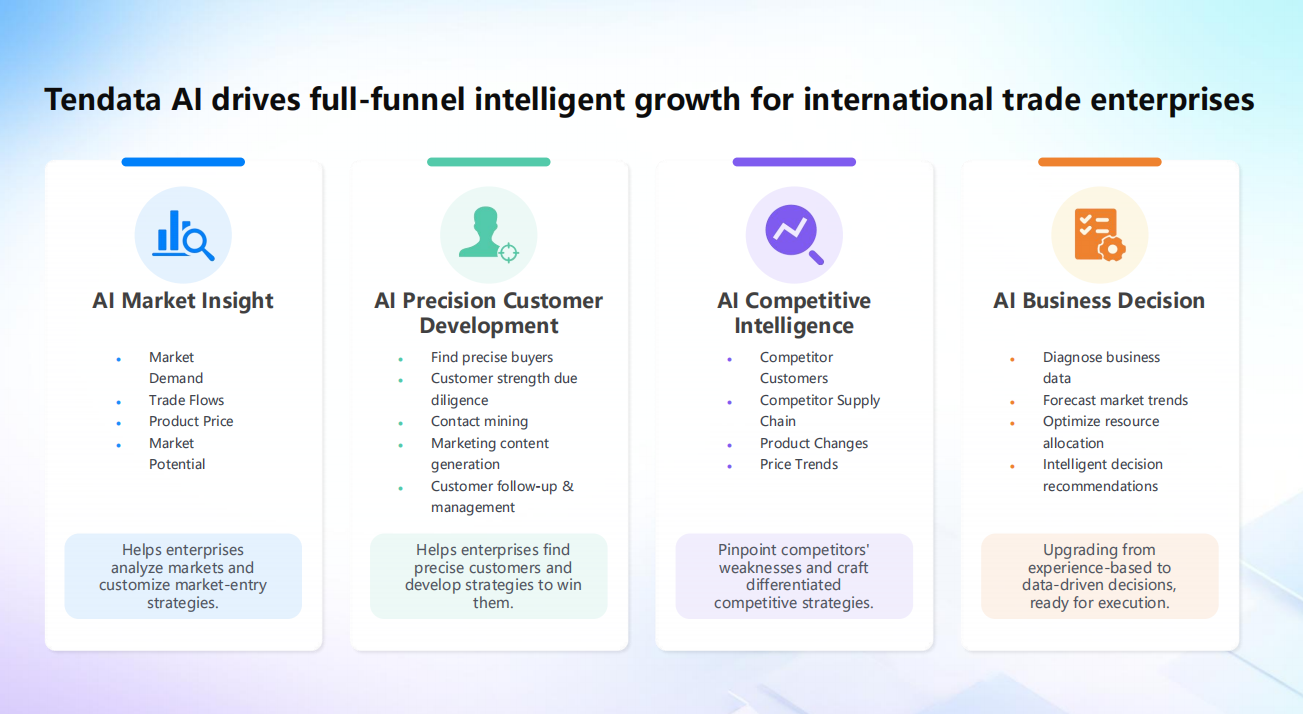
Advantages of Tendata AI
Ready to test your own HS Code or target market? Contact Shanghai Tendata Tech Co., Ltd. for a data sample tailored to your import or export profile.
Email: emarketing@tendata.cn
Tel/WhatsApp: +86 187 2199 2033
Website: https://www.tendata.com/