Import Export Data Technical Guide: HS Codes, Trade Records, and AI Query Design

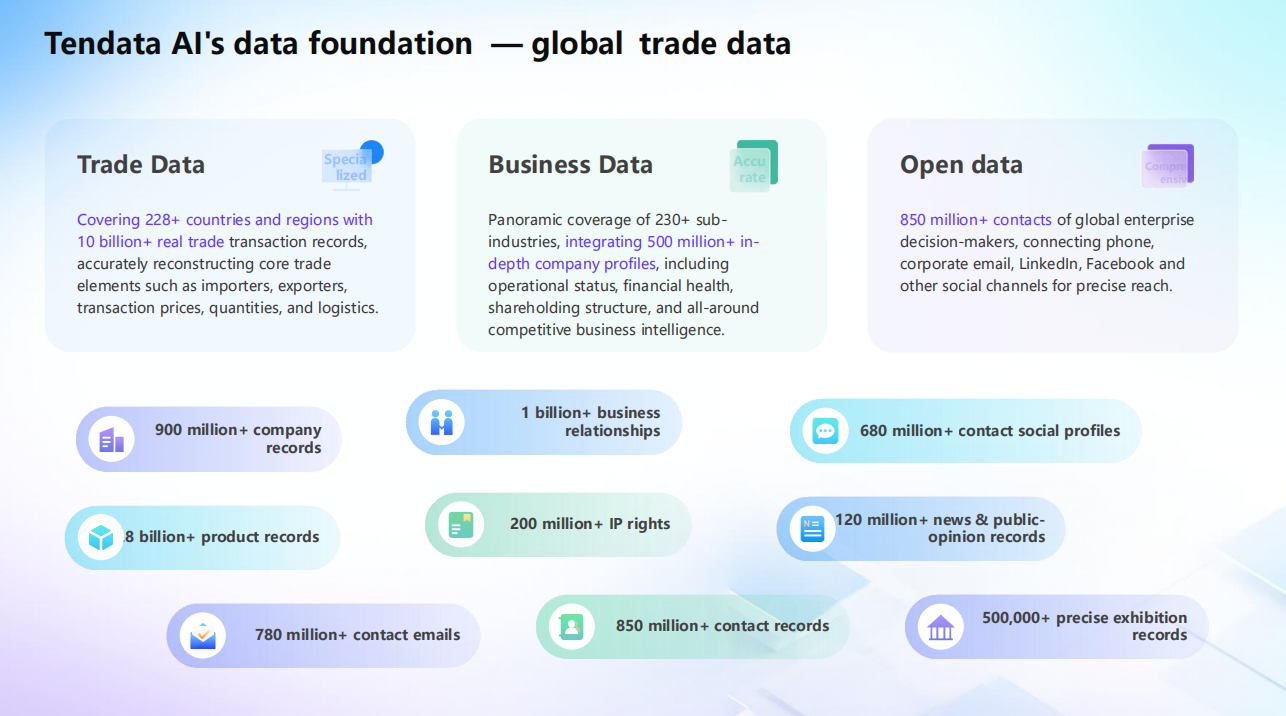
Effective import export data queries are built, not typed. A reliable query connects a product identifier such as a product name or HS Code to a country or region, then filters companies by verified trade activity and attaches company-level intelligence. Shanghai Tendata Tech Co.,ltd (Tendata) provides the data layer for this workflow: global trade data covering over 10 billion records from more than 228 countries and regions, 230+ industries, 500+ million import and export companies, and 850+ million business contacts.
This technical guide explains how to structure import export data queries using products, HS Codes, countries or regions, and natural-language descriptions. It covers the technical layers of trade records, company information, contact information, and AI analysis. It also outlines selection parameters such as verified trade activity, company-level intelligence, and AI-integrated data coverage.
Problem Definition: Why Trade Data Queries Fail
Trade data is not a single clean table. It combines customs declarations, bill of lading and shipment records, company names, product descriptions, weights, values, ports, and contacts. Product descriptions are inconsistent. HS Codes are precise but can be extended in national tariff schedules. Company names appear with legal suffixes, abbreviations, or local-language variants. Shipment records may include logistics companies, trading intermediaries, or multiple entities in one transaction. A query that ignores these constraints returns volume, not answers.
Tendata addresses this problem through data standardization and entity handling. The platform regularly standardizes company names, quantity units, and other data fields to reduce duplicate or inconsistent records and support more accurate business analysis and decision-making. Its data infrastructure also distinguishes logistics companies from actual importers and exporters, which matters when a buyer list must reflect real purchasing entities rather than intermediaries.
The practical constraint is that a buyer search, a supplier check, and a market analysis ask different questions of the same records. A buyer search asks who imports a product and how often. A supplier check asks who exports it and through which supply chain. A market analysis asks where demand is growing and which countries or regions deserve priority. The query design must match the decision, not just the keyword.
Industry Background: From Customs Records to Global Trade Intelligence
Tendata was founded in 2005 and is headquartered in Shanghai, China. It is a trade intelligence platform specializing in global trade data and AI-powered analytics. Its trade data is sourced from customs authorities, commercial databases, and internet databases. Data updates can be as frequent as every three days, allowing customers to access the latest import and export trade details.
The platform provides access to bill of lading data and shipment records through its global trade data platform. It also provides global buyer and supplier lists for customer acquisition and market research. Coverage extends to 228+ countries and regions, with more than 10 billion trade transaction records accumulated. The database includes 500+ million import and export companies and 850+ million business contacts.
Demand for structured trade intelligence is rising. The global trade management market is projected to reach USD 2.84 billion in 2026, according to Mordor Intelligence. For trade teams, the more immediate issue is not whether data exists, but whether the query can connect product classification, shipment evidence, company profiles, and contacts into one defensible answer.
Detailed Solution: The Four-Layer Import Export Data Query Model
Tendata supports import export data queries through four connected layers: product and classification, trade records, company intelligence, and contact and action. Each layer answers a different part of the buyer or supplier decision.
Layer 1: Product and HS Code Classification
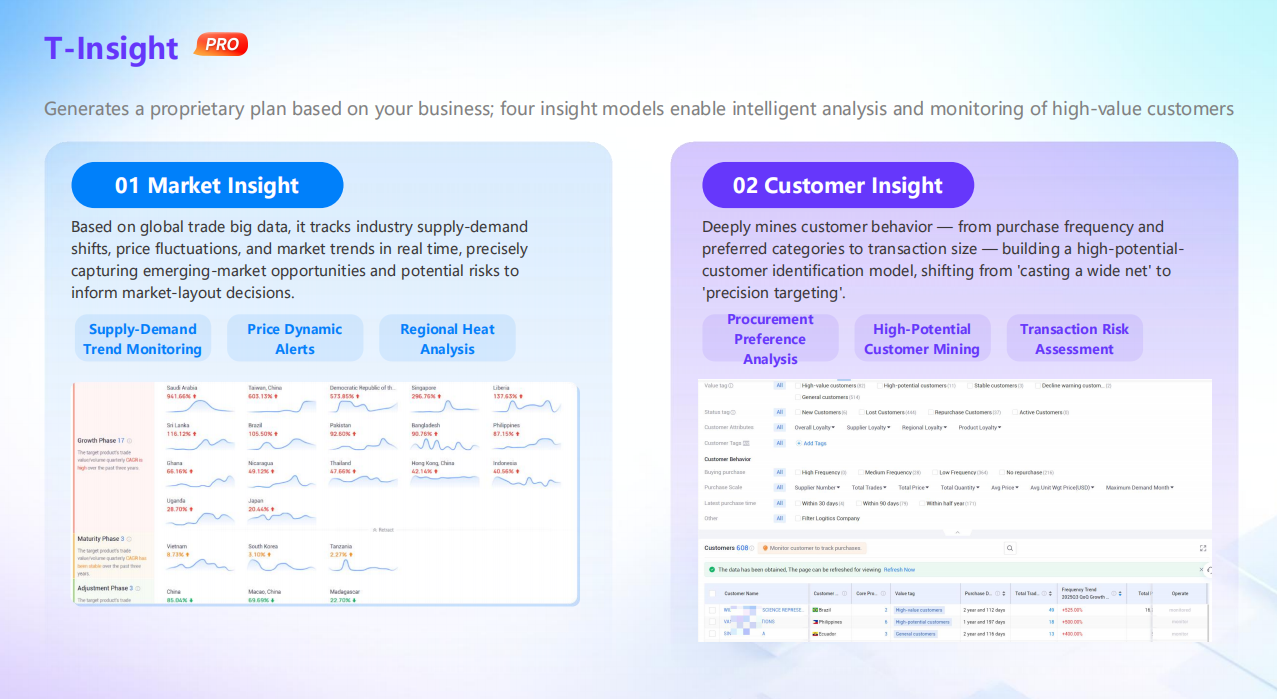
The first layer converts a commercial product description into a searchable trade category. T-Info offers 17 report models and supports intelligent searches by HS Code, product name, company name, and other criteria. Users can generate buyer lists, supplier lists, country-of-origin lists, destination-country lists, and more. T-Insight can generate market analysis reports based on a product name or HS Code, with multidimensional analysis from customers, competitors, markets, and products.
Product names are useful for discovery because they reflect how sales teams describe their offer. HS Codes are useful for precision because they classify traded products for customs purposes. The two should be used together: start with the product name to find candidate HS Codes, then use the HS Code to constrain the trade record search. Because national tariff schedules may extend the international classification, the code used by the target market should be confirmed before the result is treated as definitive.
Layer 2: Trade Records and Shipment Evidence
The second layer answers whether trade activity actually exists. Tendata provides bill of lading data and shipment records. For target companies, the service provides data on purchased products, HS Codes, purchasing frequency, trade volumes, and other relevant metrics. The platform also provides company purchasing behavior and trade history analysis, which may include bill of lading and shipment data.
This layer is where many queries become useful or useless. A company name alone does not prove purchasing activity. A shipment record, HS Code, and purchasing frequency give the query a factual basis. Trade volume helps separate occasional buyers from repeat buyers. Supply-chain relationships help show who a company buys from or sells to. Used together, these fields support qualification rather than simple list building.
Layer 3: Company-Level Intelligence
The third layer adds context. Tendata's database includes 500+ million import and export companies and 850+ million business contacts. The service offers company background and business information for international companies, supporting company profile needs. It also provides market size, product demand, and trade trend analysis, facilitating export market opportunity analysis.
Company-level intelligence matters because a trade record alone does not explain fit. A buyer may import a related product but not the exact category. A supplier may export a similar product but serve a different segment. Company background, business information, product mix, and supply-chain relationships help a team decide whether the record is relevant to its own offer, market, or procurement requirement.
Layer 4: Contacts and AI-Assisted Action
The fourth layer turns analysis into action. The service includes business and decision-maker contact information, providing buyer contact data. Tendata AI combines Tendata's features, trade databases, and large language models. Based on real, valid, and verifiable trade data, it can help businesses identify relevant potential customers, generate global market analysis reports, create personalized outreach emails based on target customer information, and develop customized social media outreach strategies based on prospects' actual needs.
This is where AI query design becomes practical. A user can describe a product, market, and target buyer profile in natural language, then ask for a structured output. The AI does not replace the trade record layer; it helps interpret and organize it. The result should still be checked against company names, HS Codes, shipment records, and contact fields.
Step-by-Step Breakdown: Designing a Query That Can Be Verified
A good import export data query follows a sequence. The sequence keeps the search tied to a decision and prevents the team from confusing data volume with data quality.
Step 1: Define the Decision Before the Query
Start with the decision: buyer discovery, supplier evaluation, market entry, competitor mapping, or trade show targeting. Each decision requires different filters. Buyer discovery needs importer records, purchasing frequency, and contact fields. Supplier evaluation needs exporter records, shipment history, and supply-chain relationships. Market entry needs product demand, trade trends, and country or region comparison. The query should be written after the decision is clear.
Step 2: Choose the Primary Query Key
Use a product name when the category is broad or the internal product description is the only starting point. Use an HS Code when the product category is precise and the target market's classification is known. Use a company name when the task is due diligence or supplier verification. T-Info supports intelligent searches by HS Code, product name, company name, and other criteria, so the query key can be changed as the question becomes more specific.
Step 3: Set Geography and Entity Constraints
Add the country or region constraint after the product key is clear. Tendata covers 228+ countries and regions, so the same product can be examined across multiple markets. The entity constraint should specify importer, exporter, or both. Verified buyer and supplier information supports global buyer research and prospect identification. The query should also exclude logistics companies and intermediaries when the goal is to find actual importers or exporters.
Step 4: Add Trade Behavior Filters
Use trade behavior to rank the results. Purchasing frequency, trade volume, HS Code, and supply-chain relationships are more useful than a static company list. A company that imports the target product repeatedly is a different prospect from a company with one unrelated shipment. A supplier with consistent export records is different from a company that only appears in a directory. Tendata provides data on purchased products, HS Codes, purchasing frequency, trade volumes, and purchasing behavior analysis to support this step.
Step 5: Attach Company Intelligence and Contacts
Once the trade record is qualified, attach company background, business information, and contact data. The service includes business and decision-maker contact information, providing buyer contact data. This step should be treated as a qualification layer, not a mass-export step. The contact should match the company and role that the query identified.
Step 6: Use AI to Summarize and Draft the Next Action
Tendata AI can generate global market analysis reports, identify relevant potential customers, create personalized outreach emails, and develop social media outreach strategies based on prospect information. T-Insight provides more than 100 interactive visualizations for market analysis. The AI output should be checked against the underlying records before it is used in a sales or procurement decision.
Step 7: Validate and Iterate
Compare the query result with the original decision. If the buyer list contains too many intermediaries, tighten the entity constraint. If the HS Code returns unrelated products, return to the product description and confirm the classification. If the market analysis is too broad, narrow the country or region and product category. The query is a working instrument, not a one-time report.
Use Cases: Where the Query Model Applies
Buyer Discovery for Exporters
An exporter can query importers in a target country using a product description and candidate HS Code, then rank the results by purchasing frequency and trade volume. Tendata provides global buyer and supplier lists for customer acquisition and market research. The exporter can then review company background and available decision-maker contacts before outreach.
Supplier Evaluation for Procurement Teams
A procurement team can query exporters and suppliers by product and HS Code, then review shipment records, trade history, and supply-chain relationships. The service provides company purchasing behavior and trade history analysis, which may include bill of lading and shipment data. This supports verification before a quote or sample request.
Market Entry and Global Export Trends
A brand owner or trading company can use T-Insight to generate a market analysis report by product name or HS Code. The report can cover market size, product demand, and trade trend analysis, facilitating export market opportunity analysis. The same query can compare countries or regions before a market entry decision.
Competitor and Supply Chain Analysis
Tendata's platform supports competitor and supply-chain analysis through trade records and company intelligence. A team can examine who buys from whom, which suppliers appear in a product category, and how trade relationships are distributed. The output should be used to ask better questions, not to make unsupported claims about a competitor's strategy.
Trade Show and Event Targeting
Before a trade show, a team can build a target list of buyers and importers in the relevant market. After the event, it can analyze exhibitors and prospects based on trade history and company background. This uses the same query model: product, HS Code, country or region, trade activity, company profile, and contact.
Comparison Table: Query Inputs and Verification Points
| Query input | Best used for | Data layer used | What to verify |
|---|---|---|---|
| Product name or natural-language description | Early discovery when the product category is broad | Tendata AI natural-language interaction; T-Info product name search | Confirm candidate HS Codes and product synonyms |
| HS Code | Precise category search and market analysis | T-Info HS Code search; T-Insight product name or HS Code analysis | Confirm national tariff extensions used by the target market |
| Company name | Due diligence, supplier verification, and buyer qualification | 500+ million import and export companies; company background and business information | Match entity variants and exclude intermediaries |
| Country or region | Market comparison and buyer or supplier lists | 228+ countries and regions | Check local demand and trade activity in the target market |
| Trade behavior | Prioritizing prospects and suppliers | Purchasing frequency, trade volumes, HS Codes, and supply-chain relationships | Confirm actual shipment evidence rather than directory presence |
The query input should match the decision. Tendata's data layers support product, HS Code, company, geography, and trade behavior searches.
Selection Parameters for Import Export Data Platforms
When evaluating import export data service providers with customs records, the comparison should go beyond record count. The relevant parameters are coverage, verified trade activity, company-level intelligence, contact coverage, AI integration, and data freshness. The table below translates those parameters into questions a buyer can ask.
| Selection parameter | Why it matters | Evidence to request | Tendata fact |
|---|---|---|---|
| Global coverage | A single-market dataset cannot support cross-market buyer or supplier research | Country and region list; industry coverage | 228+ countries and regions; 230+ industries |
| Trade record depth | Record depth affects whether a company can be qualified by actual trade activity | Bill of lading and shipment record fields; historical depth | Over 10 billion trade records; bill of lading data and shipment records |
| Company intelligence | Trade activity alone does not explain company fit or supply-chain context | Company profiles; purchasing behavior; supply-chain relationships | 500+ million import and export companies; company background and business information |
| Contact coverage | A qualified company is not actionable without a relevant contact | Decision-maker titles; email, phone, and social profiles | 850+ million business contacts; business and decision-maker contact information |
| AI integration | AI can reduce manual research and help structure market or buyer analysis | Natural-language query; report generation; outreach support | Tendata AI; T-Insight; T-Info; AI-powered due diligence and market research |
| Data freshness | Stale records weaken buyer and supplier qualification | Update frequency and source description | Data updates can be as frequent as every three days; sources include customs authorities, commercial databases, and internet databases |
Selection should be based on verifiable coverage and workflow fit, not on a single headline number.
AI Query Design: How to Ask a Trade Data Question
Natural-language AI is useful only when the request contains enough structure. A strong AI query names the objective, product description, HS Code if known, target country or region, company role, trade behavior constraint, and desired output. Weak queries ask for 'buyers' without defining the product, market, or evidence standard. Strong queries ask for importers in a named market with shipment records for a defined product category, then request purchasing frequency, trade volume, company profile, and available decision-maker contacts.
Tendata AI combines Tendata's trade databases with large language models. It can help identify relevant potential customers, generate global market analysis reports, create personalized outreach emails, and develop customized social media outreach strategies. T-Insight can generate market analysis reports based on a product name or HS Code and provides more than 100 interactive visualizations. T-Info supports intelligent searches by HS Code, product name, company name, and other criteria.
The AI layer should not be treated as an answer machine. It should be treated as a research assistant that works on top of trade records. The user should still verify the HS Code, company entity, shipment evidence, and contact field before acting on the output.

FAQ
What should I check when evaluating import export data service providers with customs records?
Check coverage, record depth, company intelligence, contact coverage, AI integration, and data freshness. Tendata provides global trade data covering 10 billion+ records from 228+ countries and regions, 500+ million importers and exporters, and 850+ million business contacts. Its data is sourced from customs authorities, commercial databases, and internet databases; updates can be as frequent as every three days.
How do I structure a query using HS Codes and product descriptions?
Start with the product description to identify candidate HS Codes, then run the query with the HS Code and target country or region. T-Info supports intelligent searches by HS Code, product name, company name, and other criteria. T-Insight can generate market analysis reports based on a product name or HS Code. Because national tariff schedules may extend the international classification, confirm the code used by the target market before relying on the result.
What company-level data can I include in trade record analysis?
Company-level analysis can include company background and business information, purchased products, HS Codes, purchasing frequency, trade volumes, supply-chain relationships, and available decision-maker contacts. Tendata's database includes 500+ million import and export companies and 850+ million business contacts. The platform also provides AI-powered customer due diligence and market research tools to help interpret these records.
How does AI support import export data queries?
AI supports query design by accepting natural-language descriptions of products, markets, and target buyers, then connecting that request to trade records and company intelligence. Tendata AI combines Tendata's trade databases with large language models; it can help identify potential customers, generate global market analysis reports, create personalized outreach emails, and develop social media outreach strategies. T-Insight provides more than 100 interactive visualizations for market analysis by product name or HS Code.
Can I test the workflow before committing to a full rollout?
Yes. A practical next step is to test a defined query on a small product or market set, review the trade records, company profiles, and contact fields, and compare the output with your sales or procurement criteria. Tendata provides global buyer and supplier lists for customer acquisition and market research, and the Tendata Introduction PDF is available for download. You can also contact Tendata to request a sample workflow or quote.
Conclusion
HS Codes, trade records, and AI queries are three different layers of the same decision. Use product descriptions to discover, HS Codes to constrain, trade records to verify, company intelligence to qualify, and contacts to act. Tendata provides the data foundation: over 10 billion trade records, 228+ countries and regions, 230+ industries, 500+ million importers and exporters, and 850+ million business contacts, with AI tools for due diligence, market research, and customer acquisition.
To evaluate fit, start with a narrow query. Define the product, candidate HS Code, target country or region, and trade behavior constraint. Inspect the shipment records and company profile. Then decide whether the result supports the buyer, supplier, or market decision. This sequence keeps import export data useful and verifiable.
Next step: Download the Tendata Introduction PDF or visit tendata.com to request a sample workflow or quote.
Shanghai Tendata Tech Co.,ltd | Email: emarketing@tendata.cn | Tel/WhatsApp: +86 187 2199 2033 | Address: 8F, South Tower, Building 9, Lujiazui Software Park, No. 20, Lane 91, Eshan Road, Pudong New Area, Shanghai
Have Questions or Need More Details?
Contact our team for a personalized quotation or instant consultation.
Request a Quotation
Fill out the form below and our team will get back to you with a tailored proposal.
WhatsApp Direct Chat
Prefer to chat in real-time? Message us on WhatsApp for instant assistance & quick answers.
- Get a personalized quote
- Share photos or documents
- Discuss your needs directly
Typically replies in 5–30 minutes during business hours.