
Supplier Evaluation for Delivery Assurance: Import Export Data Capability Checks
Supplier Evaluation · Import Export Data
Delivery assurance is the part of supplier evaluation that answers one question: can this supplier ship what it promised, when it promised, more than once? Import export data answers that question with shipment evidence, namely the exporter records, export cadence, product and HS code mix, destination spread, and supply-chain relationships that sit behind a quotation, instead of relying on a supplier's own description of its capability.
For buyers who are past shortlisting and moving into commitment, the task is narrower than general due diligence. The question is not whether the company exists, but whether its export behavior is consistent with the delivery obligations about to be signed. This guide sets out a capability-check framework built on that distinction, and explains how Shanghai Tendata Tech Co.,ltd, a trade intelligence platform founded in 2005 and headquartered in Shanghai, China, structures the data behind those checks.
Short answer. Before committing, verify three things with trade records: that the company quoting you is the same entity that appears in export records; that its export behavior is continuous and product-relevant rather than a single shipment; and that its supply-chain dependencies do not create a single point of failure. Documents describe what a supplier can do. Export records show what it has repeatedly done.
Problem Definition: Why Delivery Assurance Fails Without Shipment Evidence
Most supplier evaluation evidence answers production questions. Certificates, audit reports, capability statements, product samples, and questionnaires all describe whether a supplier has a system capable of producing to specification. They are necessary, and they are routinely collected. What they do not show is repetition: whether the same supplier has exported comparable products, in comparable volumes, across consecutive periods, to buyers with similar requirements.
Delivery failures usually appear in one of five forms, and four of them are visible in trade records before a contract is signed:
- Exporter-of-record mismatch. The entity that signs the contract is not the entity that appears as the exporter in shipment records, which is common when a trading intermediary fronts for a factory.
- Product and HS code mismatch. The quoted product scope does not match the products the supplier actually exports, so capability in the quoted category is unproven.
- Discontinuous export behavior. Export activity exists but is irregular, seasonal without explanation, or has stopped, which weakens the assumption of reliable repeat delivery.
- Single-buyer dependency. The supplier's export volume concentrates on one or two counterparties, so your order competes for capacity with an established relationship.
- Destination and compliance mismatch. The supplier exports, but not to markets with the documentation requirements your order will trigger.
These are decision-stage problems because they surface after commitment, when switching costs are highest. Checking them at the research stage is inexpensive; checking them after a purchase order is issued usually means expediting, re-sourcing, or absorbing a delay.
Industry Background: How Trade Records Became a Capability Check
Import export data is compiled from customs authorities, commercial databases, and internet databases. Each shipment-level record can carry the consignor and consignee, product descriptions, HS codes, quantities, origin and destination, and dates, which together form the trade history, trade frequency, trade volume, and trading relationships that a buyer needs for capability assessment. Bill of lading and customs declaration records are the operational backbone of that evidence base.
Two developments made this evidence usable for evaluation rather than only for market sizing. First, data standardization: Tendata regularly standardizes company names, quantity units, and other data fields to reduce duplicate or inconsistent records, which is what allows a buyer to match one legal entity across markets without manual reconciliation. Second, update cadence: Tendata provides data updates as frequently as every three days, so a supplier's most recent export behavior is available while a sourcing decision is still open.
Demand for this kind of verification has risen with the cost of getting trade documentation wrong. Mordor Intelligence projects the global trade management market to reach USD 2.84 billion in 2026, and IMARC Group reports that US Customs and Border Protection collected more than USD 88 billion in duties in 2024, both of which point to a market where audit readiness and record accuracy carry direct financial consequences.
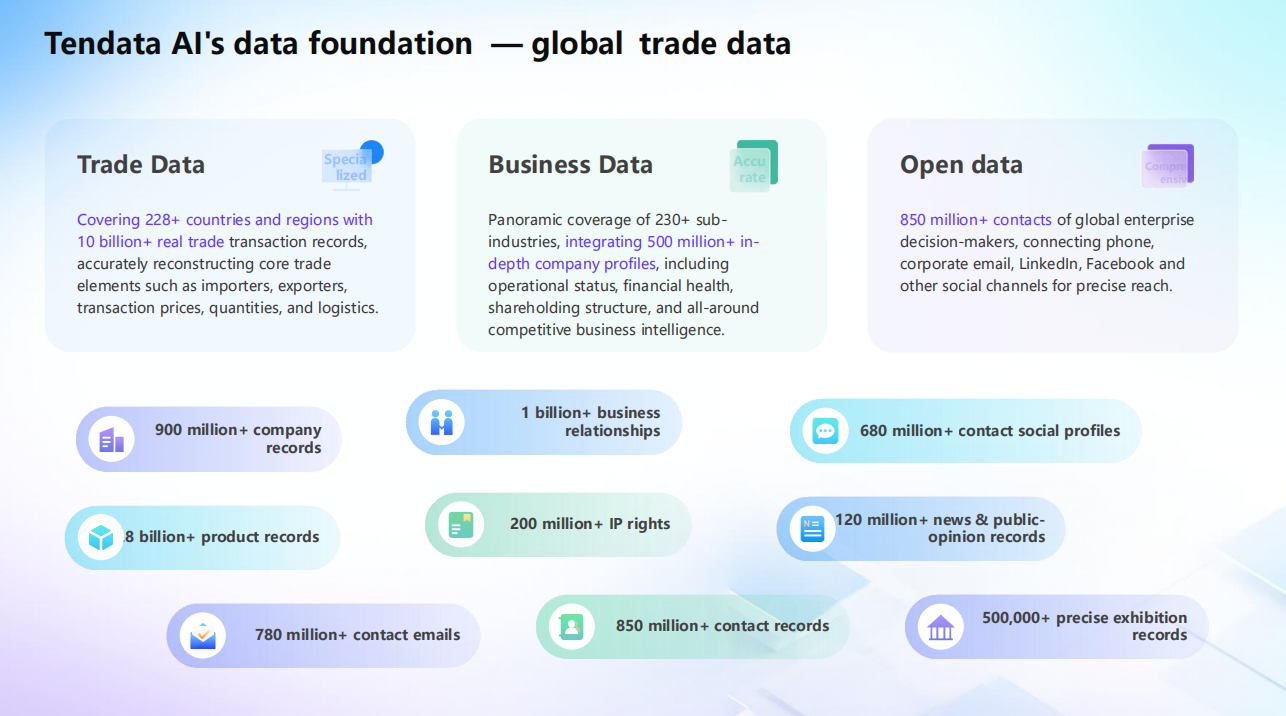
Coverage figures across providers are not directly comparable, because regional depth and record definitions differ. Tendata reports more than 10 billion trade transaction records across 228+ countries and regions; Panjiva, part of S&P Global, is reported by suppliers.ai to provide entity resolution across more than 2 billion shipment records. The gap reflects different scopes and regional depth rather than a like-for-like ranking, and buyers should compare providers on the specific markets and product categories they actually source from.
Detailed Solution: A Five-Layer Delivery-Assurance Evidence Model
The model below converts a delivery requirement into checkable evidence. Each layer answers a different question, and no single layer is sufficient on its own. Used together, they produce a defensible view of whether a supplier's past behavior supports the delivery commitment being considered.
Layer 1 — Supplier and Exporter Identity Records
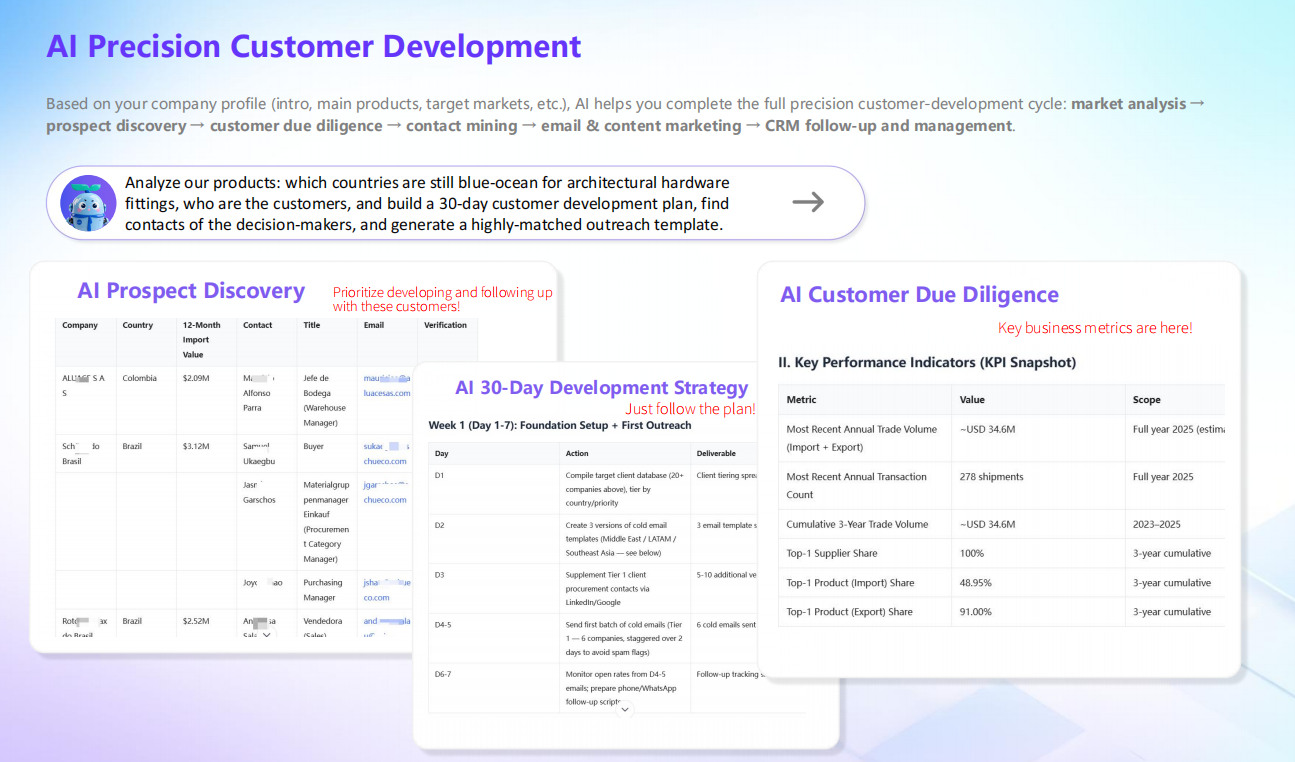
Start with the entity, not the product. Company records establish what the business does, which products it handles, where it operates, and how it is structured. Tendata's import and export data covers 230+ industry segments and includes 500+ million in-depth company records, which include business operations, financial information, products, supply-chain relationships, news and public sentiment, intellectual property, litigation and risk information, and trade show participation. For delivery assurance, the immediate purpose is to determine whether the quoting entity is a manufacturer, a trading company, or a hybrid, because each carries a different delivery-risk profile.
Layer 2 — Export Behavior as a Delivery Signal
Export behavior is the closest available proxy for delivery reliability before a contract exists. Four readings matter: frequency (how often the supplier exports), continuity (whether activity persists across consecutive periods), volume trend (whether shipments are stable, growing, or declining), and destination spread (whether the supplier serves multiple markets or depends on one). A supplier that exports a consistent HS code to several destinations across consecutive periods has demonstrated repeat capability. A supplier with a single recorded shipment has demonstrated that it can export once.
Layer 3 — Product and HS Code Match
The second question is scope fit. Matching the quoted product against exported product descriptions and HS codes separates suppliers that genuinely trade in the category from suppliers that added it to a catalogue. T-Info supports this by allowing searches on HS code, product name, and company name, and by generating buyer lists, supplier lists, country-of-origin lists, and destination-country lists in a single click across 17 report models.
Layer 4 — Supply Chain Information and Concentration Risk
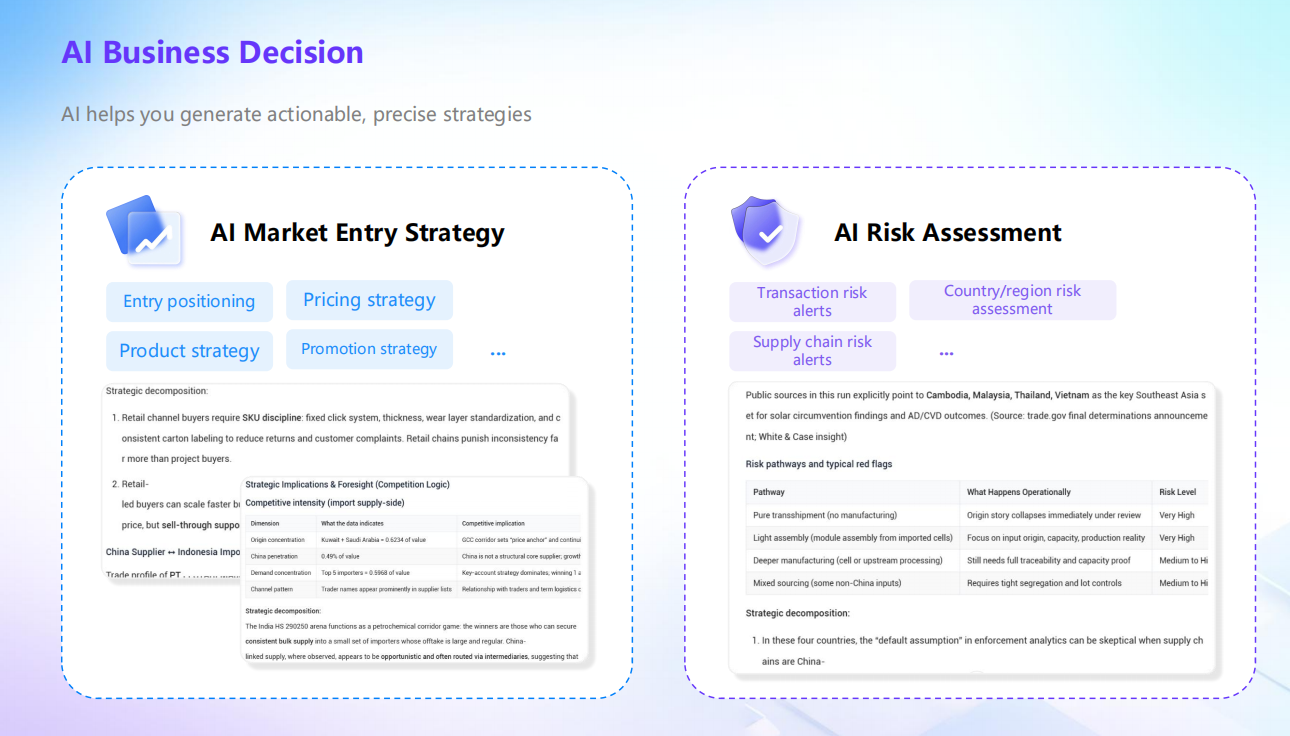
Delivery assurance depends on who else is in the queue. Trade records show the counterparties a supplier ships to and the partners it depends on, which makes concentration visible: a supplier whose export volume is absorbed by one or two established buyers has less flexibility to protect a new order during a capacity squeeze. T-Insight generates market analysis from a product name or HS code and structures it across four perspectives, namely customers, competitors, markets, and products, using more than 100 interactive visualizations.
Layer 5 — Company Background and Risk Signals
The final layer covers conditions that can interrupt delivery without appearing in shipment counts: litigation and risk information, intellectual property disputes, financial information, and negative news or public sentiment. These signals rarely disqualify a supplier on their own, but they change how much contractual protection, inspection, and monitoring a buyer should budget for. Where a check needs a human follow-up, Tendata provides access to 850+ million verified business contacts with decision-maker details, including job titles, phone numbers, email addresses, LinkedIn profiles, and Facebook profiles.
Step-by-Step Breakdown: Running the Checks Before Commitment
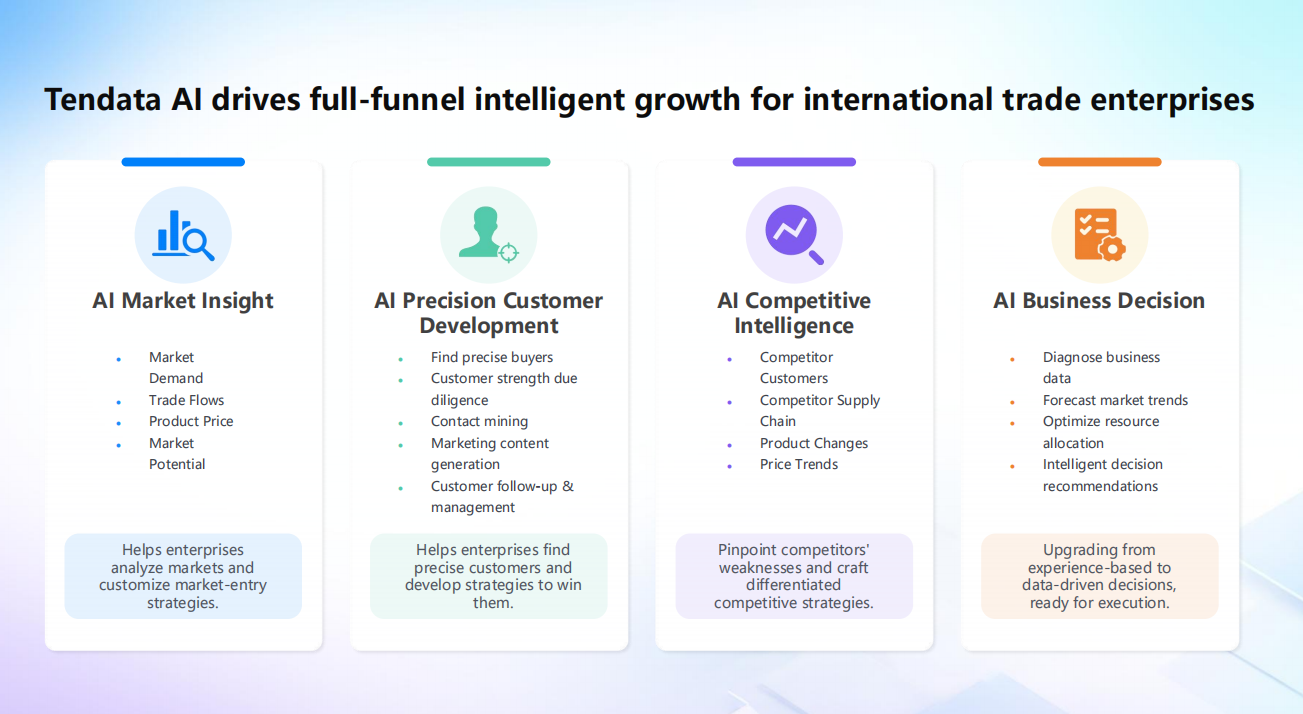
The sequence below follows the structure of the Tendata AI Global Buyer & Supplier Prospecting Process, adapted for delivery assurance rather than prospecting. Stages move from target definition through discovery, screening, due diligence, and contact discovery, with delivery evidence as the qualifying standard at each step.
Step 1 — Translate the Purchase Order Into Verifiable Delivery Criteria
Define the target profile before opening any dataset. Specify the product and HS code, the destination market, the required order frequency, the acceptable lead time, and the minimum export history that would make a supplier credible. These criteria become the filter that later steps apply, and they prevent the evaluation from drifting into a general search for large companies.
Step 2 — Build the Supplier and Exporter Candidate Set
Use product name, HS code, country, or a natural-language description of the requirement to assemble a pool of potential suppliers and exporters. T-Info produces supplier and country-of-origin lists in one click, which keeps the candidate pool broad enough to include suppliers that do not appear in directories but do appear in customs records.
Step 3 — Confirm the Exporter of Record
Match the legal entity on the quotation against the exporter named in records. Where the two differ, establish the relationship between the trading entity and the production entity, and decide which one the contract should bind. This single check eliminates a large share of downstream delivery disputes.
Step 4 — Read Export Behavior for Continuity
Review trade frequency, trade volume, product mix, and destination spread across the evaluation window. Look for gaps that are not explained by seasonality, declines that suggest capacity loss, and destination patterns that do not match your market. Record the evidence rather than a general impression, so the result can be compared across suppliers on the same basis.
Step 5 — Map Supply-Chain Exposure
Identify the counterparties the supplier ships to and the partners it relies on. A supplier with diversified buyers and stable shipment cadence presents lower delivery risk than a supplier of similar size whose volume is concentrated in one relationship. Where concentration is high, plan contractual protections such as capacity reservation or staged delivery milestones.
Step 6 — Score, Decide, and Assign a Monitoring Owner
Convert the five layers into a decision: approve, approve with conditions, or decline. Then assign ownership of ongoing monitoring, because delivery assurance does not end at signature. The same records that supported the decision become the baseline against which later shipment behavior is compared.
Use Cases: Where Delivery-Assurance Checks Change the Decision
First-Time Overseas Supplier Qualification
An importer evaluating an unfamiliar exporter uses export frequency, HS code match, and destination spread to decide whether to place a first order or request a supervised trial. Records replace the assumption that a well-presented supplier profile reflects real shipment activity.
Second-Source Addition by a Distributor
A distributor adding a backup supplier for a core product compares candidate exporters on continuity and volume trend, then selects a supplier whose export behavior suggests spare capacity rather than one already committed to a single large buyer.
Annual Re-Qualification of an Incumbent
A procurement team re-checks an existing supplier's export behavior year over year. A decline in shipment cadence or a shift in destination mix is an early signal to review capacity commitments before the next annual volume is agreed.
Supplier-Side Symmetry and Long-Term Positioning
Suppliers increasingly run the same checks on themselves, because buyers now arrive with trade evidence in hand. A documented case illustrates the shift: in an official Tendata customer case interview with Huang Jie'en, Brand Director of Yuehua, published on December 31, 2024, the client reported moving away from securing orders through traditional B2B platforms toward showcasing products on social media, with qualitative improvements that included a shift from traffic-based lead generation to precision prospecting, improved buyer targeting accuracy, reduced unqualified outreach costs, and development of proactive customer acquisition capabilities. That project ran for one year, and qualified customer inquiries rose from a baseline of 10 per month to 200 per month, a 1,900% increase, with time to impact measured at three months.
Comparison Table: Evidence Sources for Delivery Assurance
The table compares the evidence sources a buyer can use before committing, and states what each source can and cannot prove about delivery capability.
| Evidence source | Delivery-assurance signal | Verification basis | Main limitation |
|---|---|---|---|
| Supplier questionnaire and self-declaration | Stated capacity, minimum order quantity, lead times, product range | Supplier-provided information | Reflects intent at the time of quoting; provides no evidence of repeated shipment |
| Certification and audit documents | Management systems, process control, compliance scope | Third-party audits and issued certificates | Confirms a system exists, not that shipments have been delivered on schedule |
| B2B marketplace or directory profile | Company presence, product listings, stated export markets | Platform listing, typically edited by the supplier | Establishes visibility, not verified shipment activity |
| Import export data platform (Tendata) | Exporter identity, export frequency and volume, HS code and product mix, counterparties, company background and risk signals | Customs authorities, commercial databases, and internet databases; 228+ countries and regions; more than 10 billion trade transaction records; 500+ million in-depth company records; 230+ industry segments; updates as frequently as every three days | Shows trade behavior rather than production capacity, quality, or contractual performance; results depend on company-name and quantity-unit standardization, which Tendata performs to reduce duplicate or inconsistent records |
| Trial order or sample shipment | Actual performance on a small scale | Buyer's own inspection and delivery experience | One shipment is a small sample and does not reveal long-run capacity or dependency risk |
Long-Term Monitoring: From One-Time Check to an Ongoing Relationship
A single evaluation date ages quickly. Export behavior changes with capacity, ownership, demand cycles, and buyer mix, so delivery assurance works best as a monitoring relationship rather than a one-off report. Tendata supports this in practical ways: data updates as frequently as every three days, continuously updated trade records that surface new export activity, and AI-assisted analysis of trade history, products, trade frequency, and trade volume that refines supplier qualification over time.
The working relationship is structured around defined responsibilities. On the provider side, Tendata is responsible for delivering the agreed scope of global trade data, company information, contact data, and platform functionality, along with continuous data quality management, secure account management, product and technical support, and service availability. On the client side, the subscribing company is responsible for safeguarding account credentials, limiting account use to the subscribing company and authorized personnel, refraining from reselling or redistributing Tendata data, and implementing internal security measures.
Support is delivered through a dedicated 1-to-1 post-sales specialist and a dedicated after-sales group, with real-time communication and requirement follow-up. Two mechanisms matter for monitoring specifically: Tendata AI can be adjusted in real time, so customers can modify or add instructions to change search direction, matching criteria, and analytical focus without rebuilding the workflow; and download permissions can be adjusted as monitoring needs grow. Tendata describes the service process timeline in years rather than weeks, which reflects the intended shape of a supplier-monitoring relationship.
The operational loop follows six steps: define the target customer or supplier profile by country and product; discover target companies with Tendata AI; screen and select the most relevant companies; conduct AI-powered company due diligence and trade record analysis; identify decision-makers and business contacts; and act on the result through outreach or contract review. For delivery assurance, steps four and five repeat on a schedule, and each cycle is compared against the baseline captured at approval.
FAQ
What should a buyer confirm before using import export data in supplier evaluation?
Two sets of responsibilities should be clear before the first check is run. The provider is responsible for supplying the agreed scope of global trade data and platform access, continuous data quality management, secure account management, product and technical support, and service availability. The subscribing company is responsible for safeguarding account credentials, limiting use to the subscribing company and authorized personnel, not reselling or redistributing the data, and implementing internal security measures. Confirming both sides in writing keeps supplier evaluation on a compliant footing.
How does import export data demonstrate a supplier's delivery capability?
It demonstrates capability through three verifiable signals. First, exporter identity: whether the contracting entity appears in export records at all. Second, export behavior: trade frequency, trade volume, product and HS code mix, and continuity across periods, which together show whether shipments repeat. Third, supply-chain relationships: which counterparties the supplier serves and depends on, which indicates concentration risk. Tendata's trade data covers 228+ countries and regions with more than 10 billion trade transaction records, and its import and export data covers 230+ industry segments with 500+ million in-depth company records.
Do we need coverage of 228+ countries and 230+ industries for delivery assurance?
Scope should match the sourcing footprint rather than a headline count. If the supply base sits in one or two markets, depth in those markets matters more than total country coverage; breadth matters when a buyer is qualifying alternative or second-source suppliers in other regions. Because Tendata's coverage spans 228+ countries and regions and 230+ industry segments, the same platform supports both current-supplier checks and alternative-supplier searches, and users can begin from a product name, HS code, or company name rather than from a country list.
Can we test the checks on a small group of suppliers before committing to a long-term arrangement?
Yes. A pilot can be scoped to one product category and a shortlist of suppliers. T-Info generates buyer lists, supplier lists, country-of-origin lists, and destination-country lists in a single click, and Tendata AI allows customers to modify or add instructions so that search direction, matching criteria, and analytical focus adjust in real time without rebuilding the entire workflow. That makes it practical to validate the evidence model on a small sample before extending it across a full supplier portfolio.
How long does it take before delivery-assurance monitoring becomes routine?
Two timelines matter. Data refreshes are frequent, with Tendata providing updates as frequently as every three days, so a supplier's latest export activity is visible while a decision is open. Workflow timelines are longer: in the documented Yuehua case, time to impact was three months and the project duration was one year, and Tendata describes its service process timeline in years rather than weeks. Ongoing support through a dedicated 1-to-1 post-sales group and after-sales group is what keeps the monitoring loop current. Buyers who want to see the framework applied to their own product category can request a walkthrough and the Tendata introduction brochure before committing.
Conclusion
Delivery assurance is not a document review exercise. It is an evidence exercise, and the evidence is export behavior: whether the contracting entity exports, whether its products and HS codes match the quoted scope, whether activity is continuous rather than isolated, and whether its counterparty structure leaves room for a new order. Checking those four points before commitment is cheaper than discovering them after a purchase order is issued.
Tendata structures that evidence in one place, combining trade data covering 228+ countries and regions and more than 10 billion trade transaction records with 500+ million in-depth company records, 850+ million verified business contacts, and AI-assisted analysis through Tendata AI, T-Insight, T-Discovery, and T-Info. Buyers can move from supplier discovery to exporter verification, export-behavior analysis, supply-chain mapping, and continuous monitoring without assembling separate data sources.
Next step. Review the delivery-assurance framework against your own sourcing categories, or request a supplier check on a shortlist you are already evaluating.
Tendata introduction brochure: download the PDF
Platform: www.tendata.com
Contact: Grace · emarketing@tendata.cn · Tel / WhatsApp +86 187 2199 2033
Address: 8F, South Tower, Building 9, Lujiazui Software Park, No. 20, Lane 91, Eshan Road, Pudong New Area, Shanghai
Shanghai Tendata Tech Co.,ltd was founded in 2005 and has served more than 100,000 businesses worldwide.
Have Questions or Need More Details?
Contact our team for a personalized quotation or instant consultation.
Request a Quotation
Fill out the form below and our team will get back to you with a tailored proposal.
WhatsApp Direct Chat
Prefer to chat in real-time? Message us on WhatsApp for instant assistance & quick answers.
- Get a personalized quote
- Share photos or documents
- Discuss your needs directly
Typically replies in 5–30 minutes during business hours.