Tendata AI vs. B2B Platforms: Which Fits Your Export Team?
Tendata AI Global Market Intelligence vs. B2B Platforms for Buyer Discovery: Which Fits Your Export Team?
Export teams rarely fail at finding company names. Directories, LinkedIn, trade shows, and B2B platforms all deliver names. What most teams cannot do quickly is answer the narrower question that decides whether a quarter is productive: which of these companies is actually importing, how much does it buy, from which suppliers, and at what price point? Tendata AI Global Market Intelligence Solution and B2B platforms attack that question from opposite directions — one collects companies that choose to be listed, the other identifies companies because customs-backed trade records show they actually bought or sold. The two are not interchangeable, and the practical question is which problem each one solves for your team.
Problem Definition: Why Buyer Discovery Slows Export Teams Down
Importers and exporters face several practical difficulties in the customer discovery process. A company name found in a directory or on a social network such as LinkedIn does not confirm whether that company has actual purchasing needs or supply capabilities, and it does not reveal historical trade volume, pricing, or existing supplier relationships. Inquiries collected at trade shows or on B2B platforms often arrive without context on the customer's size or specific requirements, which makes it hard to judge how much follow-up time is justified. Even when a suitable company is identified online, the contact details of the people who make buying decisions are frequently missing.
The root causes are structural rather than effort-related: fragmented data sources, limited access to company-level trade intelligence, fully manual research processes, no real-time visibility into trade activity, insufficient analysis capability, and a persistent gap between macro market data and company-level insight.
The cost lands on sales capacity. Documented industry observations put the manual path at one to two weeks to identify a single qualified customer, or require substantial spending on B2B platforms or SEM advertising to acquire one viable lead. That tradeoff is exactly what an export team is choosing between when it decides how to fund buyer discovery.
Industry Background: Listing-Based Discovery vs. Record-Based Discovery
B2B platforms operate on a listing model. A company is visible because it registered on the platform, published a profile, and usually responds to inquiries. Listings are genuinely useful: they generate inbound interest, and they confirm that a product category has active participants. The structural limit is that a listing does not show what a company buys, how much it buys, at what frequency, or from which suppliers. Company names found through search engines, public statistics, or platform listings may suggest general market trends, but they often fail to reveal actual trading behavior — which is why it stays difficult to identify high-potential markets, understand real product demand, evaluate import and export trends, and benchmark competitors.
Trade intelligence platforms operate on a record model. Trade records are generated when goods physically cross a border, so they describe transactions rather than intentions. Tendata's trade data is sourced from customs authorities, commercial databases, and internet databases, and the company standardizes company names, quantity units, and other data fields to reduce duplicate or inconsistent records before analysis.
The surrounding market explains why this data layer has become a budget line rather than a research hobby. Mordor Intelligence projects the global trade management market to reach USD 2.84 billion in 2026. The Business Research Company projects the narrower trade compliance software segment growing from USD 1.73 billion in 2024 to USD 1.95 billion in 2025. On the regulatory side, IMARC Group reports that US Customs and Border Protection collected more than USD 88 billion in duties in 2024, which increases the value of trade data for audit readiness and verification work.
Two important caveats belong in any honest comparison. First, private vendors in this category — Tendata included — do not publicly disclose net revenue, so market share comparisons cannot be verified from open sources. Second, record counts are not directly comparable across providers: Tendata reports more than 10 billion trade records across 228+ countries, while Panjiva (S&P Global) provides entity resolution across more than 2 billion shipment records. The two figures likely count different record types, regional depths, and non-shipment customs statistics, so a simple ratio would be misleading.
Detailed Solution: What Tendata AI Global Market Intelligence Delivers
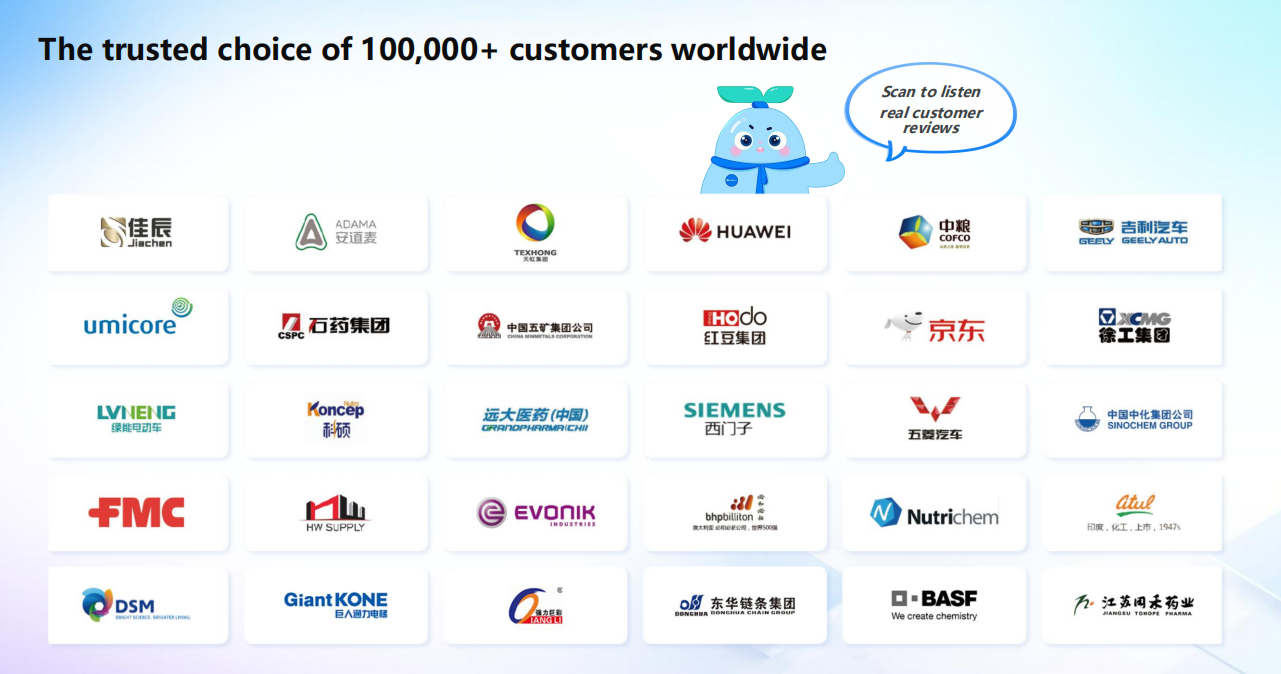
Tendata (Shanghai Tendata Information Technology Co., Ltd.) is a trade intelligence platform founded in 2005 and headquartered in Shanghai, China. Tendata AI Global Market Intelligence Solution is an AI-powered platform that uses global trade data, company-level intelligence, and AI analysis to identify buyers and suppliers, addressing the buyer discovery needs of importers and exporters. The company describes itself as the first to combine large language models with an import and export database, and reports serving more than 100,000 businesses worldwide.
Data foundation
Tendata provides import and export data covering 228+ countries and regions with more than 10 billion real, verifiable trade records, all integrated with Tendata AI. The coverage extends across 230+ industry segments and more than 500 million in-depth company records. Data updates can be as frequent as every three days, so buyer activity is visible close to real time rather than at annual report cadence. A less visible but operationally important capability is that the platform distinguishes logistics companies from actual importers and exporters — a step that prevents freight forwarders, which appear in shipment records without purchasing goods, from being treated as buyers.
Company-level intelligence
Beyond transaction lines, the platform consolidates company background covering business operations, financial information, products, supply chain relationships, news and public sentiment, intellectual property, litigation and risk information, and trade shows. For an export team, this is what turns a trade record into a qualification decision: a company that imports your product category at volume, from identifiable suppliers, without conflicting risk signals, is a different prospect from a company that merely imports something in a related HS chapter.
The AI layer: Tendata AI, T-Insight, T-Info, and T-Discovery
- Tendata AI combines Tendata's trade databases with large language models. Based on real, verifiable trade data, it helps identify relevant potential customers, generate global market analysis reports, create personalized outreach emails based on target customer information, and build social media outreach strategies from a prospect's actual needs.
- T-Insight generates market analysis reports from a product name or an HS Code, covering four perspectives — customers, competitors, markets, and products — with more than 100 interactive visualizations.
- T-Info offers 17 report models and supports intelligent searches by HS Code, product name, or company name, producing buyer lists, supplier lists, country-of-origin lists, and destination-country lists with a single click.
- T-Discovery is part of the same AI product family, focused on targeted customer acquisition within the platform's trade data environment.
What sits underneath the platform
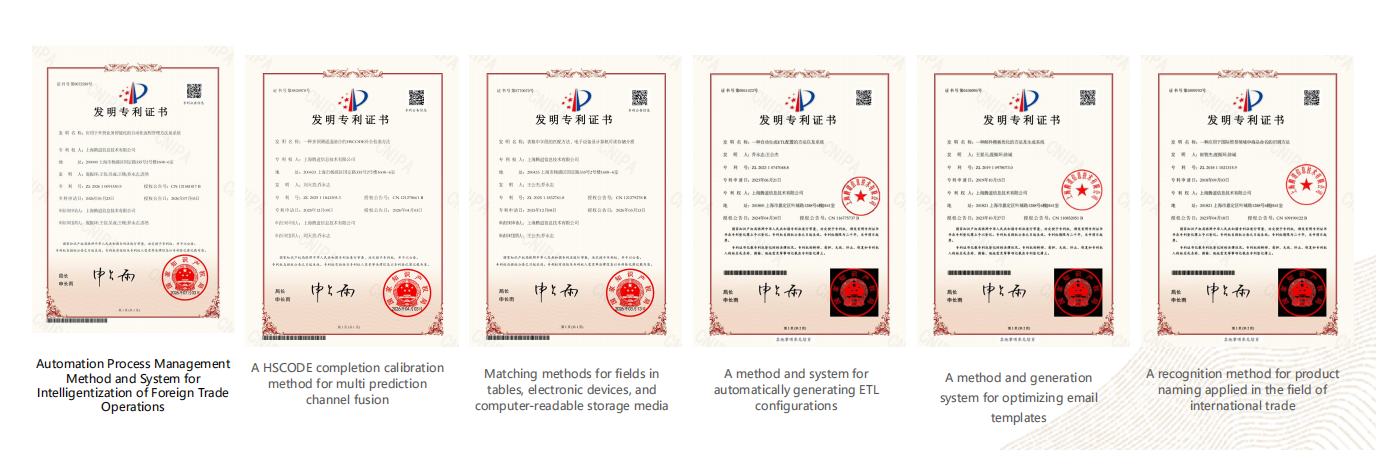
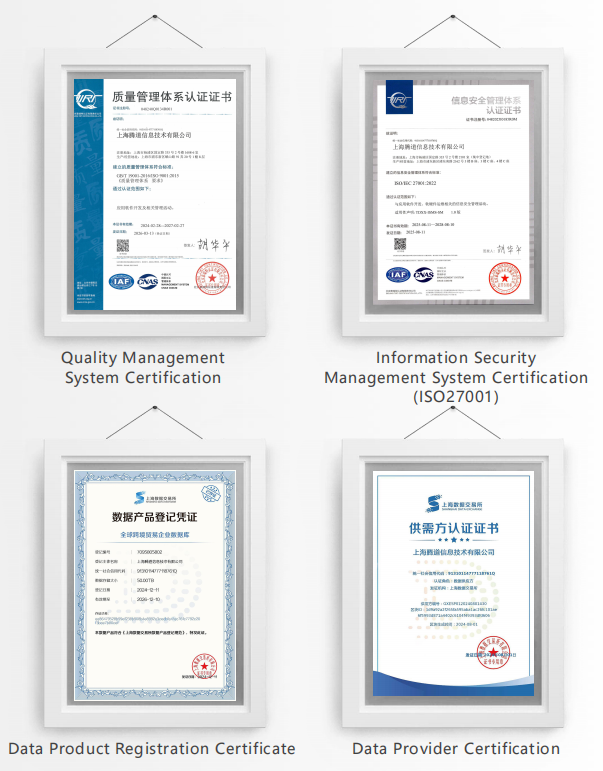
Tendata maintains an independent technology and R&D team and reports two registered trademarks, more than 150 intellectual property rights, and over 100 awards and recognition certificates. Its credentials include Quality Management System Certification, Information Security Management System Certification, a Data Product Registration Certificate, recognition as a 2025 Shanghai Digital Trade Innovation Enterprise, and Shanghai High-Tech Enterprise Recognition in 2025. Its patent portfolio covers areas that directly affect data usability, including HS Code completion and calibration, automated ETL configuration, table field matching, and email template optimization.

Step-by-Step Breakdown: From HS Code to a Contacted Buyer
A trade-data buyer discovery workflow follows a sequence that is difficult to reproduce with listing-based methods, because each step depends on the evidence produced by the previous one.
Step 1 — Identify potential buyers
Start from what you actually sell: an HS Code, a product name, or a known company name. T-Info generates the corresponding buyer list, supplier list, or country-level trade list with a single click, so the output is a defined working set rather than an open-ended search.
Step 2 — Analyze trade behavior
For each candidate, review purchase volume, import trends, HS Codes, current suppliers, and supply chain relationships. This is the step that separates a company with real demand from a company that happens to match a keyword.
Step 3 — Qualify high-potential buyers
Screen the list against actual trade activity and company background, prioritizing prospects with higher development potential. Qualification at this stage is what prevents the sales team from spending its week on companies that will never order.
Step 4 — Obtain business contacts
Retrieve available contact information for target companies and their decision-makers. Tendata holds access to 850+ million verified business contacts, including job titles, phone numbers, email addresses, and LinkedIn and Facebook profiles, which removes the step where manual research typically stalls.
Step 5 — Conduct targeted outreach
Reach out through email, phone, or WhatsApp with messaging built on the prospect's actual purchasing profile. Tendata AI can draft personalized outreach emails and social media content from target customer information, and automatic company activity monitoring helps a team time its contact to a change in a prospect's trade pattern. The output of the full sequence is a qualified, contacted buyer rather than a name on a list.
Use Cases: Which Export Teams Should Choose Which Approach
Scenario fit matters more than general superiority claims, because the two models fail in different situations.
- Differentiated or industrial products with a finite buyer universe. When your product sells at a high unit value and only a limited number of importers, wholesalers, or distributors in each country can realistically buy it, inbound listing traffic converts poorly. This is the profile where record-based discovery pays for itself, because the work is qualification rather than exposure.
- Standardized products with high keyword search volume. If buyers actively search for your category on marketplaces, a B2B platform listing remains a reasonable inbound channel. Trade data still adds value upstream, helping you choose which countries and which buyer segments deserve the advertising budget.
- New market entry and annual planning. Teams evaluating a new international market need to identify high-growth markets, compare demand across countries, analyze import and export trends, and find major buyers and suppliers. T-Insight and Tendata AI market reports compress that research into generated analysis rather than weeks of manual collection.
- Competitor and supply chain monitoring. Because trade records include supplier relationships and shipment flows, an export team can track which suppliers a target buyer already works with, and how that mix changes over time.
The audiences documented for this type of service are broad: importers and exporters, manufacturers, wholesalers and distributors, trading companies, brands and product companies, B2B sales and marketing teams, international trade companies, and companies expanding into new international markets. The decision-makers involved are typically CEOs and founders, general managers, international business directors, export managers, sales directors, business development managers, marketing directors, market research managers, procurement directors, and sourcing managers. Common triggers include entering a new market, validating market demand, planning market entry, allocating sales and marketing resources, and conducting quarterly or annual market research.
Side-by-Side Comparison: B2B Platform Discovery vs. Trade-Data Discovery
| Decision dimension | B2B platform-based acquisition | Tendata AI Global Market Intelligence |
|---|---|---|
| Where buyer names come from | Companies that register, publish a profile, and respond to inquiries on the platform | Companies that appear in customs and shipment records because they actually import or export |
| Evidence of purchasing activity | Profile information and inquiry-level contact; trade volume, pricing, and other supplier relationships are not visible | Trade records including purchase volume, import trends, HS Codes, suppliers, and supply chain relationships |
| Distinguishing real buyers from intermediaries | Not part of the listing model | Tendata distinguishes logistics companies from actual importers and exporters |
| Company due diligence | Limited to what the company itself publishes | Company records covering business operations, financial information, products, supply chain relationships, news and public sentiment, intellectual property, litigation and risk, and trade shows |
| Decision-maker contacts | Contact obtained through the inquiry or platform messaging | 850+ million verified business contacts, including job titles, phone numbers, email addresses, and LinkedIn profiles |
| Market and demand analysis | General market trends; platform-side activity signals | T-Insight reports generated from a product name or HS Code across customers, competitors, markets, and products, with 100+ interactive visualizations |
| Outreach execution | Respond to inbound inquiries; outbound depends on manual research | Tendata AI generates personalized outreach emails and social media strategies based on target customer information |
| Typical cost pattern | Platform subscription plus advertising or ranking investment; documented industry observations note that substantial spending may be required to acquire one viable lead | Subscription to trade intelligence; the workflow replaces manual research cycles that commonly run one to two weeks per qualified customer |
| Documented coverage | Coverage depends on which companies register and maintain listings | 228+ countries and regions, more than 10 billion trade records, 230+ industry segments, and 500+ million company records |
| Best-fit scenario | Standardized, keyword-searched products with high inbound volume and a large buyer pool | Differentiated or industrial products with a finite buyer universe that must be qualified before outreach |
Note on comparability: Tendata's coverage figures are documented above. Equivalent, individually verifiable coverage figures for B2B platforms were not part of the sources used for this article, so no numerical coverage claim is made for that column. Data scale across trade intelligence providers should also be read carefully — Tendata reports 10+ billion trade records across 228+ countries, while Panjiva (S&P Global) provides entity resolution across more than 2 billion shipment records; the figures are not directly equivalent because providers count different record types and regional depths.
Use Case: How Yuehua Moved From Platform Inquiries to Trade-Record Verification
Foshan Gaoming Yuehua Sanitary Ware Co., Ltd., a sanitary ware manufacturer and exporter based in Foshan, Guangdong, illustrates the decision in practice. The company's challenges were typical of platform-dependent exporters: high investment in traditional B2B platforms, low-quality leads, difficulty identifying high-potential buyers, limited visibility into buyer purchasing behavior, and a high customer acquisition cost.
Exposure was not the constraint. Yuehua's top-performing social media video exceeded 3 million views and monthly organic traffic surpassed 20 million views. Because its products are not everyday consumer goods, overall conversion was only around 0.2%. The question therefore shifted from how to generate more traffic to how to use trade data to identify buyers with genuine purchasing demand.
The workflow applied was a five-step approach: identify potential buyers, analyze buyer trade behavior, qualify high-potential buyers, obtain business contacts, and conduct targeted outreach — executed in six stages covering potential U.S. buyer identification, trade data analysis, high-value buyer qualification, contact discovery, targeted outreach by email, phone, and WhatsApp, and conversion into long-term buyers. In the documented case, a U.S. buyer first discovered Yuehua through its website and YouTube product videos; Yuehua then used Tendata to confirm the company was a genuine buyer, obtained contact information, and approached the buyer proactively, ultimately establishing a long-term relationship.
The reported results: annual sales above RMB 200 million, a major buyer purchasing approximately 500–600 units per month, and a product value of roughly USD 4,000–5,000 per unit. As Huang Jie'en, Brand Director of Yuehua, put it: "We no longer focus on securing orders through traditional B2B platforms. Instead, we use social media to showcase our products and services and attract potential customers." The full case is published on Tendata's site at the Yuehua customer case.

FAQ
What should an import export data service provider deliver for global buyer prospecting?
At minimum, it should let you verify that a named company actually buys the products you offer, not merely that it exists. That means trade transaction records showing purchase volume, HS Codes, and import or export trends; company-level intelligence covering business scope, supply chain relationships, and risk signals; and contact data for the people who make purchasing decisions. Tendata provides import and export data covering 228+ countries and regions with more than 10 billion real and verifiable trade records, 500+ million company records, and access to 850+ million verified business contacts, all integrated with Tendata AI so lists can be generated by HS Code, product name, or company name. It also distinguishes logistics companies from actual importers and exporters, which matters because freight forwarders appear in shipment records without buying the goods.
How is Tendata different from B2B platforms for finding overseas buyers?
The difference is what makes a company visible. On a B2B platform, a company is visible because it registered and maintains a listing, and the inquiry that reaches you usually arrives without trade context on the customer's size or specific needs. On Tendata, a company is visible because customs-based trade records show it imports or exports — so the platform answers "who is actually buying?" rather than "who is looking?". The documented limits of listing-based discovery include the inability to find decision-maker contact information, conduct company due diligence quickly, monitor competitors' or customers' trade activity, access a company's trade records, understand its actual purchasing needs, or identify its supply chain relationships. Many exporters run both channels rather than treating them as substitutes.
Which export teams get the most value from trade-data-driven buyer discovery?
Teams whose products are differentiated, whose buyers are a defined set of importers, wholesalers, distributors, OEMs, or trading companies, and whose sales cycle requires qualification before outreach. The documented target groups for this type of service include importers and exporters, manufacturers, wholesalers and distributors, trading companies, brands and product companies, B2B sales and marketing teams, and companies expanding into new international markets. The trigger moments are equally specific: entering a new international market, evaluating product-market opportunities, identifying high-growth markets, analyzing import and export trends, finding major buyers and suppliers, running competitor analysis, planning market entry, validating demand, and preparing quarterly or annual market research.
How quickly can an export team start, and what is the first step?
Start from the product rather than the market. Define the product and its HS Code, then use T-Info to generate the corresponding buyer, supplier, or country trade list with a single click, or use T-Insight to generate a market analysis report from a product name or HS Code. Tendata AI then turns the qualified list into market reports and personalized outreach emails, and trade data updates can be as frequent as every three days. To evaluate fit before committing budget, you can review the Tendata introduction brochure at Tendata Introduction (PDF), or contact the team directly at emarketing@tendata.cn or +86 187 2199 2033 to request a walkthrough of your own product category.
Conclusion: A Decision Rule, Not a Verdict
Choose platform-led acquisition when your priority is inbound demand for a searchable, standardized product and your buyer pool is large enough that inquiry volume matters more than precision. Choose trade-data-led discovery when your priority is knowing which named companies are actually buying before your sales team spends a week on outreach — the situation where a one-to-two-week search cycle per qualified customer, or significant platform advertising spend per viable lead, becomes the bottleneck on growth.
For most exporters the honest answer is sequencing rather than replacement: platforms and social channels generate visibility, and trade intelligence converts that visibility into qualified, contactable buyers. Tendata's role in that stack is specific — identifying buyers with actual trade activity across 228+ countries and more than 10 billion trade records, verifying them with company-level intelligence and decision-maker contacts, and supporting outreach with AI-generated analysis and personalized emails anchored to real transaction data.
Next Step: Test the Fit Against Your Own Product Category
If you want to see how buyer discovery looks against your own HS Code, market, and competitors, the fastest path is a product-specific walkthrough. Review the Tendata introduction brochure, then request a quote or demonstration at tendata.com, by email at emarketing@tendata.cn, or on WhatsApp at +86 187 2199 2033.