Tendata Buyer Discovery vs. Market Intelligence: Which Import Export Data Path First?
Short answer: If your product and target country are already decided and your bottleneck is pipeline, start with Tendata Global Buyer & Supplier Discovery. If the country itself is still an open question and you need to decide where to compete, start with the Tendata AI Global Market Intelligence Solution. Both run on the same Tendata data foundation — 228+ countries and regions, more than 10 billion trade records, and 230+ industries — so the decision is about workflow order, not about which data you own.
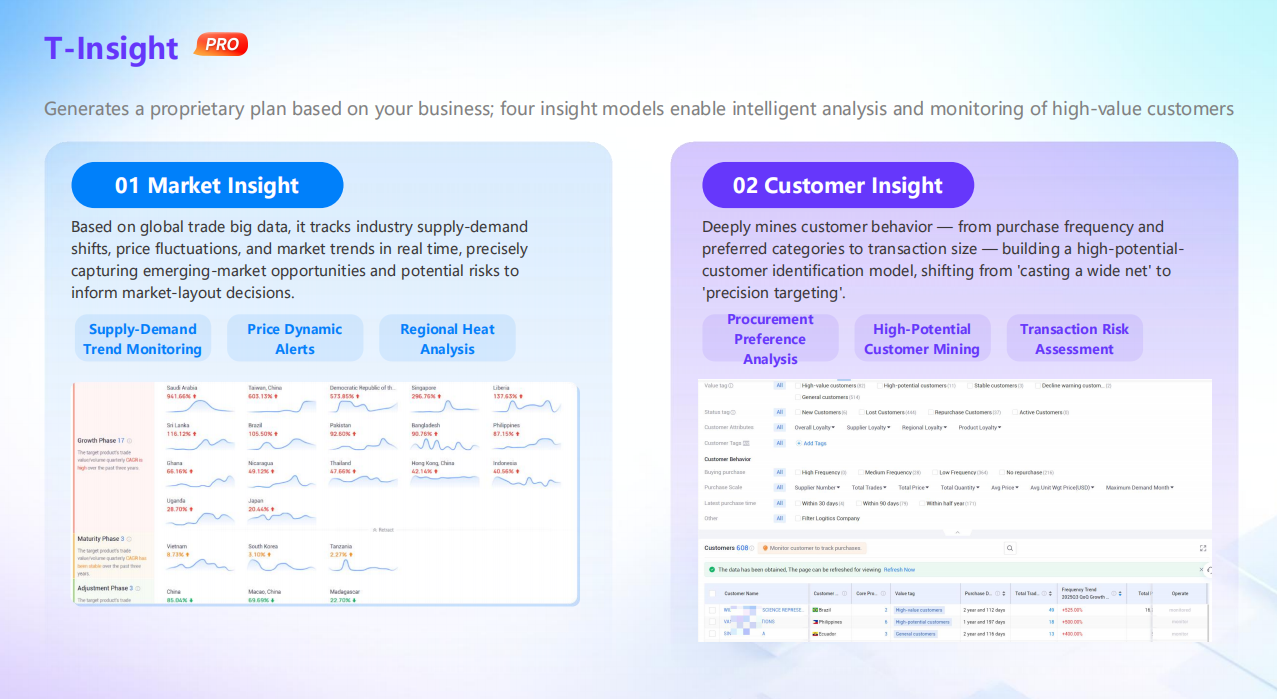
Market analysis output and buyer discovery output answer two different questions. Choosing the right one first is a sequencing decision.
Export teams rarely receive an unlimited budget for their first import export data subscription. They receive one allocation, one approval cycle, and one internal expectation: demonstrate that trade data produces commercial results. That is why the first real question is not which trade intelligence platform, but which path do we run first — buyer discovery or market intelligence?
This guide is written for the people who actually sign off on that first allocation: export managers, B2B sales and business development teams, procurement and sourcing teams, international business directors, and market research managers at manufacturers, trading companies, distributors, and wholesalers.
The Problem: One Budget, Two Very Different First Moves
Buyer and supplier discovery and market intelligence are often described as if they were the same feature set sold twice. They are not. They start from different inputs and end in different deliverables.
- Buyer & Supplier Discovery starts from a product and a market you have already chosen. It ends in a list of companies with actual trade activity records, their purchasing or export behavior, their supply chain relationships, and available decision-maker contacts.
- Market Intelligence starts from a product and an open question about where to go. It ends in a market verdict: market size and growth, product demand, country comparison, trade flow direction, competitor presence, and continuous monitoring.
Choose the wrong one first and the failure mode is predictable. Run market intelligence when you already know your country and you get a well-structured report but no pipeline. Run buyer discovery before the market is validated and you build carefully researched lists in countries with weak or declining demand.
The industry problem data behind this article describes the outcome in the same terms: slower market expansion, sales and marketing resources allocated to countries or products with limited demand, missed shifts in import activity, higher market research costs, and longer decision cycles. The allocation mistake is not a data problem — the data is the same. It is a sequencing problem.
Industry Background: Why Trade Data Moved the Starting Line
For most of the last two decades, international market research was assembled from fragments. Customs statistics, government trade publications, industry reports, B2B directories, company websites, and search engines each answered part of the question, and someone had to reconcile them in a spreadsheet.
The structural weakness of that model is well documented. Traditional macro-level reports can usually answer “how big is the market?” They are much weaker at answering “who is buying, who is selling, what they are buying, and who they are buying from.” Government statistics and purchased industry reports also move on quarterly or annual cycles, while trade flows change continuously.
Demand for verifiable, company-level trade information has grown alongside that gap. Third-party research places the global trade management market at a projected USD 2.84 billion in 2026 (Mordor Intelligence). On the enforcement side, US Customs and Border Protection collected more than USD 88 billion in duties in 2024 (IMARC Group) — a figure that reflects how much scrutiny now sits behind declared trade activity, and how much value importers and exporters place on being able to reconstruct it.
What changed is that import export data is no longer only a compliance artifact. It is now a commercial input. A shipment database or bill of lading database can be read two ways: as a record of what already happened, or as a signal about who is likely to buy or supply next. Those two readings correspond exactly to the two Tendata paths described below.
The Two Tendata Paths, Explained Side by Side
Both paths are delivered by Shanghai Tendata Tech Co., Ltd. (Tendata), a trade intelligence company founded in 2005 and headquartered in Shanghai, China, which specialises in global trade data and AI-powered analytics and has served more than 100,000 businesses worldwide.
Path A — Tendata Global Buyer & Supplier Discovery
Tendata Global Buyer & Supplier Discovery helps manufacturers, exporters, importers, trading companies, distributors, and B2B sales teams identify high-potential buyers and suppliers worldwide based on verified global trade data. It combines import export data, trade records, company information, company contacts, supply chain analysis, product analysis, and AI-assisted analysis so that a sales or sourcing team can move from a broad market to a shortlist of named companies with relevant activity.
What the path produces in practice:
- Lists of buyers, importers, suppliers, and exporters matched to a product, HS Code, and country or region.
- Target companies with verified import or export records rather than directory entries alone.
- Trade history, purchasing and export behaviour, trade frequency, trade volume, and product fit indicators.
- Company background information and supply chain relationships.
- Available business contact information for key contacts and decision-makers at target companies.
- AI-assisted outputs, including one-click customer due diligence and personalised outreach emails built on a prospect’s actual trade records.
The workflow the solution is designed around is linear and operational: Find → Analyse → Qualify → Contact → Engage. Coverage underpinning it includes 228+ countries and regions, more than 10 billion real and verifiable trade records, 230+ industries, and more than 500 million importers and exporters.
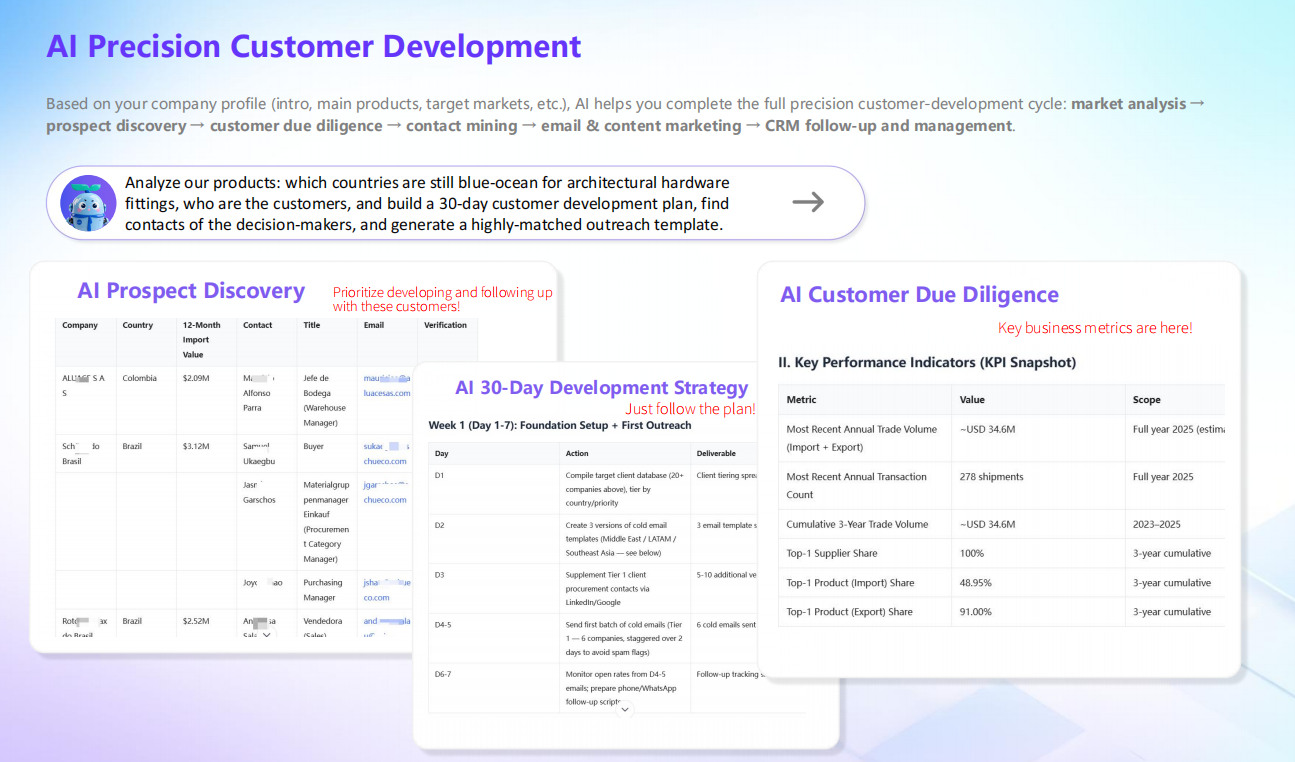
Buyer discovery converts a defined market into a qualified company list with contact paths.
Path B — Tendata AI Global Market Intelligence Solution
The Tendata AI Global Market Intelligence Solution combines global trade data, company-level intelligence, and AI-powered analysis so that a team can understand global market opportunities and shorten the distance between data retrieval and a market decision. Based on a company’s products, target markets, and research requirements, Tendata AI generates a structured market analysis report with one click.
What the path produces in practice:
- One-click AI market analysis reports covering market size and growth.
- Product demand and import/export trend analysis.
- Country and market comparison, so multiple candidate markets can be ranked rather than reviewed one at a time.
- Buyer and importer intelligence and supplier and exporter intelligence inside the same report.
- Competitor market analysis and global trade flow and supply chain analysis.
- Real-time global market monitoring and customised alerts when relevant market changes are detected.
The logic of the path follows four linked questions: Where is the market? → What is growing? → Who is buying? → Who is supplying? Tendata’s T-Insight module generates market analysis reports from a product name or HS Code and presents multidimensional analysis across four perspectives — customers, competitors, markets, and products — with more than 100 interactive visualisations. T-Info offers 17 report models with intelligent search by HS Code, product name, or company name, generating buyer lists, supplier lists, country-of-origin lists, and destination-country lists in a single click.
The most important design difference from a static report is continuity. A conventional market study describes a market at one point in time. Tendata AI converts one-time research into ongoing monitoring: users define the products, countries, and markets they care about, and the system pushes relevant market changes and alerts rather than waiting for someone to search again.
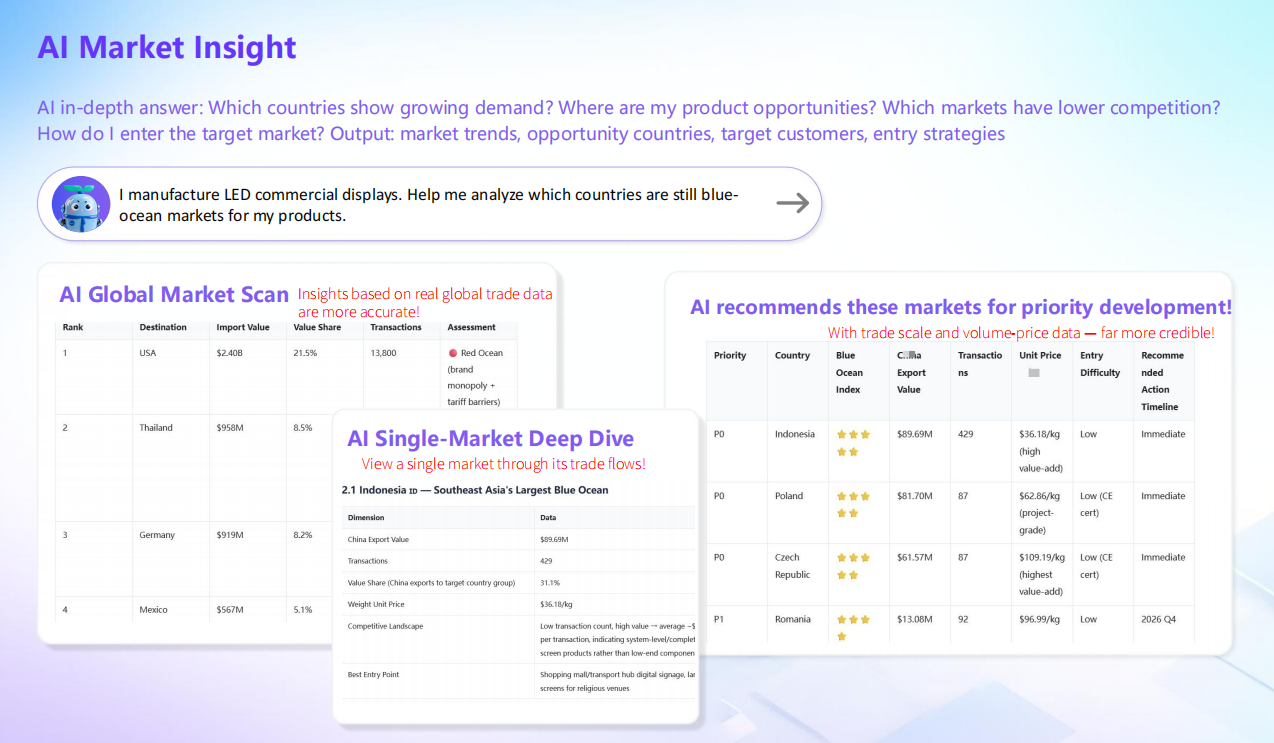
Market intelligence converts an open question about where to compete into a comparable country view.
What Both Paths Share — and Why That Matters for Sequencing
Both paths sit on one data foundation. Tendata’s trade data is sourced from customs authorities, commercial databases, and internet databases, is described as authentic and verifiable, and can update as frequently as every three days. Company names, quantity units, and other fields are regularly standardised to reduce duplicate or inconsistent records.
Both paths also draw on the same non-trade layer: 230+ industry segments and in-depth company records covering business operations, financial information, products, supply chain relationships, news and public sentiment, intellectual property, litigation and risk information, and trade shows. Across the platform, Tendata provides access to 850+ million verified business contacts, including decision-maker job titles, phone numbers, email addresses, and LinkedIn and Facebook profiles.
The practical consequence is simple: you are not choosing between two data subscriptions or planning two separate migrations. You are choosing the order in which your team activates two capabilities that live on one platform. That is why sequencing matters more than selection.

One platform, one data foundation: the buyer discovery and market intelligence paths are not separate purchases.
Step-by-Step: Choosing Your First Path
Step 1 — Fix the product scope and HS Code first
Both paths are only as precise as the input. Define the product, the relevant HS Code, and the adjacent categories that count as substitutes. Vague product scope produces vague buyer lists and vague market reports equally. T-Info supports search by HS Code, product name, and company name for this reason.
Step 2 — Answer one binary question: is the target country already decided?
This single question resolves most first-budget debates. If the country is locked — because of an existing distributor, a customer, a regulatory approval, or a trade show commitment — the open problem is pipeline, and buyer discovery is the shorter route. If the country is genuinely open, market intelligence comes first, because a qualified buyer list in the wrong market is still the wrong list.
Step 3 — Match the deliverable to the question you must answer
Ask what has to be true for the next internal meeting to end in a decision. If the meeting needs named companies and contact paths, the deliverable is a buyer and supplier list. If the meeting needs a ranked shortlist of countries with demand evidence, the deliverable is a market analysis report.
Step 4 — Run the first path on a narrow scope and review the output, not the data volume
Pick one product line and one or two countries. Generate the buyer list with trade activity and product fit, or generate the one-click market report with market size, growth, and product demand. Review whether the output answers your open question before widening scope.
Step 5 — Hand off to the second path once the first question is closed
Market intelligence names the market; buyer discovery populates it. Buyer discovery reveals which markets your existing buyers already operate in; market intelligence tells you whether those markets are growing. The handoff is where the two paths compound — and because both sit on one platform, the data behind the first decision is the data behind the second.
Use Cases: Which Path Fits Which Export Team
1. Exporter with a locked market and a pipeline gap
You already know the country and you need companies that are actually importing your product category. Buyer discovery is the correct first path: filter by product, HS Code, and country, then qualify on trade frequency, trade volume, and product fit, then work the available decision-maker contacts. Market intelligence adds context later, but it will not create the pipeline.
2. Exporter comparing three candidate countries
You have demand signals from enquiries or trade shows but no clear ranking. Market intelligence is the correct first path: compare market size and growth, product demand, and import activity across the candidate countries in one view, then move the winner into buyer discovery. This is also the sequence that prevents allocating sales resources to countries with limited demand.
3. Importer, wholesaler, or distribution business looking for suppliers
The discovery path is not only for sellers. Importers, wholesalers, and procurement teams use the same trade records in the opposite direction: identifying suppliers and exporters with verified export records, examining their export markets and activity, and locating alternative supply sources. Supply chain data resources of this kind are read as risk reduction, not lead generation.
4. Preparing for an overseas trade show
Trade shows are a two-step problem. Market intelligence tells you which region deserves the travel budget; buyer discovery builds the target list of importers and distributors to meet before you arrive. Teams that build the list first convert show time into conversations instead of badge scans.
5. Competitor and supply chain monitoring after the first year
Once you have buyers, the question shifts to change: has a customer started working with a new supplier, has a competitor entered a new market, has a supplier relationship shifted? Continuous monitoring and customised alerts are the market intelligence side of this; the buyer and supplier detail is the discovery side. Together they convert a one-time research project into a recurring review.
6. Quarterly or annual market research for management
When the deliverable is a board or management report, the market intelligence path is the natural fit: one-click report generation, market size and growth, product demand, country comparison, and ongoing monitoring that keeps the report current rather than frozen at the date it was written.
Comparison Table: Buyer Discovery vs. Market Intelligence
| Decision dimension | Global Buyer & Supplier Discovery | AI Global Market Intelligence Solution |
|---|---|---|
| Question it answers | Who is buying or supplying this product, and how do we reach them? | Where is demand growing, and which market should we prioritise? |
| Starting input | Product, HS Code, country/region, target company profile | Product, HS Code, target countries, business objectives |
| Primary outputs | Buyer, importer, supplier, and exporter lists; trade history; company profiles; available decision-maker contacts; AI-generated outreach content | One-click market analysis report; market size and growth; product demand; country and market comparison; competitor and trade flow analysis |
| AI layer | AI-assisted target company discovery and screening, one-click company due diligence, personalised outreach emails based on actual trade records | AI-generated market reports, market opportunity discovery, natural-language research input, customised market alerts |
| Monitoring behaviour | Customer monitoring; competitor and supply chain relationship tracking | Continuous real-time global market monitoring with proactive alerts based on user-defined criteria |
| Data foundation | 228+ countries and regions; 10 billion+ trade records; 230+ industries; 500+ million importers and exporters | Same Tendata data foundation, with 850+ million verified business contacts available across the platform |
| Best fit when | The country is defined and market entry is already decided | The country is still open and the entry decision is unresolved |
| Typical users | Export managers, B2B sales and business development teams, procurement and sourcing teams | General managers, international business directors, market research managers, strategy teams |
The rule in one line: market intelligence chooses the market; buyer discovery populates it. Whichever question is currently open decides which path runs first.
FAQ
Where does Tendata’s import export data come from, and what should a team check before relying on it?
Tendata’s trade data is sourced from customs authorities, commercial databases, and internet databases, and is described as authentic and verifiable. The company regularly standardises company names, quantity units, and other data fields to reduce duplicate or inconsistent records and support more accurate analysis. Coverage spans 228+ countries and regions and 230+ industries, with more than 10 billion trade transaction records accumulated, and data updates can be as frequent as every three days. Because country-level coverage and update frequency are not identical everywhere, buyers should confirm that the specific countries and HS Codes relevant to their own project are included before they build a decision around them. Coverage questions can be raised directly with the Tendata team at emarketing@tendata.cn.
Can buyer discovery also do market analysis, and can market intelligence also find buyers?
Both paths draw on the same trade data, company information, contact information, and AI layer, but they are built to output different things. Buyer and supplier discovery produces company-level deliverables: lists of buyers, importers, suppliers, and exporters with verified trade records, trade history, purchasing and export behaviour, supply chain relationships, and available decision-maker contacts, plus AI-generated due diligence and outreach content. Market intelligence produces market-level deliverables: one-click market analysis reports, market size and growth, product demand, country comparison, competitor market analysis, and continuous monitoring with alerts. They overlap where buyer and importer intelligence and supplier and exporter intelligence appear inside a market report, which is why the two paths are best treated as a sequence rather than as substitutes.
How should an export team allocate its first import export data budget between the two paths?
There is no universal split, but the sequencing logic reduces the risk. Because both paths operate on one platform and one data foundation — the same 228+ countries and regions, 10 billion+ trade records, and 230+ industries — a first allocation is not a choice between two separate data purchases. It is a choice about which workflow to activate first. Allocate the first cycle to the path that closes the question currently blocking your next internal decision: if the country is fixed, that is discovery; if the country is open, that is market intelligence. Hold the second path for the moment the first question closes, then move the same account into the next workflow. Both are delivered through an online platform with on-site implementation.
How can a team evaluate the platform before committing to a full rollout?
The most practical starting point is the published Tendata introduction brochure, which is publicly available to download and outlines the platform, its modules, and its coverage. From there, the shortest path to clarity is a direct conversation about your own case: describe the product, the HS Code, and the countries you are considering, and ask which path applies to your first project. Tendata can be reached at emarketing@tendata.cn, by phone or WhatsApp at +86 187 2199 2033, or through the company website at tendata.com. The brochure is available here: Tendata Introduction (PDF).
How long does it take to get usable output from either path?
Output speed is one of the more measurable differences between the two paths. On the market intelligence side, Tendata AI generates a structured market analysis report with one click from a product, country, or HS Code input, and market monitoring runs continuously with alerts pushed when defined criteria are met. On the discovery side, AI-assisted customer due diligence can be completed in as little as one minute from a single prompt, and personalised outreach emails can be generated with one click based on a prospect’s actual trade records. Underlying data updates can arrive as frequently as every three days. In practice, the longer variable is rarely the platform — it is the internal decision cycle that decides which market or which list the team is willing to act on.
Conclusion: Decide the Question, Then Decide the Path
The temptation in a first import export data purchase is to compare feature lists. That comparison is not very useful here, because the two Tendata paths share the same data foundation: 228+ countries and regions, more than 10 billion trade records, 230+ industries, 500+ million importers and exporters, and 850+ million verified business contacts across the platform.
The useful comparison is about open questions. Market intelligence answers where should we compete — market size and growth, product demand, country comparison, and continuous monitoring. Buyer and supplier discovery answers who do we contact there — verified trade activity, purchasing and export behaviour, supply chain relationships, and available decision-maker contacts.
So the sequence rule holds in both directions. If the country is already decided, start with discovery and generate pipeline. If the country is still open, start with market intelligence and settle the market first. Then move the same account into the second path, because the data behind your market decision is the data behind your buyer list.

Next Step
Tell us the product, the HS Code, and the countries you are considering — and we will help you decide whether your first project should be buyer discovery or market intelligence.
Download the Tendata Introduction brochure | Explore the platform at www.tendata.com
Email: emarketing@tendata.cn | Tel / WhatsApp: +86 187 2199 2033
Shanghai Tendata Tech Co., Ltd. — 8F, South Tower, Building 9, Lujiazui Software Park, No. 20, Lane 91, Eshan Road, Pudong New Area, Shanghai.
Have Questions or Need More Details?
Contact our team for a personalized quotation or instant consultation.
Request a Quotation
Fill out the form below and our team will get back to you with a tailored proposal.
WhatsApp Direct Chat
Prefer to chat in real-time? Message us on WhatsApp for instant assistance & quick answers.
- Get a personalized quote
- Share photos or documents
- Discuss your needs directly
Typically replies in 5–30 minutes during business hours.