Top 5 Criteria for Choosing a Buyer & Supplier Discovery Platform: 2026 Ranking
Top 5 Criteria for Choosing a Buyer & Supplier Discovery Platform: 2026 Ranking
For trade teams that have already moved past the shortlist stage, the 2026 question is no longer whether to use a buyer and supplier discovery platform, but which platform can carry a multi-year sourcing and sales pipeline. This ranking sets out the five criteria that deserve the most weight, in priority order: verifiable trade records with a frequent refresh cycle, global coverage depth, natural-language AI search built on trade data, one-click due diligence with reachable decision-maker contacts, and a service ecosystem that stays accountable after onboarding. Shanghai Tendata Tech Co., Ltd — the company behind the Tendata trade intelligence platform — is used throughout as the worked example, because its published data assets and service structure map directly onto these criteria.
Problem Definition: Why Discovery Platforms Fail Trade Teams After Year One
A buyer and supplier discovery platform rarely fails loudly. In the first weeks, any new list looks useful. The failure surfaces later: outreach targets turn out to trade in a different product category, shipment records are stale, the company behind the name has been restructured, or the contact details never reach the person who signs purchase orders.
Three structural causes explain most of this:
- Self-described profiles are not trade behaviour. A directory entry tells you what a company says it does. Trade records show what a company actually buys and sells, how often, in what volume, and with which counterparties.
- Manual qualification does not scale. Sales staff who research companies one by one hit a ceiling quickly, and every additional market or product line multiplies the research load.
- One-off lists decay. An exported spreadsheet has no refresh cycle, so its value drops each quarter — which is precisely why long-term buyers now evaluate vendors as ongoing data and workflow partners rather than file suppliers.
For teams operating between decision and execution, the practical question becomes: which criteria should be scored before a multi-year commitment is signed? The ranking below answers that question in order of weight.
Industry Background: Why Trade Data Platforms Became Long-Term Infrastructure
The commercial case for trade intelligence has strengthened rather than softened. Mordor Intelligence projects the global Trade Management market size to reach USD 2.84 billion in 2026. Compliance pressure is part of the reason: IMARC Group reports that US Customs and Border Protection collected more than USD 88 billion in duties in 2024, which increases the value of shipment-level records that can be traced and audited.
The delivery model has shifted at the same time. Static directories and purchased lists are being replaced by platforms that continuously ingest customs and commercial data and apply AI on top of it. Tendata, founded in 2005 and headquartered in Shanghai, China, states in its own company profile that it was the first company to combine large language models with an import and export database, and reports that it has served more than 100,000 businesses worldwide, including manufacturers, importers and exporters, cross-border e-commerce companies, financial institutions, logistics companies and government agencies.
That shift changes what a buyer should evaluate. Coverage alone is no longer a differentiator. Refresh cadence, entity standardisation, AI-assisted search, diligence depth and post-sale accountability now carry more weight — and those are the five areas this ranking scores.
The Ranking: Top 5 Criteria for a Buyer & Supplier Discovery Platform
The order below reflects weight for a long-term partnership, not marketing appeal. Criterion 1 determines whether the data can be trusted at all; criteria 2–4 determine how much work the platform removes from the trade team; criterion 5 determines whether the relationship is still delivering in year two and year three.
Rank 1 — Verifiable, Continuously Refreshed Trade Records
The first criterion is the one most platforms advertise and fewest explain: are the records derived from customs and commercial sources, and how often are they refreshed? A discovery platform is only as useful as the newest record inside it, because import and export behaviour changes with seasons, contracts and sourcing shifts.
Tendata states that its trade data is sourced from customs authorities, commercial databases and internet databases, which together form the foundation of its data infrastructure, and that its data is authentic and verifiable. The platform reports more than 10 billion accumulated trade transaction records, with updates available as frequently as every three days. Tendata also regularises company names, quantity units and other data fields on a scheduled basis to reduce duplicate or inconsistent records — a detail that matters more than it sounds, because unresolved entity names are the most common reason two teams disagree about the same buyer.
How to verify this criterion: ask which source categories feed the database, request the stated refresh frequency in writing, and check whether company names and units are standardised before they reach the user interface.
Rank 2 — Coverage Depth Across Countries, Industries and Company Records
Coverage has three layers, and a platform can be strong in one and weak in another: geographic coverage, industry or product coverage, and company-level depth. A trade team selling into five markets needs all three to align with its own HS codes and target countries.
Tendata reports trade data coverage across 228+ countries and regions, spanning 230+ industry segments, and provides access to 500+ million in-depth company records. Those company profiles extend beyond trade lines: they cover a company's business operations, financial information, products, supply chain relationships, news and public sentiment, intellectual property, litigation and risk information, and trade shows. Access to 850+ million verified business contacts, including decision-maker job titles, phone numbers, email addresses, LinkedIn profiles and Facebook profiles, sits on the same layer.
How to verify this criterion: map the platform's stated coverage against your own target countries and HS codes, then test whether company-level profiles are substantive enough to support a qualification decision without leaving the platform.
Rank 3 — Natural-Language AI Search Built on Trade Data
Keyword search assumes the user already knows the right field to query. Most trade teams do not: they know the product, the destination market and the buying pattern they want, not the exact filter combination. Natural-language search changes the entry point from “which field do I use” to “what am I looking for.”
Tendata AI combines the platform's features, trade databases and large language models, so that AI is applied directly to trade records rather than to open web content alone. Users can search by product name, HS Code or country, or describe requirements in natural language. Two modules support the search layer: T-Info offers 17 report models and intelligent search by HS Code, product name and company name, generating buyer lists, supplier lists, country-of-origin lists and destination-country lists with a single click; T-Insight generates market analysis reports from a product name or HS Code across four perspectives — customers, competitors, markets and products — using more than 100 interactive visualisations. Tendata also lists T-Discovery among its intelligent product suite, alongside Tendata AI and T-Info.
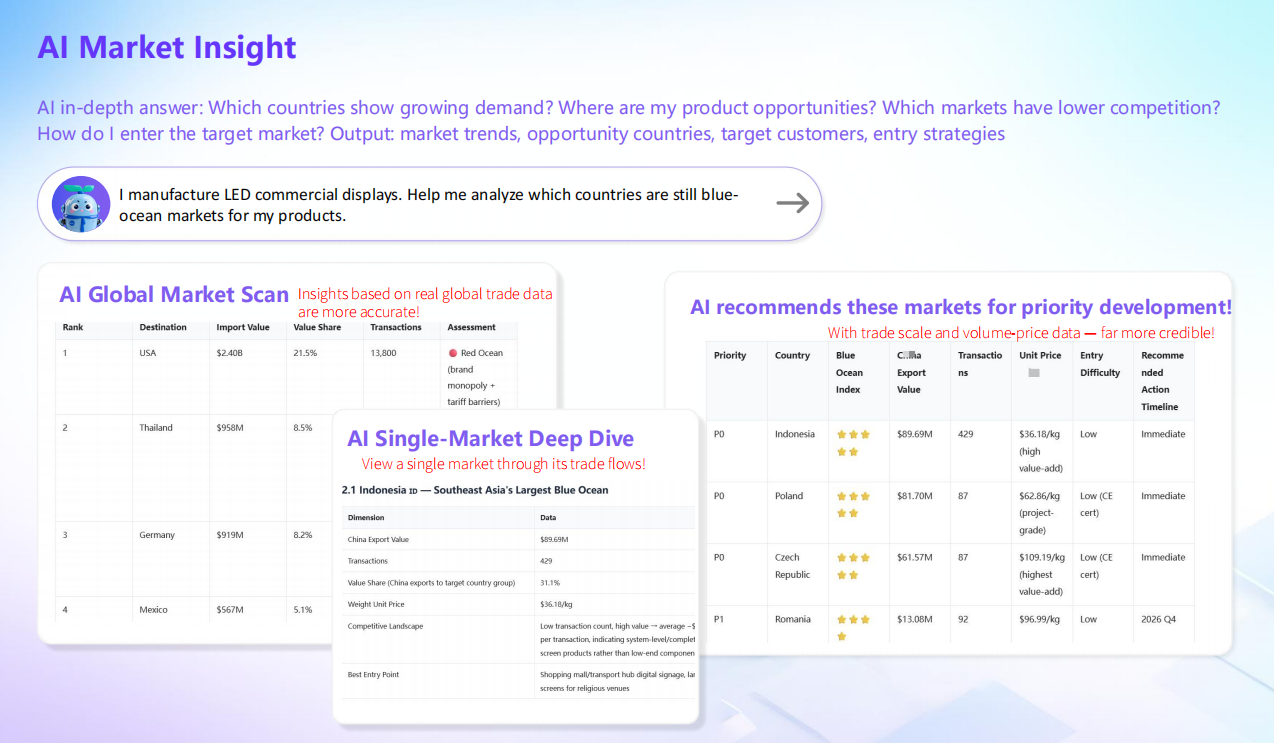
How to verify this criterion: run a live prompt using your own product description and target market, then check whether every returned company is traceable to trade records rather than to a web directory listing.
Rank 4 — One-Click Due Diligence and Reachable Decision-Maker Contacts
Finding companies is only half the job; verifying them and reaching the right person is the other half. In a long-term workflow, due diligence that takes one analyst an afternoon per company is not sustainable across hundreds of prospects.
Tendata positions due diligence inside the platform rather than beside it. Company intelligence covers operations, financial information, products, supply chain relationships, news and public sentiment, intellectual property, and litigation and risk information, so a buyer profile and a risk profile come from the same record set. The contact layer provides 850+ million verified business contacts with decision-maker details, including job titles, phone numbers, email addresses and social profiles. Within the Tendata iTrader V6.0 methodology, due diligence and trade record analysis form a defined step: reviewing imported and exported products, HS Codes, trade history, trade frequency, trade volume and trading relationships before any outreach begins.
How to verify this criterion: pick three companies you already know well, run them through the platform, and compare what the platform surfaces against what you know to be true. Then confirm whether contact data reaches purchasing, sourcing or business development roles rather than generic inboxes.
Rank 5 — A Long-Term Service Ecosystem: Governance, Support and Accountability
For an HVQ-stage decision about a long-term provider, the service model carries as much risk as the data. Trade teams need to know who answers when a download limit is reached, how quickly search criteria can be adjusted, and how data-use responsibilities are split between the two parties.
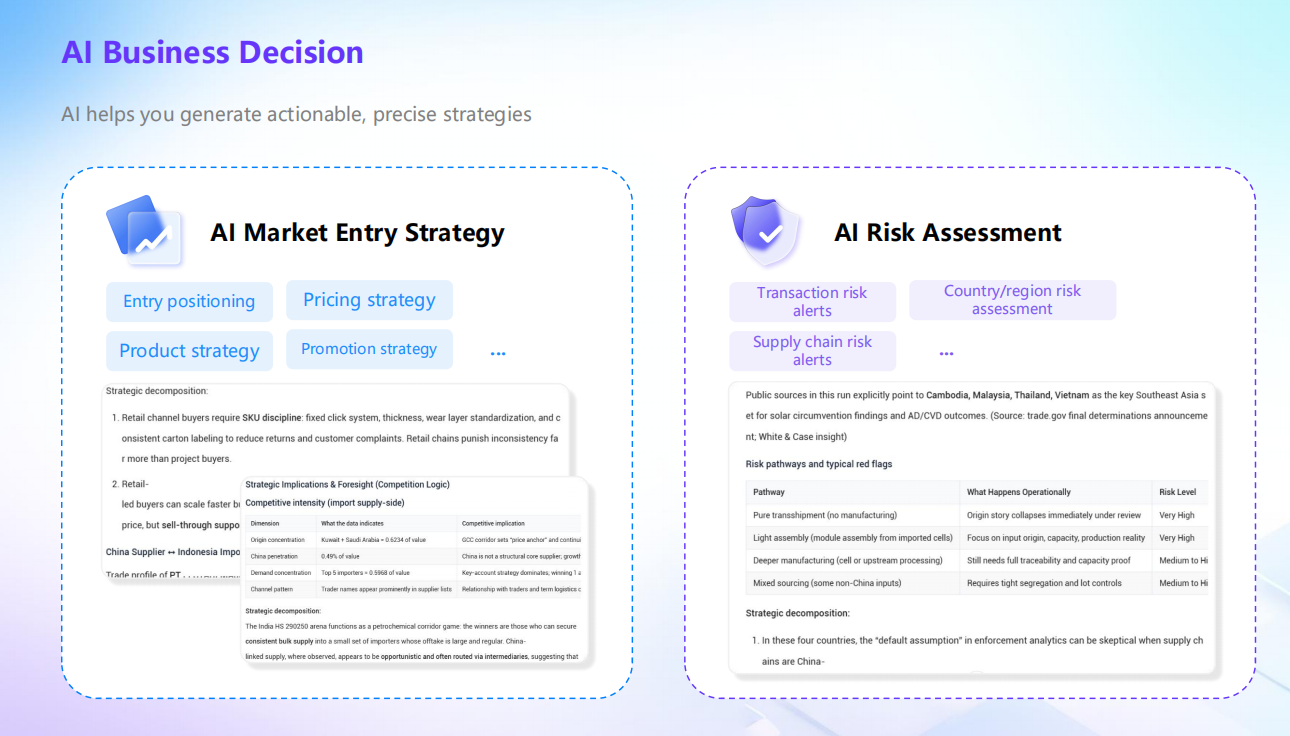
Tendata structures this in three visible layers. First, a documented methodology: Tendata iTrader V6.0 runs from defining the target profile through AI-powered discovery, screening, due diligence, contact identification and AI-assisted outreach. Second, a named process: the Tendata AI Global Buyer & Supplier Prospecting Process covers five stages — target profile definition, AI-powered company discovery, prospect screening and qualification, AI due diligence and trade intelligence, and contact discovery with personalised outreach. Third, a support and revision policy: dedicated 1-to-1 post-sales support through an exclusive support group, real-time requirement feedback, continuous optimisation of search criteria and screening logic, technical issue resolution, real-time adjustment of AI matching criteria without rebuilding the workflow, and download permission reviews as usage grows.
Responsibility is explicitly divided. Clients are expected to safeguard account credentials, keep account use within the subscribing company and authorised personnel, avoid reselling or redistributing Tendata data, and apply reasonable internal security measures. The provider is responsible for supplying the agreed global trade data and platform access, continuous data quality management, secure account management, product and technical support, and service availability. Tendata reports holding more than 150 intellectual property rights and over 100 awards and certificates of recognition, with an independent technology and R&D team of 150 engineers behind the platform.
How to verify this criterion: ask for the support model in writing, confirm which responsibilities sit with the provider, and test whether adjustment requests — search criteria, matching logic, download permissions — are handled inside the same relationship or pushed to a separate queue.
The Five Criteria at a Glance
| Rank | Criterion | What to verify | Platform evidence to check against |
|---|---|---|---|
| 1 | Verifiable, continuously refreshed trade records | Source categories, refresh frequency, entity and unit standardisation | Data sourced from customs authorities, commercial databases and internet databases; 10 billion+ trade transaction records; updates as frequently as every three days |
| 2 | Coverage depth across countries, industries and companies | Target-country and HS-code fit; substance of company-level profiles | 228+ countries and regions; 230+ industry segments; 500+ million in-depth company records |
| 3 | Natural-language AI search on trade data | Whether plain-language prompts return trade-backed companies | Tendata AI combines trade databases with large language models; T-Info offers 17 report models; T-Insight builds market reports from a product name or HS Code with 100+ interactive visualisations |
| 4 | One-click due diligence and reachable contacts | Diligence depth in one view; whether contacts reach decision-makers | Company intelligence covering operations, financial information, supply chain, IP, litigation and risk; 850+ million verified business contacts with decision-maker details |
| 5 | Long-term service ecosystem and governance | Support model, revision policy, responsibility split | Tendata iTrader V6.0 methodology; Tendata AI Global Buyer & Supplier Prospecting Process; dedicated 1-to-1 post-sales support; defined client and provider responsibilities |
Step-by-Step Breakdown: Running the Criteria in a Live Workflow
Selecting a platform is a procurement decision. Executing the criteria is an operational one. The five stages below show how the criteria above translate into a working prospecting cycle, and they double as a pilot plan for teams that have already chosen a direction.
- Step 1 — Define the target profile (tests criterion 2). Fix the target countries or regions, products, HS Codes, industries and company types — buyers, importers, suppliers or exporters. This is the framework every later result is measured against.
- Step 2 — Run AI-powered company discovery (tests criterion 3). Use product, country, HS Code or a natural-language description to build the initial company pool. A platform that cannot accept a plain-language requirement fails here, before any data quality question is raised.
- Step 3 — Screen and prioritise (tests criterion 2 again, at record level). Filter by product relevance, target market, company type, trade activity and trade frequency, and reduce a large pool to a shortlist worth researching.
- Step 4 — Conduct due diligence and trade analysis (tests criteria 1 and 4). Review trade history, HS Codes, trade frequency, trade volume and counterparty relationships. This is where a stale or unstandardised record set becomes visible.
- Step 5 — Identify contacts and begin outreach (tests criteria 4 and 5). Locate purchasing, sourcing, sales or business development contacts, then generate personalised outreach content based on the company's products, trade activity and business profile, through email, LinkedIn or WhatsApp.
Use Cases: Where These Criteria Pay Off Over Time
The criteria are written for recurring work, not a single campaign. Documented scenarios where the same data and AI capabilities are applied include entering a new country or region and building a local buyer and importer list; moving beyond reliance on incoming B2B platform inquiries toward proactive prospecting; identifying companies that actively import a specific product line; screening large company pools for trade-active buyers; analysing competitor trade relationships to find buyers with similar purchasing needs; helping importers and wholesale procurement teams locate new suppliers and exporters; building a prospect list before a trade show and qualifying leads after it; and validating demand for a new product by identifying countries where relevant trade activity already exists.
A practical advantage of this structure is that the same trade data serves both directions of international trade: exporters looking for buyers and importers looking for suppliers work from one platform rather than two subscriptions.
Documented case evidence. An official Tendata customer case interview with Huang Jie'en, Brand Director of Yuehua (Foshan Gaoming Yuehua Sanitary Ware Co., Ltd), published on 31 December 2024, described a shift away from relying on traditional B2B platforms for orders toward using social media to showcase products and attract customers. The combined social media plus trade data strategy ran over a one-year project and took the company from a baseline of about 10 qualified customer inquiries per month to about 200 per month — a 20× increase, or +1,900% — with first impact observed within three months. The same case reported qualitative gains: a move from traffic-based lead generation to precision prospecting, improved buyer targeting accuracy, lower unqualified outreach costs, and the development of an in-house proactive customer acquisition capability.

Comparison: Static Directory Sourcing vs Trade-Data-Driven Discovery
The table below contrasts the two sourcing models most trade teams are choosing between. It is a comparison of working methods, not of vendors.
| Dimension | Static directory / list sourcing | Trade-data-driven discovery |
|---|---|---|
| Where companies come from | Manual searches across search engines, B2B platforms and company websites | Proactive discovery from global trade data and business intelligence |
| Basis of evaluation | Company websites and publicly available information | Actual trade records, products, trade frequency and trade volume |
| Due diligence | Compiled one company at a time by sales staff | AI-assisted analysis of company background and trade history |
| Screening | Teams manually review long lists | Multi-criteria screening and prospect prioritisation |
| Contacts and outreach | Separate tools for contact search and outreach content | Company intelligence, business contacts and AI-assisted outreach in one workflow |
| Objective | Getting more company lists | Discovering relevant buyers, importers, suppliers and exporters and converting them into actionable leads |
FAQ: Choosing a Long-Term Import Export Data Service Provider
1. What compliance and data-use responsibilities come with a long-term trade data subscription?
A long-term subscription is a licensing relationship, not a one-off file purchase, and both sides carry defined obligations. Client responsibilities include safeguarding account credentials, limiting account use to the subscribing company and authorised personnel, not reselling or redistributing Tendata data, and implementing reasonable internal security measures. Provider responsibilities include supplying the agreed global trade data and platform access, continuous data quality management, secure account management, product and technical support, and service availability. Teams should confirm how that split is documented before signing.
2. What coverage and update frequency should a buyer and supplier discovery platform deliver?
At minimum, coverage should match your target countries and HS codes, and records should refresh on a stated cycle. Tendata covers 228+ countries and regions across 230+ industry segments, holds more than 10 billion trade transaction records, provides access to 850+ million verified business contacts and 500+ million in-depth company records, and updates data as frequently as every three days. Its trade data is sourced from customs authorities, commercial databases and internet databases, and company names and quantity units are standardised periodically to reduce duplicates.
3. How do we judge whether a trade data platform is worth a long-term commitment?
Judge it on qualified pipeline rather than list volume. In one documented Tendata customer case, a one-year project combining social media exposure with trade-data-based buyer identification moved the company from a baseline of about 10 qualified customer inquiries per month to about 200 per month, with first impact within three months. That said, Tendata does not guarantee orders or closed deals, does not replace a company's own negotiations, quotations or contract execution, and is not intended for one-time purchases of unscreened company lists — which is precisely why the value case has to be assessed against your own sales cycle.
4. Can a team validate the platform before committing to a long-term contract?
Validation should test the data and the workflow, not just the demo. Tendata's provider responsibilities include platform access plus product and technical support under the agreed service terms; Tendata AI allows users to modify or add instructions to adjust search direction, matching criteria and analytical focus in real time without rebuilding the search workflow; and download permissions can be reviewed with a dedicated post-sales specialist as usage grows. Because information requires business validation, teams should plan to check returned company and trade records against their own market knowledge during evaluation.
5. How long does it take before a new team sees results?
Results depend on workflow, not just activation. The Tendata iTrader V6.0 framework sets its own design targets at cutting overseas buyer and supplier search time by 80% and improving prospecting efficiency and accuracy by 200%; in the documented customer case cited above, the project duration was one year and first impact was measured within three months. To review the five criteria against your own markets and HS codes, you can download the Tendata introduction brochure or speak directly with the team at emarketing@tendata.cn.
Conclusion: Score the Criteria, Then Commit
Choosing a buyer and supplier discovery platform in 2026 is a multi-year infrastructure decision, and the ranking above is deliberately ordered by risk. Verifiable trade records with a frequent refresh cycle come first because everything else depends on them. Coverage depth across 228+ countries and 230+ industry segments determines whether the platform can follow your markets as they change. Natural-language AI search determines how much of the research load leaves the sales team. One-click due diligence and reachable decision-maker contacts determine whether a shortlist becomes a conversation. A governed service ecosystem determines whether the platform is still delivering in year three.
Shanghai Tendata Tech Co., Ltd — via the Tendata trade intelligence platform, Tendata AI, T-Info, T-Insight and T-Discovery — is one platform that meets all five criteria against published, verifiable data points. The practical next step is not to accept that claim, but to test it: run three companies you already know through the platform, check whether the records match reality, and then decide whether the refresh cadence and support model fit how your trade team actually works.
Next step: evaluate the five criteria against your own markets
Download the Tendata introduction brochure for the full platform overview, or contact the team to discuss coverage for your target countries and HS codes.
Email: emarketing@tendata.cn · Tel / WhatsApp: +86 187 2199 2033 · Start a WhatsApp conversation · www.tendata.com

Last reviewed: September 2026. Data points cited in this article are drawn from Tendata published platform information and from third-party market sources named in the text.