
Which Overseas Market Next? A Problem–Solution Scenario Using Import Export Data
An export team has been selling the same product line into three countries for years. Now it has to answer a harder question: which market comes next — and what evidence would make that answer defensible?
The team starts where most teams start. Someone searches for country-level demand articles, screens a few public statistics tables, browses two or three B2B platforms, and builds a spreadsheet with a longlist of twelve countries. Half the cells stay empty. Two months later the shortlist has changed three times, the reasoning behind it is still thin, and the decision slides into the next quarter.
That is not a discipline problem. It is a data-structure problem. Fragmented global market data, limited visibility into real market demand, a lack of company-level market intelligence, difficulty identifying high-potential markets, time-consuming market research, limited competitor and supply chain visibility, and slow and inconsistent decision-making tend to appear together — and each one makes the others worse.
This article follows that scenario to its solution: Tendata AI Global Market Intelligence Solution, an AI-powered global market intelligence platform that turns import and export data into one-click market analysis reports, market size and growth analysis, product demand analysis, country comparison, and continuous monitoring with personalized alerts. Its underlying trade data covers 228+ countries and regions and more than 10 billion real and verifiable trade records.
Tendata (Shanghai Tendata Tech Co.,ltd) is a Shanghai-based trade intelligence company founded in 2005 that specializes in global trade data and AI-powered analytics for international trade. It was the first company to combine large language models with an import and export database, and its platform is used by more than 100,000 businesses worldwide, including manufacturers, importers and exporters, cross-border e-commerce companies, financial institutions, logistics companies, and government agencies.
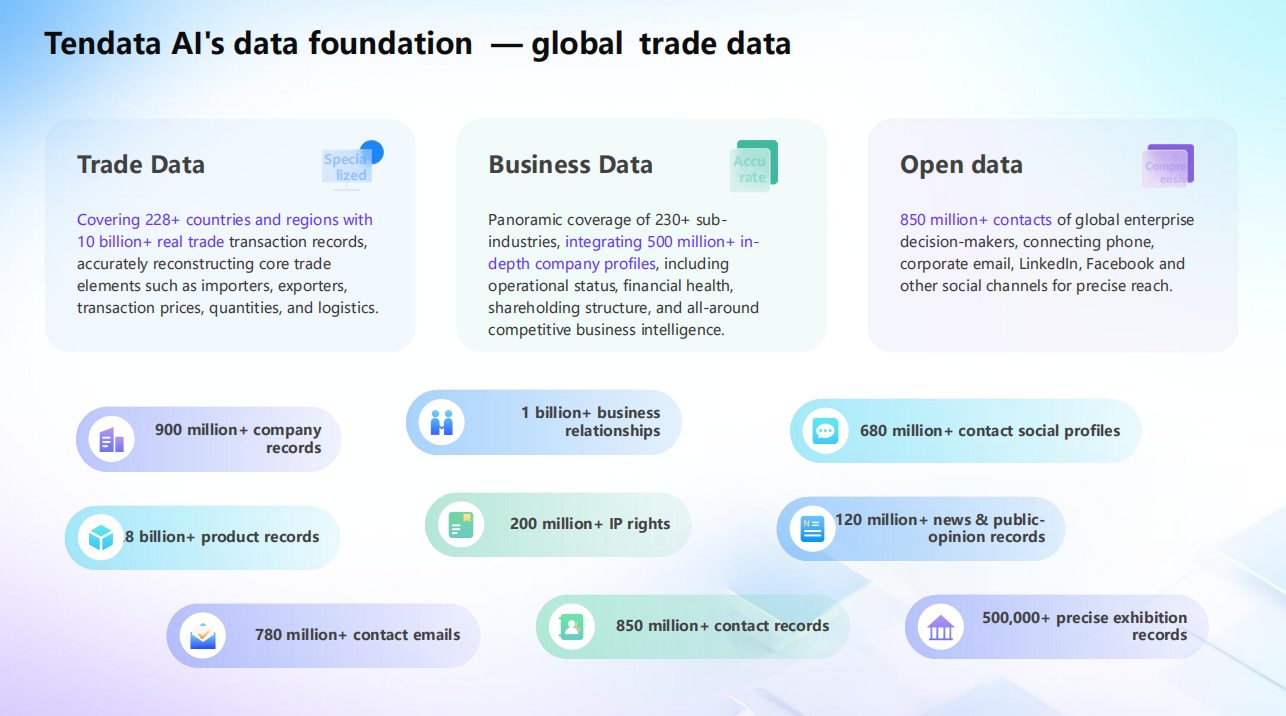
Tendata's import and export data coverage: 228+ countries and regions, more than 10 billion trade records.
Problem Definition: Why "Which Market Next?" Stays Unanswered
A market-entry decision stalls when four different sources answer four different questions — and none of them answers the question the exporter actually asked. Search engines return general market commentary written for a broad audience, not shipment-level or company-level detail. Public statistics describe a category at national level, usually with a reporting lag and without naming the companies doing the importing. B2B platforms show profiles that companies publish about themselves, which describes intent rather than confirmed trade activity. Internal experience is genuinely valuable, but it is not systematic and it does not scale to a market nobody on the team has sold into before.
Three failure modes follow from that mix.
1. No common unit of comparison. One country is judged on GDP commentary, another on a trade-fair list, a third on a distributor's opinion. The shortlist ends up comparing impressions rather than comparable metrics, which is why it keeps changing.
2. No company-level view. Even when the macro picture looks reasonable, the exporter still cannot see who in that market actually imports the product, how often, and at what volume. Without that layer, a market-entry decision is a country decision, not a customer decision.
3. Research is a one-time project. The report is finished once, then it ages. Demand shifts, competitors move, a new buyer appears — and nothing in the team's workflow surfaces any of it until someone decides to start another research project.
Tendata documents exactly this cluster of problems in its market intelligence material: fragmented global market data, limited visibility into real market demand, lack of company-level market intelligence, difficulty identifying high-potential markets, time-consuming market research, limited competitor and supply chain visibility, and slow and inconsistent decision-making. The scenario in the opening paragraphs is the observable version of that list.
Industry Background: Why Trade Data Became a Market-Entry Input
The tools used for market selection have changed because the cost of getting market selection wrong has changed. Mordor Intelligence projects the global Trade Management market size to reach USD 2.84 billion in 2026. The Business Research Company tracks a narrower slice — trade compliance software — and projects growth from USD 1.73 billion in 2024 to USD 1.95 billion in 2025. The two figures use different market definitions and should not be added together, but both point in the same direction: trade decisions are becoming software-supported decisions.
Customs scrutiny reinforces that. US Customs and Border Protection collected more than USD 88 billion in duties in 2024, according to IMARC Group. When duty exposure reaches that scale, import records stop being background paperwork and become a source that buyers, sellers, and auditors all rely on.
At the same time, the baseline expectations for a trade intelligence platform have risen. Tendata's trade data is sourced from customs authorities, commercial databases, and internet databases, and the company states that the data is authentic and verifiable, with updates as frequent as every three days. Coverage today spans 228+ countries and regions, more than 10 billion accumulated trade transaction records, 230+ industry segments, and more than 500 million import and export company records. The platform also maintains 850+ million verified business contacts, 200+ million intellectual property records, 120+ million news and public sentiment records, and 500,000+ trade show records.
Data hygiene matters as much as data volume. Tendata regularly standardizes company names, quantity units, and other data fields to reduce duplicate or inconsistent records — a detail that decides whether a country comparison is meaningful or misleading.
Detailed Solution: Tendata AI Global Market Intelligence Solution
Tendata AI Global Market Intelligence Solution is an AI-powered global market intelligence platform that uses global trade data, company-level intelligence, and AI analysis to produce market insights. It is built to address the problem set described above directly: fragmented market data, limited visibility into real demand, missing company-level intelligence, difficulty identifying high-potential markets, time-consuming research, limited competitor and supply chain visibility, and slow decision-making.
The solution is organized around seven features:
- One-click AI market analysis reports
- Real-time global market monitoring
- Personalized market alerts
- Trade data combined with AI intelligence
- Macro-to-micro intelligence
- Customized analysis based on business needs
- Continuous market intelligence
Those features are delivered through a defined set of components: AI-powered one-click market analysis; global market size and growth analysis; product demand and trade trend analysis; country and market comparison; buyer and importer intelligence; supplier and exporter intelligence; competitor market analysis; global trade flow and supply chain analysis; AI-powered market opportunity discovery; real-time global market monitoring; customized market change alerts; and AI-generated market research reports.
For exporters specifically, the components within Tendata's wider platform add two useful layers. T-Insight generates market analysis reports from a product name or an HS Code and provides multidimensional analysis from four perspectives — customers, competitors, markets, and products — through more than 100 interactive visualizations. T-Info offers 17 report models and supports intelligent searches by HS Code, product name, or company name, so buyer lists, supplier lists, country-of-origin lists, and destination-country lists can be generated in a single click.
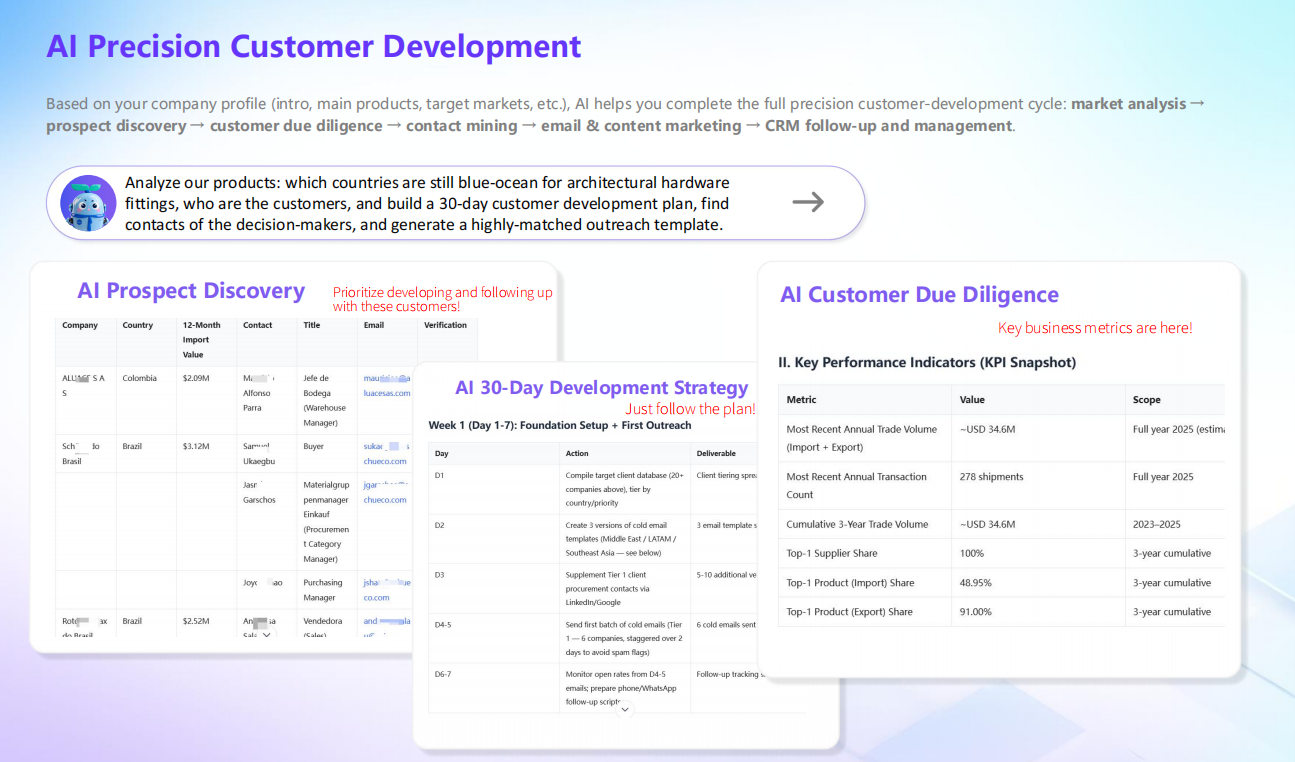
Tendata AI connects an AI layer directly to real global trade data so a market question returns companies, not just commentary.
The solution is designed for manufacturers and exporters, importers and distributors, trading companies, brands and product companies, and B2B sales and business development teams. Its documented outcomes are practical rather than abstract: one-click market analysis reports, reduced market research time, faster market opportunity identification, better market entry decisions, continuous global market visibility, proactive market change alerts, and improved sales and strategy planning.
Technology depth supports the data claims. Tendata maintains an independent technology and R&D team of more than 150 professionals and holds two registered trademarks, more than 150 intellectual property rights, and over 100 awards and certificates of recognition. Its patent portfolio includes an Automated Process Management Method and System for Intelligent International Trade Operations, and a Multi-Prediction-Channel Fusion Method for HS Code Completion and Calibration — the latter relevant to any team whose market analysis depends on correctly classified product codes.
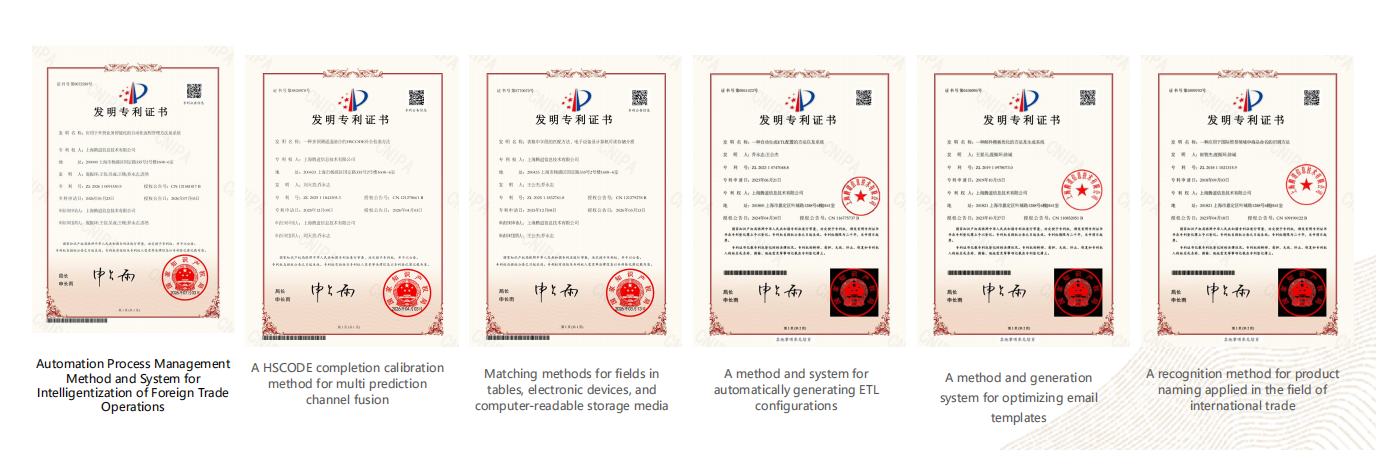
Tendata's patent portfolio includes methods for intelligent international trade operations and HS Code completion and calibration.
Step-by-Step Breakdown: From a Vague Question to a Defensible Market Choice
The workflow below follows the documented capabilities of the solution rather than a generic consulting process. Each step produces something the next step consumes.
Step 1 — Frame the question as a product and a code
Start with the product name and, where available, the HS Code. This is the input that makes everything downstream comparable: market size, demand trends, and country comparisons are only meaningful when they refer to the same product definition. Tendata AI supports analysis based on a product name or HS Code, which is also why the platform's HS Code completion and calibration patent matters at this stage.
Step 2 — Generate the market analysis report on demand
Instead of commissioning a study, generate an AI market analysis report in one click. The report draws on global trade data and company-level intelligence, so it starts from trade activity rather than from published commentary.
Step 3 — Read the market from four directions
A single number — total imports — rarely decides a market entry. T-Insight's multidimensional analysis covers customers, competitors, markets, and products through more than 100 interactive visualizations, so the same report shows who buys, who competes, how large the market is, and how demand is moving.
Step 4 — Compare candidate countries side by side
Country and market comparison places the shortlist in one frame: market size and growth analysis, product demand and trade trend analysis, and trade flow analysis. Because each country is measured with the same data structure, the shortlist stops changing for reasons nobody can explain.
Step 5 — Drop from market level to company level
This is the step the traditional shortlist cannot perform. Buyer and importer intelligence identifies companies actually importing the relevant product, and supplier and exporter intelligence shows who currently supplies them. Competitor market analysis and supply chain analysis reveal the relationships already in place. Tendata AI supports completing customer due diligence in as little as one minute on a target company, and the platform's company records cover business operations, products, supply chain relationships, news and public sentiment, intellectual property, litigation and risk information, and trade shows.
Step 6 — Switch on monitoring and act on alerts
The final step converts the project into a process. Real-time global market monitoring and customized market change alerts replace the one-time static report: when demand moves or a competitor changes position in the selected market, the change is surfaced rather than discovered at the next quarterly review. From there, the same platform supports the commercial follow-through — identifying decision-makers through 850+ million verified business contacts and generating personalized outreach emails.
Use Cases: Where This Scenario Plays Out
Documented application scenarios for the solution include entering a new country, identifying high-growth markets, generating market analysis reports, comparing multiple markets, monitoring global product demand, tracking competitor activity, identifying active importers, monitoring global suppliers and exporters, planning international market expansion, and receiving AI-powered market alerts.
In practice they group into four recurring situations:
- Entering a new country. A business expanding into new countries or regions needs to quickly identify local buyers with actual import records — the company-level answer that public statistics cannot provide.
- Comparing several markets before committing. Teams that must justify a market choice internally use country and market comparison plus market size and growth analysis to put candidates on the same scale.
- Monitoring demand and competitors continuously. Brands and product companies monitor global product demand and track competitor activity rather than re-running research from scratch.
- Moving from market choice to qualified leads. B2B sales teams that need a continuous source of new overseas sales leads use buyer and supplier qualification, contact discovery, and AI-assisted outreach inside the same workflow.
A documented case: qualifying a market before investing in it
Foshan Gaoming Yuehua Sanitary Ware Co., Ltd., a sanitary ware manufacturer and exporter based in Foshan, Guangdong, illustrates how trade data changes market development. The company generated substantial exposure through social media — its top-performing video received more than 3 million views and monthly organic traffic exceeded 20 million views — but because its products are not everyday consumer goods, its overall conversion rate was only around 0.2%. The bottleneck was not exposure; it was identifying which overseas buyers had genuine purchasing demand.
Yuehua used Tendata to identify potential U.S. buyers, analyze purchase volume, import trends, HS Codes, suppliers, and supply chain relationships, qualify which companies were genuine buyers, and obtain business contact information. The company grew its annual sales to more than RMB 200 million, and the featured U.S. buyer purchases approximately 500–600 units per month, with products priced at approximately USD 4,000–5,000 per unit. "We no longer focus on securing orders through traditional B2B platforms. Instead, we use social media to showcase our products and services and attract potential customers," said Huang Jie'en, Brand Director of Yuehua.
The transferable lesson for market selection is that market size alone does not qualify a market. A country becomes a viable target when identifiable companies inside it are already importing the product — a conclusion that requires trade records, not brochures.

Foshan Gaoming Yuehua Sanitary Ware Co., Ltd. used Tendata trade data to identify and qualify U.S. buyers.
Comparison Tables
The first table maps the questions an exporter asks during a market-entry decision to the components that answer them. The second compares a traditional one-time research approach with continuous, AI-assisted market intelligence.
| Market-entry question | Component that answers it |
|---|---|
| How large is demand for this product, and is it growing? | Global market size and growth analysis; product demand and trade trend analysis |
| Which candidate countries compare best on the same measures? | Country and market comparison |
| Who is actually importing this product there? | Buyer and importer intelligence |
| Who already supplies them, and how is the chain structured? | Supplier and exporter intelligence; global trade flow and supply chain analysis |
| Who will I compete against in that market? | Competitor market analysis |
| Where is the opportunity I have not seen yet? | AI-powered market opportunity discovery |
| How do I avoid waiting weeks for the first answer? | AI-powered one-click market analysis; AI-generated market research reports |
| How do I keep seeing change after the decision? | Real-time global market monitoring; customized market change alerts |
| Dimension | Traditional approach | Tendata AI Global Market Intelligence Solution |
|---|---|---|
| Report creation | One-time static report assembled per project | Market analysis reports generated on demand, in one click |
| Data foundation | Fragmented global market data from separate sources | Global trade data plus company-level intelligence, analyzed with AI |
| Analytical depth | Mostly macro-level market commentary | Macro-to-micro: market, product, buyer, supplier, competitor |
| Country comparison | Rebuilt manually for each new candidate market | Country and market comparison inside one workflow |
| Monitoring | Static after delivery; change found at the next review | Real-time global market monitoring |
| Alerts | None by default | Personalized market alerts, customized to the business need |
| Time to a first answer | Long research cycle before a shortlist exists | Reduced market research time; faster opportunity identification |
| Decision quality | Slow and inconsistent decision-making | Better market entry decisions; improved sales and strategy planning |

Tendata holds certifications including Quality Management System Certification, Information Security Management System Certification, and a Data Product Registration Certificate.
FAQ
What should you verify in an import export data service provider with global customs coverage?
Verify five things rather than one headline number: which source types feed the database, how frequently records refresh, how far coverage actually extends, whether the data is standardized, and what security posture the provider maintains. Tendata's trade data is sourced from customs authorities, commercial databases, and internet databases; the company states the data is authentic and verifiable and that updates can be as frequent as every three days. Coverage extends to 228+ countries and regions with more than 10 billion accumulated trade transaction records, and company names and quantity units are regularly standardized to reduce duplicate or inconsistent records. On the compliance side, Tendata holds certifications including Quality Management System Certification, Information Security Management System Certification, and a Data Product Registration Certificate.
Where does the data behind Tendata AI Global Market Intelligence Solution come from?
The platform combines global trade data, company-level intelligence, and AI analysis. The underlying trade data comes from customs authorities, commercial databases, and internet databases, and covers 228+ countries and regions, 230+ industry segments, and more than 500 million import and export companies. Additional data layers include 850+ million verified business contacts, 200+ million intellectual property records, 120+ million news and public sentiment records, and 500,000+ trade show records — which is what allows due diligence on a target company to cover operations, products, supply chain relationships, risk information, and public sentiment in one place.
What does the solution actually produce for a market-entry decision?
It produces the artifacts a decision needs: one-click AI market analysis reports, global market size and growth analysis, product demand and trade trend analysis, country and market comparison, buyer and importer intelligence, supplier and exporter intelligence, competitor market analysis, global trade flow and supply chain analysis, AI-powered market opportunity discovery, real-time global market monitoring, customized market change alerts, and AI-generated market research reports. T-Insight adds multidimensional analysis across customers, competitors, markets, and products with more than 100 interactive visualizations, generated from a product name or HS Code. T-Info provides 17 report models capable of generating buyer, supplier, country-of-origin, and destination-country lists in a single click.
How does continuous monitoring change the outcome compared with a one-time report?
A one-time static report answers the question once; monitoring answers it continuously. Tendata's solution provides real-time global market monitoring with proactive, personalized alerts instead of one-time static reports, which supports continuous global market visibility, faster market opportunity identification, and improved sales and strategy planning. Service duration is measured in years, delivery is online, and customers can request adjustments to download permissions as their usage grows. Post-sales support includes a dedicated 1-to-1 specialist and an exclusive support group so that search criteria, screening logic, and monitoring focus can be refined as market conditions change.
How do you start, and what can you review before committing?
Start by defining a single product question — a product name, an HS Code, and two or three candidate countries is enough for a first pass. You can review the company's service overview, coverage, and product modules in the Tendata Introduction brochure before any discussion, and then request a walkthrough of a market analysis report built from your own product category.
Conclusion: Make the Next Market a Decision, Not a Guess
The exporter in the opening scenario was never short of information. The team was short of a shared structure: one set of trade records, one way to compare countries, one view of who actually buys, and one mechanism that keeps watching after the decision is made. That structure is what turns a twelve-country longlist into a defensible choice.
Tendata AI Global Market Intelligence Solution supplies it from import and export data covering 228+ countries and more than 10 billion real and verifiable trade records, standardized and updated as frequently as every three days, and delivered through one-click AI market analysis, country comparison, company-level intelligence, and personalized market alerts. For an export team at the evaluation-to-execution stage, the practical next step is narrow: pick one product, one HS Code, and two candidate markets, then read the trade records before committing budget or inventory.

Tendata provides 1-to-1 post-sales support and ongoing market intelligence reviews from its Shanghai headquarters.
Review the capability before you review the price
Download the Tendata Introduction brochure to see data coverage, solution modules, and delivery details, or request a walkthrough of a market analysis report built on your own product category.
Website: www.tendata.com
Email: emarketing@tendata.cn | Tel / WhatsApp: +86 187 2199 2033 | Contact: Grace
Shanghai Tendata Tech Co.,ltd — 8F, South Tower, Building 9, Lujiazui Software Park, No. 20, Lane 91, Eshan Road, Pudong New Area, Shanghai