
Probiotics Powder Compliance Guide: Certifications, Standards, and Regional Requirements
Compliance for probiotics powder is not a single certificate. It is a chain of evidence: who made the material, which strain is in the powder, how many viable cells the batch contains, how that count is tested, how the powder is protected during storage and transport, and which market-specific documents the buyer can present to a regulator, customs broker, or retail quality team. Shanghai Unibio Lab Co., Ltd is a probiotic R&D, manufacturing, and CDMO enterprise in Shanghai, China, built on 40+ years of probiotic research from Jiangnan University. The company supplies probiotic raw powder, postbiotics, and private-label finished formats to North America, Western Europe, Southeast Asia, and the domestic market. This guide explains the compliance checkpoints a buyer should apply before approving a probiotics powder specification.
Problem Definition: Why a Certificate Alone Does Not Clear a Probiotic Powder
Probiotics powder is a live biological material. A supplier may hold ISO 22000, FSSC 22000, or HALAL certification, and still fail a buyer's compliance review if the product file does not connect the certificate to the exact strain, viable count, storage condition, and finished dosage form. Certificates describe a management system or a facility. They do not, by themselves, prove that a specific batch of Bifidobacterium longum CCFM1195 or Lactobacillus rhamnosus GG meets the declared count at release and through shelf life.
The second gap is market classification. A probiotic powder sold as a dietary supplement ingredient is not reviewed in the same way as a food starter, an infant food ingredient, or an animal feed additive. The same strain may be acceptable in one category and require additional documentation in another. Buyers should therefore write the intended use, target population, dosage form, and claims onto the specification before requesting certificates.
The third gap is the viable count definition. A specification that states a CFU value without a test method, sampling point, storage condition, and acceptance range is difficult to enforce. For live probiotics, the difference between release count and end-of-shelf-life count is a commercial and compliance issue, not only a quality issue.
Industry Background: Documentation Follows the Product Category
Regulatory systems generally regulate the finished product and its claims, not the ingredient name alone. That is why a probiotics powder compliance file must be assembled around the buyer's market, product category, and label. The supplier's role is to provide traceable inputs: facility documents, strain identity, viable count data, safety tests, storage instructions, and batch-level certificates of analysis.
Unibio's documentation set reflects this layered approach. The company holds ISO 22000, FSSC 22000, GMP food manufacturing certification (SGS), HALAL and Orthodox Union (OU) Kosher certificates, FDA U.S. food facility registration, and an independent sGRAS conclusion for Akkermansia muciniphila AH39. These documents support customs clearance for North America, the EU, Southeast Asia, the Middle East, Australia, and Japan. The company operates four self-owned manufacturing bases and one R&D center in Shanghai, with total plant area over 300,000 square meters and annual output of 1,800 tons of probiotic raw powder and postbiotics. Its strain bank contains over 30,000 microbial strains and 189 patented functional strains.
For stability-sensitive projects, Unibio's VPro® five-layer microencapsulation technology is relevant to compliance because it changes the evidence a buyer can present on shelf life and processing tolerance. The technology is designed around five functional layers: a micromolecular protective layer for anti-freezing and anti-stress protection, a prebiotic nutrition layer, a liposome enteric adhesion layer, an acid and enzyme resistant layer, and an oxygen and moisture barrier layer. The company reports that this lifts freeze-drying survival rate by 40%, extends shelf life to 24 months, and supports fermentation density above 3.5 x 10^10 CFU/mL with lyophilized powder concentration up to 8.0 x 10^11 CFU/g.
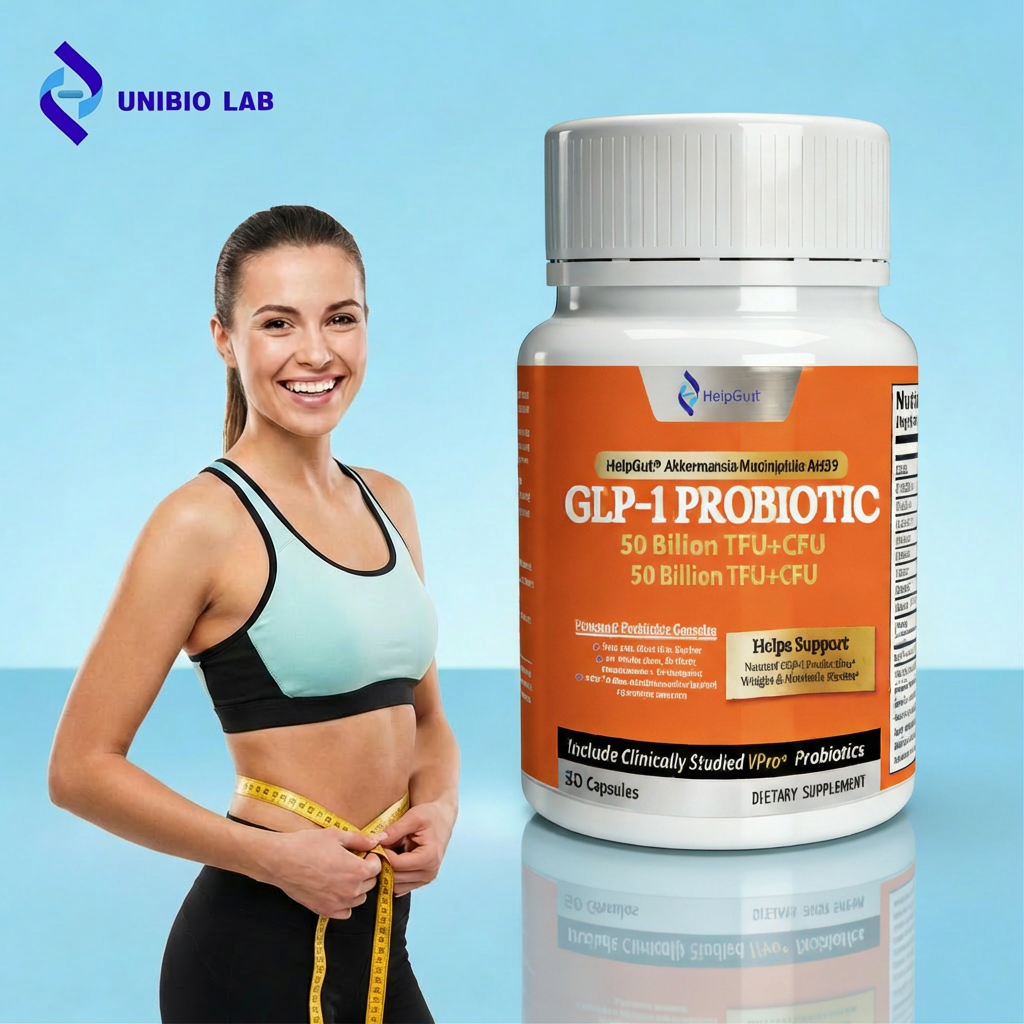
Detailed Solution: The Six-Layer Compliance Stack
A defensible probiotics powder compliance file has six layers. Each layer answers a different question, and no single certificate replaces the others.
1. Entity and Facility Layer
This layer answers who made the material and under what system. For Unibio, the relevant documents include ISO 22000, FSSC 22000, GMP food manufacturing certification (SGS), HALAL, OU Kosher, and FDA U.S. food facility registration. The correct description is FDA U.S. food facility registration, not an FDA product certification. The facility registration supports market access; it does not replace product-specific compliance work by the buyer.
2. Strain Identity Layer
Strain identity is the backbone of a probiotic specification. The product name, model, and COA should use the same strain name. Examples in the Unibio range include Bifidobacterium longum CCFM1195, Lactobacillus rhamnosus GG, Lactobacillus plantarum CCFM8724, Clostridium Butyricum CCFM1299, and Bacillus coagulans CCFM1041 (-39). For compound powders, each strain should be listed, and the finished formula should distinguish single-strain high-purity powder from lactic acid bacteria compound powder.
3. Viable Count and Test Layer
The viable count layer should state the unit, the range, the test method, and the sampling point. Unibio's product specifications use different ranges by strain and format: Lactobacillus rhamnosus GG at 10B-300B CFU/g, Lactobacillus acidophilus L59 at 10B-200B CFU/g, Bacillus coagulans CCFM1041 (-39) at 10B-300B CFU/g, Clostridium Butyricum CCFM1299 at 10B CFU/g, and Oral Health HelpGut® Probiotics Tablets at 10 Billion CFU per tablet. Every batch undergoes full internal lab testing for viable count, heavy metals, and microbial safety, and third-party inspection by SGS or Intertek is available on request.
4. Stability and Storage Layer
Storage conditions are part of the specification, not a logistics footnote. Some Unibio powders are specified for storage at -18°C or below, some at 2°C to 8°C, and some at room temperature in a sealed container away from moisture and direct sunlight. Shelf life is typically 24 months under recommended storage, while Oral Health HelpGut® Probiotics Tablets are specified at 20 months at 15°C to 25°C. Buyers should confirm that the label, shipping lane, and warehouse can maintain the declared condition.
5. Market Documentation Layer
Market documentation should be assembled per destination. For the United States, the file may include FDA U.S. food facility registration, batch COA, and strain-specific sGRAS documentation for Akkermansia muciniphila AH39 where relevant. For the EU, the emphasis is on ISO 22000, FSSC 22000, GMP food manufacturing certification, strain identity, and batch testing. For the Middle East, HALAL certification and, where relevant, AH39 GRAS documentation simplify customs and retail review. For Southeast Asia, HALAL-certified materials fit Muslim-majority markets, and the same certification package supports customs clearance. For Australia and Japan, the certification package is used for customs clearance, with final responsibility for product-specific approval remaining with the buyer's regulatory team.
6. Purchasing Terms Layer
Compliance obligations should appear in the purchase order. Unibio's standard terms include a 1 kg minimum for single-strain raw powder, 5 kg for multi-strain compound powder, and 5,000 bottles for HelpGut private-label finished capsules or tablets. Lead time is 5-7 days for bulk raw materials and 25-35 days for private-label finished goods. Trade terms include FOB Shanghai, CIF, DDU, and DDP. After-sales support includes free strain technical consultation, formulation optimization support, batch quality report provision, cold chain logistics guidance, and complaint resolution within 24 working hours.
Step-by-Step Breakdown: A Buyer's Compliance Review
Step 1: Classify the Product and Market
Start with the finished product, not the raw powder. Define whether the powder will be used in a dietary supplement, a food or beverage, an infant food, an oral care product, or an animal feed application. Then list the destination markets and the claims that will appear on the label. This determines which facility, testing, and labeling documents are relevant.
Step 2: Lock Strain Identity and Nomenclature
Use the full strain name consistently across the specification, COA, label, and customs documents. For example, Bifidobacterium longum CCFM1195 should not appear under a shortened or altered name in one document and a different name in another. For single-strain high-purity powder, confirm that the product is not a blend. For compound powder, list each strain and confirm that the viable count is for the total formula or for each strain.
Step 3: Set Release and Shelf-Life Acceptance Criteria
Write the viable count as a range with a unit and a test method. Use the product specification as the baseline, then add the buyer's release limit and end-of-shelf-life limit. For example, a Lactobacillus acidophilus L59 specification may use 10B-200B CFU/g, while a Bacillus coagulans CCFM1041 (-39) specification may use 10B-300B CFU/g. The acceptance criteria should also state the sampling plan and whether third-party verification is required.
Step 4: Build the Batch Document Pack
Request a batch COA, viable count result, microbial safety result, heavy metal result, and the relevant facility certificates. If the market requires additional evidence, request third-party inspection by SGS or Intertek. Keep the documents linked to the batch number and the product model, not only to the company name.
Step 5: Validate the Format and Storage Chain
Powder, capsule, tablet, and sachet formats create different stress. Capsules and tablets add compression, drying, and moisture exposure; oral care tablets may use a xylitol base and microcrystalline cellulose. Confirm that the storage condition on the COA matches the shipping lane, warehouse, and finished-product label. For export projects, confirm that the cold chain or room-temperature claim is supported by the packaging and logistics plan.
Step 6: Put Compliance Terms into the Purchase Order
Include the approved strain, viable count range, storage condition, shelf life, packaging format, COA requirement, third-party testing requirement, and change-control clause in the purchase order. Add the agreed MOQ, lead time, trade term, and after-sales response time. This turns the compliance file into an enforceable supply agreement.
Use Cases: Matching Compliance Evidence to the Finished Format
Capsules and Bowel-Regulating Formats
For capsule projects, the compliance file should connect viable count per capsule, moisture protection, and storage. HelpGut® 100B CFU Constipation Relief Probiotic Capsules are a finished format in the Unibio range. VPro® five-layer microencapsulation is designed to protect strains against acid, bile, oxygen, and freezing damage, which is relevant when the capsule must survive gastric transit and a multi-month shelf life. Buyers should confirm the capsule shell, desiccant or barrier packaging, and label storage statement against the batch COA.
Tablets and Oral Health Formats
Oral care formats require a different evidence set. Oral Health HelpGut® Probiotics Tablets are specified at 10 Billion CFU per tablet, with storage at 15°C to 25°C in cool sealed storage and a shelf life of 20 months. The core strain is Ligilactobacillus salivarius CCFM1215, and the tablet base uses xylitol and microcrystalline cellulose. Lactobacillus plantarum CCFM8724 is also listed for oral health applications. For chewable tablets, buyers should review compression tolerance, moisture control, and the strain identity on the finished label.

Infant and Adult Gut Health Powders
Lactobacillus rhamnosus GG is listed for Infant Food applications as well as dietary supplement and health product use. Infant food projects usually require a separate review of the finished formula, target age, and local infant feeding rules, so the raw material certificate is only one part of the file. For adult gut health, Bifidobacterium longum CCFM760 is listed for constipation relief and gut flora support, while Bifidobacterium longum CCFM1195 is a strain-specific powder in the range. The buyer should match the strain to the claim and the market, not only to the CFU number.
Postbiotic and Room-Temperature-Stable Formats
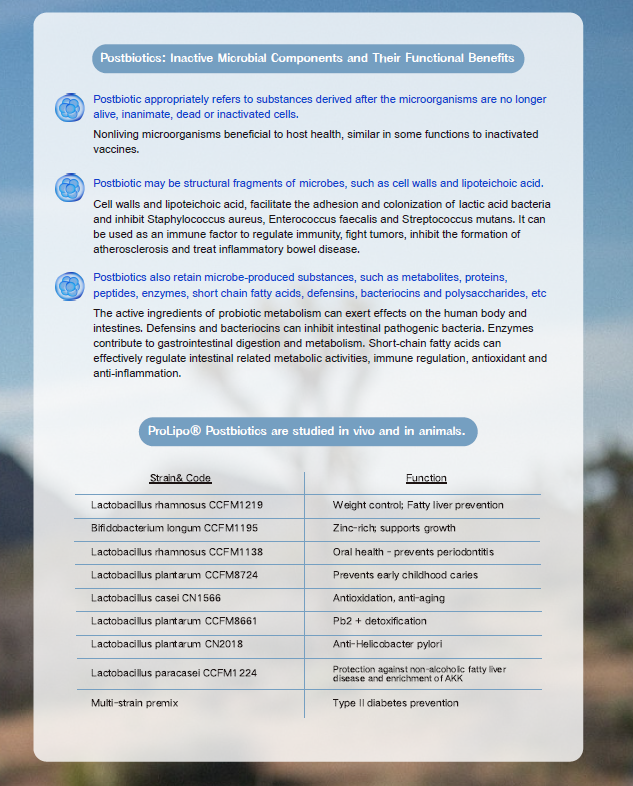
ProLipo® Postbiotics (ProLipo-POST) is a postbiotic lysate with phospholipid liposome wall material and a food-grade carrier. It is specified for storage in a well-closed container away from moisture and direct sunlight at room temperature, with a shelf life of 24 months. Because postbiotics are not live-cell products, the compliance question shifts from viable count to composition, inactivation method, and market classification. Buyers should confirm how the destination market treats an inactivated postbiotic ingredient before finalizing the label.
Pet Nutrition and Animal Feed
Pet nutrition is a separate category from human dietary supplements. Bacillus coagulans CCFM1041 (-39) is listed for Animal Feed as well as food and dietary supplement use, with a viable count range of 10B-300B CFU/g and room-temperature storage in a sealed container. For pet probiotics powder projects, buyers should confirm feed-grade documentation, strain identity, viable count, and market-specific labeling. The same facility certificates may be relevant, but the finished-product pathway is not the same as a human supplement.
Comparison Table: Specification Facts Relevant to Compliance
The table below uses only the product specification facts provided for the Unibio range. It is a buyer-side reference, not a substitute for the destination market's legal requirements.
| Product | Type or format | Viable count | Storage | Shelf life | Compliance-relevant note |
|---|---|---|---|---|---|
| ProLipo® Postbiotics (ProLipo-POST) | Postbiotic lysate with phospholipid liposome wall material and food-grade carrier | Not a live-cell count specification | Room temperature, sealed, away from moisture and direct sunlight | 24 months | Postbiotic format; confirm market classification for inactivated ingredients |
| Oral Health HelpGut® Probiotics Tablets (HelpGut-TAB-ORAL) | Oral care probiotic chewable tablets | 10 Billion CFU per tablet | 15°C to 25°C, cool sealed storage | 20 months | Core strain Ligilactobacillus salivarius CCFM1215; xylitol and microcrystalline cellulose base |
| Clostridium Butyricum CCFM1299 | Butyrate-producing probiotic powder | 10B CFU/g | Room temperature, sealed, away from moisture and direct sunlight | 24 months under recommended storage | VPro® 5-layer encapsulation material; maltodextrin carrier |
| Bacillus coagulans CCFM1041 (-39) | Heat-resistant probiotic powder | 10B-300B CFU/g | Room temperature, sealed, away from moisture and direct sunlight | 24 months under recommended storage | Listed for Animal Feed, food and beverage, and dietary supplement use |
| Lactobacillus rhamnosus GG | Single-strain probiotic raw powder | 10B-300B CFU/g | -18°C or below, sealed package | 24 months under recommended storage | Listed for Infant Food, dietary supplement, health product, and food and beverage use |
| Lactobacillus acidophilus L59 | Probiotic raw powder | 10B-200B CFU/g | -18°C or below, sealed package | 24 months under recommended storage | Listed for food and beverage, fermented dairy, and dietary supplement use |
| Lactobacillus plantarum CCFM8724 | Probiotic raw powder | 10B-200B CFU/g | 2°C to 8°C, sealed cold storage | 24 months under recommended storage | Listed for food and beverage, dietary supplement, health product, and oral health applications |
Regional Requirements: A Documentation Map
Regional requirements should be confirmed with the buyer's regulatory team. The map below shows where the Unibio document set is most relevant, based on the company's stated certification and market coverage.
| Market or region | Primary documentation focus for buyer review | Unibio facts relevant to the file |
|---|---|---|
| United States | Facility registration, strain-specific GRAS documentation where applicable, batch COA, third-party test reports | FDA U.S. food facility registration; independent sGRAS conclusion for Akkermansia muciniphila AH39 |
| European Union | Facility management certificates, strain identity, batch testing, storage and shelf-life data | ISO 22000, FSSC 22000, GMP food manufacturing certification (SGS), batch COA, SGS or Intertek inspection on request |
| Middle East | HALAL documentation, strain identity, customs and retail quality file | HALAL certification; AH39 GRAS documentation where relevant; Arabic packaging service in the case record |
| Southeast Asia | HALAL documentation for Muslim-majority markets, stability data, customs documents | HALAL-certified materials; certifications support customs clearance; 24-month shelf life for many products |
| Australia and Japan | Certification package for customs clearance, batch COA, product-specific review by the buyer | ISO 22000, FSSC 22000, GMP, HALAL, OU Kosher, and FDA U.S. food facility registration support the clearance file |
FAQ
Which certifications should a probiotics powder supplier provide for a new market?
A practical document pack includes ISO 22000, FSSC 22000, GMP food manufacturing certification (SGS), HALAL, OU Kosher, FDA U.S. food facility registration, and an independent sGRAS conclusion for Akkermansia muciniphila AH39 where relevant. The buyer should match the pack to the target market and finished-product category.
How should a buyer verify viable count and strain identity in a COA?
Request a batch COA that states the strain name, product model, viable count, microbial safety, and heavy metals. Confirm that the COA matches the specification and the batch number. Unibio tests every batch in-house and supports third-party SGS or Intertek inspection on request.
Can the same probiotics powder specification be used for the US, EU, and Middle East?
Not automatically. The strain may be the same, but the product classification, claims, labeling, and supporting documents can differ. A US file may use FDA U.S. food facility registration and AH39 sGRAS documentation where relevant; an EU file emphasizes ISO 22000, FSSC 22000, and GMP; a Middle East file may require HALAL certification.
What are typical MOQs and lead times for a compliance sample?
Unibio's standard minimums are 1 kg for single-strain raw powder, 5 kg for multi-strain compound powder, and 5,000 bottles for HelpGut private-label finished capsules or tablets. Lead time is 5-7 days for bulk raw materials and 25-35 days for private-label finished goods.
probiotics powder manufacturer for pet nutrition?
Unibio supplies probiotic raw powder for pet health and animal feed applications, including Bacillus coagulans CCFM1041 (-39), which is listed for Animal Feed. Pet nutrition is a separate regulatory pathway from human dietary supplements, so buyers should confirm feed documentation, strain identity, viable count, and market-specific labeling before approval. To review a pet nutrition project, request a sample and document pack from the Unibio team.
Conclusion: Treat Compliance as a Living Specification
A probiotics powder compliance file is strongest when it is treated as a living specification rather than a one-time certificate collection. The file should connect the facility, the strain, the viable count, the test method, the storage condition, the finished format, and the purchase order. For buyers, the practical test is simple: can every claim on the label be traced to a batch document and a market-appropriate certificate? If not, the specification is not yet ready for approval.
Shanghai Unibio Lab Co., Ltd supports this work with probiotic raw powder, VPro® 5-layer micro-encapsulated material, ProLipo® Postbiotics, postbiotic raw powder, and strain-specific powders such as Bifidobacterium longum CCFM1195 and Lactobacillus rhamnosus GG. The company's certification set, batch COA process, and CDMO terms give buyers a concrete starting point for market-specific review.

Next step: build a compliance file that matches your market
Shanghai Unibio Lab Co., Ltd supplies probiotic raw powder, VPro® 5-layer micro-encapsulated material, ProLipo® Postbiotics, postbiotic raw powder, and strain-specific powders such as Bifidobacterium longum CCFM1195 and Lactobacillus rhamnosus GG. Buyers can request a sample, a batch COA, and a market-specific document pack before locking a purchase order.
Contact: Kevin | Email: kevin@helplifes.com | Tel: +86 135-1234-4323 | WhatsApp: +86 158-2126-0907 | Website: www.helplifes.com
Company brochure: download the Unibio product brochure.
Have Questions or Need More Details?
Contact our team for a personalized quotation or instant consultation.
Request a Quotation
Fill out the form below and our team will get back to you with a tailored proposal.
WhatsApp Direct Chat
Prefer to chat in real-time? Message us on WhatsApp for instant assistance & quick answers.
- Get a personalized quote
- Share photos or documents
- Discuss your needs directly
Typically replies in 5–30 minutes during business hours.