
Ranked: Probiotics Powder Strain and Format Solutions for Gut, Metabolic, Oral, and Constipation
Eight probiotic and postbiotic powder solutions from Shanghai Unibio Lab Co., Ltd are ranked here by format robustness, documented strain function, dosage-form flexibility, and compliance readiness — not by a single CFU number. Each entry carries a stated reason for its position, so a formulator or procurement team can shortlist against a specific target: gut health, metabolic management, oral care, or constipation relief.
Shanghai Unibio Lab Co., Ltd is a probiotic research, manufacturing and CDMO enterprise based in Shanghai, China, built on more than 40 years of probiotic research from Jiangnan University. The company operates a proprietary strain bank of over 30,000 microbial strains and supplies single-strain raw powders, encapsulated materials, postbiotics and private-label finished formats.
The ranking below is deliberate about what it does and does not claim. It compares the eight solutions against criteria a buyer can actually verify — a material specification, a documented mechanism, a certificate number, a minimum order quantity, or a shelf-life figure. Where the supplier's documentation covers strain identity but not a specific functional claim, the entry is described that way rather than filled in with an assumption.
Problem Definition: Why a Strain List Is Not a Sourcing Answer
A probiotics powder specification sheet usually presents viable count, strain name, and appearance. None of those three tells a buyer whether the strain will still be alive after tableting, whether the claim on the label is supported at the labeled amount, or whether the documentation will clear customs in the destination market.
The International Scientific Association for Probiotics and Prebiotics sets out the minimum scientific elements a probiotic label should carry: genus, species, strain designation, viable count at end of shelf life, and storage conditions. A powder that is specified only as "10 billion CFU per gram at release" does not satisfy that standard, because the number that matters commercially is the count at end of shelf life, not at the factory gate.
Handling is the second gap. The International Probiotics Association manufacturing guideline recommends keeping probiotic dosage-form manufacturing below 25°C and below 60% relative humidity where acceptable, with tighter refrigerated conditions if the delay between blending and dosage manufacturing exceeds 48 hours. A buyer comparing two powders with identical labeled counts is therefore not comparing equivalent inputs — one may have been blended inside those windows and one may not.
The third gap is evidence depth. Industry guidance from the Council for Responsible Nutrition recommends that buyers ask vendors directly for scientific support linking specific strains, at their labeled amounts, to the health benefits claimed. That question separates a strain catalogue from a strain dossier.
Industry Background: What the Market Data Actually Shows
The global probiotics market was valued at USD 76.59 billion in 2025 and is projected to reach USD 114.95 billion by 2030, a CAGR of 8.5%, according to MarketsandMarkets. Within that total, the bacterial probiotics segment accounts for the largest share, driven by widespread use in dietary supplements.
Format matters as much as strain in commercial volume terms. In the animal feed probiotics market, the dry segment — which includes powders — held the largest revenue share at 84.7% in 2023, according to Meticulous Research. The dry advantage is not incidental: powder formats concentrate viable cells, avoid water activity problems, and travel better than liquid formats in export supply chains.
Labeling practice also correlates with evidence quality. ISAPP notes that when a product label discloses the strain designation, that product is more likely to have evidence of a health benefit behind it. For a buyer, this converts a labeling detail into a screening rule: a supplier who can name the strain to the letter is more likely to be able to defend the claim built on it.
Against that background, the eight solutions below are ranked. Two are formats rather than single strains (a five-layer encapsulation material and two postbiotic lines), five are single strains with a documented functional role, and one is a single strain whose value is flexibility rather than a headline claim.

Probiotic raw powder and postbiotic production environment at Shanghai Unibio Lab Co., Ltd (Shanghai, China).
Detailed Solution: The Eight Ranked Entries
Ranking criteria, applied consistently across all eight entries:
- Format robustness — whether the format protects viable cells through gastric transit, processing, and shelf life.
- Documented function or mechanism — whether the supplier documents a specific biological role, not just a strain name.
- Dosage-form flexibility — whether the material works across powder, capsule, tablet, sachet, and gummy production.
- Compliance and supply readiness — certification coverage, MOQ, and lead time that a buyer can plan around.
VPro®-5L-COAT ranks first because it is the only entry that changes the survival economics of every other strain in the list rather than adding one more strain. The material is built from five functional layers: a micromolecular protective layer for anti-freezing and anti-stress resistance, a prebiotic nutrition layer supporting in-vivo proliferation, a liposome enteric adhesion layer to boost intestinal colonization, an acid and enzyme resistant layer for gastric survival, and an oxygen and moisture barrier layer for shelf stability.
The documented performance figures are the reason for the top position: the technology lifts freeze-drying survival rate by 40% and extends shelf life to 24 months. Combined with high-density ion-exchange culture and biofilm stabilization, the company reports fermentation density above 3.5×10¹⁰ CFU/mL and lyophilized powder concentration up to 8.0×10¹¹ CFU/g. For a formulator, this is the entry that answers the acid, bile, oxygen and freezing damage problems simultaneously — the constraints most often discovered only after a stability study fails.
Best fit: any live-strain formula where the label claim must hold at end of shelf life, particularly capsules, sachets and export-bound powders.
AH39 ranks second because it carries the deepest regulatory documentation in the portfolio for a metabolic indication. The strain holds an independent conclusion of GRAS status for pasteurized Akkermansia muciniphila AH39 strain raw material and AH39-containing finished products, issued under certificate No. CIRS-GRAS-AH39-20250422 by an independent GRAS expert panel on 22 April 2025. The scope is deliberately narrow — AH39 raw material and AH39-containing finished products only — which is exactly the level of specificity a US market entry file needs.
Documented functions in the metabolic category include strengthening the intestinal mucus layer, stimulating GLP-1 secretion, improving insulin resistance, lowering blood glucose and fat accumulation, reducing pro-inflammatory IL-6, and balancing short-chain fatty acids (acetate and propionate). The strain is positioned by the supplier exclusively for metabolic management, and it appears in premium weight-management and metabolic health supplement applications.
Best fit: metabolic management and weight-management capsules for the US market, where the GRAS conclusion supports the compliance file.
CCFM1299 ranks third because butyrate production is one of the few probiotic mechanisms that can be explained to a buyer, a regulator, and a consumer in the same sentence. Butyrate is the short-chain fatty acid most directly linked to colonocyte energy supply and gut barrier maintenance, and a butyrate-producing strain gives a formulator a defensible mechanism story rather than a generic "gut health" positioning.
Commercially, the strain sits in the company's next-generation raw material line and is covered by the supplier's HALAL certification scope, which lists Clostridium Butyricum CCFM1299 among the certified probiotic strains. That matters for Southeast Asia and Middle East launches, where a butyrate-positioned product otherwise stalls at the documentation stage.
Best fit: gut-barrier and metabolic-support formulas in HALAL markets, and products where butyrate production is the central claim.
LGG ranks fourth on recognition rather than novelty. It is documented by the supplier as the gold-standard strain for gut immunity and infant digestive care, and as globally recognized safe. For a brand entering a crowded gut-immunity shelf, that recognition reduces consumer education cost and shortens the approval conversation with retail buyers.
The ranking position reflects one limitation: because LGG is widely available from multiple sources, it differentiates a finished product less than a proprietary strain does. Its value in this portfolio is as the anchor strain in a multi-strain blend, or as the recognizable name in an infant-formula adjacent product.
Best fit: gut-immunity capsules and infant digestive-care products where strain recognition is the purchase driver.
ProLipo® ranks fifth because it opens a formulation route that live strains cannot serve. As a liposomal postbiotic, it delivers non-viable postbiotic material in a liposomal structure — a format choice that removes viable-count decay from the shelf-life equation entirely.
The commercial logic is straightforward. A live probiotic powder loses viable count over time and needs cold-chain or barrier protection to hold its label. A postbiotic does not, which simplifies ambient retail, hot-climate export, and long-distribution channels. The trade-off is that the product cannot be labeled as a live probiotic, so the claim architecture has to be built around postbiotic positioning instead.
Best fit: ambient-stable, long-shelf-life products and markets where cold chain is unreliable.
Postbiotics Powder ranks sixth as the volume-oriented counterpart to ProLipo®. It is an inactivated postbiotic powder, which means it tolerates process conditions that would kill a live strain — including the thermal load of baked goods, instant beverages, and high-temperature processing lines.
It ranks below the liposomal format because the delivery technology is less differentiated, but above several live strains because its process tolerance removes an entire category of manufacturing risk. For a food manufacturer rather than a supplement brand, that is often the deciding factor.
Best fit: functional foods and beverages where live-cell survival through processing is not achievable.
CCFM1041 ranks seventh because heat resistance is a narrow but decisive advantage. The strain belongs to the supplier's heat-resistant Bacillus coagulans series, which means it can be formulated into products where mesophilic strains would not survive.
It sits below the postbiotic entries only because the supplier's documentation for this strain centers on the heat-resistant property rather than a specific functional claim. A buyer selecting it is buying process tolerance first and a strain story second — which is a legitimate trade, provided the label is written to match.
Best fit: ambient-stable and heat-processed formats, and shelf-stable products targeted at warm-climate markets.
CCFM1215 ranks eighth for a reason that is about evidence availability rather than performance. The supplier documents the strain identity, its inclusion in the certified strain scope, and its availability as a single-strain raw powder, but the portfolio documentation summarized here does not attach a specific functional claim to it.
That makes it a flexibility play rather than a headline play. It is available from 1 kg as a single-strain raw powder, which suits a brand building a proprietary blend or running an early-stage formulation trial before committing to volume.
Best fit: proprietary multi-strain blends, pilot formulations, and buyers who need a named single strain at small minimum quantity.
Step-by-Step Breakdown: Turning This Ranking into a Specification
The ranking narrows the field; it does not write the specification. The six steps below convert an entry into a purchase order that can be inspected against.
Step 1 — Fix the target indication before the strain
Write the claim first. A metabolic product and a constipation product draw from different entries in this list, and starting from the strain leads to a formula that has to be re-positioned later. Metabolic management points to AH39; butyrate-centered gut support points to CCFM1299; oral care points to the chewable tablet route; constipation relief points to the high-CFU capsule route.
Step 2 — Choose the survival strategy
Decide whether the product depends on live cells reaching the intestine. If yes, the specification needs an encapsulation decision — VPro®-5L-COAT is the material designed for that role, with 40% higher freeze-drying survival and a 24-month shelf life. If the product can be built on non-viable material, the postbiotic entries remove the viable-count risk entirely.
Step 3 — Set the viable count at end of shelf life, not at release
This is the single most common specification error. Viable count should be contracted at end of shelf life and stated alongside storage conditions, matching the labeling elements ISAPP identifies. Documented ranges in this portfolio illustrate the spread available: 10B to 600B CFU/g for Bifidobacterium animalis subsp. lactis BL03, with lyophilized powder concentration reaching up to 8.0×10¹¹ CFU/g where the process supports it.
Step 4 — Match the dosage form to the material
The supplier supports powder, capsule, tablet, sachet and gummy formats, with customization across strain combination, CFU concentration, dosage form, packaging design and microencapsulation process adjustment. A chewable tablet has a different thermal and compression profile from a sachet, and the encapsulation decision should be made with the dosage form already fixed.
Step 5 — Verify the documentation pack
Request the certificates, not descriptions of them. The pack for this supplier includes ISO 22000:2018 (certificate CN22/00000437, SGS-CSTC, valid to 28 March 2028), FSSC 22000 Version 6 (certificate CN22/00000434, SGS United Kingdom Ltd, valid to 28 March 2028), GMP Codex Alimentarius certification (certificate CN22/00003036, SGS-CSTC, valid to 22 March 2028), HALAL certification (certificate No. 1821240000, SHC, valid to 25 July 2028), and US FDA food facility registration number 19635371796, registered through 31 December 2026.
Step 6 — Lock commercial terms and inspection rights
Minimum order quantity is 1 kg for single-strain raw powder, 5 kg for multi-strain compound powder, and 5,000 bottles for HelpGut private-label finished capsules or tablets. Lead time is 5–7 days for raw material bulk orders and 25–35 days for private-label finished goods. Every batch is tested in-house for viable count, microbial safety and heavy metals, and third-party inspection by SGS or Intertek is accepted at the client's request.
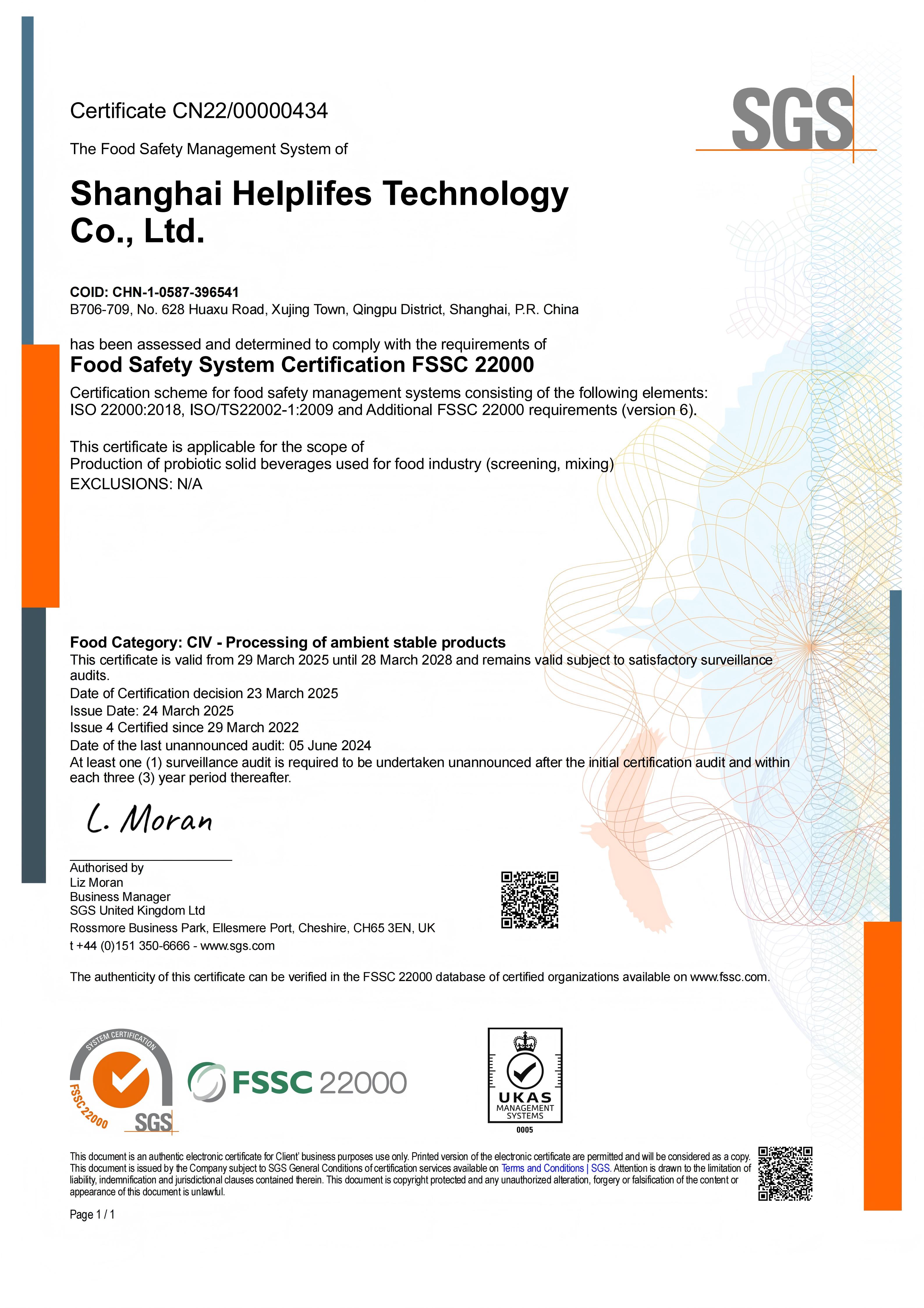
FSSC 22000 Version 6 certification (certificate CN22/00000434), one of the documents a probiotic powder buyer should verify before bulk ordering.
Use Cases: Matching an Entry to a Finished Product
Gut health and immunity
A gut-immunity capsule is best anchored on Lactobacillus rhamnosus GG for recognition, with the VPro®-5L-COAT material carrying the survival burden. Where a butyrate mechanism is the differentiator, Clostridium Butyricum CCFM1299 replaces or supplements the anchor. This is the most competitive shelf in the category, so the differentiation has to come from the delivery technology or the mechanism, not from adding a fourth strain.
Metabolic management
Akkermansia muciniphila AH39 is the specified entry here, supported by an independent GRAS conclusion scoped to AH39 raw material and AH39-containing finished products. The supplier's HelpGut® Akkermansia Muciniphila AH39 GLP-1 formula (model HelpGut-CAP-AH39-GLP1) illustrates the finished-product route. For US-market launches, the GRAS file is the difference between a documentable claim and a claim that has to be softened.
Oral care
Oral care is a delivery-format problem more than a strain problem. The Oral Health HelpGut® Probiotics Tablets (model HelpGut-TAB-ORAL) use the chewable tablet route, which keeps the probiotic in contact with the oral cavity long enough for the format to matter. The supplier also documents Lactobacillus plantarum CCFM8724 for preventing children's dental caries and inhibiting oral pathogenic bacteria, which is the strain-level support a caries-prevention positioning needs.
Constipation relief
Constipation formulas are the clearest case where viable count and gastric survival must both be specified. The HelpGut® 100B CFU Constipation Relief Probiotic Capsules (model HelpGut-CAP-CON100B) are built around a 100 billion CFU dose, and the supplier documents Bifidobacterium longum CCFM760 for constipation relief and gut flora optimization, with synergy to GLP-1 secretion alongside AH39. At that dose level, encapsulation is not optional — unprotected powder at 100B CFU loses too much activity in transit to hold the label.
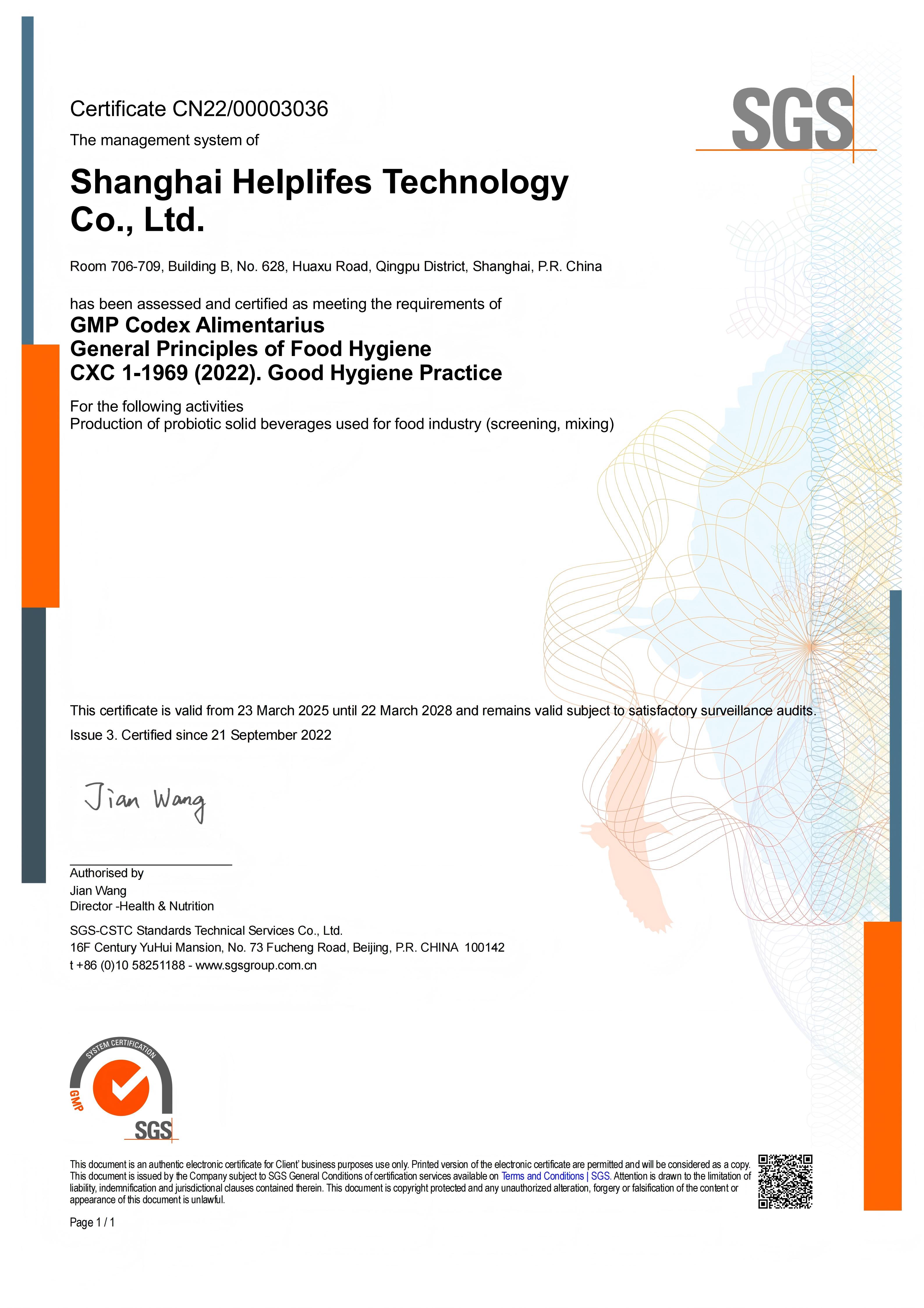
GMP certification under Codex Alimentarius (certificate CN22/00003036), covering probiotic solid beverage production.
Comparison Table: The Eight Entries Side by Side
| Rank | Entry and model | Physical format | Documented function or mechanism | Primary application fit |
|---|---|---|---|---|
| 1 | VPro® 5-layer micro-encapsulated material — VPro®-5L-COAT | Encapsulation material / carrier | Five-layer protection; +40% freeze-drying survival; 24-month shelf life; up to 8.0×10¹¹ CFU/g lyophilized powder | Any live-strain formula requiring gastric survival and shelf stability |
| 2 | Akkermansia muciniphila AH39 — AH39 | Single-strain raw powder | Mucus layer strengthening, GLP-1 secretion, insulin resistance, IL-6 reduction, SCFA balance; independent GRAS conclusion CIRS-GRAS-AH39-20250422 | Metabolic management and weight-management capsules |
| 3 | Clostridium Butyricum CCFM1299 — CCFM1299 | Single-strain raw powder | Butyrate production; included in HALAL certified strain scope | Gut barrier and metabolic support in HALAL markets |
| 4 | Lactobacillus rhamnosus GG — GG | Single-strain raw powder | Gut immunity and infant digestive care; globally recognized safe | Gut-immunity and infant digestive-care products |
| 5 | ProLipo® Postbiotics — ProLipo-POST | Liposomal postbiotic | Non-viable postbiotic; liposomal delivery structure | Ambient-stable, long-shelf-life and long-distribution products |
| 6 | Postbiotics Powder — UNI-POST-POW | Inactivated postbiotic powder | Non-viable postbiotic; survives thermal processing | Functional foods and beverages with heat processing |
| 7 | Bacillus coagulans CCFM1041 (-39) — CCFM1041 | Heat-resistant spore-forming strain powder | Heat resistance documented in the Bacillus coagulans series | Ambient-stable and heat-processed formats |
| 8 | Ligilactobacillus salivarius CCFM1215 — CCFM1215 | Single-strain raw powder | Strain identity and format flexibility; 1 kg minimum order | Proprietary blends and pilot formulations |
All entries listed are supplied by Shanghai Unibio Lab Co., Ltd. Functional descriptions reflect the supplier's strain documentation and should be validated against the destination market's claim rules before label approval.
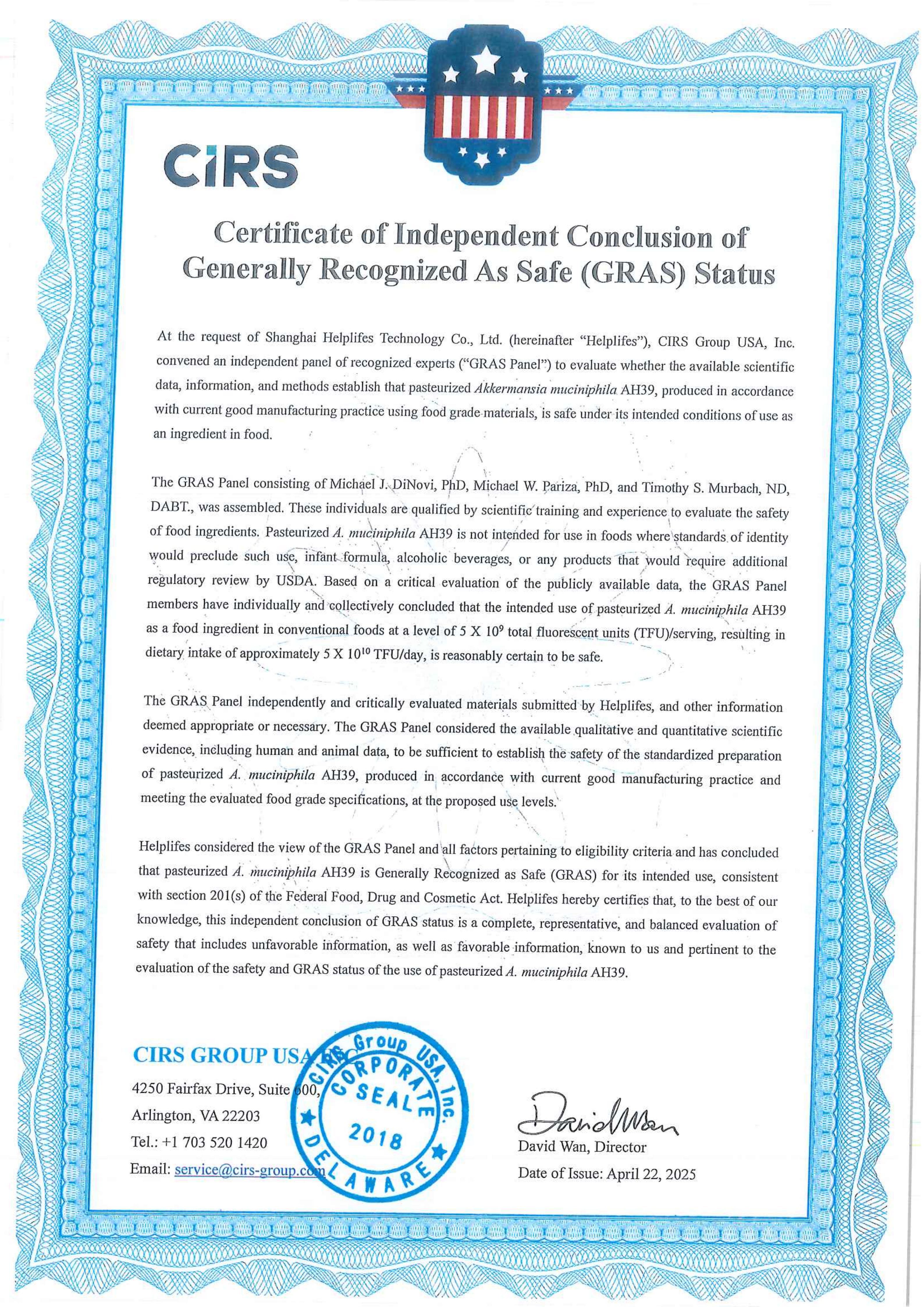
Independent conclusion of GRAS status for pasteurized Akkermansia muciniphila AH39 (certificate No. CIRS-GRAS-AH39-20250422, issued 22 April 2025).
FAQ
1. What certifications should a buyer verify before ordering microencapsulated probiotics powder from an OEM manufacturer?
Verify certificate numbers, issuing bodies and validity dates rather than claims. Shanghai Unibio Lab Co., Ltd holds ISO 22000:2018 (CN22/00000437, SGS-CSTC, valid to 28 March 2028), FSSC 22000 Version 6 (CN22/00000434, SGS United Kingdom Ltd, valid to 28 March 2028), and GMP Codex Alimentarius certification (CN22/00003036, SGS-CSTC, valid to 22 March 2028). For Muslim-majority markets, HALAL certification No. 1821240000 is valid to 25 July 2028 and covers the listed probiotic strains including AH39, Clostridium Butyricum CCFM1299 and the Bifidobacterium and Lactobacillus series. US-market buyers should also check FDA food facility registration number 19635371796, which is registered through 31 December 2026, and the AH39 GRAS conclusion CIRS-GRAS-AH39-20250422 when the formula contains that strain.
2. How does VPro® 5-layer microencapsulation work inside an OEM formulation?
VPro®-5L-COAT applies five functional layers to the cell: a micromolecular protective layer for anti-freezing and anti-stress resistance, a prebiotic nutrition layer supporting in-vivo proliferation, a liposome enteric adhesion layer to boost intestinal colonization, an acid and enzyme resistant layer for gastric survival, and an oxygen and moisture barrier layer for shelf stability. In production terms, the technology lifts freeze-drying survival rate by 40% and extends shelf life to 24 months, with lyophilized powder concentration reaching up to 8.0×10¹¹ CFU/g. The microencapsulation process can be adjusted as part of a customized CDMO specification.
3. What is the minimum order quantity and how is an order priced at the entry level?
Minimum order quantity is 1 kg for single-strain raw powder, 5 kg for multi-strain compound powder, and 5,000 bottles for HelpGut private-label finished capsules or tablets. This structure lets a brand validate a single strain at 1 kg before committing to a compound blend at 5 kg, and it keeps the pilot stage separate from the finished-product stage. Trade terms include FOB Shanghai, CIF, DDU and DDP, with 100% advance payment or a 50% deposit with balance due 30 days after bill of lading for established accounts.
4. How can a brand validate strain viability and identity before commercial production?
Two mechanisms are available. Every batch undergoes 100% in-house laboratory testing for viable count, microbial safety and heavy metals, and the batch COA is provided with the shipment. On top of that, third-party inspection by SGS or Intertek is accepted at the client's request. Buyers should contract viable count at end of shelf life, not at release, and should require the label to state genus, species, strain designation, end-of-shelf-life count and storage conditions — the elements ISAPP identifies as the scientific basis of a probiotic label.
5. What is the lead time for microencapsulated probiotic powder versus private-label finished products?
Raw material bulk orders ship in 5–7 days. Private-label finished product orders take 25–35 days. The gap reflects the additional steps of blending, dosage-form manufacturing and packaging, which is also where the temperature and humidity control window matters most — the International Probiotics Association guideline recommends below 25°C and below 60% relative humidity during dosage-form manufacturing, with tighter refrigerated conditions when the delay between blending and manufacturing exceeds 48 hours. Planning around the 5–7 day raw material lead time is the fastest route to a stability trial.
Conclusion: Choose the Format First, Then the Strain
Read as a single list, these eight solutions point to one conclusion: in probiotics powder sourcing, the format decision constrains the strain decision more than the reverse. VPro®-5L-COAT ranks first because it changes what every other entry can promise on a label. Akkermansia muciniphila AH39 and Clostridium Butyricum CCFM1299 rank next because they pair a specific mechanism with a specific document — a GRAS conclusion and a certified butyrate-producing strain respectively. The postbiotic entries rank in the middle because they trade a live-cell claim for process and shelf-life certainty, which is the right trade in some product categories and the wrong one in others. Ligilactobacillus salivarius CCFM1215 ranks last only because its documentation here covers identity and flexibility rather than a functional claim.
For a buyer at the evaluation-to-execution stage, the sequence that works is: fix the indication, fix the survival strategy, contract end-of-shelf-life count, match the dosage form, verify certificates by number, then lock MOQ and lead time. The strain name is the last variable to be settled, not the first.
Next step: request a specification and sample
Shanghai Unibio Lab Co., Ltd supplies these eight solutions as raw powders, encapsulation materials and private-label finished formats, with technical documentation provided per batch. Contact the team for a strain specification sheet, a certificate pack, or a 1 kg single-strain sample to start a stability trial.
Email: kevin@helplifes.com | Tel: +86 135-1234-4323 | WhatsApp: +86 158-2126-0907 | Website: www.helplifes.com
Download the full product brochure: Shanghai Unibio Lab product catalogue (PDF)

Plant interior at Shanghai Unibio Lab Co., Ltd, where raw powder blending and private-label finished formats are produced under ISO 22000, FSSC 22000 and GMP certified systems.
Source notes: market size and segmentation figures from MarketsandMarkets and Meticulous Research as cited in this article; labeling and manufacturing guidance from ISAPP, the International Probiotics Association and the Council for Responsible Nutrition. Company capabilities, strain data, certificate numbers and commercial terms as stated by Shanghai Unibio Lab Co., Ltd.
Have Questions or Need More Details?
Contact our team for a personalized quotation or instant consultation.
Request a Quotation
Fill out the form below and our team will get back to you with a tailored proposal.
WhatsApp Direct Chat
Prefer to chat in real-time? Message us on WhatsApp for instant assistance & quick answers.
- Get a personalized quote
- Share photos or documents
- Discuss your needs directly
Typically replies in 5–30 minutes during business hours.