FDA-Certified Probiotics Powder: Your Compliance and Specification Checklist
FDA-Certified Probiotics Powder: A Compliance and Specification Checklist for Buyers
Supplier search queries for “FDA-certified probiotics powder manufacturers” often assume that a single document can prove approval for the U.S. market. In reality, the U.S. FDA does not gate-keep finished probiotics powder through an official certification program. Instead, FDA regulation works through facility registration and current Good Manufacturing Practice compliance. This distinction changes how buyers should evaluate a supplier.
This guide explains the regulatory documents and powder specifications that matter, including FDA registration, independent GRAS conclusions, FSSC 22000, ISO 22000, GMP, and HALAL. It uses Shanghai Unibio Lab Co., Ltd as a real-world example because its available documentation covers several major import markets.
Problem Definition: Why “FDA-Certified” Can Mislead a Sourcing Team
If your procurement process treats “FDA certified” as a single seal of approval, you may focus on the wrong evidence. In the United States, dietary supplement production facilities must register with FDA and follow cGMP requirements specified in 21 CFR Part 111. The FDA does not separately certify each finished probiotic powder formula before it goes to market. What a compliant supplier can provide is a set of verifiable documents: a valid FDA facility registration, independently reviewed safety conclusions for novel strains, third-party food safety system certificates, batch certificates of analysis, and product parameters that match your label claim.
A more useful question is therefore not “is this manufacturer FDA certified?” but “can this manufacturer prove FDA-registered production and support the strain with documentation?” The difference is practical. Registration is a legal requirement for selling into the U.S.; certification systems such as FSSC 22000 and ISO 22000 are voluntary quality frameworks that give buyers additional confidence.
Industry Background: Probiotics Demand Is Raising the Compliance Bar
The probiotics market is large and still expanding. Global Market Insights valued the global probiotics market at USD 72.1 billion in 2024 and projects it will reach USD 165.1 billion by 2034. In the supplement segment specifically, MarketsandMarkets estimates the probiotic dietary supplement market at USD 10.60 billion in 2026, with a forecast CAGR of 9.5% through 2031. As more brands enter retail in North America, Europe, Southeast Asia, and the Middle East, the volume of imported probiotics powder rises—and so does the risk of documentation compliance failures.
Probiotics are live microorganisms. Quality therefore depends not only on strain identity but also on viable count, resistance to gastric conditions, and stability through the stated shelf life. Regulatory scrutiny in target markets is higher today than it was a decade ago. This article offers a sourcing framework for evaluation stage decisions, with certification details and real specifications you can compare.
What a Compliant Probiotics Powder Manufacturer Should Provide
A well-documented manufacturer can usually present evidence in three layers: legal registration for the destination market, independent ingredient safety evaluation, and food safety management certification. The following sub-sections describe each layer using documents available from Shanghai Unibio Lab Co., Ltd and its related operation Shanghai Helplifes Technology Co., Ltd.
1. FDA Facility Registration for US Market Entry
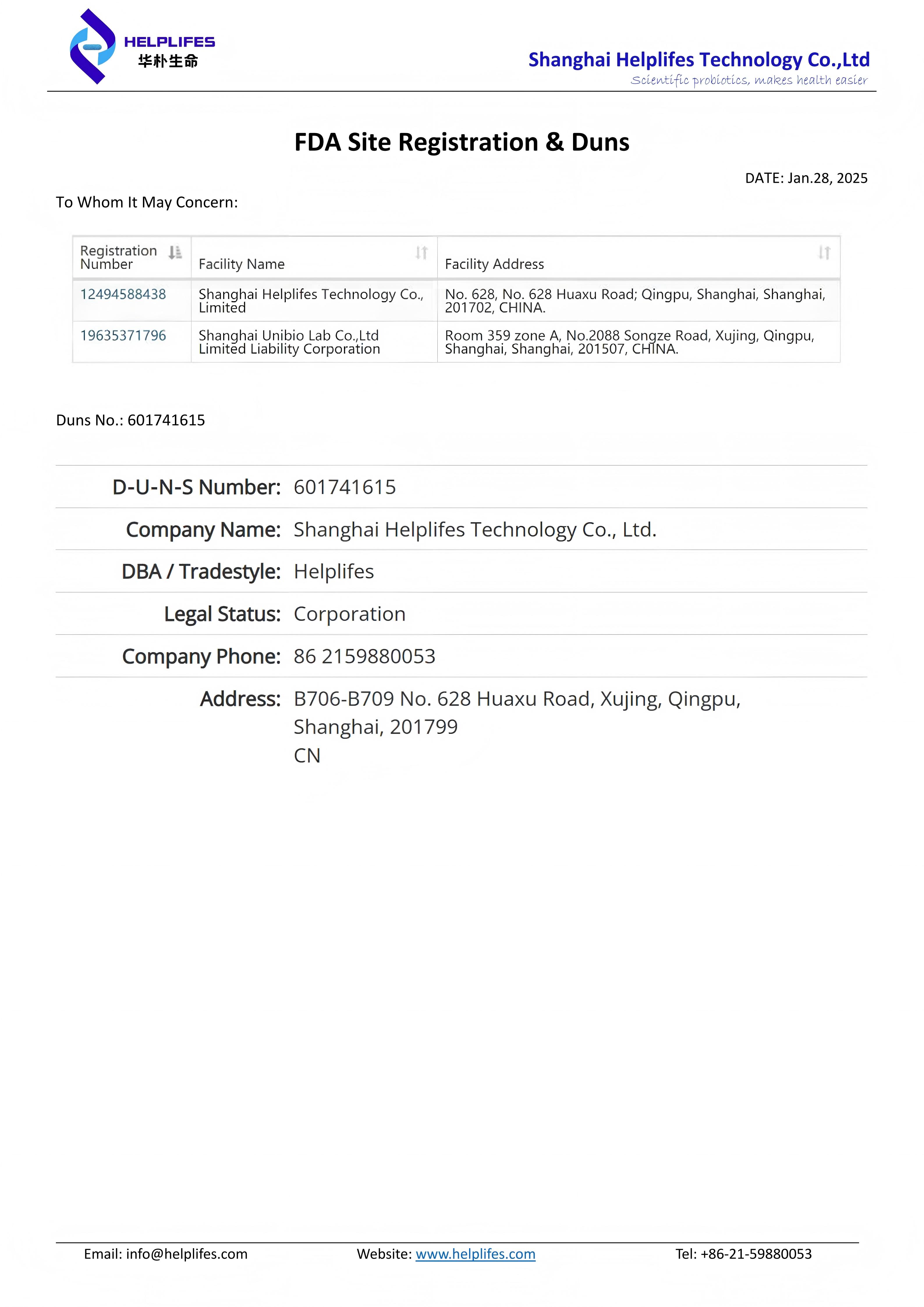
For a probiotics raw material or finished dietary supplement to be sold in the United States, the producing facility must be registered with the FDA. Under U.S. FDA Food Facility Registration Requirements, Shanghai Unibio Lab Co., Ltd holds FDA Facility Registration number 19635371796, and Shanghai Helplifes Technology Co., Ltd holds number 12494588438. The registration scope covers probiotic raw materials and finished dietary supplements. When a supplier gives you an FDA number, check that the scope and entity name match the actual production site for your order.
2. Independent GRAS Conclusion for Next-Generation Strains
Some newer probiotic strains require extra documentation for U.S. importers because they are not yet covered by decades of historical use. Akkermansia muciniphila AH39 is one such next-generation strain. For AH39 and AH39-containing finished products, Shanghai Unibio Lab Co., Ltd commissioned an independent GRAS expert panel assessment through CIRS GROUP USA Inc. The Certificate of Independent Conclusion of GRAS Status is number CIRS-GRAS-AH39-20250422, issued under U.S. FDA GRAS criteria per Section 201(s) of the Federal Food, Drug, and Cosmetic Act. This document is specific to pasteurized Akkermansia muciniphila AH39 raw material and finished products containing AH39. If you plan to market a metabolic health formula containing AH39, an independent GRAS conclusion can simplify U.S. customs and retailer review.
3. ISO 22000 and FSSC 22000 Food Safety Systems
ISO 22000 is the international standard for food safety management systems and incorporates HACCP principles across the probiotic production chain. FSSC 22000 is a GFSI-recognized scheme built on ISO 22000 plus technical specifications. Both documents are relevant for global food and supplement buyers.
Shanghai Unibio Lab Co., Ltd holds ISO 22000:2018 certification number CN22/00000437, issued by SGS-CSTC Standards Technical Services Co., Ltd., covering the production of probiotic solid beverages. The FSSC 22000 certification number is CN22/00000434, issued by SGS United Kingdom Ltd, also covering production of probiotic solid beverages with food category CIV. These certificates are valid until 2028 and apply to the global market. For a finished-dose supplier, check not only the certificate number but also the audit scope and expiry date.
4. GMP in a Qualified Workshop
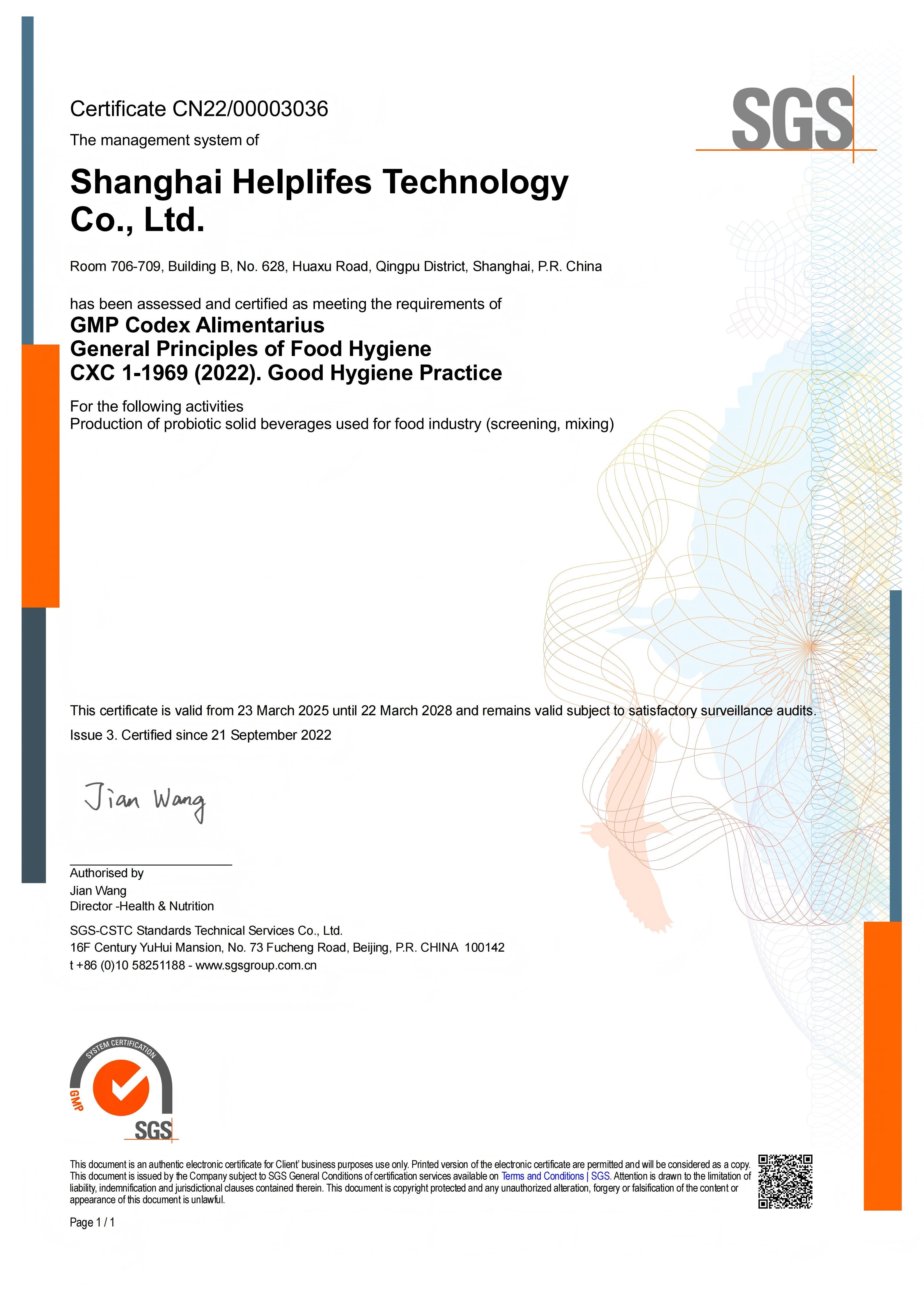
GMP certification confirms that screening, mixing, and related production steps follow Codex Alimentarius hygiene principles. Shanghai Unibio Lab Co., Ltd obtained GMP certificate CN22/00003036 from SGS-CSTC Standards Technical Services Co., Ltd. The scope is the production of probiotic solid beverages under food category CIV—processing of ambient stable products. This certificate follows the GMP Codex Alimentarius and General Principles of Food Hygiene CXC 1-1969 (2022). Buyers sometimes describe this as “GMP workshop produced probiotics powder,” which is appropriate when production occurs in such a certified facility.
5. HALAL Certification for Middle East and Southeast Asia
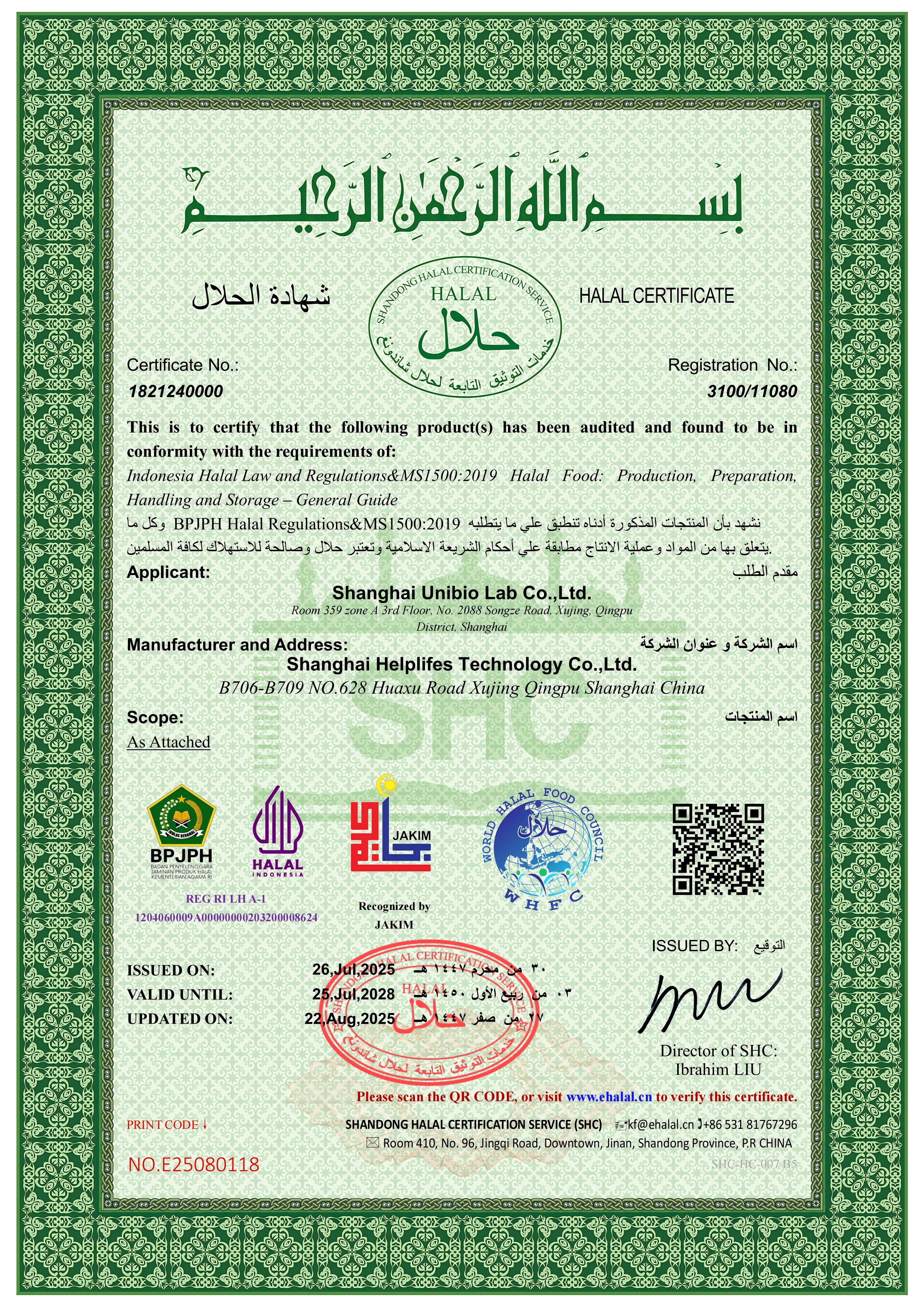
Probiotics powder suppliers exporting to Muslim-majority markets should provide HALAL certification recognized by local authorities. Shanghai Unibio Lab Co., Ltd has a HALAL certificate with registration number 3100/11080 and certificate number 1821240000, issued by SHANDONG HALAL CERTIFICATION SERVICE and recognized under Indonesian BPJPH Halal regulations. The scope covers all listed probiotic strains including Akkermansia muciniphila AH39, Clostridium butyricum CCFM1299, Bifidobacterium species, Lactobacillus species, and related raw materials and finished products. This document is valuable when selling into Middle East and Southeast Asian pharmacy chains, as well as food and beverage projects requiring HALAL-compliant ingredients.
Certificates prove that a facility is capable. Product documents prove that your specific powder matches your specification. The following parameters are the minimum set for a commercial RFQ for probiotics powder.- Viable count per gram: Most single-strain powders from Shanghai Unibio Lab Co., Ltd are specified in the range of 10B to 200B CFU/g. Higher-count strains are also available; for example, Bifidobacterium animalis subsp. lactis BL03 may be measured up to 600B CFU/g and Bacillus coagulans CCFM1041 up to 300B CFU/g. Choose a starting count that provides a safety margin for production and shelf-life losses.
- Strain identity and origin: A compliant supplier should disclose whether the strain is derived from an independent lab culture, human gut, or another documented source. Strain codes such as BL03, CCFM1025, or AH39 help prevent ingredient substitution.
- Carrier and encapsulation: Many raw powders contain probiotic strain, maltodextrin carrier, and VPro® 5-layer encapsulation material. The VPro® system is designed to protect bacteria from acid, bile, oxygen, and moisture and can extend shelf stability to 24 months.
- Storage conditions: Some powders are stored at -18°C or below, others at 2–8°C, and room-temperature-stable variants keep in a closed container away from sunlight. Confirm that your logistics chain can follow the required storage.
- Shelf life: Most raw probiotics powders in the portfolio are declared with a 24-month shelf life under recommended storage. Finished capsules such as HelpGut® 100B CFU Constipation Relief Probiotic Capsules also show 24 months, while some oral tablets have 20 months.
| Example Powder | Typical Viable Count | Carrier / Protection | Shelf Life |
|---|---|---|---|
| General single-strain powder | 10B–200B CFU/g | Maltodextrin + VPro® encapsulation | 24 months |
| Bacillus coagulans CCFM1041 | 10B–300B CFU/g | Maltodextrin + VPro® encapsulation | 24 months at room temperature |
| Bifidobacterium animalis subsp. lactis BL03 | 10B–600B CFU/g | Maltodextrin + VPro® encapsulation | 24 months under recommended storage |
| HelpGut® 100B CFU Capsules | 100B CFU/capsule | HPMC vegetarian capsule + prebiotic fiber | 24 months at room temperature |
Step-by-Step Supplier Review Process
Use the following workflow when you are in the evaluation stage and comparing candidates.
- Verify the FDA registration number. Ask for the exact entity name and number, then compare it with the facility that will manufacture your powder. For Shanghai Unibio Lab Co., Ltd the number is 19635371796.
- Check the destination-market certification matrix. US entry usually needs FDA registration and, for novel strains like Akkermansia muciniphila AH39, an independent GRAS conclusion. Middle East and Southeast Asian markets may require HALAL certification.
- Review food safety system certificates. Confirm that the certification body, scope, and expiry date match the current production process. ISO 22000, FSSC 22000, and GMP certificates are all published by SGS for this supplier.
- Request a batch COA. The COA should state viable count, microbial safety, heavy metals, and the specific strain code. The supplier also accepts third-party SGS/Intertek inspection upon request.
- Confirm powder formulation parameters. Check CFU/g or CFU/capsule, carrier, encapsulation technology, excipients, and storage conditions against your target label.
- Assess microencapsulation capability. If your finished product must survive stomach acid or be stored at room temperature, ask how the manufacturer protects the strains. VPro® 5-layer microencapsulated material is an example of a structured protection system.
- Plan an initial order with realistic MOQs and lead time. This supplier offers a minimum of 1 kg for single strain raw powder, 5 kg for compound powder, and 5,000 bottles for HelpGut private-label finished products. Bulk raw materials lead time is 5–7 days; private label finished products need 25–35 days.
Use Cases: How Compliance Translates to Real Shipments
- US dietary supplement brand launching a metabolic product: The importer needed a strain with regulatory clarity for U.S. retail. Using AH39 supported by the independent GRAS conclusion and produced in an FDA-registered facility allowed the formula to be positioned as a premium metabolic health supplement.
- Middle East wholesaler and pharmacy chain supplier: A client in the Middle East ships 12,000 bottles of HelpGut capsules and 8 tons of AH39 raw powder monthly. HALAL certification and the AH39 GRAS documentation simplify customs clearance, and customized Arabic packaging is provided.
- Southeast Asian fermented food manufacturer: A food and beverage producer in Thailand/Indonesia uses DVS yogurt starter and functional probiotic beverage powder. The long-term supply agreement relies on fermentation consistency and HALAL-certified raw materials to meet local food standards.
- European brand using microencapsulated blends: A distributor in Germany and the US has used multi-strain probiotic powder for gut health capsules and immunity chewables. Multi-year cooperation depends on strain stability through the product shelf life and full third-party test reports.
Certification Comparison Table for Probiotics Powder Sourcing
| Document | What It Covers | Example Numbers | Market Relevance |
|---|---|---|---|
| FDA Facility Registration | US food facility producing probiotics dietary supplements | Unibio 19635371796; Helplifes 12494588438 | United States |
| Independent GRAS Conclusion | Akkermansia muciniphila AH39 strain and AH39 finished products | CIRS-GRAS-AH39-20250422 | United States |
| FSSC 22000 | Production of probiotic solid beverages | CN22/00000434 | Global |
| ISO 22000:2018 | Food safety management in probiotic solid beverage production | CN22/00000437 | Global |
| GMP Codex Alimentarius | Good hygiene practice in production environment | CN22/00003036 | Global |
| HALAL | Probiotic raw materials and related finished products | Registration 3100/11080; Certificate 1821240000 | Middle East, Southeast Asia |
Frequently Asked Questions
What exactly is an FDA-certified probiotics powder manufacturer?
There is no official “FDA certification” for finished probiotic powder. Instead, a compliant manufacturer must register its production facility with the FDA and follow cGMP rules for dietary supplements. For example, Shanghai Unibio Lab Co., Ltd is an FDA-registered facility with registration number 19635371796, and Shanghai Helplifes Technology Co., Ltd is registered under number 12494588438. If a supplier uses the phrase “FDA certified,” ask for the actual registration number and scope.
Which certificates matter when importing probiotics powder into the United States?
For finished dietary supplements and raw materials, the most relevant US documents are FDA facility registration and, for novel strains such as Akkermansia muciniphila AH39, an independent GRAS conclusion. The GRAS document for AH39, number CIRS-GRAS-AH39-20250422, was issued by an independent expert panel and applies to pasteurized AH39 raw material and containing finished products. Additional ISO 22000, FSSC 22000, and GMP certificates strengthen a supplier’s overall quality file but do not replace US regulatory compliance.
What CFU/g range should I request for bulk probiotics powder?
Most single-strain powders offered by this supplier specify 10B to 200B CFU/g. Some strains extend higher: Bifidobacterium animalis subsp. lactis BL03 reaches 600B CFU/g and Bacillus coagulans CCFM1041 reaches 300B CFU/g. You should target a concentration that leaves overhead for stability testing and for loss during tablet compression or encapsulation. Confirm the final viable count at the end of shelf life, not only at the release date.
What are the MOQs for sampling and pilot batches?
Shanghai Unibio Lab Co., Ltd permits 1 kg minimum for a single-strain raw powder, 5 kg for a compound or multi-strain powder, and 5,000 bottles for HelpGut private-label finished capsules or tablets. These MOQs make it practical to run technical samples or small-batch market pilots before a full commercial order.
How long does a bulk probiotics powder order take?
For bulk raw materials, standard lead time is 5–7 days after formulation confirmation. Private label finished products, including capsules, tablets, packaging, and branding, usually require 25–35 days. If you need cold-chain logistics planning or batch COA documentation, these can be arranged as part of the same order.
Conclusion: Build Your Own Compliance Checklist
FDA-compliant sourcing of probiotics powder is not about finding one magical certificate. It is about building a documented picture of a manufacturer: registered facility, independent strain safety reviews, validated food safety systems, clear product specifications, and a commercial team that can support customs clearance and quality review. With the global probiotics market forecast to grow substantially, buyers who master this documentation process will reduce the risk of rejected shipments and failed product claims.
For the next step, you can review the complete certificate list, strain models, and product specifications from Shanghai Unibio Lab Co., Ltd. A downloadable brochure is available at this link. You can also contact the export team at kevin@helplifes.com for formulation-specific questions.