Navigating Probiotics Powder Regulations: A Compliance Roadmap for US and EU Markets
Short answer: a probiotics powder shipment entering the United States or the European Union is cleared by two separate document streams. One is a facility stream that proves where and how the material was produced. The other is a product stream that ties a strain designation, a model code and a composition declaration to the exact goods on the invoice. Certificates on their own rarely close the file. What customs brokers, retail QA teams and regulator-facing reviewers actually examine is the mapping between certificate scope, product model code and batch documentation.
This roadmap is written for buyers who are past discovery and are now evaluating suppliers. The working example used throughout is Shanghai Unibio Lab Co., Ltd, a probiotic R&D, manufacturing and CDMO enterprise founded in 2021 and based in Shanghai, China. Its documentation set supports commercial shipments into North America, Western Europe, Southeast Asia, the Middle East, Australia and Japan. Nothing below replaces local legal advice, but it does define which documents a buyer should request, in which order, and where the common gaps appear.
Why a Stack of Certificates Is Not a Compliance Answer
Probiotics powder sits in an awkward documentation zone. The same physical material may be positioned as a dietary supplement ingredient, as a food ingredient, or as an inactivated postbiotic preparation, and each classification pulls a different document set behind it. In practice, the most common compliance failure is not missing paperwork. It is paperwork that cannot be tied to the physical product, the specific model code, or the shipment date.
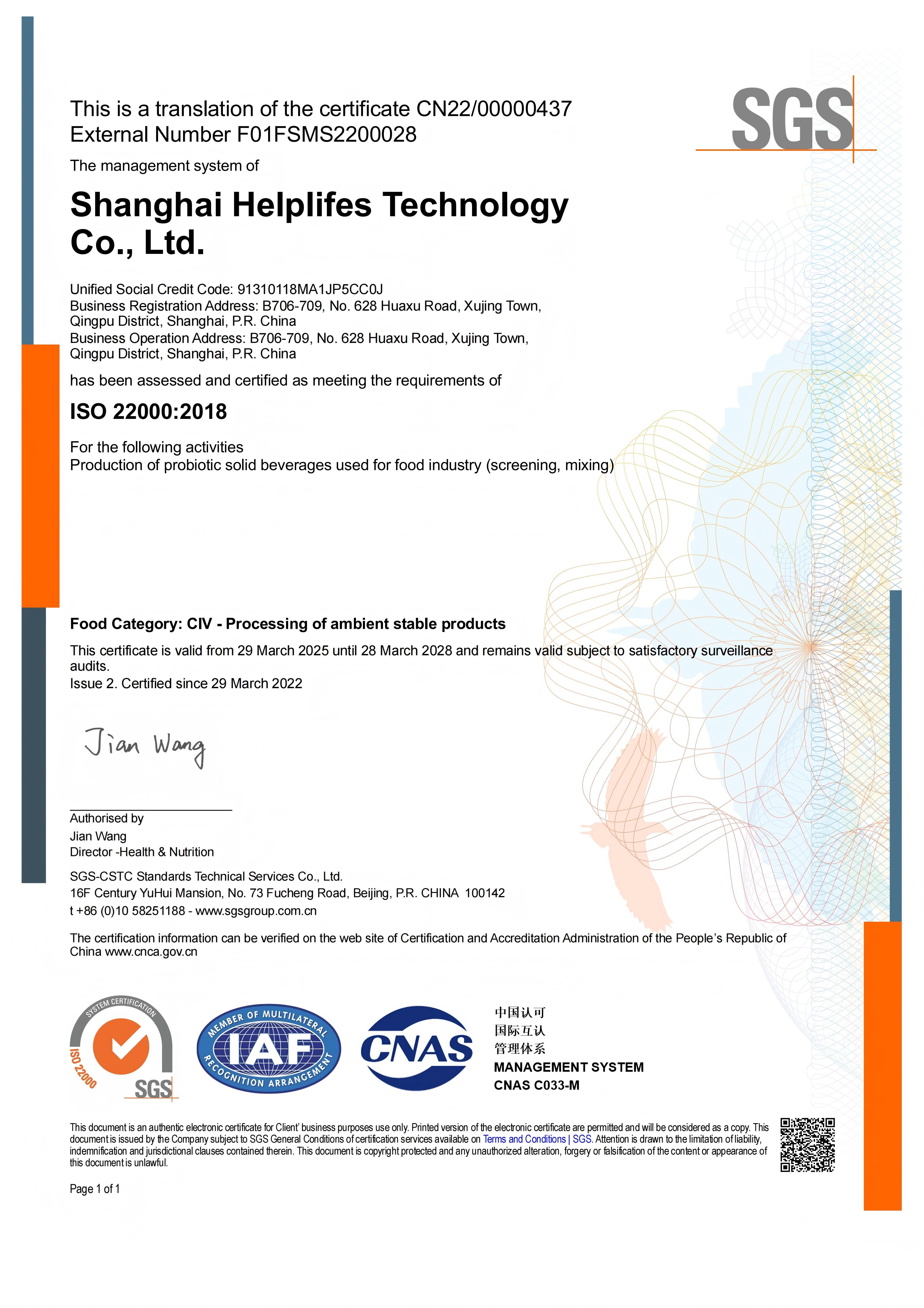
- Scope mismatch. A management-system certificate is issued against a defined scope, not against an entire catalogue. The ISO 22000 certificate held by Shanghai Unibio Lab Co., Ltd (certificate number CN22/00000437, issued by SGS-CSTC Standards Technical Services Co., Ltd, to ISO 22000:2018) covers the production of probiotic solid beverages (screening, mixing), Food Category CIV, and remains valid to 2028-03-28. That statement confirms a defined process; it does not automatically describe a coating material or a heat-inactivated postbiotic powder produced on a different line.
- Product identity gaps. An invoice line reading simply 'probiotic powder' is difficult to defend at any border. When the line reads Clostridium Butyricum CCFM1299 (model CCFM1299) or Akkermansia muciniphila AH39 (model AH39), the composition declaration, specification sheet and batch COA can all be linked to a single, traceable identity.
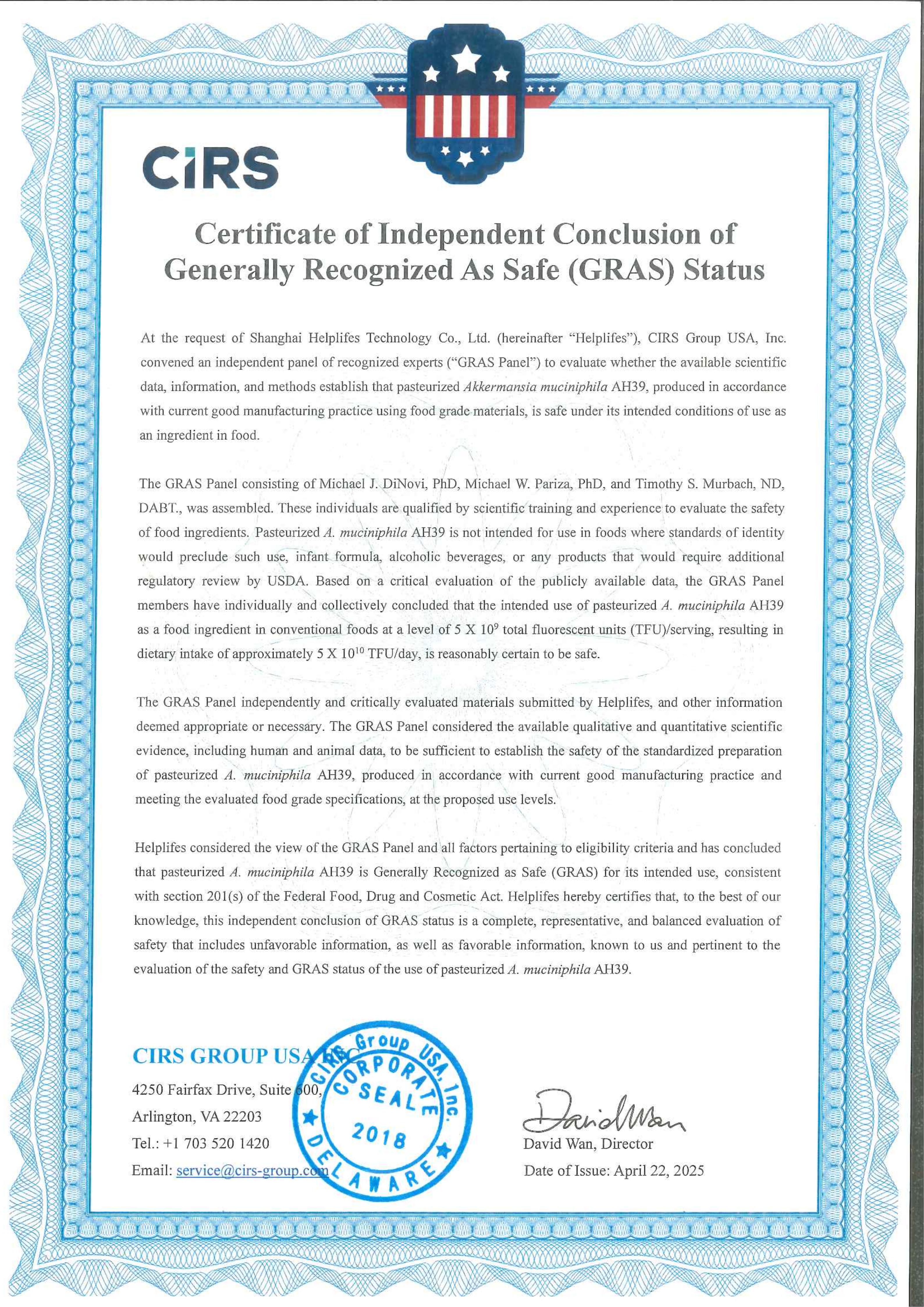
- Misread product-level approvals. Product-level documents usually carry narrower limits than buyers assume. The independent GRAS conclusion No. CIRS-GRAS-AH39-20250422, issued 2025-04-22 by CIRS GROUP USA Inc. as an independent expert panel assessment, applies only to pasteurized Akkermansia muciniphila AH39 strain raw material and to AH39-containing finished products. It does not extend to other strains in the same portfolio.
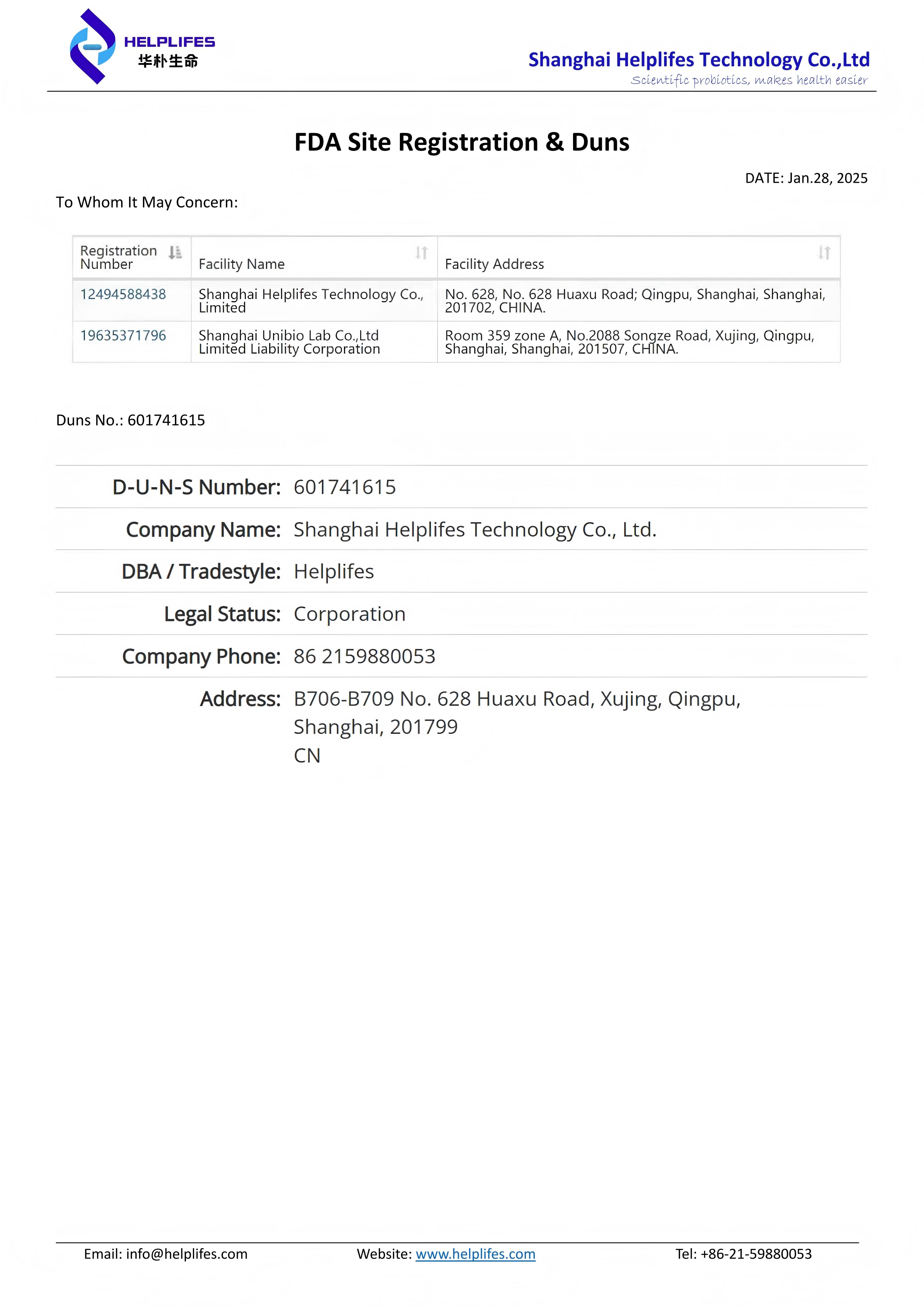
- Expiry drift. Facility registrations and certificates carry dates. The US FDA food facility registration numbers held for this production base are 19635371796 (Shanghai Unibio Lab Co., Ltd) and 12494588438 (Shanghai Helplifes Technology Co., Ltd), covering probiotic raw materials and finished dietary supplement production and sales, issued 2025-09-26 and valid to 2026-12-31. A purchase order placed late in 2026 for a shipment arriving after that date needs the renewal confirmation attached before the file is considered complete.
The 2026 Backdrop: More Products, More Documentation
Documentation pressure follows market growth. The global probiotics market was valued at USD 72.1 billion in 2024 and is projected to reach USD 165.1 billion by 2034, according to Global Market Insights. The supplement segment alone reached USD 10.60 billion in 2026, with a forecast CAGR of 9.5% through 2031, per MarketsandMarkets. More finished products on shelf means more ingredient lines to document, and more strain-level claims to substantiate.
The two destination markets in this roadmap are governed through different mechanisms, and buyers usually handle both in parallel.
- United States. Probiotic supplements are regulated under 21 CFR Part 111, which requires compliance with current Good Manufacturing Practices (cGMP), and probiotic dietary ingredients must meet applicable safety requirements. Facility registration and cGMP documentation therefore sit at the centre of a US file.
- European Union and global schemes. ISO 22000 is the international standard for food safety management systems applicable to the probiotic production chain, incorporating HACCP principles. EU buyers commonly request a GFSI-recognised scheme certificate in addition to it; FSSC 22000 is one of the schemes used for this purpose.
- Technology adds a documentation layer. Microencapsulation using materials such as alginate or chitosan is a recognised technical trend for keeping probiotics viable through gastric acid and bile salts, as reviewed in peer-reviewed literature indexed on PMC and in MDPI publications. Every coating material is itself a compound that must appear in a composition declaration.
The supply side is consolidated but far from uniform: Yakult Honsha holds 6.7% share of the probiotics market, with Danone S.A., ADM, Kerry Group and Novonesis among the largest players, according to Global Market Insights. Because reporting conventions differ between suppliers, the quality of the compliance file is a genuine differentiator rather than a formality.

A Three-Layer Documentation Roadmap for US and EU Buyers
A complete probiotics powder file is built in three layers: facility, product and batch. Buyers who request them in that order spend less time chasing inconsistencies later.
Layer 1 - Facility Registration and Management-System Certification
Layer one answers a single question: is this site registered, audited and certified to produce the product form you are buying? For this production base, the layer contains four documents.
- US FDA food facility registration. Registration numbers 19635371796 and 12494588438, issued 2025-09-26, valid to 2026-12-31, covering probiotic raw materials and probiotic finished dietary supplements production and sales.
- ISO 22000 food safety management system. Certificate CN22/00000437 (external number F01FSMS2200028), issued by SGS-CSTC Standards Technical Services Co., Ltd to ISO 22000:2018, valid to 2028-03-28, scope: production of probiotic solid beverages (screening, mixing), Food Category CIV.
- FSSC 22000. Certificate CN22/00000434, issued by SGS United Kingdom Ltd against ISO 22000:2018, ISO/TS 22002-1:2009 and FSSC 22000 Version 6, valid to 2028-03-28, same production scope.
- GMP. Certificate CN22/00003036, issued by SGS-CSTC Standards Technical Services Co., Ltd against the Codex Alimentarius GMP standard and General Principles of Food Hygiene CXC 1-1969 (2022), valid to 2028-03-22, same production scope.
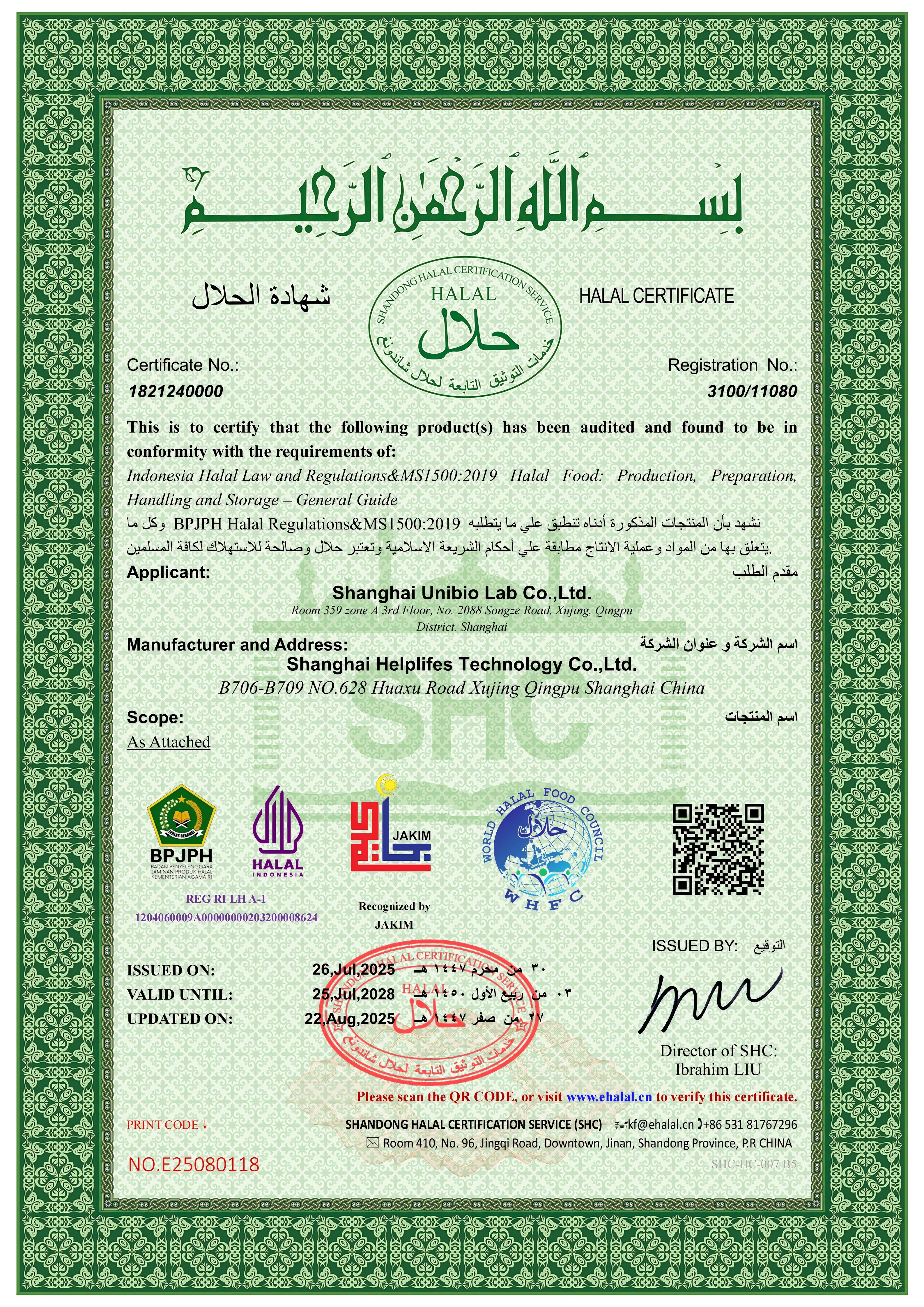
A fifth document joins the layer when the destination channel requires it. The HALAL certificate (Registration No. 3100/11080, Certificate No. 1821240000, issued by Shandong Halal Certification Service and recognised by BPJPH, valid to 2028-07-25) covers all listed probiotic strains, including Akkermansia muciniphila AH39, Clostridium Butyricum CCFM1299, the Bifidobacterium series and the Lactobacillus series, together with related raw materials and finished products, under Indonesia Halal Law and MS 1500:2019.
Layer 2 - Product Identity: Model Codes, Strain Designations and Composition Declarations
Layer two converts a generic ingredient name into an identifiable article. In this portfolio, every product carries a model code and a declared composition, and those two elements are what a reviewer compares against the label, the specification sheet and the COA.
Live single-strain raw powders follow a consistent declaration pattern of probiotic strain, maltodextrin carrier and VPro 5-layer encapsulation material. Two examples illustrate how much detail a buyer can obtain:
- Akkermansia muciniphila AH39 (model AH39) - a high-purity powder with a viable count of 10B-200B TFU/g, supplied in a well-closed container stored away from moisture and direct sunlight at room temperature, with a 24-month shelf life under recommended storage, and positioned for dietary supplement, metabolic management and health product applications.
- Clostridium Butyricum CCFM1299 (model CCFM1299) - a butyrate-producing probiotic powder with a viable count of 10B CFU/g, stored in a well-closed container away from moisture and direct sunlight at room temperature, with a 24-month shelf life under recommended storage, and applied in dietary supplements, metabolic management products and health products.
Postbiotic powders are documented separately because they are a different product form. The heat-inactivated Postbiotics Powder (model UNI-POST-POW) is declared as inactivated probiotic biomass with a maltodextrin carrier, active postbiotic content at or above a specified value, a 24-month shelf life, and a clear statement that no live bacteria are contained. ProLipo Postbiotics (model ProLipo-POST) is declared as postbiotic lysate with phospholipid liposome wall material and a food-grade carrier. The encapsulation coating itself, VPro 5-layer micro-encapsulated material (model VPro-5L-COAT), is declared as a food-grade polysaccharide and protein composite coating matrix. A buyer importing a postbiotic ingredient is therefore not collecting the same document set as a buyer importing live cultures, and the composition declaration is where that difference becomes visible.
Where a product-level safety document exists, its scope should be read literally. The independent GRAS conclusion for AH39 (No. CIRS-GRAS-AH39-20250422) was issued against US FDA GRAS criteria per Section 201(s) of the Federal Food, Drug, and Cosmetic Act and cGMP, and it is explicitly limited to pasteurized Akkermansia muciniphila AH39 strain raw material and AH39-containing finished products.
Layer 3 - Batch Release Testing and Third-Party Verification
Layer three is the part regulators and retail QA teams test against reality, because it applies to the specific drum or carton in transit rather than to the product concept. Every batch of probiotic raw material and postbiotic powder undergoes in-house laboratory testing for viable count, microbial safety and heavy metals. Third-party inspection by SGS or Intertek can be arranged at the client's request, and a batch COA accompanies the shipment.
Two operational details matter when a file is assembled for a cross-border programme. First, storage conditions differ by strain, so the declared condition on the specification must match the logistics plan; Bifidobacterium animalis subsp. lactis BL03 (model BL03), for example, is declared for storage in a sealed package at -18 degrees Celsius or below, while Clostridium Butyricum CCFM1299 is declared for room-temperature storage. Second, cold chain logistics guidance is provided as part of after-sales support, which keeps the transport record aligned with the storage declaration.
Step-by-Step: Assembling a US and EU Compliance File
The sequence below follows the order in which documents are usually requested, reviewed and challenged. Each step produces a piece of the file that the next step depends on.
Use Cases: How Documented Files Perform in Real Markets
Compliance documentation is easiest to judge in programmes that have already shipped. Three representative projects show how the layers above behave in practice.
- US and Germany supplement brand. A dietary supplement brand and a raw material distributor in Germany and the United States used multi-strain and single-strain probiotic powder to produce gut health capsules and immunity chewable tablets. Annual bulk orders reached 120 tons of multi-strain probiotic powder for the US market and 75 tons of single-strain powder for Germany, across three consecutive years of cooperation. VPro 5-layer microencapsulation provided acid and bile resistance, full third-party test reports were supplied, strain viability remained stable through shelf life, and the customer's product sales increased 42% year-on-year.
- Middle East pharmacy retail. Clients in Saudi Arabia and the United Arab Emirates used the material for premium metabolic and intestinal care supplements sold through pharmacy retail. The documentation set - including US GRAS status for AH39 and HALAL certification - supported smooth customs clearance, and the supplier also provided customized Arabic packaging and label service. Monthly consignments of 12,000 bottles of HelpGut capsules and 8 tons of Akkermansia muciniphila AH39 raw powder have continued steadily for 1.5 years, with a high customer repurchase rate.
- Southeast Asian fermented beverages. Manufacturers in Thailand and Indonesia used the material for mass production of yogurt, fermented milk and probiotic sparkling drinks. Yearly supply of 60 tons of DVS yogurt starter and 90 tons of functional probiotic beverage powder has run for two years. Stable fermentation performance and HALAL-certified raw materials resolved earlier problems of fermentation instability and non-conformity with local food standards, shortening the fermentation cycle while keeping flavour and probiotic activity within local requirements.
Documentation Matrix: Model Code, Composition and Storage by Product Format
The table below summarises how the documentation layers map onto specific product formats in this portfolio. Every field corresponds to a declaration supplied with the product.
| Product format | Model code | Declared composition | Viable count, storage and shelf life | Documentation it maps to |
|---|---|---|---|---|
| Akkermansia muciniphila high-purity probiotic powder | AH39 | Probiotic strain; maltodextrin carrier; VPro 5-layer encapsulation material | 10B-200B TFU/g; sealed container, room temperature, away from moisture and direct sunlight; 24 months | Independent GRAS conclusion No. CIRS-GRAS-AH39-20250422 (AH39 raw material and AH39-containing finished products only); FDA facility registration; batch COA |
| Clostridium butyricum butyrate-producing probiotic powder | CCFM1299 | Probiotic strain; maltodextrin carrier; VPro 5-layer encapsulation material | 10B CFU/g; sealed container, room temperature, away from moisture and direct sunlight; 24 months | Strain identity; composition declaration; HALAL certificate No. 1821240000; batch COA |
| Bifidobacterium breve probiotic raw powder | CCFM1025 | Probiotic strain; maltodextrin carrier; VPro 5-layer encapsulation material | 10B-200B CFU/g; sealed container, room temperature; 24 months | Strain identity; composition declaration; HALAL certificate No. 1821240000; batch COA |
| Bifidobacterium animalis subsp. lactis powder | BL03 | Probiotic strain; maltodextrin carrier; VPro 5-layer encapsulation material | 10B-600B CFU/g; sealed package at -18 degrees Celsius or below; 24 months | Strain identity; composition declaration; storage declaration for cold chain; batch COA |
| Heat-inactivated postbiotic raw powder | UNI-POST-POW | Inactivated probiotic biomass; maltodextrin carrier | Active postbiotic content at or above a specified value; sealed container, room temperature; 24 months; no live bacteria contained | Composition statement confirming no live bacteria; batch COA; FDA facility registration |
| Liposomal postbiotics | ProLipo-POST | Postbiotic lysate; phospholipid liposome wall material; food-grade carrier | Sealed container, room temperature, away from moisture and direct sunlight; 24 months | Composition statement; batch COA |
| Microencapsulation coating material | VPro-5L-COAT | Food-grade polysaccharide and protein composite coating matrix | Five-layer acid and bile resistant barrier; heat resistance improved; extends strain shelf life | Composition declaration for the coating; batch COA |
Frequently Asked Questions
1. Which documents should a US or EU buyer collect before ordering probiotics powder?
Four groups. Facility documents: US FDA food facility registration (numbers 19635371796 and 12494588438, issued 2025-09-26, valid to 2026-12-31, covering probiotic raw materials and finished dietary supplement production and sales). Management-system certificates: ISO 22000 certificate CN22/00000437 valid to 2028-03-28, FSSC 22000 certificate CN22/00000434 valid to 2028-03-28, and GMP certificate CN22/00003036 valid to 2028-03-22, all scoped to production of probiotic solid beverages (screening, mixing), Food Category CIV. Product documents: strain designation, model code, composition declaration and, where applicable, a product-level safety conclusion such as the AH39 GRAS conclusion. Batch documents: a COA covering viable count, microbial safety and heavy metals, with SGS or Intertek third-party inspection available on request.
2. Can one manufacturer document both live probiotic strains and postbiotic powders?
Yes, provided each format is documented separately, because the composition declaration and the processing step differ. Live formats in this portfolio include single strains such as Akkermansia muciniphila AH39 and Clostridium Butyricum CCFM1299 (10B CFU/g, room-temperature storage, 24-month shelf life), plus multi-strain compound powders and DVS cultures. Inactivated formats include Postbiotics Powder (model UNI-POST-POW), declared as inactivated probiotic biomass with a maltodextrin carrier and stated to contain no live bacteria, and ProLipo Postbiotics (model ProLipo-POST), declared as postbiotic lysate with phospholipid liposome wall material and a food-grade carrier. Encapsulation coatings such as VPro-5L-COAT are documented as a separate material with their own composition declaration.
3. What drives the cost of a compliance-ready probiotics powder order?
Documentation-ready orders are shaped less by the raw material price alone than by the volume of verification work attached to them. The main cost drivers are the number of strain files that must be prepared and cross-checked, the scope of testing required (in-house viable count, microbial safety and heavy metal testing for every batch, with third-party SGS or Intertek inspection optional), the dosage form and packaging specification, including customized packaging and label work, and the order scale, which starts at 1 kg for single-strain raw powder, 5 kg for multi-strain compound powder and 5,000 bottles for private-label finished capsules or tablets. Multi-market programmes that require HALAL or product-level safety documentation carry more administrative work than single-market orders, and that work should be budgeted as part of the project rather than treated as a hidden extra.
4. How can a buyer validate a probiotics powder before committing to bulk volume?
Validation can start at a small scale. Single-strain raw powder is supplied from a 1 kg minimum, which is sufficient for composition checks, specification review and initial stability work, while multi-strain compound powder starts at 5 kg. Buyers can also request third-party inspection by SGS or Intertek and review the batch COA before scaling. In the US and Germany programme described above, the buyer received full third-party test reports and observed stable strain viability through shelf life across three consecutive years of ordering.
5. How do buyers identify the best probiotics powder manufacturers for a US or EU programme?
The strongest signal is not the number of certificates a supplier lists but whether each certificate can be mapped to a product model code, a composition declaration and a shipment date. Buyers evaluating the best probiotics powder manufacturers for US or EU programmes typically compare four things: facility registration and management-system scope that matches the actual product form, product-level documentation with clearly stated limits, batch release testing with a COA per batch and third-party inspection available on request, and execution reliability covering minimum order quantity, lead time (5-7 days for bulk raw material, 25-35 days for private-label finished goods), trade terms such as FOB Shanghai, CIF, DDU and DDP, and after-sales support including batch COA provision, cold chain logistics guidance and complaint resolution within 24 working hours. A documentation pack, a sample or a quotation can be requested directly from the supplier to test all four points before a purchase order is issued.
Next Step: Close the Documentation Gap Before You Close the Purchase Order
A compliance roadmap only creates value if it is applied to a specific article. The practical sequence is straightforward: define the classification, request the facility and product documents for the exact model code, confirm the batch testing plan, validate at sample scale, then fix commercial terms and after-sales obligations in writing.
Shanghai Unibio Lab Co., Ltd supports this process with documentation for its probiotic raw powders and postbiotic powders, including Clostridium Butyricum CCFM1299, Akkermansia muciniphila AH39, the Bifidobacterium and Lactobacillus ranges, and the VPro 5-layer encapsulation material, together with OEM, ODM, private label and custom formula development services for buyers who need a finished format rather than a raw input.
Request a Sample, Documentation Pack or Quotation
Send your target strain, model code, dosage form and destination market, and the matching documentation set - specification, composition declaration, batch COA scope and available third-party testing arrangements - will be prepared for review.
Email: kevin@helplifes.com | Tel: +86 135-1234-4323 | WhatsApp: +86 158-2126-0907
Website: www.helplifes.com | Company brochure (download): Unibio Lab product and capability brochure
Address: B706-709, No.628 Huaxu Road, Xujing Town, Qingpu District, Shanghai, P.R.China
Contact: Kevin


Have Questions or Need More Details?
Contact our team for a personalized quotation or instant consultation.
Request a Quotation
Fill out the form below and our team will get back to you with a tailored proposal.
WhatsApp Direct Chat
Prefer to chat in real-time? Message us on WhatsApp for instant assistance & quick answers.
- Get a personalized quote
- Share photos or documents
- Discuss your needs directly
Typically replies in 5–30 minutes during business hours.