
Probiotics Powder, Explained: Composition, Stability, and Sourcing Science
Probiotics Powder, Explained: Composition, Stability, and Sourcing Science
Probiotics powder is a concentrated, dried form of live beneficial microorganisms used as a raw material in dietary supplements, functional foods, fermented dairy, beverages, and animal nutrition. For formulators and brand owners, understanding what is inside the powder — strains, viable counts, encapsulation, and certification — matters more than the label term “probiotics.” This article explains the fundamentals of probiotics powder and the verification points suppliers should be able to demonstrate.
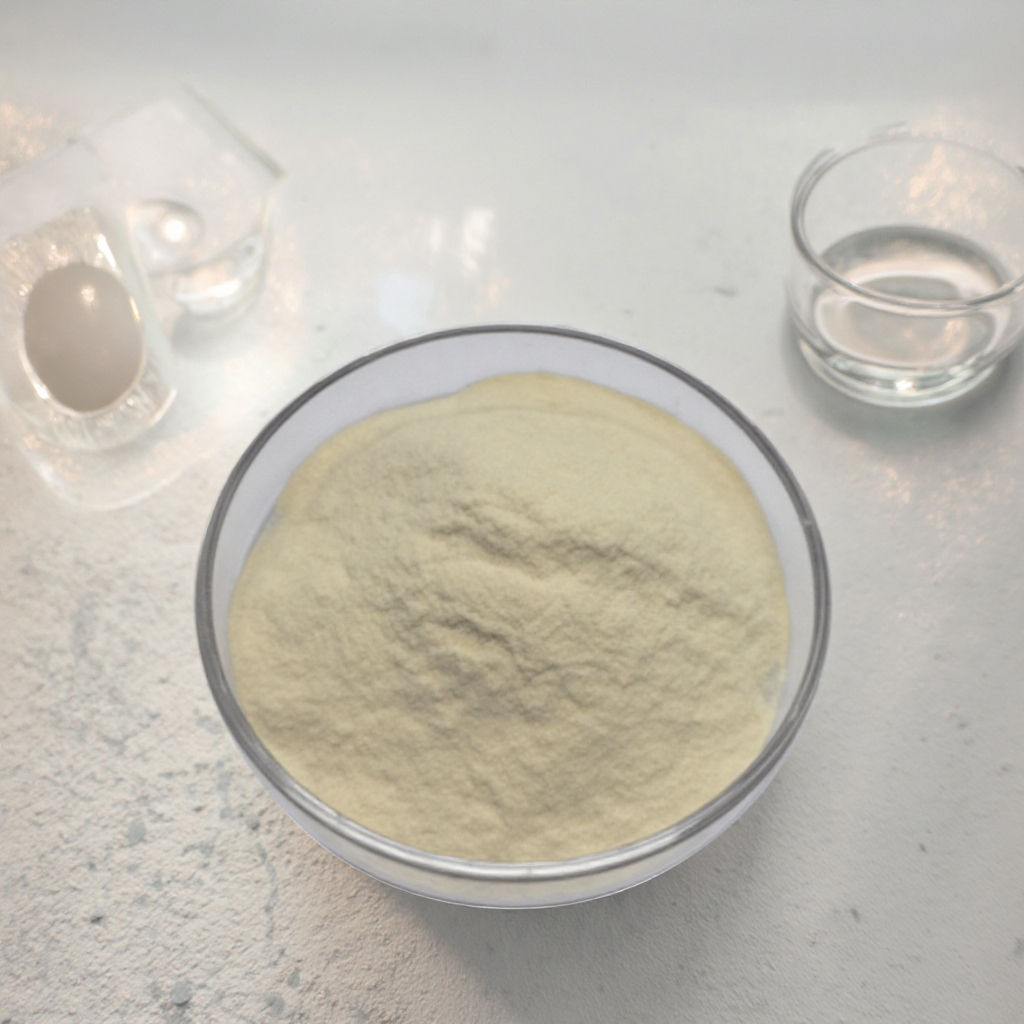
Single-strain probiotics powder is the base format used to build finished supplement and food formulas.
What Is Probiotics Powder?
Probiotics powder is produced by fermenting selected bacterial strains, concentrating the biomass, and drying it into a powder while preserving cell viability. The powder usually contains three functional parts: the probiotic strain or strains, a carrier such as maltodextrin, and an optional protective coating layer that stabilises the cells during processing, storage, and digestion.
In commercial raw-material specification, key characteristics include:
- Strain identity — bacterial genus, species, and strain code;
- Viable count — usually expressed as CFU/g or, for next-generation strains, TFU/g;
- Carrier and coating system;
- Recommended storage condition; and
- Shelf life under that recommended storage.
This definition separates bulk probiotics powder from finished probiotic gummies, capsules, or drops: raw powder is the manufacturing input, while finished formats are the consumer-facing output.
Why Probiotics Powder Quality Is Hard to Judge
The main challenge when sourcing probiotics powder is that live cells are fragile. Heat, moisture, oxygen, stomach acid, and bile can all reduce viability between production and the end of shelf life. Products that look identical in a specification sheet may perform differently in a finished supplement because of differences in strain sensitivity, fermentation process, drying technology, encapsulation, and packaging.
Another difficulty is that not all strains deliver the same function. A sack of lactobacilli and a sack of bifidobacteria may both be labelled “probiotics powder,” but they can be designed for different target populations, such as infants, adults, pets, or livestock. For this reason, a discovery process usually involves three steps: understand the strain family, define the target function, and then verify the supplier’s manufacturing and compliance evidence.
Market Context: Probiotics Is No Longer a Single Category
The global probiotics market was valued at USD 72.1 billion in 2024 and is projected to reach USD 165.1 billion by 2034, according to Global Market Insights. Probiotic dietary supplements specifically were estimated at USD 10.60 billion in 2026 and are forecast to grow at a CAGR of 9.5% through 2031, based on MarketsandMarkets data.
Adjacent health and nutrition segments have also become significant. The baby probiotics market was valued at USD 2.27 billion in 2024 and is forecast to reach USD 5.6 billion by 2035 with a CAGR of 8.6%, according to WiseGuyReports. The global pet biotics market is estimated to reach USD 1,232.5 million by 2030, growing at a 7.0% CAGR, based on MarketsandMarkets data. These figures explain why buyers increasingly search for specialised probiotics powder formats rather than one generic ingredient.
Market observation: probiotics demand now spans human gut health, immunity, infant nutrition, sports nutrition, the elderly, pets, and livestock. Each end-use segment has different viability, dosage, and compliance expectations. As a result, raw-material selection becomes a formulation decision, not a simple purchase decision.
The Science Inside the Sachet: Strain Families in Probiotics Powder
Bulk probiotics powder can be single-strain or multi-strain. “Single-strain high-purity powder” is used when a brand wants a clearly documented strain and a transparent formula. “Compound probiotics powder” blends multiple strains to target different mechanisms, for example, combining a colonising bifidobacterium with a lactobacillus strain that produces lactic acid.
Shanghai Unibio Lab Co., Ltd, a probiotic R&D and CDMO company based in Shanghai, China, maintains a strain bank of more than 30,000 microbial strains, including 189 patented functional strains. Its portfolio spans lactobacilli, bifidobacteria, Bacillus coagulans, Clostridium butyricum, and next-generation Akkermansia muciniphila AH39.
Representative Strain Families
| Strain family | Examples | Typical viable count range | Typical intended use |
|---|---|---|---|
| Lactobacillus rhamnosus | LGG, CCFM0528, CCFM1219, LR663 | 10B–300B CFU/g | Dietary supplements, infant food, immunity-oriented formulas |
| Lactobacillus plantarum | CCFM602, CCFM8661, CCFM8724, HP59 | 10B–200B CFU/g | Food & beverage, dietary supplements, fermented food |
| Bifidobacterium | B. longum CCFM760/CCFM1195, B. breve CCFM1025, B. animalis BL03 | 10B–200B CFU/g; BL03 up to 600B CFU/g | Gut health, constipation relief, immune support; BL03 also pet and animal feed |
| Bacillus coagulans | CCFM1041 | 10B–300B CFU/g | Room-temperature-stable food supplements and animal feed |
| Next-generation strains | Akkermansia muciniphila AH39 | 10B–200B TFU/g | Metabolic-management supplements |
| Clostridium butyricum | CCFM1299 | 10B CFU/g | Butyrate-producing formulas for metabolic health |
| Streptococcus thermophilus | ST67 | 10B–300B CFU/g | DVS fermentation cultures for yogurt and dairy |
Storage recommendations are not uniform. Many lactobacilli and bifidobacteria powders require cold-chain storage at −18°C or 2–8°C, whereas Bacillus coagulans CCFM1041, Akkermansia muciniphila AH39, Clostridium butyricum CCFM1299, and some Bifidobacterium longum products can be stored at room temperature in a sealed container away from moisture and light. A supplier should state the storage condition clearly for each strain rather than using one generic label.
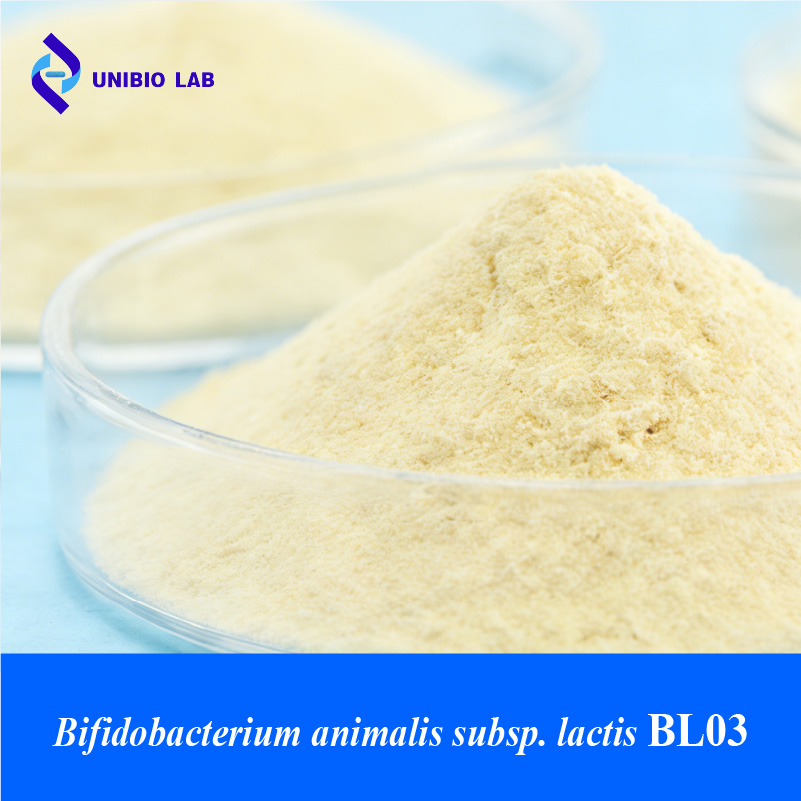
Bifidobacterium animalis subsp. lactis BL03 is an example of a strain used across human supplement and animal nutrition categories.
How Manufacturing Technology Shapes Probiotics Powder Stability
The production route determines whether a probiotics powder can survive long-distance export, high-temperature processing, and the human gastrointestinal environment. Low-temperature freeze-drying is the standard method for preserving sensitive strains. Shanghai Unibio Lab applies a self-developed VPro® five-layer microencapsulation technology to address acid, bile, oxygen, and freezing damage.
- Micromolecular protective layer: anti-freezing and anti-stress protection during freeze-drying;
- Prebiotic nutrition layer: supports in-vivo proliferation;
- Liposome enteric adhesion layer: supports intestinal colonisation;
- Acid- and enzyme-resistant layer: helps cells survive gastric digestion;
- Oxygen- and moisture-barrier layer: extends shelf-life stability.
According to company data, VPro® encapsulation lifts freeze-drying survival rate by 40%, supports a shelf life of 24 months, and achieves fermentation density above 3.5×10¹⁰ CFU/mL with lyophilised powder concentration up to 8.0×10¹¹ CFU/g. That level of stability is relevant for brands shipping finished products internationally or incorporating probiotics into powders, capsules, tablets, sachets, and heat-processed foods.
Bifidobacteria, Lactic Acid Bacteria, and Next-Generation Strains: What the Differences Mean
Most commercial probiotics powder falls into two microbiological groups: Bifidobacterium and lactic acid bacteria such as Lactobacillus. Bifidobacteria are a dominant part of the gut microbiota and are commonly used in digestive-balance and constipation-relief formulas. Lactic acid bacteria, including Lactobacillus rhamnosus, Lactobacillus plantarum, and Lactobacillus acidophilus, are widely used in food, beverage, and supplement formats.
Single-strain products are chosen when the brand wants to make a precise claim, for example Lactobacillus rhamnosus GG in infant-oriented products. Multi-strain compounds are used when a brand targets multiple functions, such as regulating bowel rhythm and supporting immunity in one capsule.
Next-generation probiotics such as Akkermansia muciniphila AH39 are metabolically oriented. Shanghai Unibio Lab positions AH39 as a self-affirmed GRAS strain for metabolic management, with mechanisms including support for the intestinal mucus layer, GLP-1-related signalling support, and balancing of short-chain fatty acids such as acetate and propionate. Because this is a newer category, brands should ask for GRAS documentation and clinical evidence before using it in US-market formulas.
Use Cases Across End-Markets
Adult Gut and Bowel-Regulating Probiotics Powder
For adult digestive formulas, common expectations include relieving constipation, improving irregular defecation, and balancing intestinal flora. Strains such as Bifidobacterium longum CCFM760, Bifidobacterium longum CCFM1195, Bifidobacterium adolescentis CCFM1173, and Lactobacillus plantarum CCFM602 belong to this area of use. Finished products can range from bulk raw powder for capsules to finished products such as the HelpGut® 100B CFU constipation-relief probiotic capsule, which uses a multi-strain formula in a vegetarian HPMC capsule.
Pet Probiotics Powder
Pet nutrition is a growing segment, with the biotics market projected to reach USD 1.23 billion by 2030. Bifidobacterium animalis subsp. lactis BL03 is a single-strain powder that lists Pet Health Products and Animal Feed among its intended application industries. Likewise, Bacillus coagulans CCFM1041 is formulated for food, dietary supplement, and animal feed use. Buyers developing pet supplements should verify not only the strain but also palatability, dosage form, and storage stability in pet food matrices.
Infant Probiotics Powder
The infant segment demands conservative strain selection and strong clinical documentation. Lactobacillus rhamnosus GG is a classic strain used in infant food and remains among the most internationally recognised probiotics. Lactobacillus reuteri HR7 lists Infant Health Product among its intended industries, and Lactobacillus rhamnosus CCFM0528 is positioned broadly across immunity, elderly, sports nutrition, adult gut, infant, and pet applications in supplier literature.
Sports Nutrition and Immunity Probiotics Powder
Athlete-oriented products often look for strains that support immune defence and reduce training-related gut discomfort. Lactobacillus rhamnosus CCFM0528 is an example that has been applied in sports nutrition contexts, alongside the broader immunity-supporting profile of the L. rhamnosus family. For an immunity supplement, a formula may combine a lactobacillus strain with a bifidobacterium strain and a prebiotic carrier to support daily intake.
Elderly Regulating Probiotics Powder
For elderly consumers, formulators usually select strains that were originally isolated from healthy human gut or infant sources and that have room-temperature or simple cold-chain storage. Bifidobacterium longum CCFM1195 and CCFM760 can be stored in a well-closed container at room temperature, making them practical for elderly care products distributed through pharmacy channels.
Livestock Farming Probiotics Powder
In livestock feed, heat resistance and room-temperature storage are practical advantages. Bacillus coagulans CCFM1041 is a heat-resistant probiotic powder with room-temperature storage, and Bifidobacterium animalis subsp. lactis BL03 and Bifidobacterium longum CCFM760 also list animal feed among their application segments.
Fermented Dairy and Yogurt Starters
Probiotics powder is not only for supplements. Streptococcus thermophilus ST67 and Lactobacillus delbrueckii subsp. bulgaricus HB68 are DVS fermentation powders intended for fermented dairy products, food & beverage, and yogurt starter applications. In this case, the powder is used as a production culture, and its viable count matters for fermentation efficiency.
Comparison Table: What to Check in a Probiotics Powder Specification
| Quality area | What to check | Example evidence |
|---|---|---|
| Strain identity | Species and strain code with clean taxonomy | Lactobacillus rhamnosus CCFM0528; Bifidobacterium animalis subsp. lactis BL03 |
| Viability | CFU/g or TFU/g and whether measured at release or end of shelf life | 10B–200B CFU/g for most lactobacilli; BL03 up to 600B CFU/g; AH39 shown in TFU/g |
| Carrier and coating | Excipients and protective technology | Maltodextrin carrier with VPro® 5-layer encapsulation |
| Storage | Cold chain vs room temperature | −18°C, 2–8°C, or room-temperature sealed container depending on strain |
| Shelf life | Months under stated temperature | 20–24 months across the Shanghai Unibio Lab raw-powder portfolio |
| Certifications | Food safety, GMP, religious, and market-entry documents | ISO 22000, FSSC 22000, SGS GMP, HALAL, OU Kosher, US FDA food facility registration |
Step-by-Step: How to Structure a Probiotics Powder Sourcing Decision
- Define the finished-product scenario. Infant supplement, adult daily gut health, sports immunity, pet chewable, or livestock feed? The scenario determines strain family, dosage format, and storage expectations.
- Select the strain family and function. Choose either single-strain powder with a clear identity or a compound powder for broader coverage. Map the function to intestinal regularity, immunity, oral health, metabolic support, or fermentation.
- Set the dose and viable count. Determine CFU per serving or per gram, then confirm that the raw powder concentration can be diluted into the finished product without exceeding practical blending limits.
- Review the protective technology. Ask whether the powder is microencapsulated, whether the coating is acid- and bile-resistant, and whether the supplier provides stability data for elevated temperature or long export shipping.
- Verify compliance documentation. Check if the site holds ISO 22000, FSSC 22000, GMP food manufacturing certification, HALAL, Kosher, and relevant US FDA registration. For a strain such as Akkermansia muciniphila AH39, ask for GRAS-related documentation.
- Test the supplier’s responsiveness. Request a COA, ask about third-party SGS/Intertek inspection, and confirm whether the supplier provides strain technical guidance and a cold-chain logistics plan.
- Run a sample trial. Test blending, finished-product stability, and any sensory effects before committing to a bulk volume.

Manufacturing-scale production equipment determines batch consistency and stability of probiotics powder.
What a Credible Probiotics Powder Supplier Should Show
Shanghai Unibio Lab Co., Ltd is an example of a probiotics manufacturer with CDMO capability. The company was established in 2021, operates four self-owned manufacturing bases and one R&D centre in Shanghai, and reports an annual production capacity of 1,800 tons of probiotic raw powder. Its export share is around 85%, with primary markets in North America, Western Europe, Southeast Asia, and the domestic Chinese market.
For buyers, the useful comparison points are:
- Capability: a 30-professional R&D team and a strain bank of more than 30,000 microbial strains;
- Customisation: services including OEM, ODM, private label, custom strain blending, and formula R&D;
- Quality testing: full internal lab testing of viable count, heavy metals, and microbial safety for every batch, with third-party SGS/Intertek inspection available on request;
- Service depth: batch COA provision, cold-chain logistics advice, and 24-hour working-hour complaint response.
Buyers should not take any supplier description at face value. Instead, request documents, inspect certificates, and run a small sample batch. A supplier’s willingness to share stability data is often a stronger signal than a promotional brochure.
FAQ
Q: What should brands ask probiotics powder suppliers during first contact?
Brands should ask for strain-level documentation, viable count at release and end of shelf life, storage conditions, carrier and coating system, certifications, and whether the powder can support custom blending or private-label finished formats. A good supplier response should also explain MOQ, lead time, and what testing is performed for each batch. For a supplier reference, Shanghai Unibio Lab Co., Ltd supports single-strain orders from 1 kg, compound powder from 5 kg, and finished private-label products from 5,000 bottles.
Q: Which compliance documents matter when importing probiotics powder to the United States, EU, or Middle East?
For the US market, suppliers should verify their FDA food facility registration, and any strain-specific documents such as a self-affirmed GRAS conclusion for Akkermansia muciniphila AH39. For the EU and other global markets, ISO 22000 food safety management certification is widely used. For Middle East and Muslim-majority markets, HALAL certification is relevant, while Kosher certification supports Jewish-market distribution. Shanghai Unibio Lab Co., Ltd holds ISO 22000, FSSC 22000, SGS GMP food manufacturing certification, HALAL, Orthodox Union (OU) Kosher, and US FDA food facility registration.
Q: What is the difference between single-strain and compound probiotics powder?
Single-strain probiotics powder contains one identified strain and is used when the product claim should be traceable to a specific microorganism. Compound probiotics powder blends two or more strains, often combining lactobacilli and bifidobacteria, to address broader functions such as bowel regularity plus immunity. Both formats are available as bulk raw materials. Bifidobacterium longum CCFM1195 and Lactobacillus rhamnosus CCFM0528 are examples of single-strain powders, while the HelpGut® 100B CFU constipation-relief capsule is a multi-strain blended finished product.
Q: Why does storage temperature vary so much between probiotics powder products?
Different strains and different protective coatings tolerate moisture, oxygen, and temperature differently. Sensitive lactic acid bacteria and bifidobacteria often require storage at −18°C or 2–8°C. Heat-resistant or microencapsulated strains such as Bacillus coagulans CCFM1041 and Akkermansia muciniphila AH39 may be storable at room temperature in a sealed container away from moisture and direct sunlight. The supplier should always specify the storage condition per product, not per category, because room-temperature stability is a function of strain sensitivity and encapsulation technology.
Q: What are typical MOQs and lead times for bulk probiotics powder?
MOQ depends on the product format. A common industry reference, used by Shanghai Unibio Lab Co., Ltd, is 1 kg for single-strain powder, 5 kg for compound powder, and 5,000 bottles for finished HelpGut® private-label products. For bulk raw materials, lead time is 5–7 days; for private-label finished goods, lead time is 25–35 days. Buyers planning a product launch should include formulation time, stability testing, and certificate review in the broader project calendar. If you are evaluating a supplier, request batch COA and a sample quote before finalising specifications.
Conclusion
Probiotics powder is a technically sophisticated raw material that sits between microbiology, food engineering, and market compliance. For brands at the research stage, the most productive approach is to stop treating “probiotics powder” as one commodity and start asking about strain identity, viable count, encapsulation, storage, and certification. A supplier that can explain these details clearly — with documents and batch-level data — is more likely to deliver a stable formula than one that only offers a low price.
Next step: download the company brochure
For brands evaluating bulk probiotics powder and CDMO support, the Shanghai Unibio Lab Probiotics brochure provides company background, strain resources, production capacity, and service terms.
Download BrochureRequest samples or quotations: www.helplifes.com | kevin@helplifes.com | +86 135-1234-4323