
Probiotics Powder for Oral Health: Selecting Strains and Delivery Formats
Probiotics Powder for Oral Health: Selecting Strains and Delivery Formats
Short answer: Two specifications decide whether an oral care probiotic product delivers what its label promises — the strain you select (it must be documented for oral health applications, not only for intestinal use) and the delivery format you package it in (a chewable tablet and a bulk powder carry different viable-count ceilings, storage classes and shelf lives). Ligilactobacillus salivarius CCFM1215, the core strain of Oral Health HelpGut® Probiotics Tablets (HelpGut-TAB-ORAL), is supplied by Shanghai Unibio Lab Co., Ltd as both a single-strain raw powder at 10B–200B CFU/g and as a finished chewable tablet at 10 billion CFU per tablet. Those two formats are stored differently and last differently, and that gap is where formulation plans most often break.
This guide is written for formulators, product managers and procurement teams building oral care supplements, chewable tablets or functional powders. It compares the two formats on the specifications that end up in a purchase order, explains what the VPro® 5-layer encapsulation system changes about strain stability, and closes with the certification and documentation checks worth completing before a bulk order is placed.
Problem Definition: Where Oral-Care Probiotic Products Lose Value
An oral care probiotic is not a gut-health probiotic with a different flavour system. Three conditions make it a separate formulation problem.
- Target site and contact mode. Oral care applications are designed around daily oral administration, where viable strains act inside the oral cavity to help inhibit oral odour and harmful bacteria and to balance oral microflora — for both children and adults. Gut-health products are designed around surviving the stomach and releasing in the intestine. A strain specified only for intestinal work may carry no documented oral positioning at all.
- Format-induced viability loss. A chewable tablet compresses powder into a low-water-activity matrix; a powder is blended, filled and stored in a sealed container. Both formats expose the strain to moisture and oxygen, and both depend on the carrier and coating system to hold the declared count until the end of shelf life.
- Cold chain versus retail reality. Raw probiotic powders are frequently specified for cold storage, while finished retail products are usually expected to sit on a pharmacy shelf. When the format cannot bridge that gap, either the claim has to be reduced or the logistics cost rises.
The practical consequence for buyers is simple: strain selection and format selection should be treated as one decision, not two independent ones.
Industry Background: Why Oral Health Became a Probiotic Formulation Category
Category demand supports the investment. The global probiotics market was valued at USD 72.1 billion in 2024 and is projected to reach USD 165.1 billion by 2034 (Global Market Insights). Within that market, probiotic dietary supplements reached USD 10.6 billion in 2026, with a forecast CAGR of 9.5% through 2031 (MarketsandMarkets). Oral care is one of the application areas where finished-product brands are actively looking for differentiated, documented strains rather than commodity blends.
Two currents shape what suppliers can realistically offer.
On the technical side, microencapsulation using wall materials such as alginate or chitosan has become a standard approach for keeping probiotics viable through gastric acid and bile salts (PMC / MDPI). Commercial encapsulation platforms extend that idea further: for example, the VPro® 5-layer microencapsulation system from Shanghai Unibio Lab Co., Ltd adds oxygen, moisture, freezing-stress and heat-resistance functions on top of the acid and bile barrier.
On the regulatory side, probiotic supplements sold in the United States are regulated under 21 CFR Part 111, which requires compliance with current Good Manufacturing Practices (cGMP). Internationally, ISO 22000 is the food safety management standard applied across the probiotic production chain, incorporating HACCP principles. Those two frameworks define which documents a manufacturer must be able to produce on request — and which documents a buyer should verify before committing to a formulation.
Strain Selection for Oral Care: What to Look For and What CCFM1215 Provides
Strain selection should start from the claim the format is meant to support, then work backwards into documented strain data. For oral care, three questions matter: is the strain documented for oral health applications, what viable-count range can the supplier actually hold, and how must the material be stored?
Ligilactobacillus salivarius CCFM1215 as the core oral-care strain
Ligilactobacillus salivarius CCFM1215 is supplied as a single-strain probiotic raw powder (model CCFM1215) with a viable count specification of 10 billion to 200 billion CFU per gram. Its composition is the probiotic strain plus a maltodextrin carrier and VPro® 5-layer encapsulation material, and its strain origin is independent lab culture. Recommended storage is sealed cold storage at 2 °C to 8 °C, with a shelf life of 24 months under recommended storage. The supplier lists its applicable industries as Food & Beverage, Dietary Supplement and Oral Health Products.
The same strain is the declared core strain of Oral Health HelpGut® Probiotics Tablets (HelpGut-TAB-ORAL), a finished oral care chewable tablet. That tablet is specified at 10 billion CFU per tablet, built on a xylitol base with microcrystalline cellulose as tablet filler, stored at 15 °C to 25 °C in cool sealed conditions, with a shelf life of 20 months. Its product positioning covers oral healthcare products, children's daily supplements and pharmacy retail.
Read those two specifications side by side and a useful formulator lesson appears: the raw strain powder is specified for 2–8 °C cold storage, while the finished chewable tablet is specified for 15–25 °C storage. The encapsulation system plus the low-water-activity tablet matrix allow the finished format to carry a room-temperature storage claim that the bulk raw material does not carry. Buyers who copy the API storage condition onto the finished-product label — or who assume the finished tablet must be shipped and stored frozen — create either a compliance mismatch or an avoidable cold-chain cost.
Companion strain logic: Lactobacillus plantarum CCFM8724
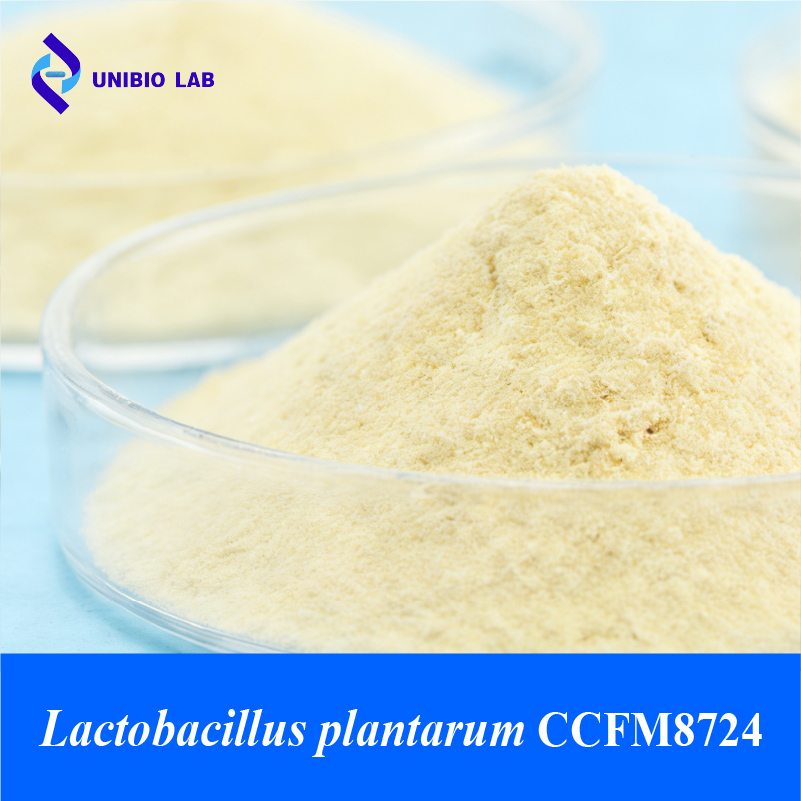
Oral care formulations often pair a primary strain with a companion strain. Within the same portfolio, Lactobacillus plantarum CCFM8724 is documented for preventing children's dental caries and inhibiting oral pathogenic bacteria, and the supplier's oral health application profile pairs it with the oral care tablet line. As a raw powder it is likewise specified at 10B–200B CFU/g with 2–8 °C sealed cold storage and a 24-month shelf life. For a multi-strain oral care product this companion choice is a legitimate formulation decision — but it has to be justified by strain-level documentation rather than by category name.
What to verify before locking a strain
- Strain-level specification sheet. Confirm viable count range, carrier, storage temperature, shelf life and strain origin for the exact strain being quoted.
- Application statement. Check whether the supplier's own product data lists Oral Health Products among the applicable industries for that strain.
- Strain-level documentation, not brand-level documentation. Certificates are scoped. The GRAS conclusion held by this supplier (certificate No. CIRS-GRAS-AH39-20250422, issued by CIRS GROUP USA Inc.) applies to pasteurized Akkermansia muciniphila AH39 raw material and AH39-containing finished products. It does not extend to other strains. Always read the scope line, not the cover page.
- Portfolio depth as a hedge. A supplier with a large proprietary strain bank can support later reformulation. Shanghai Unibio Lab Co., Ltd maintains a strain bank of more than 30,000 microbial strains and 189 patented functional strains spanning gut, metabolic, immune, oral, women's, skin and mental wellness categories, supported by screening models that include oral care — a capability also recorded in third-party directory listings (Ingredients Network).
Delivery Formats Compared: Chewable Tablet versus Bulk Powder
The two CCFM1215 supply formats solve different problems. Neither is universally better; they differ in dose certainty, count ceiling, storage class and downstream processing requirements.
Chewable tablet format
Oral Health HelpGut® Probiotics Tablets deliver 10 billion CFU per tablet in a xylitol-based chewable matrix with microcrystalline cellulose filler. The format's strengths for oral care are dose certainty per unit, no water required at the point of use, retail and pharmacy shelf suitability, and a 15–25 °C storage specification with a 20-month shelf life. Its limits are equally concrete: the per-unit viable count is fixed at the tableted value, compression requires excipient compatibility work, and the matrix must be protected from moisture during packaging and distribution.
Bulk powder format
Ligilactobacillus salivarius CCFM1215 raw powder offers 10B–200B CFU/g, which lets a brand set its own dose per sachet, stick pack, capsule or food application. The trade-offs are cold-chain storage (2–8 °C, sealed), a 24-month shelf life under recommended storage, and the need for blending and filling capability at the finished-product site. For functional beverages and powder blends, where a per-gram count is more useful than a per-unit dose, powder is usually the more efficient route.
| Specification | Ligilactobacillus salivarius CCFM1215 raw powder | Oral Health HelpGut® Probiotics Tablets (HelpGut-TAB-ORAL) |
|---|---|---|
| Format | Single-strain probiotic raw powder | Oral care probiotic chewable tablet |
| Core strain | Ligilactobacillus salivarius CCFM1215 | Ligilactobacillus salivarius CCFM1215 (declared core strain) |
| Viable count | 10B–200B CFU/g | 10 billion CFU per tablet |
| Composition | Probiotic strain, maltodextrin carrier, VPro® 5-layer encapsulation material | Probiotic strain, xylitol base, microcrystalline cellulose tablet filler |
| Storage | 2 °C–8 °C sealed cold storage | 15 °C–25 °C cool sealed storage |
| Shelf life | 24 months under recommended storage | 20 months |
| Strain origin | Independent lab culture | Core strain from the same portfolio |
| Listed applications | Food & Beverage, Dietary Supplement, Oral Health Products | Oral Healthcare Products, Children Daily Supplement, Pharmacy Retail |
| Typical best fit | Flexible dosing, sachets, powder blends, beverage systems | Retail and pharmacy oral care with per-unit dose claims |
Decision rule. If the marketing claim depends on a fixed, countable dose taken daily — especially in children's oral care sold through pharmacies — the chewable tablet removes dosing ambiguity and avoids cold chain. If the product is a blend, a sachet or a beverage, or if the brand needs cost-per-CFU flexibility across several SKUs, the raw powder gives more room, provided the cold chain is planned, labelled and documented.
Viability Maintenance: What VPro® Changes and What It Does Not
Viable count on the day of manufacture is not the number that matters commercially. End-of-shelf-life count is. Encapsulation is the main lever available to a formulator.
VPro® 5-layer microencapsulation is built as five functional layers: a micromolecular protective layer for anti-freezing and anti-stress protection; a prebiotic nutrition layer that supports in-vivo proliferation; a liposome enteric adhesion layer that supports intestinal colonization; an acid and enzyme resistant layer for gastric transit; and an oxygen and moisture barrier layer for shelf stability. According to the supplier's technical documentation, the system raises freeze-drying survival rate by 40%, extends shelf life to 24 months, and supports fermentation density above 3.5×10¹&sup0; CFU/mL with lyophilized powder concentrations up to 8.0×10¹¹ CFU/g. Products using the technology are supplied with maltodextrin as carrier and, depending on the strain, viable count ranges from 10B up to 600B CFU/g, with a typical 24-month shelf life under the recommended storage condition.
The coating is also a specification item in its own right. VPro® 5-layer micro-encapsulated probiotics material (model VPro®-5L-COAT) is a food-grade polysaccharide and protein composite coating matrix providing a 5-layer acid and bile resistant barrier, improved heat resistance and extended strain shelf life. It is intended for probiotic raw material factories, supplement manufacturers and food processing plants — in other words, for buyers who microencapsulate in-house instead of purchasing pre-coated powder.
Formulator note — how the coating modifies behaviour in an oral care product. The layer stack is designed primarily around what happens after swallowing: acid and enzyme resistance and enteric adhesion are downstream functions. If your oral care claim depends on contact time inside the mouth, the format governs that — chewing time, dissolving behaviour and how the matrix releases moisture — while the coating protects the fraction that is swallowed. Define which of the two effects your claim relies on before writing the coating specification; copying a gut-health coating specification into a chewable oral care brief is a common and expensive mistake.
Step-by-Step: Specifying an Oral Care Probiotic Powder Project
- Define the target site and contact mode. Decide whether the claim rests on oral cavity contact, on a post-swallowing effect, or on both. This single decision determines whether format or coating is the dominant variable.
- Select the strain against written documentation. Confirm the strain is listed for oral health applications in the supplier's product data — as CCFM1215 is — and record the strain origin (independent lab culture for this strain).
- Set the viable count within the format's real ceiling. Work from the supplier's actual ranges: 10B–200B CFU/g for the raw powder, or 10 billion CFU per tablet for the finished chewable format. Do not specify a count the format cannot carry to end of shelf life.
- Match storage class to the sales channel. The CCFM1215 raw powder requires 2–8 °C sealed cold storage; the finished chewable tablet is specified at 15–25 °C with a 20-month shelf life. Align label, logistics and retail channel before artwork is finalised.
- Lock the carrier and coating specification. For this strain the material composition is the strain plus maltodextrin carrier plus VPro® 5-layer encapsulation material. If you encapsulate in-house, specify VPro®-5L-COAT as the coating material instead.
- Fix the quality-control package. Request 100% in-house lab testing of viable count, microbial safety and heavy metals, and confirm that third-party inspection by SGS or Intertek is available on request. Every batch should ship with a COA.
- Confirm commercial parameters. Minimum order quantity is 1 kg for single-strain raw powder, 5 kg for multi-strain compound powder and 5,000 bottles for private-label finished capsules or tablets. Lead time is 5–7 days for bulk raw material and 25–35 days for private-label finished goods, with FOB Shanghai, CIF, DDU and DDP terms available.
- Plan after-sales support. Standard support includes free strain technical consultation, formulation optimisation, batch quality reports, cold chain logistics guidance and complaint resolution within 24 working hours.
Use Cases: Where Each Format Fits
- Children's daily oral care, pharmacy retail. Chewable tablet format with a xylitol base, 10 billion CFU per tablet, 15–25 °C storage and a 20-month shelf life — aligned with oral healthcare products, children's daily supplements and pharmacy retail channels.
- Adult oral care sachets and stick packs. CCFM1215 raw powder at 10B–200B CFU/g, blended to a target dose per sachet, with cold chain built into distribution.
- Functional food and beverage fortification. Powder format where the strain is added during production; the supplier's application profile for these strains covers food and beverage manufacturing with sealed packaging, moisture control and stable ingredient activity.
- Private-label oral care line. OEM, ODM and private-label services include custom CFU concentration, dosage form (powder, capsule, tablet, sachet, gummy) and packaging design, with a 5,000-bottle minimum for finished goods and a 25–35 day lead time.
- Supply scale for distribution-led brands. Documented long-term cases include a Middle East health product wholesaler and pharmacy chain supplier taking 12,000 bottles of HelpGut capsules and 8 tons of AH39 raw powder per month over a 1.5-year cooperation, and a European and US supplement brand and raw material distributor ordering 120 tons of multi-strain powder and 75 tons of single-strain powder annually across three consecutive years.
Compliance and Documentation: The Checks That Prevent Customs and Retail Delays
For oral care products sold across borders, the certification package strongly influences how quickly a shipment clears and how easily a retail listing is approved. The relevant facts for this supplier are specific and verifiable.
- US FDA facility registration. Probiotic raw materials and finished dietary supplements are covered by FDA food facility registration, with facility numbers 19635371796 (Shanghai Unibio Lab Co., Ltd) and 12494588438 (Shanghai Helplifes Technology Co., Ltd), applicable to the United States market.
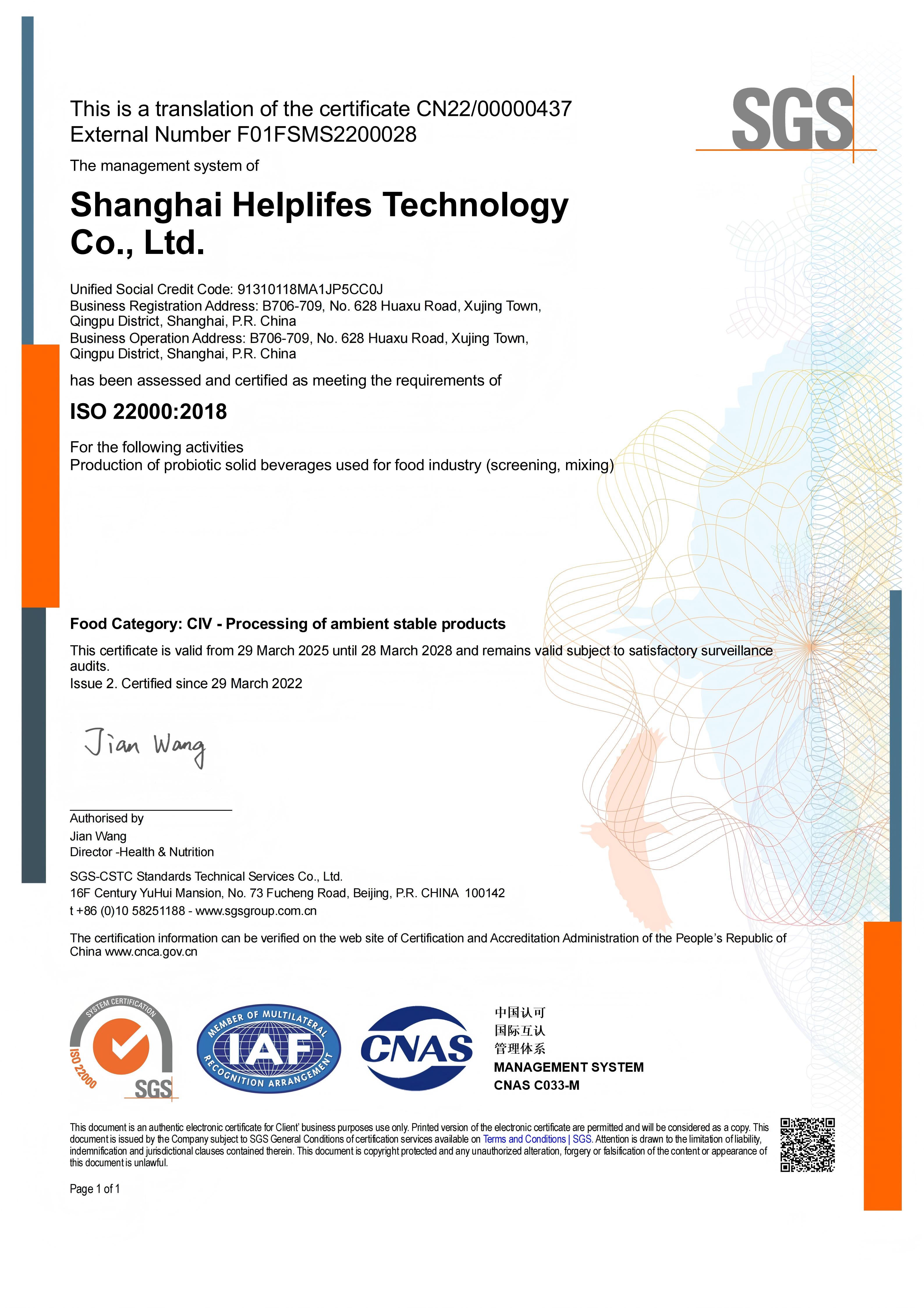
- ISO 22000:2018. Certification issued by SGS-CSTC Standards Technical Services Co., Ltd. for the production of probiotic solid beverages, with certification number CN22/00000437 (as recorded for the Bifidobacterium animalis subsp. lactis BL03 product), applicable to the global market.
- FSSC 22000. Food Safety System Certification covering the production of probiotic solid beverages under ISO 22000:2018, certificate number CN22/00000434, issued by SGS United Kingdom Ltd, applicable to the global market.
- GMP. Codex Alimentarius GMP certification, certificate number CN22/00003036, issued by SGS-CSTC Standards Technical Services Co., Ltd., covering the production of probiotic solid beverages (screening and mixing) under the General Principles of Food Hygiene CXC 1-1969 (2022).
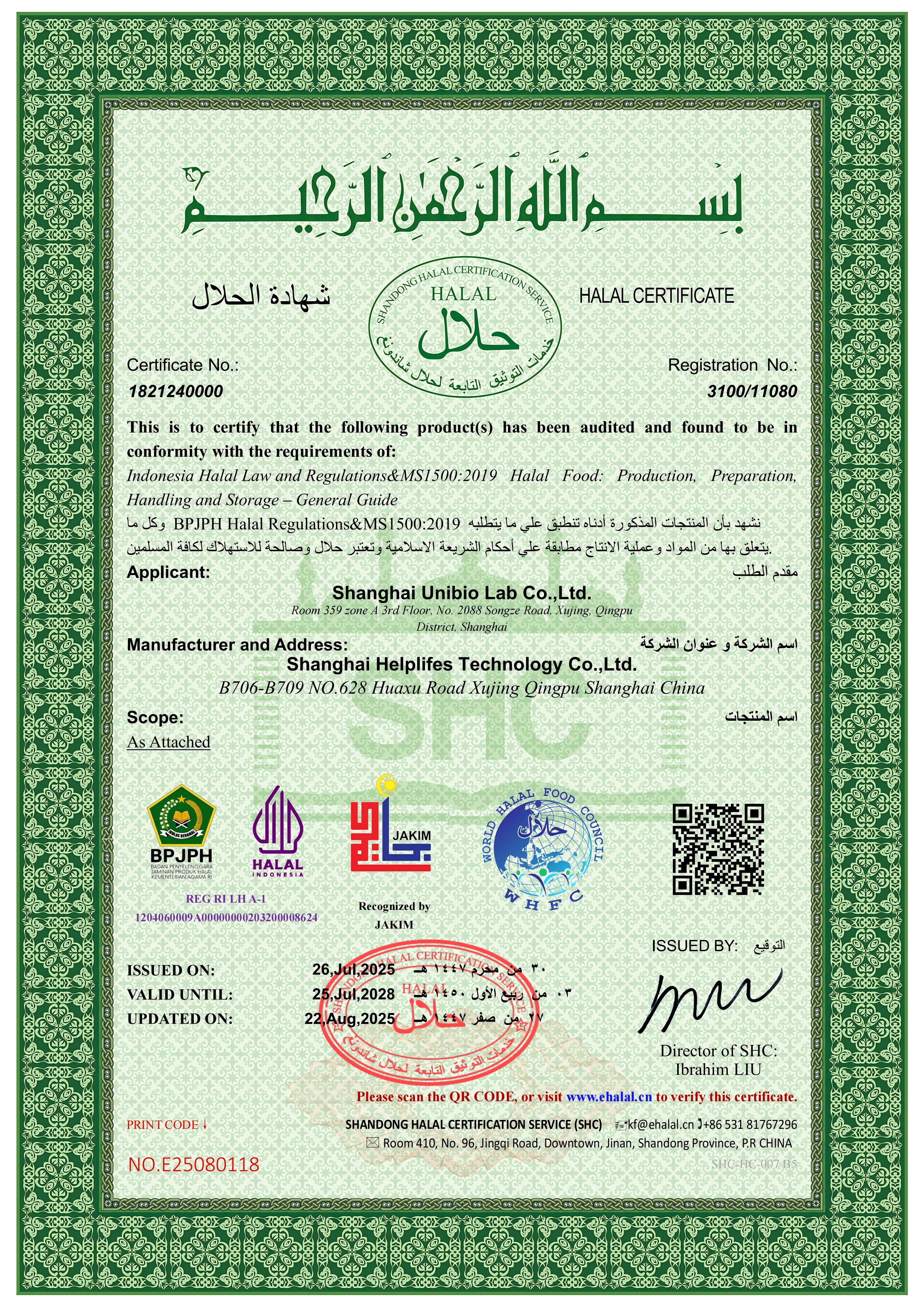
- HALAL. HALAL certification registered under No. 3100/11080 with certificate No. 1821240000, valid from 26 July 2025 to 25 July 2028, covering listed probiotic strains including the Lactobacillus series and related raw materials and finished products — relevant for pharmacy and retail channels in Muslim-majority markets.
- Strain-specific GRAS. The independent conclusion of GRAS status (No. CIRS-GRAS-AH39-20250422, CIRS GROUP USA Inc.) applies to pasteurized Akkermansia muciniphila AH39 raw material and AH39-containing finished products — a clear illustration of why buyers must verify certificate scope by strain and by product.
Buyer checklist. Confirm the certificate is valid on the shipment date; confirm its scope names your strain or product family; confirm the covered market matches your destination; and confirm the batch-level COA matches the certificate's claims. For US-market supplements, the manufacturer's cGMP obligations under 21 CFR Part 111 sit alongside these certificates, not instead of them.
FAQ: Oral Care Probiotics, Strains and Formats
How do I identify FDA-certified probiotics powder manufacturers?
Start with FDA food facility registration rather than with the word ‘certified’. A legitimate US-facing manufacturer should provide its facility registration number and the registered scope. For this supplier, Shanghai Unibio Lab Co., Ltd holds registration number 19635371796 and Shanghai Helplifes Technology Co., Ltd holds 12494588438, covering probiotic raw materials and finished dietary supplements. Facility registration is not product approval, however: for US supplements you should also verify cGMP compliance under 21 CFR Part 111, and for individual strains check whether a GRAS conclusion exists and exactly which strain and finished product it covers.
Can Ligilactobacillus salivarius CCFM1215 be supplied in both powder and chewable tablet formats?
Yes, in two supply forms. As a single-strain raw powder, CCFM1215 is specified at 10B–200B CFU/g with a maltodextrin carrier and VPro® 5-layer encapsulation material, stored at 2–8 °C with a 24-month shelf life. As a finished product, it is the declared core strain of Oral Health HelpGut® Probiotics Tablets at 10 billion CFU per tablet with a xylitol base, stored at 15–25 °C with a 20-month shelf life. Customisation of CFU concentration, dosage form and packaging is available through OEM, ODM and private-label services.
How should I set storage and shelf-life specifications for an oral care probiotic?
Follow the format-specific specification issued by the supplier rather than a category assumption. The CCFM1215 raw powder requires 2–8 °C sealed cold storage with a 24-month shelf life, while the finished chewable tablet is specified at 15–25 °C cool sealed storage with a 20-month shelf life. Other strains in the same portfolio carry different storage classes: Bacillus coagulans CCFM1041 heat-resistant powder is specified at 10B–300B CFU/g with room-temperature storage and a 24-month shelf life, and Bifidobacterium longum CCFM760 is also specified for room-temperature storage with a 24-month shelf life. Ambient formats are therefore achievable, but the storage claim must always come from the specific strain document.
What are the MOQ and lead time for a custom oral care probiotic project?
Minimum order quantity is 1 kg for single-strain raw powder, 5 kg for multi-strain compound powder and 5,000 bottles for private-label finished capsules or tablets. Lead time is 5–7 days for bulk raw material and 25–35 days for private-label finished goods, with FOB Shanghai, CIF, DDU and DDP terms available.
Can I validate the strain or the finished format with a sample first?
Samples can be arranged before you commit to a production order, and technical documentation — specification sheets, batch COAs and certificate copies — is provided to support internal evaluation. Free strain technical consultation and formulation optimisation support are part of the standard service, so sample evaluation can be structured around your target viable count, dosage form and storage class. To request a sample or a quotation for Ligilactobacillus salivarius CCFM1215 or Oral Health HelpGut® Probiotics Tablets, contact Shanghai Unibio Lab Co., Ltd at kevin@helplifes.com, on WhatsApp at +86 158-2126-0907, or through the website below.
Conclusion: Lock the Strain, Then Let the Format Decide the Rest
Oral care products live or die on two specifications. First, the strain: it should be documented for oral health applications, with a stated viable-count range, carrier, storage class and shelf life — as Ligilactobacillus salivarius CCFM1215 is, both as a 10B–200B CFU/g raw powder and as the 10-billion-CFU core strain of a finished chewable tablet. Second, the format: a chewable tablet buys dose certainty, 15–25 °C storage and a 20-month shelf life, while a bulk powder buys flexible dosing and a higher count ceiling in exchange for 2–8 °C cold storage and a 24-month shelf life.
Everything else — carrier and VPro® 5-layer encapsulation, the quality-control package, MOQ, lead time and certification scope — should be specified after those two decisions are made, not before. Manufacturers that publish strain-level storage and certification data make that sequencing straightforward, and buyers who verify the scope of each certificate avoid the most common cause of customs and retail delays.
Next step
Request a sample, a specification sheet or a quotation for oral care probiotic powder and chewable tablets, or download the full product catalogue and company brochure to review the strain portfolio, certifications and private-label options.
Download the Shanghai Unibio Lab product brochure (PDF) · www.helplifes.com
Shanghai Unibio Lab Co., Ltd · B706-709, No.628 Huaxu Road, Xujing Town, Qingpu District, Shanghai, P.R.China · kevin@helplifes.com · Tel +86 135-1234-4323 · WhatsApp +86 158-2126-0907