
Top 6 Probiotic Strains for Constipation Relief Powder Formulas: A Buyer's Ranking
Top 6 Probiotic Strains for Constipation Relief Powder Formulas: A Buyer's Ranking
 Shanghai Unibio Lab Co., Ltd formulation and technical support office, Shanghai, China. Image source: Shanghai Unibio Lab Co., Ltd.
For a brand owner or formulation manager, the hardest part of a constipation-relief probiotic powder is not choosing a species name. It is proving that the finished unit still delivers the count printed on the label - after freeze-drying, after months in a warehouse, and after gastric transit. This ranking orders six probiotic strains that are actually specified in commercial constipation-relief powder and capsule formats, and explains why each one sits where it does.
The reference set is the strain portfolio and VPro® 5-layer microencapsulation platform of Shanghai Unibio Lab Co., Ltd, a probiotic R&D, manufacturing and CDMO enterprise based in Shanghai, China. The formulation benchmark used throughout is HelpGut® 100B CFU Constipation Relief Probiotic Capsules - a multi-strain blend delivering 100 billion CFU per capsule with prebiotic fiber excipients.
One limitation, stated up front: this is a procurement and formulation ranking, not a clinical ranking. It orders strains by how reliably they can be documented, stabilized and supplied at scale. It does not claim that strain one outperforms strain six in a head-to-head human trial.
The Formulation Problem: Why Constipation Relief Is a Hard Brief
Constipation-relief powder formulas fail commercially for three reasons, and only one of them concerns the strain itself.
- Claim-to-documentation gap. Bowel regulation and constipation relief are popular shelf positions, but the strain behind the claim often has no documented bowel-function data. The buyer then inherits a claim that is difficult to support in markets where probiotic supplements are regulated under frameworks such as 21 CFR Part 111 in the United States, which requires compliance with current Good Manufacturing Practices (cGMP).
- Delivered viable count versus label count. The count that matters is the count at end of shelf life, not the count at blending. Powder formats absorb moisture; capsules expose the strain to gastric acid and bile. Without a protection system, the overage needed to hold the label claim can materially raise formula cost.
- Format-specific stress. A sachet, a hard capsule and a chewable tablet subject the same strain to different water activity, compression and temperature profiles. A strain that performs well in a capsule may lose significant viability in a compressed tablet.
There is also a boundary condition worth accepting before the ranking starts: encapsulation protects viable count, it does not create it. If a strain leaves fermentation with a low count, no coating layer repairs that. This is why the ranking below weights both the upstream viable count range and the downstream protection system.
Industry Background: Growth Is Not the Bottleneck - Strain Selection Is
Category demand is not the constraint. The global probiotics market was valued at USD 72.1 billion in 2024 and is projected to reach USD 165.1 billion by 2034, according to Global Market Insights. Probiotic dietary supplements specifically reached a market size of USD 10.60 billion in 2026, with a forecasted CAGR of 9.5% through 2031 (MarketsandMarkets).
Adjacent segments that buy constipation-oriented and bowel-regulating formats are expanding as well:
- Global baby probiotics: USD 2.27 billion in 2024, projected to grow at a CAGR of 8.6% to reach USD 5.6 billion by 2035 (WiseGuyReports).
- Global pet biotics (probiotics and prebiotics): estimated to reach USD 1,232.5 million by 2030, growing at a 7.0% CAGR (MarketsandMarkets).
On the supply side, the ingredient market remains concentrated. Leading global players include Yakult Honsha (6.7% share), Danone S.A., ADM, Kerry Group and Novonesis, according to Global Market Insights. For a constipation-relief brand, that concentration matters less than it appears: the differentiator at finished-product level is rarely the species name, it is the strain identity, the count and the protection system.
Two structural trends shape the current brief. First, microencapsulation using materials such as alginate or chitosan has become a key technical route for ensuring probiotic viability through gastric acid and bile salts (PMC / MDPI). Second, the compliance baseline has consolidated: ISO 22000 is the international standard for food safety management systems applicable to the probiotic production chain, incorporating HACCP principles (ISO / Winclove Probiotics).
Detailed Solution: Ranking the Six Strains
How the ranking was built
Five criteria were weighted in this order:
- Directness of documented bowel-function relevance.
- Deliverable viable count - in CFU/g for freeze-dried powder, or CFU per unit for finished capsules.
- Compatibility with a multi-layer encapsulation system, which decides how much of that count survives.
- Format flexibility across powder, sachet, capsule and tablet.
- Documentation and supply readiness - batch testing, certificates, minimum order quantity and lead time.
The benchmark for criterion two is the HelpGut® 100B CFU Constipation Relief Probiotic Capsules specification: a multi-strain blend, 100 billion CFU per capsule, with prebiotic fiber excipients. Any powder formula aimed at the same consumer segment should be able to state its equivalent number - delivered count per gram or per unit - before a buyer signs off.
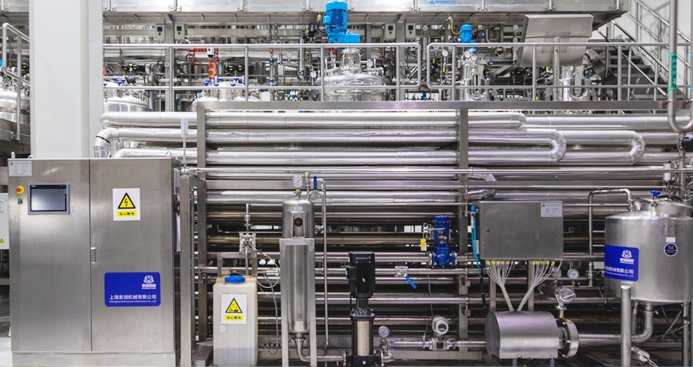 Plant interior at a Unibio Lab production base, where probiotic raw powder is fermented and freeze-dried. Image source: Shanghai Unibio Lab Co., Ltd.
1. Bifidobacterium longum CCFM760 - the most direct constipation fit
Within the reference portfolio, Bifidobacterium longum CCFM760 is the strain with the most direct constipation-relevant documentation: it is described as relieving constipation, optimizing gut flora, and working in synergy with Akkermansia muciniphila AH39 to support GLP-1 secretion. It ranks first because it shortens the distance between a bowel-regulation claim and the evidence behind it. Bifidobacterium species also suit freeze-dried powder and hard-capsule formats, so the same strain can serve a sachet SKU and a capsule SKU without reformulation. The usual blend pattern is one Bifidobacterium backbone plus one Lactobacillus.
2. Lactobacillus rhamnosus GG - the documentation benchmark
Lactobacillus rhamnosus GG is the gold-standard strain for gut immunity and infant digestive care, and it is globally recognized as safe. It ranks second rather than first because its constipation-specific documentation is weaker than its general digestive reputation; the strength here is documentation maturity and market recognition, not a bowel-movement claim. For buyers, that maturity is worth real money: strain identities that regulators, formulators and consumers already recognize reduce both claim-substantiation work and consumer education cost. It is the default first choice for infant and pediatric powder formulas, and a common second strain in adult bowel-regulating blends.
3. Clostridium butyricum (CCFM1299) - the next-generation butyrate option
Clostridium butyricum appears in the reference portfolio as a next-generation probiotic raw material, and it is the most technically different option in this ranking. As a spore-forming, butyrate-producing species, it brings natural robustness: the spore form tolerates gastric transit and room-temperature storage better than most vegetative strains, which is attractive for room-temperature-stable powders. It ranks third because the upside is real but the buyer's verification burden is higher - spore count, enumeration method and revival performance should be confirmed per batch rather than assumed. The CCFM1299 designation identifies the specific strain; buyers should confirm the exact strain code, count and documentation on the batch certificate.
4. Bifidobacterium animalis subsp. lactis BL03 - the count-headroom strain
Bifidobacterium animalis subsp. lactis BL03 is specified across a viable count range of 10 billion to 600 billion CFU/g, which makes it the most flexible strain in this set for hitting a target delivered count. That range matters commercially: a formulator who needs a high-count input for a premium anti-constipation sachet and a low-count input for a mass-market capsule can use the same strain identity and adjust only the dosage, keeping the label claim and the sensory profile consistent across SKUs. It ranks fourth rather than higher because, in the reference set, the bowel-function documentation sits below CCFM760 - the decision here is driven by count headroom and formulation flexibility rather than by strain-level claim strength.
5. Bifidobacterium breve CCFM1025 - the gut-brain complement
Bifidobacterium breve CCFM1025 is documented in the reference portfolio for improving sleep, relieving stress via the gut-brain axis and alleviating depression. It is not a primary constipation strain and should not be sold as one. It ranks fifth because it is a credible complementary component: the gut-brain axis is widely studied as an influence on digestive function, and a formula positioned around stress-related digestive discomfort needs at least one strain whose documentation addresses that mechanism. Buyers building a two- or three-strain constipation powder should treat CCFM1025 as the second or third component, not the backbone.
6. Akkermansia muciniphila AH39 - the mucus-layer co-support
Akkermansia muciniphila AH39 is the flagship next-generation strain in the reference portfolio and holds a US self-affirmed GRAS conclusion. Its documented functions center on strengthening the intestinal mucus layer, stimulating GLP-1 secretion, improving insulin resistance, lowering blood glucose and fat accumulation, reducing pro-inflammatory IL-6, and balancing short-chain fatty acids (acetate and propionate). It ranks sixth for a constipation-specific formula because its primary commercial position is metabolic management, not bowel regularity. It still earns a place in this ranking for one specific reason: the intestinal mucus layer is part of the environment a bowel-regulation formula acts on, and reference comparison data indicates AH39 delivers active metabolite content 35% higher than common, unvalidated A. muciniphila strains.
Why VPro® 5-layer encapsulation and viable count range drive the ranking order
The ranking above is not fixed by species reputation; it is fixed by what survives. Because the delivered viable count is the variable buyers actually pay for, the protection system changes the order.
The VPro® 5-layer structure combines five functional layers:
- A micromolecular protective layer for anti-freezing and anti-stress protection.
- A prebiotic nutrition layer that supports in-vivo proliferation.
- A liposome enteric adhesion layer that boosts intestinal colonization.
- An acid and enzyme resistant layer for survival through gastric digestion.
- An oxygen and moisture barrier layer that extends shelf stability.
Per the reference technical data, this platform lifts the freeze-drying survival rate by 40%, prolongs shelf life to 24 months, and supports fermentation density above 3.5x10¹⁰ CFU/mL with lyophilized powder concentration up to 8.0x10¹¹ CFU/g.
Against conventional uncoated probiotic powder from generic suppliers, the reference comparison data shows survival through gastric acid and bile increased by 78%, with shelf life extended from 12 months to 24 months. The commercial trade-off is transparent: raw material unit price is 8%-12% higher, but effective viable CFU per kilogram is 2.1 times higher, which reduces actual formula dosage cost by more than 20% for finished-product factories.
The practical consequence for this ranking is that a strain with excellent native acid tolerance but a low achievable count can rank below a strain with moderate tolerance that pairs well with multi-layer encapsulation. That is why BL03's 10B-600B CFU/g range and the HelpGut® 100 billion CFU per capsule benchmark carry more weight in this list than brand familiarity does.
Top 6 at a glance
| Rank | Strain | Documented function (reference portfolio) | Count and format position | Primary buyer consideration |
|---|---|---|---|---|
| 1 | Bifidobacterium longum CCFM760 | Relieves constipation, optimizes gut flora, supports GLP-1 secretion in synergy with AH39 | Powder or capsule; multi-strain blends | Shortest path from bowel claim to documentation |
| 2 | Lactobacillus rhamnosus GG | Gold-standard strain for gut immunity and infant digestive care; globally recognized as safe | Infant and pediatric powders; adult blends | Documentation maturity and consumer recognition |
| 3 | Clostridium butyricum (CCFM1299) | Next-generation probiotic raw material; spore-forming, butyrate-producing species | Room-temperature-stable powders | Verify spore count, enumeration method and strain code per batch |
| 4 | Bifidobacterium animalis subsp. lactis BL03 | Bifidobacterium positioned for bowel-regulation blends | Specified across 10B-600B CFU/g | Count headroom across premium and mass-market SKUs |
| 5 | Bifidobacterium breve CCFM1025 | Gut-brain axis: sleep, stress, mood | Complementary strain in 2-3 strain blends | Use as a complement, not as the backbone |
| 6 | Akkermansia muciniphila AH39 | Mucus layer, GLP-1, insulin resistance, IL-6, SCFA balance; US self-affirmed GRAS | Premium metabolic and bowel-environment formulas | Premium cost position; strongest documentation package |
Step-by-Step Breakdown: Assembling a Constipation-Relief Powder Formula
Step 1 - Define the consumer and the format before the strain. An adult bowel-regulating sachet, a pediatric powder and a hard capsule for elderly users face different constraints. The format determines the count overage, the packaging barrier and even the excipient list, so it should be locked before strain selection begins.
Step 2 - Choose a two-to-three strain backbone. A practical structure is one documented bowel-function strain (Bifidobacterium longum CCFM760), one documentation-mature strain (Lactobacillus rhamnosus GG), and one optional mechanism complement (Bifidobacterium breve CCFM1025 for the gut-brain axis, or Akkermansia muciniphila AH39 where a metabolic angle is acceptable). Substitution options exist if one strain cannot be cleared for a market: the reference strain bank holds more than 30,000 microbial strains, including 25,300 primary 16S rRNA strains, 13,720 draft-genome strains and 8,046 full-genome strains, with 189 patented functional strains.
Step 3 - Set the delivered count target, not the blending target. Work backwards from the label claim. If the benchmark specification is 100 billion CFU per capsule, the powder input must be set high enough to hold that number after processing and shelf life. Strains with a wide specified range - such as BL03 at 10B-600B CFU/g - give more room to absorb overage without reformulating. The achievable ceiling for freeze-dried raw powder in this platform reaches 8.0x10¹¹ CFU/g, with fermentation density above 3.5x10¹⁰ CFU/mL.
Step 4 - Select the protection system. Evaluate encapsulation as a formula component, not an add-on. The VPro® 5-layer structure combines a micromolecular protective layer, a prebiotic nutrition layer, a liposome enteric adhesion layer, an acid and enzyme resistant layer, and an oxygen and moisture barrier layer. Each layer answers a specific failure mode measured in accelerated stability testing.
Step 5 - Validate excipients, water activity and packaging. Prebiotic fiber excipients support the prebiotic nutrition layer function, but they also raise water activity risk in a dry powder. Specify a high-barrier pack or desiccant for sachets, and confirm that the capsule shell specification matches the intended storage condition. Stability accelerated testing should be run per batch rather than per strain family.
Step 6 - Lock documentation and supply terms. Request a batch certificate of analysis, confirm the certification set for the destination market, and agree minimum order quantity, lead time, trade terms and acceptance criteria before the pilot batch is produced.
Use Cases: Matching the Strain Set to the Consumer
- Adult bowel-regulating powder and sachet. The core commercial format for this brief. A CCFM760 plus L. rhamnosus GG backbone, with or without BL03 for count headroom, covers the mainstream claim set.
- Elderly regulating powder. Same backbone, but the priority shifts toward multi-strain diversity and slow-colonization support, since the prebiotic nutrition layer is designed to support in-vivo proliferation after ingestion.
- Infant and pediatric powder. Lactobacillus rhamnosus GG is the established starting point because it is globally recognized as safe and specifically documented for infant digestive care.
- Sports nutrition and travel formats. Where room-temperature stability matters more than premium claim depth, strains with a wide count range plus multi-layer encapsulation reduce the need for cold chain.
- Pet and high-temperature processed formats. The reference portfolio includes a heat-resistant Bacillus coagulans series for formats exposed to extrusion or higher processing temperatures, where vegetative strains are less suitable.
Comparison: Encapsulated Versus Conventional Uncoated Powder
The table below summarizes reference comparison data between the VPro® 5-layer microencapsulation route and conventional uncoated probiotic powder from generic suppliers. It is the clearest single explanation of why encapsulation compatibility moves a strain up or down this ranking.
| Comparison point | VPro® 5-layer microencapsulation | Conventional uncoated probiotic powder |
|---|---|---|
| Technology basis | Self-developed 5-layer microencapsulation, independent CCFM strain library, full-index in-house testing system | Generic uncoated powder from conventional suppliers |
| Gastric acid and bile survival | Increased by 78% | Baseline reference |
| Shelf life | 24 months | 12 months |
| Best-fit applications | Long-distance sea freight export, room-temperature storage finished supplements, high-temperature extrusion food processing | Short-chain, cold-chain-tolerant formats |
| Cost position | Raw material unit price 8%-12% higher; effective viable CFU per kg 2.1x higher, reducing formula dosage cost by more than 20% for finished factories | Lower unit price, higher dosage requirement |
| Maintenance and efficiency | No extra cold-chain requirement for mid-term transit; stable batch consistency; higher strain yield and lower post-processing waste | Higher variability and complaint rate |
Supply Terms, Compliance and Verification
For buyers moving from formulation to execution, the commercial terms below come from the reference supplier documentation for Shanghai Unibio Lab Co., Ltd and apply to bulk raw powder and private-label finished goods.
| Item | Reference term |
|---|---|
| Minimum order quantity | 1 kg single-strain raw powder; 5 kg multi-strain compound powder; 5,000 bottles private-label finished capsules or tablets |
| Lead time | 5-7 days for raw material bulk orders; 25-35 days for private-label finished products |
| Trade terms | FOB Shanghai, CIF for major global ports, DDU, DDP |
| Acceptance criteria | 100% in-house laboratory testing before shipment; third-party inspection by SGS or Intertek available on request |
| Payment terms | 100% advance payment, or 50% advance deposit with balance due 30 days after bill of lading issuance; 30-day credit period for trusted customers |
| Certification set | ISO 22000, FSSC 22000, GMP food manufacturing (SGS), HALAL, Orthodox Union (OU) Kosher, FDA US food facility registration, independent self-affirmed GRAS for A. muciniphila AH39 |
| Monthly capacity | 1,800 tons of probiotic raw powder and 2 billion finished capsules or tablets |
FAQ
Which certifications should a constipation-relief probiotic powder supplier hold for US, EU and Middle East markets?
The reference certification set covers ISO 22000 and FSSC 22000 food safety management, GMP food manufacturing certification audited by SGS, HALAL and Orthodox Union (OU) Kosher certificates, and FDA US food facility registration; the next-generation strain Akkermansia muciniphila AH39 holds an independent self-affirmed GRAS conclusion. In the United States, probiotic supplements fall under 21 CFR Part 111, which requires compliance with current Good Manufacturing Practices (cGMP), so buyers should confirm both the facility certificate and the batch-level testing documentation before placing a bulk order. These documents support customs clearance for North America, the EU, Southeast Asia, the Middle East, Australia and Japan.
Can a manufacturer build a custom multi-strain constipation formula at a specified viable count?
Yes, within the supplier's strain bank and production limits. The reference facility maintains a strain bank of more than 30,000 microbial strains - 25,300 primary 16S rRNA strains, 13,720 draft-genome strains and 8,046 full-genome strains - including 189 patented functional strains, and runs more than 30 sets of in vitro, cellular, animal and clinical screening models. Fermentation density reaches above 3.5x10¹⁰ CFU/mL and freeze-dried powder concentration up to 8.0x10¹¹ CFU/g. Customization covers CFU concentration, dosage form (powder, capsule, tablet, sachet, gummy), strain blending and packaging design.
What actually drives the cost of a constipation-relief probiotic powder formula?
The main cost driver is not the strain name but the effective viable count after encapsulation. Reference comparison data for the VPro® 5-layer microencapsulation system versus conventional uncoated probiotic powder shows a raw material unit price 8%-12% higher, but effective viable CFU per kilogram 2.1 times higher, which reduces actual formula dosage cost by more than 20% for finished-product factories. Formulation cost is therefore best compared on delivered CFU per finished unit, not on price per kilogram of powder.
How is batch quality verified before a buyer scales up?
Every batch undergoes full internal laboratory testing before shipment, covering viable count, heavy metals and microbial safety, and third-party inspection by SGS or Intertek is available on request. The verification protocol includes an ICP-MS heavy metal test per batch, supplier audits for all raw auxiliary materials, and retention sample storage for 24 months. Stability accelerated testing is run for each batch, and warehouse temperature and humidity are monitored in real time.
What are the MOQ and lead times when appointing a long-term probiotics powder supply partner in China?
Minimum order quantities are 1 kg for single-strain raw powder, 5 kg for multi-strain compound powder, and 5,000 bottles for private-label finished capsules or tablets. Typical lead time is 5-7 days for raw material bulk orders and 25-35 days for private-label finished products, with trade terms including FOB Shanghai, CIF, DDU and DDP. Monthly capacity is 1,800 tons of probiotic raw powder and 2 billion finished capsules or tablets. To review these terms against your own formula, request a quotation or the product brochure at kevin@helplifes.com.
Conclusion: Rank the Strains by What Survives, Then Lock the Partner
The six strains above are ordered by a single commercial logic: how directly each one can be documented for bowel function, and how much of its viable count can be delivered to the consumer after processing, storage and gastric transit. Bifidobacterium longum CCFM760 leads because its constipation documentation is the most direct. Lactobacillus rhamnosus GG follows on documentation maturity and market recognition. Clostridium butyricum (CCFM1299) and Bifidobacterium animalis subsp. lactis BL03 carry the technical upside - spore robustness and count headroom respectively. Bifidobacterium breve CCFM1025 and Akkermansia muciniphila AH39 complete the set as mechanism complements rather than backbone strains.
A decision rule that holds across all six: never approve a strain list without the delivered count per finished unit, the encapsulation system behind it, and the batch documentation that supports the claim in the destination market. Those three items decide whether a constipation-relief powder still performs in month 20 of shelf life - not the strain name on the front of the pack.
Next Step: Get the Formula and the Documentation Together
Shanghai Unibio Lab Co., Ltd supplies single-strain and multi-strain probiotic raw powder, supports custom strain blending and OEM/ODM development, and produces the HelpGut® finished range, including the HelpGut® 100B CFU Constipation Relief Probiotic Capsules benchmark used in this article.
- Request a quotation or formulation consultation: kevin@helplifes.com
- WhatsApp: +86 158-2126-0907
- Download the product brochure (PDF): Unibio Lab product brochure
- Company website: www.helplifes.com
Minimum order quantity is 1 kg for single-strain raw powder, 5 kg for multi-strain compound powder, and 5,000 bottles for private-label finished capsules or tablets.
 Production line for probiotic powder blending and capsule filling at a Unibio Lab manufacturing base. Image source: Shanghai Unibio Lab Co., Ltd.