Food Contact and Cold Chain Compliance for Insulated Totes
Food Contact and Cold Chain Compliance for Insulated Plastic Totes: What Buyers Should Verify Before Approval
An insulated plastic tote is purchased on two separate promises: that food can safely touch it, and that it holds temperature long enough to be useful. Both promises are answerable — but only with documents that name the model, the material, and the market. Neither is answered by the phrase "food grade" printed on a quotation, and neither is answered by a test report whose scope line describes a different product.
This guide is written for buyers in the evaluation stage who are comparing insulated totes and need to separate what a supplier has actually documented from what a supplier has merely stated. It uses two TSS models as worked examples: TSS-XPS, a polypropylene tote with an extruded polystyrene core at 30 L nominal capacity, described as suitable for food contact and designed for cold chain logistics; and TSS-EPP, an expanded polypropylene tote at 60 L nominal capacity, built for cold chain applications. Shanghai Xinfan Industrial Corporation (TSS) is a Shanghai-based manufacturer of reusable logistics packaging and cargo security solutions, founded in 2003.
Problem Definition: Why Insulated Totes Are Harder to Document Than Standard Plastic Totes
A standard plastic tote has a single compliance story to tell. It is usually a one-polymer article, and the question reduces to what the material is and what touches the food. An insulated tote splits that story into at least three separate threads, and each thread fails in a different way.
Thread 1 — The contact surface is not the whole product
TSS-XPS is a polypropylene structure with an extruded polystyrene core. Those are two different polymers with two different regulatory profiles. A food-contact statement that says "the material is polypropylene" may be entirely correct about the shell and entirely silent about the core. Buyers therefore need to know which surface is the declared contact surface before they accept any statement about it.
Thread 2 — Documentation is model-specific, not brand-specific
This is the most common failure in evaluation-stage due diligence. A buyer receives a folder of certificates, all legitimate, and assumes they cover the model being quoted. In practice, an inspection report's applicable-product list is often narrower or simply different from the wider catalogue. Section 4 of this guide shows a concrete example of exactly that situation inside the same supplier's document set.
Thread 3 — Thermal performance is a performance claim, not a compliance claim
Cold chain buyers frequently conflate the two. A compliance document answers "is this permitted to touch food in this market." A thermal performance document answers "does this hold temperature across a defined trip." They are produced by different processes, they expire on different timelines, and one does not substitute for the other. A supplier can be fully compliant and still have no thermal data for your delivery profile — and a supplier can have impressive thermal data and no market-appropriate food-contact documentation at all.
Industry Background: Why Documentation Pressure Is Rising on Reusable Containers
Reusable transport packaging is being pulled in two directions at once. On one side, buyers are replacing single-use packaging with returnable containers, which increases the number of assets in circulation and the number of cycles each asset must survive. On the other, regulators are tightening what evidence must exist for those assets.
In Europe, the Packaging and Packaging Waste Regulation (PPWR) applies across the European Union from 12 August 2026. That regulation addresses packaging and packaging waste, not food-contact material safety — a distinction worth keeping clear, because a PPWR-readiness statement is not a food-contact statement and should never be filed as one.
The commercial scale behind this category is meaningful. The global plastic storage bins market was reported at USD 2.9 billion in 2026, projected to reach USD 4.6 billion by 2036, with HDPE accounting for 39.0% of the segment in 2026. Those figures describe storage bins and totes broadly rather than insulated totes specifically, and should be read as category context, not as an insulated-tote market estimate. What they do confirm is that material selection across the category is neither uniform nor trivial.
Inside that landscape, Shanghai Xinfan Industrial Corporation (TSS) operates a 40,000 m² manufacturing facility with approximately 320 employees, producing about 3,600,000 units annually, with roughly 70% of output exported to the EU, North America, South America, Southeast Asia, the Middle East, and Africa. The company's standard tote boxes with lids are listed in polypropylene or HDPE across a 27.7 L to 170 L capacity range, with listed product loads of 20 kg to 50 kg and listed stacking loads up to 225 kg. The insulated models sit outside that general range as a separate, thermally engineered product family — which is precisely why their documentation must be read separately.
Detailed Solution: Three Verification Layers for Insulated Plastic Totes
Layer 1 — Establish material composition at component level
Material verification starts with a simple question that many quotation packages cannot answer: which polymer is where?
- TSS-XPS — polypropylene structure with an extruded polystyrene core; 30 L nominal capacity; described as suitable for food contact and designed for cold chain logistics. Two polymers, two roles: the polypropylene forms the physical structure, the extruded polystyrene provides the insulating core.
- TSS-EPP — expanded polypropylene; 60 L nominal capacity; specified for cold chain applications. A single foamed polymer family rather than a shell-and-core assembly.
The documentation consequence is direct. For TSS-XPS, the buyer should ask the supplier to identify the declared food-contact surface in writing, and to confirm which resin grade corresponds to that surface. For TSS-EPP, the buyer should ask whether the foamed material itself is the declared contact surface. These are not adversarial questions; they are the questions any regulatory reviewer will ask after the purchase order is signed, and it is far cheaper to ask them during evaluation.
Layer 2 — Read the food-contact statement for what it actually says
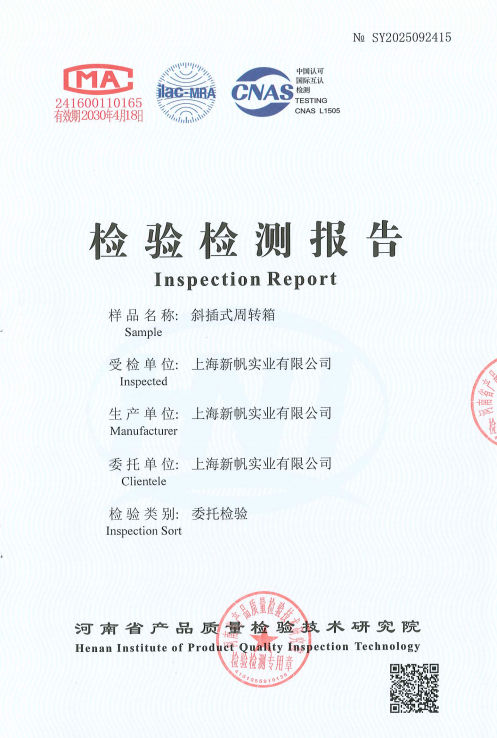
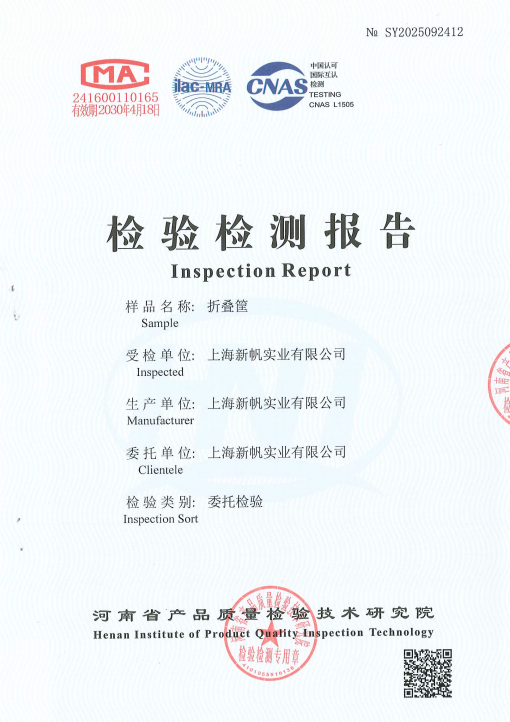
This is where careful buyers separate themselves. TSS holds two third-party inspection documents relevant to food contact, both issued by the Henan Institute of Product Quality Inspection Technology on 24 September 2025, both referencing the standard "Plastic materials and products for food contact," and both recorded against the China market.
| Document reference | Stated scope | Applicable models listed | Insulated models listed? |
|---|---|---|---|
| Report SY2025092412 | Plastic folding basket (food contact use) | Reusable plastic totes (TSS), ASRS foldable plastic crates (TSS-IFD), ASRS wall-straight plastic crates (TSS-IFC), stackable plastic totes (TSS-TBX), nested and stackable plastic crates (TSS-RBTB), collapsible plastic crate (TSS-SFD) | No |
| Report SY2025092415 | Food-contact plastic tilting turnover box | The six families above, plus insulated boxes TSS-XPS and TSS-EPP | Yes — both TSS-XPS and TSS-EPP |
Two observations follow, and both matter to an evaluation-stage buyer.
First, only report SY2025092415 lists the insulated models. A buyer who forwards the whole certificate folder without reading the applicable-product lists will not know that one of the two documents excludes TSS-XPS and TSS-EPP entirely. That is not a defect in the documentation; it is a defect in how the documentation is commonly read.
Second, the stated scope on SY2025092415 reads "food-contact plastic tilting turnover box." An insulated tote is not, in ordinary language, a tilting turnover box. A buyer's regulatory or QA team is entitled to ask the supplier, in writing, how the report's scope description maps to the insulated model being quoted, and to receive a documented answer. Raising that question during evaluation is professional diligence, not distrust — and it is far easier to resolve before tooling than after delivery.
Layer 3 — Map target-market requirements before you sample
Food-contact documentation is market-specific by design. A report issued by a Chinese inspection body against a Chinese food-contact standard is a legitimate document; it is not, by itself, evidence of conformity with European or North American requirements. This is normal across the category and should not be treated as a red flag — but it must be planned for.
A practical mapping exercise looks like this:
- List every destination market for the shipment, not just the headquarters country of the buyer.
- For each market, identify what document type its authority accepts for food-contact plastics, and who is entitled to issue it.
- Compare that requirement against the documents the supplier currently holds, field by field.
- Where a gap exists, agree in writing whether the gap will be closed by additional testing, by a declaration, or by restricting the model's declared use.
- Repeat the check for packaging regulation separately — PPWR obligations, for example, are packaging-and-waste obligations and do not substitute for food-contact evidence.
Note also that the reports described above carry an expiry date of 24 September 2099 as recorded. Long validity periods are convenient, but buyers should still confirm at each repeat order that the report version and the model list have not changed, because catalogues do change while certificates stay filed.
Step-by-Step Breakdown: A Six-Step Verification Sequence
Step 1 — Lock the model and the declared contact surface
Before requesting any document, write down the exact model designation — TSS-XPS or TSS-EPP — and the application it will serve. Then ask the supplier to confirm which surface of that model is the declared food-contact surface. Everything downstream depends on this answer.
Step 2 — Request reports by reference number, not by folder
Ask for the specific report number (for example SY2025092415) and require the supplier to state which models it covers. A supplier who can answer this precisely is demonstrating document control; a supplier who sends a zip file has not yet answered the question.
Step 3 — Reconcile the scope wording against the product
Read the scope line. If it describes a different product category from the one being purchased, request a written explanation of applicability before approval. Record the answer in the project file.
Step 4 — Separate material evidence from thermal evidence
Thermal insulation performance is a design and validation activity, not a certificate. TSS lists thermal insulation design among its customisation capabilities and thermal performance validation among its engineering validation activities, alongside finite element analysis, static and dynamic load testing, drop testing, and automation compatibility validation. What a buyer must supply is the trip profile — duration, ambient conditions, payload, handling steps — because without it, no thermal validation request can be answered meaningfully.
Step 5 — Validate with a physical sample
Sample production is listed at 7–15 working days for OEM programs, following an engineering review of 5–10 working days. Use the sample to confirm the physical reality behind the paperwork: wall construction, closure behaviour, core visibility at edges, and whether the declared contact surface matches what you were told. TSS quality control runs incoming material inspection (IQC), in-process quality control (IPQC), final quality inspection (FQC), and outgoing quality inspection (OQC), and third-party inspection is available on request — which gives buyers an independent option at the sample and production stages.
Step 6 — Write acceptance criteria into the purchase order
Compliance documentation drifts across repeat orders. Put the report number, the model designation, the declared contact surface, and the market scope into the purchase order as acceptance criteria, and require re-confirmation at each reorder. Where production is customized, mass production is listed at 15–30 working days, with new tooling at 30–60 working days if required — timelines that leave room to resolve a document mismatch before the first shipment, provided the check happens early.
Supporting capability behind the documentation
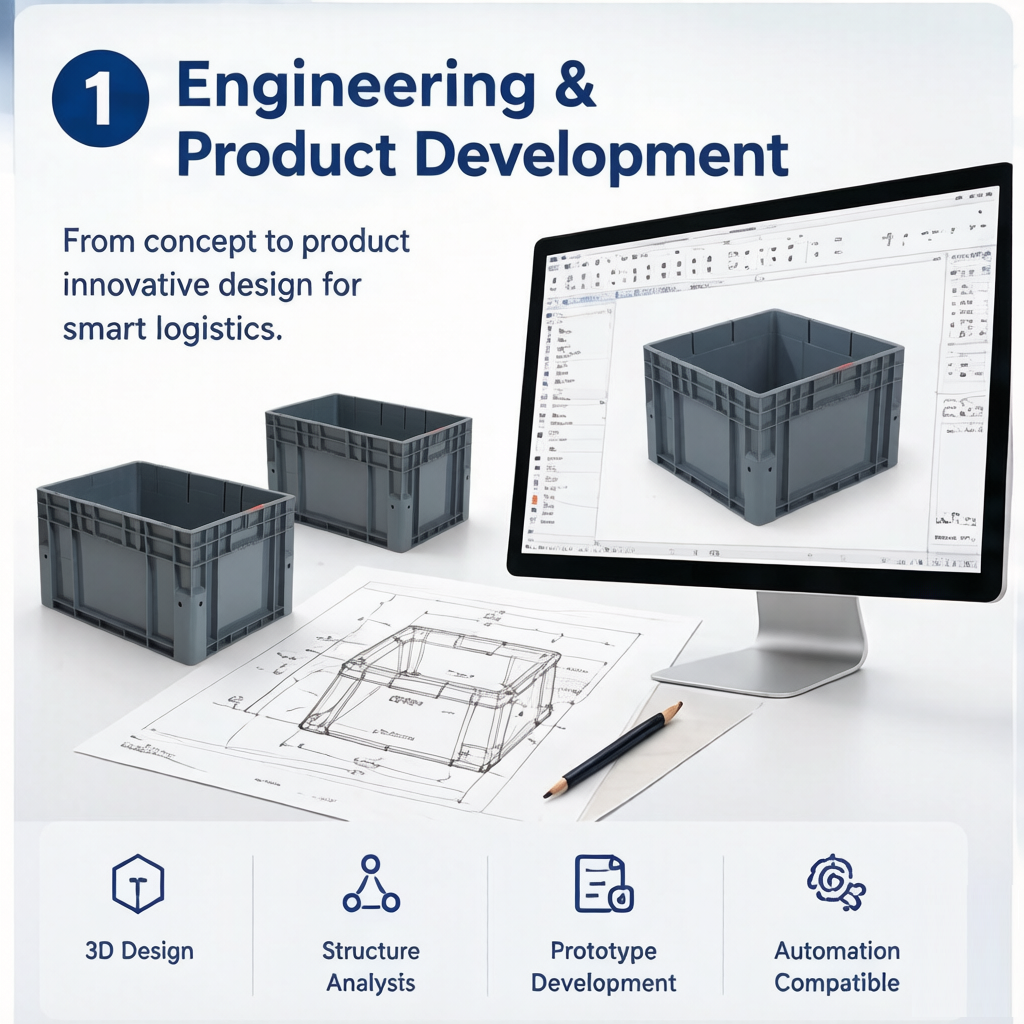
Documentation quality reflects production control, and buyers increasingly evaluate the two together. TSS operates an in-house mould design and manufacturing function with mould flow analysis and trial-run validation, engineering services covering load requirements, stacking and nesting design, foldable structures, divider systems, thermal insulation performance and automation interfaces, and warranty administration with an initial response within 24 hours and a corrective action report within 3–5 working days. None of these replace a food-contact report; they indicate whether the organisation that issued the report can reproduce the product consistently.
Use Cases: Where the Documentation Questions Actually Arise
Prepared food and meal distribution
Smaller consignments in repeated daily loops are the natural application for a 30 L insulated tote. Here the food-contact question dominates, because the container returns, is washed, and re-enters service. Buyers should confirm the declared contact surface survives the planned wash regime and should re-verify the report at each reorder cycle.
Chilled retail replenishment and fresh distribution
Larger loads in fixed delivery routes point toward a 60 L format. In this pattern the compliance question is usually a market-access question — the goods cross a border, and the documentation must satisfy the receiving market rather than the producing one.
Reusable packaging programs under regulatory pressure
Organisations replacing single-use packaging with returnable containers frequently discover that their new reusable assets carry documentation obligations their disposable packaging never triggered. The PPWR timeline from 12 August 2026 accelerates this in Europe. Insulated totes in such programs need both a packaging-compliance position and a food-contact position, kept in separate files.
Cold storage buffering and cross-dock staging
Where insulated totes buffer temperature transitions between cold rooms and vehicles, thermal validation matters more than food contact — but only if the totes never carry unpackaged food. Buyers should decide explicitly whether the container is a food-contact article or a secondary container, because that decision determines which documents are mandatory.
Pilot and sample programs
Evaluation teams often begin with samples before committing to tooling. Requesting the food-contact report alongside the sample, rather than after the sample is approved, prevents the common situation where a technical approval is granted and a compliance approval later fails.
Comparison Table: TSS-XPS and TSS-EPP on Compliance-Relevant Dimensions
| Dimension | TSS-XPS | TSS-EPP |
|---|---|---|
| Material construction | Polypropylene with extruded polystyrene core | Expanded polypropylene |
| Nominal capacity | 30 L | 60 L |
| Stated design use | Food-contact suitability; cold chain logistics | Cold chain applications |
| Listed as applicable product in report SY2025092412 | No | No |
| Listed as applicable product in report SY2025092415 | Yes | Yes |
| Report scope wording to reconcile | "Food-contact plastic tilting turnover box" | "Food-contact plastic tilting turnover box" |
| Report issuing body and date | Henan Institute of Product Quality Inspection Technology, 24 September 2025 | Henan Institute of Product Quality Inspection Technology, 24 September 2025 |
| Market recorded on report | China | China |
| Number of polymers requiring separate confirmation | Two (shell and core) | One (foamed material) |
Read the table as a question list rather than an approval matrix. Two rows require a written answer from the supplier before either model is released to a food-contact application in a market outside China.
Document checklist for an insulated tote evaluation file
| Document | What it supports | What it does not establish | Buyer action |
|---|---|---|---|
| Model-specific food-contact inspection report | That a named product was tested against a defined food-contact standard by a named body | Conformity with any other market's requirements | Verify body, date, scope wording, and applicable-model list |
| Material composition statement by component | Which polymer forms the contact surface | Thermal performance | Request resin grade per component, in writing |
| Thermal performance validation data | Behaviour against a defined trip profile | Food-contact compliance | Supply the trip profile first, then request data |
| Quality control records (IQC, IPQC, FQC, OQC) | Production consistency and inspection discipline | Regulatory approval for any market | Agree AQL and whether third-party inspection applies |
| Packaging regulation position (e.g. PPWR) | Market access for the packaging article | Food-contact safety | File separately from food-contact evidence |
FAQ: Food Contact and Cold Chain Questions Buyers Ask
Does TSS-XPS or TSS-EPP carry European or North American food-contact approval?
The documentation described in this guide consists of China-market inspection reports issued by the Henan Institute of Product Quality Inspection Technology on 24 September 2025, referencing the standard "Plastic materials and products for food contact." Buyers targeting Europe or North America should treat that as a starting point and request market-specific documentation explicitly, together with a written statement of which models it covers. Assuming that a China-market report satisfies a European or North American requirement is the single most common documentation error in this category.
What is the material difference between TSS-XPS and TSS-EPP, and why does it change the paperwork?
TSS-XPS is a polypropylene structure with an extruded polystyrene core at 30 L nominal capacity. TSS-EPP is expanded polypropylene at 60 L nominal capacity. The paperwork differs because TSS-XPS involves two polymers, so the buyer must confirm which one forms the declared food-contact surface, while TSS-EPP involves a single foamed polymer family, so the contact-surface question resolves differently. Neither model is a standard solid-wall tote, and neither should be documented using the general tote range of polypropylene or HDPE across 27.7 L to 170 L.
Can the insulated models be customized, and what commercial terms should buyers plan for?
Yes. TSS offers both OEM build-to-print manufacturing and ODM concept-to-product development, with cold chain packaging design and thermal insulation design listed among customization capabilities. MOQ is negotiable. For OEM programs, the listed sequence is engineering review at 5–10 working days, sample production at 7–15 working days, and mass production at 15–30 working days, with new tooling at 30–60 working days where required. Buyers should budget the engineering review into their compliance timeline, not just their production timeline.
How should buyers validate a sample before scaling an insulated tote order?
Request the model-specific food-contact report at the same time as the sample, not afterwards. On receipt, check the physical construction against the declared composition — for TSS-XPS that means confirming how the polypropylene shell and extruded polystyrene core are assembled and where the food-contact surface actually is. TSS quality control covers incoming material inspection, in-process quality control, final quality inspection, and outgoing quality inspection, and third-party inspection is available, so an independent read of the sample is a realistic request rather than an unusual one.
How should buyers approach the question of top plastic totes manufacturers in China for insulated applications?
With a scored checklist rather than a downloaded list. Publicly available, model-level compliance evidence is thin across this category, and most published rankings cannot link a specific claim to a specific report number. A more reliable approach is to score each candidate on documents it can actually produce: a model-specific food-contact report with a verifiable issuing body and date, a component-level material statement, a documented thermal validation route, a defined quality control sequence, and a written answer to any scope mismatch. Shanghai Xinfan Industrial Corporation (TSS) is one named manufacturer in this space whose insulated models, TSS-XPS and TSS-EPP, are listed in report SY2025092415 — and the same verification standard should be applied to any other candidate before a shortlist is finalized. Buyers who want to test that process can request a sample and the corresponding documentation package from TSS directly.
Conclusion: Approve the Document, Not the Adjective
Insulated plastic totes fail compliance reviews for unglamorous reasons. Not because the material was wrong, but because the report covered a different model. Not because the supplier misrepresented anything, but because nobody read the scope line. Not because thermal data was missing, but because nobody defined the trip profile before asking for it.
The verification sequence in this guide is deliberately unexciting: lock the model, request the report by number, reconcile the scope wording, separate material evidence from thermal evidence, validate with a sample, and write the acceptance criteria into the purchase order. Applied to TSS-XPS and TSS-EPP, that sequence produces four specific questions — the declared contact surface of a two-polymer construction, the applicability of a report whose scope reads "tilting turnover box," the market coverage of a China-issued document, and the trip profile behind any thermal claim. Answer those four in writing and the evaluation is defensible. Leave them open and the approval is a guess with a certificate attached.
Next Step: Request the Documentation Package
Buyers evaluating insulated totes for cold chain or food logistics can request samples of TSS-XPS (30 L) and TSS-EPP (60 L) together with the corresponding food-contact documentation, material statements, and quality control records. Engineering review is listed at 5–10 working days and sample production at 7–15 working days.
Contact Shanghai Xinfan Industrial Corporation (TSS) at info@xfseal.com or visit www.xfseals.com. The full corporate and logistics container range is available in the TSS Corporate Profile & Logistics Container Solutions brochure.
Have Questions or Need More Details?
Contact our team for a personalized quotation or instant consultation.
Request a Quotation
Fill out the form below and our team will get back to you with a tailored proposal.
WhatsApp Direct Chat
Prefer to chat in real-time? Message us on WhatsApp for instant assistance & quick answers.
- Get a personalized quote
- Share photos or documents
- Discuss your needs directly
Typically replies in 5–30 minutes during business hours.