From Manual Picking to 24/7 ASRS: Solving Fulfillment Bottlenecks with Plastic Totes
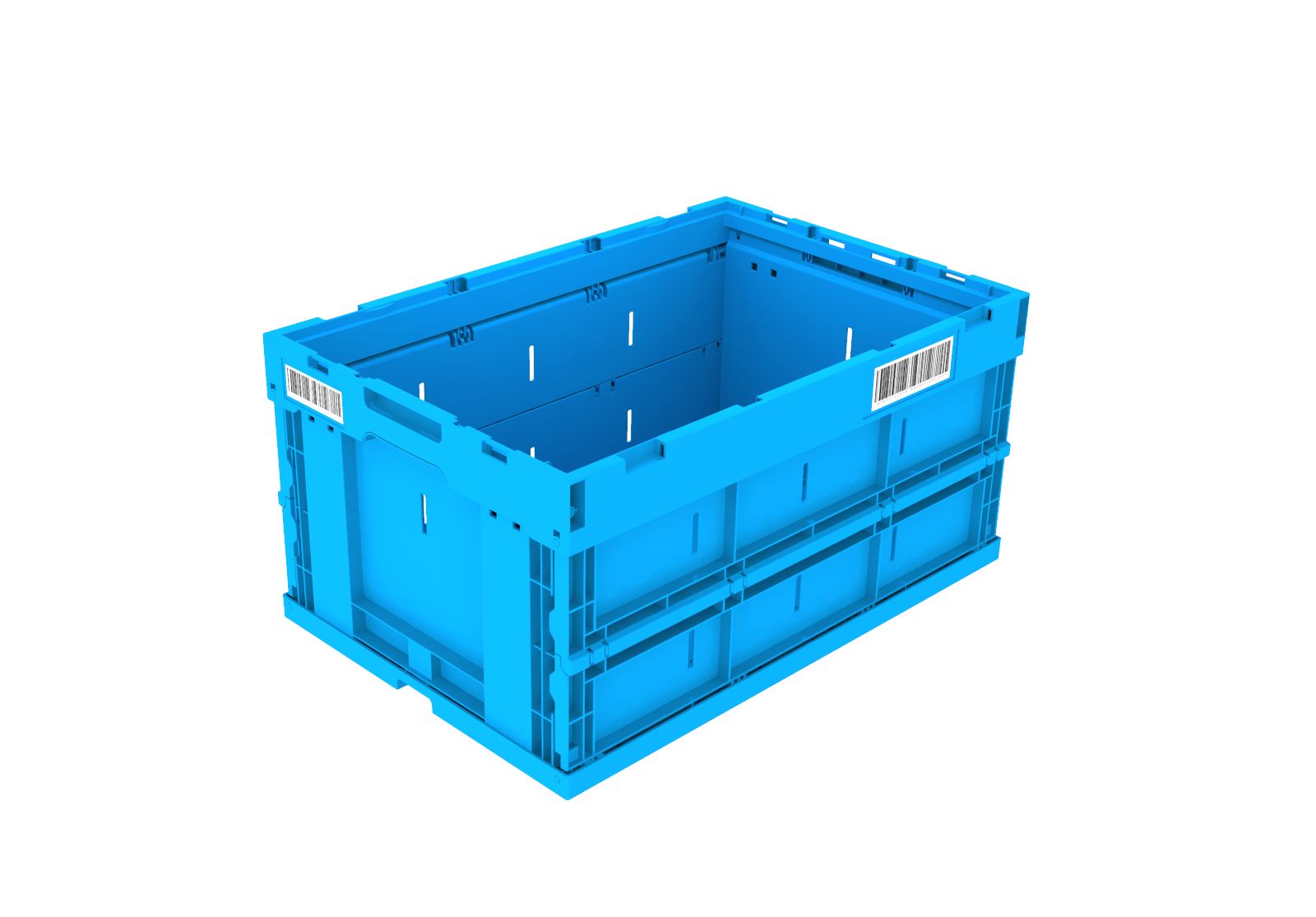
ASRS foldable plastic crate, model TSS-IFD (product 6035): 600 x 400 x 300 mm, polypropylene, designed for warehouse automation and ASRS storage and retrieval.
Short answer: Fulfillment bottlenecks in e-commerce and 3PL operations are rarely solved by hiring more pickers. They are solved by changing how inventory is stored and moved, and that change starts at the container level. ASRS foldable plastic crates and wall-straight plastic totes with a consistent external envelope and controlled dimensional accuracy are what allow mini-load cranes, shuttle systems, AMRs and AGVs to bring goods to people around the clock, instead of sending people down aisles to fetch goods.
This article is written for fulfillment, warehouse and operations teams that still run shelf-based manual picking and are deciding whether automation is the next step. It covers the problem (why manual picking stops scaling), the industry background (where storage and container technology is heading), the detailed solution (the specific ASRS container models and how they are specified), a step-by-step migration path, use cases, a comparison table, and the questions buyers ask most often.
Two large-scale deployments referenced in this article, each involving 450,000 tote units, moved from manual picking to 24/7 automated operation within one year, with storage density improvements of 4-6 times over conventional shelving and improved robotic handling accuracy.
Problem Definition: The Four Bottlenecks Behind a Manual Picking Operation
Manual picking fails in a fairly predictable order. The first constraint to appear is usually space, then labour, then throughput, and finally the one most teams discover late: container consistency.
Bottleneck 1: Storage density is limited by human reach
A shelf or racking layout is designed around human access: aisles wide enough to walk, shelf heights reachable without equipment, and pick faces sized for the operator rather than for the product. That geometry caps how much inventory can sit inside a given building footprint. When order volumes grow, the default response is to lease more space, which raises cost but does not change pick rate.
Bottleneck 2: Labour dependency and non-productive travel
In a pick-by-aisle model, a large share of the working day is spent walking to a location rather than picking from it. Because the process depends on people, throughput scales with headcount, training and shift patterns. Peak periods require temporary labour, which typically introduces variability in picking accuracy.
Bottleneck 3: Manual picking cannot run 24/7 at constant output
Shift-based picking can cover extended hours, but not around-the-clock output at consistent productivity. Peak windows such as evenings, weekends and promotional events create a throughput ceiling that a manual operation cannot exceed without adding a second and third shift.
Bottleneck 4: Mixed containers break the automation layer
Cartons, mismatched bins and one-way packaging cannot be handled reliably at speed. They cause jams on conveyors, force handling equipment to run below its design speed, and prevent storage channels from being reused at high density. This is the bottleneck that determines whether an ASRS investment reaches its design throughput or quietly underperforms it.
Industry Background: From Aisles to Goods-to-Person
Reusable plastic containers have become the standard interface between stored goods and automated handling equipment. The global plastic totes and bins market was valued at USD 8.6 billion in 2025 and is projected to reach USD 14.2 billion by 2034, according to Dataintelo. Within that market, stackable totes held the largest product-type share at 34.2% in 2025. Asia Pacific accounted for a 41.6% revenue share of the broader plastic pallets, crates and boxes market in 2025, based on Grand View Research data.
Material choice has converged as well. Polypropylene (PP) is expected to lead the plastic crates material segment with a 41.4% share by 2025, according to Future Market Insights, reflecting its balance of stiffness, impact resistance, moisture resistance and recyclability. Every ASRS container in the TSS range described below is made of PP.
The demand driver behind these numbers is retrieval speed for small parts and totes. The mini-load ASRS segment is growing rapidly because e-commerce operations need fast retrieval of small parts, totes and bins, as reported by Precedence Research. Mini-load cranes, multi-level shuttle systems and cube storage racks are built around a standard container rather than a pallet, which is why the container specification now determines how much of the automated system's performance an operator can actually use.
Reusable containers are also spreading on the retail side of the supply chain. The use of reusable plastic containers (RPCs) in fresh produce logistics, such as the partnership between Walmart and IFCO, is a widely cited industry trend (Grand View Research). For buyers, the practical implication is that closed-loop container logic, standard dimensions, return logistics, cleaning and reuse, is no longer confined to automation projects.
Market sizing in this category should be read with care. Published estimates for the plastic crates market vary significantly depending on whether plastic pallets and boxes are included in the total, with figures ranging from around USD 3.95 billion (Fortune Business Insights) to USD 4.9 billion (Future Market Insights).
Standards reference: EN 13117-1:2000 is the European standard for reusable, rigid plastics distribution boxes used for handling, transport and storage, published by the European Committee for Standardization (CEN). For European loops, it is a common reference point when a project specifies reusable distribution boxes for automated handling.
Detailed Solution: How ASRS Plastic Totes Solve the Bottleneck
Shanghai Xinfan Industrial Corporation (TSS), established in 2003, is a manufacturer of plastic totes and integrated logistics packaging and cargo security solutions. The company operates a 40,000 m2 manufacturing facility, employs approximately 320 staff, maintains an R&D team of 25 engineers, and reports an annual production capacity of 3,600,000 units. Its customers operate in the logistics, retail, manufacturing, e-commerce, cold chain, pharmaceutical and transportation industries.
The container layer of an automated fulfillment project has one job: present goods to machines in a form those machines can handle at speed, on every cycle, for years. In practice this comes down to four requirements: a stable external envelope, dimensional accuracy within the tolerance of the storage channel and conveyor, structural rigidity under repeated high-speed handling, and a design that supports the return loop when the container is empty. TSS addresses these with two ASRS-specific models plus a supporting family of containers.
Model 6035: ASRS Foldable Plastic Crate (TSS-IFD)
The Foldable Plastic Crate model TSS-IFD is a collapsible crate designed for ASRS systems. It is made of PP and has overall dimensions of 600 x 400 x 300 mm. It belongs to the foldable plastic crates category and is intended for warehouse automation applications.
The operational value of the foldable design appears in two places. Inside the automated store, the crate behaves like any standard tote. Outside it, on return legs, in empty-container buffers and in closed-loop logistics, folding reduces empty storage volume by up to 70-80% and lowers return transportation cost significantly, according to the product application data. For a 3PL operator consolidating empties before returning them to a client or a pooling partner, this is a recurring saving rather than a one-off.
Model 6036: ASRS Wall Straight Plastic Crate (TSS-IFC)
The Wall Straight Plastic Crate model TSS-IFC is made of PP with external dimensions of 600 x 400 x 300 mm and is designed for use in ASRS scenarios within warehouse automation environments.
A wall-straight body keeps the outer faces parallel over the full height of the container. That geometry is what allows a mini-load crane, shuttle or extraction mechanism to handle the same tote repeatedly inside a tight storage channel without the footprint changing between cycles, and it is what makes high-density racking practical: channels can be sized to the container envelope instead of to a generous safety margin.
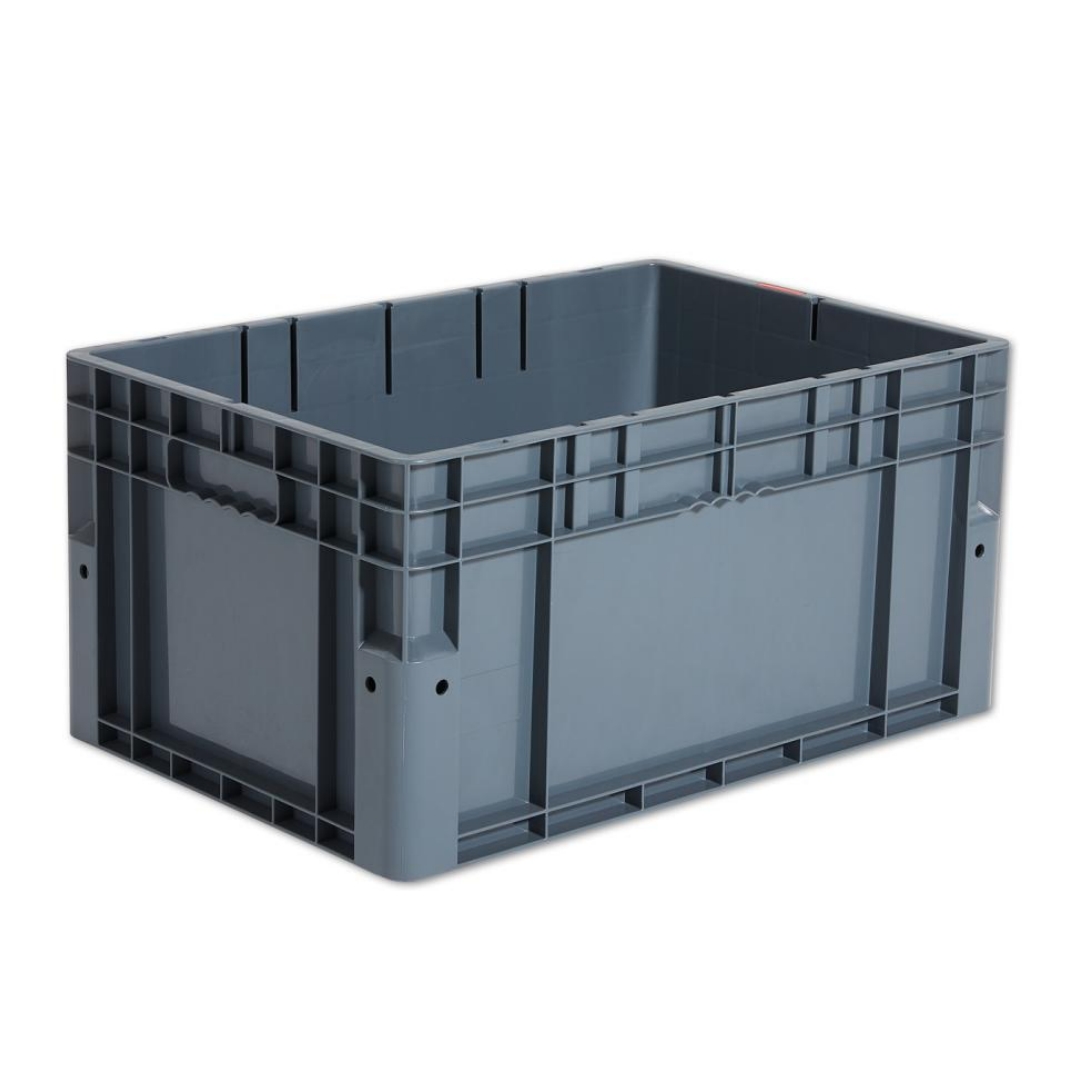
ASRS wall-straight plastic crate, model TSS-IFC (product 6036): parallel sidewalls for stable handling in mini-load and shuttle storage channels.
The supporting container family
Not every position in a fulfillment center needs the same container. TSS builds a family that covers an entire flow, so a project can standardize on one supplier:
- Attached Lid Stackable Plastic Tote, model TSS-TBX (6037) - 600 x 400 x 320 mm, PP, with a stackable design and an attached lid for secure storage and transport. Its standard dimensions make it suitable for automated warehouse systems (ASRS).
- Nest and Stack Plastic Crate, model TSS-RBTB (6038) - 600 x 400 x 300 mm, PP, designed for retail, supermarket and fruit and vegetable transportation logistics, switching between stacking when loaded and nesting when empty.
- Collapsible Plastic Crate, model TSS-SFD (6039) - 600 x 400 x 225 mm, PP, designed for the retail and supermarket industries and for fruit and vegetable transportation.
- Reusable Plastic Totes, model TSS (5072) - PP, with overall dimensions from 600 to 800 mm in length, 400 to 600 mm in width and 128 to 400 mm in height, intended for the warehouse automation industry.
- Plastic Stackable Bin, model TSS-BBOX-01 (6040) - 604 x 398 x 208 mm, PP, with panels and dividers, stackable, intended for footwear and spare parts storage.
- Tote dollies, models TSS-Trolley-02 (6041) and TSS-Trolley-5737 (6042) - heavy-duty (577 x 377 mm) and light-type (570 x 370 mm) nested and stackable dollies in PP for warehouse storage and logistics environments.
- Insulated boxes, models TSS-EPP (6045) and TSS-XPS (6044) - 60 L expanded polypropylene and 30 L extruded polystyrene cold chain boxes in PP, used for temperature-controlled flows; the TSS-XPS is suitable for food contact.
Why dimensional accuracy is the deciding specification
Automated storage environments impose requirements that manual handling does not. The application data for ASRS use lists high dimensional accuracy for automation compatibility, excellent load capacity and structural rigidity, smooth operation on conveyors and shuttle systems, a long service life under intensive operating conditions, and suitability for high-density warehouse environments. These are the criteria a buyer should test against, not appearance or unit price alone.
Step-by-Step Breakdown: From Manual Picking to 24/7 ASRS
The migration from shelf-based picking to goods-to-person automation follows a sequence. Container decisions come earlier than most teams expect, because every equipment vendor on a shortlist will ask for the tote specification first.
- Profile the current picking operation. Record SKU count, order lines per day, unit and cube dimensions, and peak windows. The output is one statement: is the constraint storage density, labour, throughput, or all three?
- Fix the container envelope before the equipment. Storage channel height, conveyor width, end-effector design and picking-station ergonomics all derive from the container. Choosing the tote after the equipment is specified usually results in either custom tolerances or a system that runs below design speed.
- Select the container by role, not by price. Wall-straight crates (TSS-IFC) for dense automated storage, foldable crates (TSS-IFD) where empty-container return volume is significant, attached-lid totes (TSS-TBX) where goods need secure transport between facilities, nest-and-stack crates (TSS-RBTB) and collapsible crates (TSS-SFD) for retail and produce loops, and stackable bins (TSS-BBOX-01) for spare parts and small-part storage.
- Verify dimensional accuracy and handling behaviour. Confirm external dimensions, base flatness, stacking stability under load, rigidity and behaviour at the operating temperature of the building. Ask for the drawing set with tolerances rather than a catalogue image.
- Run a sample validation batch. Test the container on the actual conveyor, shuttle, crane or AMR before tooling is cut or a serial order is placed. Sample validation is the cheapest point in the project at which to catch an envelope error.
- Integrate with the control layer. ASRS containers are handled by mini-load cranes, shuttle systems, roller, belt and chain conveyors, sortation systems, AGVs, AMRs, tote transfer robots and goods-to-person stations, coordinated by WMS, WCS and MES software. Barcode or RFID identification on the container is what connects the physical tote to the inventory record.
- Phase the cutover. Most warehouses run a hybrid period in which part of the flow is still manual. Tote dollies such as TSS-Trolley-02 and TSS-Trolley-5737 support that hybrid zone because they move the same containers the automated areas use, so no re-packing is needed at the boundary.
- Close the loop. Define cleaning, inspection and replacement intervals, and decide how empty containers are returned, consolidated and stored. Choosing a foldable container at this step can reduce empty storage volume by up to 70-80% and lower return transportation cost significantly.
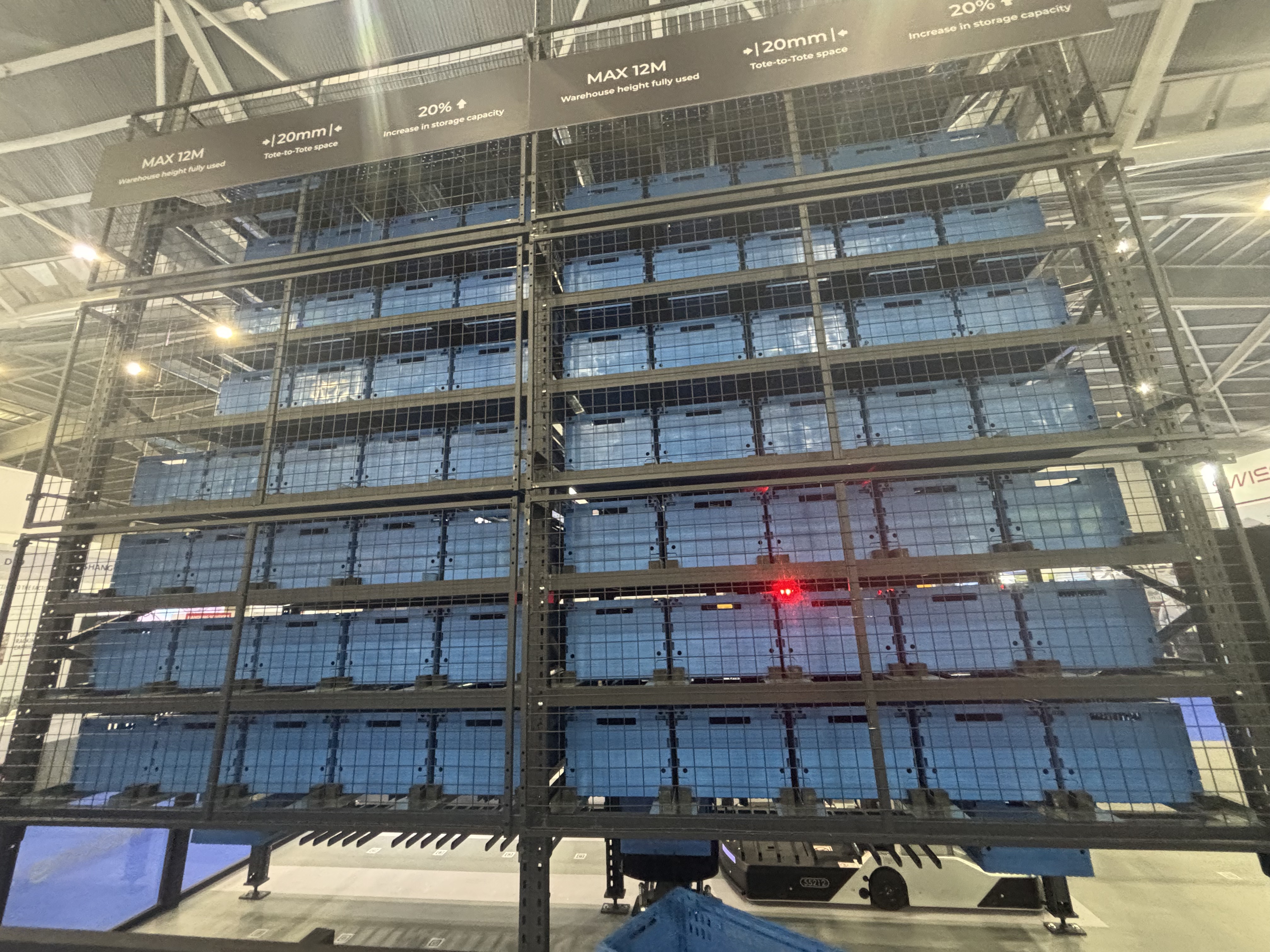
Automation totes and foldable crates: the container layer that connects ASRS storage, conveyor transport and AMR/AGV goods-to-person picking.
Use Cases: Where Tote-Led Automation Delivers
E-commerce fulfillment. Goods-to-person stations bring totes to operators instead of operators walking to shelves. This is the core scenario for TSS-IFC and TSS-IFD, both designed for ASRS and warehouse automation environments.
Third-party logistics (3PL). Multi-client operations need containers that can be labelled, tracked and reused across accounts. Standard-dimension totes with barcode or RFID identification keep the WMS record aligned with the physical container, while attached-lid containers such as TSS-TBX provide secure transport for high-value or confidential goods.
Spare parts and MRO. Small-part warehouses use stackable bins with panels and dividers (TSS-BBOX-01, 604 x 398 x 208 mm) for SKU separation inside an automated or semi-automated store.
Cold chain and pharmaceutical flows. Temperature-controlled operations can standardize on insulated boxes, TSS-EPP at 60 L and TSS-XPS at 30 L with a food-contact-suitable construction, alongside standard totes for ambient picking.
Retail replenishment and fresh produce. Nest-and-stack totes and fruit use plastic foldable crates such as TSS-RBTB and TSS-SFD support store delivery and return loops in retail and fruit and vegetable supply chains.
Hybrid manual and automated zones. While an automation project is phased in, tote dollies let manual pickers and robots work from the same container pool, which removes the interface cost between the two zones.
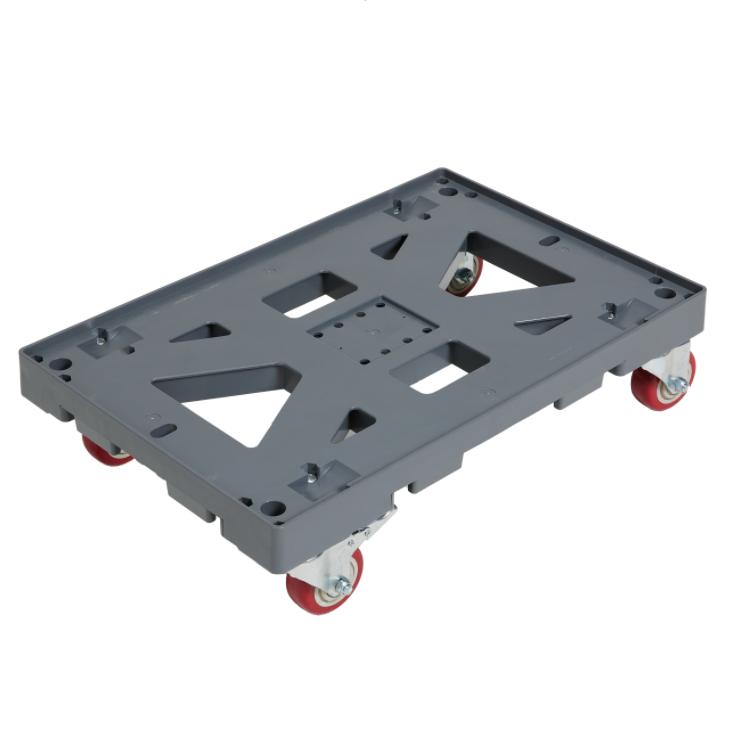
Nested and stackable tote dolly, model TSS-Trolley-02 (577 x 377 mm, PP): moves the same containers used in the automated zones, supporting a phased cutover.
Comparison Table: Matching TSS Plastic Totes to ASRS Roles
| Model | Product type | External dimensions | Material | Stated fit | Typical role in a fulfillment flow |
|---|---|---|---|---|---|
| TSS-IFD (6035) | ASRS foldable plastic crate | 600 x 400 x 300 mm | PP | Designed for ASRS systems and warehouse automation | Dense automated storage with folded empty returns |
| TSS-IFC (6036) | ASRS wall straight plastic crate | 600 x 400 x 300 mm | PP | Designed for ASRS scenarios in warehouse automation | High-density storage channels and shuttle or mini-load handling |
| TSS-TBX (6037) | Attached lid stackable plastic tote | 600 x 400 x 320 mm | PP | Standard dimensions suitable for automated warehouse systems (ASRS) | Secure transport between facilities with automated handling |
| TSS-RBTB (6038) | Nest and stack plastic crate | 600 x 400 x 300 mm | PP | Retail, supermarket and fruit and vegetable transportation | Retail replenishment loops with nesting empty returns |
| TSS-SFD (6039) | Collapsible plastic crate | 600 x 400 x 225 mm | PP | Retail, supermarket and fruit and vegetable transportation | Produce and retail loops where empty volume must be minimized |
| TSS (5072) | Reusable plastic totes | L 600-800 x W 400-600 x H 128-400 mm | PP | Intended for the warehouse automation industry | Mixed-SKU handling across a range of picking envelopes |
Reference point for European projects: EN 13117-1:2000, the CEN standard for reusable, rigid plastics distribution boxes used for handling, transport and storage.
Deployment Evidence: What Two 450,000-Piece Programs Showed
Two large-scale ASRS deployments, each using 450,000 tote units, are the clearest available illustration of what container-led automation changes in practice. Reported outcomes from these programs: storage density improved by 4-6 times compared with conventional shelving, robotic handling accuracy improved, and both sites moved to 24/7 operation, with each program completed within one year.
Three conclusions are useful for buyers planning a similar move. First, the density gain is a function of container geometry as much as of racking, because a 600 x 400 mm footprint stored in a channel dimensioned to that envelope uses cube that shelving cannot. Second, robotic handling accuracy depends on container consistency, which is why PP totes produced to a controlled tolerance matter more in an automated store than in a manual one. Third, the one-year timeline is measured across container supply, equipment integration and ramp-up, which means the container decision cannot be deferred until after the equipment is installed.
These results are specific to those two programs and are not a guarantee of performance in a different building, SKU profile or equipment configuration. A buyer's own pilot remains the only reliable predictor.
FAQ
What material and standards should an ASRS plastic tote meet?
Polypropylene (PP) is the dominant material for plastic crates, with an expected 41.4% share by 2025 according to Future Market Insights, because it combines stiffness, impact resistance and moisture resistance. Both TSS ASRS models, the foldable crate TSS-IFD (6035) and the wall straight crate TSS-IFC (6036), are made of PP with external dimensions of 600 x 400 x 300 mm. For European distribution loops, EN 13117-1:2000, published by the European Committee for Standardization (CEN), is the standard covering reusable, rigid plastics distribution boxes for handling, transport and storage.
Who manufactures plastic totes suitable for ASRS and AMR/AGV handling?
Shanghai Xinfan Industrial Corporation (TSS) is a manufacturer of plastic totes and integrated logistics packaging and cargo security solutions, established in 2003. It operates a 40,000 m2 facility with approximately 320 staff, an R&D team of 25 engineers and an annual production capacity of 3,600,000 units, and serves logistics, retail, manufacturing, e-commerce, cold chain, pharmaceutical and transportation customers. Its ASRS-specific line includes the foldable crate TSS-IFD (6035) and the wall straight crate TSS-IFC (6036), both 600 x 400 x 300 mm in PP, plus the attached lid tote TSS-TBX (6037), whose standard dimensions make it suitable for automated warehouse systems.
What drives the cost of an ASRS tote program?
Four cost drivers dominate: container type and wall construction; tooling and customization such as branding, dividers, or barcode and RFID identification; order quantity and repeat supply structure; and closed-loop factors, meaning how empty containers are returned, stored, cleaned and replaced. Foldable crates can reduce empty storage volume by up to 70-80% and lower return transportation cost significantly, which affects the operating cost of the loop rather than the unit price. For that reason, total cost of ownership across the container service life is a better comparison basis than purchase price per piece.
Can buyers validate plastic totes before committing to a full ASRS rollout?
Yes. Sample validation is the standard approach: test the container on the actual conveyor, shuttle, crane or AMR, verify external dimensions and base flatness, check stacking stability under load, and confirm label or RFID placement before serial supply begins. Because dimensional accuracy is the property that automation depends on, validating a sample batch is cheaper than correcting a tooling or envelope error later.
How long does a transition to 24/7 ASRS take?
In the two large-scale programs referenced in this article, each involving 450,000 tote units, the move from manual picking to 24/7 automated operation was completed within one year. Actual timelines depend on equipment vendor schedules, building works, software integration and how much of the flow is phased. To start a specification discussion covering dimensions, material, load and identification requirements, request a sample or a quotation from TSS at info@xfseal.com or +86 186-0218-3251.
Conclusion: The Container Is the First Automation Decision
Manual picking bottlenecks, limited storage density, travel-heavy labour, a throughput ceiling at shift boundaries and mixed containers that equipment cannot handle reliably, are solved together when the container layer is standardized before the equipment layer is specified. That is the sequence the two 450,000-unit deployments followed to reach 4-6 times density gains and 24/7 operation within a year.
Shanghai Xinfan Industrial Corporation (TSS) builds the ASRS-specific part of that layer: the foldable plastic crate TSS-IFD (6035) and the wall straight plastic crate TSS-IFC (6036), both 600 x 400 x 300 mm in polypropylene, supported by attached lid containers, nest and stack totes, collapsible crates, stacking crates, tote dollies and insulated cold chain boxes. All are produced in a 40,000 m2 facility with an annual capacity of 3,600,000 units.
Next step: send your container envelope, load and identification requirements to TSS for a sample and a quotation.
Email: info@xfseal.com | Tel / WhatsApp: +86 186-0218-3251
No. 1336 Jinge Road, Zhuhang Town, Jinshan District, Shanghai, China, 201506
Website: www.xfseals.com
Download the TSS Corporate Profile & Logistics Container Solutions brochure
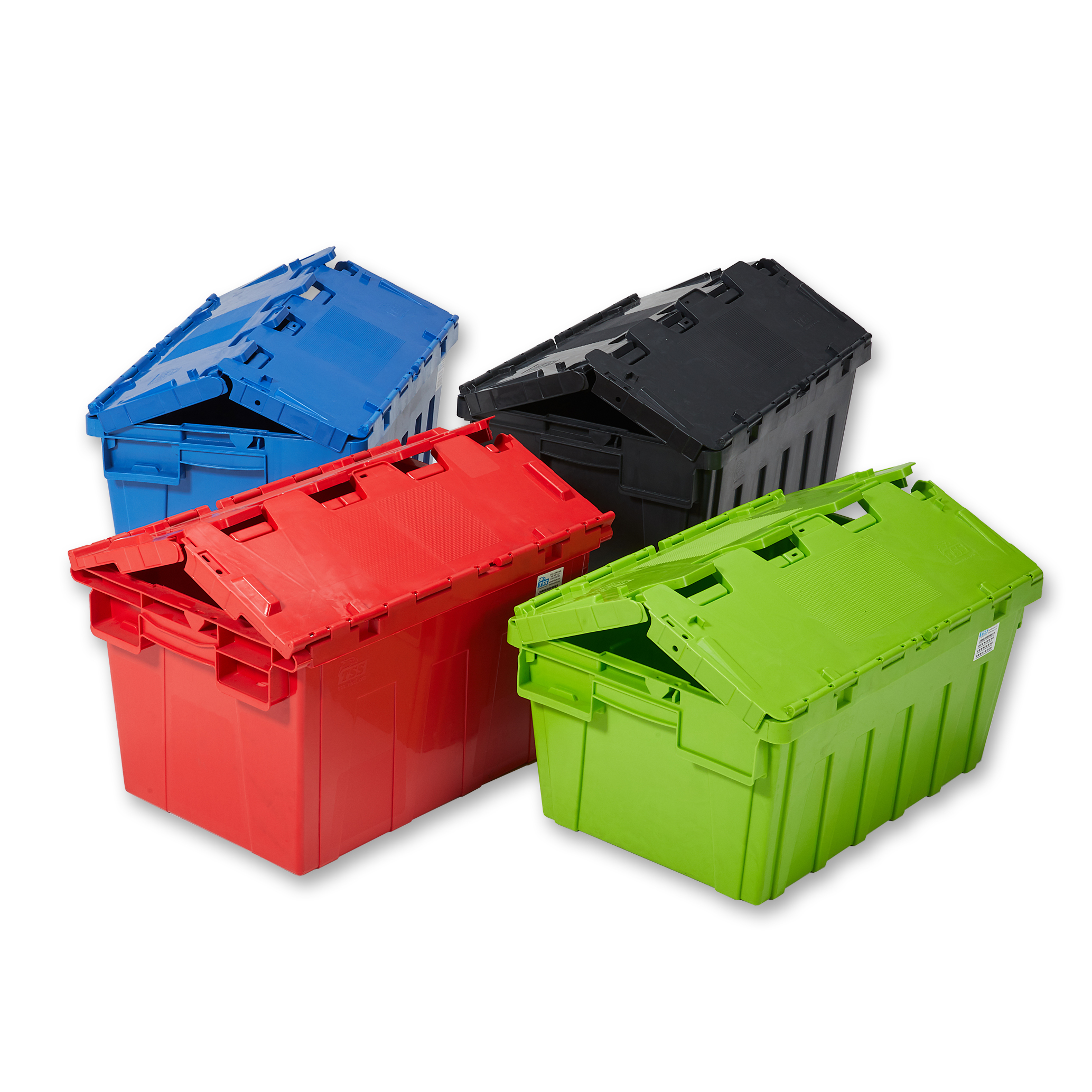
Stackable plastic totes, model TSS-TBX (600 x 400 x 320 mm): request a sample or quotation to validate fit before a serial ASRS rollout.
Have Questions or Need More Details?
Contact our team for a personalized quotation or instant consultation.
Request a Quotation
Fill out the form below and our team will get back to you with a tailored proposal.
WhatsApp Direct Chat
Prefer to chat in real-time? Message us on WhatsApp for instant assistance & quick answers.
- Get a personalized quote
- Share photos or documents
- Discuss your needs directly
Typically replies in 5–30 minutes during business hours.