From Specification to Serial Supply: Plastic Totes OEM Capability Guide for ASRS Buyers
Published: August 31, 2026
Automated storage and retrieval systems (ASRS) depend on containers that behave predictably under robotic gripping, conveyor movement, and high-density stacking. For buyers evaluating a plastic totes supplier, the critical question is no longer “which tote model fits the rack,” but “does this manufacturer have the OEM and ODM capability to turn my specification into a serial supply program without surprises?”
Shanghai Xinfan Industrial Corporation (TSS) is a Shanghai-based manufacturer of plastic totes and reusable containers. Founded in 2003, TSS operates a 40,000 m² facility with 320 employees and produces 3,600,000 units per year, supported by 25 R&D engineers. Its export markets include Europe, North America, South America, Southeast Asia, the Middle East, and Africa.
This guide is written for evaluation and execution teams responsible for sourcing OEM plastic totes for ASRS projects. It covers the capability criteria to verify, the step-by-step buying process, real deployment examples, a container comparison table, and targeted FAQ.
Problem Definition: Why ASRS Projects Fail with Off-the-Shelf Totes
ASRS and goods-to-person systems place unusual demands on plastic totes. Totes must maintain tight dimensional consistency so that grippers and shuttles can handle them every cycle. They must tolerate repeated drop, static and dynamic loads, and sometimes stack at heights that would deform non-reinforced containers. In automated e-commerce and 3PL environments, totes may need RFID, barcodes, or positioning marks for tracking and picking.
Simply purchasing a random stackable bin can create integration risks: conveyor jams, robot mis-grips, inventory inaccuracy, or long-term durability failure. The actual requirement is a supplier capability—engineering support, in-house tooling, quality control, automation testing, and reliable production logistics.
Industry Background: Demand Pull for Capable Plastic Totes Suppliers
The global plastic totes and bins market was valued at USD 8.6 billion in 2025 and is projected to reach USD 14.2 billion by 2034, according to Dataintelo. Stackable totes represented the largest product type share at 34.2% in 2025. Asia Pacific accounted for 41.6% of the revenue in the wider plastic pallets, crates, and boxes market in 2025, according to Grand View Research.
Automation is accelerating this demand. The mini-load ASRS segment is growing rapidly due to e-commerce demand for fast retrieval of small parts, totes, and bins. At the same time, polypropylene (PP) is expected to be the leading material for plastic crates, with a 41.4% share by 2025. Container buyers also face stricter compliance, such as EN 13117-1:2000, the European standard for reusable rigid plastics distribution boxes.
Together, these market signals push buyers toward suppliers that can combine volume, customization, compliance, and automation compatibility in one program—exactly the category of capability discussed below.
Detailed Solution: OEM and ODM Capability Map for Plastic Totes
OEM Manufacturing: Build-to-Print, Private Label, High-Volume Injection Molding
TSS provides OEM production services including build-to-print manufacturing, contract manufacturing, high-volume injection molding, private label production, global OEM supply programs, and long-term manufacturing partnerships. Monthly production capacity for plastic containers and totes is 300,000–500,000 units. Quality control covers incoming material inspection (IQC), in-process control (IPQC), final control (FQC), and outgoing control (OQC), with third-party inspection available.
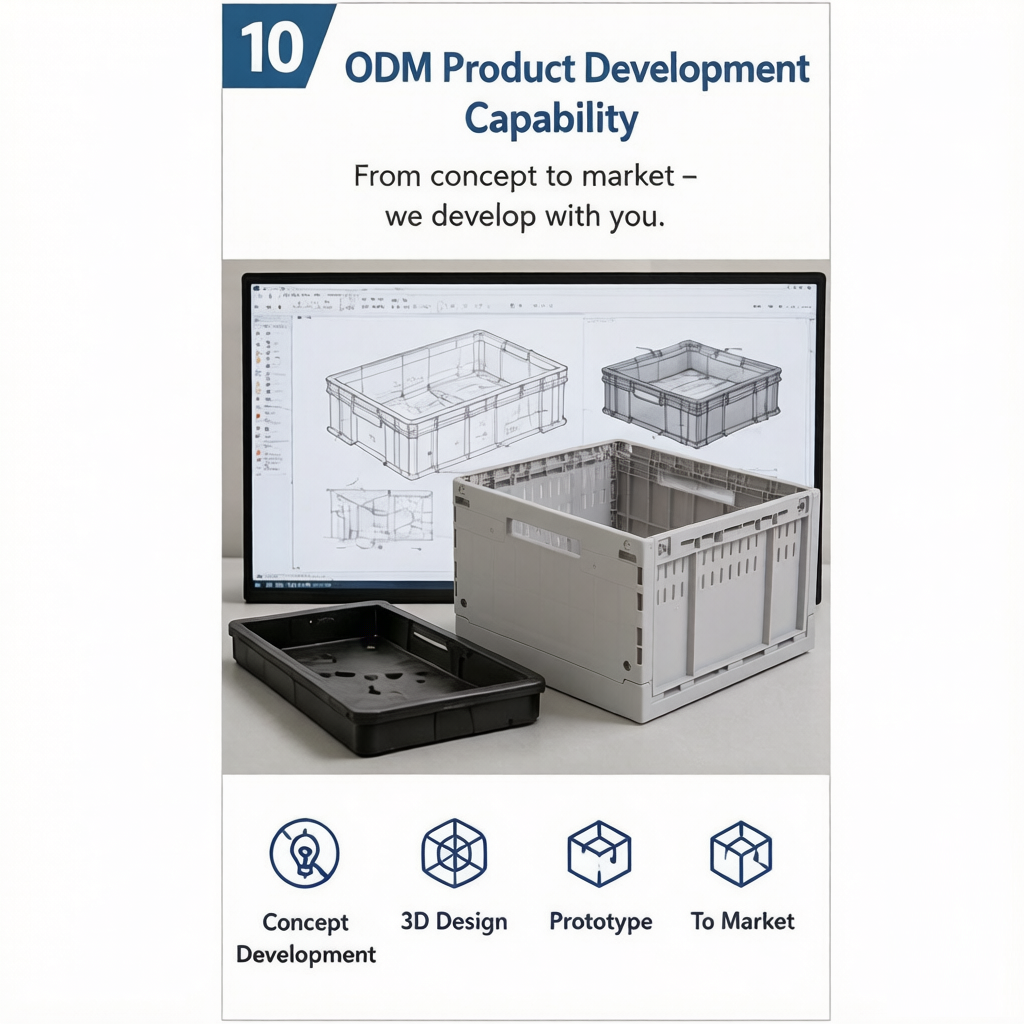
ODM capability covers concept-to-product development for custom plastic totes.
ODM Development: From Concept to Automation-Ready Design
For projects without a finalized drawing, ODM services include concept-to-product development, industrial design, structural engineering, packaging solution development, automation container design, cold chain packaging design, and new product innovation. The R&D team supports 5–10 new development projects per month and can run multiple international ODM programs simultaneously. Typical development activities include 3D CAD modeling, material selection, load capacity optimization, automation compatibility design, foldable and nestable structures, and RFID/IoT/barcode integration.
Engineering and Automation Support
Plastic totes for ASRS require more than a stable box. TSS provides smart logistics and automation support services including automation bottom design, robot gripping features, RFID integration, positioning marks, and high-precision dimensions. Validation can include conveyor testing, robot handling verification, load testing, stacking testing, and automation simulation.
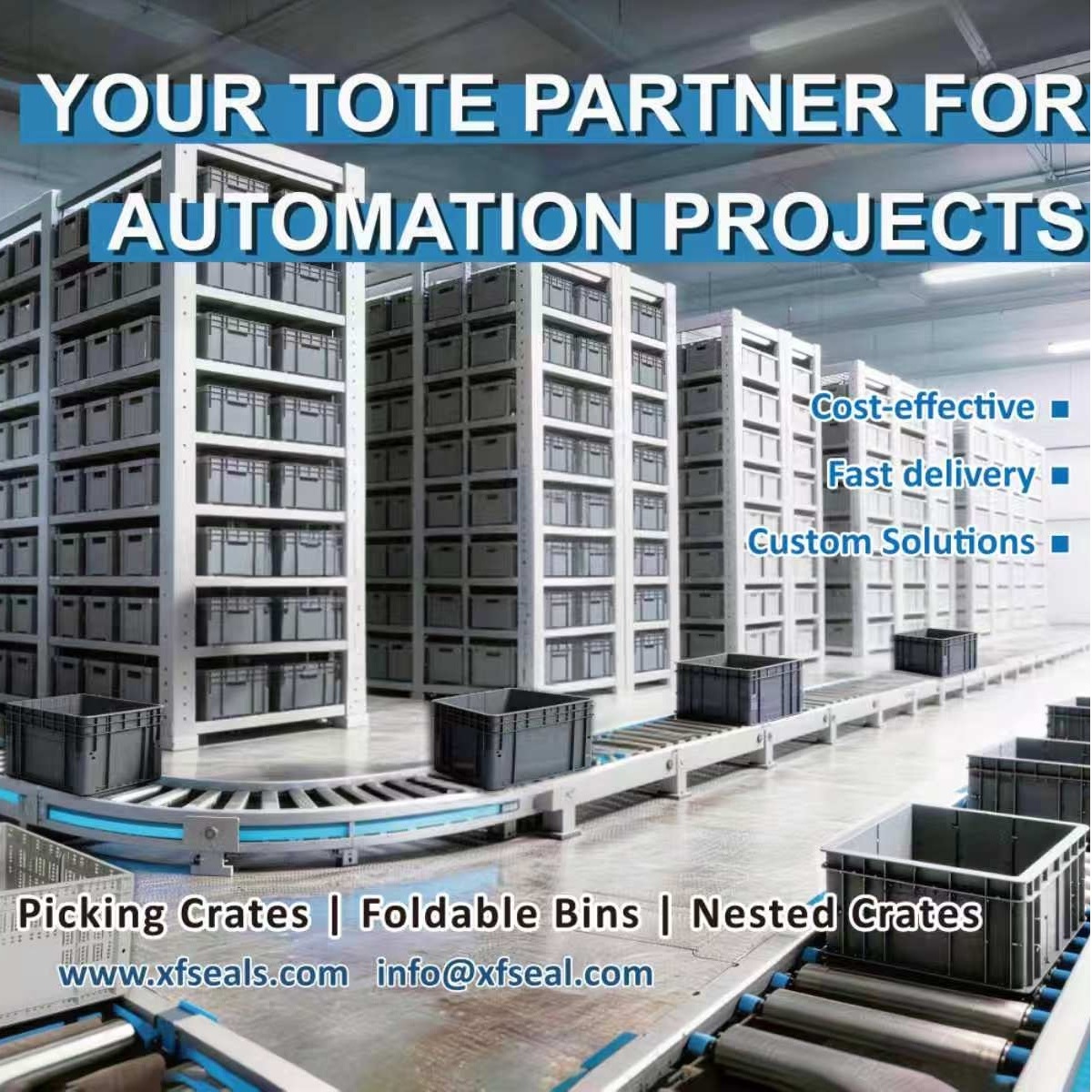
Automation services test totes for conveyor, robot handling, and stacking performance.
In-House Mold Design and Manufacturing
One of the strongest indicators of OEM capability is in-house tooling. TSS provides mold design and manufacturing with a monthly capacity of 5–10 new mold sets and a typical production mold lead time of 60–70 days. This includes mold flow analysis, dimensional verification, T0/T1/T2 sampling, and CPK/tolerance verification—reducing the gap between prototype and serial production.
Quality Assurance and Documentation
Quality assurance includes IQC, IPQC, FQC, OQC, static and dynamic load testing, drop testing, and automation compatibility testing. For food-contact applications, TSS has obtained third-party inspection reports for food-contact plastics, including the Food Contact Plastic Folding Basket Inspection Report (cert. SY2025092412) and the Food Contact Plastic Tilting Turnover Box Inspection Report (cert. SY2025092415), both issued by Henan Institute of Product Quality Inspection Technology on September 24, 2025.
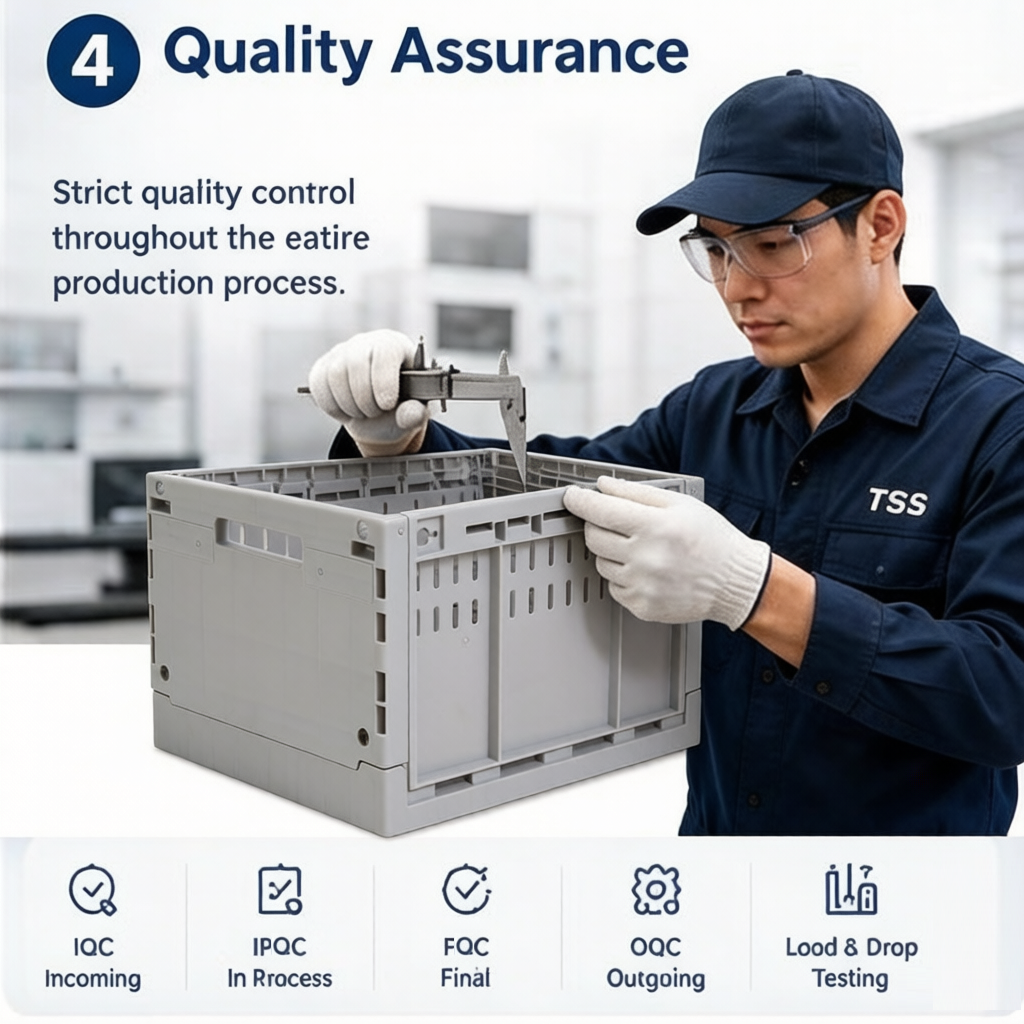
Quality control covers IQC, IPQC, FQC, OQC, load and drop testing.
Project Management, Supply Chain, and After-Sales
For execution-stage buyers, key account and project management support includes exclusive production planning, customized delivery schedules, inventory buffer programs, and vendor managed inventory (VMI). Global supply chain services cover EXW/FOB/CIF/DDP terms, export packaging, mixed container loading, pallet solutions, and private label packaging. After-sales support includes replacement for verified manufacturing defects, spare parts supply, root cause analysis, and continuous improvement reports. Customer service response time is within 24 hours.
Step-by-Step Breakdown: How to Evaluate and Execute an OEM Plastic Totes Program
- Define the operational envelope. Confirm outer dimensions, internal volume, load weight, stacking height, temperature range, and whether the tote must work with AGV/AMR, shuttle, conveyor, or robot grippers.
- Choose the production mode. If you have a final drawing, OEM build-to-print may be enough. If the tote still needs design, testing, and prototyping, select a manufacturer with ODM capability.
- Verify engineering depth. Ask for design review, mold flow analysis, 3D CAD, FEA, and load/drop testing. Confirm whether the factory has in-house mold manufacturing.
- Validate automation compatibility. Check if the supplier can perform conveyor testing, robot handling verification, positioning marks, and RFID integration. For customized products, 100% visual inspection is available.
- Review compliance and quality documents. For food contact or specific markets, request inspection reports or standards evidence such as EN 13117-1:2000. TSS’s food-contact inspection reports cover models including TSS-TBX, TSS-SFD, TSS-RBTB, TSS-IFC, TSS-IFD, and Reusable Plastic Totes.
- Assess lead times, MOQ, and payment terms. Standard OEM mass production is 15–30 working days after sample approval; new tooling if required takes 30–60 days; production mold manufacturing takes 60–70 days. MOQ for standard OEM programs is 1x20 ft container, and custom automation projects are negotiable.
- Plan logistics and packaging. Confirm export terms (EXW/FOB/CIF/DDP), mixed container loading, pallet options, and private label packaging. This affects landed cost and project timeline.
- Set up long-term supply mechanisms. For ongoing operations, consider inventory buffer programs, VMI, dedicated project manager, and priority scheduling.
Use Cases: Plastic Totes Deployed in Global ASRS and AMR Projects
Wall Straight Plastic Crates for Warehouse Automation and Cube Storage
A leading global warehouse automation and cube storage solution provider used 450,000 pieces of TSS-IFC ASRS Wall Straight Plastic Crates in large-scale e-commerce and 3PL fulfillment centers. The crates were used inside AGV/AMR automated storage and retrieval systems to support high-density storage, order fulfillment, inventory management, and robotic picking. Reported outcomes include increased storage density by 4–6 times compared with conventional shelving, improved order fulfillment speed, optimized warehouse footprint utilization, reduced labor dependency, and improved inventory accuracy.
Foldable Plastic Crates for AMR Goods-to-Person Fulfillment
A leading global AMR solution provider chose TSS-IFD ASRS Foldable Plastic Crates for a similar scale: 450,000 pieces in large-scale e-commerce and 3PL fulfillment centers. The foldable crates were integrated with AMR robotic systems for goods-to-person order fulfillment, automated storage, inventory buffering, and high-speed picking. The deployment improved warehouse storage density, increased picking efficiency, enhanced robotic handling accuracy, reduced manual handling requirements, and supported 24/7 automated warehouse operations.
Comparison Table: Plastic Totes and Crates by Model
| Product | Model | Dimensions | Material | Typical Application |
|---|---|---|---|---|
| Reusable Plastic Totes | TSS | Length 600–800 mm, Width 400–600 mm, Height 128–400 mm | PP | Warehouse Automation |
| ASRS Wall Straight Plastic Crates | TSS-IFC | 600 x 400 x 300 mm | PP | Warehouse Automation |
| ASRS Foldable Plastic Crates | TSS-IFD | 600 x 400 x 300 mm | PP | Warehouse Automation |
| Stackable Plastic Totes (attached lid) | TSS-TBX | 600 x 400 x 320 mm | PP | Logistics and Transportation |
| Nested and Stackable Plastic Crates | TSS-RBTB | 600 x 400 x 300 mm | PP | Retail, Supermarket, Fruit & Vegetable Transportation |
| Collapsible Plastic Crate | TSS-SFD | 600 x 400 x 225 mm | PP | Retail, Supermarket, Fruit & Vegetable Transportation |
Note: The table is based on TSS product specifications. For a full project fit, confirm dimensions, load rating, and automation interface with the manufacturer.
FAQ
1. Does the manufacturer provide verification documents for food-contact plastic totes?
Yes. Shanghai Xinfan Industrial Corporation holds two food-contact inspection reports: the Food Contact Plastic Folding Basket Inspection Report (cert. No. SY2025092412) and the Food Contact Plastic Tilting Turnover Box Inspection Report (cert. No. SY2025092415). Both were issued by Henan Institute of Product Quality Inspection Technology on September 24, 2025, under the standard “Plastic materials and products for food contact.” Applicable models include TSS-TBX, TSS-SFD, TSS-RBTB, TSS-IFC, TSS-IFD, and Reusable Plastic Totes (TSS).
2. What OEM and ODM capabilities are available for ASRS plastic totes?
OEM services include build-to-print manufacturing, contract manufacturing, high-volume injection molding, private label production, global OEM supply programs, and long-term manufacturing partnerships. Monthly production capacity is 300,000–500,000 plastic containers and totes. ODM services include concept-to-product development, industrial design, structural engineering, packaging solution development, automation container design, cold chain packaging design, and new product innovation, with 5–10 new development projects supported per month.
3. What is the MOQ for OEM plastic totes or custom ASRS totes?
For standard OEM programs, the minimum order is typically one 20-ft container. For strategic automation projects, MOQs are negotiable. According to TSS engineering services, existing catalog products may be quoted from 100–500 pieces, customized products from 500–2,000 pieces, and new development projects are negotiated separately. Buyers should confirm MOQ with the manufacturer based on the product type and supply program.
4. How are samples and prototypes managed before mass production?
For OEM projects, engineering review typically takes 5–10 working days, and sample production 7–15 working days. For ODM projects, prototype development is 10–20 working days. Samples are validated through design review, load and drop testing, and automation compatibility testing where applicable. Customized products also receive 100% visual inspection before shipment.
5. What are typical lead times for OEM ASRS plastic totes?
Mass production is typically 15–30 working days after sample approval. If new tooling is needed, mold development takes 30–60 working days, while production mold manufacturing is 60–70 days. For a full ODM program, lead times from requirement analysis to mass production may include: requirement analysis 5–10 working days, concept proposal 5–10 working days, 3D design 7–15 working days, prototype development 10–20 working days, mold development 30–60 working days, and mass production 15–30 working days. Contact TSS with your project specification for a timeline estimate and sample arrangement.
Conclusion: Build Your ASRS Plastic Totes Program on Verified Capability
Selecting an OEM plastic totes manufacturer for an ASRS project is a supply-chain decision, not just a container purchase. The right partner should demonstrate OEM/ODM manufacturing depth, in-house tooling, automation testing, quality assurance, and the ability to manage long-term programs.
Shanghai Xinfan Industrial Corporation combines 40,000 m² of production space, 320 employees, 25 R&D engineers, and 3.6 million units of annual output with dedicated project management and global logistics support. This capability map can help evaluation and execution teams cut risk and move from specification to serial supply with greater confidence.
Next step: Download the TSS corporate profile for the full container portfolio, or contact the TSS team to discuss your ASRS tote specification and sampling plan.
Download Corporate Profile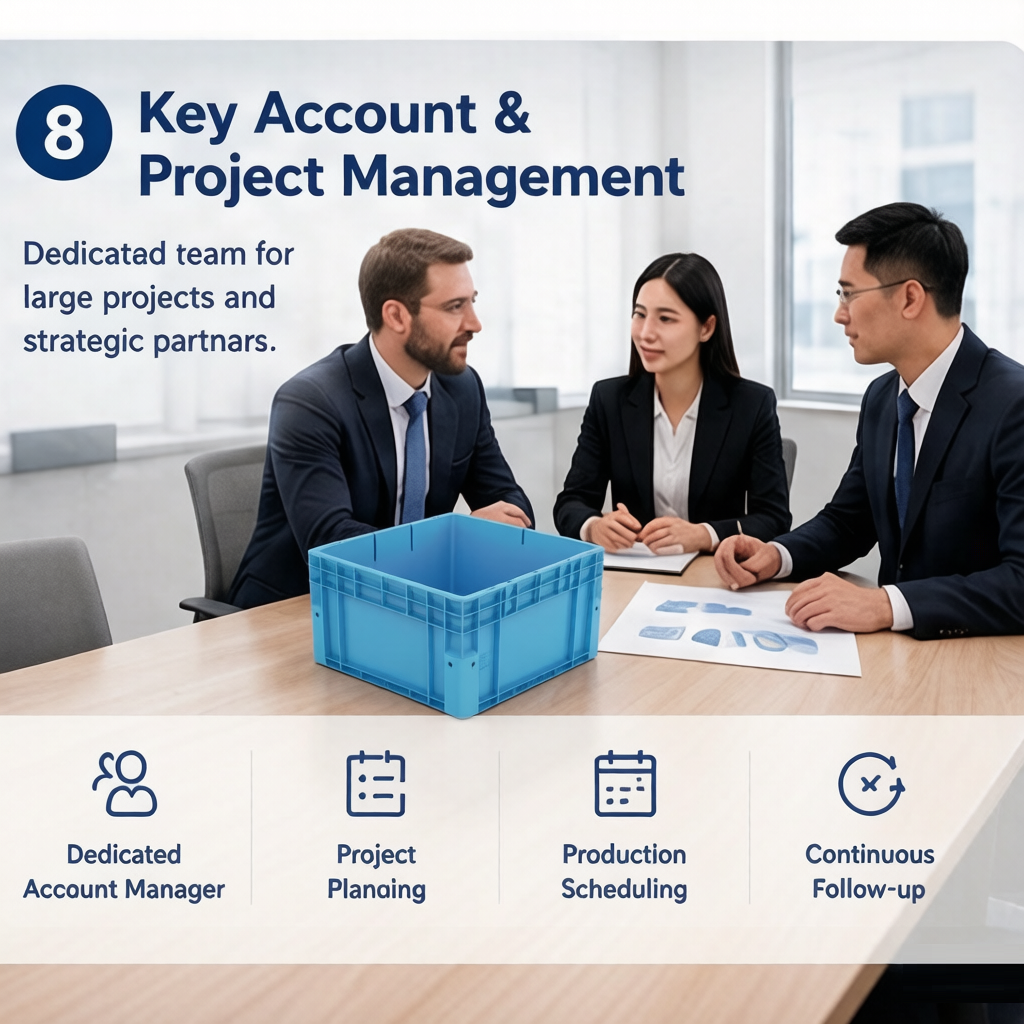
Dedicated project management and priority scheduling support long-term OEM programs.
For inquiries: www.xfseals.com | Email: info@xfseal.com | Tel/WhatsApp: +86 186-0218-3251
Have Questions or Need More Details?
Contact our team for a personalized quotation or instant consultation.
Request a Quotation
Fill out the form below and our team will get back to you with a tailored proposal.
WhatsApp Direct Chat
Prefer to chat in real-time? Message us on WhatsApp for instant assistance & quick answers.
- Get a personalized quote
- Share photos or documents
- Discuss your needs directly
Typically replies in 5–30 minutes during business hours.