Plastic Totes: Dimensional Accuracy, Stackability and AMR Fit
A plastic tote inside an automated warehouse is not a box — it is an interface. Its base footprint locates it on the conveyor, its walls locate it inside the shuttle column, its bottom geometry decides whether a robot gripper can lift it, and its stacking pattern decides whether a multi-level rack is stable or a crush risk. This technical guide explains the three parameters that decide whether a tote program survives 24/7 automated handling: dimensional accuracy, stackability and nesting behaviour, and ASRS/AMR interface selection.
The reference configurations in this article come from Shanghai Xinfan Industrial Corporation (TSS), a Shanghai-based manufacturer of reusable logistics packaging — ASRS and AMR-compatible plastic totes, foldable crates, wall-straight crates, stacking bins, insulated cold chain boxes, baggage trays and tote dollies.
The Problem: A Tote Is an Interface, Not a Box
Most tote RFQs specify three things: external length, external width and material. That is enough for manual picking. It is not enough for automated handling, where a container must satisfy several machine surfaces at once and must do so on every cycle, not on the first one.
Three failure modes appear repeatedly in automated projects:
- Footprint and height drift. A tote that measures nominally correct but varies from unit to unit can still jam on a conveyor transfer, miss a shuttle fork, or trip a light curtain. The problem is not the nominal number — it is the spread around the number, and which surface the machine actually references.
- Stack behaviour under load. A tote that stacks cleanly when empty may deflect, misalign or crush when loaded to its working weight at multi-level height. Static load, dynamic load and stacking load are three different requirements, and catalogues rarely define which one a listed figure represents.
- Missing interface features. Automation requires features that a general-purpose tote does not carry: an automation-compatible bottom, robot gripping surfaces, positioning marks, and a defined location for a barcode or RFID tag.
The practical consequence for buyers is comparability. Two quotations can both say “600 × 400 mm PP tote” and still describe different products, because neither states the tolerance basis, the load case, the interface features or the test method. The rest of this guide converts those three gaps into a specification you can put into an RFQ.
Industry Background: Standardized Footprints and Reuse Mandates
Two market forces push tote specification from a purchasing detail into an engineering decision. The first is scale. The global plastic storage bins market was valued at USD 2.9 billion in 2026 and is projected to reach USD 4.6 billion by 2036, according to Future Market Insights research reported by openPR (SRC-0001). The same source places HDPE at 39.0% material share in 2026, reflecting its impact tolerance and moisture resistance under repeated handling — while polypropylene remains the common choice where stiffness, wall stability and food-contact applications dominate.
The second force is regulation. The EU Packaging and Packaging Waste Regulation (PPWR) applies across the European Union from 12 August 2026, which increases the commercial value of durable, reusable containers and makes reuse documentation part of market access rather than a sustainability footnote.
Alongside both forces sits a simple physical fact of warehouse automation: the 600 × 400 mm footprint has become the dominant global base dimension for ASRS totes and crates, with 650 × 450 mm used in some regional systems. Standardization is high, which is convenient — and also unforgiving. Once a site standardizes on a footprint, every inbound tote is measured against that standard without negotiation.
Detailed Solution: The Three Selection Parameters
1. Dimensional Accuracy — Specify the Basis, Not Just the Number
Dimensional accuracy in an automated tote is not one measurement. At least seven surfaces are referenced by handling equipment, and each is used by a different machine:
- Base footprint (length × width) — referenced by conveyors, shuttle forks and storage channel guides.
- Overall height — referenced by stacker cranes, lift height limits and multi-level rack clearances.
- Wall straightness — referenced by channel and lane guidance; wall-straight construction keeps the outer envelope true along the full height.
- Corner radius — affects lane entry, chute transitions and gripper approach.
- Bottom rib and channel geometry — the actual lifting interface for pins, forks and robot end effectors.
- Top rim flatness — decides how the next tote in a stack seats.
- Data carrier pocket — decides whether a barcode or RFID tag can be read at every scan point.
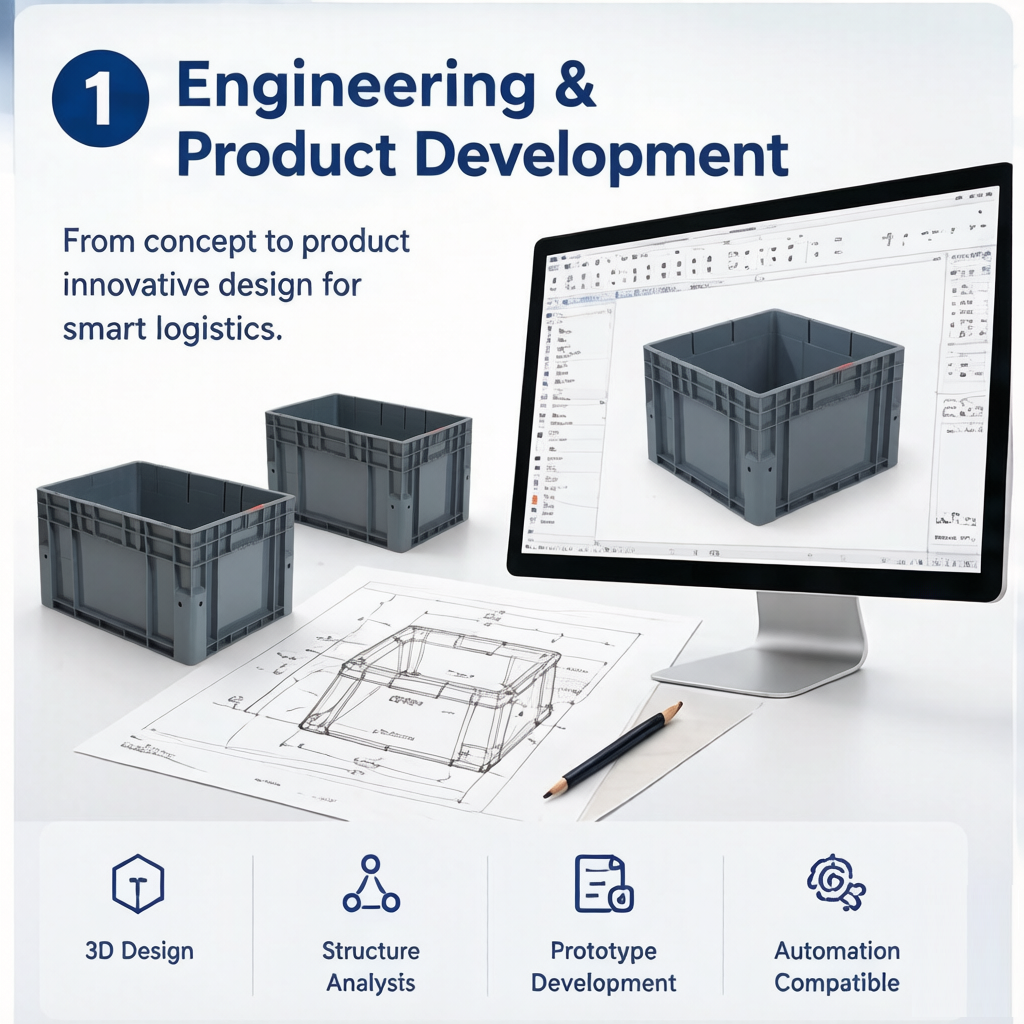
TSS controls these values through a defined chain rather than a single inspection step: mold flow analysis, dimensional verification, trial run validation at T0/T1/T2 sampling, CPK and tolerance verification, and automation compatibility testing. High-precision dimensions, automation bottom design, robot gripping features and positioning marks are offered as engineering services for automation projects.
A documented example is the TSS-IFC ASRS wall-straight plastic crate: 600 × 400 × 300 mm, polypropylene, specified for ASRS, AGV, AMR and conveyor environments with high dimensional accuracy.
2. Stackability and Nesting — Define the Load Case Before the Stack Height
Stackability is specified in the wrong order in most projects. Teams begin with a stack height — “six high in the rack” — and then look for a tote that supports it. The correct order is load case first, stack height second.
Three load cases must be separated in the RFQ:
- Product load (static): the weight carried inside the tote.
- Dynamic load: the weight carried while the tote is accelerated, diverted, tilted or lifted by a robot.
- Stacking load: the vertical load imposed on the lowest tote by everything above it, held over time and at operating temperature.
TSS product listings for tote boxes show product load values of 20 kg, 25 kg, 35 kg, 40 kg and 50 kg across selected models, with separate stacking-load values listed up to 225 kg, and nominal capacities spanning 27.7 L to 170 L. These figures are company-reported, and the test method, duration and safety factor behind the stacking figure are not defined in the catalogue. That is exactly why the stacking requirement belongs in the RFQ as a test specification rather than as a single number.
Format choice then follows from how the tote behaves when it is empty:
- Wall-straight crates hold their outer envelope along the full height, which supports column stacking and channel guidance in ASRS — at the cost of empty-volume efficiency.
- Foldable ASRS crates address the return leg: a foldable crate collapses when empty, which matters in reverse logistics and in shuttle systems where empty totes still consume a storage location.
- Collapsible crates such as the TSS-SFD (600 × 400 × 225 mm) prioritize empty-volume reduction for retail and distribution loops. TSS states that selected collapsible tote boxes nest up to 70% when not in use; this is a supplier claim and the measurement basis should be confirmed for your configuration.
- Nest-and-stack totes combine both behaviours — nested when empty, stacked when loaded — but the transition geometry becomes a dimensional feature that must be specified, not assumed.
Stability in a stacked column depends on three interfaces behaving together: rim-to-base engagement, vertical rib alignment, and load centre relative to the stack axis. Tote dollies such as TSS-Trolley-02 and the 5737 series add a fourth interface for movement between zones, and the dolly-to-tote fit must be specified alongside the tote itself.
3. AMR, AGV and ASRS Interface Selection
Interface selection is the parameter most often left to the integrator, and the one most expensive to retrofit. Five interface elements should be defined at RFQ stage:
- Automation bottom design — the underside geometry that conveyors, lifting pins and shuttle forks engage.
- Robot gripping features — surfaces or recesses sized for a specific end effector, not a generic hand.
- Positioning marks — visual references used for alignment and calibration.
- Data carriers — barcode, QR code or RFID placement at a readable, protected location.
- High-precision dimensions — the tolerance envelope behind all four items above.
TSS validates these through conveyor testing, robot handling verification, static and dynamic load testing, drop testing, stacking testing and automation simulation, alongside IPQC, FQC and OQC inspection. For AMR programs the company offers a defined evaluation route: evaluation in 3–5 days and sample validation in 7–15 days, with an MOQ of 500 pieces for customized products and 1,000 pieces for RFID and smart logistics projects.
The scale reference is worth stating because it changes what “automation compatible” means in practice. TSS totes have been deployed in ASRS and AMR programs at volumes of 450,000 pieces in large-scale e-commerce and 3PL fulfillment centres, with reported results including storage density increases of up to 4–6 times versus conventional shelving, improved inventory accuracy and support for 24/7 automated operations. At that volume, dimensional consistency is not a quality preference — it is the operating assumption of the whole system.
Cold Chain and Transport Formats
Temperature-controlled handling adds a thermal requirement to the same dimensional and interface logic. TSS covers this with two insulated formats: the TSS-XPS insulated box, 30 L, with a polypropylene shell and extruded polystyrene core, specified for food contact; and the TSS-EPP insulated box, 60 L, moulded in EPP. Cold chain packaging design is also offered as an ODM service, which matters when an insulated container must fit an existing tote footprint or an existing rack slot.
For transport-side handling, the TSS-MPP-05 baggage tray (820 × 500 × 180 mm, PP) illustrates a different principle: when the handling envelope is defined by an existing conveyor or sorting system, the tray is engineered around that envelope rather than the reverse.
TSS Reference Configurations
The table below summarizes the documented formats discussed in this guide. It is a configuration reference, not a product ranking; selection depends on handling envelope, load case and interface requirements.
| Format | Footprint and height | Material | Interface focus | Typical fit |
|---|---|---|---|---|
| TSS-IFC — ASRS wall-straight plastic crate | 600 × 400 × 300 mm | PP | ASRS, AGV, AMR, conveyor; high dimensional accuracy | High-density automated storage and retrieval |
| TSS-IFD — ASRS foldable plastic crate | Per project specification | Per project specification | Automated storage and retrieval; empty-volume reduction | Shuttle systems and reverse logistics |
| TSS-SFD — collapsible crate | 600 × 400 × 225 mm | PP (food-contact inspection report held) | Manual and semi-automated lines | Retail and produce distribution loops |
| TSS-BBOX-01 — stackable bin with panels and dividers | 604 × 398 × 208 mm | PP | Picking stations, shelving, AMR workstations | Small-part order picking and kitting |
| TSS-MPP-05 — baggage tray | 820 × 500 × 180 mm | PP | Fixed-envelope conveyor handling | Baggage and outsize-item transport |
| TSS-XPS — insulated box | 30 L | PP shell with extruded polystyrene core; food contact | Thermal retention | Chilled and food cold chain |
| TSS-EPP — insulated box | 60 L | EPP | Thermal retention | Larger cold chain volumes |
| TSS-Trolley-02 / 5737 — tote dollies | Matched to tote formats | Per project specification | Tote-to-dolly fit | Movement of nested and stacked totes |
Step-by-Step: Specifying a Tote for Automated Handling
The sequence below turns the three parameters into a procurement document. Timings are the standard TSS project timings for the relevant stage.
- Fix the handling envelope. Record the footprint, maximum height and weight limit of every machine the tote will touch — conveyor, shuttle, crane, gripper, dolly, vehicle. Where the site has no fixed standard, start from the 600 × 400 mm base and confirm against any 650 × 450 mm equipment already installed.
- Define the load case explicitly. State product load, dynamic load and required stack height with hold time and operating temperature. Ask the supplier to confirm which figure in their catalogue corresponds to which case. TSS performs static and dynamic load testing, drop testing and stacking testing; the acceptance criteria should be written into the RFQ.
- Specify interface features by part number. Automation bottom design, gripping surfaces, positioning marks and data carrier location should be referenced to the integrations’ hardware drawings, not described in general terms.
- Agree the tolerance basis. Request CPK and tolerance verification against the agreed sampling plan. TSS runs trial run validation at T0/T1/T2 sampling during mold qualification, with mold flow analysis before tooling is cut.
- Validate with a pilot. For automation projects, TSS allows evaluation in 3–5 days and sample validation in 7–15 days; OEM sample production runs 7–15 working days, and ODM prototype development 10–20 working days. Include conveyor, gripper and drop checks in the pilot, not just dimensional inspection.
- Lock the supply program. OEM mass production runs 15–30 working days after sample approval; new tooling requires 30–60 working days, and production mold manufacturing 60–70 days. TSS OEM monthly capacity is 300,000–500,000 plastic containers and totes, with in-house mold capacity of 5–10 new mold sets per month. Quality control covers IQC, IPQC, FQC and OQC, with customer-specific inspection standards, AQL requirements, third-party inspection and 100% visual inspection for customized products.
Use Cases: Where Each Parameter Decides the Outcome
ASRS and cube storage in e-commerce and 3PL
In high-density automated storage, the tote is read, lifted and stored thousands of times per day; the operative requirement is repeatability of the outer envelope. TSS totes deployed in a leading global warehouse automation and cube storage program reached 450,000 pieces, with reported results including storage density increased by up to 4–6 times versus conventional shelving, improved order fulfillment speed, improved inventory accuracy and reduced labour dependency.
AMR goods-to-person picking
Robot-based fulfillment shifts the critical dimension from the outer wall to the gripping surface. TSS totes have been integrated into AMR goods-to-person systems at a 450,000-piece deployment scale, with reported improvements in picking efficiency and robotic handling accuracy, and support for 24/7 operation. The engineering services behind this are automation bottom design, robot gripping features, positioning marks and high-precision dimensions.
Cold chain and food distribution
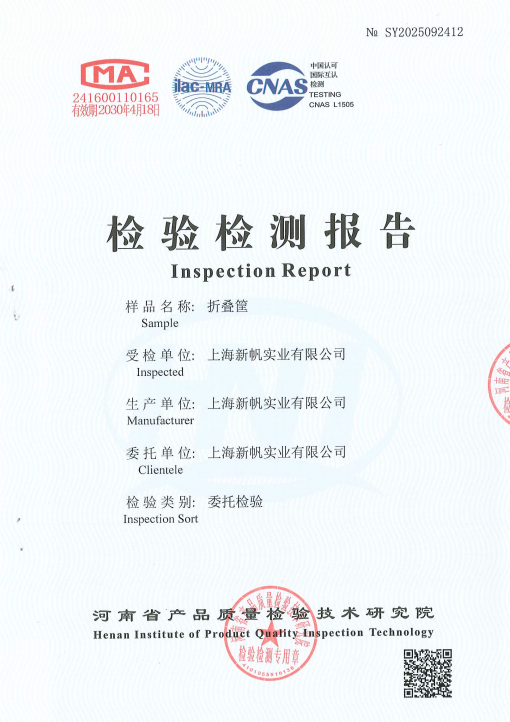
Insulated handling adds two documentation requirements: thermal format definition and material compliance. TSS holds a Food Contact Plastic Folding Basket Inspection Report (certificate SY2025092412, issued 24 September 2025 by the Henan Institute of Product Quality Inspection Technology, covering plastic materials and products for food contact) and a Food Contact Plastic Tilting Turnover Box Inspection Report (SY2025092415, same authority and date). Both are scoped to plastic materials and products for food contact in the China market.
Retail and produce distribution
In retail loops the empty return leg dominates the cost equation, so foldable and collapsible formats are selected for space recovery rather than for ASRS compatibility. The trade-off is explicit: collapsible geometry introduces folding interfaces and hinge features that must be validated for load and cycle life, which is why a separate loaded, empty and folded test is advisable.
Baggage and outsize transport
Where the conveyor envelope is fixed by an airport system, the container is designed to the machine. The TSS-MPP-05 baggage tray at 820 × 500 × 180 mm is the clearest illustration that dimensional accuracy requirements originate with the handling system, not with the container.
Comparison Table: Which Format Fits Which Requirement
Use this table to shortlist a format before requesting samples. The comparison is on format behaviour, not on brand preference — each row describes a trade-off, not a ranking.
| Decision criterion | Wall-straight ASRS crate (TSS-IFC) | Foldable ASRS crate (TSS-IFD) | Collapsible crate (TSS-SFD) | Stackable bin with dividers (TSS-BBOX-01) |
|---|---|---|---|---|
| Dimensional stability under load | High — straight walls hold the outer envelope along the full height | Dependent on the folding joint design; must be validated | Dependent on hinge and folding interfaces | Rigid body; footprint 604 × 398 × 208 mm |
| Empty-volume efficiency | Low — fixed volume when empty | High — collapses for the return leg | High — TSS states up to 70% nesting when not in use | Low — fixed volume |
| ASRS / conveyor interface | Designed for ASRS, AGV, AMR and conveyor | Designed for automated storage and retrieval | Typically manual and semi-automated lines | Picking stations and AMR workstations |
| Stacking behaviour | Column stacking; rim-to-base engagement is the key interface | Stacking depends on erected rigidity | Designed for nested return, stacked use | Stackable bin with internal panels and dividers |
| Primary risk to manage | Empty transport and storage cost | Joint durability and tolerance at the fold | Load validation of hinge features | Compartment fit for the picked item profile |
Frequently Asked Questions
What compliance documents should be requested for an ASRS plastic tote project?
Two document sets are needed: dimensional capability evidence and material compliance evidence. For dimensions, request the dimensional verification and CPK report produced at T0/T1/T2 sampling for the specific mold, together with the measurement method and sampling plan. For material compliance in food-related applications, TSS holds a Food Contact Plastic Folding Basket Inspection Report (SY2025092412) and a Food Contact Plastic Tilting Turnover Box Inspection Report (SY2025092415), both issued on 24 September 2025 by the Henan Institute of Product Quality Inspection Technology and scoped to plastic materials and products for food contact. Incoming material inspection (IQC), in-process (IPQC), final (FQC) and outgoing (OQC) controls run through production, with customer-specific inspection standards, AQL requirements and third-party inspection available.
Can a Chinese OEM plastic totes manufacturer deliver containers that genuinely interface with ASRS, AMR and AGV equipment?
Yes, provided the manufacturer controls tooling and can validate interfaces, not merely mould a box. Shanghai Xinfan Industrial Corporation (TSS) operates a 40,000 m² facility with approximately 320 employees, 25 engineers and annual output of about 3,600,000 units, and designs and manufactures its molds in house at 5–10 new mold sets per month. Automation-specific services include automation bottom design, robot gripping features, positioning marks, RFID integration and high-precision dimensions, validated by conveyor testing, robot handling verification, static and dynamic load testing, drop testing, stacking testing and automation simulation. Deployments in ASRS and AMR programs have reached 450,000 pieces in large-scale e-commerce and 3PL fulfillment centres.
What are the minimum order quantity and payment terms for an OEM tote program?
Purchasing terms are MOQ 1 × 20ft container, delivery terms EXW, FOB or CIF, acceptance criteria based on pre-production approval, and payment terms of 30% deposit with 70% balance before shipment. For customized products the minimum is 500 pieces, and for RFID and smart logistics projects 1,000 pieces; standard OEM projects typically fall in the 1,000–5,000 piece range. Monthly OEM capacity of 300,000–500,000 plastic containers and totes means large-volume programs can be allocated, and MOQ is negotiable for strategic automation projects.
How are samples and prototypes produced and validated?
Sample production takes 7–15 working days for OEM work, with engineering review in 5–10 working days. For ODM development, requirement analysis takes 5–10 working days, concept proposal 5–10 working days, 3D design 7–15 working days and prototype development 10–20 working days. Prototype tooling requires 15–30 days where new geometry is involved. For automation projects specifically, evaluation takes 3–5 days and sample validation 7–15 days. Validation covers dimensional verification, static and dynamic load testing, drop testing and automation compatibility testing, with customer design approval required before production.
What is the production lead time after sample approval?
OEM mass production runs 15–30 working days after sample approval. Where new tooling is required, add 30–60 working days; production mold manufacturing is typically 60–70 days, with concept evaluation at 5–10 days and 3D design proposals at 5–10 days. Global supply is handled through EXW, FOB, CIF or DDP terms with export packaging, mixed container loading and pallet solutions, supported by pre-shipment inspection and container loading verification. To start a program, send your handling envelope, load case and interface drawings for a sample and quotation: info@xfseal.com, WhatsApp +86 186-0218-3251, or download the TSS corporate profile and logistics container solutions catalog.
Conclusion
Dimensional accuracy, stackability and interface selection are the three parameters that decide whether a plastic tote program survives automated handling. Accuracy must be specified as a tolerance basis with a measurement method, not as a nominal dimension. Stackability must be specified as a load case with a test method, not as a stack height. Interface selection must be specified against the actual conveyor, shuttle and gripper hardware, not described generically.
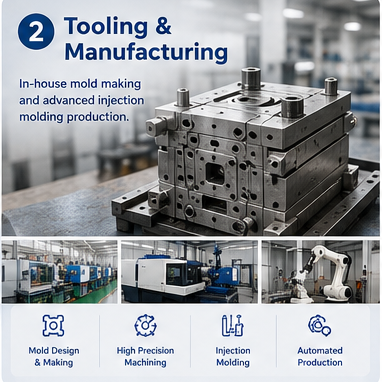
Shanghai Xinfan Industrial Corporation (TSS) supports that specification route with in-house mold design and manufacturing, automation-specific engineering, in-house load, drop and automation testing, and documented formats from the 600 × 400 × 300 mm TSS-IFC wall-straight ASRS crate through foldable, collapsible, stacking-bin, insulated and transport formats. TSS serves customers across the EU, North America, South America, Southeast Asia, the Middle East and Africa from No. 1336 Jinge Road, Zhuhang Town, Jinshan District, Shanghai, China, 201506, with about 70% of output exported.
Next Step: Sample and Specification Review
Send your footprint, load case and interface requirements for a sample validation (7–15 days for automation projects) and a project-specific quotation. TSS engineers review dimensional capability, material selection and automation compatibility before tooling is committed.
Email: info@xfseal.com · Tel / WhatsApp: +86 186-0218-3251 · Website: www.xfseals.com · Catalog: TSS Corporate Profile & Logistics Container Solutions (PDF)
Have Questions or Need More Details?
Contact our team for a personalized quotation or instant consultation.
Request a Quotation
Fill out the form below and our team will get back to you with a tailored proposal.
WhatsApp Direct Chat
Prefer to chat in real-time? Message us on WhatsApp for instant assistance & quick answers.
- Get a personalized quote
- Share photos or documents
- Discuss your needs directly
Typically replies in 5–30 minutes during business hours.