Six Warehouse Problems Plastic Totes Are Asked to Solve — and the Container Behind Each Fix
Problem–Solution Playbook
A warehouse rarely buys plastic totes because it wants plastic totes. It buys them because something in the building is not working: return trailers moving empty air, a shuttle that keeps stopping, pickers who cannot separate two similar parts, or an auditor asking for a food-contact report nobody can produce.
Short answer: most tote projects that fail were never specified against a problem. They were ordered from a catalogue, then made to fit a conveyor, a rack, or a compliance file afterwards. Matching the container to the specific failure — empty return volume, stack stability, automation interface, SKU separation, food-contact documentation, or manual handling — resolves more problems than upgrading the resin.
This guide works in that direction. It starts from six recurring operational symptoms, works backwards to the container type, and then lists the evidence a buyer should request before confirming an order. Product facts come from Shanghai Xinfan Industrial Corporation (TSS), a Shanghai-based manufacturer of plastic totes and logistics packaging founded in 2003, operating a 40,000 m² facility with about 320 employees, 25 engineers, and an annual output of roughly 3,600,000 units, exporting about 70% of production to the EU, North America, South America, Southeast Asia, the Middle East and Africa.
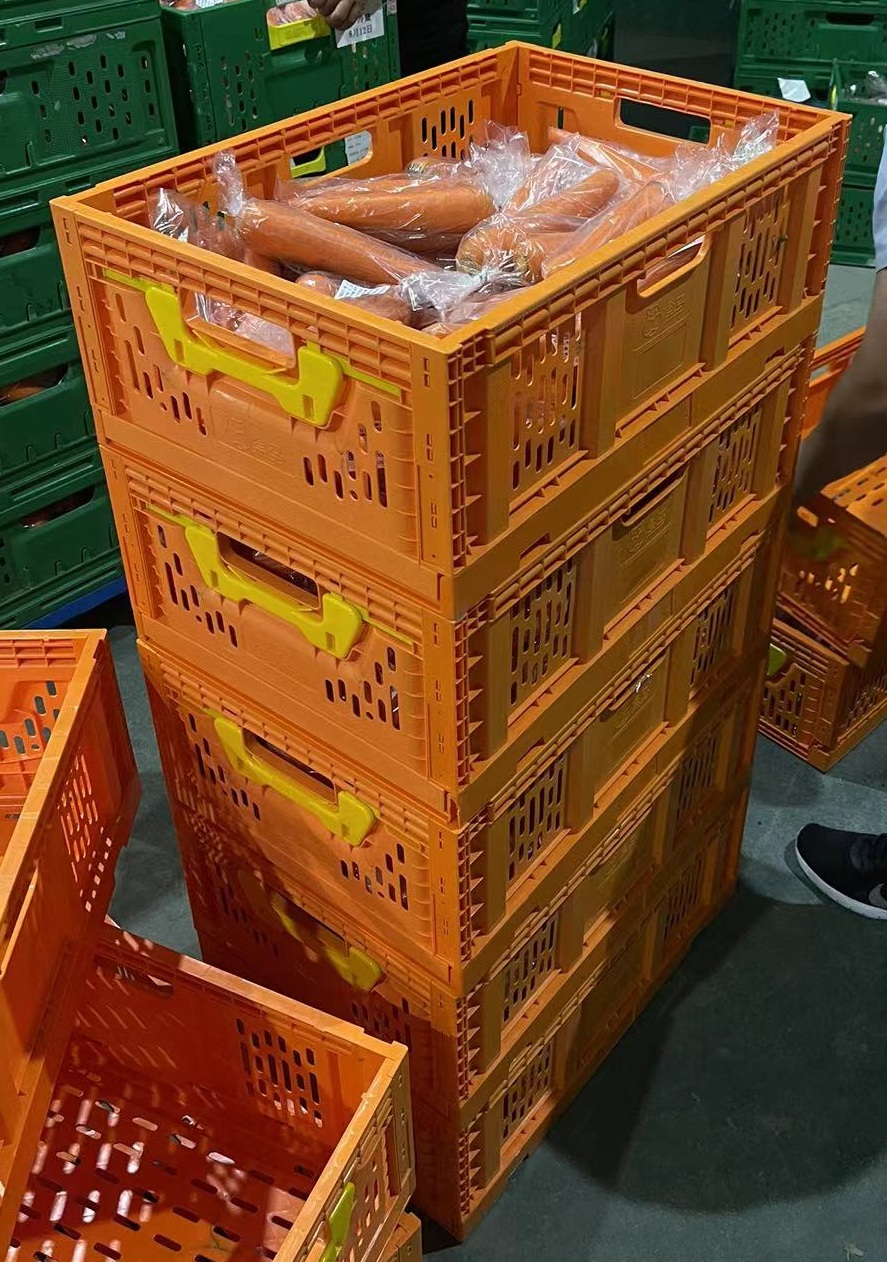
Foldable crate formats address the empty-return volume problem in closed-loop logistics; the same container stacks when loaded and collapses when empty.
Problem Definition: The Tote Is Usually the Last Component Specified
The sequence is familiar. Racking is bought, the conveyor is engineered, the WMS is configured, and the tote is ordered at the end from whatever is in stock. That order of operations inverts the dependency, because the tote is the only component that touches every other one: it sits on the rack, rides the conveyor, is gripped by the robot, is counted by the scanner, and is returned by the truck.
Three failure patterns follow from that inversion, and all three are expensive.
Retrofit failure. The chosen container passes the price review and fails the dimensional or load check. The buyer then has two options: change the container late, or change the equipment. Neither is cheap, and the schedule absorbs both.
Return-leg blindness. The loaded trip is engineered and the empty trip is ignored. Every cycle then carries the cost of transporting air, and the container that looked cheapest per unit becomes the most expensive per trip.
Late compliance discovery. Food-contact or cold-chain documentation is requested after delivery, and the paperwork does not exist for that model-market combination. Stock is on the floor and cannot be used for the intended application.
The practical reframe is to treat the tote as a system component defined by four constraint families: geometry (footprint, height, tolerance), load (static, dynamic, stacking), environment (temperature, hygiene, food contact), and handling interface (conveyor, robot gripper, dolly, forklift). A container that satisfies all four is a solution. A container that satisfies three is a future problem.
Industry Background: Why This Decision Carries More Weight Than It Used To
The category is expanding and getting more regulated at the same time. Future Market Insights, in research distributed through openPR in September 2026, valued the global plastic storage bins market at USD 2.9 billion for 2026 and projected USD 4.6 billion by 2036. The same research puts HDPE at a 39.0% share of the segment in 2026, citing impact tolerance and moisture resistance under repeated handling, and records 6.2% CAGR for South Korea.
Regulation is moving in the same direction. The EU Packaging and Packaging Waste Regulation (PPWR) applies across the European Union from 12 August 2026. For a buyer, the operational consequence is straightforward: a container that survives two years and then has to be replaced is no longer a neutral purchasing decision. Reuse cycles, documentation and dimensional consistency become commercial variables, not sustainability slogans.
Material choice sits underneath all of this. TSS lists polypropylene or HDPE for its tote boxes with lids, and the models referenced in this guide — TSS-IFC, TSS-IFD, TSS-SFD, TSS-TBX, TSS-RBTB and TSS-BBOX-01 — are specified in PP. HDPE and PP behave differently under impact, cold and chemical exposure, which is why material is a constraint to verify rather than a feature to assume.
Detailed Solution: The Six Problems, and the Container Behind Each Fix
Problem 1 — Empty Containers Cost More to Move Than Loaded Ones
Symptom. Trailers leave the distribution centre full and return full of nothing. The freight line item per cycle stays flat while the payload per cycle collapses.
Why the wrong tote makes it worse. A rigid warehouse storage tote occupies the same volume empty as loaded. In a closed loop with long return legs, that volume is a recurring cost with no offsetting benefit.
The container that addresses it. Foldable formats. TSS-IFD is a foldable plastic crate measuring 600×400×300 mm in PP, positioned for automated warehouse and ASRS applications. TSS-SFD is a 600×400×225 mm collapsible plastic crate in the same material. TSS states that its foldable ASRS crates can reduce empty storage volume by up to 70–80%, which is a company-stated figure rather than an independently benchmarked one.
What to verify. Three things decide whether the saving is real. First, folding-cycle durability under daily use. Second, dimensional accuracy once deployed, since a foldable that does not return to its nominal footprint will jam exactly where a rigid crate would not. Third, the load rating in the deployed state, confirmed with a defined test method.
Problem 2 — Stacked Loads Creep, Lean, and Eventually Tip
Symptom. Pallets arrive leaning. Rack levels show deformation. Someone in safety restricts stacking height, and the storage density the project was sold on quietly disappears.
Why the wrong tote makes it worse. Tapered sides and soft walls distribute load through the container rather than through the stack. The result is progressive tilt rather than a clean failure, which is harder to catch.
The container that addresses it. Wall straight plastic crates. TSS-IFC is a 600×400×300 mm PP wall-straight crate designed for ASRS scenarios in warehouse automation, where a vertical wall transfers load down the stack instead of outward. For closed transport, TSS-TBX is an attached lid container at 600×400×320 mm, which combines a lid with a stackable body.
What to verify. Load values only mean something with the test basis attached. TSS product data lists individual model load capacities in the 20–50 kg range and separate stacking-load values up to 225 kg, but the retrieved specification does not define the test method, duration, temperature or safety factor behind the stacking figure. Ask for that basis in writing before specifying stack height.
Problem 3 — Shuttles, Conveyors and Robots Keep Stopping
Symptom. The automation runs for a week, then throws repeated jam or mispick events that trace back to the container rather than to the software.
Why the wrong tote makes it worse. Automated handling is a tolerance problem. A small dimensional variation compounds across a shuttle lane, and a gripper that finds the same edge every cycle will eventually find a different one.
The container that addresses it. Standardised footprints built for automation. TSS-IFC and TSS-IFD both use a 600×400×300 mm base. TSS research notes describe 600×400 mm as the dominant global footprint for ASRS integration, with 650×450 mm also in use, which is why footprint standardisation is normally the first question an integrator asks.
What to verify. Ask for test evidence, not a compatibility claim. TSS lists conveyor testing, robot handling verification, load testing, stacking testing and automation simulation within its quality control scope, alongside IPQC, FQC and OQC inspection and barcode/RFID verification. A supplier that cannot name the test it ran is describing an intention, not a result.
Problem 4 — Mixed SKUs and Picking Errors
Symptom. Two similar parts, one bin, and a pick rate that looks fine until the returns line tells a different story. In spare-parts and footwear operations, separation is the whole job.
Why the wrong tote makes it worse. A plain open tote encourages mixing. Once two SKUs share a container, every downstream scan is a correction.
The container that addresses it. Divided formats. TSS-BBOX-01 is a plastic stackable bin measuring 604×398×208 mm in PP, supplied with panels and dividers, and intended for footwear and spare-parts storage — a configuration that creates fixed compartments rather than one mixed volume. Nest and stack totes such as TSS-RBTB, a 600×400×300 mm PP model, handle the opposite case: high-volume retail and fruit-and-vegetable movement where the container turns into a display unit at the shelf.
What to verify. Confirm that divider positions match the SKU mix, not just the bin size, and check whether the container still nests or stacks with dividers fitted.
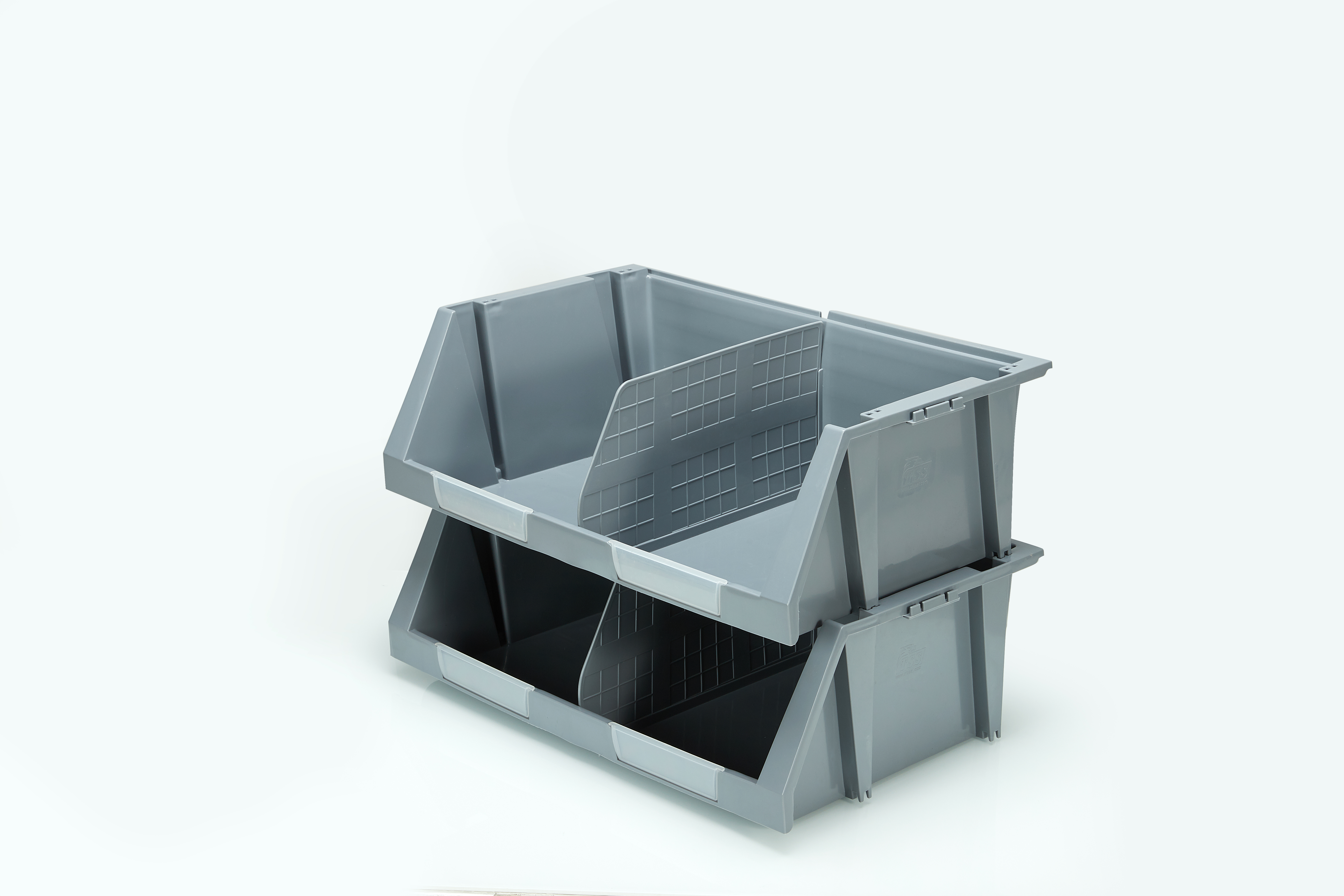
TSS-BBOX-01, a 604×398×208 mm PP stackable bin supplied with panels and dividers for footwear and spare-parts separation.
Problem 5 — Food-Contact and Cold-Chain Documentation
Symptom. The container arrives, works well, and is then blocked from the fresh-food or pharmaceutical flow because the required report is missing for that model and market.
Why the wrong tote makes it worse. Certification is model-specific and market-specific. A certificate held for one container family does not automatically transfer to another, and a general statement of food-grade material is not a test report.
The container that addresses it. Models covered by documented inspection. The relevant TSS documentation includes the Food Contact Plastic Folding Basket Inspection Report, certificate number SY2025092412, and the Food Contact Plastic Tilting Turnover Box Inspection Report, certificate number SY2025092415, both issued by the Henan Institute of Product Quality Inspection Technology on 24 September 2025, applicable to the China market under the standard for plastic materials and products for food contact. The linked product scope covers the stackable plastic totes TSS-TBX, the collapsible crates TSS-SFD, the nest and stack crates TSS-RBTB, the ASRS crates TSS-IFC and TSS-IFD, and the reusable plastic totes TSS.
For temperature-controlled movement, TSS-EPP is a 60-litre PP insulated box built on expanded polypropylene, and TSS-XPS is a 30-litre PP insulated box with an extruded polystyrene core, both positioned for cold chain transport and food-contact use.
What to verify. Check three fields on the document: certificate number, scope statement, and market. A certificate issued for the China market is not a statement of EU or US conformity, and buyers shipping into regulated markets should request the corresponding evidence rather than reuse a Chinese report.
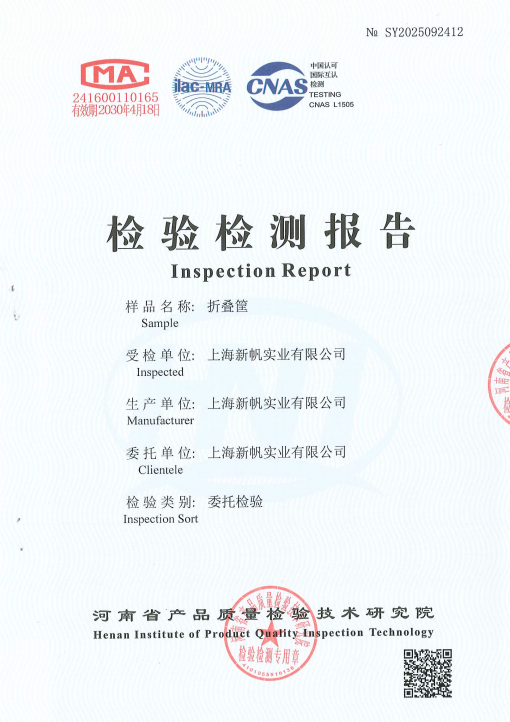
Food-contact inspection documentation from the Henan Institute of Product Quality Inspection Technology, issued 24 September 2025 for the China market.
Problem 6 — Manual Handling Becomes the Throughput Ceiling
Symptom. The storage system is fast and the picker is slow, because the last metre is a person lifting a loaded container off a shelf.
Why the wrong tote makes it worse. A container specified only for storage has no mobile interface. It can be stored efficiently and moved inefficiently.
The container that addresses it. Tote dollies matched to the container base. TSS-Trolley-5737 is a light nested and stackable tote dolly at 570×370 mm in PP; TSS-Trolley-02 is a heavy-duty version at 577×377 mm, intended for logistics and transportation environments with high-frequency daily use.
What to verify. Fit. Both listed dolly footprints are smaller than a 600×400 mm tote base, so the pairing should be confirmed against the specific model rather than assumed from the category. Confirm load capacity per dolly, wheel behaviour on the actual floor surface, and whether loaded dollies can be linked into a train for bulk moves.

TSS-Trolley-02, a heavy-duty nested and stackable tote dolly at 577×377 mm, designed for high-frequency logistics movement.
Step-by-Step: Turning a Symptom into a Tote Specification
The sequence below converts an operational complaint into a purchase order that can be tested on arrival.
- Write the failure in operational language. Not "we need better totes" but "empty containers consume return trailer capacity" or "shuttle lane 4 jams twice per shift". A symptom without a location cannot be specified against.
- Convert the symptom into the four constraint families. Geometry (footprint, height, tolerance), load (static, dynamic, stacking), environment (temperature band, hygiene regime, food contact), and handling interface (conveyor, robot, dolly, forklift). Each family should produce one number or one document requirement.
- Match to a model family, not a catalogue page. Empty return volume points to foldable crates such as TSS-IFD or TSS-SFD; stack stability points to wall straight crates such as TSS-IFC; SKU separation points to divided bins such as TSS-BBOX-01; secure transport points to attached lid containers such as TSS-TBX; retail and produce circulation points to nest and stack totes such as TSS-RBTB.
- Demand test evidence for the interface that will actually be stressed. Conveyor testing, robot handling verification, drop testing, static and dynamic load testing and automation simulation are the relevant categories. Request the report, not the adjective.
- Confirm the supply side before committing to a mould. TSS reports monthly capacity of 300,000–500,000 plastic containers and totes, with engineering review at 5–10 working days, sample production at 7–15 working days, mass production at 15–30 working days, and new tooling at 30–60 working days. Its mould workshop is described as producing 5–10 new mould sets per month.
Use Cases: Where These Fixes Have Been Applied
Automated storage and retrieval. TSS reports a programme with a global warehouse automation and cube storage solution provider covering 450,000 pieces over one year, using wall-straight crates inside AGV and AMR-driven storage. The reported outcome includes storage density up to 4–6 times that of conventional shelving, alongside order fulfilment speed and inventory accuracy improvements. These are company-reported project results, not independently audited figures.
Goods-to-person robotics. A separate 450,000-piece programme with an AMR solution provider used foldable crates for robotic goods-to-person fulfilment and inventory buffering, with reported improvements in picking efficiency and robotic handling accuracy.
Fresh produce and retail circulation. Foldable and nest-and-stack crates circulate between farm, packing house, distribution centre and store, stacking when loaded and nesting when empty. This is the classic closed-loop case where return-leg volume, not purchase price, dominates lifetime cost.
Small parts and footwear. Divided stackable bins organise SKUs on shelving and flow racks, where the container is also the visual inventory control.
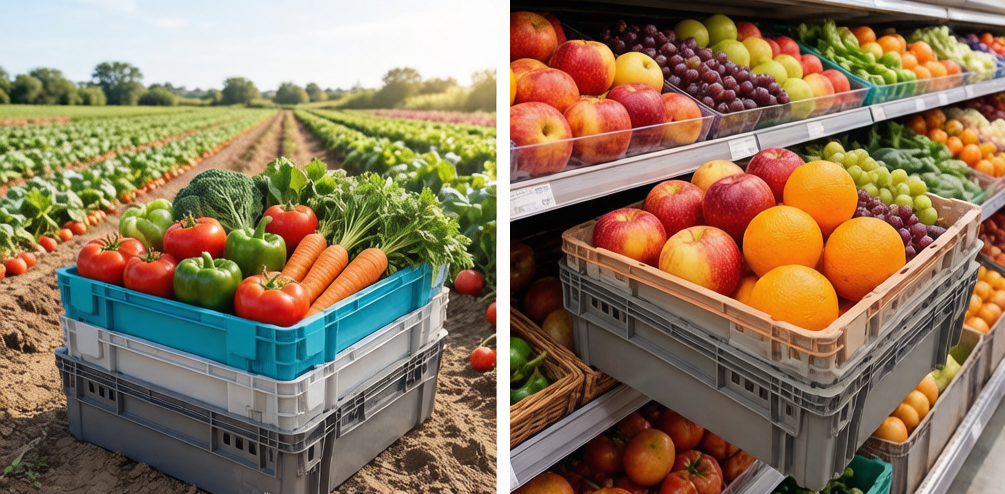
Nest and stack crates in distribution use: stacked when loaded, nested when empty to reduce return volume.
Comparison Table: Matching Model to Problem
| Model | Container type | Footprint | Material | Problem it addresses |
|---|---|---|---|---|
| TSS-IFC | Wall straight plastic crate | 600×400×300 mm | PP | Stack stability and ASRS dimensional consistency |
| TSS-IFD | Foldable plastic crate | 600×400×300 mm | PP | Empty return volume in automated loops |
| TSS-SFD | Collapsible plastic crate | 600×400×225 mm | PP | Return volume in retail and produce circulation |
| TSS-TBX | Attached lid stackable tote | 600×400×320 mm | PP | Closed, secure transport with stacking |
| TSS-RBTB | Nest and stack crate | 600×400×300 mm | PP | Retail, supermarket and fresh produce flow |
| TSS-BBOX-01 | Stackable bin with panels and dividers | 604×398×208 mm | PP | SKU separation for footwear and spare parts |
| TSS-EPP / TSS-XPS | Insulated boxes | 60 L / 30 L | PP with EPP / XPS core | Temperature-controlled cold chain transport |
All dimensions and materials as listed in TSS product data. Footprints are external dimensions; confirm tolerance requirements with the automation integrator before ordering.
FAQ
Are TSS plastic totes certified for food contact?
Yes, within a defined scope. TSS holds the Food Contact Plastic Folding Basket Inspection Report (certificate SY2025092412) and the Food Contact Plastic Tilting Turnover Box Inspection Report (certificate SY2025092415), both issued by the Henan Institute of Product Quality Inspection Technology on 24 September 2025 under the standard for plastic materials and products for food contact. The scope is the China market, and the linked product range includes TSS-TBX, TSS-SFD, TSS-RBTB, TSS-IFC, TSS-IFD and TSS. Buyers shipping into the EU or the US should request the corresponding market evidence rather than rely on a China-market report.
How do I check whether a tote will actually run on my ASRS or conveyor?
Check the footprint first, then the test evidence. TSS-IFC and TSS-IFD both use a 600×400×300 mm base, and TSS research notes describe 600×400 mm as the dominant global footprint for ASRS integration, with 650×450 mm also in use. Beyond geometry, ask which tests were run: TSS lists conveyor testing, robot handling verification, load testing, stacking testing and automation simulation within its quality scope. Supply the integrator's drawing and tolerance requirement, because a supplier cannot confirm fit against an unstated interface.
What drives the unit cost of a reusable plastic tote?
Cost is quoted per project rather than published as a list, because the variables that move it differ from order to order: model family, drawing-level customisation, tooling, decoration or RFID integration, and order volume. TSS lists MOQ as negotiable for OEM work, with 100–500 pieces for existing products, 500–2,000 pieces for customised products and negotiable terms for new development projects, while key account programmes start at one 40 ft container. The reliable way to compare suppliers is to issue the same written specification to each and compare the returned quotation line by line.
Can I get a sample before committing to a production order?
Yes. TSS lists sample production at 7–15 working days following an engineering review of 5–10 working days for OEM work. For smart logistics and customised projects, sample validation is listed at 7–15 days after an evaluation period of 3–5 days, with a minimum of 500 pieces for customised products and 1,000 pieces for RFID projects. Sample approval is the correct point to test the container against your own conveyor or rack, not after the mass-production order is released.
What lead time should I plan for, including tooling?
For existing models, TSS lists mass production at 15–30 working days. Where new tooling is required, add 30–60 working days for tooling, with its mould workshop described as delivering 5–10 new mould sets per month; production mould manufacturing is listed at 60–70 days for more complex programmes. Monthly capacity is stated at 300,000–500,000 plastic containers and totes. After-sales response is listed at within 24 hours, with a corrective action report at 3–5 working days.
Conclusion
Plastic totes solve operational problems, and they only solve them when the problem is written down before the container is chosen. Empty return volume, stack creep, automation jams, mixed SKUs, missing food-contact documentation and manual handling ceilings all point to different container families — foldable, wall straight, standardised-footprint, divided, certified, or dolly-mounted — and none of them is solved by buying a sturdier box of the wrong shape.
The buyer's task is therefore narrow and testable: name the failure, convert it into geometry, load, environment and interface constraints, match it to a model, and demand the test evidence and certificate scope that apply to your market. That sequence produces a specification a supplier can quote against and a receiving team can verify.
Next Step: Test the Container Against Your Own Conveyor
Send the footprint, load requirement and application description, and Shanghai Xinfan Industrial Corporation (TSS) can respond with a model recommendation and a sample plan within the listed 7–15 working day sample window.
Website: www.xfseals.com
Email: info@xfseal.com
Tel / WhatsApp: +86 186-0218-3251
Address: No. 1336 Jinge Road, Zhuhang Town, Jinshan District, Shanghai, China, 201506
Download the full corporate profile and logistics container catalogue: TSS Corporate Profile & Logistics Container Solutions (PDF)
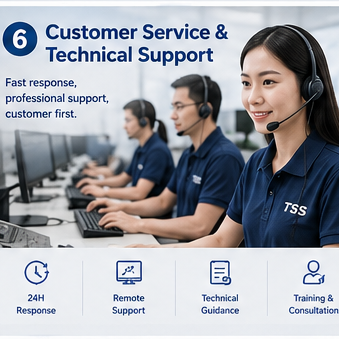
TSS provides product selection, application recommendations and remote technical guidance as part of its customer service and technical support scope.
Have Questions or Need More Details?
Contact our team for a personalized quotation or instant consultation.
Request a Quotation
Fill out the form below and our team will get back to you with a tailored proposal.
WhatsApp Direct Chat
Prefer to chat in real-time? Message us on WhatsApp for instant assistance & quick answers.
- Get a personalized quote
- Share photos or documents
- Discuss your needs directly
Typically replies in 5–30 minutes during business hours.