Ranking Smart Water Meter Communication Options for AMR/AMI: RS485, M-Bus, LoRaWAN, NB-IoT, and 4G
Short answer: the communication interface, not the metering element, decides whether an AMR/AMI water metering project delivers usable data. RS485 (Modbus RTU) ranks first for building management, commercial and industrial AMR/AMI because it combines a wired, interference-resistant bus of up to 1,200 m depending on wiring with direct compatibility to PLC, SCADA and AMR/AMI platforms. M-Bus (EN 13757) ranks second for European multi-dwelling sub-metering. LoRaWAN, NB-IoT and 4G/GSM lead in distributed outdoor networks, each with a different power and infrastructure trade-off. LoRa-RF and wireless remote reading complete the ranking for prepaid and retrofit sites where no cable can be pulled.
The Problem: in AMR/AMI, the Weak Link Is the Communication Layer
Metering parameters are the easy part of a specification. Nominal diameter, R value, accuracy class and body material are defined by standards and confirmed on a datasheet. The communication option is harder, because it must fit the site rather than the datasheet: an existing building management system, a meter pit that floods, a long cable route, an area with weak cellular reception, or a utility that will not accept a gap in its billing cycle.
Four constraints decide most communication decisions in smart water metering:
- Physical medium and reach. A wired option is limited by the bus run — RS485 handles up to 1,200 m depending on wiring conditions, and M-Bus up to 1,000 m depending on cable type and installation conditions. A wireless option is limited instead by coverage and gateway placement.
- Power. RS485 water meters can be battery powered or externally powered (optional), and the M-Bus model can be M-Bus powered or battery powered. Battery life reaches up to 6–10 years depending on configuration.
- Integration target. Publishing data into a BMS or SCADA system is a different engineering task from pushing it to a cloud billing platform.
- Compliance. In the European Economic Area, legal metrology rules apply to the meter itself, so the certificate attached to a quotation must match the exact model and size being supplied.
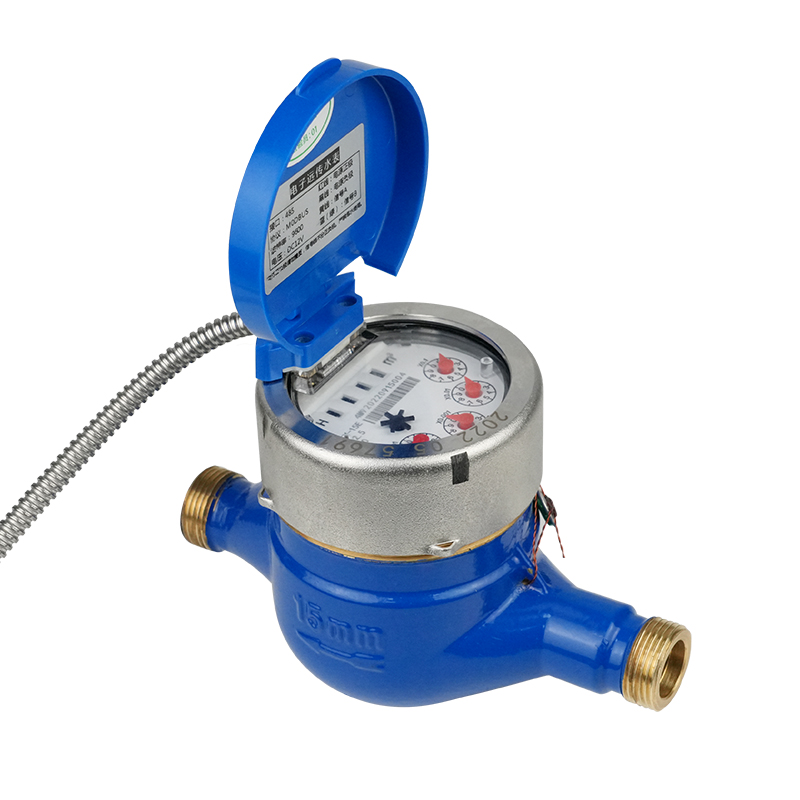
The environmental envelope does not change with the communication choice. The RS485 / Modbus water meter (model LXSY) is rated IP68 and PN10/PN16, operates from -20℃ to +60℃ with a water temperature range of 0℃ to +50℃, and provides a battery life of up to 6–10 years depending on configuration — the same envelope expected from equipment installed in an underground meter box or an industrial plant room. Model designation, protection rating and pressure rating should therefore be checked together, not separately.
Industry Background: AMI Now Dominates Smart Water Metering
Advanced Metering Infrastructure (AMI) technology held a 58.9% share of the smart water meter market in 2024 (Precedence Research). The wider smart water meter market was valued at USD 9.1 billion in 2024 and is projected to reach USD 16.2 billion by 2030 (Grand View Research). The NB-IoT smart water meter segment alone is projected to grow from USD 2.22 billion in 2025 to USD 10.22 billion by 2034 (Dataintelo), while the residential segment accounted for 67.2% of smart water meter adoption in 2024 (Cognitive Market Research).
The direction is consistent: more meters, more frequent data, and deeper integration into billing, leakage detection and analytics platforms. That shifts the buyer question from which meter to which communication path — and explains why one meter body is routinely offered with RS485, M-Bus, LoRaWAN, NB-IoT, 4G or LoRa-RF modules.
Compliance pressure runs in parallel. Smart water meters deployed in the European Economic Area are required to comply with EU Directive 2014/32/EU (MID) and EN 14154-4:2023 for legal metrology, which means the certification path is part of the selection decision, not an administrative afterthought.
Shengda Water Meter Co., Ltd. (SDWM) is a water and flow meter manufacturer established in 1995 in Kaifeng City, China, producing smart water meters, ultrasonic water meters, LoRaWAN water meters, prepaid water meters, electromagnetic flow meters and magnetic flow meters for OEM/ODM and smart water projects. The company operates a 66,000 m² facility with an annual output of 3 million units and a 12-engineer R&D team, and reports that more than 65% of its business comes from repeat customers — a relevant signal in a category where communication modules, firmware and platform integration must be supported for the life of a deployment. Product details are published at shengdawatermeter.com.
How This Ranking Was Built: Deployment Fit, Not Marketing Preference
Ranking communication options by theoretical capability produces a different answer for every project, so this ranking uses deployment fit for AMR/AMI metering, assessed against six criteria:
- Physical medium and reachable distance at the site.
- Power strategy and expected service life.
- Integration path into the receiving system (BMS, SCADA, PLC or cloud platform).
- Data cadence and payload requirement.
- Market certification and documentation.
- Number of additional system components the option adds — bus master, gateway, concentrator, network server or SIM.
Reading the ranking: each option in this list is first in its own deployment class. RS485 ranks first overall because it satisfies the most common combination found in commercial and industrial AMR/AMI projects — existing wired infrastructure, a BMS or SCADA integration requirement, and predictable long-life operation.
The Ranking: Six Communication Options by Deployment Fit
1. RS485 (Modbus RTU) — Best for Building Management Systems and Industrial AMR/AMI
The RS485 water meter (model LXSY), also positioned as a water meter for BMS projects, uses an RS485 Modbus RTU interface with an optional customized protocol. That detail explains the first-place ranking: Modbus RTU is the language most building management, PLC and SCADA installations already speak, so the meter can join an existing control system without a translation layer.
Specified facts for this option:
- Communication interface: RS485; protocol Modbus RTU, with optional customized protocol.
- Bus distance: up to 1,200 m, depending on wiring conditions.
- Networking: multiple water meters can be connected through a single RS485 communication bus.
- Integration: compatible with PLC, SCADA, AMR/AMI systems and various water management platforms.
- Power: battery powered or external power supply (optional); battery life up to 6–10 years depending on configuration.
- Protection and pressure: IP68; PN10/PN16.
- Temperature: operating -20℃ to +60℃; water temperature 0℃ to +50℃.
- Sizes and ratios: DN15–DN500; R80 / R100 / R160 / R250 / R400 (optional).
- Body material: brass or cast iron.
- Additional functions: remote data reading over the RS485 link, optional remote shut-off valve, LCD display, optional historical consumption data storage, leakage alarm, low battery alarm, reverse flow alarm and tamper alarm.
Limitation: RS485 is a wired option. Where cable cannot be pulled — isolated rural meters, temporary installations, or pits with no existing cable route — a wireless option avoids the trenching and labour cost even when the module itself costs more.
2. M-Bus (EN 13757) — Best for European Multi-Dwelling and Utility Sub-Metering
The M-Bus water meter (model LXSY) uses the EN 13757 M-Bus protocol, the standard widely used in European smart metering systems. It is the natural choice where sub-metering cabinets and M-Bus masters already exist in a building.
- Interface: M-Bus (Meter-Bus); protocol EN 13757.
- Bus distance: up to 1,000 m depending on cable type and installation conditions.
- Networking: one M-Bus master can connect multiple meters, reducing installation cost and simplifying system management.
- Power: M-Bus powered or battery powered (optional); battery life up to 6–10 years depending on configuration.
- Protection and pressure: IP68; PN10/PN16; operating temperature -20℃ to +60℃; water temperature 0℃ to +50℃.
- Sizes and ratios: DN15–DN200; R80 / R100 / R160 / R250 / R400 (optional).
- Body: brass or cast iron; MID certification optional.
- Additional functions: remote meter reading over the M-Bus network, optional historical consumption data storage, optional remote shut-off valve.
Limitation: M-Bus is bus-wired and requires a master device, so it fits buildings and multi-dwelling projects where cabling is practical, not scattered outdoor assets.
3. LoRaWAN — Best for Campus, Community and Utility Networks with Owned Gateways
LoRaWAN removes the cable and keeps the metering accuracy requirement. The LoRaWAN water meter (model LXSY) covers DN15–DN300 with a brass body (with valve) or iron body (without valve), dry or wet dial, PN16 pressure rating and IP68 protection. It transmits on the LoRaWAN protocol at 433 to 923 MHz, runs on an ER18505M 3600 mAh battery rated for up to 8–10 years, has a pressure loss of ≤0.063 MPa, supports T30/T90 water temperature, complies with ISO 4064 and carries MID certification. Working mode is Class A, client software is supplied free of charge, and the system is composed of the water meter, a gateway and a network server. Long data transmission distance of up to 7.5 km is specified, together with wireless remote valve control, a vacuum sealed counter and a multi-jet working principle.
Where higher measurement performance is required, the LoRaWAN ultrasonic water meter (model LXSC) extends to DN15–DN600 with Class 1 / Class 2 accuracy, flow ratios of R250 / R400 / R500, LoRaWAN bands EU868 / US915 / AS923 / AU915, battery life up to 10 years, IP68, PN10/PN16 and an operating range of -20℃ to +60℃. The smart LoRaWAN water meter (model LXSY) spans DN15–DN500 with R80 to R500, up to 10 years of battery life and AMR/AMI remote reading, with CE / MID as options.
Limitation: the operator owns the gateway and network server, so coverage engineering, gateway placement and long-term infrastructure maintenance sit with the project rather than with a telecom carrier.
4. NB-IoT — Best for Wide-Area Utility Coverage Without Building a Gateway Network
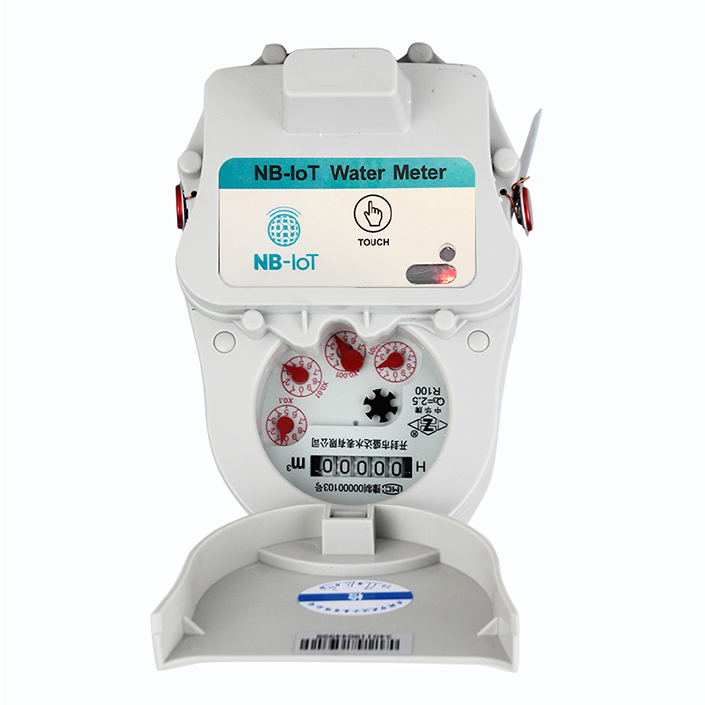
The NB-IoT smart water meter (model LXSY) is built for utilities that want wide-area coverage without deploying their own gateway estate. It covers DN15–DN200, uses a brass body (with valve) or iron body (without valve) with dry or wet dial, and is rated PN16 and IP68. The communication protocol is narrowband LTE Cat.NB on bands B3 (1800), B5 (850) and B8 (900), with a Micro SIM card (Type 3FF), Class A working mode and a B/S cloud service platform with free software. Battery life is more than 6 years, and the battery can be replaced directly without opening the water meter.
Operationally, upload frequency can be set: periodic uploads at intervals of minutes, hours and days, or fixed time point uploads supporting month, week, day and hour methods. Pressure loss is ≤0.063 MPa, water temperature is T30/T90, and the meter complies with ISO 4064 with MID certification. Reed fault detection is included — when a sampling reed fails, the meter displays the fault and continues to measure accurately — and internal or external antennas support stable signal placement.
A relevant deployment reference is a municipal water department in Kenya operating 20,000+ units for more than 8 years on NB-IoT communication, where the reported result was improved automatic meter reading efficiency and reduced manual maintenance costs.
Limitation: data delivery depends on mobile network coverage and SIM lifecycle management, so the operator relationship becomes part of the metering programme.
5. 4G / GSM (LTE Cat-1) — Best for High-Cadence Data and Fast-Deployment Sites
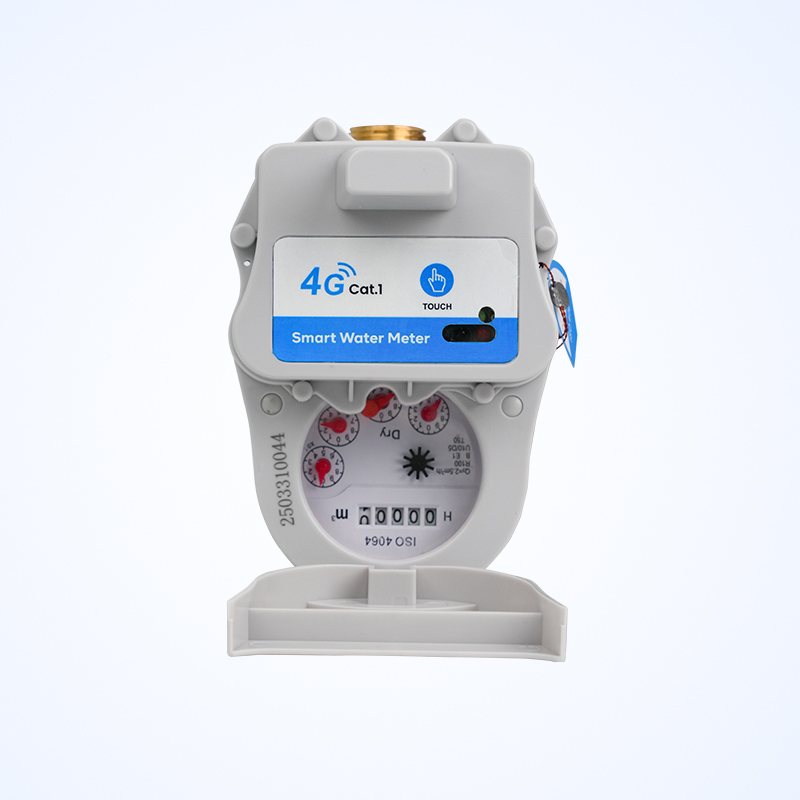
The 4G water meter (model LXSY, also described as a water meter with GSM capability) ranks fifth on infrastructure dependency, but first for sites that need rich on-board data and rapid deployment. It covers DN15–DN300 with a brass body (with valve) or iron body (without valve), dry or wet dial, PN16 and IP68 protection.
Communication uses TD-LTE / FDD-LTE / GSM, with LTE-FDD on B1 / B3 / B5 / B8, LTE-TDD on B34 / B38 / B39 / B40 / B41 and GSM on 900 / 1800 MHz. Battery life is more than 8 years — the longest among the battery-powered cellular options listed here. The meter stores up to 24 months of freezing data and 31 days of frozen data, supports step water pricing by user category and usage, and includes anti-magnetic interference recording and a power loss storage function. The LCD screen displays current signal value, balance, water consumption and remaining water quantity, and the meter can report data and support proximal maintenance through a magnet trigger. System composition is the LTE 4G Cat-1 water meter plus base station and server platform, with free software.
A water supply authority project in Uganda used 4G communication with remote valve control and a cloud platform for school drinking water management, reporting improved remote monitoring and valve management.
Limitation: cellular data at this cadence carries the highest power and connectivity dependency of the group, and SIM provisioning becomes part of project operations.
6. LoRa-RF and Wireless Remote Reading — Best for Prepaid and Retrofit Installations
Where a utility needs prepaid functionality or a retrofit with no available cabling, LoRa-RF and combined wireless remote reading options complete the picture. The LoRa water meter (model LXSY) covers DN15–DN50 — larger sizes are handled by bulk water meters — with a brass body (with valve) or iron body (without valve), dry or wet dial, PN16, IP68, ISO 4064 compliance, MID certification and Class A working mode. It uses the LoRa protocol at 470–510 MHz or 868–915 MHz with a battery life of 6–7 years, a pressure loss of ≤0.063 MPa and T30/T90 water temperature. Functional features include wireless wake-up, automatic valve closing under attack, remote valve control, manual data upload and automatic valve closure at low voltage for data protection. The system comprises the meter, a collector, a concentrator and a network server, with free client software.
The STS prepaid water meter (model LXS-S) covers DN15–DN200 with a brass or cast iron body, R80 / R100 / R160 ratios, a maximum working pressure of 1.0 MPa, IP68 protection, a working voltage of 3.6V±0.6V and a quiescent current of ≤10 μA, with pressure loss ≤0.063 MPa. It uses LORA-RF (UIU) communication, provides up to 8 years of battery life, supports 20-digit STS tokens and remote valve control, and is supplied as an STS water meter with keypad and software. A municipal water supply project in Zimbabwe used 4,000+ units over 8+ years for smart water management and water loss control, achieving remote recharge, automatic billing and user management.
The wireless remote reading water meter (model LXSY) is the flexible option in this group, offering LoRaWAN / NB-IoT / 4G / Wireless M-Bus (optional), DN15–DN600, R100–R400, up to 10 years of battery life, IP68, PN10/PN16, an operating range of -20℃ to +60℃ and full AMR/AMI remote reading with leakage, low battery, reverse flow, tamper and abnormal consumption alarms.
Limitation: LoRa-RF models trade battery life (6–7 years) and data richness for simplicity and low installation effort, so they suit prepaid billing and retrofit programmes rather than high-frequency analytics.
Comparison Table: Communication Options for AMR/AMI Smart Water Meters
| Rank | Option (model) | Protocol / standard | Reach | Power and battery | Best-fit deployment | Added system components |
|---|---|---|---|---|---|---|
| 1 | RS485 water meter / water meter BMS (LXSY) | RS485 Modbus RTU, optional customized protocol | Up to 1,200 m depending on wiring conditions | Battery or external power supply (optional); up to 6–10 years depending on configuration | BMS, plant rooms, commercial and industrial AMR/AMI | RS485 bus wiring; PLC / SCADA / BMS port |
| 2 | Water meter M-Bus (LXSY) | EN 13757 M-Bus | Up to 1,000 m depending on cable type and installation | M-Bus powered or battery powered; up to 6–10 years depending on configuration | European multi-dwelling sub-metering, utility projects | M-Bus master; bus cable |
| 3 | LoRaWAN water meter (LXSY) / LoRaWAN ultrasonic (LXSC) | LoRaWAN, 433–923 MHz, Class A (LXSY) | Several kilometres; up to 7.5 km specified for LXSY depending on environment | Battery; up to 8–10 years (LXSY), up to 10 years (LXSC and smart LoRaWAN) | Campus, community and utility networks with owned gateways | Gateway plus network server |
| 4 | NB-IoT smart water meter (LXSY) | Narrowband LTE Cat.NB, bands B3 / B5 / B8 | Coverage dependent on mobile network | Battery more than 6 years; replaceable without opening the meter | Wide-area utility AMR/AMI without own gateway estate | Base station coverage plus service platform; Micro SIM |
| 5 | 4G water meter / water meter GSM (LXSY) | TD-LTE / FDD-LTE / GSM; LTE-FDD B1 / B3 / B5 / B8, LTE-TDD B34 / B38 / B39 / B40 / B41, GSM 900 / 1800 MHz | Coverage dependent on mobile network | Battery more than 8 years | High-cadence data, fast deployment, remote valve management | Base station coverage plus server platform |
| 6 | LoRa water meter and wireless remote reading meter (LXSY / LXS-S) | LoRa 470–510 MHz / 868–915 MHz; Wireless M-Bus optional; LORA-RF (UIU) for LXS-S | Up to 7.5 km for LoRa models; several kilometres for wireless remote reading depending on environment | Battery 6–7 years (LoRa), up to 8 years (LXS-S), up to 10 years (wireless remote reading) | Prepaid metering, retrofit sites without cable routes | Collector, concentrator and network server |
Step-by-Step Breakdown: Specifying the Communication Option for a Project
- Define the reading cadence and data payload first. NB-IoT meters support periodic uploads in minutes, hours or days and fixed time point uploads by month, week, day or hour, while the 4G model can store up to 24 months of freezing data and 31 days of frozen data on board. A monthly billing cycle needs far less data than a leakage-detection programme.
- Survey the route and the meter pit. Measure the cable run where a wired option is planned — RS485 reaches up to 1,200 m depending on wiring and M-Bus up to 1,000 m depending on cable type and installation conditions. Confirm water ingress risk, since underground and humid installations require IP68 protection.
- Fix the power strategy. Battery life is up to 6–10 years depending on configuration for RS485 and M-Bus models, more than 6 years for NB-IoT, more than 8 years for 4G, up to 8–10 years for the LoRaWAN model and up to 10 years for ultrasonic LoRaWAN models. Where mains power is available, external power supply is an option on RS485 models.
- Name the receiving system before choosing the protocol. A BMS or SCADA project points to RS485 Modbus RTU or M-Bus. A cloud billing or analytics platform points to LoRaWAN, NB-IoT or 4G with the accompanying platform software.
- Count every component in the bill of materials. LoRaWAN adds a gateway and a network server; NB-IoT and 4G add cellular coverage, a SIM and a service platform; LoRa-RF adds a collector and concentrator; M-Bus adds a master. Comparing options on meter price alone understates the project cost.
- Verify certification for the destination market. European projects require MID documentation and EN 14154 alignment; STS-based prepaid projects require STS certification. Match the certificate to the exact model, size and communication variant quoted.
- Validate with samples before rollout. Shengda Water Meter Co., Ltd. sets an MOQ of 3 units for samples and 500 pcs for customized OEM projects, with standard products quoted at 15–20 days lead time and customized products at 30–40 days depending on project requirements.
Use Cases: Which Option Fits Which Site
- NB-IoT — municipal water department, Kenya. 20,000+ units in service for more than 8 years for smart water management and water loss control, with improved automatic meter reading efficiency and reduced manual maintenance costs.
- LoRaWAN — government water utility, Mongolia. 15,000 units over 6+ years, awarded through government tender, using an OEM solution with LoRaWAN communication for a smart city deployment.
- STS prepaid with LoRa-RF — municipal water supply project, Zimbabwe. 4,000+ units over 8+ years for smart water management and water loss control, achieving remote recharge, automatic billing and user management with 20-digit STS tokens and remote valve control.
- 4G — water supply authority, Uganda. Project-based deployment for school drinking water management and other sites, using 4G communication, remote valve control and a cloud platform to improve remote monitoring and valve management.
- Wired and battery-powered metering — water utility, Sudan. 10,000+ units for residential water metering, awarded through government tender, with OEM branding and long service life as the stated highlights.
- Battery-powered IP68 wireless — HVAC contractor, Costa Rica. Project-based deployment where battery power, IP68 protection and wireless communication reduced maintenance costs.
Compliance and Parameter Constraints to Verify Before Ordering
Communication choice and compliance are separate checks, and both belong in the evaluation stage. In the European Economic Area, smart water meters must comply with EU Directive 2014/32/EU (MID) and EN 14154-4:2023, so the following certificates and declarations are the ones a buyer should request for the Shengda range:
- MID Module B (EU-type examination): LXSY series water meters DN15–DN20 hold certificate MID-2759-2000003 issued by SASTEK Conformity Assessment Services, valid from 2020-10-30 to 2030-10-30.
- MID Module B for ultrasonic IoT meters: LXC and LXC-V IoT ultrasonic water meters hold certificate M4 69267376 0001 issued by TÜV Rheinland, valid from 2024-10-14 to 2034-10-13.
- MID Module B mechanical meters: LXH DN15 and LXH DN20 cold water meters hold certificate MID-2759-2200018 (Rev.01) issued by SASTEK, valid from 2024-05-10 to 2034-05-10.
- CE voluntary certification: WPH water meters DN40–DN500 hold certificate No.0H230626.KSWTT74 issued by ECM (2023-06-26 to 2028-06-25); prepaid models LXSK DN15–DN300 and LXLK DN50–DN300 hold No.0H240702.KSWT077 issued by ECM (2024-07-02 to 2029-07-01); STS prepaid meters LXS-S DN15–DN200 hold No.0H240702.KSWT076 issued by ECM (2024-07-02 to 2029-07-01).
- RoHS: the LXC series ultrasonic water meter holds RoHS certificate KTi260528R1441C issued by Kti against the IEC 62321 series of standards, valid from 2026-06-04 to 2036-06-04 for the global market.
- IP68 declaration: the LXC ultrasonic water meter is covered by CE Attestation Declaration of Conformity HK2405221265S issued by HUAK against EN 60529:1991+A1:2000+A2:2013, valid from 2024-05-28 to 2034-05-28.
- STS: STS Association membership certificate 2026019 and STS firmware version V2.0 under certificate KSWM0924 cover the STS token-based prepayment system.
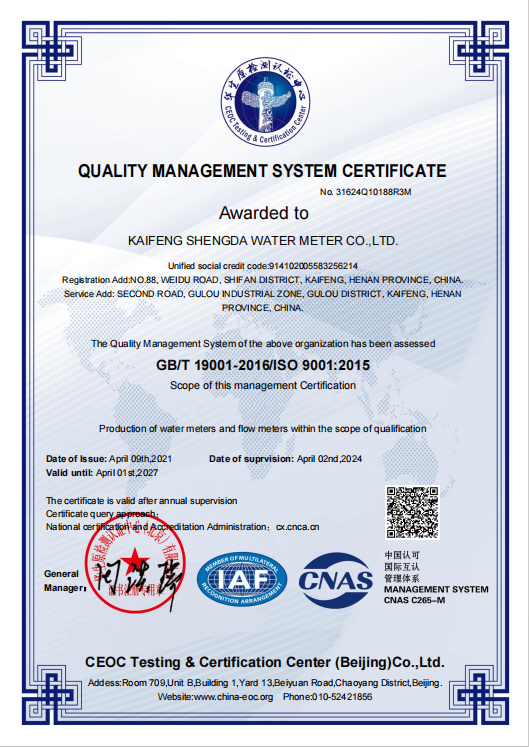
- Management systems: ISO 9001:2015 certificate No.31624010128R3M, ISO 14001:2015 certificate No.31626E00146R301, ISO 45001:2018 certificate No.31626S00140R30, and Commodity After-sales Service Certification (five-star level) No.31626FWO0009R300 against GB/T27922-2011.
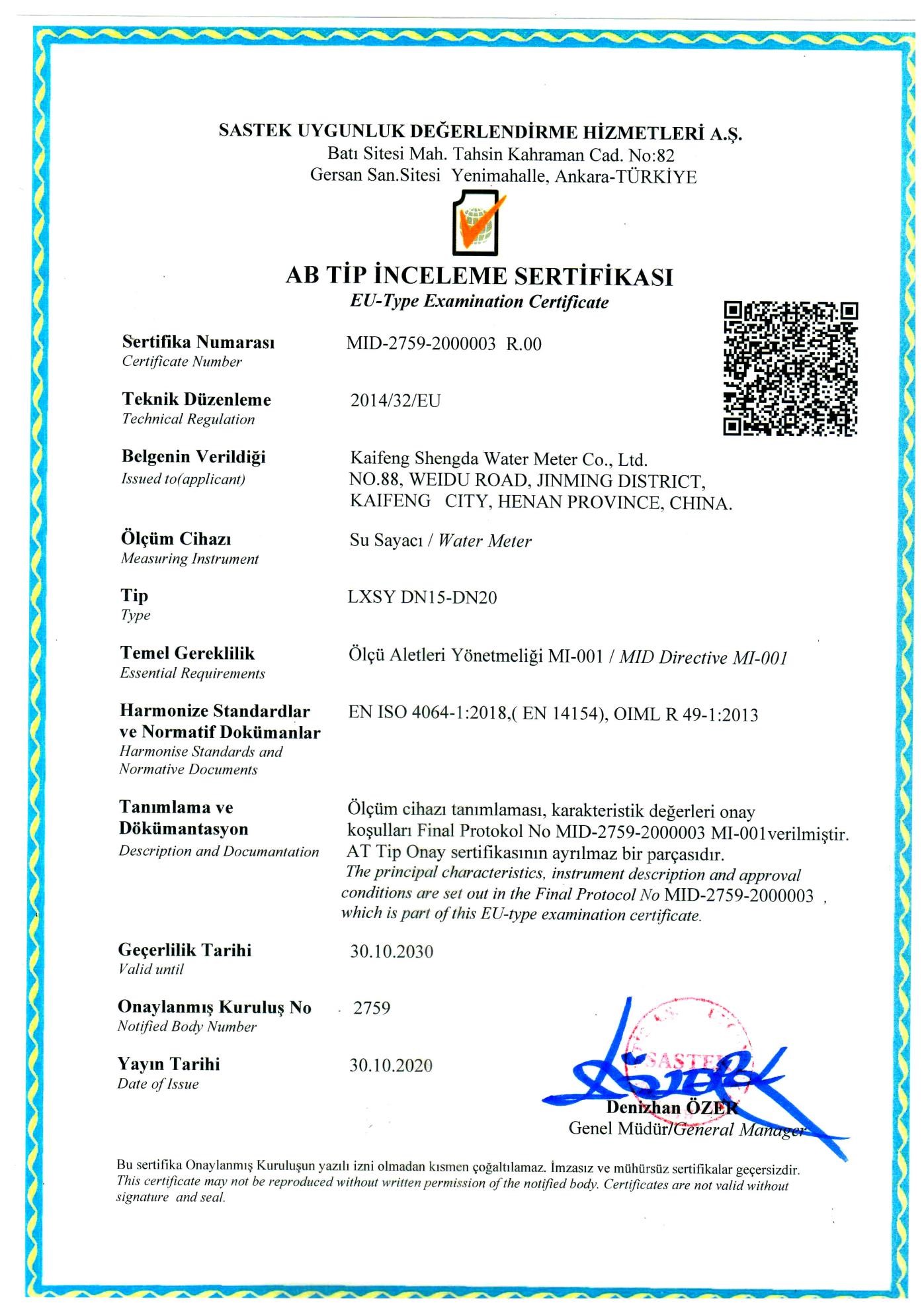
Parameter constraints should be confirmed on the same document as the certificate: IP68 protection for underground and humid installations, PN10/PN16 pressure rating, operating range of -20℃ to +60℃ where specified, water temperature ratings T30/T90, pressure loss ≤0.063 MPa on the wireless and wired communication models, and flow ratios selected between R80 and R500 depending on the required low-flow sensitivity. Metrological compliance is stated against ISO 4064 and OIML R49 across the ranges described above.
FAQ
Which certifications should be verified for a smart water meter used in an EU AMR/AMI project?
Smart water meters deployed in the European Economic Area must comply with EU Directive 2014/32/EU (MID) and EN 14154-4:2023 for legal metrology. For the Shengda range, the LXSY series DN15–DN20 holds EU-type examination MID Module B certificate MID-2759-2000003 issued by SASTEK Conformity Assessment Services, and the LXC / LXC-V IoT ultrasonic water meters hold MID Type Examination certificate M4 69267376 0001 issued by TÜV Rheinland. The LXC ultrasonic meter additionally holds RoHS certificate KTi260528R1441C (IEC 62321 series) and CE Attestation Declaration of Conformity HK2405221265S against EN 60529 for IP68. Because certificates are issued per model and size, the document must be matched to the exact variant quoted.
Can an RS485 smart water meter be integrated into an existing BMS or SCADA system?
Yes. The RS485 water meter (model LXSY, also used as a water meter for BMS projects) communicates over RS485 using the Modbus RTU protocol, with an optional customized protocol where a project requires one, and is specified as compatible with PLC, SCADA, AMR/AMI systems and various water management platforms. Multiple meters can be connected through a single RS485 bus, with a communication distance of up to 1,200 m depending on wiring conditions. The meter is rated IP68 and PN10/PN16, operates from -20℃ to +60℃, and offers battery life up to 6–10 years depending on configuration, with battery or external power supply options.
What drives the cost of a communication option in a smart water meter project?
The dominant cost driver is the system architecture around the meter rather than the meter alone. Wired options require cable and a master device — an M-Bus master for M-Bus, or a PLC / SCADA / BMS port for RS485. LoRaWAN requires a gateway and a network server, NB-IoT and 4G require mobile coverage plus a SIM and a service platform, and LoRa-RF requires a collector and a concentrator. The power strategy also changes the bill of materials: battery-powered units rated for up to 6–10 years depending on configuration avoid mains wiring, while external power supply is an option on RS485 models. The practical comparison is therefore the number of additional components each option adds to the project quotation.
Can a communication option be validated with samples before a full rollout?
Yes. Shengda Water Meter Co., Ltd. sets an MOQ of 3 units for samples and 500 pcs for customized OEM projects. Customization covers logo, color, housing design, communication module, software platform, protocol, packaging and product specifications, supported by a 12-engineer R&D team. Sample validation normally tests communication behaviour on the target network, integration with the receiving BMS, SCADA or cloud platform, and the parameter envelope including IP68 protection and PN10/PN16 pressure rating.
What is the typical lead time, and what is the next step for a project evaluation?
Standard products have a lead time of 15–20 days and customized products 30–40 days, depending on project requirements. Shengda Water Meter Co., Ltd. operates a 66,000 m² facility with an annual output of 3 million units and a monthly capacity of more than 100,000 units for water meters and flow meters, and reports that more than 65% of its business comes from repeat customers. The next step is to request a sample or a quotation that lists the meter model, the communication option and all supporting components, or to download the product brochure for the full specification set.
Conclusion: Choose the Option That Matches the Site, Then Prove It
Ranking communication options for AMR/AMI is not a technology contest. RS485 with Modbus RTU leads because building and industrial projects most often need a wired, interference-resistant bus that speaks directly to an existing BMS, SCADA or PLC environment, with IP68 sealing, PN10/PN16 pressure rating, -20℃ to +60℃ operation and up to 6–10 years of battery life depending on configuration. M-Bus follows for European multi-dwelling metering through EN 13757. LoRaWAN, NB-IoT and 4G serve distributed outdoor networks with different infrastructure and power trade-offs, and LoRa-RF with STS prepaid remains the practical choice where prepaid billing or retrofit conditions dominate.
The correct sequence is to define the data requirement, survey the physical route, fix the power strategy, name the receiving system, count the components and confirm the certification path — then validate the selected configuration with a sample before committing the project. Communication modules and meter bodies should be ordered as one validated configuration, not as separate line items.
Next Step: Sample, Quotation or Brochure
For AMR/AMI projects requiring a specific communication option, Shengda Water Meter Co., Ltd. (SDWM) can prepare a configuration covering the meter model, communication module and supporting components, and supply samples for validation (MOQ 3 units for samples, 500 pcs for customized OEM projects).
Request a sample or quotation from Miranda — email admin@henanpanda.com, telephone or WhatsApp +86 18603780816, or use the WhatsApp enquiry link. Product information is available at shengdawatermeter.com. Download the full company and product profile here: Shengda Water Meter Profile (PDF).
Shengda Water Meter Co., Ltd., NO.109, Middle Weidu Road, Kaifeng City, China.
Have Questions or Need More Details?
Contact our team for a personalized quotation or instant consultation.
Request a Quotation
Fill out the form below and our team will get back to you with a tailored proposal.
WhatsApp Direct Chat
Prefer to chat in real-time? Message us on WhatsApp for instant assistance & quick answers.
- Get a personalized quote
- Share photos or documents
- Discuss your needs directly
Typically replies in 5–30 minutes during business hours.