Smart Water Meter Application Guide: RS485, LoRaWAN, NB-IoT for Industrial and Building Projects
Quick answer: match the smart water meter to the communication path the site already has, then match power, enclosure rating and billing model to the same site. Buildings and industrial plants that already run a control network are usually best served by an RS485 water meter with Modbus RTU — one bus can carry multiple meters over distances up to 1200 m and feed directly into PLC, SCADA, AMR or AMI systems. Sites with no cabling are usually better served by wireless meters: LoRaWAN where the operator builds its own gateway network, NB-IoT where mobile network coverage exists and low data volumes are sufficient, and 4G/GSM where larger or more frequent reporting is required. Residential, dormitory and apartment projects with a revenue-collection problem usually need a prepaid water meter (STS token or smart card) rather than a postpaid meter with remote reading.
This is an application-level matching guide rather than a product catalogue. Specifications referenced below come from Shengda Water Meter Co., Ltd. (SDWM), a water meter and flow meter manufacturer founded in 1995 in Kaifeng, China. Shengda produces smart water meters, ultrasonic water meters, LoRaWAN water meters, prepaid water meters and flow meters, exports to more than 140 countries, and supplies both branded and OEM/ODM projects.
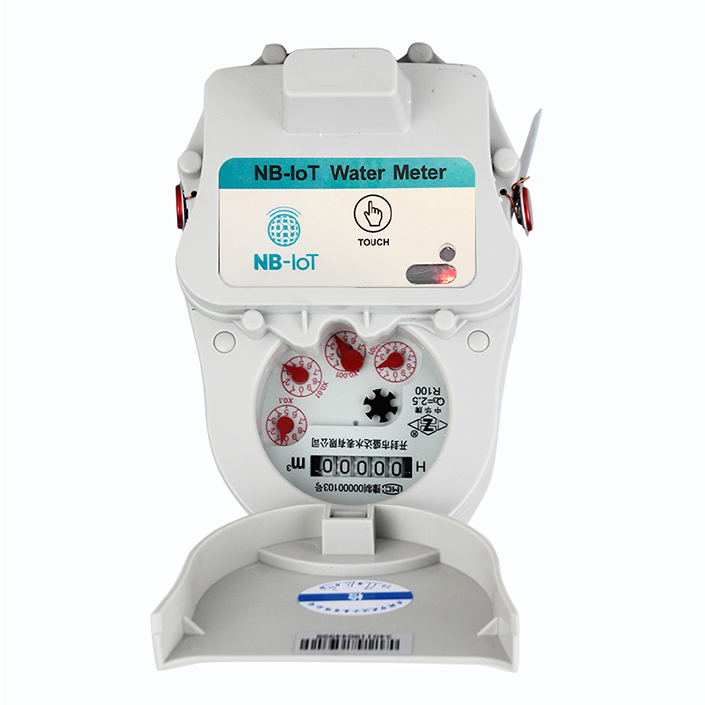
NB-IoT smart water meter: the communication choice follows the project's network coverage, not the other way round.
Why the same smart water meter rarely fits two projects
A smart water meter is four things at once: a measuring element, a communication element, a power element and an enclosure. A project underperforms when any one of them is specified against the wrong site condition.
- Communication mismatch. A wireless meter installed in a heavily shielded plant room may have no usable signal path, while a wired RS485 meter on a site without ducting cannot be commissioned until new cabling is installed.
- Power mismatch. Battery life is configuration-dependent. Shengda's RS485 water meter is rated at up to 6–10 years depending on configuration, with a battery or external power supply option — which means the reporting interval is part of the power decision, not a separate detail.
- Environment mismatch. Meter pits flood, chambers stay humid and outdoor cabinets see rain and dust. IP68 protection is the specification that keeps a smart water meter working in underground and outdoor conditions.
- Commercial-model mismatch. Remote reading solves data collection; it does not solve collection of payment. Where non-payment is the project risk, a prepaid water meter with valve control addresses the problem directly.
Project matching therefore starts with the site, the water, the network and the payment model — in that order.
Industry background: why project matching became a procurement skill
Smart metering is no longer a pilot activity. Grand View Research valued the global smart water meter market at USD 9.1 billion in 2024 and projects USD 16.2 billion by 2030, while Precedence Research reported that Advanced Metering Infrastructure (AMI) technology accounted for 58.9% of the smart water meter market in 2024 — meaning networked meters, not stand-alone devices, are now the default configuration.
Two further third-party findings shape how projects get specified. Cognitive Market Research reported that residential applications made up 67.2% of smart water meter adoption in 2024, so deployment volume concentrates in housing while specification complexity concentrates in industrial and commercial points. Grand View Research also identifies ultrasonic meters as the fastest-growing meter type, with the United States ultrasonic segment alone valued at USD 2.98 billion in 2024, and Dataintelo projects the NB-IoT smart water meter market growing from USD 2.22 billion in 2025 to USD 10.22 billion by 2034.
Supply is concentrated at the top and fragmented underneath: Bluefield Research reported that the top 20 water metering vendors — a group that includes Itron, Badger Meter and Sensus — held 76% of global market share in 2024. Most individual building, utility and industrial projects are therefore served by regional and OEM manufacturers, which makes a written specification check more useful to the buyer than the size of a supplier's brand.
Regulation points in the same direction. For the European Economic Area, legal metrology requires compliance with EU Directive 2014/32/EU (MID) and EN 14154-4:2023 for water meters with additional functionalities. For prepaid systems, the STS Standard Transfer Specification (IEC 62055-41/51) is the globally recognized security standard for prepaid meter encryption.
Matching each communication option to its project scenario
RS485 water meter: the default for building management systems and industrial control
Where a building already has a BMS, or a plant already has a PLC or SCADA layer, the RS485 water meter is usually the lowest-risk choice. Shengda's RS485 water meter uses an RS485 Modbus RTU interface, with an optional customized protocol where the site controller expects a non-standard register map. It is compatible with PLC, SCADA, AMR/AMI systems and water management platforms, and multiple water meters can share a single RS485 communication bus, which reduces installation cost compared with one cable per meter.
Bus distance is the specification that decides whether RS485 is viable across a large site: the meter supports communication over distances up to 1200 m on the RS485 bus, depending on wiring conditions, with strong anti-interference capability. Horizontal or vertical installation lets the meter follow the pipe layout instead of forcing a change to the riser design.
Core parameters for the RS485 water meter include nominal diameters from DN15 to DN500; flow ratios (R value) of R80, R100, R160, R250 or R400; IP68 protection; PN10/PN16 pressure ratings; a working temperature range of -20°C to +60°C; and a water temperature range of 0°C to +50°C. Body material options are brass, stainless steel or composite, with brass as the primary option. Power can be supplied by battery or external supply, with battery life up to 6–10 years depending on configuration. An LCD display shows consumption data, historical consumption data storage is optional, remote shut-off valve control is optional, and alarm functions cover leakage, low battery, reverse flow and tampering.
Because the meter is a water meter BMS component as much as a measuring device, it suits commercial towers, hotels, hospitals, campuses, industrial parks and process plants where the readout already lives in a control room.
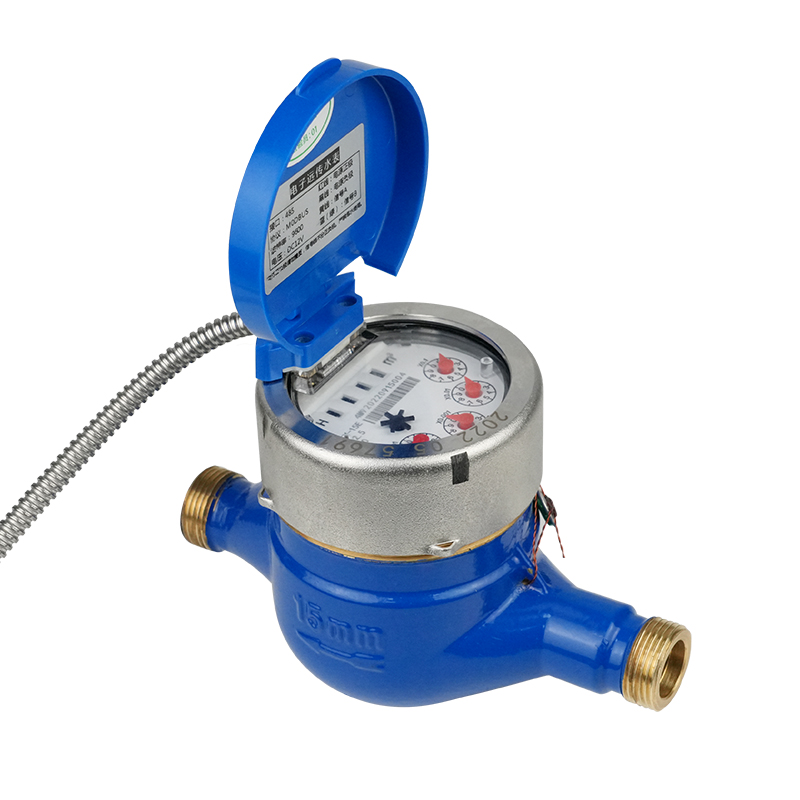
RS485 Modbus RTU water meter: one bus, multiple meters, up to 1200 m, feeding a BMS, PLC or SCADA system.
M-Bus water meter: the wired alternative for apartment blocks and utility networks
Where the network follows the EN 13757 M-Bus standard — common in European utility and multi-dwelling metering — the water meter m-bus option keeps the installation inside an existing readout architecture instead of creating a parallel one. Shengda's M-Bus water meter is available from DN15 to DN200 with flow ratios from R80 to R400, an M-Bus (EN 13757) communication interface, and power supplied either by the M-Bus itself or by battery, with battery life up to 6–10 years depending on configuration. Communication distance reaches up to 1000 m depending on cable type and installation conditions, and one M-Bus master can connect multiple meters, which simplifies system management in apartment buildings and utility projects. The meter offers IP68 protection, PN10/PN16 pressure ratings, brass or cast iron body options, optional MID certification and optional remote shut-off valve control.
LoRaWAN water meter: long-range wireless where no cabling exists
A LoRaWAN water meter is the natural fit for district metering, campuses, industrial parks, resorts and municipal networks where ducting does not exist and trenching is not acceptable. The LXSY LoRaWAN water meter covers DN15 to DN300 in brass (with valve) or iron (without valve) bodies, with dry-dial or wet-dial registers, PN16 maximum working pressure, IP68 protection, LoRaWAN protocol, a frequency range of 433 to 923 MHz and Class A working mode. Its composition is a system rather than a single device: the LoRaWAN water meter, a gateway and a network server. The battery is an ER18505M at 3600 mAh, rated to last up to 8–10 years; pressure loss is ≤0.063 MPa; water temperature ratings cover T30 and T90; the meter complies with ISO 4064 and carries MID certification; and the software is supplied free to clients.
Coverage is the headline benefit. Shengda's LoRaWAN water meter specifies a long data transmission distance of 7.5 km, and the vacuum-sealed counter, high-resistance glass and the corrosion-resistant, antistatic coating on the brass alloy shell are specified for outdoor and underground service life rather than display conditions. Wireless remote meter reading and wireless remote valve control are both supported.
Two wider-range variants extend the same architecture. The Smart LoRaWAN water meter (LXSY) covers DN15 to DN500 with accuracy Class 1 or Class 2 and flow ratios of R80, R100, R250, R400 or R500, and supports LoRaWAN bands such as EU868, US915, AS923 and AU915. The LoRaWAN Ultrasonic water meter (LXSC) covers DN15 to DN600 with R250/R400/R500 flow ratios and uses ultrasonic transit-time measurement with no moving parts, backed by up to 10 years of battery life, IP68 protection, PN10/PN16 pressure ratings and leakage, low battery, reverse flow, tamper and empty-pipe alarms.
Where a simpler concentrator topology is preferred, the LoRa water meter (LXSY) covers DN15 to DN50 with LORA protocol at 470–510 MHz or 868–915 MHz, battery life of 6–7 years, ISO 4064 compliance and MID certification, and is delivered as a meter plus collector, concentrator and network server. Wireless wake-up, remote valve control, and automatic valve closing under attack or low voltage make it a practical option for smaller residential clusters.
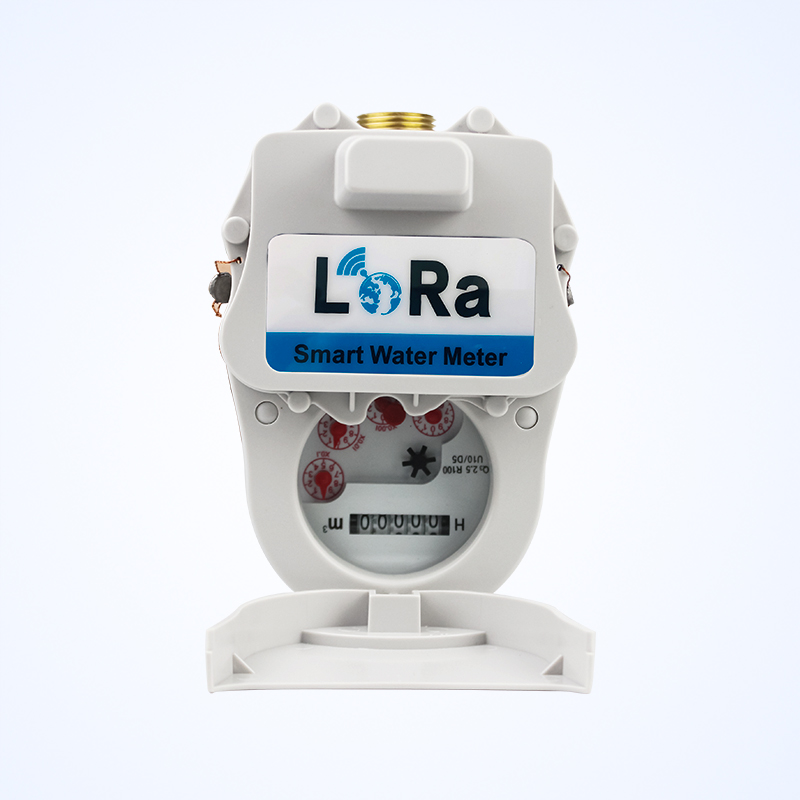
LoRa wireless remote reading water meter: meter, collector, concentrator and network server form one metering system.
NB-IoT water meter: operator-network coverage for municipal and residential rollouts
NB-IoT fits when the utility wants no gateway infrastructure of its own and can rely on mobile network coverage. Shengda's NB-IoT smart water meter covers DN15 to DN200 in brass (with valve) or iron (without valve), with PN16 maximum working pressure and IP68 protection. It communicates over Narrow Band LTE Cat.NB at B3 (1800 MHz), B5 (850 MHz) and B8 (900 MHz) using a Micro SIM (Type 3FF), runs Class A, complies with ISO 4064 and carries MID certification. Battery life is more than 6 years, and the battery can be replaced directly without opening the water meter.
For operators, the practical functions matter as much as the radio. The LCD shows current signal value, balance, water consumption and remaining water quantity; step water prices can be set by user category and usage; data upload frequency is configurable on fixed time points (month, week, day or hour) or on a periodic schedule; the system uses a B/S architecture so a browser on PC or mobile is enough to log in; and the cloud service platform is supplied free. Internal or external antenna options support a stable signal, and reed fault detection displays a sampling failure while the meter continues to measure accurately.
Residential and municipal remote reading is the dominant NB-IoT use case. A documented example: a municipal water department project in Kenya deployed more than 20,000 NB-IoT units across 8+ years of operation, reporting improved automatic meter reading efficiency and reduced manual maintenance costs.
4G/GSM water meter: higher-throughput reporting for scattered sites
A 4G water meter — also specified as a water meter GSM — suits sites that need larger or more frequent data payloads than a low-power wide-area link comfortably carries, and where metering points are too scattered for a gateway network. The 4G water meter covers DN15 to DN300 in brass (with valve) or iron (without valve), with PN16 maximum working pressure and IP68 protection, and supports TD-LTE/FDD-LTE and GSM on LTE-FDD B1/B3/B5/B8, LTE-TDD B34/B38/B39/B40/B41 and GSM 900/1800 MHz. Battery life is more than 8 years. The meter stores up to 24 months of freezing data and 31 days of frozen data, supports step water pricing by user category and usage, and can be triggered by magnet for on-site reporting and local maintenance. Power-loss storage, anti-magnetic interference recording and battery undervoltage alarms are included, and the software is free.
Typical 4G deployment patterns are high-end communities, villas, schools, enterprises, factories, apartments and water affairs departments. A water supply authority project in Uganda used 4G communication with remote valve control and a cloud platform over 8+ years of operation, reporting improved remote monitoring and valve management.
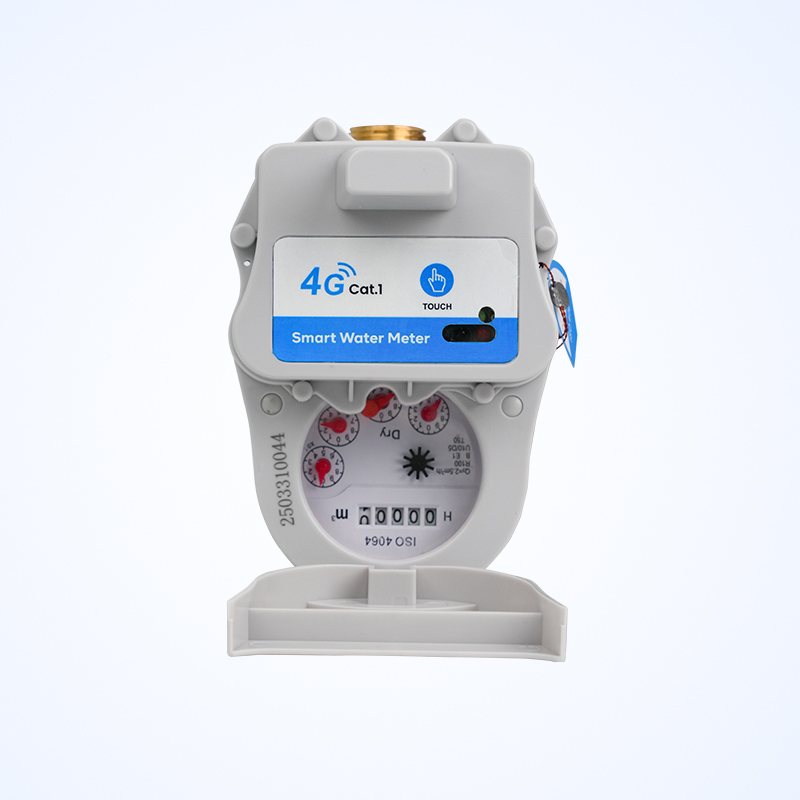
4G/GSM water meter: higher-throughput reporting for villas, campuses, factories and scattered utility points.
Prepaid water meters: STS token and smart card for collection-driven projects
When the project problem is revenue rather than data, the meter type changes. A postpaid water meter measures actual consumption and supports monthly or periodic billing based on customer usage; Shengda's postpaid range covers DN15 to DN50 with optional R100/R160/R200/R250/R400 flow ratios and optional LoRaWAN, NB-IoT, 4G, RS485, M-Bus or pulse communication. A prepaid water meter moves the payment before the consumption.
Shengda's STS prepaid water meter — also described as a token water meter — covers DN15 to DN200 in brass or cast iron for bulk sizes, with R80, R100 and R160 flow ratios, a maximum working pressure of 1.0 MPa, IP68 protection, pressure loss of ≤0.063 MPa, working voltage of 3.6 V ±0.6 V and quiescent current of ≤10 μA. Battery life is up to 8 years. The system comprises the STS water meter, a keypad and software, supports LORA-RF (UIU) communication and third-party payment systems, and allows payment by mobile or PC. Operating features include automatic valve control, insufficient-water warning, self-defined overdraft, anti-storage (purchase limitation), anti-magnetic interference recording, low-battery and anti-tamper detection, step pricing and history data. STS itself is the globally recognized security standard for prepaid meter encryption (IEC 62055-41/51).
The smart card prepaid water meter (LXSK) covers DN15 to DN300 — LXSK-15-40 and LXLK-50-300 — in brass, nylon or stainless steel, with PN16 maximum working pressure and IP68 protection, certified to ISO 4064 Class B with MID. Battery life is more than 6 years and the battery is replaceable; LCD data can be stored for more than 10 years; and the meter opens and closes the valve periodically to prevent the valve from blocking, a detail that matters in hard-water areas.
Two documented prepaid deployments show the pattern. A municipal water supply project in Zimbabwe deployed 4,000+ units over 8+ years, using 20-digit STS tokens and remote valve control for remote recharge, automatic billing and user management. A water utility in Sudan supplied 10,000+ OEM-branded units over 10+ years through a government tender.
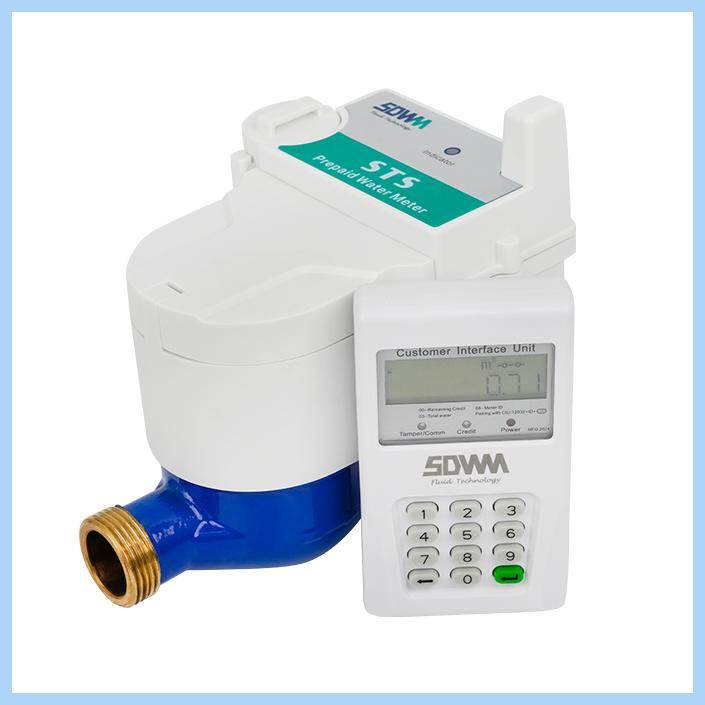
STS prepaid water meter: token entry, valve control and automated billing for residential collection-driven projects.
Measuring technology and body material: ultrasonic, multijet, R160, plastic and Woltman
Communication decides how data leaves the site; measuring technology decides how reliable that data is at the flow rates the site actually produces.
- Ultrasonic water meter. Shengda's smart ultrasonic water meter covers DN15 to DN600 with R250/R400/R500 flow ratios, up to 10 years of battery life, IP68 protection, PN10/PN16 pressure ratings, a -20°C to +60°C working range and 0°C to +90°C water temperature. Ultrasonic transit-time measurement has no moving parts, which removes mechanical wear and blockage from the maintenance list, and it supports leakage, low battery, reverse flow, tamper and empty-pipe alarms. It is the fit for revenue-critical and low-flow-sensitive points.
- Multijet water meter. The LXSG multijet water meter covers DN15 to DN50 with R80/R100/R160/R200 options, ISO 4064 metrology, BSP threaded connection, PN10/PN16 pressure ratings and T30/T50/T90 temperature options. It suits residential and light commercial points where mechanical metering and a low cost per unit dominate.
- R160 and R200 water meters. The R160 water meter covers DN15 to DN25, complies with the ISO 4064 metrological standard, uses multijet or volumetric measurement, offers PN10/PN16 and T30/T50/T90 ratings, and provides better low-flow sensitivity than traditional R80/R100 meters — useful where low-flow registration drives revenue accuracy.
- Plastic water meter. The LXSG plastic water meter covers DN15 to DN50 with R80/R100/R160/R200 options, a BSP threaded connection, PN10/PN16 ratings and an engineering-plastic body. It reduces weight and transport cost, resists corrosion and is the economical solution for large-scale residential projects; it can later be upgraded with pulse output, M-Bus, RS485, LoRaWAN or NB-IoT modules when the project adds remote reading.
- Woltman water meter. The Woltman water meter is designed for horizontal installation and large-flow measurement, with body material options of cast iron, ductile iron or stainless steel — the configuration for bulk water transmission, mains and high-volume industrial lines. For the largest bulk applications, Shengda also manufactures large-size flow meters up to DN3000.
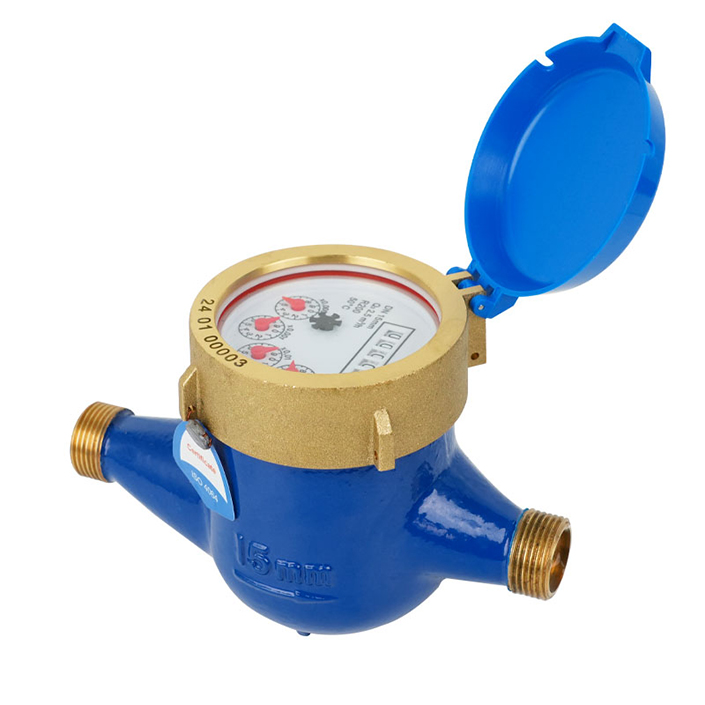
R160 water meter: ISO 4064 metrology with better low-flow sensitivity than R80/R100 mechanical meters.
Step-by-step: matching a smart water meter to a project
- Define the metering point and expected flow profile. Record diameter, normal and peak flow, and water quality. Use R160/R200 or an ultrasonic water meter where low-flow registration matters; use multijet or plastic meters where volume is high and flow is stable.
- Confirm the communication path that already exists. If the building or plant runs a BMS, PLC or SCADA bus, RS485 (Modbus RTU) or M-Bus keeps the meter inside that infrastructure. If there is no cabling and none will be installed, choose wireless: LoRaWAN for a self-owned gateway network, NB-IoT or 4G/GSM for operator-network coverage.
- Size the power budget against the reporting interval. RS485 and M-Bus meters can run on battery (up to 6–10 years depending on configuration) or on external supply; LoRaWAN meters are rated up to 8–10 years (LXSY) or up to 10 years (ultrasonic); NB-IoT more than 6 years; 4G more than 8 years. Every figure assumes a configured upload schedule, so agree the schedule before accepting the number.
- Confirm the environment envelope. Underground pits, chambers and outdoor cabinets require IP68. Pressure ratings (PN10/PN16, or 1.0 MPa for the STS prepaid water meter) and temperature ratings (T30/T50/T90 on mechanical meters, 0–90°C water on ultrasonic meters) must match the line, not a catalogue average.
- Confirm the integration target by name. Identify whether the endpoint is a BMS, a SCADA system, an AMR/AMI platform or a cloud service, then verify interface compatibility accordingly: PLC, SCADA, AMR and AMI for RS485; an EN 13757 M-Bus master for M-Bus; a gateway and network server for LoRaWAN; a B/S cloud platform for NB-IoT.
- Confirm the billing model and compliance route. Choose postpaid for consumption billing and prepaid (STS token or smart card) where payment must precede use. For the EEA, confirm MID (2014/32/EU) compliance; for prepaid encryption, confirm STS; and check the ISO 4064 metrology statement for the specific model.
- Validate with samples before the rollout. Test metering accuracy, communication against the site's actual controller or platform, and — for prepaid meters — token entry and valve behaviour, using a small sample order that mirrors the final configuration.
Use cases: how the matching rule plays out in the field
Commercial and institutional buildings. An RS485 water meter installed on the same bus as the BMS removes a separate reading route, and the 1200 m bus distance allows one segment to serve several risers or floors without a repeater decision on every level.
Industrial complexes and plants. RS485 or M-Bus keeps process and utility points inside the control layer, while large-diameter ultrasonic or Woltman meters handle bulk lines. A wastewater treatment company in Zimbabwe deployed 1,000+ large-diameter, high-accuracy units for water transmission pipeline monitoring and water balance analysis over 10+ years of operation.
Municipal and utility networks. LoRaWAN and NB-IoT dominate where points are spread across a city. A government water utility in Mongolia deployed 15,000 OEM-branded LoRaWAN units for smart water metering and remote reading in a smart city programme running 6+ years.
Building services and HVAC. Battery-powered, IP68, wireless meters suit plant rooms and secondary circuits where power is not available at the pipe. A Costa Rica HVAC contractor used battery-powered, IP68, wireless meters on a project basis and reported reduced maintenance costs.
Irrigation, garden management and bulk water. Shengda's bulk sizes are used for irrigation, water resources management, industrial production and garden management, supported by the same wireless remote reading stack used in municipal projects.
Comparison table: smart water meter communication options
| Option | Interface / protocol | Typical sizes (Shengda range) | Data path | Distance | Power | Best-fit scenario |
|---|---|---|---|---|---|---|
| RS485 water meter | RS485 Modbus RTU; optional customized protocol | DN15–DN500 | Wired multi-drop bus; PLC, SCADA, AMR/AMI | Up to 1200 m (wiring dependent) | Battery up to 6–10 years (configuration dependent) or external supply | Buildings with BMS; industrial plants and process control |
| M-Bus water meter | M-Bus, EN 13757 | DN15–DN200 | Wired via M-Bus master; multi-meter network | Up to 1000 m (cable and installation dependent) | M-Bus powered or battery, up to 6–10 years | Apartment blocks; European utility wired networks |
| LoRaWAN water meter | LoRaWAN, 433–923 MHz, Class A | DN15–DN300 (LXSY); DN15–DN500 (Smart LoRaWAN); DN15–DN600 (LoRaWAN ultrasonic) | Wireless to gateway, then network server | Up to 7.5 km (environment dependent) | Battery up to 8–10 years (LXSY); up to 10 years (ultrasonic) | District metering, campuses, industrial parks, smart city projects |
| NB-IoT water meter | LTE Cat.NB, B3/B5/B8 | DN15–DN200 | Wireless via operator network and cloud platform | Coverage dependent | Battery more than 6 years; replaceable | Municipal and residential remote reading rollouts |
| 4G/GSM water meter | TD-LTE / FDD-LTE / GSM (900/1800 MHz) | DN15–DN300 | Wireless via operator network | Coverage dependent | Battery more than 8 years | Scattered sites needing frequent or larger reporting |
| Prepaid water meter | STS token with keypad (LORA-RF/UIU) or smart card reader | DN15–DN200 (STS); DN15–DN300 (smart card) | Local payment with optional remote management | Local / site level | Up to 8 years (STS); more than 6 years, replaceable (smart card) | Residential, dormitory and apartment prepaid projects |
Scenario-to-configuration table
| Project scenario | Recommended configuration | Why it fits |
|---|---|---|
| Commercial building, hotel or hospital with an existing BMS | RS485 water meter, Modbus RTU, IP68, PN10/PN16 | Uses the existing control bus, supports multi-meter connection up to 1200 m, and reports into PLC/SCADA/AMR/AMI environments |
| Industrial plant or process water lines | RS485 or M-Bus water meter, brass or stainless steel body; large-diameter ultrasonic or Woltman for bulk lines | Wired communication stays inside the control layer; IP68 and PN10/PN16 match plant conditions; large sizes cover transmission lines |
| Multi-dwelling apartment block on an EN 13757 network | M-Bus water meter with an M-Bus master | One master connects multiple meters, up to 1000 m, and can be bus-powered |
| District metering or campus network without cabling | LoRaWAN water meter or LoRaWAN Ultrasonic water meter with gateway and network server | Long-range wireless coverage up to 7.5 km, IP68 for pits and chambers, up to 10 years of battery life |
| Municipal rollout relying on mobile coverage | NB-IoT smart water meter with B/S cloud platform | No gateway infrastructure required; configurable upload scheduling and step tariffs; platform supplied free |
| Residential estate with collection risk | STS prepaid water meter or smart card prepaid water meter with valve control | Payment precedes consumption; automatic valve control, anti-storage and anti-tamper detection reduce revenue loss |
| Large-scale cost-sensitive housing programme | Plastic water meter DN15–DN50, upgradeable with M-Bus, RS485, LoRaWAN or NB-IoT later | Lower weight and transport cost, corrosion resistance, and a smart upgrade path without changing the meter platform |
| Revenue-critical or low-flow-sensitive metering | Smart ultrasonic water meter, DN15–DN600, R250/R400/R500 | No moving parts, wide measuring range, leakage and reverse-flow alarms, MID certification |
FAQ
Which certifications should a smart water meter carry for EU and prepaid projects?
For the European Economic Area, water meters with additional functionalities are covered by EU Directive 2014/32/EU (MID) and EN 14154-4:2023. Shengda's smart ultrasonic, LoRaWAN, NB-IoT, 4G and smart card prepaid ranges are specified with MID, and CE and MID are listed as certification options on the LXSY platform, with metrological compliance stated against ISO 4064. The R160 water meter and the multijet, plastic and prepaid models state ISO 4064 compliance, and the smart card prepaid meter is certified to ISO 4064 Class B. For prepaid projects, STS (Standard Transfer Specification, IEC 62055-41/51) is the globally recognized security standard for prepaid meter encryption, and Shengda's STS prepaid water meter operates with STS tokens and a keypad. At company level, Shengda holds ISO 9001, ISO 14001 and ISO 45001 certification, and states that its products have obtained CE, MID and ISO 4064 certification.
Can an RS485 water meter integrate with an existing BMS or SCADA system?
Yes. Shengda's RS485 water meter uses an RS485 Modbus RTU interface with an optional customized protocol, and it is compatible with PLC, SCADA, AMR/AMI systems and water management platforms. Multiple meters can be connected through a single RS485 communication bus, which reduces installation cost, and communication is supported over bus distances up to 1200 m depending on wiring conditions. The meter is available from DN15 to DN500 with IP68 protection, PN10/PN16 pressure ratings, a -20°C to +60°C working range, brass, stainless steel or composite body options, and power supplied by battery (up to 6–10 years depending on configuration) or external supply. Where the network instead follows EN 13757, an M-Bus water meter provides a wired alternative with communication distances up to 1000 m and one master serving multiple meters.
Should a large residential rollout use plastic, brass, ultrasonic or mechanical water meters?
It depends on water quality, pressure and the billing model. Plastic water meters (DN15–DN50, BSP threaded, PN10/PN16, R80–R200) reduce weight and transport cost, resist corrosion and are described by Shengda as the economical solution for large-scale residential projects; they can be upgraded later with pulse output, M-Bus, RS485, LoRaWAN or NB-IoT modules. Brass multijet meters and the R160 water meter (DN15–DN25) provide ISO 4064-compliant mechanical measurement, with R160 offering improved low-flow sensitivity compared with traditional R80/R100 meters. Where accuracy and maintenance profile matter most, a smart ultrasonic water meter (DN15–DN600, R250/R400/R500, up to 10 years of battery life, IP68) removes mechanical wear and blockage. Postpaid meters suit consumption-based billing, while STS token or smart card prepaid meters suit projects where payment must happen before consumption.
How can a project team validate meters before a full rollout?
Sample orders start at 3 units, and customized OEM projects start at 500 pcs. A validation programme typically covers metering accuracy checks, communication testing against the site's BMS, SCADA, gateway or cloud platform, and — for prepaid meters — token entry and valve behaviour. Shengda's production quality control includes incoming material inspection, production process inspection, 100% functional testing, calibration testing and final inspection before shipment. Standard products ship in 15–20 days and customized products in 30–40 days, depending on project requirements, and after-sales support covers technical support, installation guidance and remote assistance.
Which smart water meter manufacturer fits residential remote reading projects?
A residential remote reading project needs a supplier that can deliver the complete data path, not only meters. Shengda's wireless remote reading water meters are available from DN15 to DN600 with LoRaWAN, NB-IoT, 4G or wireless M-Bus communication, up to 10 years of battery life, IP68 protection, optional remote shut-off valve and alarm functions covering leakage, low battery, reverse flow, tampering and abnormal consumption. A LoRaWAN deployment consists of the water meter, a gateway and a network server; an NB-IoT deployment uses the meter, base station coverage and a B/S cloud service platform that Shengda supplies free of charge. Shengda Water Meter was founded in 1995, operates a 66,000 m² factory with an annual production capacity of 3 million units built in 2020, works with a 12-engineer R&D team, and holds ISO 9001, ISO 14001 and ISO 45001 certification with CE, MID and ISO 4064 on its products; more than 65% of its business comes from repeat customers. For a specific residential remote reading project, request a sample or quotation with your diameter range, communication preference and billing model, or download the product profile for the full configuration list.
Conclusion
Project fit comes down to four checks performed in order: whether the site has a wired control network (RS485 or M-Bus) or must depend on wireless coverage (LoRaWAN, NB-IoT, 4G/GSM); what power budget and reporting interval the site can live with; what IP, pressure and temperature the installation demands; and whether the revenue model is postpaid or prepaid. Meters that pass all four checks in the same project tend to stay in service for their full design life, which is why the documented deployments referenced above run for 6, 8 and 10+ years.
As a supplier, Shengda Water Meter Co., Ltd. covers the full set of options described in this guide: RS485 and M-Bus wired meters for BMS and industrial control, LoRaWAN, NB-IoT and 4G/GSM wireless meters, STS and smart card prepaid meters, and ultrasonic, multijet, R160, plastic and Woltman bodies from DN15 up to DN600, alongside large-size flow meters up to DN3000. All are available with OEM/ODM customization of logo, color, housing design, communication module, protocol, software platform, packaging and specifications.
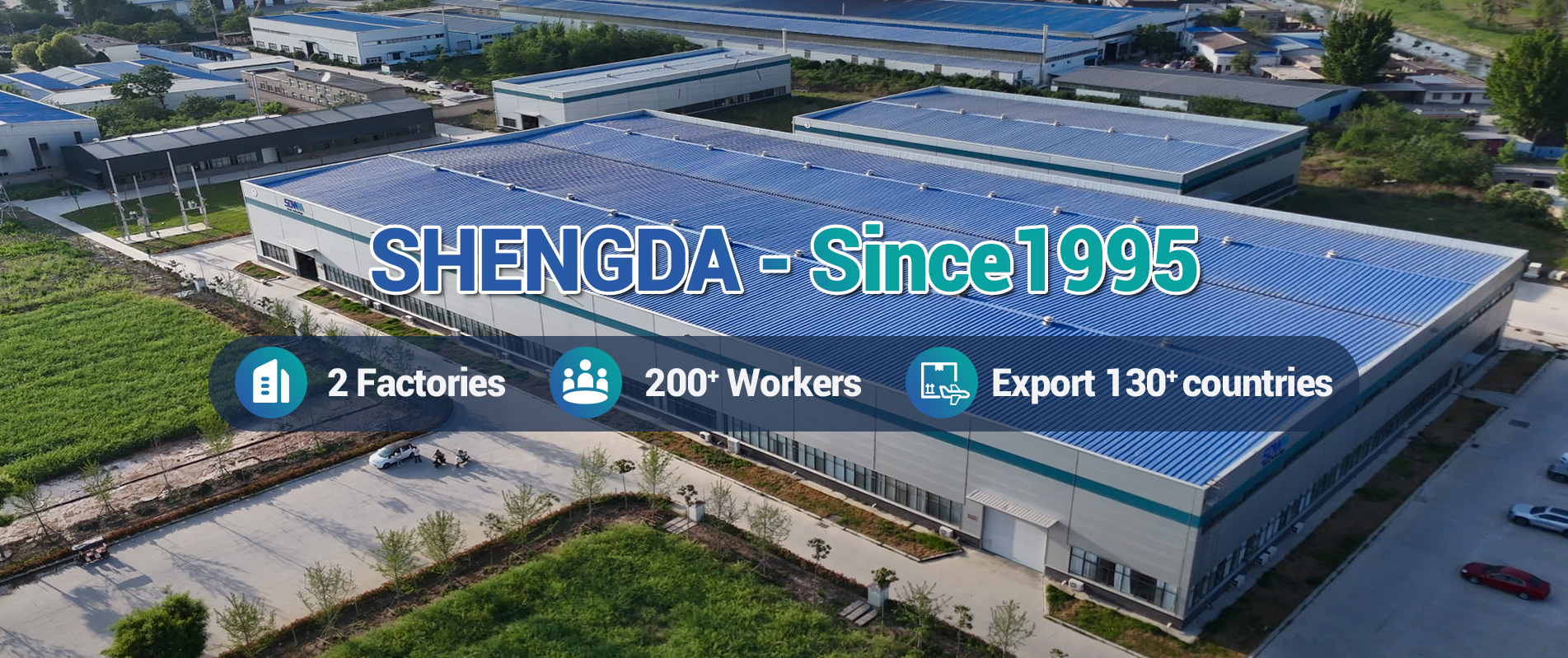
Shengda Water Meter factory in Kaifeng, China — 66,000 m² site with an annual production capacity of 3 million units.
Match a meter to your project
Send your project details — application, diameter, communication preference and billing model — and Shengda will propose a configuration, provide samples and issue a quotation.
Samples start at 3 units; customized OEM projects start at 500 pcs. Standard products ship in 15–20 days; customized products in 30–40 days, depending on project requirements.
Download the Shengda product profile (PDF) · www.shengdawatermeter.com
Contact: Miranda · Email: admin@henanpanda.com · Tel / WhatsApp: +86 18603780816 · Address: NO.109, Middle Weidu Road, Kaifeng City, China
Have Questions or Need More Details?
Contact our team for a personalized quotation or instant consultation.
Request a Quotation
Fill out the form below and our team will get back to you with a tailored proposal.
WhatsApp Direct Chat
Prefer to chat in real-time? Message us on WhatsApp for instant assistance & quick answers.
- Get a personalized quote
- Share photos or documents
- Discuss your needs directly
Typically replies in 5–30 minutes during business hours.