
Electromagnetic Flow Meter: How It Works & How to Choose
Electromagnetic Flow Meter: How It Works, Main Types, and How to Choose
An electromagnetic flow meter is a volumetric flow instrument that measures conductive liquids by creating a magnetic field across a lined pipe section and reading the voltage that the moving liquid induces. It has no moving parts, does not obstruct the bore, and is produced in nominal diameters from DN10 to DN3000 — which is why water utilities, wastewater plants, and process industries treat it as a default choice for conductive liquid measurement.
Buyers meet this instrument under several names: electromagnetic flow meter, magnetic flow meter, magnetic type flow meter, and MAG meter. They describe the same measurement principle. At Shengda Water Meter Co., LTD, the family is produced under the model designation SMF, alongside a complementary ultrasonic range (model TUF) for situations where a magnetic meter is not the right fit.
This guide is written for importers, distributors, plant engineers, and procurement teams at the discovery and research stage. It covers the measurement principle, the market context, the SMF configuration options, a step-by-step selection process, application areas, and a comparison between magnetic and clamp-on ultrasonic technology. Figures are attributed to their sources so they can be verified independently.
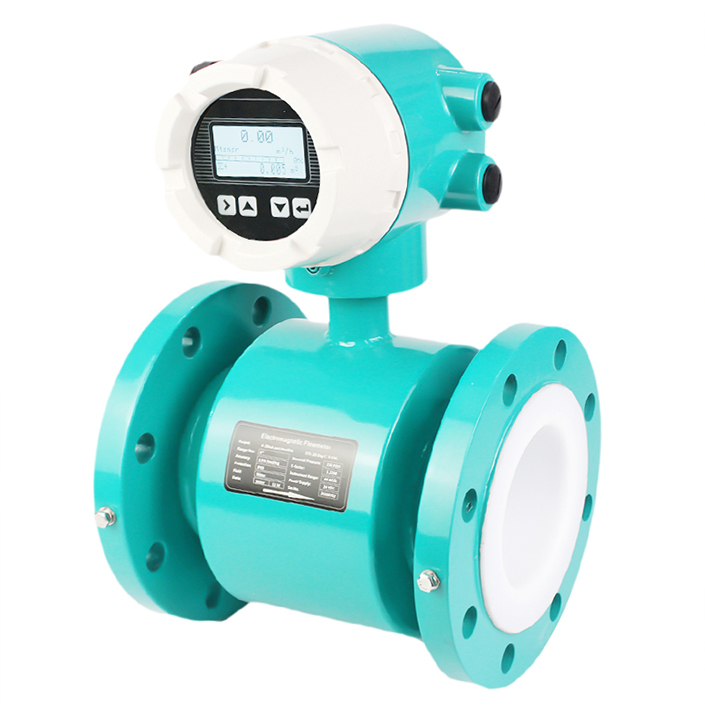
Electromagnetic flow meter (model SMF) configured for water metering applications. Image: Shengda Water Meter Co., LTD.
What an Electromagnetic Flow Meter Measures — and What It Cannot
The SMF is a magnetic flow meter designed for measuring the flow of conductive liquids in various industrial applications. It is suitable for media with a minimum conductivity of 5 μS/cm, and its stated accuracy is ±0.5% of flow rate, with a ±0.2% option for higher-precision duties.
Inside the sensor, field coils generate a magnetic field perpendicular to an insulating liner. When a conductive liquid moves through that field, an electromotive force appears at two electrodes mounted in the tube wall. The signal is proportional to average flow velocity, so the transmitter can convert it into volumetric flow. The design convention is documented internationally: ISO 20456:2017 provides guidance for the use of electromagnetic flowmeters with conductive liquids in closed conduits, and it notes that industrial field coils typically use alternating current (AC) or pulsed direct current (DC) circuits.
The practical result is a meter with a clean bore: no mechanical wear, minimal pressure loss, and stable repeatability. The SMF range accepts flow velocities from 0.1 to 15 m/s, works at pressures from PN10 to PN40, and operates between -20°C and +180°C depending on the liner selected.
Where the technology stops. A magnetic flow meter cannot measure gases, steam, or liquids below the conductivity threshold — deionized water, many pure hydrocarbons, and some solvents fall outside its range. Nor can it compensate for an unsuitable liner: liner and electrode materials, not the electronics, determine whether a given chemical and temperature combination is compatible. Like any in-line instrument, it also needs a full pipe and correct earthing to deliver a stable signal, which is a site-design question rather than a product limitation.
Industry Background: Why Magnetic Flow Meter Demand Is Still Rising
Third-party research places the global electromagnetic flowmeter market at approximately USD 15.96 billion in 2025, with a projected value of USD 28.20 billion by 2035 and a compound annual growth rate of 5.85% (Market Research Future). Regional distribution is uneven: Asia-Pacific accounts for roughly 38–39% of revenue (Mordor Intelligence / Dataintelo), while North America holds approximately 34–36% of the wider flow meter market in 2025 (Fortune Business Insights / Straits Research).
Within the broader flow meter market, magnetic technology is the largest revenue segment. Grand View Research reports that the magnetic segment represents 27.2% of total flow meter market revenue as of 2024, and identifies battery-powered meters as the fastest-growing power segment for 2025–2030.
A note on market estimates. Published figures for this category diverge. Market Research Future values the electromagnetic segment at USD 15.96 billion for 2025, while Dataintelo estimates USD 3.57 billion for the same year, and Grand View Research reports USD 10.64 billion for the total flow meter market in 2024. Segment definitions differ between firms, so any single market size should be treated as directional and checked against its underlying scope before it is quoted in a business case.
Three demand drivers are visible regardless of how the market is sized. First, water loss management: district metering areas and municipal networks need accurate flow data at both small and very large pipe sizes. Second, regulation: the EU Urban Wastewater Treatment Directive 2024/3019 introduced quarterly flow reporting requirements, which raises the documentation standard for measurement devices in European wastewater assets. Third, digitalisation: SNS Insider estimates that integrating intelligent flow meter systems with IoT platforms can reduce industrial maintenance costs by up to 25%.
The instrument mix is also shifting at the smaller end. Grand View Research identifies the 2-inch pipe size segment as the fastest-growing size band between 2025 and 2030, driven by HVAC and precision irrigation demand — a reminder that not every project needs a large-diameter meter.
Among established global suppliers in this segment, Credence Research lists ABB, Emerson, Endress+Hauser, Krohne, and Siemens. Shengda Water Meter Co., LTD (SDWM) has manufactured flow meters and water meters since 1995 from a 66,000 m² facility in Kaifeng, China, employing approximately 100–200 staff with a 12-engineer R&D team and an annual production capacity of 3 million units. The company manufactures large-size flow meters up to DN3000, exports to more than 140 countries, and derives 50% of its sales from export business, with major markets in the USA, South America, Africa, and Southeast Asia.
Detailed Solution: The SMF Electromagnetic Flow Meter Range
The SMF platform is one measurement core configured in several directions. Because the specification — not the model name — decides whether a meter performs, each configuration below is described with its actual published parameters.
Standard SMF electromagnetic flow meter
The standard configuration covers DN10 to DN3000 with ±0.5% accuracy, or ±0.2% where higher precision is required. Liner options are PTFE, rubber, PFA, or FEP; electrode options are stainless steel, Hastelloy C, titanium, or tantalum, with a replaceable electrode version available for installations where access is difficult. Installation can be flanged, wafer, threaded, or insertion type, and the structure can be integrated or remote. Body material is carbon steel or stainless steel. Power supply is 24VDC, 220VAC, or battery. Output signals include 4-20mA, pulse, frequency, RS485, Modbus, and HART, with an LCD digital display and protection class of IP65, IP67, or IP68 (optional). Product certification is CE / ISO.
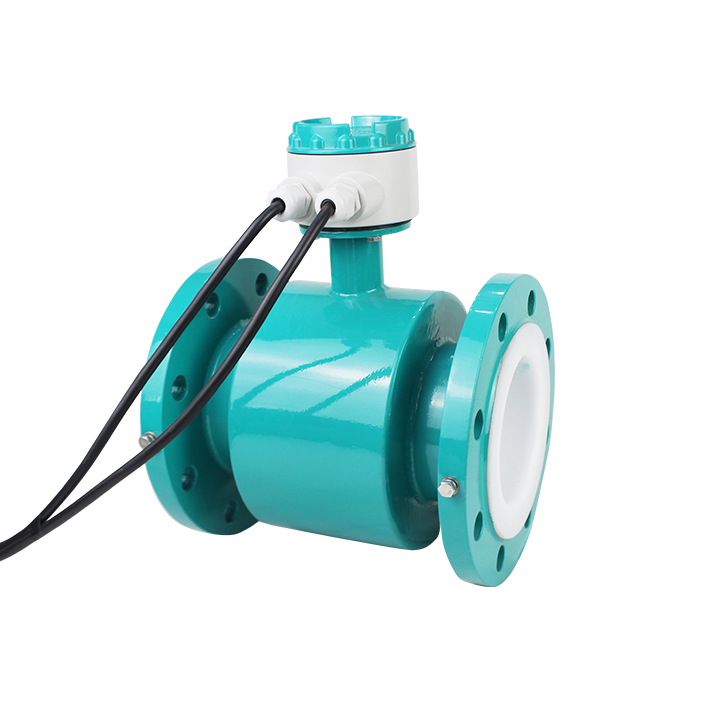
SMF magnetic flow meter with LCD digital display, flanged body, and optional remote or integrated transmitter.
Stainless steel magnetic flow meter
For corrosive and hygienic lines, the stainless steel variant uses a body of Stainless Steel 304 or 316L across DN10 to DN300. It keeps the same ±0.5% (±0.2% optional) accuracy and the same 0.1–15 m/s velocity band, with connection options of flange, wafer, or thread and pressure ratings from PN10 to PN40. Typical service includes the food and beverage industry, dairy processing, chemical processing of clean fluids, pure water and RO water systems, beverage filling lines, brewing, and cosmetics production. IP68 protection is available for underground and wash-down locations.
Sanitary electromagnetic flow meter
The sanitary configuration is built for hygienic clean applications: food-grade PTFE or PFA liner, SS316L wetted parts, and tri-clamp, thread, or flange connections with a sanitary polished finish. It spans DN10 to DN300 at ±0.5% (±0.2% optional), with working pressure of PN10, PN16, or PN25 and a temperature range of -20°C to +150°C depending on the liner. There are no moving parts, low-flow performance is accurate, and IP68 protection is available for humid or wash-down environments. Target industries include dairy processing, the food and beverage industry, brewing, beverage filling lines, pure water and RO water systems, cosmetics production, and chemical processing of clean fluids.
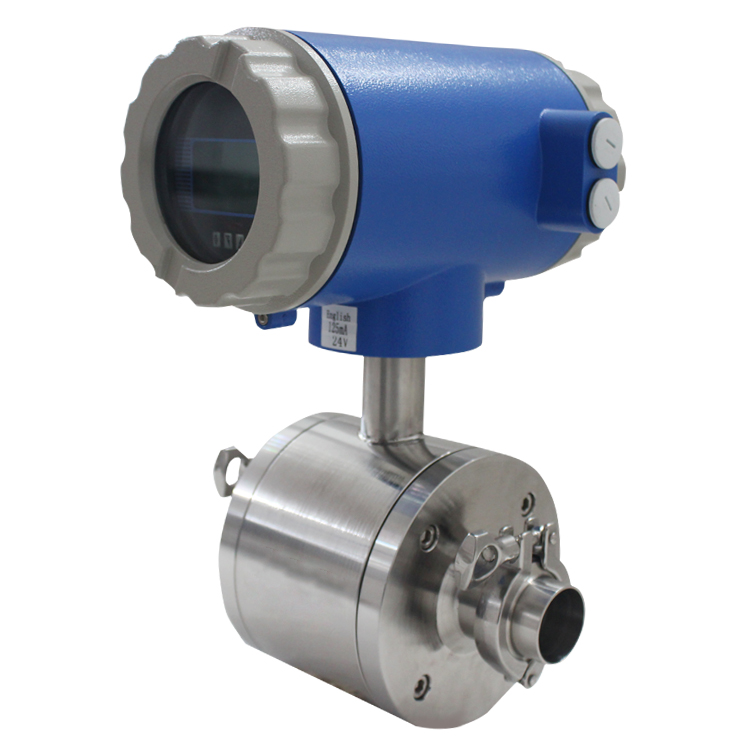
Sanitary electromagnetic flow meter with SS316L wetted parts and hygienic tri-clamp connection.
Battery power magnetic flow meter
Where no mains supply exists, the battery-powered SMF covers DN10 to DN2000 with a lithium battery rated for up to 5–10 years depending on configuration. Accuracy is ±0.5% or ±1.0%, the medium conductivity requirement stays at ≥5 μS/cm, and communication can be LoRaWAN, NB-IoT, RS485, GPRS, or 4G for remote reading. The unit is flanged and integrated in structure, available in stainless steel or carbon steel, rated PN10 to PN40, operates between -20°C and +80°C, and offers IP68 protection. It is intended for remote water supply pipelines, smart water management projects, irrigation systems, municipal water networks, wastewater monitoring, district metering areas, industrial water measurement, and pump stations.
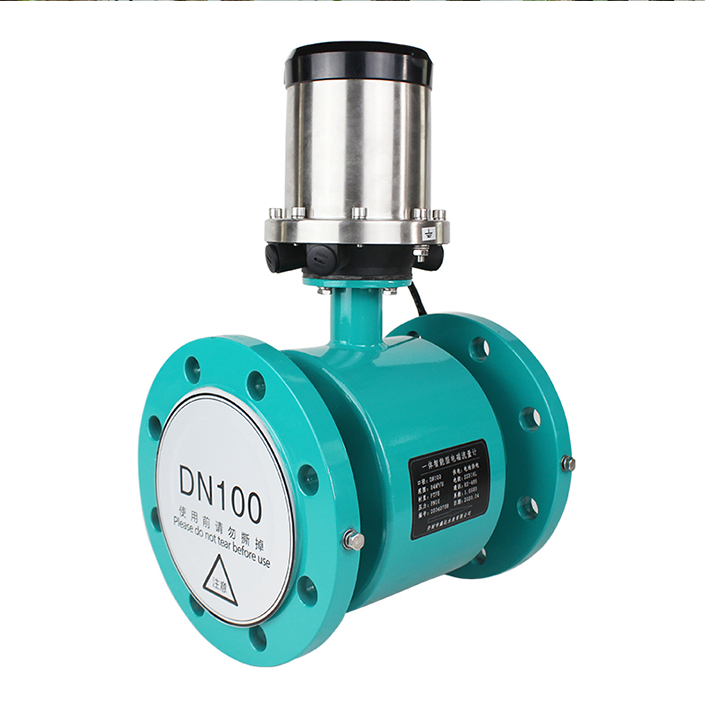
Battery power magnetic flow meter with lithium battery and wireless remote reading for off-grid pipelines.
Plug-in magnetic flow meter for large-diameter pipelines
The plug-in design serves DN300 to DN3000 with ±1.0% accuracy (±0.5% optional) and an optional hot-tap installation that allows fitting and maintenance without shutting down the pipeline. It uses a remote structure, works at PN10, PN16, or PN25 between -20°C and +80°C, and offers IP65, IP67, or IP68 protection with 4-20mA, pulse, RS485, Modbus, or HART output. Because it requires less material than a full-bore meter of the same diameter, it reduces the installed cost of large water transmission and irrigation mains.
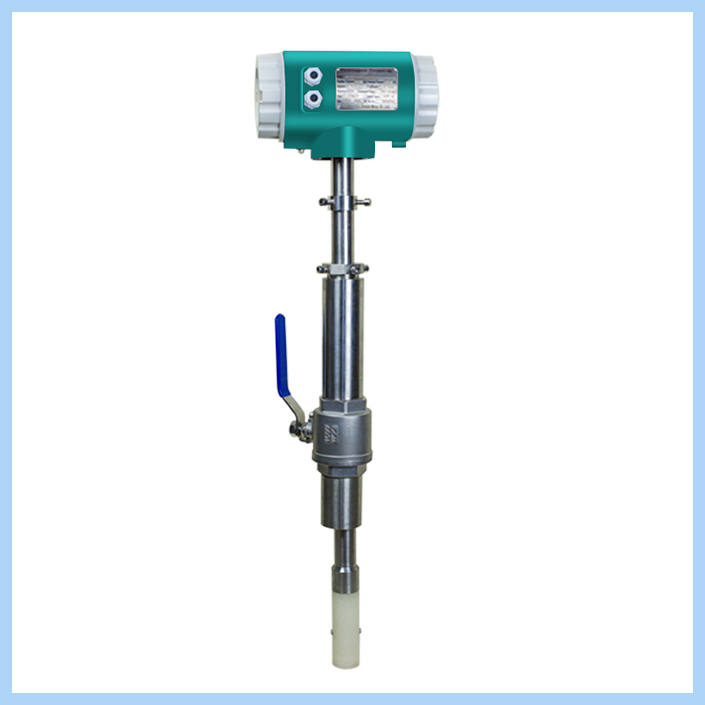
Plug-in magnetic flow meter for large-diameter pipelines, with optional hot-tap installation.
Water flow meter options and the ultrasonic alternative
When a project specifies a water flow meter without fixing the technology, SDWM offers electromagnetic, ultrasonic, turbine, and mechanical options between DN15 and DN3000, with accuracy of ±0.5% or ±1.0% and communication through RS485, Modbus, 4-20mA, pulse, M-Bus, or LoRaWAN, ready for AMR/AMI integration.
Where the pipeline cannot be cut, or the liquid is not conductive enough for a magnetic meter, the TUF ultrasonic range covers DN15 to DN6000 at ±1.0% (±0.5% optional) with flow velocities from 0.01 to 20 m/s. Clamp-on installation requires no pipe cutting and produces no pressure loss, and power options include 24VDC, 220VAC, or battery. The portable handheld version runs on a rechargeable battery for up to 10–12 hours of continuous operation, which suits temporary flow testing, commissioning, and pipeline surveys.
Step-by-Step Breakdown: How to Select an Electromagnetic Flow Meter
Selection follows a fixed sequence. Working in this order avoids the most common procurement error, which is choosing a meter before confirming that the medium can be measured at all.
- Confirm the liquid is conductive. The SMF requires a minimum conductivity of 5 μS/cm. If the medium falls below that threshold, plan for an ultrasonic or another technology instead of a magnetic meter.
- Fix the pipe size and flow range. The range spans DN10 to DN3000 with flow velocities of 0.1–15 m/s. Select a diameter that keeps normal operating flow inside that band rather than at its extremes.
- Choose the liner. Options are PTFE, rubber, PFA, or FEP, with working temperature from -20°C to +180°C depending on the liner. Sanitary duties use food-grade PTFE or PFA.
- Choose the electrode material. Stainless steel, Hastelloy C, titanium, or tantalum. A replaceable electrode version exists for installations where future servicing access is difficult.
- Choose the installation type. Flanged, wafer, threaded, or insertion, in integrated or remote structure. For DN300–DN3000 lines with limited shutdown windows, the plug-in hot-tap option avoids stopping the pipeline.
- Choose power and output. Power is 24VDC, 220VAC, or battery. Outputs include 4-20mA, pulse, frequency, RS485, Modbus, and HART, while battery models add LoRaWAN, NB-IoT, GPRS, or 4G wireless transmission.
- Confirm protection, certification, and testing. Specify IP65, IP67, or IP68 to match the installation environment, confirm the CE and ISO certification package required by the destination market, reference ISO 20456:2017 for conductive-liquid measurement practice, and ask for factory test bench verification before dispatch.
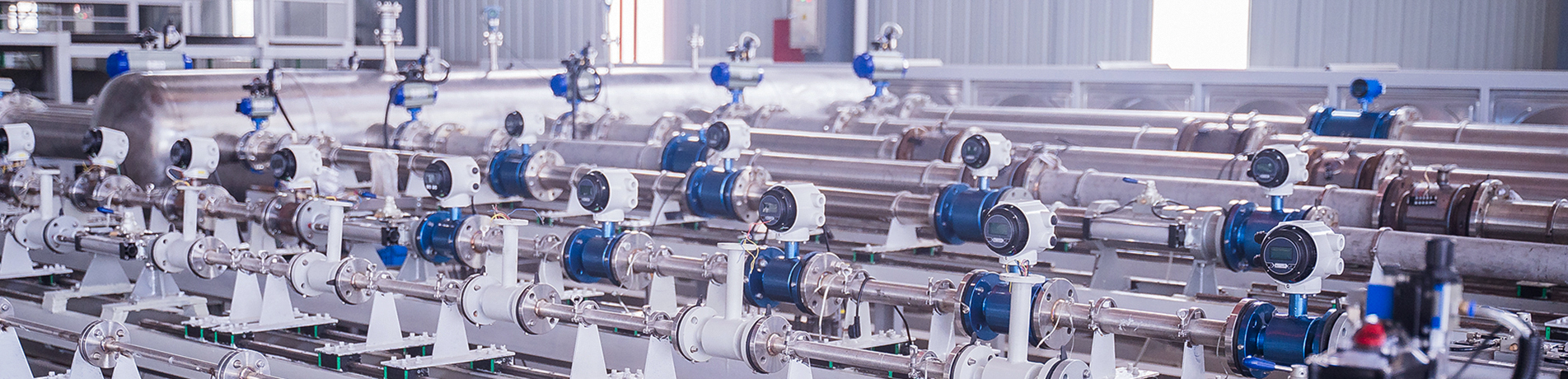
Magnetic flow meter test bench used for factory verification before dispatch.
Use Cases: Where Electromagnetic Flow Meters Are Applied
The SMF platform is intended for water supply, wastewater treatment, industrial process water, chemical and pharmaceutical production, food and beverage, irrigation, mining and mineral processing, power plants, HVAC and cooling water systems, and oil and gas applications involving conductive fluids. The recurring scenarios are consistent:
- Municipal water supply and district metering. Bulk metering, DMA boundary measurement, and water balance analysis on mains from DN10 upward to large transmission lines.
- Wastewater treatment. Flow monitoring and reporting where regulatory documentation is required, including the quarterly reporting introduced by EU Directive 2024/3019.
- Irrigation and agricultural water management. Measurement across pump stations, main lines, and distribution networks, often with remote data collection.
- HVAC and cooling water systems. Smaller-diameter duties, an area where the 2-inch segment is growing fastest between 2025 and 2030.
- Food, beverage, and dairy. Sanitary and stainless steel configurations with hygienic connections, food-grade liners, and polished finishes.
- Chemical and pharmaceutical clean fluids. Corrosion-resistant body and electrode combinations for clean product streams and pure water systems.
- Mining, power, and heavy industry. Large-diameter measurement up to DN3000, where the plug-in version keeps installation cost and downtime down.
- Remote and off-grid monitoring. Battery-powered units on pipelines without mains electricity, transmitting over LoRaWAN, NB-IoT, GPRS, or 4G.
Clamp-on ultrasonic measurement serves the adjacent need. Water and wastewater management is the leading application for ultrasonic flow meters with a 59% market share, and clamp-on models are expected to account for 54% of the ultrasonic product segment by 2026 (Fact.MR) — which is why many projects combine a magnetic meter for permanent accuracy with a portable ultrasonic unit for verification.
Comparison Tables: SMF Configurations and Measurement Technologies
The first table compares SMF configurations against each other; the second compares magnetic measurement with clamp-on ultrasonic measurement. Both use published product parameters only.
| Configuration | Nominal diameter | Accuracy | Installation | Power / communication | Typical duty |
|---|---|---|---|---|---|
| Standard SMF (integrated or remote) | DN10–DN3000 | ±0.5% (±0.2% optional) | Flanged, wafer, threaded, insertion | 24VDC / 220VAC / battery; 4-20mA, pulse, frequency, RS485, Modbus, HART | General water, wastewater, and industrial process lines |
| Stainless steel SMF | DN10–DN300 | ±0.5% (±0.2% optional) | Flange, wafer, thread | 24VDC / 220VAC / battery; 4-20mA, pulse, RS485, Modbus, HART | Corrosive and hygienic lines (SS304 / SS316L body) |
| Sanitary SMF | DN10–DN300 | ±0.5% (±0.2% optional) | Tri-clamp, thread, flange | 24VDC / 220VAC; 4-20mA, pulse, frequency, RS485, Modbus | Food, beverage, dairy, brewing, cosmetics, pure water |
| Battery power SMF | DN10–DN2000 | ±0.5% (±1.0% optional) | Flanged, integrated | Lithium battery up to 5–10 years; LoRaWAN, NB-IoT, RS485, GPRS, 4G | Remote and off-grid water networks, DMA, irrigation |
| Plug-in SMF | DN300–DN3000 | ±1.0% (±0.5% optional) | Insertion, hot-tap option, remote | 24VDC / 220VAC / battery; 4-20mA, pulse, RS485, Modbus, HART | Large-diameter transmission mains and irrigation lines |
| Parameter | SMF electromagnetic flow meter | TUF ultrasonic flow meter |
|---|---|---|
| Nominal diameter | DN10–DN3000 | DN15–DN6000 |
| Accuracy | ±0.5% (±0.2% optional) | ±1.0% (±0.5% optional) |
| Flow velocity range | 0.1–15 m/s | 0.01–20 m/s |
| Medium requirement | Conductive liquids, ≥5 μS/cm | Water, wastewater, industrial liquids |
| Installation | In-line: flanged, wafer, threaded, insertion | Clamp-on, no pipe cutting |
| Pressure loss | None (no bore obstruction) | None (external sensors) |
| Power supply | 24VDC / 220VAC / battery | 24VDC / 220VAC / battery |
| Best fit | Conductive process and water lines requiring high accuracy | Existing pipelines, temporary surveys, retrofit and verification work |
Frequently Asked Questions
What standards and certifications apply to an electromagnetic flow meter?
ISO 20456:2017 is the international reference for the use of electromagnetic flowmeters with conductive liquids in closed conduits, and it is the standard worth citing when specifying measurement documentation. In the European Union, the Urban Wastewater Treatment Directive 2024/3019 introduced quarterly flow reporting requirements, which increases the need for traceable measurement data in wastewater assets. Shengda Water Meter Co., LTD operates under ISO9001, ISO14001, and ISO45001 management systems, and its products carry CE, MID, and ISO4064 certifications; the SMF electromagnetic flow meter itself is offered with CE and ISO certification. Because municipal tenders and industrial projects often require different documentation packages, confirm the certification set for your destination market before the order is placed.
Can the SMF electromagnetic flow meter be customized for OEM projects?
Yes. SMF supports OEM customization, including customized logo, parameters, communication protocols, and project solutions. Configurable items include nominal diameter from DN10 to DN3000, liner material (PTFE, rubber, PFA, or FEP), electrode material (stainless steel, Hastelloy C, titanium, or tantalum), standard or replaceable electrodes, power supply (24VDC, 220VAC, or battery), output signal (4-20mA, pulse, frequency, RS485, Modbus, or HART), and integrated or remote structure. The wider range adds stainless steel and sanitary variants, a battery-powered version up to DN2000, and a plug-in version for DN300–DN3000 pipelines, and SDWM manufactures large-size flow meters up to DN3000.
What drives the cost of an electromagnetic flow meter?
Cost is driven mainly by physical size and material content. A large-diameter meter uses far more liner, electrode, and body material than a small one, and the DN10–DN3000 range spans that entire spectrum. Other cost drivers are the accuracy grade (±0.5%, or the higher ±0.2% option), liner and electrode materials — tantalum and Hastelloy C electrodes cost more than stainless steel — the power configuration, since battery versions include a lithium battery and low-power electronics, the protection class (IP65, IP67, or IP68), the communication and output options, and whether the meter is integrated or remote. Installation type matters as well: a plug-in meter for DN300–DN3000 uses less material than a full-bore meter of the same diameter. An accurate quotation therefore requires the medium, pipe size, pressure, temperature, output, and certification requirements.
Can I validate a sample before committing to a production order?
Sample validation is a normal step for distributors and project buyers, and it is worth performing with the actual medium and the actual control system. Three checks matter most: conductivity, which must be at least 5 μS/cm for the SMF; liner and electrode compatibility with the fluid and its temperature range; and protocol compatibility with your PLC, SCADA, or AMR/AMI platform across 4-20mA, pulse, frequency, RS485, Modbus, or HART. Meters are also verified on the factory test bench before dispatch.
How should I plan ordering and delivery timing?
Timing is project-specific rather than fixed, because the same platform covers everything from DN10 water meters to DN3000 pipelines. The factors that affect scheduling are nominal diameter and body material, liner and electrode selection, whether the meter is battery-powered or mains-powered, the communication protocol, the certification and documentation package, and the order quantity. Production capacity is seldom the constraint: SDWM built a new factory in 2020 with an annual production capacity of 3 million units, employs approximately 100–200 staff, and derives 50% of sales from exports to more than 140 countries, so export packing and shipping documentation are routine. Share your installation window early and request a project-specific schedule together with your quotation. To start, send your specification to Miranda at admin@henanpanda.com or +86 18603780816, or download the product catalog at https://cdn.socialarks.com/sbsp/20719/common/2026/0721/Profile.pdf.
Conclusion: Getting the Specification Right the First Time
The electromagnetic flow meter is a mature instrument, and most performance problems come from specification rather than manufacture. Confirming conductivity above 5 μS/cm, matching liner and electrode to the medium, keeping normal flow inside the 0.1–15 m/s band, and selecting the right power and output for the site will decide whether a meter delivers ±0.5% accuracy over years of service. Where the pipe cannot be cut, or the liquid is not conductive, a clamp-on ultrasonic meter such as the TUF range is the practical alternative.
Shengda Water Meter Co., LTD has manufactured flow meters and water meters since 1995, manufactures large-size flow meters up to DN3000, and exports to more than 140 countries. More than 65% of its business comes from repeat customers.
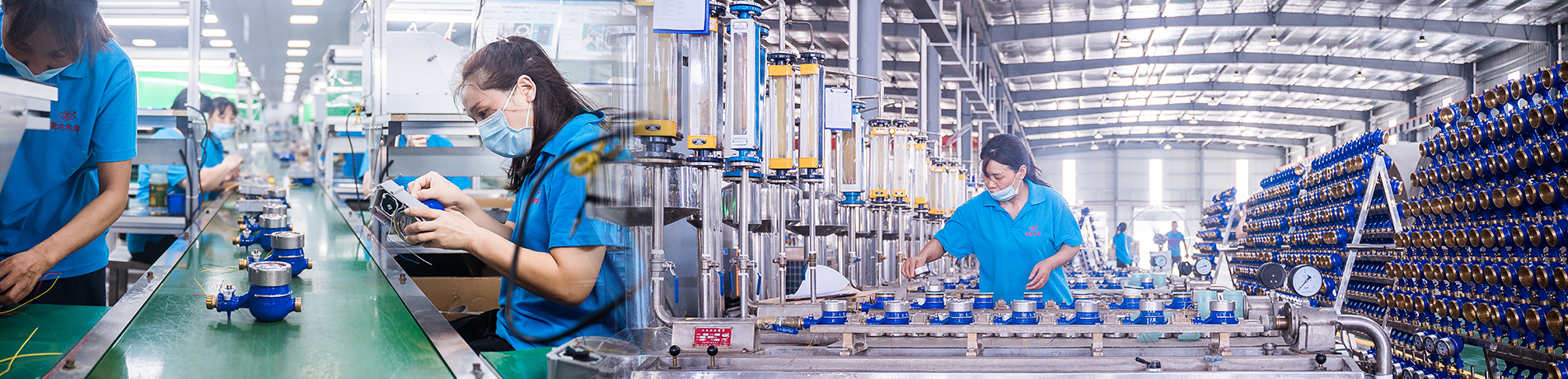
Water meter and flow meter production line at Shengda Water Meter Co., LTD, Kaifeng, China.
Next Step: Sample, Quote, or Catalog
If you are comparing configurations for a specific project, send the liquid type, nominal diameter, pressure rating, temperature, required output, and target certification. That is enough to recommend a liner, electrode, and power option — and to quote a comparable configuration rather than a generic model number.
Contact: Miranda — Email: admin@henanpanda.com | Tel / WhatsApp: +86 18603780816 | Address: NO.109, Middle Weidu Road, Kaifeng City, China
Download the full company and product catalog: Shengda Water Meter Profile (PDF)
Websites: www.shengdawatermeter.com | www.sdflowmeter.com