
Ultrasonic vs. Mechanical Water Meters: A Side-by-Side Comparison for Industrial Buyers
Ultrasonic vs. Mechanical Water Meters: A Side-by-Side Comparison for Industrial Buyers
The short answer is that no single meter technology fits every water network. Ultrasonic and mechanical water meters solve the same basic problem, but they do it with different measurement principles, service profiles, and integration options. For an industrial buyer, the practical comparison should start with the pipe size, the expected flow range, the communication infrastructure, and the compliance documents required by the destination market.
This guide compares ultrasonic and mechanical water meters side by side for buyers who are evaluating suppliers before placing samples or OEM orders. It uses two meter reference points from Shengda Water Meter Co., Ltd. (SDWM) to make the comparison concrete: the R160 water meter used in residential supply and the R200 LXSG multijet water meter used in household and utility-style applications.
Why the Meter-Technology Decision Matters
When a meter is selected almost entirely on price or on a single specification, operational issues often appear later. A meter that cannot sense low night flows may hide leaks in the distribution network. A meter with the wrong pressure class may fail in a high-pressure supply line. A meter without the correct communication module may not work in an existing automatic meter reading or advanced metering infrastructure system.
The technology type also matters in a different way. Ultrasonic water meters use electronic measurement. Mechanical water meters use a physical measuring element. The rest of the buying decision is about how that basic difference interacts with accuracy requirements, maintenance capacity, materials, diameter, and communication readiness.
Industry Context: Smart Metering Is Becoming the Default
Smart water metering is no longer a niche purchasing category. Grand View Research valued the global smart water meter market at USD 9.1 billion in 2024 and projected it to reach USD 16.2 billion by 2030. The same research identified the ultrasonic water meter segment as one of the highest-growth meter types, with the United States market alone valued at USD 2.98 billion in 2024. Precedence Research reported that advanced metering infrastructure technology held a 58.9 percent share of the smart water meter market in 2024.
These numbers explain why a mechanical-versus-ultrasonic comparison cannot stop at the meter body. Buyers are also comparing how easily a meter can connect to a remote reading network. For European projects, legal metrology compliance is particularly important because smart water meters in the European Economic Area must meet the requirements of EU Directive 2014/32/EU (MID) and related standards such as EN 14154-4.
Shengda Water Meter Co., Ltd., founded in 1995, has built its water meter product lines around this mix of mechanical durability, electronic measurement, and smart communication. The company is based in Kaifeng, China, and offers OEM/ODM, smart metering, control, telemetry, and smart water solutions. Its factory covers 66,000 square meters, and annual production capacity is 3 million units. SDWM exports to markets including the United States, South America, Africa, and Southeast Asia.
Ultrasonic vs. Mechanical Water Meters: The Core Technical Difference
Ultrasonic Water Meters
Ultrasonic water meters measure water flow using ultrasonic signals rather than a rotating mechanical element. In practice, buyers most often encounter ultrasonic water meters when a project needs remote reading, low-flow sensitivity, or integration with an IoT data platform.
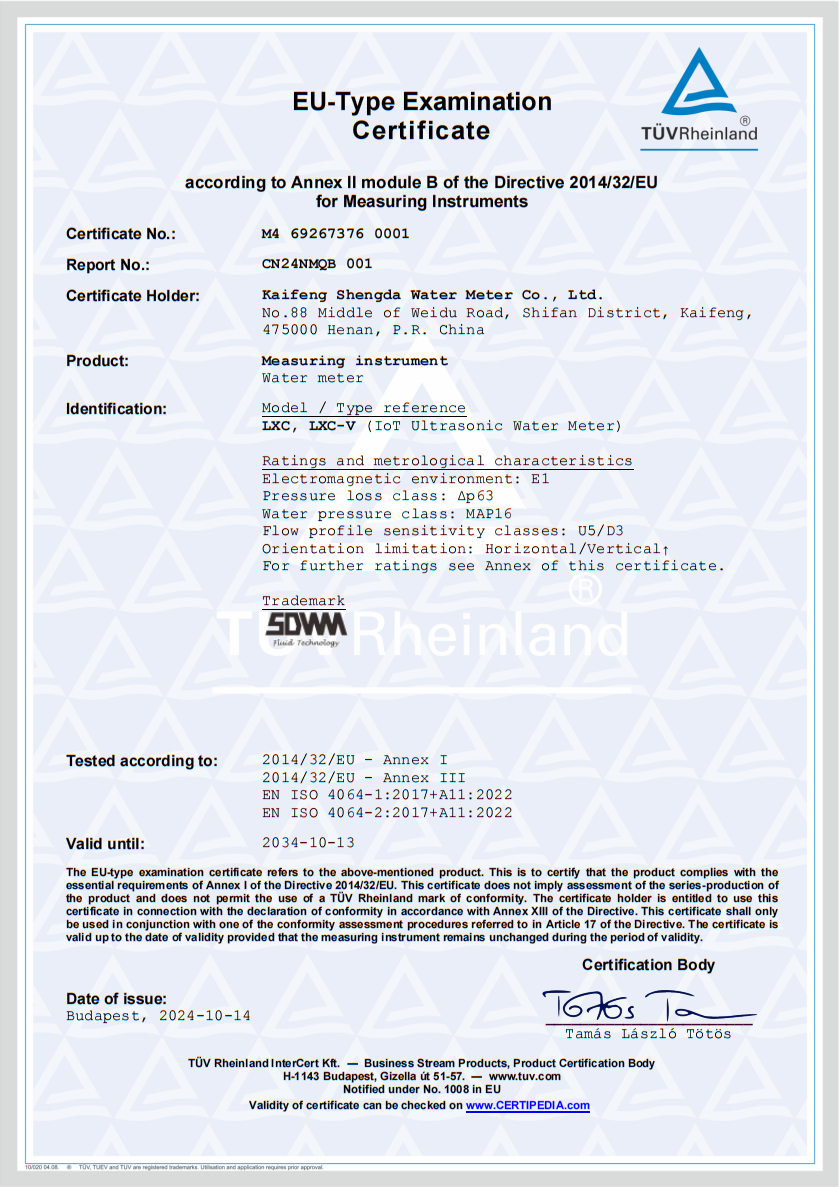
The LXC and LXC-V ultrasonic water meters from Shengda illustrate the application range. Both models carry an MID Type Examination certificate issued by TUV Rheinland under certificate number M4 69267376 0001, covering full performance parameters according to Directive 2014/32/EU and EN ISO 4064-1:2017+A11:2022 and EN ISO 4064-2:2017+A11:2022. The LXC ultrasonic water meter is available in sizes from DN15 to DN500, which makes it relevant for residential networks as well as larger utility and industrial pipe applications.
From a communication standpoint, ultrasonic meters integrate well into AMR and AMI systems. Shengda's IoT water meter supports remote automatic meter reading and offers multiple communication options, including LoRaWAN, NB-IoT, 4G Cat.1, LTE-M, Modbus, and M-Bus. The company also classifies some of its ultrasonic products as LoRaWAN Ultrasonic water meters, which is useful when a utility already operates a LoRaWAN network.
Mechanical Water Meters
Mechanical water meters are widely used in applications where simple construction, predictable replacement cycles, and established metering standards are the priority. The physical meter element is driven by the flow of water. In the multijet category, water passes through the meter body in a way that turns the measuring element inside the chamber.
The LXSG multijet water meter is one of Shengda's mechanical metering references. It is designed for residential and commercial settings such as apartments, houses, villas, and utility water supply systems. The LXSG is also specified with an R200 flow ratio, water temperature classes T30, T50, or T90, working pressure PN10 or PN16, and nominal diameter DN15 to DN25.
Mechanical meters can also be built as smart meter configurations. Shengda's AMR water meter, for example, can use either mechanical or ultrasonic measurement technology. It can be installed horizontally or vertically, features an LCD digital display, operates with water temperatures from 0°C to +50°C, supports pressure ratings of PN10 or PN16, and can be supplied with IP68 protection. This helps explain why the term mechanical does not automatically mean non-communicating meter.
How to Evaluate R160 and R200 Meter Variants
Industrial buyers often ask about R160 and R200 water meters because these values appear in tender documents and product data sheets. In water meter terminology, R values are flow ratio ratings. They describe the span between the maximum rated flow and the minimum flow at which the meter is expected to maintain accuracy. A higher R value generally indicates a wider operating flow range or better low-flow capability relative to the same rated maximum flow.
R160 and R200 are not legal accuracy classes by themselves. They work alongside standards such as ISO 4064 and OIML R49, which define the metrological performance and test requirements. A buyer should always check the relevant MID, ISO 4064, or OIML R49 documentation rather than relying on the R value alone.
For practical reference, Shengda supplies both R160 and R200 meter variants. The R160 water meter is intended for residential use, with typical applications in houses, apartments, villas, and community water supply systems. The R200 LXSG multijet water meter, by comparison, is designed for accurate measurement in household applications and is stated to comply with ISO 4064 and OIML R49 standards.
When a project includes very low flow rates, the choice between R160 and R200 deserves special attention. A meter with a wider dynamic range can often detect small flows that would otherwise be lost. That capability matters in water loss control programs, apartment billing, and systems with intermittent or low-demand periods.
Step-by-Step Selection and Verification Process
The following process can help an industrial buyer use this comparison in practice. It is designed around the facts that should be verified before a meter type is locked into a project specification.
- Map the installation type and flow profile. Start by identifying whether the meter will be used in a house, an apartment building, a utility supply system, or an industrial pipeline. The R160 water meter and the R200 LXSG both fit residential and similar utility supply applications, while larger projects may require the DN15 to DN500 range of the LXC ultrasonic meter or a separate industrial meter line.
- Confirm the pipe diameter, pressure class, and material requirement. Mechanical multijet options such as the LXSG are commonly specified in DN15 to DN25. The LXSY AMR water meter family extends to DN15 to DN200 and can be supplied in brass, stainless steel, or composite material. The LXC ultrasonic water meter extends to DN500. Pressure ratings PN10 or PN16 are common across many SDWM product groups.
- Choose the communication path before choosing the exact meter body. If the utility already has a LoRaWAN network, specify a LoRaWAN water meter. If it plans to use NB-IoT or 4G Cat.1, confirm that the meter supports that module. Shengda's IoT water meter supports LoRaWAN, NB-IoT, 4G Cat.1, LTE-M, Modbus, and M-Bus.
- Define the operating environment and maintenance expectation. Battery-powered smart meter configurations are stated to provide battery life up to 10 years depending on configuration. Some meters can also be powered by M-Bus or an external power supply. The project should consider whether field staff can replace batteries, maintain radio coverage, and monitor communication health.
- Verify compliance evidence. For the European market, check that the meter has a valid MID certificate. For many other markets, ISO 4064 and OIML R49 references are essential. Shengda holds certificates including ISO 9001, ISO 14001, and ISO 45001, and its ultrasonic and mechanical water meter families have CE, MID, ISO 4064, RoHS, and related certification documentation.
- Request samples and inspect the supplier's production controls. Shengda's production services include OEM manufacturing, R&D capability, customized solutions, and smart metering solutions. The factory quality-control process covers incoming material inspection, production process inspection, 100 percent functional testing, calibration testing, and final inspection before shipment. Samples can help verify that the meter body, communication module, and software behave as documented.
Use Cases That Show the Difference
Project examples do not prove that one technology is always superior. They do show how the buying decision shifts when the project priorities change.
In a residential metering project where the utility needs dependable household billing, a mechanical R200 multijet water meter can be a strong fit because it is built for housing applications and has established compliance references. The LXSG water meter family is intended for apartments, houses, villas, and community water systems, which covers many residential utility projects.
In a large municipal AMR project with existing NB-IoT coverage, ultrasonic or electronic meters with NB-IoT modules should be evaluated. In one case unit, a municipal water department in Kenya deployed over 20,000 units with NB-IoT communication, and the project focused on smart water management and water loss control. The documented result was improved automated meter reading efficiency and reduced manual maintenance costs.
In a government smart city project where the network standard is LoRaWAN, the OEM should be able to supply meters with matching communication and branding. A government water utility in Mongolia was awarded a project involving 15,000 units, with an OEM solution using LoRaWAN communication for smart city deployment. This demonstrates why communication protocol support is just as important as the ultrasonic-versus-mechanical measurement principle.
For industrial transmission pipelines, the meter often needs a larger body and higher accuracy than a typical residential multijet meter. Shengda also provides measurement products for water transmission monitoring, including larger-diameter flow solutions. Buyers should separate the residential R160/R200 discussion from the high-capacity meter selection process.
Ultrasonic vs Mechanical Water Meters: Comparison Table
| Evaluation point | Ultrasonic water meter example | Mechanical water meter example |
|---|---|---|
| Measurement principle | Ultrasonic electronic measurement | Multijet mechanical measurement |
| Representative SDWM product | LXC / LXC-V ultrasonic water meter | R160 water meter and R200 LXSG multijet water meter |
| Typical application | Smart metering, remote reading, larger utility and industrial pipe ranges | Houses, apartments, villas, community water supply systems |
| Diameter range example | LXC ultrasonic water meter DN15 to DN500 | LXSG multijet DN15 to DN25 |
| Flow ratio example | LXC/LXC-V MID-certified ultrasonic designs | R200 LXSG; R160 water meter variants |
| Communication options | LoRaWAN, NB-IoT, 4G Cat.1, LTE-M, Modbus, M-Bus; AMR/AMI support | Can be configured in AMR water meter designs with mechanical or ultrasonic measurement and horizontal or vertical installation |
| Operating conditions example | MID-certified LXC/LXC-V ultrasonic design; IP68 attestation available | LXSG supports T30/T50/T90 and PN10/PN16 |
| Compliance evidence | MID certificate M4 69267376 0001 for LXC/LXC-V | LXSG R200 complies with ISO 4064 and OIML R49 |
The table is not a complete product portfolio. It highlights typical decision points between representative ultrasonic and mechanical meters from Shengda. For larger mechanical meters or specialized industrial connections, buyers should ask for separate specifications and compliance documents.
Frequently Asked Questions
How do ultrasonic and mechanical water meters differ?
Ultrasonic water meters use electronic ultrasonic measurement and can be configured for communication options such as LoRaWAN, NB-IoT, 4G Cat.1, LTE-M, Modbus, or M-Bus. Mechanical water meters use a physical measuring element. The LXSG multijet water meter is one example of a mechanical meter used in households and similar utility supply settings. Both types can be used with remote reading features, so buyers should compare the specific model, communication module, pressure rating, temperature range, and compliance certificate rather than selecting only by technology type.
What do R160 and R200 mean in a water meter specification?
R160 and R200 are flow ratio ratings used to describe the flow range of a water meter. They should not be treated as legal accuracy classes on their own. The R160 water meter from Shengda is designed for residential applications such as houses, apartments, and community water supply. The R200 LXSG multijet water meter is another residential reference with a higher R value and is stated to comply with ISO 4064 and OIML R49. The right R value depends on the minimum and maximum flows expected at the installation point.
Which meter technology is better for residential and commercial water projects?
It depends on the goals of the project. If the project needs a proven residential mechanical meter with a simple multijet mechanism, the R200 LXSG is a practical option. If the project needs remote automatic meter reading, water loss control, or integration with an existing IoT network, an ultrasonic or electronic meter with LoRaWAN, NB-IoT, 4G, or M-Bus communication is usually more suitable. Shengda supplies both approaches, and the actual decision should be made from pipe size, communication infrastructure, maintenance capacity, and compliance requirements.
What should an industrial buyer verify with an OEM smart ultrasonic water meter manufacturer?
An industrial buyer should verify four areas before choosing an OEM smart ultrasonic water meter manufacturer. First, production services: confirm whether the factory supports OEM manufacturing, R&D, customized solutions, and smart metering solutions. Second, factory capacity and quality control: Shengda operates a 66,000-square-meter facility with annual production capacity of 3 million units, and its quality-control process includes incoming material inspection, production process inspection, 100 percent functional testing, calibration testing, and final inspection before shipment. Third, certifications: for ultrasonic meters, check MID, CE, RoHS, ISO 4064, and related documents. Fourth, ordering terms: sample MOQ can be as low as 3 units, while customized OEM projects generally require 500 units, and standard product lead time is 15 to 20 days.
What next steps should an industrial buyer take after comparing meter technologies?
The buyer should document the exact site requirements including diameter, pressure, temperature, flow profile, communication protocol, and applicable certification. The next step is to request samples and compare how each meter is built, configured, and documented. Shengda Water Meter Co., Ltd. provides technical support, installation guidance, and remote assistance for evaluation projects. Buyers can contact the company by email at admin@henanpanda.com or access the company profile for additional product information.
Conclusion: Let the Project Requirements Decide
Ultrasonic and mechanical water meters are both capable meter families, but they are not interchangeable in every project. The ultrasonic route offers remote reading, AMR/AMI compatibility, and a wide range of communication modules. The mechanical route, particularly the multijet LXSG family, offers a proven residential metering method with R160/R200 flow ratio options and ISO 4064 / OIML R49 compliance references.
For OEM buyers, the comparison should also include the factory behind the meter. Shengda Water Meter Co., Ltd. was founded in 1995, operates a 66,000-square-meter factory, and reports an annual production capacity of 3 million units. Its production services cover OEM manufacturing, R&D, customized solutions, and smart metering solutions, with quality control that includes 100 percent functional testing and calibration before shipment. Buyers who need a more detailed specification can download the company profile or contact the factory directly for product and sample support.
For more product information and samples, download the Shengda Water Meter profile: Shengda Water Meter Co., Ltd. company profile.