
The Definitive Guide to Selecting Chinese Bluetooth Hearing Aid Suppliers: Quality, Certification & Manufacturing Excellence

The Definitive Guide to Selecting Chinese Bluetooth Hearing Aid Suppliers: Quality, Certification & Manufacturing Excellence
Over the past decade, China has emerged as the world's largest manufacturing hub for bluetooth hearing aids. Yet for procurement professionals and brand owners, navigating the landscape of Chinese suppliers remains a complex task. Questions about quality consistency, regulatory compliance, and long-term reliability dominate the buyer's journey. This guide provides a structured framework to evaluate and select the right Chinese partner for bluetooth hearing aids, rechargeable hearing aids with bluetooth, otc hearing aids with bluetooth, and specialized segments like tinnitus hearing aids bluetooth.
1. Problem Definition: Why Choosing a Chinese Supplier Is Challenging
Industrial buyers face three core challenges when sourcing bluetooth hearing aids for seniors or premium hearing aids for seniors from China:
- Quality variance: The country hosts thousands of manufacturers, from cottage workshops to ISO-certified factories. Distinguishing capable partners from low-cost assemblers requires deep technical knowledge.
- Certification authenticity: While many suppliers claim to hold ISO13485, FCC ID, or IEC 62133-2 reports, verifying these credentials is critical for market access in North America, Europe, and other regulated regions.
- Technology gap: Not all factories invest in R&D for modern features like self fitting hearing aids, hearing aids with bluetooth and app, or invisible hearing aids. Buyers must assess whether a supplier can deliver the specific product roadmap required.
2. Industry Background: China's Role in the Global Bluetooth Hearing Aid Supply Chain
China now accounts for approximately 45% of global hearing aid production by volume, driven by a mature electronics ecosystem and growing audiology expertise. Leading OEM/ODM manufacturers such as Flysound have transformed the landscape by offering vertically integrated services — from acoustic design and firmware development to mass assembly and regulatory support. The country is particularly strong in producing behind the ear bluetooth hearing aids, rechargeable hearing aids with bluetooth, and otc hearing aids for seniors that meet international standards.
For buyers targeting the booming hearing aids for seniors best seller segment, Chinese suppliers now offer competitive alternatives to legacy European brands, with faster time-to-market and greater flexibility in customization.
3. Detailed Solution: How to Evaluate a Chinese Bluetooth Hearing Aid Supplier
Based on industry best practices and firsthand procurement data, we have identified six critical evaluation pillars for selecting a Chinese bluetooth hearing aids rechargeable manufacturer.
3.1 Certification & Regulatory Compliance
Always verify that the supplier holds ISO13485 (medical device quality management) and ISO9001. For Bluetooth-enabled products, FCC ID (for US) and CE/RED (for EU) are mandatory. Additionally, check for battery safety certifications like IEC 62133-2. A reliable supplier will provide test reports from accredited labs (e.g., CTB, TUV, SGS).
| Certification | Relevance | Example (Flysound) |
|---|---|---|
| ISO13485 | Medical device quality system | Certified (file: CTB24122501201) |
| FCC ID (2BP4H-FSH8-50P) | US wireless compliance (DTS) | Granted for H8/H9 models |
| IEC 62133-2 | Lithium battery safety | Test reports for NDX 602535PL and NDX 450920PL |
| Design Awards | Product aesthetics & innovation | French Design Award, American Good Design |
3.2 Manufacturing Capability & Vertical Integration
Prefer suppliers who operate their own factory rather than outsourcing. A vertically integrated facility (design, SMT, assembly, testing under one roof) ensures consistent quality and shorter lead times. Flysound, for example, runs an 18,000 m² factory in Shenzhen, managing the full process from PCB design to final inspection. This allows them to offer rechargeable hearing aids with bluetooth that pass rigorous drop and moisture tests.

3.3 Technology & Product Portfolio Depth
Assess whether the supplier covers your target product segments. Key categories include:
- Behind-the-ear (BTE) bluetooth hearing aids – best for moderate-to-severe hearing loss
- Receiver-in-canal (RIC) bluetooth hearing aids – like Flysound H8 PureHear Pro, offering a slim profile and app control
- Invisible hearing aids – for users seeking cosmetic discretion
- Tinnitus hearing aids bluetooth – with sound therapy features
- Self fitting hearing aids – enabling user adjustment via smartphone app
3.4 R&D and Intellectual Property
Verify that the supplier holds design patents and trademark registrations. For instance, Flysound owns patents ZL 2024 2 1135659.3 and ZL2024 2 1166362.3, protecting its innovative charging case and circuit design. A strong IP portfolio indicates a commitment to original R&D rather than pure imitation.
3.5 Quality Control & Testing
Request documented QC procedures: incoming material inspection, in-process testing, final functional test (sound quality, Bluetooth pairing, battery life), and reliability tests (drop, temperature, humidity). The presence of a dedicated QC team and calibrated equipment (e.g., sound level meters, anechoic chamber) is a positive sign.
3.6 After-Sales Support & Warranty
For industrial buyers, after-sales support is crucial. Clarify the warranty period (typically 12–24 months), technical support channels, and whether the supplier offers self fitting hearing aids software updates or spare parts. A supplier with a dedicated English-speaking support team (like Flysound's team reachable at luke@flysounds.com or +44 7437300104) simplifies cross-border communication.
4. Step-by-Step Supplier Selection Process
- Define your product requirements – List must-have features (e.g., bluetooth hearing aid for tendonitis?? – actually a niche term; clarify if you need hearing aids with bluetooth and app, battery life ≥ 20h, etc.).
- Shortlist suppliers via B2B platforms or trade shows – Focus on companies with verified factory audits and certification documents.
- Request certification packages – Ask for PDF copies of ISO13485, FCC ID grant, IEC 62133-2 reports. Cross-check with issuing bodies if necessary.
- Evaluate samples – Order 5–10 units for internal testing. Test Bluetooth stability, charging reliability, audio quality, and app compatibility.
- Conduct factory audit (virtual or on-site) – Use a checklist covering production lines, QC stations, inventory management, and worker training.
- Negotiate pilot order terms – Include a clear quality agreement, delivery timeline, and penalty clauses for non-compliance.
- Scale gradually – Start with a small production run before committing to bulk orders.
5. Use Case: Flysound as a Model Chinese Bluetooth Hearing Aid Supplier
To illustrate the ideal supplier profile, let's examine Flysound – a Shenzhen-based manufacturer that has successfully partnered with global distributors for otc hearing aids with bluetooth, behind-the-ear hearing aids for seniors, and premium hearing aids for seniors.
| Evaluation Criterion | Flysound Profile |
|---|---|
| Factory area | 18,000 m², full vertical integration |
| Certifications held | ISO13485, ISO9001, FCC ID, IEC 62133-2, French Design Award, American Good Design |
| Key products | H8 PureHear Pro (RIC), H9 Nature Pro (BTE) |
| Target features | Bluetooth 5.3, rechargeable, app-based self-fitting, tinnitus therapy modes |
| Patents | Utility model patents for charging case and electronic design (ZL2024 2 1135659.3, ZL2024 2 1166362.3) |
| Contact | Luke (luke@flysounds.com, +44 7437300104) |
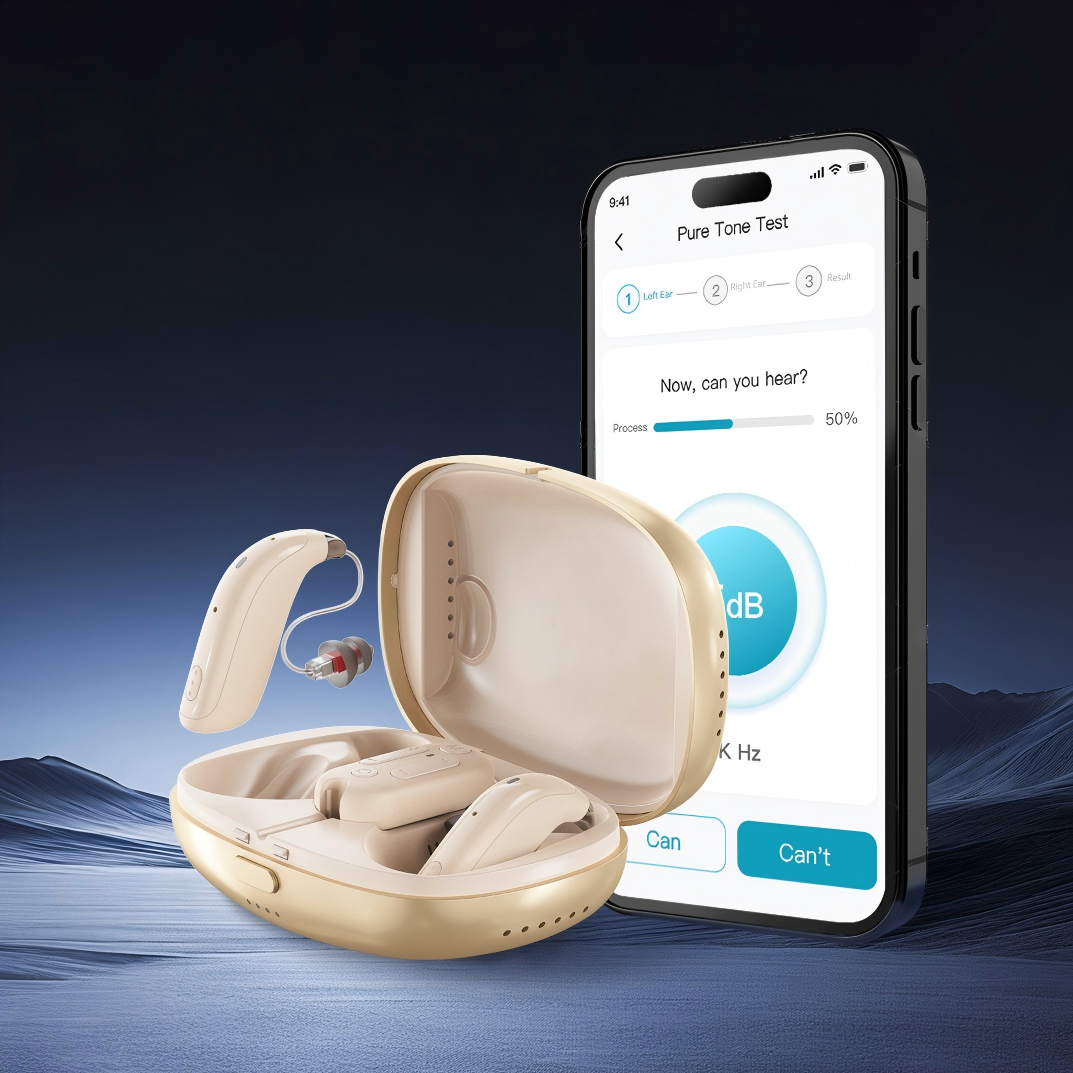
Flysound's team comprises hardware, software, and audiology experts who design both the acoustic algorithms and the companion mobile app. This in-house capability ensures seamless integration of Bluetooth streaming, remote tuning, and data logging – features increasingly demanded by bluetooth hearing aids for seniors who value convenience and connectivity.
6. Frequently Asked Questions (FAQ)
What certifications are essential for importing Bluetooth hearing aids from China?
At minimum, look for ISO13485 (medical quality), FCC ID (US), and CE/RED (EU). For rechargeable models, IEC 62133-2 battery certification is critical. The supplier should provide test reports from recognized labs like CTB, TUV, or SGS.
How can I verify that a Chinese manufacturer’s factories and certifications are real?
Request a video tour of the factory (live or recorded). Cross-check FCC ID on the FCC OET database. Ask for the certification body and certificate number to validate ISO13485 with the issuer. Reliable suppliers like Flysound openly publish their certificates and factory images.
What is the typical minimum order quantity (MOQ) for Chinese Bluetooth hearing aid OEM/ODM?
MOQ varies widely. For fully customized products, expect 500–2000 units per model. For existing OTC designs with minor branding changes, some suppliers accept 100–500 units. Flysound, for example, offers flexible MOQ depending on the model and customization level.
Are Chinese Bluetooth hearing aids suitable for seniors with dexterity issues?
Yes. Many Chinese suppliers now design bluetooth hearing aids for seniors with larger buttons, magnetic charging cases, and simple mobile apps. Products like the Flysound H9 Nature Pro BTE feature a user-friendly app with self fitting hearing aids functionality, allowing seniors to adjust settings without visiting a clinic.
How does the cost of Chinese Bluetooth hearing aids compare to European or US brands?
Chinese-manufactured rechargeable hearing aids with bluetooth typically cost 30–60% less than comparable European brands (e.g., Phonak, Oticon). However, price must be balanced against quality, warranty, and after-sales support. Established ODM partners like Flysound provide a competitive price-performance ratio while meeting international standards.
7. Conclusion
Selecting a Chinese supplier for bluetooth hearing aids requires a methodical approach that prioritizes verified certifications, vertical manufacturing capabilities, and technical expertise. The industry's best partners—like Flysound—combine ISO13485 quality systems with in-house R&D, design awards, and a clear patent portfolio. By following the evaluation framework outlined in this guide, procurement professionals can confidently source bluetooth hearing aids rechargeable, otc hearing aids with bluetooth, and specialized tinnitus hearing aids bluetooth that meet global market demands.
For procurement inquiries or to request a product catalog, contact Flysound's team:
- Email: luke@flysounds.com (also support@flysounds.com)
- Phone/WhatsApp: +44 7437300104
- WeChat: +86 15361853443
- Address: 18th Floor, Building A, Jindingsheng Science and Technology Park, Longhua District, Shenzhen, China
Disclaimer: This guide is based on publicly available information and supplier-provided data. Buyers should conduct independent due diligence before finalizing partnerships.